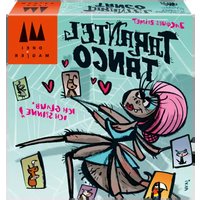
Tarantel Tango - Board game Schmidt - Free user manual and instructions
Find the device manual for free Tarantel Tango Schmidt in PDF.



| Product type | Board game |
| Brand | Schmidt |
| Model | Tarantel Tango |
| Recommended age | Ages 7 and up |
| Number of players | 2 to 6 players (estimated) |
| Game duration | 15 to 20 minutes |
| Box contents | 115 Animal cards, 5 Tarantula cards, 1 Tarantula Tango board (pentagon), 1 rulebook |
| Box dimensions (approx.) | 12 x 12 x 4 cm (estimated) |
| Weight (approx.) | 200 g (estimated) |
| Power required | None |
| Main features | Card and reaction game: imitate animal sounds, slap the tarantula, place cards on spaces |
| Game mechanics | Simultaneous action, speed, memory, imitation |
| Care and cleaning | Clean cards with a soft dry cloth. Avoid moisture. |
| Safety | Small parts (cards): choking hazard for children under 3. Do not allow young children to play unsupervised. |
| Spare parts and repairability | Cards can be replaced with generic cards of the same size. The board is cardboard. No official spare parts. |
| General information | Game created by Jacques Zeimet, illustrations by Rolf Vogt. Published by Schmidt. |
Frequently Asked Questions - Tarantel Tango Schmidt
User questions about Tarantel Tango Schmidt
0 question about this device. Answer the ones you know or ask your own.
Ask a new question about this device
Download the instructions for your Board game in PDF format for free! Find your manual Tarantel Tango - Schmidt and take your electronic device back in hand. On this page are published all the documents necessary for the use of your device. Tarantel Tango by Schmidt.
USER MANUAL Tarantel Tango Schmidt
D THRANTEL TANGO
natural_image
Illustration of a cartoon spider with a pink head and green body, set within a pentagon frame (no text or symbols)Tango-Tarantel
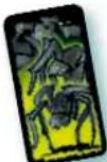
Tarantelkarten
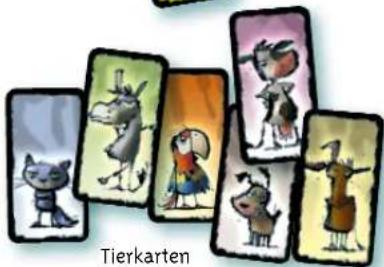
natural_image
Illustration of five cartoon animal characters in separate panels, no text or symbols presentflowchart
graph TD
    A["Insect Icon"] --> B["Flower Flower Box"]
    B --> C["Recircled Box"]
natural_image
Illustration of a cartoon spider inside a pentagon with scattered items (no text or symbols)Tango tarantula
Author: Jacques Zeimet Illustration & graphics: Rolf Vogt Editor: Claudia Wieczorek
Players: 2 to 5
Ages: 7 years and over
Duration of game: 15-20 minutes
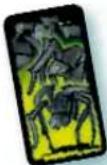
Tarantula cards
Contents
• 120 Animal cards (dog, cow donkey, goat, cat, parrot)
• 5 Tarantula cards
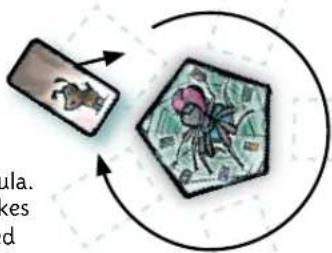
• Tango tarantula (5-sided)
- Game rules
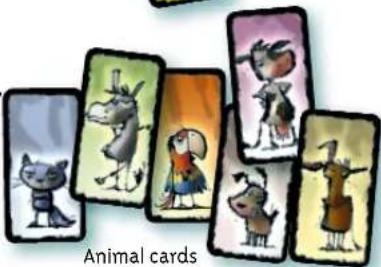
natural_image
Illustration of six cartoon animal cards with different facial features (no text or symbols on cards)8
Idea and aim of the game
The wild Tango Tarantula is desperately looking for one of the animals as a dancing partner! But the animals get scared and cry out every time the hairy and poisonous spider looks at them! The winner is the first contestant to get rid of all of their cards.
How to prepare for the game
Place the Tango Tarantula in the middle of the table. Thoroughly shuffle all 120 cards and distribute them equally amongst the other players. The players then pick up their cards and hold their cards in the form of a pack so they can't see their cards' identity.
How to play the basic game
The youngest player starts and places the top card from their pack against one of the five sides of the Tango Tarantula. The player to their left now takes their turn. The cards are placed down in a clockwise direction.
The different cards have the following meanings:
mal card with one tarantula
card of the player who made their move before you ys an animal with one tarantula, you must first of all the noise of the animal which is displayed, and proceed to place the top card from your pack one
space further along.
Animal noises: The cow says 'moo moo', the donkey 'eeyore', the goat 'maa', the dog 'woof', the cat 'meow' and the parrot says 'ow'.
mal card with two tarantulas
card of the player who made their move before you ys an animal with two tarantulas, you must first of ce mimic the noise of the animal which is displayed, and then proceed to place your card one space further along.
mal card without tarantula
If the card of the player who made their move before you dis-an animal with no tarantula, place the top card from your pack one space further along without making a noise.

uble animal card without tarantula
card of the player who made their move before you ys two animals, move your card not one, but two is further along without making a noise.

antula card
rantula card appears then all players must slap the with their hand as quickly as they can in order to the nasty beast off. The slowest player to hit the table pick up all the cards on the table and include them in pack.
Mistakes
Each player has just two seconds to complete a move correctly (also including mimicking and animal noise and putting their card down). At the same time, the top card can only be turned over and placed after a noise has been made! Anyone who makes the following mistakes:
1) they take too long, hesitate, or make the wrong noise (like an 'erm' or a 'baah' for instance),
2) they make the wrong noise, they make it too late or too soon or they place their card down too late or too soon,
3) they slap the table too late or at the wrong time (Tarantula card) must pick up all the cards on the table and include them in their pack.
End of the game and the winner
The first person to get rid of all their cards wins the game!
Example:
- Tina starts and plays her card, it's a dog with one tarantula.
- Her left hand neighbour Daniel calls out 'woof' and places his top card down which is a cat without a tarantula.
- Bianca stays silent and places down her card, it's a cow with two tarantulas.
- Anna goes 'moo moo' and plays her card – it's a tarantula card.
- Everyone slaps the table. Daniel is slowest. He takes all the cards on the table, adds them to his pack and then starts a new round. He plays his card — it's a cat without a tarantula.
- Bianca goes 'meow', which is wrong because the last person's card was of an animal without a tarantula. She picks up Daniel's card and starts a new round.
Tarantula tip: First of all, get used to playing the basic game. Once you've got your speed up, you can then increase the difficulty level by adopting the rules for experienced players (* = easy and **** = hardest).
Rules for experienced players
\* The stubborn donkey won't move
If the card of the player who made their move before you is a donkey (with or without a tarantula or double card), then you don't put your card one or two spaces further along, but on the same space — on top of the donkey, and, of course, with or without the appropriate noise.
\*\* The curious dog runs the wrong way
If a dog (with or without a tarantula or double card) is played then the direction in which the players put down their cards changes. Everyone must stick to this rule until the next dog appears. The direction then changes once again. If a dog card is the first card to be played, the next card also has to be played in an anti clockwise direction.
\*\*\* The dumb cow plays again
Anyone who plays a cow (with or without a tarantula or double card) has to play another card straight away as soon as they have gone 'moo' or remained silent. They then have to place their next card one or two spaces further along. (If the next player is too fast, or moos or puts their card down too soon, they have made a mistake and have to pick up all the cards that are on the table).
\*\*\*\* The cheeky parrot imitates everyone
The parrot without a tarantula imitates the previous player. The double parrot repeats the noise of the previous player twice. Please note: with the parrot cards that have tarantula(s), the parrot shouts out 'ow' in the normal way.
TARENTULE TANGO
natural_image
Illustration of a cartoon spider with pink head and blue body, set within a green leafy background (no text or symbols)Plaque Tarentule Tango
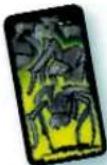
Cartes Tarentules
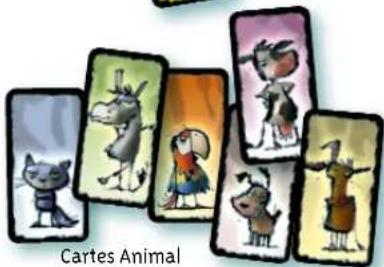
natural_image
Illustration of six cartoon animal characters in colorful frames, labeled 'Cartes Animal' below (no other text or symbols)natural_image
Three abstract black-and-white line drawings resembling stylized figures or symbols (no text or symbols present)NL
TARANTULA TANGO
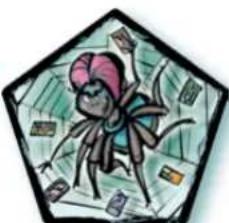
natural_image
Illustration of a cartoon spider inside a hexagonal frame with no text or symbolsTango tarantulakaart
natural_image
Illustration of six cartoon animals in colorful frames, labeled 'Dierenkaarten' at bottom (no other text or symbols)natural_image
Illustration of a cartoon spider inside a hexagonal frame with floating objects (no text or symbols)Tarantola ballerina
natural_image
Illustration of cartoon animals including a wolf, deer, and sheep in separate panels (no text or symbols)Carte degli animali
natural_image
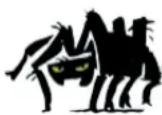
Black silhouette of a stylized cat with yellow eyes, standing on a light blue background (no text or symbols)
Copyright 2009:
DREI MAGIER SPIELE


- D THRANTEL TANGO
- Contents
- Idea and aim of the game
- How to prepare for the game
- How to play the basic game
- mal card with one tarantula
- mal card with two tarantulas
- mal card without tarantula
- uble animal card without tarantula
- antula card
- Mistakes
- End of the game and the winner
- Example:
- Rules for experienced players
- \* The stubborn donkey won't move
- \*\* The curious dog runs the wrong way
- \*\*\* The dumb cow plays again
- \*\*\*\* The cheeky parrot imitates everyone
- TARENTULE TANGO
- TARANTULA TANGO
Brand : Schmidt
Model : Tarantel Tango
Category : Board game