
Cornwall - Board game Schmidt - Free user manual and instructions
Find the device manual for free Cornwall Schmidt in PDF.


| Product Type | Board game |
| Brand | Schmidt |
| Model | Cornwall |
| Number of players | 2 to 4 players |
| Recommended age | Ages 8 and up |
| Average game duration | 45 to 60 minutes |
| Box dimensions | 30 x 30 x 7 cm |
| Weight | Approximately 1.2 kg |
| Main material | Cardboard, plastic |
| Box contents | 1 game board, 4 pawns, 1 die, 60 cards, 1 rulebook |
| Rulebook languages | French, German, English, Italian |
| Power | None (classic board game) |
| Maintenance and cleaning | Clean with a soft, dry cloth |
| Safety | Contains small parts, not suitable for children under 3 years |
| Spare parts and repairability | Spare parts available on request from the manufacturer |
| Game type | Path game or strategy game (depending on version) |
Frequently Asked Questions - Cornwall Schmidt
User questions about Cornwall Schmidt
0 question about this device. Answer the ones you know or ask your own.
Ask a new question about this device
Download the instructions for your Board game in PDF format for free! Find your manual Cornwall - Schmidt and take your electronic device back in hand. On this page are published all the documents necessary for the use of your device. Cornwall by Schmidt.
USER MANUAL Cornwall Schmidt
natural_image
Illustration of a house with red roof and green lawn, connected to a pie chart below (no text or symbols)natural_image
Illustration of green geological formations with a red 'X' symbol indicating a missing or excluded area (no text or symbols present)natural_image
Two green arrow-shaped diagrams showing a village scene with houses and trees, connected by a checkmark (no text or symbols)natural_image
Illustration of green hexagonal cells with embedded biological structures and red arrows indicating direction (no text or symbols)natural_image
Illustration of green plant cells with embedded illustrations and directional arrows (no text or symbols)natural_image
Topographic map with colored icons (red, blue, green) overlaid on terrain and landforms, no readable text or labelsnatural_image
Topographic map layout with colored icons (red, blue, green, yellow) on terrain and terrain features, no readable text or labelsnatural_image
Solid red silhouette of a stylized human figure (no text or symbols)[Non-Text]
natural_image
Illustration of a two-story house with green-tiled roof and wooden benches (no text or symbols)An exciting tile-laying game by Johannes Schmidauer-König for 2-4 players aged 8 years and up.
Contents
28 playing pieces (7 of each color – in different sizes)
4 points markers (1 of each color)
1 starting tile (with 5 fi elds)
36 landscape tiles (with 3 fi elds each)
11 cottages (2 pieces)
40 coins
1 pub
4 game overview cards
1 scoring board

Aim of the game
Lot by lot, players claim for themselves the fascinating landscape of Cornwall in the southwest of England. Picturesque villages, meadows, forests, mountain ranges and wetlands are taken piece by piece. Each player has to try to collect as many points as possible. Unfortunately, not every player behaves like a fine English gentleman, and at the end of the game you may find that not all the property you claimed is still in your possession... Whoever has the most points at the end of the game wins.
Game setup
Each player chooses a color and places his points marker of the same color on the field "0/40" of the scoring board. Each player receives the 7 playing pieces of his own color, 1 coin, and 1 game overview.
The coins must always lie visibly before the players. Put the remaining coins beside the scoring board. Have the pub nearby. The last person to visit England gets to go first. Shuffle the 36 landscape tiles (with 3 fields each) and put them into a draw pile. Assemble the cottages and put them to the side within reach.

Put the large foresting tile (with 5 fields)
Mount
Village Meadow
in the middle of the table.
It shows all 5 types of landscapes in the game: Swamp, forest, mountain, village and meadow.
How to play
Each player takes turns in a clockwise direction. On your turn, carry out the following actions in exactly this order:
1) Turn over a tile and lay it in the middle of the table
2) Place playing pieces (optional)
3) Evaluate completed landscapes (if applicable)
1) Turn over a tile and lay it in the middle of the table: On your turn, turn over a tile from the draw pile and lay it adjacent to a tile already in the middle of the table (at the beginning of the game only the starting tile is in the middle of the table). You can rotate the tile in any direction. You must observe the following rules for laying tiles:
- No tile may cover another tile.
- At least one landscape type (= region) of the new tile must be laid adjacent to a matching landscape type of the tile already laid to extend the region.
- At least 2 edges of the new tile must be touching any of the edges of the tile(s) already lying in the middle of the table.
Examples:

natural_image
Illustration of four green landscape plots with red arrows and a red 'X' symbol, no text or symbols present.Wrong: Forest is not touching forest.
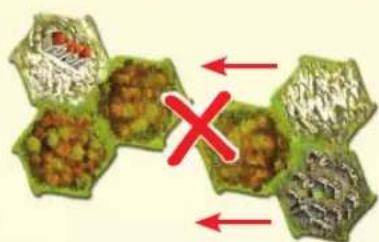
Wrong: Forest is touching forest, but only one edge of the new tile is touching.

natural_image
Illustration of a landscape with green hills and red arrows indicating direction, no text or symbols present.Right: Mountain is touching mountain. 3 edges are touching in total.
A region with a cottage

depicted on it is considered completed and cannot be extended by
a region of the same landscape type. To show that the region is complete, put a cottage on top of the field depicting the cottage.


Note: When you lay a tile depicting a cottage you have the option of placing your playing piece on top of the cottage-field.
Example:
Wrong: Since the meadow region (outlined in blue) has been completed with the cottage, no further meadow field can be laid next to it.
After laying a tile, check to see how many regions that were already previously laid have been extended:
- If, by laying your tile, you manage to extend 2 different types of regions (see example A), you immediately receive 1 coin.
- If you extend only 1 existing region (see example B) or join 2 regions (see example C), you receive no coins.
- If you manage to extend 3 different regions (see example D) with a single tile, you immediately receive 2 coins.
Examples:

natural_image
Illustration of green, textured, and brown cellular structures with directional arrows (no text or symbols)A) Since 2 regions (mountain and meadow) were extended, the player receives 1 coin.

B) 2 meadow fi elds are laid correctly adjacent to the existing meadow, but the player does not receive any coins because only 1 region has been extended.

flowchart
graph TD
    A["Green Block"] --> B["Brown Block"]
    B --> C["Green Block"]
    C --> D["Brown Block"]
    D --> E["Green Block"]
    E --> F["Red Arrow Down"]
    F --> G["Red Arrow Up"]
    G --> H["Red Arrow Down"]
    H --> I["Red Arrow Up"]
    I --> J["Red Arrow Down"]
C) The new mountain fi eld that has been laid joins 2 existing mountain regions. The player does not receive any coins.

In extremely rare cases it is possible that you cannot lay your tile anywhere. If that is the case, move the tile to the bottom of the draw pile and pick up a new tile.
2) Placing playing piece(s) (optional): On your turn you can place up to 3 of your playing pieces that are not already on another field on the tile that you just finished laying. The size of the playing piece you choose doesn't matter. Only one playing piece can occupy a fi eld.
If you place only one single playing piece on a tile, it doesn't cost you any coins, as long as no other playing piece (of any color) is in the same region. For every playing piece that is already in the same region, you have to pay 1 coin. The same applies for your own playing pieces.
If you want to place more than one playing piece, you can only place them on the remaining fields of the tile you just finished laying. But, for each additional field that you want to occupy with your playing piece you have to pay 1 coin. If there are already other playing pieces placed in this region, you have to pay additional coins according to how many playing pieces there are.
If you place your playing piece on a field with a chapel on it, immediately move your points marker forward by 3 points on the scoring board. The playing piece stays on the field with the chapel.
Examples:
E) Carsten expands the regions mountain and village with his tile. That earns him 1 coin. He then places a small playing piece on the meadow and another small playing piece on the village with the fl ag. For the second playing piece he has to pay 1 coin.

natural_image
Topographic map with green terrain, red and blue icons, and a red outline (no text or labels)F) Ronald extends the meadow and receives no coins, since only one region was extended. He places a tall, slender playing piece on the meadow. Normally this would not have cost him anything, but since there is already a playing piece (blue) on the meadow he has to pay 1 coin. For the second playing piece (small) that he places in the forest he has to pay yet another coin.
F


G) Nina extends the regions forest and meadow with her tile, which earns her 1 coin. Then she places one small playing piece on the mountain fi eld with the chapel, which doesn't cost her any coins. She immediately receives 3 points on the scoring board. Additionally she places a tall, slender playing piece on the forest fi eld, which costs her 2 coins (1 coin for an additional fi eld and 1 coin on account of the yellow playing piece that is already in the forest region).
H
H) Marie extends the mountain and meadow regions. She earns 1 coin. Because the flag (more on that later) increases the value of the large meadow region, she places her big, fat playing piece on the meadow. Since 2 playing pieces are already on the meadow (yellow and blue), she has to pay 2 coins.

natural_image
Topographic map layout with colored icons (red, green, blue, yellow) on terrain and terrain patches, no text or labels visible.3) Evaluate completed landscapes (if applicable): At the end of a player's turn, regions are evaluated if:
a cottage

was placed in a region;
a region cannot be extended any further because it is surrounded by other tiles.
● After the evaluation all playing pieces are removed from the evaluated tiles and placed in the pub.

Note: Swamps are always evaluated at the end of the game only, even when they have been surrounded by other regions. That means that playing pieces that have been placed on swamps cannot be re-used throughout the course of the game!
Evaluation:
When evaluating a region, first determine which player has the majority in the region. The playing pieces are evaluated differently:
If a player has multiple playing pieces in a region, add up the value of these playing pieces.

123

[Non-Text]

[NO TEXT]
In all regions without the flag of Cornwall only the player who has the majority in this region gets 1 point per fi eld (exception: swamp).
If there is at least 1 flag in the region, then the player with the second most playing pieces in the region also gets points.

Swamp regions are evaluated only at the end of the game. There are never flags in the swamp regions. The player with the majority receives 2 points per fi eld. The player with the second highest score receives 1 point for each fi eld.
| Evaluation | Points for a majority | Points for the second highest score | ||||
| Throughout the game (phase 3 “evaluate regions”) and at the end of the game |  | 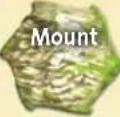 | 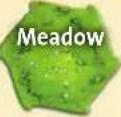 |  | 1 point per field | 0 points |
| Mount Meadow Forest | 2 points per field | 1 point per field | ||||
 |  |  |  | 3 points per field | 1 point per field | |
| Only at the end of the game |  | 2 points per field | 1 point per field | |||
If there is a tie for first place, the points for the first and second place are added, and the total sum of all fi elds is split up between them (round up if necessary). No points are awarded to any other players.
If exactly one player has the majority (for a region with a fl ag), and there is a tie for second place among multiple players, these players divide up the points for this region among them (1 point per field, rounding up if necessary). If no player places second in a region with a fl ag, the points for second place are not awarded.
The players move their respective points marker forward on the scoring board accordingly.
Pub
Playing pieces that have already been evaluated are removed from the tiles and the players do not take them back. Instead the playing pieces are placed in the pub. Immediately after laying a tile (and possibly receiving coins) any player can pay 1 coin and pick up all his playing pieces that are currently in the pub.

natural_image
Illustration of a two-story stone house with green roof and two bench stools, under a blue sky (no text or symbols)Note: During the tile-laying phase of the game it can be a smart move to lay your tile in such a way as to force a premature evaluation of another player's region before his point total gets to high.
It may also make sense to force a premature evaluation of one of your own regions by laying a tile, when, for example, you desperately need more playing pieces, or when you suspect that another player (by spending coins) may overtake your lead in the region and gain the majority.
Examples:
1) Carsten lays mountain next to mountain. He places 1 playing piece on the mountain for free. However, since there is already a green playing piece in the region, he has to pay 1 coin. The region is completed by the cottage. Since the tall blue playing piece is worth more than the small green playing piece, Carsten receives 3 points for the 3 mountain fields.
He then places a cottage on the mountain field. Now, no further mountain tiles can be placed next to this mountain field. Then his tall blue playing piece and the small green playing piece are put into the pub.


J) Ronald lays the perfect tile. Meadow to meadow, village to village and forest to forest. He receives 2 coins. Since he no longer has a big fat playing piece, he places a small one on the meadow, which costs him 3 coins (there are already 3 playing pieces in the region). The tall slender playing piece costs him another 2 coins (1 coin for the additional field and 1 coin because there is already 1 playing piece in the village).
Since the meadow that was just laid has a cottage on it, this region is immediately evaluated. The yellow and the red playing pieces share a majority (3 points each), so the points for first and second place are added up. That means that each of the 6 meadow fields is worth 2+1=3 points, and the entire meadow
region is then worth 6x3=18 points. Player red and yellow divide these points among them (9 points each). Blue doesn't receive any points for the meadow region. The village, which was also extended, cannot be extended any further. That means this region is also complete and therefore must be evaluated. Yellow receives 3x3=9 points and blue 3x1=3 points. After the evaluation, both blue playing pieces, the big red and the three yellow playing pieces that were evaluated are all removed from the tiles and placed in the pub.
End of game
The game is over once all the tiles have been laid. All regions that have yet to be evaluated (the swamp regions) are now evaluated. For every coin that a player has by the end of the game, the points marker is moved forward by 1 point on the scoring board. The player with the most points wins. If multiple players tie for first place, the one with the most coins wins.
Author and editor would like to thank all test players and rule proofreaders.
Specials Thanks from the author to his wife Magdalena.
Her vacation to Cornwall and the many pictographic descriptions of this unique landscape was laying the cornerstone of this game.
Schmidt Spiele GmbH
But du jeu
montagne village prairie
natural_image
Illustration of green geological formations with a red 'X' symbol indicating a cross, no text or symbols present.natural_image
Illustration of two green-tinted landforms with arrows indicating direction, no text or symbols presentnatural_image
Illustration of green geological or biological structures with arrows indicating direction (no text or symbols)natural_image
Illustration of a multi-garden landscape with green foliage and small animal figures, no text or symbols presentnatural_image
Topographic map with colored icons (red, green, blue) overlaid on terrain and landforms, no readable text or labelsnatural_image
Topographic map layout with green terrain, red outline, and numbered village icons (no text labels)natural_image
Solid red silhouette of a stylized human figure (no text or symbols)[NO TEXT]
natural_image
Illustration of a two-story house with green roof and two benches, no visible text or symbolsScopo del gioco
natural_image
Illustration of a house with red roof and green lawn, showing a 3D top-down view of its roof and surrounding landscape (no text or symbols)natural_image
Illustration of three green landforms with a red 'X' symbol between them, no text or symbols present.natural_image
Illustration of a green checkmark over a stylized landscape with red arrows indicating direction (no text or symbols)natural_image
Illustration of green, textured, and brown cellular structures with directional arrows (no text or symbols)flowchart
graph TD
    A["Green Block"] --> B["Brown Block"]
    B --> C["Green Block"]
    C --> D["Brown Block"]
    D --> E["Green Block"]
    E --> F["Red Arrow Down"]
    F --> G["Red Arrow Up"]
    G --> H["Red Arrow Down"]
    H --> I["Red Arrow Up"]
    I --> J["Red Arrow Down"]
natural_image
Topographic map with colored icons (red, green, blue) overlaid on terrain and landforms, no readable text or labels
The image is too blurry to recognize any text content.

natural_image
Solid red silhouette of a stylized human figure (no text or symbols)[Non-Text]
natural_image
Illustration of a two-story house with green-tiled roof and windows, featuring a bench and small entrance (no text or symbols)


Brand : Schmidt
Model : Cornwall
Category : Board game