
Black DOG - Board game Schmidt - Free user manual and instructions
Find the device manual for free Black DOG Schmidt in PDF.


| Product type | Board game |
| Brand | Schmidt |
| Model | Black DOG |
| Number of players | 2 to 6 players |
| Recommended age | 8 years and up |
| Box dimensions | Approximately 30 x 30 x 5 cm |
| Weight | Approximately 1 kg |
| Power supply | None (non-electronic game) |
| Main features | Card and dice game, strategy and luck |
| Rule languages | French, German, English, Italian |
| Materials | Cardboard, laminated cards, plastic dice |
| Care and cleaning | Wipe with a dry, soft cloth |
| Safety | Contains small parts, choking hazard for children under 3 years |
| Spare parts | Not available individually, contact customer service |
| Repairability | Not applicable (non-electronic game) |
| General information | Instruction manual free to download in PDF format at notice-facile.com |
Frequently Asked Questions - Black DOG Schmidt
User questions about Black DOG Schmidt
0 question about this device. Answer the ones you know or ask your own.
Ask a new question about this device
Download the instructions for your Board game in PDF format for free! Find your manual Black DOG - Schmidt and take your electronic device back in hand. On this page are published all the documents necessary for the use of your device. Black DOG by Schmidt.
USER MANUAL Black DOG Schmidt
Spielziel

men werden.

Wichtig:
The team game with bite from Johannes Schmidauer-König for 2–4 players
To make it easier for you to get started, all the sections of the game that deviate from the game instructions of the classic game of DOG® are marked "NEW" on the edge of the page.

First, the rules for the 4-player game are explained. Rule variations for the 2- and 3-player games are explained at the end of these instructions.
Contents
• 1 game board
- 1 spin wheel
• 1 washer
• 1 pressure eyelet
• 110 playing cards
• 21 playing pieces (5 pieces in each color + 1 black playing piece)

Aim of the game
Build teams of 2 players each. All players try to move their own 4 playing pieces from their starting position to their home position as fast as they can. The playing pieces are
moved depending on the played cards. It is not possible to win alone as a single player. Once a player has brought all his playing pieces home, he helps his partner bring his playing pieces home. Only once all 8 playing pieces of a team have been brought home, this team has won the game. Team members are not allowed to communicate with one another about the cards in their hands or their intended moves.

Game setup
When playing for the first time, you first have to assemble the game board. First place the washer in the center of the game board, then the spin wheel, and finally press them together with the pressure eyelet. You can leave the game assembled together in the game box when putting it away, and do not have to re-assemble it before each new game.

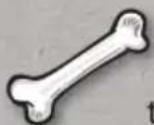
Position the spin wheel so that
the 4 bones are visible. The players put their respective 4 playing pieces of their color on the starting area of the same color. The 5th playing piece is required only for the 2- and 3-player games. Leave it in the game box for this game. Select one player to be the dealer. The dealer shuffles the cards thoroughly and deals out 5 cards to each player, face down. He then gives the stack of cards to the player on his left for the next round, who puts it down in front of him on the table ready for the next round.
In a 4-player game, the players sitting opposite to one another play together and form one team.
To start the game, players are allowed to put another playing piece from their respective starting area onto the board and in play, without having to play a card. This special start happens only at the beginning of the game, but not before each new round. The player to the right of the start player now puts the black playing piece (BLACK DOG) on any one of the spaces on the spin wheel.

How to play
Once the cards have been dealt, the teammates trade 1 card each among themselves before the round begins. Players can look at the new card only once they have handed over their card, face down, to their teammate. Trade cards with your teammate so that you help your teammate. For example, if your teammate doesn't have a playing piece in play, it would make sense to give him a start card.
The player who has the stack of cards in front of him begins the game by playing one of the cards from his hand face up and moving one of his playing pieces accordingly on the game board. Do not draw a new card! Then the next player in a clockwise direction takes his turn and play continues. If a player cannot move any of his pieces, he turns over
his cards. They are completely forfeited and are put at the bottom of the discard pile. The player is out of the game for this round.
A round is over when all cards have been played or discarded.
Beginning with the second round, the player who has the stack of cards in front of him deals out another 5 cards to all players, and then gives the stack of cards to the player on his left, who begins this round. In this way, you each take turns in a clockwise direction dealing and starting the round. If the stack of cards runs out, shuffle the discard pile and use it as the new stack of cards.
After dealing 5 cards to each player, players trade one card face down with their teammate to begin the new round.
Starting position
To be able to move one of your playing pieces from your starting area to the starting position you need a start card (card with the symbol ⚙A playing piece on a starting position of its own color blocks other playing pieces of the same color or different color. It doesn't matter how they landed on the starting position, whether from the starting area or by moving along the track!
A playing piece on its own (colored) starting position is safe and cannot be captured or switched (see below). It cannot be passed by any other playing piece (of the same or different color). Generally, only the BLACK DOG moves past the starting position and does not count it.

Moving and capturing
The playing pieces are moved depending on the played cards. For example, if a player plays an 8, he has to move his playing piece exactly 8 spaces further in a clockwise direction. When moving pieces you can pass your own and other playing pieces (exception: occupied starting position and home), but you have to count the passed space.
One playing piece only can occupy any one space at a time. If a player's turn ends on a space where another playing piece already stands, this piece is captured (even own-colored pieces) and put back into the starting area of its respective color. The BLACK DOG is never captured.

Note to our Swiss DOG®-Fans: Contrary to all other DOG® games from Schmidt Spiele, BLACK DOG must move in a clockwise direction, unlike the typical Swiss custom.
Zugzwang
Every card must be carried out completely. You cannot forfeit any points. It is entirely possible that a player that has, for example, 3 more spaces to reach his home, but only has higher cards in his hand, therefore moves right on by his home and starts a new lap. In general, you can only move your own playing pieces.
Home
The playing pieces are safe at home. They can be neither passed, nor captured here. A playing piece has to pass over the starting position to be brought home. But it cannot move from the starting position directly home, even if it has already completed one lap (in this case it would have to do another lap, unfortunately).
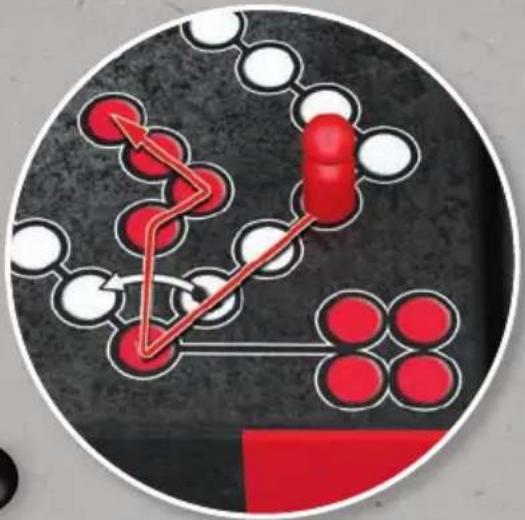
When do you turn the spin wheel?
Whenever a player actively moves one of his playing
pieces onto one of the 8 paws (but not when he merely passes by one), he has to turn the spin wheel 90 degrees clockwise or counterclockwise until the next colored
paw. But turn the spin wheel only once your turn has been

completed. That means, only once you have moved all possible playing pieces. Once you have started to turn the spin wheel in one direction, you can no longer change directions and decide to turn it in the opposite direction. The white and black paws make it easier to recognize where the turned piece—and also the BLACK DOG—will be after turning the wheel.
- If a playing piece ends up on a paw as a result of someone playing a "Switch" card (see below), do not turn the spin wheel (since a playing piece was already there before).
• If a playing piece is moved onto a paw by playing the
"Magnet" card (see below), turn the wheel (since in this case the playing piece moved to the space).
Cards with a blue background
For all cards with a blue background the playing piece is moved forward according to the number shown.

Cards with a red background
and their special features
All cards with a red background are special cards with their own special feature:

This is a start card. It lets you move one of your playing pieces from its starting area to its starting position. Alternatively, this card can also be used to move a playing piece forward by 1 or by 11 spaces.

This is a start card. It lets you move one of your playing pieces from its starting area to its starting position. Alternatively, this card can also be used to move a playing piece forward by 13 spaces.
![graph TD A["Component 1"] --> B["Component 2"] B --> C["End"]](/content/2026/06/1287950/images/4b82ce11ac3e2d756c4973a2d4334ad0edd2e8fadb4a8cc4f7a068bcf5fcef02.jpg)
Switch: When this card is played, one of your own playing pieces must be switched with one of your opponent's or one of your teammate's pieces, even if it is disadvantageous for you. Playing pieces that are safe (pieces on their own colored starting position), pieces that are already home and the BLACK DOG may not be switched. If only your own playing pieces or pieces that are safe are in play, the card cannot be played. If a playing piece ends up on a paw as a result of someone playing a switch card, do not turn the spin wheel.

Magnet: When playing the magnet card, move one of your own playing pieces up to the space directly behind the next playing piece (regardless of its color, or if its the BLACK DOG). This can be a considerable distance. The playing piece must be moved all the way up to the next piece until it is directly behind it. It is not allowed to stop before. You are not allowed to play this card to bring your

playing piece home, or to move any of your pieces that are already home up by a few spaces. Nor can a magnet card be used for a playing piece that is already directly behind another piece. The playing piece has to be moved by at least one space. If a playing piece is moved onto a paw by playing the magnet card, turn the wheel.
Copy: This card copies the last card played (not necessarily the selected action of the card and not a discarded card). By playing this card, it is as though you had just played the same card as the player before you. For example, if you play the copy card after a 1/11 card was just played (the previous player moved his piece 11 spaces forward), you can also use the card to bring one of your pieces from the starting area onto the starting position. The copy card does not apply across rounds. That means it cannot be the first card played in a new round (with 5 cards for each player). If a copy card is played after another copy card, it copies the same card as has the first copy card.

Partner: The 4 movement points can be divided up among your own playing pieces as well as those of your partner, however you want. But you have to use up all 4 points. No points may be forfeited. You can choose the order and division of points however you want. You can (or you may even be forced to, if you don't have any more pieces of your own) use up all 4 points to move the playing pieces of your partner forward. (Careful: communication is not allowed!)
If a player has already brought all 4 of his playing pieces home, the players of this team can use the 4 movement points on the pieces of their partner and on pieces of other players (or even use all of them on other players' pieces), but not on the playing piece of the BLACK DOG.
If more than one playing piece lands on a paw by playing the partner card, the spin wheel is still only turned once by 90 degrees.
Cards with a black background

You get to choose the value of this card yourself (from 1 to 7). First, move your own playing piece and then also move the BLACK DOG by the same number of spaces. But if you cannot move any of your own pieces, you cannot play this card.
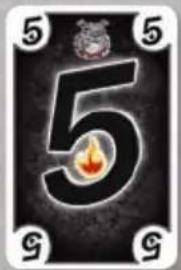
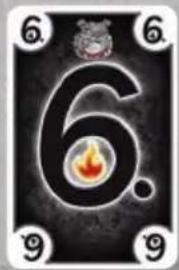
For these cards, first move one of your own playing pieces and then also the BLACK DOG by the same number of spaces. For example, for the black 5, move your own playing piece 5 spaces forward, and then move the BLACK DOG 5 spaces forward, too. But if you cannot move any of your own pieces, you cannot play this card.
Black DOG:

The BLACK DOG playing piece is dangerous. It always chases all pieces it comes up to, or which come up to it. The pieces are captured and are returned to their starting area. If you are forced to move your playing piece to the space where the BLACK DOG is, your piece is also captured.

Important:
● The BLACK DOG cannot be switched or captured.
● The BLACK DOG moves around the track in a clockwise direction just like all the other playing pieces. It skips the starting positions
and doesn't count them when moving forward. A playing piece on its own starting position is not captured by the BLACK DOG, nor does it block the BLACK DOG's path.
- If the BLACK DOG ends up on a paw, the spin wheel is not turned!
- In seldom cases: If a playing piece lands on a paw and is then captured by the BLACK DOG, the spin wheel is not turned! Always turn the wheel at the end of your turn.

General order of play:
- Move your playing pieces
- Move the BLACK DOG, if required
- Turn the spin wheel, if required
Partner game
Once a player has brought all his playing pieces home, he helps his partner by moving his pieces when he plays his cards. This player is still dealt cards. The team works together to bring home the last pieces. But the teammates are still not allowed to communicate with one another about their cards or intended moves.
As soon as the last playing piece of a team has been brought home at the conclusion of a turn, this team has won the game. It is entirely possible that the last playing piece has to go around the board several times before it manages to arrive home safely.
End of game
The first team that manages to bring all 8 playing pieces home wins the game.
Variation for 2- and 3-player games
In addition to the above rules, the following changes and extra rules apply:
- Players don't play in teams, but everyone for himself.
- Everyone plays with 5 playing pieces, with 4 pieces starting off in the starting area and 1 piece on the starting position.
- If all a player's playing pieces have been captured, put the 5th piece next to the starting area.
- If a player cannot move one of his playing pieces with the cards he has in his hand, he has to discard one card and draw a new one from the draw pile. If he still cannot move one of his pieces with the card that he has just drawn, instead of a normal turn, he has to discard one of his cards (so that all players have the same number of cards).
● The 4 movement points of the partner card can always also be applied to playing pieces of other players, but not to the playing piece of the BLACK DOG.
● Trading cards: To start the round, each player gives one of his cards of his choice to the player on his left without showing the card.
● The first player to bring home 4 playing pieces wins.
The publishing house and the author are grateful to all the test players for countless hours of testing, suggestions and ideas. And a special thanks goes to Christwart Conrad and Wolfgang Wichmann for their ideas on how to make BLACK DOG fun as a 2- and 3-player game. The author also expresses special thanks to Helmut Hofstadler for manufacturing the first prototype.
QUI A PEUR DU CHIEN NOIR ?
But du jeu

Déplacer et prendre
Important :
Scopo del gioco

Muovere e battere
Importante:


- SPIELZIEL
- WICHTIG
- CONTENTS
- AIM OF THE GAME
- GAME SETUP
- HOW TO PLAY
- A ROUND IS OVER WHEN ALL CARDS HAVE BEEN PLAYED OR DISCARDED
- STARTING POSITION
- MOVING AND CAPTURING
- ZUGZWANG
- HOME
- WHEN DO YOU TURN THE SPIN WHEEL
- CARDS WITH A BLUE BACKGROUND
- CARDS WITH A RED BACKGROUND
- AND THEIR SPECIAL FEATURES
- CARDS WITH A BLACK BACKGROUND
- BLACK DOG
- IMPORTANT
- GENERAL ORDER OF PLAY
- PARTNER GAME
- END OF GAME
- VARIATION FOR 2- AND 3-PLAYER GAMES
- QUI A PEUR DU CHIEN NOIR
- BUT DU JEU
- DÉPLACER ET PRENDRE
- SCOPO DEL GIOCO
- MUOVERE E BATTERE
- IMPORTANTE
Brand : Schmidt
Model : Black DOG
Category : Board game