ABA12 - Battery charger Perel - Free user manual and instructions
Find the device manual for free ABA12 Perel in PDF.
User questions about ABA12 Perel
0 question about this device. Answer the ones you know or ask your own.
Ask a new question about this device
Download the instructions for your Battery charger in PDF format for free! Find your manual ABA12 - Perel and take your electronic device back in hand. On this page are published all the documents necessary for the use of your device. ABA12 by Perel.
USER MANUAL ABA12 Perel
To all residents of the European Union Important environmental information about this product This symbol on the device or the package indicates that disposal of the device after its lifecycle could harm the environment. Do not dispose of the unit (or batteries) as unsorted municipal waste; it should be taken to a specialized company for recycling. This device should be returned to your distributor or to a local recycling service. Respect the local environmental rules. If in doubt, contact your local waste disposal authorities. Thank you for choosing Perel! Please read the manual thoroughly before bringing this device into service. If the device was damaged in transit, do not install or use it and contact your dealer.
2. General Guidelines
Refer to the Velleman® Service and Quality Warranty on the last pages of this manual.
Keep this device away from dust, humidity and extreme temperatures.
Protect this device from shocks and abuse. Avoid brute force when operating the device.
Familiarise yourself with the functions of the device before actually using it. All modifications of the device are forbidden for safety reasons. Damage caused by user modifications to the device is not covered by the warranty. Only use the device for its intended purpose. All other uses may lead to short circuits, burns, electroshocks, crash, etc. Using the device in an unauthorized way will void the warranty. Damage caused by disregard of certain guidelines in this manual is not covered by the warranty and the dealer will not accept responsibility for any ensuing defects or problems. Do not use outside the technical specifications. Nor Velleman nv nor its dealers can be held responsible for any damage (extraordinary, incidental or indirect) – of any nature (financial, physical…) arising from the possession, use or failure of this product.ABA12
V. 01 – 07/09/2015 4 ©Velleman nv
Do not switch the device on immediately after it has been exposed to changes in temperature. Protect the device against damage by leaving it switched off until it has reached room temperature. Keep this manual for future reference.
This battery analyser is only suitable for testing 12 V batteries. The operating voltage being 9 V to 15 V, this tester should not be connected to 24 V directly as it will cause damage to the unit. For 2 x 12 V batteries in series, disconnect them and test them separately. A freshly-charged battery contains surface charge and should be slightly discharged by turning on the car’s headlights for 3 to 5 minutes before testing. Always fix the crocodile clips on the lead side of the battery terminal posts during testing and make sure they make good contact. Do not fix the crocodile clips directly onto the steel bolt, which is tightened to the battery terminal posts. This may give inaccurate readings or inconsistent results. If the battery terminal posts are oxidized, the battery analyser will prompt you to check the connections. In this case, clean the terminal posts and perform the testing directly on the terminal posts themselves. Make sure to switch off the engine if the battery is still sitting in the car.
3.2 Working with Batteries
Lead-acid batteries contain a sulphuric acid electrolyte, which is highly corrosive. It will produce gases when recharged and explode if ignited. Provide plenty of ventilation, remove your jewellery, wear protective eyewear and clothing, and exercise caution. Do not allow battery electrolyte to mix with salt water. Even small quantities of this combination will produce lethal chlorine gas. Carefully read the battery’s user manual if possible.
4.1 Starting Battery
The starting battery – sometimes called SLI (Starting, Lighting and Ignition) – is designed to start and run engines. It delivers quick bursts of energy and have a greater plate count.ABA12
V. 01 – 07/09/2015 5 ©Velleman nv
The plates will also be thinner and are composed of a lead “sponge”, similar in appearance to a very fine foam sponge. This gives a very large surface area. If deep cycled, this sponge will quickly be consumed and fall to the bottom of the cells. Automotive batteries will generally fail after 30 to 150 deep cycles if deep cycled, while they may last for thousands of cycles in normal starting use (2 ~ 5 % discharge). Starting batteries are usually rated at CCA (Cold Cranking Amps) or MCA (Marine Cranking Amps).
4.2 Deep-Cycle Battery
These batteries are used mainly on golf carts, scooters, RVs, etc. They have less instant energy but greater long-term energy delivery. They are designed to be discharged down as much as 80 %, time after time, and have much thicker plates. The major difference between a true deep- cycle battery and others is that the plates are solid lead plates and not sponge.
These batteries are actually hybrid models and fall between the starting and deep-cycle batteries. The plates may be composed of lead sponges, but they are coarser and heavier than those used in starting batteries. Hybrid types should not be discharged more than 50 %.
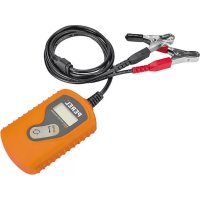
the device uses a test signal pattern to test and monitor battery cells never discharges or drains the battery maintenance-free and no internal batteries required simple and easy to use test batteries on and off the vehicle accurate results in milliseconds Battery Life Analysis large and easy-to-read LCD display test results based on JIS, EN, DIN, SAE and IEC Standards
Refer to the illustrations on page 2 of this manual.
7.1 Connecting the Analyser before Testing
1. Make sure the car’s electronics are switched off, i.e. all doors closed
and the engine switched off.
2. Carefully clean the terminal posts and make sure they are free from
dust, grease and corrosion.
3. Connect the red crocodile clip to the positive electrode; connect the
clips to the battery terminals posts. Check the connection again if this is not the case.
2. Use the scroll button and choose LANGUAGE to select the desired
language, or ANALYZER to enter the testing mode.
3. Confirm with the enter button.
In-Vehicle or Out-Of-Vehicle Testing
1. Next, choose the battery’s actual position:
o IN VEHICLE: the battery is still connected to the engine o OUT OF VEHICLE: the battery is disconnectedABA12
2. Confirm with the enter button.
Battery System Standard and Rating
1. Next, choose the battery type and rating according to the markings on
CCA Cold start current value of the most common specifications developed by the SAE and BCI. The most common starting battery rated at 0 °F (-18 °C). BCI International Battery Standards Committee.
Effective starting current rating at 0 °C. MCA Marine Battery Standard. JIS Japanese Industrial Standard. Effective starting current rating at 0 °C. DIN German Automotive Industry Standards Committee.
European Automobile Manufacturers Association Standards. SAE American Society of Automotive Engineers.
measuring standard measuring range CCA 100-2000 BCI 100-2000
2. Confirm with the enter button.
3. If needed, increase or decrease the value with 5 units by holding the
scroll button pressed for 3 seconds. Keep the scroll button pressed for 3 seconds to inverse the direction.
7.3 Reading the Test Results
There are 5 different test results. Good Battery
The battery is in good health and can be used without any problems. Good Battery, Needs RechargingABA12
The battery is in good health but is low in current. Please recharge. Replace BatteryABA12
The battery is near or has reached the end of its lifecycle. Replace the battery. Damaged Cells, Replace Battery
Cells are near or have reached the end of their lifecycle. Replace the battery.ABA12
The battery is unstable and should be tested again for an accurate result. The battery can be deemed damaged if the retest gives the same results. Note that, if you get these results from an in-vehicle battery, you should disconnect the battery from the circuit and retest before replacing.
8. Cleaning and Maintenance
The battery analyser does not need any particular maintenance. However, it is advisable to clean it occasionally to keep it looking like new. Use a soft, moist cloth and some mild soap. Never use solvents or strong, abrasive cleaning agents.ABA12
Refer to the last pages of this manual. Use this device with original accessories only. Velleman nv cannot be held responsible in the event of damage or injury resulting from (incorrect) use of this device. For more info concerning this product and the latest version of this manual, please visit our website www.perel.eu. The information in this manual is subject to change without prior notice. © COPYRIGHT NOTICE The copyright to this manual is owned by Velleman nv. All worldwide rights reserved. No part of this manual may be copied, reproduced, translated or reduced to any electronic medium or otherwise without the prior written consent of the copyright holder.ABA12
European Automobile Manufacturers Association Standards. SAE American Society of Automotive Engineers.
China National Standard.
BCI Das Battery Council International
550Velleman® Service and Quality Warranty Since its foundation in 1972, Velleman® acquired extensive experience in the electronics world and currently distributes its products in over 85 countries. All our products fulfil strict quality requirements and legal stipulations in the EU. In order to ensure the quality, our products regularly go through an extra quality check, both by an internal quality department and by specialized external organisations. If, all precautionary measures notwithstanding, problems should occur, please make appeal to our warranty (see guarantee conditions). General Warranty Conditions Concerning Consumer Products (for EU):
- All consumer products are subject to a 24-month warranty on production flaws and defective material as from the original date of purchase.
- Velleman® can decide to replace an article with an equivalent article, or to refund the retail value totally or partially when the complaint is valid and a free repair or replacement of the article is impossible, or if the expenses are out of proportion. You will be delivered a replacing article or a refund at the value of 100% of the purchase price in case of a flaw occurred in the first year after the date of purchase and delivery, or a replacing article at 50% of the purchase price or a refund at the value of 50% of the retail value in case of a flaw occurred in the second year after the date of purchase and delivery.
- Not covered by warranty: - all direct or indirect damage caused after delivery to the article (e.g. by oxidation, shocks, falls, dust, dirt, humidity...), and by the article, as well as its contents (e.g. data loss), compensation for loss of profits; - consumable goods, parts or accessories that are subject to an aging process during normal use, such as batteries (rechargeable, non-rechargeable, built-in or replaceable), lamps, rubber parts, drive belts... (unlimited list); - flaws resulting from fire, water damage, lightning, accident, natural disaster, etc.…; - flaws caused deliberately, negligently or resulting from improper handling, negligent maintenance, abusive use or use contrary to the manufacturer’s instructions; - damage caused by a commercial, professional or collective use of the article (the warranty validity will be reduced to six (6) months when the article is used professionally); - damage resulting from an inappropriate packing and shipping of the article; - all damage caused by modification, repair or alteration performed by a third party without written permission by Velleman®.
- Articles to be repaired must be delivered to your Velleman® dealer, solidly packed (preferably in the original packaging), and be completed with the original receipt of purchase and a clear flaw description.
- Hint: In order to save on cost and time, please reread the manual and check if the flaw is caused by obvious causes prior to presenting the article for repair. Note that returning a non- defective article can also involve handling costs.
- Repairs occurring after warranty expiration are subject to shipping costs.
- The above conditions are without prejudice to all commercial warranties. The above enumeration is subject to modification according to the article (see article’s manual).
EasyManual