PS 40 - Saw Hurricane - Free user manual and instructions
Find the device manual for free PS 40 Hurricane in PDF.



User questions about PS 40 Hurricane
0 question about this device. Answer the ones you know or ask your own.
Ask a new question about this device
Download the instructions for your Saw in PDF format for free! Find your manual PS 40 - Hurricane and take your electronic device back in hand. On this page are published all the documents necessary for the use of your device. PS 40 by Hurricane.
USER MANUAL PS 40 Hurricane
The Ground Truth image displays a single, solid horizontal line. According to Rule 2 (UNDERSCORE & LINE RULES), this is a stylistic or background line, not a placeholder underscore. Therefore, the OCR result must ignore it and output nothing or only meaningful text. The provided OCR content is "____", which consists of four underscores. This is an incorrect interpretation of the line as a placeholder, violating the rule that stylistic lines must be ignored. The OCR has hallucinated underscores where none should exist based on the GT's visual context. Hence, the OCR result is inconsistent with the Ground Truth.
ANBRINGEN DER SÄGEKETTE:
text_image
Diagram showing a mechanical or structural component with labeled parts A and B, likely illustrating a joint or assembly.Abb. 12

text_image
Diagram showing a person using a tool on a wooden structure with labeled points A, B, and C, including directional arrows indicating movement.Abb. 17
natural_image
Illustration of hands using a tool to interact with a textured surface (no text or symbols)Abb. 23
Meaning of symbols marked on the product
| Read the user manual before using the machine | Wear dust mask to protect against dust | ||
| Wear safety goggles to protect your eyes | Wear glove to protect your hands | ||
| Wear ear protector to protect against noise | Wear safety boots to protect agains electric shock |
WARNING! When using gas tools, basic safety precautions, including the following, should always be followed to reduce the risk of serious personal injury and/or damage to the unit.
Read all these instructions before operating this product and save these instructions.
-
DO NOT operate a chain saw with one hand! Serious injury to the operator, helpers, bystanders, or any combination of these persons may result from one-handed operation. A chain saw is intended for two-handed use.
-
DO NOT operate a chain saw when you are fatigued.
-
Use safety footwear, snug-fitting clothing, protective gloves, and eye, hearing and head protection devices.
-
Use caution when handling fuel. Move the chain saw at least 10 feet (3m) from the fueling point before starting the engine.
-
DO NOT allow other persons to be near when starting or cutting with the chain saw. Keep bystanders and animals out of the work area.
-
DO NOT start cutting until you have a clear work area, secure footing, and a planned retreat path from the falling tree.
-
Keep all parts of your body away from the saw chain when the engine is running.
-
Before you start the engine, make sure that the saw chain is not contacting anything.
-
Carry the chain saw with the engine stopped, the guide bar and saw chain to the rear, and the muffler away from your body.
-
DO NOT operate a chain saw that is damaged, improperly adjusted, or not completely and securely assembled. Be sure that the saw chain stops moving when the throttle control trigger is released.
-
Shut off the engine before setting the chain saw down.
-
Use extreme caution when cutting small size brush and saplings because slender material may catch the saw chain and be whipped toward you or pull you off balance.
-
When cutting a limb that is under tension, be alert for springback so that you will not be struck when the tension in the wood fibers is released.
-
Keep the handles dry, clean, and free of oil or fuel mixture.
-
Operate the chain saw only in well-ventilated areas.
-
DO NOT operate a chain saw in a tree unless you have been specifically trained to do so.
-
All chain saw service, other than the items listed in the user manual safety and maintenance instructions, should be performed by competent chain saw service personnel.
-
When transporting your chain saw, use the appropriate guide bar scabbard.
-
DO NOT operate your chain saw near or around flammable liquids or gases whether in or out of doors. An explosion and/or fire may result.
-
Do not tank fuel, oil or lubrication when the engine of chain saw is running.
-
USE THE RIGHT TOOL: Cut wood only. Do not use the chain saw for purposes for which it was not intended. For example, do not use the chain saw for cutting plastic, masonry, or nonbuilding materials.
NOTE: This appendix is intended primarily for the consumer or occasional user. These models are intended for infrequent use by homeowners, cottagers, and campers, and for such general applications as clearing, pruning, cutting firewood, etc. They are not intended for prolonged use. If the intended use involves prolonged periods of operation, this may cause circulatory problems in the user's hands due to vibration. It may be appropriate to use a saw having an anti-vibration feature such as the models covered in this manual with the suffix Anti-Vibration.
KICKBACK SAFETY PRECAUTIONS
Kickback may occur when the nose or tip of the guide bar touches an object, or when the wood closes in and pinches the saw chain in the cut. If the bar tip contacts, it may cause a lightning-fast reverse reaction, kicking the guide bar up and back towards the operator. Pinching the saw chain along the top of the guide bar may push the guide bar rapidly back towards the operator. Either of these reactions may cause you to lose control of the saw, which could result in serious personal injury. Do not rely exclusively upon the safety devices built into your saw. As a chain saw user, you should take several steps to keep your cutting jobs free from accident or injury.
-
With a basic understanding of kickback, you can reduce or eliminate the element of surprise. Sudden surprise contributes to accidents.
-
Keep a good firm grip on the saw with both hands, the right hand on the rear handle, and the left hand on the front handle, when the engine is running. Use a firm grip with thumbs and fingers encircling the chain saw handles. A firm grip will help you reduce kickback and maintain control of the saw. Don't let go.
-
Make sure that the area in which you are cutting is free from obstructions. Do not let the nose of the guide bar contact a log, branch, or any other obstruction which could be hit while you are operating the saw.
-
Cut at high engine speeds.
-
Do not overreach or cut above shoulder height.
-
Follow manufacturer's sharpening and maintenance
instructions for the saw chain.
- Only use replacement bars and chains specified by the manufacturer or the equivalent.
NOTE: Low-kickback saw chain is chain that has met the kickback performance.
GB
IMPORTANT SAFETY
Your Talon Chain Saw is provided with a safety label located on the chain brake lever/hand guard. This label, along with the safety instructions on these pages, should be carefully read before attempting to operate this unit.
• HOW TO READ SYMBOLS AND COLORS (FIG. 1)

WARNING: RED Used to warn that an unsafe procedure should not be performed.
GREEN
RECOMMENDED
Recommended cutting procedure.
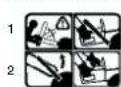
Fig. 1
WARNING
3 1. Beware of kick back. 2. Do not attempt to hold saw with one hand.
-
- Avoid bar nose contact.
RECOMMENDED
- Hold Saw properly with both
hands.
• DANGER! BEWARE OF KICKBACK!

WARNING: Kickback can lead to dangerous loss of control of the chain saw and result in serious or fatal injury to the saw operator or to anyone standing close by. Always be alert. Rotational kickback and pinch-kickback are major chain saw operational dangers and the leading cause of most accidents.
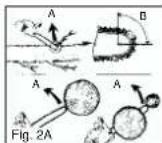
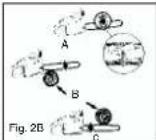
BEWARE OF:
ROTATIONAL KICKBACK THE PUSH
(Hg. 2A) (PINCH KICKBACK)
AND PULL REACTIONS
(Fig. 2B)
A = Kickback path A = Pull
B = Kickback reaction zone B = Solid objects
C = Push
KICKBACK may occur when the NOSE or TIP of the guide bar touches an object, or when wood closes in and pinches the saw chain in the cut.
Tip contact in some cases may cause a lightning-fast reverse reaction, kicking the guide bar up and back toward the operator.
PINCHING the saw chain along the BOTTOM of the guide bar may PULL the saw forward away from the operator. PINCHING the saw chain along the TOP of the guide bar may PUSH the guide bar rapidly back toward the operator.
Any of these reactions may cause you to lose control of the saw, which could result in serious personal injury.
SPECIFICATIONS
Engine Disp;acement 38 cm ^2 (2.3 cu-in)
Maximum Shaft Brake Power....1.4 kW
Cutting Length 16" (40cm)
Chain Pitch 10mm
Chain Gauge ....1.3mm
Idle Speed 2,800-3,300 min ^-1
Speed in Max power 8,000 min
Fuel Capacity 296CC (10 oz)
Oil Capacity 180CC (6.1 oz)
Anti Vibration....Y
Sprocket Tip Bar ....9 Teeth
Chain Brake Y
Clutch Y
Automatic Chain Oller ¥
Lower Kick Back Chain ¥
Net Weight (Nitour guide bar and chain) 5.1 kg
Net Weight 5.88 kg
Sound pressure level 97.6 dB(A)
Sound power level 103 dB(A)
Mean braking time at racing speed .....0.07s
Vibration 10.2 m/s
Fuel Consumption 1,5 kg/h
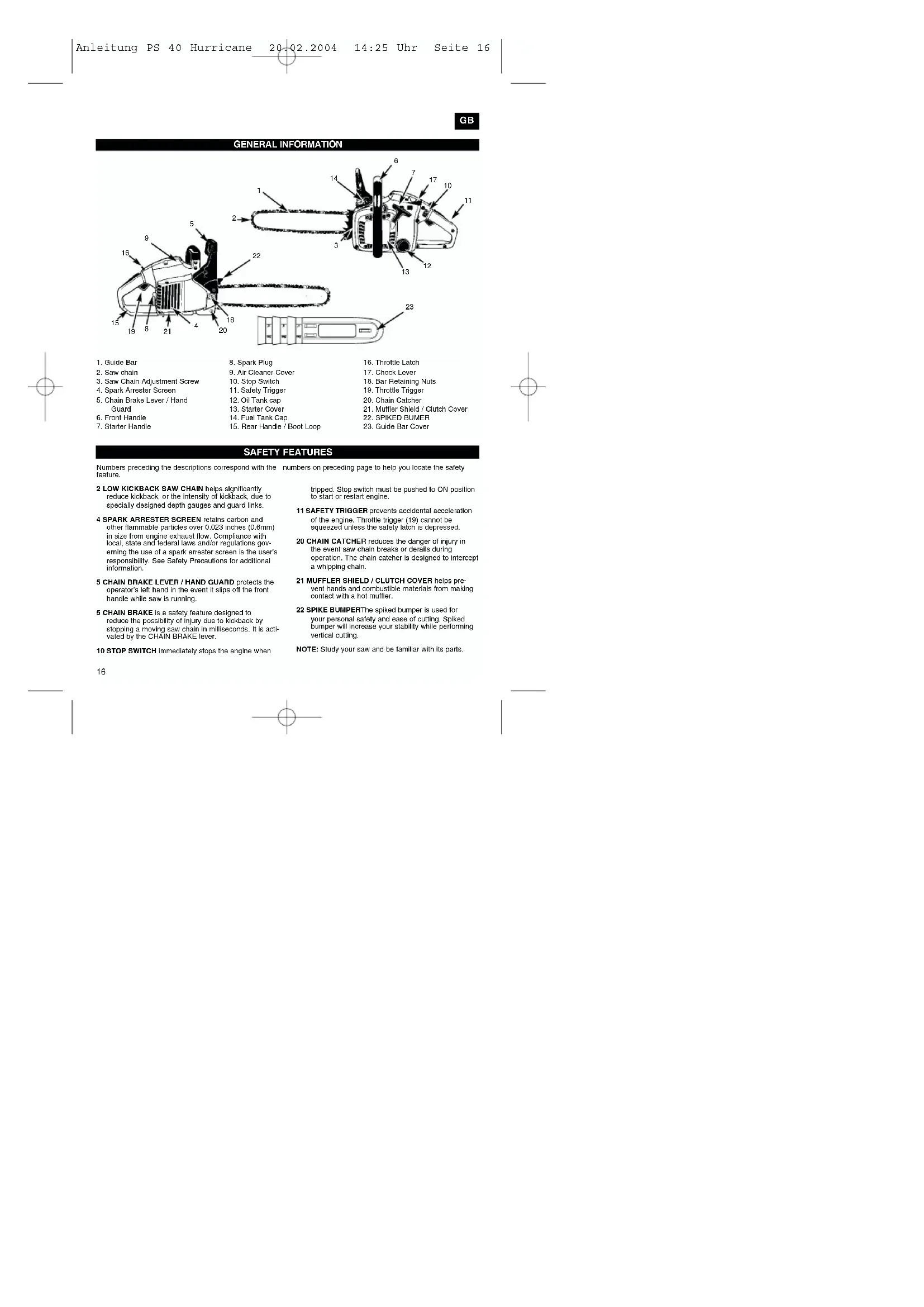
GENERAL INFORMATION
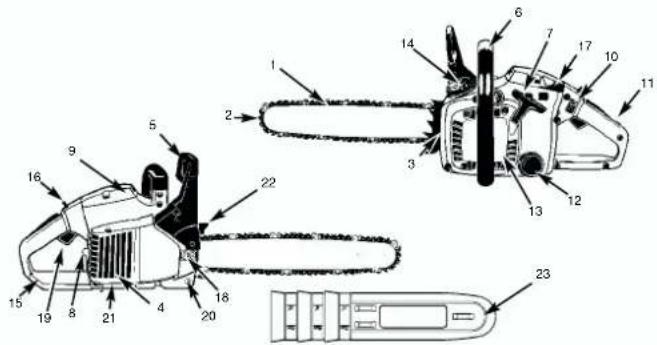
text_image
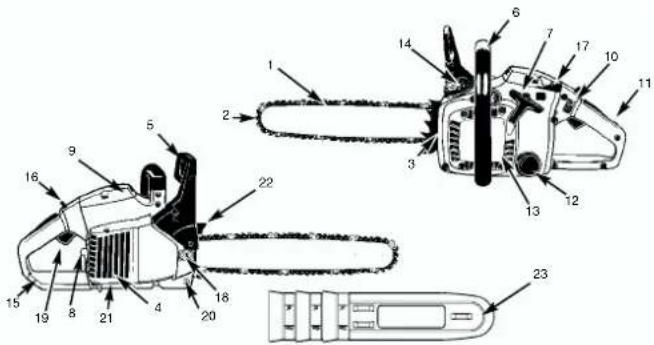
Technical diagram of a chainocopper with numbered parts for identification and assembly reference.-
Guide Bar
-
Saw chain
-
Saw Chain Adjustment Screw
-
Spark Arrester Screen
-
Chain Brake Lever / Hand
Guard
-
Front Handle
-
Starter Handle
-
Spark Plug
-
Air Cleaner Cover
-
Stop Switch
-
Safety Trigge
-
Oil Tank cap
-
Starter Cover
-
Fuel Tank Cap
-
Rear Handle / Boot Loop
-
Throttle Latch
-
Chock Lever
-
Bar Retaining Nuts
-
Throttle Trigger
-
Chain Catcher
-
Muffler Shield / Clutch Cover
-
SPIKED BUMER
-
Guide Bar Cover
SAFETY FEATURES
Numbers preceding the descriptions correspond with the numbers on preceding page to help you locate the safety feature.
2 LOW KICKBACK SAW CHAIN helps significantly reduce kickback, or the intensity of kickback, due to specially designed depth gauges and guard links.
4 SPARK ARRESTER SCREEN retains carbon and other flammable particles over 0.023 inches (0.6mm) in size from engine exhaust flow. Compliance with local, slate and federal laws and/or regulations governing the use of a spark arrester screen is the user's responsibility. See Safety Precautions for additional information.
5 CHAIN BRAKE LEVER / HAND GUARD protects the operator's left hand in the event it slips off the front handle while saw is running.
5 CHAIN BRAKE is a safety feature designed to reduce the possibility of injury due to kickback by stopping a moving saw chain in milliseconds. It is activated by the CHAIN BRAKE lever.
10 STOP SWITCH Immediately stops the engine when
Tripped. Stop switch must be pushed to ON position to start or restart engine.
11 SAFETY TRIGGER prevents accidental acceleration of the engine. Throttle trigger (19) cannot be squeezed unless the safety latch is depressed.
20 CHAIN CATCHER reduces the danger of injury in the event saw chain breaks or derails during operation. The chain catcher is designed to intercept a whipping chain.
21 MUFFLER SHIELD / CLUTCH COVER helps prevent hands and combustible materials from making contact with a hot muffler.
22 SPIKE BUMPER The spiked bumper is used for your personal safety and ease of cutting. Spiked bumper will increase your stability while performing vertical cutting.
NOTE: Study your saw and be familiar with its parts.
GB
ASSEMBLY INSTRUCTIONS
• TOOLS FOR ASSEMBLY
You will need these tools to assemble your chain saw:
-
Combination wrench-screwdriver (contained in your user's kit).
-
Heavy duty work gloves (user supplied)
• ASSEMBLY REQUIREMENTS

WARNING: DO NOT start saw engine until unit is properly prepared.
Your new chain saw will require adjustment of chain, filling the fuel tank with correct fuel mixture and filling the oil tank with lubricating oil before the unit is ready for operation.
Read the entire user manual before attempting to operate your unit. Pay particular attention to all safety precautions.
Your user manual is both a reference guide and handbook provided to furnish you with general information to assemble, operate and maintain your saw.
• GUIDE BAR / SAW CHAIN / CLUTCH COVER INSTALLATION

WARNING: Always wear protective gloves when handling chain.
TO INSTALL GUIDE BAR:
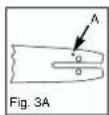
To ensure the bar and chain receive oil, ONLY USE THE ORIGINAL STYLE BAR with the oil passage hole (A) as illustrated above (Fig. 3A).
-
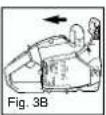
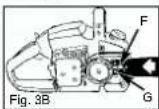
Make sure the Chain brake lever is pulled back into the DISENGAGED position (Fig. 3B)
-
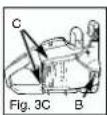
Remove the 2 bar retaining nuts (B). Loosen the 2 screws at the rear of the clutch cover (C). Remove the cover (Fig. 3C).
-
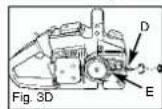
Using a screwdriver, run the adjustment screw (D) COUNTERCLOCKWISE until the TANG (E) (projecting prong) is to the end of its travel toward the clutch drum and sprocket (Fig. 3D).
-
Place the slotted end of the guide bar over the 2 bar bolts (F). Position the bar so that the adjustment TANG fits into the lower hole (G) on the guide bar (Fig. 3E).
TO INSTALL SAW CHAIN:
-
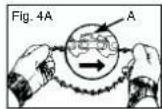
Spread chain out in a loop with cutting edges (A) pointing CLOCKWISE around loop (Fig. 4A).
-
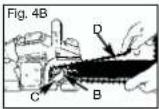
Slip the chain around the sprocket (B) behind the clutch (C). Make sure the links fit between the sprocket teeth (Fig. 4B).
-
Guide the drive links into the groove (D) and around the end of the bar (Fig. 4B).
NOTE: The saw chain may droop slightly on the lower part of bar. This is normal.
- Install the clutch cover and tighten the 2 screws. Make sure the chain does not slip off of the bar. Install the 2 nuts hand tight and follow tension adjustment instructions in Section SAW CHAIN TENSION ADJUSTMENT.
NOTE: The guide bar retaining nuts are installed only hand light at this point because saw chain adjustment is required. Follow instructions in Section SAW CHAIN
TENSION ADJUSTMENT.
• SAW CHAIN TENSION ADJUSTMENT
Proper tension of saw chain is extremely important and must be checked before starting, as well as during any cutting operation.
Taking the time to make needed adjustments to the saw chain will result in improved cutting performance and prolonged chain life.

WARNING: Always wear heavy duty gloves when handling saw chain or making saw chain adjustments.
TO ADJUST SAW CHAIN:
-
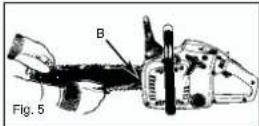
Hold nose of guide bar up and turn adjustment screw (D) CLOCKWISE to increase chain tension. Turning screw COUNTERCLOCKWISE will decrease amount of tension on chain. Ensure the chain fits snugly all the way around the guide bar (Fig. 5).
-
After making adjustment, and while still holding nose of bar in the uppermost position, tighten the bar retaining nuts securely. Chain has proper tension when it has a snug fit all around and can be pulled around by gloved hand.
NOTE: If chain is difficult to rotate on guide bar or if it binds, too much tension has been applied. This requires minor adjustment as follows:
A. Loosen the 2 bar retaining nuts so they are finger light. Decrease tension by turning the bar adjustment screw COUNTERCLOCKWISE slowly. Move chain back and forth on bar, Continue to adjust until chain rotates freely, but fits snugly. Increase tension by turning bar adjustment screw CLOCKWISE.
B. When saw chain has proper tension, hold nose of bar in the uppermost position and tighten the 2 bar retaining nuts securely.
GB

CAUTION: A new saw chain stretches, requiring adjustment after as few as 5 cuts. This is normal with a new chain, and the interval between future adjustments will lengthen quickly.

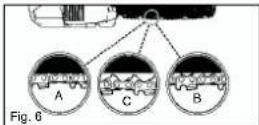
CAUTION: If saw chain is TOO LOOSE or TOO TIGHT, the sprocket, bar, chain, and crankshaft bearings will wear more rapidly. Study Fig. 6 for information concerning correct cold tension (A), correct warm tension (B), and as a guide for when saw chain needs adjustment (C).
• CHAIN BRAKE MECHANICAL TEST
Your chain saw is equipped with a Chain brake that reduces possibility of injury due to kickback. The brake is activated if pressure is applied against brake lever when, as in the event of kickback, operator's hand strikes the lever. When the brake is actuated, chain movement stops abruptly.

WARNING: The purpose of the chain brake is to reduce the possibility of injury due to kickback; however, it cannot provide the intended measure of protection if the saw is operated carelessly. Always lest the chain brake before using your saw and periodically while on the job.
TO TEST CHAIN BRAKE:
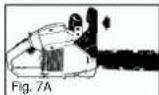
- The Chain brake is DISENGAGED (chain can move) when BRAKE LEVER IS PULLED BACK AND LOCKED (Fig. 7A).
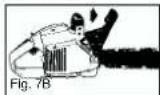
- The Chain brake is ENGAGED (chain is stopped) when brake lever is in forward position. You should not be able to move chain (Fig. 7B).
NOTE: The brake lever should snap into both positions. If strong resistance is felt, or lever does not move into either position, do not use your saw. Take it immediately to a professional Service Center for repair.
FUEL AND LUBRICATION
• FUEL
Use regular grade unleaded gasoline mixed with Talon 40:1 custom 2-cycle engine oil for best results. Use mixing ratios in Section FUEL MIXING TABLE.

WARNING: Never use straight gasoline in your unit. This will cause permanent engine damage and void the manufacturer's warranty for that product. Never use a fuel mixture that has been stored for over 90 days.

WARNING: If 2-cycle lubricant other than Telon Custom Lubricant is to be used, it must be a premium grade oil for 2-cycle air cooled engines mixed at a 40:1 ratio. Do not use any 2-cycle oil product with a recommended mixing ratio of 100:1. If insufficient lubrication is the cause of engine damage, it voids the manufacturer's engine warranty for that occurrence.
• MIXING FUEL
Mix fuel with Talon brand 2 cycle oil in an approved container. Shake container to ensure thorough mix.

WARNING: Lack of lubrication voids engine warranty.
• FUEL AND LUBRICATION


Gasoline and Oil Mix 40:1 Oil Only
• RECOMMENDED FUELS
Some conventional gasolines are being blended with oxygenates such as alcohol or an ether compound to meet clean air standards. Your Talon engine is designed to operate satisfactorily on any gasoline intended for automotive use including oxygenated gasolines.
- CHAIN AND BAR LUBRICATION
Always refill the chain oil tank each time the fuel tank is refilled. We recommend using Talon Chain, Bar and Sprocket Oil, which contains additives to reduce friction and wear and to assist in the prevention of pitch formation on the bar and chain.
GB
OPERATING INSTRUCTIONS
• ENGINE PRE-START CHECKS

WARNING: Never start or operate the saw unless the bar and chain are properly installed.
-
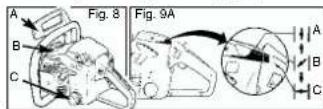
Fill the fuel tank (A) with correct fuel mixture (Fig. 8A).
-
Fill the oil tank (B) with correct chain and bar oil (Fig. 8A).
-
Be certain the chain brake is disengaged (C) before starting unit (Fig. 8A).
• TO START ENGINE
The choke has 3 positions: RUN (A), HALF (B) and CHOKE (C) (Fig. 9A).
1. Slide red STOP switch (D) up for starting (Fig. 9B).
2. Move the yellow choke lever (E) to (CHOKE) (Fig. 9C).
3. Push the primer bulb (F) 10 times (Fig. 9D).
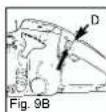
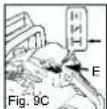
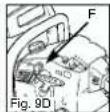
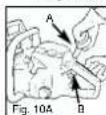
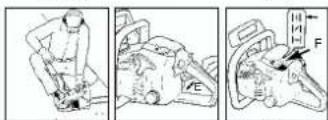
- Latch throttle advance; depress latch and hold (A) squeeze throttle trigger (B) release trigger and then the latch (Fig. 10A).
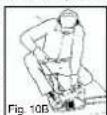
- Place saw on a firm, flat surface. Hold saw firmly as shown. Pull starter rapidly 4 times. Beware of moving chain! (Fig.10B)
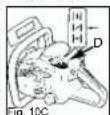
- Move yellow choke lever (D) to (HALF) (Fig.10C).
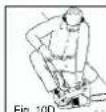
- Hold saw firmly and pull starter rapidly 4 limes. Engine should start (Fig. 10D).
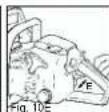
- Warm up for 10 seconds. Depress and release trigger (E) for IDLE, then go to step 9 (Fig. 10E).
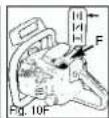
- Move yellow choke lever (F) to (FUN) (Fig. 10F). If engine failed to start, repeat these instructions.
■ BE-STARTING A WARM ENGINE
- Make sure the switch is in the ON position.
- Move the choke lever to (HALF).
- Depress the primer bulb 10 times.
- Set the throttle latch
- Pull the starter rope rapidly 4 times. The engine should start.
-
Move the choke lever to (RUN).
-
Release the throttle latch.
• TO STOP ENGINE
- Release trigger and allow engine to return to idle
speed.
- Move STOP switch down to stop engine.
NOTE: For emergency stopping, simply activate chain
brake and move STOP switch down.
Test the chain brake periodically to ensure proper function.
Perform a chain brake test prior to initial cutting,
following extensive cutting, and definitely following any Chain brake service.
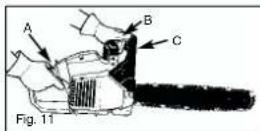
TEST CHAIN BRAKE AS FOLLOWS (Fig. 11):
- Place saw on a clear, firm, flat surface.
- Start engine.
- Grasp the rear handle (A) with your right hand.
- With your left hand, hold the front handle (B) [not chain brake lever (C)] firmly.
- Squeeze the throttle trigger to 1/3 throttle, then immediately activate the chain brake lever (C)

WARNING: Activate the chain brake slowly and deliberately. Keep the chain from touching anything; don't let the saw tip forward.
- Chain should stop abruptly. When it does, immediately release the throttle trigger.

WARNING: If chain does not stop, turn engine off and take your unit to the nearest Talon Authorized Service Center for service
- If chain brake functions properly, turn the engine off and return the chain brake to the DISENGAGED position.
GB
• SAW CHAIN / BAR LUBRICATION
Adequate lubrication of the saw chain is essential at all times to minimize friction with the guide bar. Never starve the bar and chain of oil. Running the saw with too little oil will decrease cutting efficiency, shorten saw chain life, cause rapid dulling of chain, and cause excessive wear of bar from overheating. Too little oil is evidenced by smoke, bar discoloration or pitch build-up. NOTE: Saw chain stretches during use, particularly when it is new, and it will occasionally be necessary to adjust and tighten it. New chain will require adjustment after about 5 minutes of operation.
• AUTOMATIC OILER
Your chain saw is equipped with an automatic gear driven oiler system. The oiler automatically delivers the proper amount of oil to the bar and chain. As the engine speed increases, so does the oil flow to the bar pad. There is no flow adjustment. The oil reservoir will run out at approximately the same time as the fuel supply runs out.
GENERAL CUTTING INSTRUCTIONS
• FELLING
Felling is the term for cutting down a tree. Small trees up to 6-7 inches (15-18cm) in diameter are usually cut in a single cut. Larger trees require notch cuts. Notch cuts determine the direction the tree will fall.
FELLING A TREE:

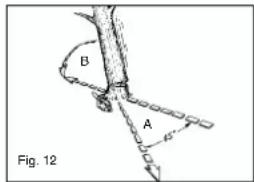
WARNING: A retreat path (A) should be planned and cleared as necessary before cuts are started. The retreat path should extend back and diagonally to the rear of the expected line of fall, as illustrated in Fig. 12.

CAUTION: If felling a tree on sloping ground, the chain saw operator should keep on the uphill side of the terrain, as the tree is likely to roll or slide downhill after it is felled.
NOTE: Direction of fall (B) is controlled by the notching cut. Before any cuts are made, consider the location of larger branches and natural lean of the tree to determine the way the tree will fall.
text_image
B A Fig. 12
WARNING: Do not cut down a tree during high or changing winds or if there is a danger to properly. Consult a tree professional. Do not cut down a tree if there is a danger of striking utility wires; notify the utility company before making any cuts.
GENERAL GUIDELINES FOR FELLING TREES:
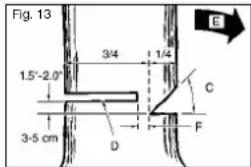
Normally felling consists of 2 main cutting operations, notching (C) and making the felling cut (D). Start making the upper notch cut (C) on the side of the tree facing the felling direction (E). Be sure you don't make the lower cut too deep into the trunk. The notch (C) should be deep enough to create a hinge (F) of sufficient width and strength. The notch should be wide enough to direct the fall of the tree for as long as possible.

WARNING: Never walk in front of a tree that has been notched. Make the felling cut (D) from the other side of the tree and 1.5 - 2.0 inches (3-5 cm) above the edge of the notch (C) (Fig. 13)
text_image
Fig. 13 3/4 1/4 1.5"-2.0" 3-5 cm D C F ENever saw completely through the trunk. Always leave a hinge. The hinge guides the tree. If the trunk is completely cut through, control over the felling direction is lost. Insert a wedge or falling lever in the cut well before the tree becomes unstable and starts to move. This will prevent the guidebar from binding in the felling cut if you have misjudged the falling direction. Make sure no bystanders have entered the range of the falling tree before you push it over.

WARNING: Before making the final cut, always recheck the area for bystanders, animals or obstacles.
FELLING CUT:
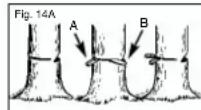
- Use wooden or plastic wedges (A) to prevent binding the bar or chain (B) in the cut. Wedges also control felling (Fig. 14A).
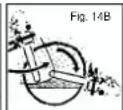
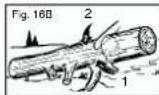
- When diameter of wood being cut is greater than the bar length, make 2 cuts as shown (Fig. 14B).

WARNING: As the felling cut gets close to the hinge, the tree should begin to fall. When tree begins to fall, remove saw from cut, stop engine, put chain saw down, and leave area along retreat path (Fig. 12).
GB
• LIMBING
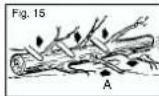
Limbing a tree is the process of removing the branches from a fallen tree. Do not remove supporting limbs (A) until after the log is bucked (cut) into lengths (Fig. 15). Branches under tension should be cut from the bottom
up to avoid binding the chain saw.

WARNING: Never cut tree limbs while standing on tree trunk.
•BUCKING
Bucking is cutting a fallen log into lengths. Make sure you have a good footing and stand uphill of the log when cutting on sloping ground. If possible, the log should be supported so that the end to be cut off is not resting on the ground. If the log is supported at both ends and you must cut in the middle, make a downward cut halfway through the log and then make the undercut. This will prevent the log from pinching the bar and chain. Be careful that the chain does not cut into the ground when bucking as this causes rapid dulling of the chain. When bucking on a slope, always stand on the uphill side.
-
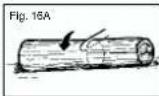
Log supported along entire length: Cut from top (overbuck), being careful to avoid cutting into the ground (Fig. 16A).
-
Log supported on 1 end: First, cut from bottom (underbuck) 1/3 diameter of log to avoid splintering. Second, cut from above (overbuck) to meet first cut and avoid pinching (Fig. 16B).
-
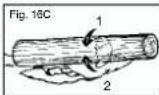
Log supported on both ends: First, overbuck 1/3 diameter of log to avoid splintering. Second, underbuck to meet first cut and avoid pinching (Fig. 16C).
NOTE: The best way to hold a log while bucking is use a sawhorse. When this is not possible, the log should be raised and supported by the limb stump using supporting logs. Be sure the log being cut is securely supported.
•BUCKING USING A SAWHORSE
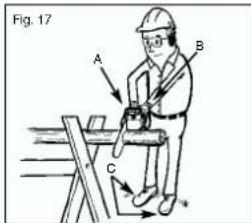
For personal safety and ease of cutting, the correct position for vertical bucking is essential (Fig. 17).
VERTICAL CUTTING:
A. Hold the saw firmly with both hands and keep the saw to the right of your body while cutting.
B. Keep the left arm as straight as possible.
C. Keep weight on both feet.
text_image
Fig. 17 A B CMAINTENANCE INSTRUCTIONS
All chain saw service, other than items listed here in your user manual maintenance instructions, should be performed professional.
• PREVENTIVE MAINTENANCE
A good preventive maintenance program of regular inspection and care will increase life and improve performance of your Talon chain saw. This maintenance checklist is a guide for such a program. Cleaning, adjustment, and parts replacement may be required, under certain conditions, at more frequent intervals than those indicated.
| Maintenance CHECKLIST USE OPERATION | EACH | |||
| ITEM ACTION | √ | 10 | 20 | |
| Screw/Nuts/Sells Inspect/Trighen | √ | |||
| Air Filter Clean or Replace | √ | |||
| Fuel Filtron/Oil Filter Science | √ | |||
| Spark Plug Clean/Replace | √ | |||
| Spark Arrester Screen | Inspect | √ | ||
| Fuel Horses | Inspect | √ | ||
| Replace as Required | ||||
| Chain brake components | Inspect | √ | ||
| Replace as Required | ||||
• AIR FILTER

CAUTION: Never operate saw without the air ter. Dust and dirt will be drawn into engine and damage it. Keep the air filter clean!
TO CLEAN AIR FILTER:
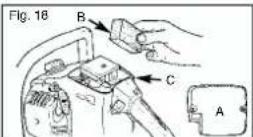
- Remove the top cover (A) by loosening the cover retaining screws. Cover will lift off.
- Lift the air filter (B) out of air-box (C) (Fig. 18).
- Clean air filter. Wash filter in clean, warm, soapy water. Rinse in clear, cool water. Air dry completely.
NOTE: It is advisable to have a supply of spare fillers. - Install air filter. Install engine / air filter cover. Make sure cover fits properly. Tighten the cover retaining screws securely.

WARNING: Never perform maintenance when the engine is hot, to avoid any chance of burning hands or fingers.
• FUEL FILTER

CAUTION: Never operate your saw without a fuel filter. The fuel filter should be replaced after each 20 hours of use. Drain fuel tank completely before changing filter.
-
Remove the fuel tank cap.
-
Bend a piece of soft wire.
-
Reach into fuel tank opening and hook fuel line. Carefully pull the fuel line toward the opening until you can reach it with your fingers.
NOTE: Do not pull hose completely out of tank.
-
Lift filter (A) out of tank (Fig. 19).
-
Pull filter off with a twisting motion. Discard filter.
-
Install new filter. Insert end of filter into tank opening. Make sure filter sits in bottom corner of tank. Use a long handle screwdriver to aid in filter placement if necessary.
-
Fill tank with fresh fuel / oil mixture. See Section FUEL AND LUBRICATION. Install fuel cap.
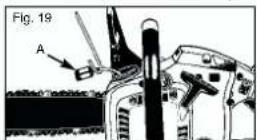
• SPARK ARRESTER SCREEN (Fig. 20A)
NOTE: A clogged spark arrester screen will dramatically reduce engine performance.
-
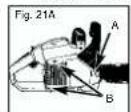
Remove the 2 bar retaining nuts (A) and loosen the 2 screws (B) that secure the chain brake cover (Fig. 20A).
-
Remove the chain brake cover. Remove the 3 screws that hold the muffler to the cylinder. The muffler will lift off after retaining screws are removed (Figure 7-4B).
-
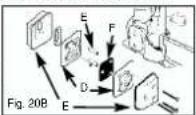
Separate muffler halves (C). Remove the metal baffles (D) and spacer tubes (E).
-
Discard the used spark arrester screen and replace it with a new one (F) (Fig. 20B).
-
Reassemble the muffler components and install the muffler to the cylinder. Tighten screws securely.
22
• SPARK PLUG
NOTE: For efficient operation of saw engine, spark plug must be kept clean and properly gapped.
-
Push STOP switch down.
-
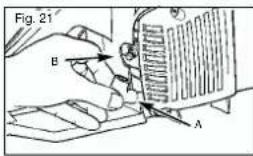
Disconnect the wire connector (A) from the spark plug (B) by pulling and twisting at the same time (Fig. 21).
-
Remove spark plug with spark plug socket wrench. DO NOT USE ANY OTHER TOOL.
-
Reinstall a new spark plug, gapped at .635mm.
text_image
Fig. 21 B A• CARBURETOR ADJUSTMENT
The carburetor was pre-set at the factory for optimum performance. If further adjustments are necessary, please take your unit to the nearest professional. • STORING A CHAIN SAW
Storing a chain saw for longer than 30 days requires storage maintenance. Unless the storage instructions are followed, fuel remaining in the carburetor will evaporate, leaving gum-like deposits. This could lead to difficult starting and result in costly repairs.

CAUTION: Never store a chain saw for longer than 30 days without performing the following procedures.
-
Remove the fuel tank cap slowly to release any pressure in tank. Carefully drain the fuel tank
-
Start the engine and let it run until the unit stops to remove fuel from carburetor.
-
Allow the engine to cool (approx. 5 minutes).
-
Using a spark plug wrench, remove the spark plug.
-
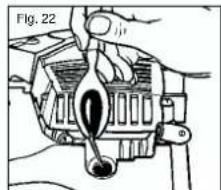
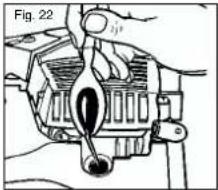
Pour 1 teaspoon of clean 2-cycle oil into the combustion chamber. Pull starter rope slowly several times to coat internal components. Replace spark plug (Fig. 22).
NOTE: Store the unit in a dry place and away from possible sources of ignition such as a furnace, gas hot water heater, gas dryer, etc.
natural_image
Mechanical assembly diagram showing a lever mechanism with no visible text or symbolsGB
• REMOVING A UNIT FROM STORAGE
- Remove spark plug.
- Pull starter rope briskly to clear excess oil from combustion chamber.
- Clean and gap spark plug or install a new spark plug with proper gap.
- Prepare unit for operation.
- Fill fuel tank with proper fuel / oil mixture. See FUEL AND LUBRICATION Section.
• MANTENIMIENTO DE LA BARRA GUIA
CAUTION: The sprocket tip on your new saw has been pre-lubricated at the factory. Failure to lubricate the guide bar sprocket tip as explained below will result in poor performance and seizure, voiding the manufacturer's warranty.
Lubrication of the sprocket tip is recommended after 10 hours of use or once a week, which ever occurs first. Always thoroughly clean guide bar sprocket tip before lubrication.
TOOLS FOR LUBRICATION:
The Lube Gun (optional) is recommended for applying grease to the guide bar sprocket tip. The Lube Gun is equipped with a needle nose tip which is necessary for the efficient application of grease to the sprocket tip.
TO LUBRICATE SPROCKET TIP:

WARNING: Wear heavy duty work gloves when handling the bar and chain.
- Move the STOP switch down.
NOTE: It is not necessary to remove the saw chain to lubricate the guide bar sprocket tip. Lubrication can be done on the job. - Clean the guide bar sprocket tip.
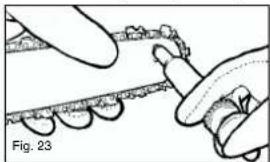
- Using the Lube Gun (optional), insert needle nose into the lubrication hole and inject grease until it appears at outside edge of sprocket tip (Fig.23).
- Rotate saw chain by hand. Repeat lubrication procedure until the entire sprocket tip has been greased.
natural_image
Illustration of hands using a tool to adjust or repair a mechanical component (no text or symbols visible)GUIDE BAR MAINTENANCE:
Most guide bar problems can be prevented merely by keeping the chain saw well maintained.
Insufficient guide bar lubrication and operating the saw with chain that is TOO TIGHT will contribute to rapid bar wear.
To help minimize bar wear, the following guide bar maintenance procedures are recommended.

WARNING: Always wear protective gloves during maintenance operations. Do not carry out maintenance when the engine is hot.
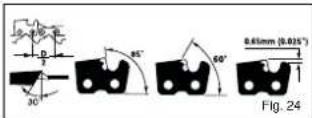
CHAIN SHARPENING - The pitch of the chain (Fig. 24) is 3/8" LoPro x .050".
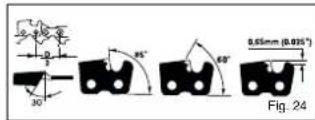
Sharpen the chain using protective gloves and a round file of 3/16' (4.8mm).
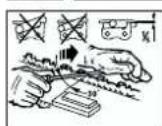
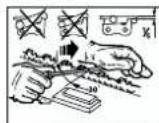
Always sharpen the cutters only with outward strokes (Fig. 25) observing the values given in Fig. 24.
After sharpening, the cutting links must all have the same width and length.

WARNING: A sharp chain produces well-defined chips. When your chain starts to produce sawdust, it is time to sharpen.
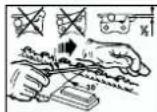
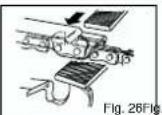
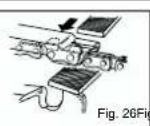
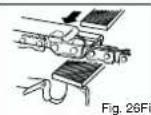
After every 3-4 times the cutters have been sharpened you need to check the height of the depth gauges and, if necessary, lower them using the flat tile and template supplied optional, then round off the front corner. (Fig. 26)

WARNING: Proper adjustment of the depth gauge is as important as proper sharpening of the chain.
GUIDE BAR - The bar should be reversed every 8 working hours to ensure uniform wear.
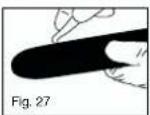
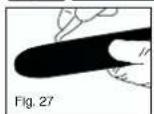
Keep the bar groove and lubrication hole clean using the bar groove cleaner supplied optional. (Fig. 27)
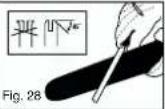
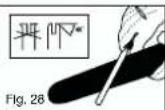
Check the bar rails frequently for wear and, if necessary, remove the burs and square-up the rails using the flat file. (Fig. 28)

WARNING: Never mount a new chain on a worn sprocket or self-aligning ring.
BAR WEAR - Turn guide bar frequently at regular intervals (for example, after 5 hours of use), to ensure even wear on top and bottom of bar.
OIL PASSAGES - Oil passages on the bar should be cleaned to ensure proper lubrication of the bar and chain during operation.
NOTE: The condition of the oil passages can be easily checked. If the passages are clear, the chain will automatically give off a spray of oil within seconds of starting the saw. Your saw is equipped with an automatic oiler system.
• CHAIN MAINTENANCE
CHAIN TENSION:
Check the chain tension frequently and adjust as often as necessary to keep the chain snug on the bar, but loose enough to be pulled around by hand.
BREAKING IN A NEW SAW CHAIN:
A new chain and bar will need chain readjustment after as few as 5 cuts. This is normal during the break-in period, and the interval between future adjustments will begin to lengthen quickly.
CHAIN LUBRICATION:

WARNING: Never have more than 3 links removed from a loop of chain. This could cause damage to the sprocket.
Always make sure the automatic oiler system is working properly. Keep the oil tank filled with Talon Chain, Bar and Sprocket Oil.
Adequate lubrication of the bar and chain during cutting operations is essential to minimize friction with the guide bar.
Never slave the bar and chain of lubricating oil. Running the saw dry or with too little oil will decrease cutting efficiency, shorten saw chain life, cause rapid dulling of chain, and lead to excessive wear of bar from overheating. Too little oil is evidenced by smoke or bar discoloration.
CHAIN SHARPENING:
Chain sharpening requires special tools to ensure that cutters are sharpened at the correct angle and depth. For the inexperienced chain saw user, we recommend that the saw chain be professionally sharpened by the nearest professional Service Center. If you feel comfortable sharpening your own saw chain, special tools are available from the professional Service Center.
ROUFL=SHOOTING=ENCINE
| PROBLEM | PROBABLE CAUSE | CORRECTIVE ACTION |
| Unit won't start or starts but will not run. | Incorrect starting procedures. | Follow instructions in the User Manual. |
| Incorrect carburetor mixture adjustment setting. | Have carburetor adjusted by an Authorized Service Center. | |
| Fouled spark plug | Clean / gap or replace plug. | |
| Fuel filter plugged. | Replace fuel filter. | |
| Unit starts, but engine has low power. | Incorrect lever position on choke. | Move to RUN position. |
| Dirty spark arreater screen. | Replace spark arreater screen. | |
| Dirty air filter. | Remove, clean and reinstall filter. | |
| Incorrect carburetor mixture adjustment setting | Have carburetor adjusted by an Authorized Service Center. | |
| Engine hesitates. | Incorrect carburetor mixture adjustment setting. | Have carburetor adjusted by an Authorized Service Center. |
| No power under load. | ||
| Runs erratically. | Incorrectly gapped spark plug. | Clean / gap or replace plug. |
| Smokes excessively. | Incorrect carburetor mixture adjustment setting. | Have carburetor adjusted by an Authorized Service Center. |
| Incorrect fuel mixture. | Use properly mixed fuel (40:1 mixture). |
F
WARNING! When using gas tools, basic safety precautions, including the following, should always be followed to reduce the risk of serious personal injury and/or damage to the unit.
Read all these instructions before operating this product and save these instructions.
Recommended cutting procedures.
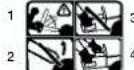
Fig. 1
AVERTISSEMENT
text_image
Technical diagram of a chain saw with numbered parts for identification22 SPIKE BUMPER The spiked bumper is used for your personal safety and ease of cutting. Spiked bumper will increase your stability while performing vertical cutting.
| Engine Displacement | 30 cm (2.1 m/s) |
| Maximum Shaft Brake Power | 1,4 kW |
| Cutting Length | 16" (40cm) |
| Chain Pitch | 10mm |
| Chain Gauge | 1.3mm |
| Idle Speed | 2800-3,300 min |
| Speed in Max power | 8,000 min |
| Fuel Capacity | 296CC (10 oz) |
| Oil Capacity | 180CC (6.1 oz) |
| Anti Vibration | Y |
| Sprocket Tip Bar | 5 Teeth |
| Chain Brake | Y |
| Clutch | Y |
| Automatic Chain Order | Y |
| Lower Kick Back Chain | Y |
| Net Weight (inches per brand pair) | 5.1 kg |
| Net Weight | 5.88 kg |
| Sound pressure level | 97.6 dB(A) |
| Sound power level | 103 dB(A) |
| Mean braking time at racing speed | 0.07s |
| Vibration | 10.2 m/s |
| Fuel Consumption | 1.5 kg/h |
INSTRUCTIONS POUR MONTAGE
natural_image
Mechanical assembly diagram showing a hand operating a valve or actuator component (no text or symbols visible)• PREPARATION APRES EMMAGASINAGE
natural_image
Illustration of hands using a tool to adjust or install a mechanical component, labeled Fig. 23 (no text or symbols on the diagram itself)ENTRETIEN DU GUIDE-CHAINE:
WARNING: Always wear protective gloves during maintenance operations. Do not carry out maintenance when the engine is hot.
CHAIN SHARPENING - The pitch of the chain (Fig.24) is 3/8" LoPro x .050".
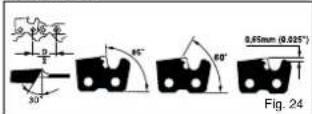
Sharpen the chain using protective gloves and a round file of 3 / 16^ (4.8mm).
Always sharpen the cutters only with outward strokes (Fig. 25) observing the values given in Fig. 24.
After sharpening, the cutting links must all have the same width and length.

WARNING: A sharp chain produces well-defined chips. When your chain starts to produce sawdust, it is time to sharpen.
After every 3-4 times the cutters have been sharpened you need to check the height of the depth gauges and, if necessary, lower them using the flat file and template supplied optional, then round off the front corner. (Fig. 26)

WARNING: Proper adjustment of the depth gauge is as important as proper sharpening of the chain.
F
GUIDE BAR - The bar should be reversed every 8 working hours to ensure uniform wear.
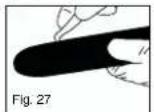
Keep the bar groove and lubrication hole clean using the bar groove cleaner supplied optional. (Fig. 27)
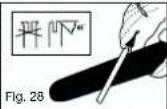
Check the bar rails frequently for wear and, if necessary, remove the burs and square-up the rails using the flat file. (Fig. 28)

WARNING: Never mount a new chain on a worn sprocket or self-aligning ring.
WARNING! When using gas tools, basic safety precautions, including the following, should always be followed to reduce the risk of serious personal injury and/or damage to the unit.
Read all these instructions before operating this product and save these instructions.
text_image
Technical diagram of a chain-linking device with numbered parts for identification-
Barra Guia
-
Cadena de la Sierra
-
Tomillo de Ajuste de la Cadena
de Sierra
-
Pantalla Contra Chispa
-
Manija del Chain Brake
Guardmanos
22 SPIKE BUMPER The spiked bumper is used for your personal safety and ease of cutting. Spiked bumper will increase your stability while performing vertical cutting.
Cutting Length 16" (40cm)
Chain Pitch 10mm
Chain Gauge....1.3mm
Idle Speed 2,600-3,300 min
Speed in Max power 8,000 min
Fuel Capacity 296CC (10 oz)
Oil Capacity 180CC (6.1 oz)
Anti Vibration Y
Sprocket Tip Bar 9 Teeth
Chain Brake Y
Clutch Y
Automatic Chain Oiler
Lower Kick Back Chain Y
Net Weight (Nitrous guide bar and chair) 5.1 kg
Net Weight 5.88 kg
Sound pressure level 97.6 dB(A)
Sound power level 103 dB(A)
Mean braking time at racing speed .....0.07s
Vibration 10.2 m/s
Fuel Consumption 1.5 kg/h
NOTE: Store the unit in a dry place and away from possible sources of ignition such as a furnace, gas hot water heater, gas dryer, etc.
text_image
Fig. 22• RETIRANDO UNA UNIDAD EL ALMACENAJE
natural_image
Illustration of hands using a tool to adjust or repair a mechanical component (no text or symbols visible)MANTENIMIENTO DE LA BARRA GUIA:
WARNING: Always wear protective gloves during maintenance operations. Do not carry out maintenance when the engine is hot.
CHAIN SHARPENING · The pitch of the chain (Fig. 24) is 3/8" LoPro x .050".
Sharpen the chain using protective gloves and a round file of c3/16" (4.8mm).
Always sharpen the cutters only with outward strokes (Fig. 25) observing the values given in Fig. 24.
After sharpening, the cutting links must all have the same width and length.




WARNING: A sharp chain produces well-defined chips. When your chain starts to produce sawdust, it is time to sharpen.
After every 3-4 times the cutters have been sharpened you need to check the height of the depth gauges and, if necessary, lower them using the flat file and template supplied optional, then round off the front corner. (Fig. 26)

WARNING: Proper adjustment of the depth gauge is as important as proper sharpening of the chain.
GUIDE BAR - The bar should be reversed every 8 working hours to ensure uniform wear.
Keep the bar groove and lubrication hole clean using the bar groove cleaner supplied optional. (Fig. 27)
Check the bar rails frequently for wear and, if necessary, remove the burs and square-up the rails using the flat file. (Fig. 28)

WARNING: Never mount a new chain on a worn sprocket or self-aligning ring.
text_image
Technical diagram of a chain-linking device with numbered parts for identificationALLMÄNNA INSTRUKTIONER FÖR SÅGNING
FÄLLNING
PACKA UPP SÅGEN PÅ NYTT
natural_image
Illustration of hands tying a knot around a chain (no text or symbols)23
UNDERHÀLLA SVÄRDET
SYMBOLIT JA VÄRIT (KUVA 1)

text_image
Technical diagram of a chainocopper with numbered parts for identificationTURVALLISUUSTOIMINNOT
text_image
Diagram of a person using a tool on a wooden structure, labeled with points A, B, and C indicating positions or directions.17
HUOLTO-OHJEET
natural_image
Illustration of hands using a tool to adjust or install a mechanical component (no text or symbols visible)FIN
TERÄLEVYN HUOLTO:
Recommended cutting procedure.
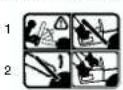
Fig. 1
Advarsel 3
Cutting Length 16" (40cm)
Chain Pilch 10mm
Chain Gauge 1.3mm
Idle Speed 2,800-3,300 mm ^2
Speed in Max power 8,000 min
Fuel Capacity 298CC (10 oz))
Oil Capacity 180CC (6.1 oz)
Anti Vibration
Spracket Tip Bar ....9 Teeth
Chain Brake Y
Clutch Y
Automatic Chain Oiler Y
Lower Kick Back Chain ....Y
Net Weight [Mn:ot guide bar and chain] 5.1 kg
Net Weight 5.88 kg
Sound pressure level 97.6 dB(A)
Sound power level 103 dB(A)
Mean braking time at racing speed 0.07s
Vibration 10.2 m/s
Fuel Consumption 1.5 kg/h
DK
GENERAL INFORMATION
text_image
Technical diagram of a chain-linking device with numbered parts for identificationnatural_image
Technical line drawing of a mechanical component with no visible text or symbols1. Fjern tændroret
natural_image
Illustration of hands adjusting a mechanical component (no text or symbols visible)text_image
Technical diagram of a chainocopper with numbered parts for identification and assembly reference.CANDELA DI ACCENSIONE
natural_image
Illustration of hands using a tool to measure a small object, no text or symbols presenttext_image
Technical diagram of a chainocopper with numbered parts for identification and assembly reference.text_image
Diagram showing a mechanical or structural component with labeled parts A and B, likely illustrating a motion or assembly.Obr. 12

text_image
Diagram showing a person using a tool on a wooden structure with labeled points A, B, and C, including directional arrows indicating movement.Abb. 17
natural_image
Illustration of hands using a tool to interact with a textured surface (no text or symbols)Abb. 23
ÚDRŽBA VODICÍ LIŠTY:
text_image
Technical diagram of a chain saw with numbered parts for identificationtext_image
Medical illustration showing three different anatomical or surgical views with labeled points A, B, and D.10A 10E
10C
text_image
Diagram showing three sequential steps of a mechanical device with labeled components and force indicators10A 10B
10C
PONOVNI ZAGON TOPLEGA MOTORJA
-
Prepricajte se, će se stikalo nahaja v položaju VKLJUČENO.
-
Postavite dušilno ročico na |/ (POL).
- Pritisnite gumb bencinske črpalke 10-krat.
- Viključite obratovalno zaporo.
- Datenovite zanopovalno unice 10
- Potegnite zagonsko vrvico 10-Kral. Motor DI se moral zagnati.
- Postavite dušilno račico na || (OBRATOVANJE).
- Spustite obratovalno zaporo.
SLO
ZAUSTAVITEV MOTORJA
-
Spustite ročico za plin in počakajte, da se motor zaustavi.
-
Potisnite stikalo STOP navzdol, da zaustavite motor. NAPOTEK: Da bi v nujnem primeru zaustavili motor. aktivirajte venizno zaporo in potisnite stikalo STOP navzdol.
TESTIRANJE DELOVANJA VERIŽNE ZAVORE
natural_image
Illustration of hands tying a knot around a chain (no text or symbols)23
VZDRŽEVANJE MEČA ŽAGE:
OPĆA PRAVILA O SIGURNOSTI

SIMBOLI I BOJE (SL. 1)

text_image
Technical diagram of a chain saw with numbered parts for identification- Klizna vodilica ili vodilica
- anac pile
- Vijak za justiranje lanca pile
- Zaštita od iskrenja
- Poluga za kočnicu lance / predn-
ja zaštita ruke - Prednja ručka
- Ručka startera
- Svječica
- Poklopac filtra za zrak
- Sklopka za zaustavljanje
- Sigurnosni okidać
- Čep spremnika za ulje
- Poklopac startera
- Cep spremnika za gorivo
- Straznja ručka / petlja za cizmu
- Blokada pogona
- Poluga za prigušivanje
(podešavanje rasplinjača) - Matica za pričvršćenje vodilice
- Poluga gasa
- Hvatač lance
- Zaštita ispušnog olvora
- Odskočni trn
- Poklopac vodilice
SIGURNOSNE FUNKCIJE
Brojevi u sljedećem opisu odgovaraju brojevima na prethodnoj strani čime se omogućava lakše pronalaženje sigurnosnih funkcija.
2 LANAC PILE S MALIM POVRATNIM UDARCEM pomaže Vam sa specijalno razvijenim sigurnosn napravama da uhvatite povratni udarac ili njihov sily.
4 ZAŠTITA OD ISKRENJA zadržava ugljen i druge zapaljive čestice veće od 0,6 mm podalje od mjesta izlaženja ispušnih plinova. Korisnik je odgovoran za pridržavanje lokalnih i državnih zakona ili propisa za reguliranje korištenja zaštite od iskrenja. Dodatne informacije pronači čete u sigurnosnim urutama.
natural_image
Illustration of hands using a tool to connect two textured objects (no text or symbols visible)ODRŽAVANJE VODILICE:
text_image
Technical diagram of a chainocopper with numbered parts for identification and assembly reference.text_image
Technical diagram showing a mechanical linkage with labeled points A and B, likely illustrating a joint or motion path.12

text_image
Diagram of a person using a tool on a wooden structure, labeled with points A, B, and C indicating positions or positions.17
BAKIM TALİMATI
natural_image
Illustration of hands using a tool to apply material or procedure (no text or symbols visible)PALANIN BAKIMI:
GB EC Declaration of Conformity
The undersigned declares in the name of the company that the product is in compliance with the following guidelines and standards.
The product described in these instructions comes with a 5-year warranty covering defects. This 5-year warranty period begins with the seating of risk or when the customer receives the product. For warranty claims to be accepted, the product has to receive the correct maintenance and be put to the proper use as described in the operating instructions. Your statutory rights of warranty are naturally unaffected during those 5 years. This warranty applies in Germany, or in the respective country of the manufacturer's main regional sales partner, as a supplement to local regulations. Please note the details for contacting the customer service center responsible for your region or the service address listed below.
© CERTIFICADO DE GARANTIA
Cales 12 September 97
Bloc 93 Parter
BO-Bucuresti Sector 5
Tel. 021 4104800 Fax 021 4103569
CZ Poker Plus S B O
Vynaciewa 1335
CZ-15300 Prabe 5 - Radotin
Tel - Fax 02 579 10204
BGFinhell Bulgarian
- À Stefan Stambolou Stu
34 A, German Standbluck St.
Apl. 4 B0.0001
BG 9000 varna Tel: 052-605254
Tel. 052-605254, Fax 052-605822
① Einhell Croatia d.o.n.
Velika Ves 2
HR 49224 Len
Tel 049/342 444. Fax 049 342 392
S10GMA-Elektromechanika d.o.o
Cesta Andreia Bitanca 115
SLO 1000 Lijubliana
Tel 01/5836304 Fax 01/5183803
©An. Mayrolidnopoulos S.A
Technical & Commercial Company
- Panestratou & Asklinicu Str
GR 19545 Piräus
Tel: 0210 4136155
①Bermas
Allodymarckup sbarre, 20
Antulyevskoye Shogao,
AOS 127273 Moscow Tel. 095-7870179, Es
LT Dirbila
Metalo str. 23
LT 2020 Vilni
LT 2036 Villus Tel. 05 2395769 Fax 05 2395770
ESTAS Balnil
Boju, Hanslava vald
EE 62102 Tartumaa
Tel 07 301710 Fax 07 301701
Helai Trading Co. LLC
POB 9282, Nakheel Rd. Deira, Shop No. 15
UAE Dubai
Tel./Fax 04 2279554
IR Alborz Abzar Co. Ltd
No. 111, Bastan Passage Imam Khomeini Ave
IR 11146 Teheran
Tel 021 6716072,
K1.B.G
Belinskii-str. 102
KZ 486008 Chimkent
Tel 03252 518461, Fax 03252 570743
BH FIS d.o.o
Poslovni Centar 96
BIH 87000 Vitez
Tel 030 715 267, Fax 030 715 320
©SMANIMEX d.o.o
Uzicke republike 93
CS 31000 Uzice
Tel 031 551 393, Fax 031 601 539
D
The reprinting or reproduction by any other means, in whole or in part, of documentation and papers accompanying products is permitted only with the express consent of ISC GmbH.