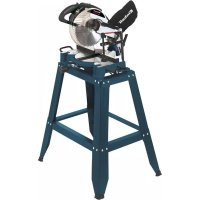
KGSL 251 U - Electric saw EINHELL - Free user manual and instructions
Find the device manual for free KGSL 251 U EINHELL in PDF.



| Product type | Laser compound miter saw |
| Brand | Einhell |
| Model | KGSL 251 U |
| Power supply | 230 V ~ 50 Hz |
| Power consumption | 1800 W (S1) |
| No-load speed | 4800 rpm |
| Blade diameter | 250 mm |
| Blade bore | 30 mm |
| Blade thickness | 3.0 mm |
| Number of teeth | 60 |
| Swivel range | -45° / 0° / +45° |
| Miter cut | 0° to 45° left |
| Cutting width 90° x 90° (workpiece ≤28 mm) | 155 x 65 mm |
| Cutting width 90° x 90° (workpiece >28 mm) | 125 x 90 mm |
| Cutting width 90° x 45° (workpiece ≤28 mm) | 120 x 65 mm |
| Cutting width 90° x 45° (workpiece >28 mm) | 90 x 90 mm |
| Cutting width 45° x 45° max. | 90 x 45 mm |
| Weight | 14.7 kg |
| Laser class | 2 |
| Laser wavelength | 650 nm |
| Laser power | 1 mW |
| Laser power supply | 2 batteries 1.5 V AAA |
| Dust bag | Yes (with zipper) |
| Laser guide | Yes (switch) |
| Clamping device | Yes (included) |
Frequently Asked Questions - KGSL 251 U EINHELL
User questions about KGSL 251 U EINHELL
0 question about this device. Answer the ones you know or ask your own.
Ask a new question about this device
Download the instructions for your Electric saw in PDF format for free! Find your manual KGSL 251 U - EINHELL and take your electronic device back in hand. On this page are published all the documents necessary for the use of your device. KGSL 251 U by EINHELL.
USER MANUAL KGSL 251 U EINHELL
3
natural_image
Mechanical device with labeled parts (② and ②1), no visible text or symbols beyond labels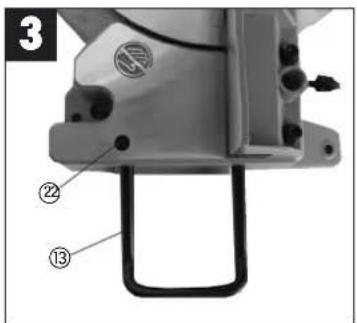
D
- Release lever
- Handle
- On/Off switch
- Machine head
- Saw blade
- Saw blade guard, hinged
- Stop rail
- Rotary table
- Base plate, fixed
- Lock screw
- Latch
- Tightening screw
- Workpiece support
- Sawdust bag
- Angle scale
- Retaining pin
- Scale (rotary table)
2. Items supplied
● Laser cross-cut saw
● Hex wrench (31)
● Clamping device (34)
● Dust bag
3. Proper use
The laser crosscut saw is designed to crosscut wood and plastic commensurate with the size of the machine.
The machine is not to be used for cutting fire wood. The machine is to be used only for its prescribed purpose.
Any use other than that mentioned is considered to be a case of misuse. The user/operator and not the manufacturer shall be liable for any damage or injury resulting from such cases of misuse.
The machine is to be operated only with suitable saw blades. It is prohibited to use any type of cutting-off wheel.
To use the machine properly you must also observe the safety regulations, the assembly instructions and the operating instructions to be found in this manual. All persons who use and service the machine have to be acquainted with this manual and must be informed about its potential hazards.
It is also imperative to observe the accident prevention regulations in force in your area.
The same applies for the general rules of occupational health and safety.
The manufacturer shall not be liable for any changes made to the machine nor for any damage resulting
from such changes.
Even when the machine is used as prescribed it is still impossible to eliminate certain residual risk factors. The following risks may arise due to the machine's design and setup:
- Contact with the saw blade in the uncovered saw zone.
● Reaching into the running saw blade (cut injuries).
- Kick-back of workpieces and parts of workpieces.
- Saw blade fracturing.
● Catapulting of faulty carbide tips from the saw blade.
● Damage to hearing if essential ear-muffs are not worn.
● Harmful emissions of wood dust when the machine is used in closed rooms.
4. Important notes
Please read this manual carefully and pay attention to the information provided. Use this manual to familiarize yourself with the machine, its correct use and safety regulations.

Safety regulations
● Always pull the plug out of the power socket before adjusting or servicing the machine.
● Give these safety regulations to all persons who work on the machine.
● Do not use this saw to cut fire wood.
● Caution! Hands and fingers may be injured on the rotating saw blade.
- check that the voltage marked on the rating plate is the same as your mains voltage.
- If you need to use an extension cable, make sure its conductor cross-section is big enough for the saw's power consumption. Minimum cross-section: 1.5 mm ^2 .
- If you use a cable reel, the complete cable has to be pulled off the reel.
● Never carry the saw by its cable.
- Do not leave the saw in the rain and never use it in damp or wet conditions.
● Provide good lighting
● Never saw near combustible liquids or gases.
- Wear suitable work clothes! Loose garments or jewellery may become caught up in the rotating saw blade.
- Operators have to be at least 18 years of age. Trainees of at least 16 years of age are allowed to use the machine under supervision.
GB
- Keep children away from the machine when it is connected to the power supply.
- Check the power cable (9). Never use a faulty or damaged power cable.
- Keep your workplace clean of wood scrap and any unnecessary objects.
● Persons working on the machine should not be distracted.
● Note the direction of rotation of the motor and saw blade.
● After you have switched off the motor, never slow down the saw blade by applying pressure to its side.
● Flt only blades which are well sharpened and have no cracks or deformations.
● The machine is to be operated only with tools which conform with prEN 847-1: 2003.
● Faulty saw blades have to be replaced immediately.
● Never use saw blades which do not comply with the data specified in this manual.
● Make sure that the arrow on the saw blade complies with the arrow marked on the machine.
● Make certain that the saw blade does not touch the rotary table in any setting. To do so, pull out the power plug and tilt the saw blade by hand into the 45° position and the 90° position. If necessary, re-adjust the saw head as described in Section C/F. - It is imperative to make sure that all the devices used to cover the saw blade are in good working order.
● Never wedge the hinged guard hood in open position. - Never dismantle the machine's safety devices or put them out of operation.
● Damaged or faulty safety devices have to be replaced immediately.
● Never cut workpieces which are too small to hold securely in your hand. - Do not place your hands in awkward positions where one or both may slip suddenly and touch the saw blade.
- When working with long workpieces, use an additional support (table, stand, etc.) to prevent the machine from tipping over.
● Always clamp round workpieces such as dowel rods etc. with suitable devices.
● There must be no nails or other foreign bodies in that part of the workpiece you want to cut.
● Always stand to the side of the saw blade when working with the saw.
● Never load the machine so much that it cuts out.
● Always press the workpiece firmly against the table and the stop rail to prevent it from wobbling or twisting.
● Make sure that off-cuts can be removed from the side of the saw blade. If not, they may catch on the saw blade crown and be catapulted into the surrounding area.
● Never saw several workpieces simultaneously.
● Never remove loose splinters, chips or jammed pieces of wood when the saw blade is running.
● To rectify faults or remove jammed pieces of wood, always switch off the machine first. - Pull out the power plug!
● Conversions, adjustments, measurements and cleaning jobs are to be performed only when the motor is switched off. - Pull out the power plug!
- Before you switch on the machine, check that all wrenches and adjustment tools have been removed.
- When you leave your workplace, switch off the motor and pull out the power plug.
● Electric installation work, repairs and maintenance are to be carried out only by specialists.
● All guards and safety devices have to be refitted immediately after completion of any repairs or maintenance.
- It is imperative to observe the manufacturer's safety, operating and maintenance instructions as well as the dimensions quoted in the technical data.
- It is imperative to observe the accident prevention regulations in force in your area as well as all other generally recognized rules of safety.
● Note the information published by your professional associations.(VBG7j)
- Switch on the dust extraction system each time you use the machine.
● The machine may be used in closed rooms only in conjunction with a suitable vacuum extraction system.
● The circular cross-cut must be connected to a 230 V socket-outlet with a minimum 10 A fuse.
● Never use light-duty machines for heavy-duty work.
● Never use the cable for any purpose other than that for which it is intended!
- Adopt a firm standing position and keep your balance at all times.
- Check the tool for signs of damage!
● Before you carry on using the tool it is imperative to check that its safety devices and any slightly damaged parts are working properly and in the way intended.
- Check that the moving parts work properly and do not jam or whether any of the parts are damaged. All parts must be fitted correctly and satisfy all conditions for the tool to work properly.
GB
● Unless otherwise stated in these instructions, damaged safety devices and parts must be repaired or replaced by experts in an approved specialist workshop.
● Have damaged switches replaced by a customer service workshop.
● This tool complies with the pertinent safety regulations. Repairs are to be carried out only by qualified electricians using original replacement parts. The user may suffer an accident if this condition is not observed.
● Be careful when making vertical cuts.
● Take special care when making double miter cuts.
- Do not overload the tool!
● Wear safety goggles
● Use a breathing mask on dusty jobs.
- Check the tool's power cable / extension cable for damage.

Important!
Laser radiation
Do not look into the beam
Laser class 2
Protect yourself and your environment from accidents by taking the appropriate precautionary measures.
● Do not look directly into the laser beam with the naked eye.
● Never look directly into the laser path.
● Never direct the laser beam at reflecting surfaces or persons or animals. Even a low output laser beam can inflict injury on the eye.
● Caution: It is vital to follow the work procedures described in these instructions. Using the tool in any other way may result in hazardous exposure to laser radiation.
● Never open the laser module.
- When the device is not going to be used for an extended period of time, the batteries should be removed.

Wear goggles

Wear ear-muffs

Wear a breathing mask
Noise emission values
- The saw's noise is measured in accordance with DIN EN ISO 3744; 11/95, E Din EN 31201; 6/93, ISO 7960 Annex A; 2/95. The machine may exceed 85 dB(A) at the workplace. In this case, noise protection measures need to be introduced for the user (ear-muffs).
Idling
Sound pressure level LPA 86 dB(A)
Sound power level LWA 99 dB(A)
"The quoted values are emission values and not necessarily reliable workplace values. Although there is a correlation between emission and immission levels it is impossible to draw any certain conclusions as to the need for additional precautions. Factors with a potential influence on the actual immission level at the workplace include the duration of impact, the type of room, and other sources of noise etc., e.g. the number of machines and other neighbouring operations. Reliable workplace values may also vary from country to country. With this information the user should at least be able to make a better assessment of the dangers and risks involved."
5. Technical data
AC motor 230 V \~ 50 Hz
Output 1800
Operating mode S1
Idle speed n_0 4800 min ^-1
Carbide saw blade ∅ 250 x ∅ 30 x 3.0 mm
Number of teeth 60
Swiveling range -45° / 0° +45°
Miter cut 0^ to 45^ to the left
Saw width at 90° x 90°
up to 28 mm workpiece height 152 x 65 mm
over 28 mm workpiece height
Saw width at 330 x 45°
up to 28 mm workpiece height 120 x 65 mm
over 28 mm workpiece height 90 x 90 mm
Saw width at 45" x 45" max. 90 x 45 mm
Weight 14.7
Laser class 2
Laser wave length 650 nm
Laser output ≤ 1 mW
Laser module power supply 2 x 1.5 V Micro (AAA)
GB
6. Before putting the machine into operation
● The machine has to be set up in a stable position, i.e. it has to be bolted to a workbench, a universal stand or the like.
● All the covers and safety devices have to be properly fitted before the machine is switched on.
- It must be possible for the saw blade to run freely.
- When working with wood that has been processed before, watch out for foreign bodies such as nails or screws etc.
- Before you actuate the On/Off switch, make sure that the saw blade is correctly fitted and that the machine's moving parts run smoothly.
● Before you connect the machine to the power supply, make sure the data on the rating plate is the same as that for your mains.
7. Assembly
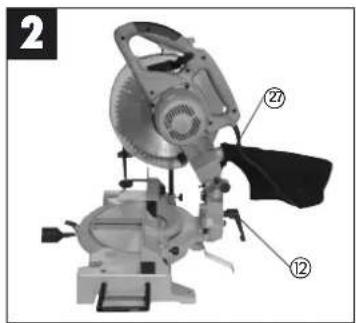
Setting up the saw (Fig. 1 / 3/12)
- Insert the two workpiece support clips (13) in the mounts (21) provided on the side of the tool and fasten them in place with thumb screws (22).
- Insert the clamping device (19) into one of the two mounts (20) provided on the top of stop rail and fasten in place with the thumb screw (33).
- Screw the additional stability bar (32) to the back of the machine. The bar is designed to protect the machine from tipping over.
A.) Adjusting the saw (Fig. 1/2)
● To adjust the rotary table (8), slacken the locking handle (10) by approx. 2 turns and press the latch (11) in order to unlock the rotary table (8).
● The rotary table (8) has latching positions at 0°, 15°, 22.5°, 30° and 45°. Once the latch (11) is engaged you must also tighten the locking hand (10) in order to fix the table in position.
- If you need to work with any other angles, the rotary table is fixed in position with just the locking handle (10).
● While pressing down lightly on the machine head (4), pull the lock pin (16) out of the motor holder to disengage the saw from its bottom working position.
● Swing up the machine head until the retaining hook latches home.
- By loosening the lock screw (12), the machine head (4) can be angled to the left up to 45°.
- Check that the voltage marked on the rating plate is the same as your mains voltage and connect up the machine.
B.) 90^ cross-cuts and 0^ rotary table (Fig. 1)
● To turn the machine on, simultaneously press the main switch (3) and locking button (30).
- Important! Place the material you want to saw flat on the machine surface and secure with the clamping device (19) so that the material cannot move while you are cutting.
● After switching on the saw, wait for the blade (5) to reach its maximum speed.
- Press the release lever (1) sideways and, using the handle (2), apply steady and light downward pressure to move the machine head through the workpiece.
- When the cut is completed, return the machine to its top parking position and let go of the On/Off switch. Caution! A return spring causes the machine head to rise automatically at the end of the cut. Do not let go of the handle (2) as soon as the cut is completed but steady the machine head and allow it to rise slowly.
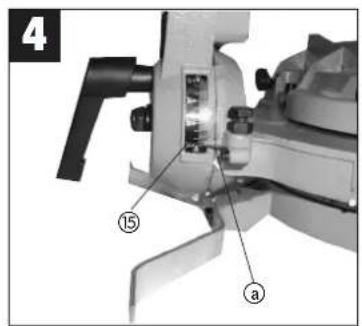
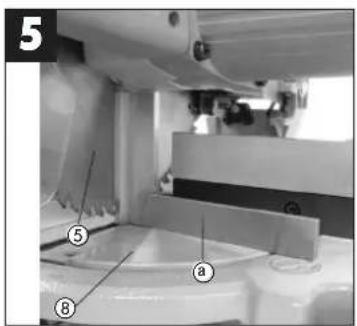
C.) Precision adjustment of the stop for 90° cross-cuts (Fig. 4/5)
● Lower the machine head (4) and fix with the lock pin (16).
● Slacken the tightening screw (12).
- Place the stop angle (A) between the saw blade (5) and the rotary table (8).
- Slacken the counter nut (23) and adjust the setting screw (24) until the angle between the saw blade (5) and the rotary table (8) equals 90°.
● Re-tighten the counter nut (23) to fix the machine in this setting.
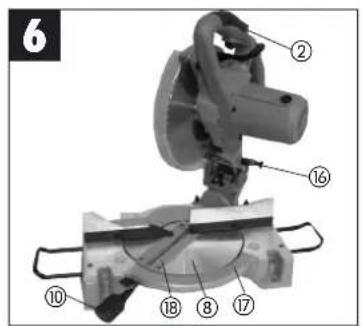
D.) 90° cross-cuts and 0°-45° rotary table (Fig.6) The KGSL 251 can be used to make angled cuts of 0°-45° relative to the stop rail on the left and right side.
- Release the rotary table (8) by slackening the locking handle (10) and pressing the latch (11).
● Turn the rotary table (8) by its handle (2) to the angle you want, i.e. the mark (a) on the rotary table has to comply with the required angle dimension (17) on the base plate (9).
● Re-tighten the locking handle (10) in order to fix the rotary table (8) in position.
● Make the cut as described in Section B.).
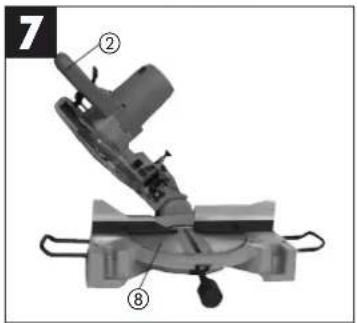
E.) Mitre cuts 0°-45° and rotary table 0° (Fig. 4/7)
The KGSL 251 can be used to make litre cuts of 0^ - 45^ relative to the machine bed on the left side.
- Lift the machine head (4) to its top position
● Fix the rotary table (8) in 0" position.
GB
- Undo the tightening screw (12) and use the handle (2) to tilt the machine head (4) to the left until the pointer (a) coincides with the required angle value (15).
● Re-tighten the locking nut (12) and make the cut as described in Section B.).
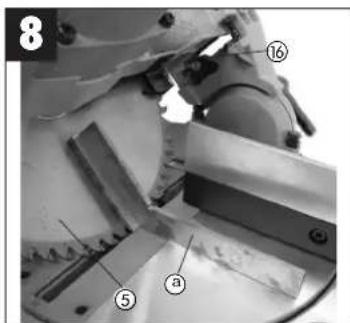
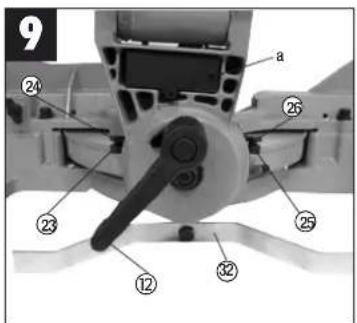
F.) Precision adjustment of the stop for 45° mitre cuts (Fig. 8/9)
● Lower the machine head (4) and fix with the lock pin (16).
● Fix the rotary table (8) in 0° position.
- Undo the tightening screw (12) and use the handle (2) to tilt the machine head (4) to the left until it coincides at 45°.
- Place the 45" stop angle (A) between the saw blade (5) and the rotary table (8).
- Slacken the counter nut (25) and adjust the setting screw (26) until the angle between the saw (5) and the rotary table (8) equals exactly 45^ .
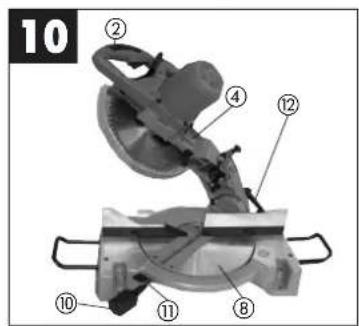
G.) Mltre cuts 0°-45° and rotary table 0°-45° (Fig. 10)
The KGSL 251 can be used to make mitre cuts on the left at an angle of 0^ - 45^ relative to the work top and 0^ - 45^ relative to the stop rail.
● Lift the machine head (4) to its top position.
- Undo the rotary table (8) by slackening the locking handle (10) and pressing the latch (11).
- Adjust the rotary table (8) by its handle (2) to the required angle (see also Section D).
● Retighten the tightening screw (10) in order to secure the turntable in place.
- Undo the tightening screw (12) and use the handle (2) to tilt the machine head (4) to the left until it coincides with the required angle value (in this connection see also section E).
- Screw the tightening screw (12) back down again.
H.) Dust bag (Fig. 2)
The saw is equipped with a bag (14) to collect sawdust and chips. You can pull off the sawdust bag (14) to the rear by pressing together the two clips (27). To empty the bag, undo the zip at the bottom.
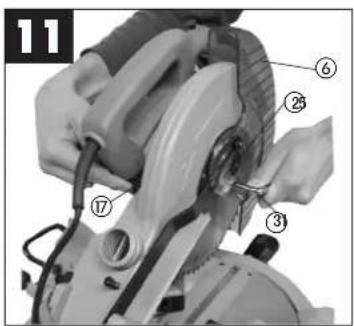
I.) Replacing the saw blade (Fig. 5/11)
● Pull out the power plug.
● Swing up the machine head (4).
- Press the lever and swing up the saw blade guard to the point where the recess in the saw blade guard is above the flange bolt.
● Press the saw shaft lock (17) with one hand while
holding the wrench (31) on the flange bolt with the other.
● Firmly press on the saw shaft lock (17) and slowly rotate the flange bolt (25) in clockwise direction. The saw shaft lock engages after no more than one rotation.
- Now, using a little more force, slacken the flange bolt (25) in clockwise direction.
● Turn the flange bolt (25) until it is completely removed.
● Take the blade (5) off the inner flange and pull out downwards.
- Mount the new saw blade in reverse order and fasten. Important! The cutting bevel of the teeth, i.e. the direction of rotation of the saw blade, has to conform with the direction of the arrow marked on the housing.
● Clean the saw blade flanges thoroughly before mounting the saw blade.
● Reattach the movable blade guard (6) in reverse order.
● Before using the saw again, check that the safety devices are in good working order.
- Important: Every time that you change the saw blade, check to see that it spins freely in the groove of the turntable in both perpendicular and 45^ angle settings.
J.) Laser function (Fig. 9)
● You can switch the laser ON and OFF with the switch (a).
● The laser directs a beam onto the workpiece.
- Extremely precise cuts can be made using the laser function.
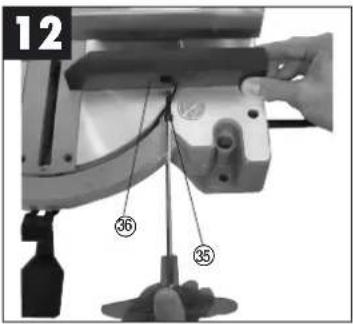
K.) Increasing the cutting width (Fig. 12)
The two removable plastic stops (36) enable you to cut workpieces to a width of up to 155 mm with a maximum thickness of 28 mm in one go. To do so, undo the two screws and remove the plastic stops. Important: To machine thicker workpieces, the plastic stops have to be fastened with the two screws (35).
8. Maintenance
- Keep the machine's air vents unclogged and clean at all times.
- Remove dust and dirt regularly from the machine. Cleaning is best done with compressed air or a rag.
● Re-lubricate all moving parts in regular intervals.
● Never use caustic agents to clean plastic parts.
GB
9. Ordering replacement parts
Please quote the following data when ordering replacement parts:
● Type of machine
● Article number of the machine
● Identification number of the machine
● Replacement part number of the part required
17
F
1. Description de la machine (fig. 1)
Subject to change without notice
D
The product meets the requirements of EN 61000-3-11 and is subject to special connection conditions.
- The product does not meet the requirements of EN 61C00-3-3, meaning that use of the product at any freely selectable connection point is not allowed.
● The product is exclusively intended for use at connection points which
a) do not exceed a maximum permissible supply impedance Z, or
b) which have a continuous current-carrying capacity of the mains of at least 100 A per phase.
As the user, you are required to ensure, in consultation with your electric power company if necessary, that the connection point at which you
wish to operate the product meets one of the two requirements, a) or b), named above.
● The electric power company may impose restrictions for the connection of the product.
①
The product described in these instructions comes with a 2-year warranty covering defects. This 2-year warranty period begins with the passing at risk or when the customer receives the product. For warranty claims to be accepted, the product has to receive the correct maintenance and be put to the proper use as described in the operating instructions.
Your statutory rights of warranty are naturally unaffected during these 2
This warranty applies in Germany, or in the respective country of the manufacturer's main regional sales partner, as a supplement to local regulations. Please note the details for contacting the customer service center responsible for your region or the service address listed below.
NL GARANTIE
Eschenstraße 6 · D-94405 Landau/Isar (Germany)
Info-Tel. 0180-5 120 509 • Telefax 0180-5 835 830
natural_image
Simple line drawing of a trash bin with crossed lines indicating no waste or restriction (no text or symbols)⑤ Nur für EU-Länder
For EU countries only
Never place any electric tools in your household refuse.
To comply with European Directive 2002/96/EC concerning old electric and electronic equipment and its implementation in national laws, old electric tools have to be separated from other waste and disposed of in an environment-friendly fashion, e.g. by taking to a recycling depot.
Recycling alternative to the demand to return electrical devices:
As an alternative to returning the electrical device, the owner is obliged to cooperate in ensuring that the device is properly recycled if ownership is relinquished. This can also be done by handing over the used device to a returns center, which will dispose of it in accordance with national commercial and industrial waste management legislation. This does not apply to the accessories and auxiliary equipment without any electrical components which are included with the used device.
The reprinting or reproduction by any other means, in whole or in part, of documentation and papers accompanying products is permitted only with the express consent of ISC GmbH.
F

- D
- Items supplied
- Proper use
- Important notes
- Safety regulations
- GB
- Noise emission values
- Technical data
- Before putting the machine into operation
- Assembly
- Setting up the saw (Fig. 1 / 3/12)
- A.) Adjusting the saw (Fig. 1/2)
- B.) 90° cross-cuts and 0° rotary table (Fig. 1)
- C.) Precision adjustment of the stop for 90° cross-cuts (Fig. 4/5)
- D.) 90° cross-cuts and 0°-45° rotary table (Fig.6) The KGSL 251 can be used to make angled cuts of 0°-45° relative to the stop rail on the left and right side.
- E.) Mitre cuts 0°-45° and rotary table 0° (Fig. 4/7)
- I.) Replacing the saw blade (Fig. 5/11)
- J.) Laser function (Fig. 9)
- K.) Increasing the cutting width (Fig. 12)
- Maintenance
- Ordering replacement parts
- F
- Description de la machine (fig. 1)
- NL GARANTIE
Brand : EINHELL
Model : KGSL 251 U
Category : Electric saw