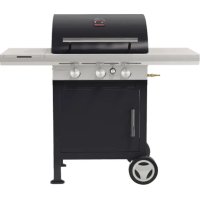
Spring 3112 - Barbecue BARBECOOK - Free user manual and instructions
Find the device manual for free Spring 3112 BARBECOOK in PDF.



| Product type | Gas barbecue |
| Brand | Barbecook |
| Model | Spring 3112 |
| Usage | Outdoor only |
| Gas supply | Propane or butane |
| Compatible gas cylinder | 4.5 to 15 kg, max height 70 cm |
| Injector diameter (main burner) | 1.00 mm |
| Ignition | Electric (AA battery not included) or match |
| Number of main burners | Several (not specified, but multiple burners) |
| Recommended preheating | 10 minutes with lid closed |
| Normal operating temperature | Approximately 210 °C |
| Maximum temperature | 300 °C for 5 minutes max |
| Materials | Enamel, stainless steel, powder coating |
| Enamel maintenance | Metal sponge, abrasive products |
| Stainless steel maintenance | Mild products, soft sponge, rinse thoroughly |
| Powder coating maintenance | Mild products, soft sponge |
| Warranty | 2 years from the date of purchase |
| Spare parts | Available at www.barbecook.com or at point of sale |
| Product registration | Recommended on www.barbecook.com |
| Dimensions (not provided) | Refer to the manual for exact dimensions |
Frequently Asked Questions - Spring 3112 BARBECOOK
User questions about Spring 3112 BARBECOOK
0 question about this device. Answer the ones you know or ask your own.
Ask a new question about this device
Download the instructions for your Barbecue in PDF format for free! Find your manual Spring 3112 - BARBECOOK and take your electronic device back in hand. On this page are published all the documents necessary for the use of your device. Spring 3112 by BARBECOOK.
USER MANUAL Spring 3112 BARBECOOK
Register your Barbecook® on
www.barbecook.com
and enjoy the full Barbecook® experience!
THIS IS YOUR UNIQUE SERIAL N°
NL - GEBRUIKSAANWIJZING 4
FR - GUIDE D'UTILISATION 14
EN - USER GUIDE 25
DE - BENUTZERHANDBUCH 34
ES - MANUAL DE USUARIO 46
IT - GUIDA PER L'UTENTE 57
PT - GUIA DO UTILIZADOR 68
SV - BRUKSANVISNING 79

6.3.2 Koppeling B



6.3.2 Raccord B




Thank you for purchasing a Barbecook barbecue.
We hope you enjoy using it and have many happy times with it! You can optimize your experience by registering your barbecue online to take advantage of the many benefits.
- You gain access to the full online user guide so you can learn the ins and outs of your appliance.
- We provide you with personalized after-sales service, which means you can quickly and easily find and order spare parts. This enables you to get the most out of the warranty service.
- You are kept informed of product updates.
- You learn many new tips and tricks.

For more information about registering your appliance, visit www.barbecook.com.

Barbecook respects your privacy. Your data will never be sold, distributed, or shared with third parties.
2. ABOUT THIS GUIDE
This guide consists of 2 parts.
Part 1 contains general instructions on assembly, use, maintenance, and warranty.
Part 2 (beginning on page 89) contains illustrations, lists of parts, and assembly drawings.

If there is an illustration that corresponds to a specific instruction in the guide, you will be referred to it with this pictogram of a pencil.
3. IMPORTANT SAFETY INSTRUCTIONS
3.1. Read and follow these instructions
Read the instructions before using the appliance
Always follow the instructions carefully. Assembling or using the appliance in a way that deviates from the instructions may result in fire and material damage.

Damage caused as a result of a failure to follow the instructions (improper assembly, misuse, improper maintenance, etc.) is not covered by the warranty.
3.2. Exercise caution when handling gas
Working with gas is safe provided that you take some precautions:
- Always store gas bottles outside of the home in a well-ventilated space. Ensure that the bottles are not exposed to high temperatures or to direct sunlight.
- Never store your gas bottle or spare gas bottle in the cabinet of your appliance.
- Never store your spare gas bottle in the vicinity of a gas appliance that is in use.
• After use, always close the gas supply at the gas bottle. - Never smoke in the vicinity of a gas-operated appliance that is in use, nor in the vicinity of a gas bottle, empty or full.

If you smell gas, close the gas supply immediately, extinguish all flames, and open the lid on the appliance. If the smell persists, call your gas supplier or the fire service.
3.3. Choosing a suitable location
Only use the appliance outside. If you use the appliance inside, even in a garage or shed, you risk carbon monoxide poisoning.
Take into account the following when choosing a location: Place the appliance at least three meters from a building in an open, well-ventilated location.
- Ensure that there is always plenty of unobstructed air to the
burners and to the ventilation openings in the cabinet.
- Do not place the barbecue below an overhanging structure (veranda, shelter, etc.) or under foliage.
- Place the appliance on a sturdy and stable surface. Do not place the appliance on a moving vehicle (boat, trailer, etc.).
3.4. Safety instructions
- Only use outside.
- Read the instructions before use.
- Do not move the appliance during use.
- Never leave the appliance unsupervised during use, and particularly if there are children or animals around.
- WARNING: Touchable parts can become very hot. Keep young children away.
- Use appropriate protection when you need to touch hot parts (lid, grill, etc.).
- Keep the appliance away from flammable materials when in use.
- Keep flammable materials, flammable liquids and, soluble objects a safe distance from the appliance when in use.
- Do not use wood, charcoal, lava stone, or ceramic briquettes in a gas appliance.
- Do not use the appliance when under the influence of alcohol or drugs.
- Close the gas supply on the gas bottle after use.
- Do not modify the appliance.
4. RECURRENT CONCEPTS
This part of the guide lists the definitions of some less familiar concepts. These concepts are used when discussing various topics throughout the guide.
4.1. Venturi tubes
The venturi tubes are the small tubes attached at the inlet to the burners. There is an opening on the side of the venturi tubes. This is visible on the main burners and, if present, on the side burner:

The gas passes through the venturi tubes on its way to the burners. The gas is mixed with air (and, therefore, oxygen) through the openings in the sides. This is essential for proper combustion in the burners: proper combustion requires the correct gas/oxygen mix to deliver nice flames.
4.2. Burner covers
The burner covers are covers placed on top of the burners on the appliance. They protect the burners from dripping fat. The openings on the sides of the covers distribute the heat over the grill so that it is heated up more quickly and more evenly.
4.3. Enamel
Some parts of the appliance are covered in a layer of melted glass, also known as enamel. This enamel protects the underlying metal from corrosion. Enamel is a high-quality material: it is corrosion-resistant, it does not degrade under the influence of high temperatures, and it is very easy to maintain.

Since the enamel is less flexible than the metal to which it is applied, pieces of enamel may break off when the appliance is used incorrectly. To avoid this problem, you
must be careful when assembling enameled parts and you must always maintain the enamel according to the instructions in this guide.
4.4. Flare-ups
Flare-ups are sudden flames that spark from the bowl when you are grilling. They are usually caused by dripping fat or marinade.
5. ASSEMBLING THE APPLIANCE
5.1. Safety instructions
- Do not make modifications to the appliance when assembling. Parts pre-fitted and/or sealed by the manufacturer must not be modified as doing so presents a hazard.
• Always follow the assembly instructions carefully. - The user is responsible for the correct assembly of the appliance. Damage caused by incorrect assembly is not covered by the warranty.
5.2. To assemble the appliance
You require a Phillips screwdriver, a flat-head screwdriver, and an AA battery (for the electrical igniter). The appliance is not supplied with batteries.
- Place the appliance on a flat and stable surface.
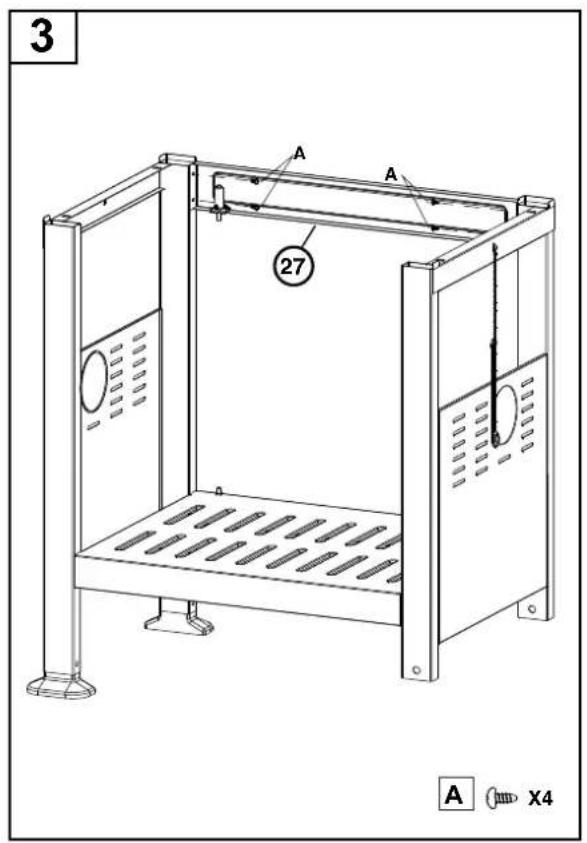
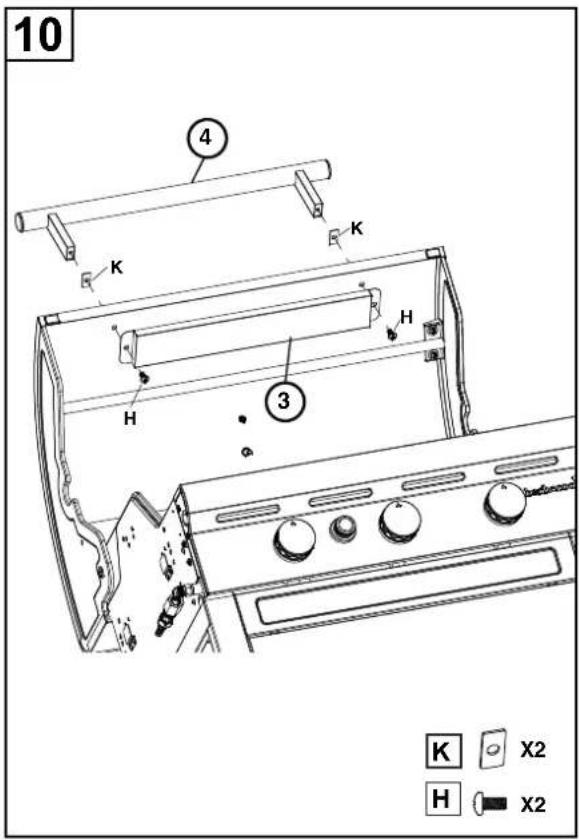
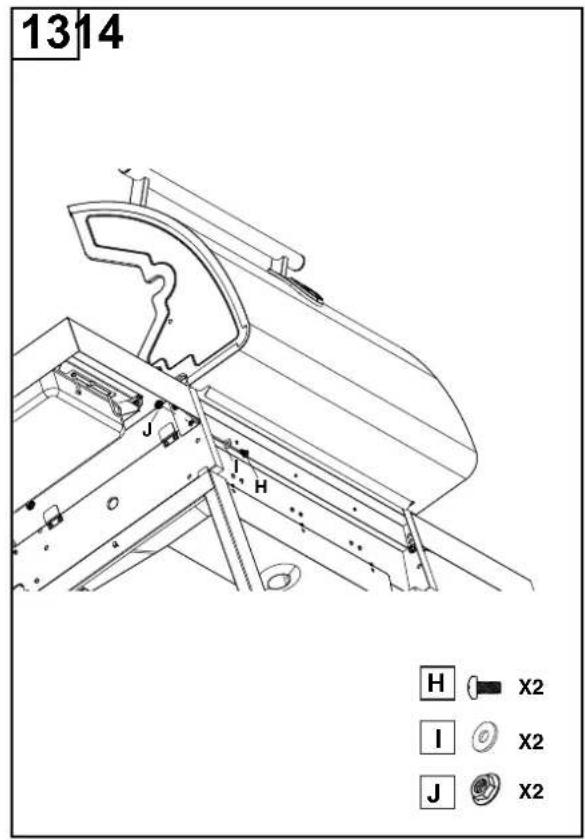
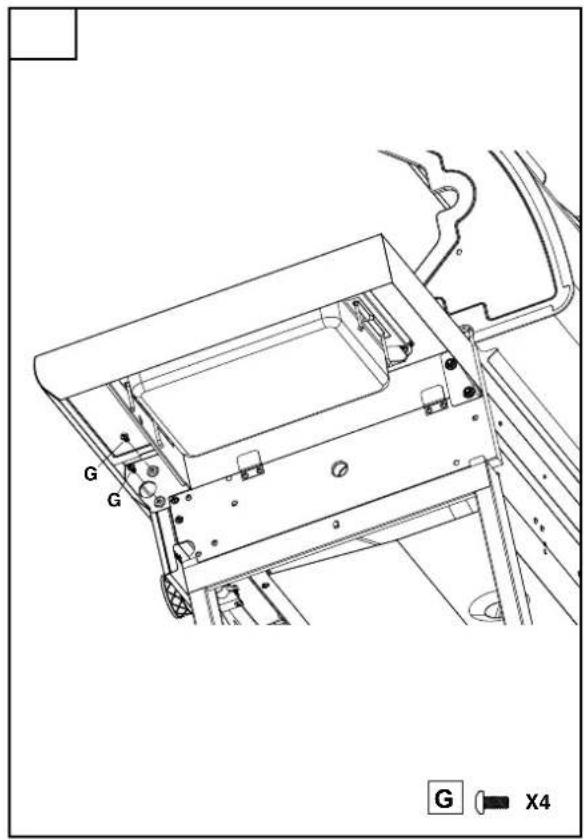
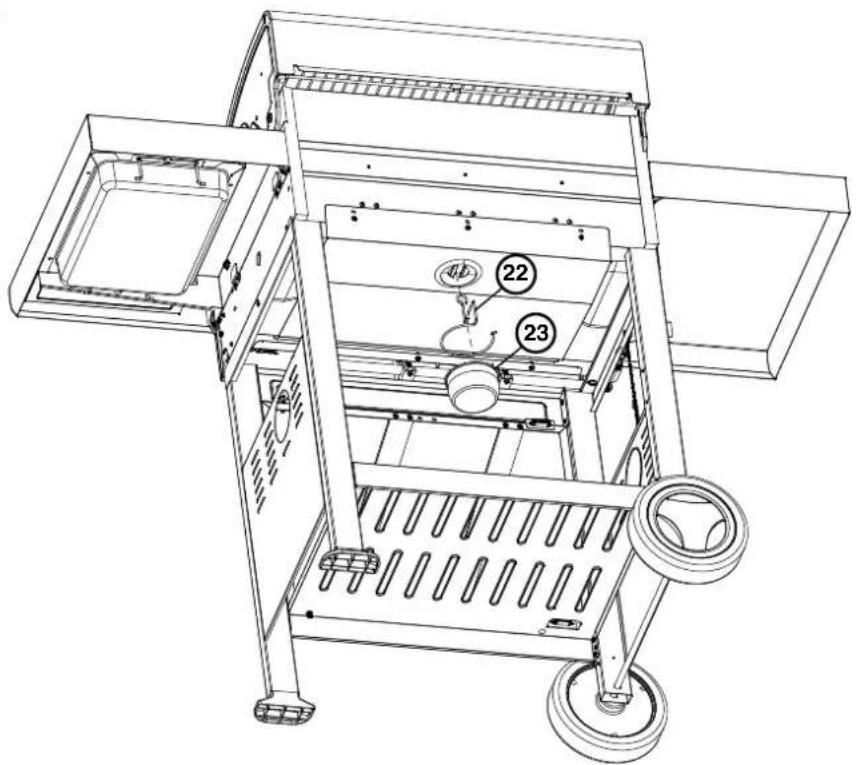
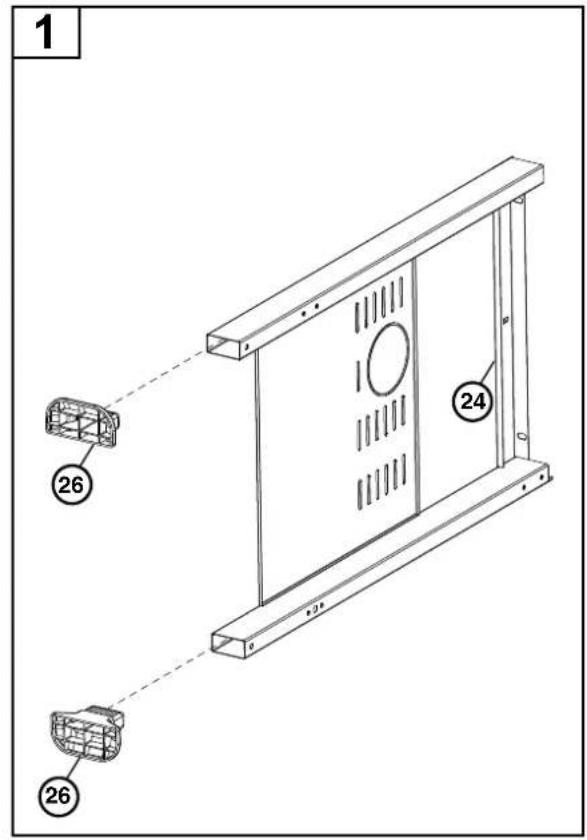
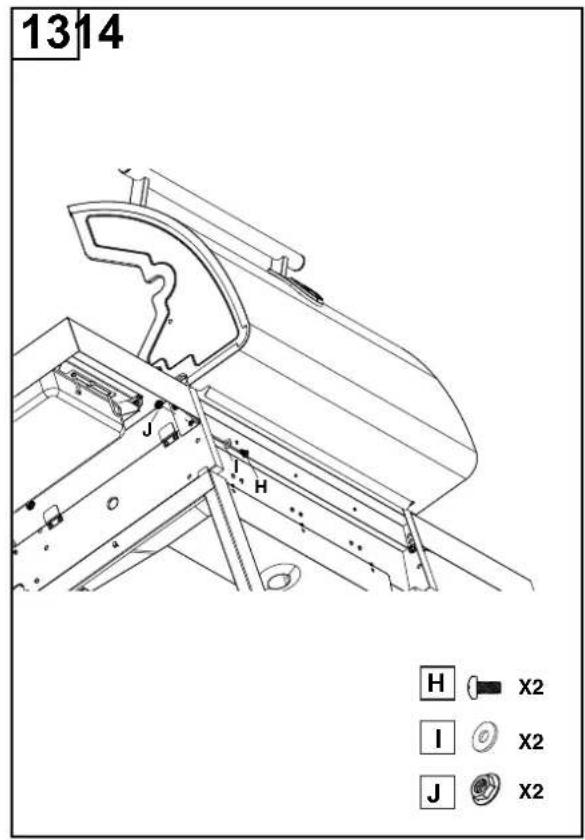
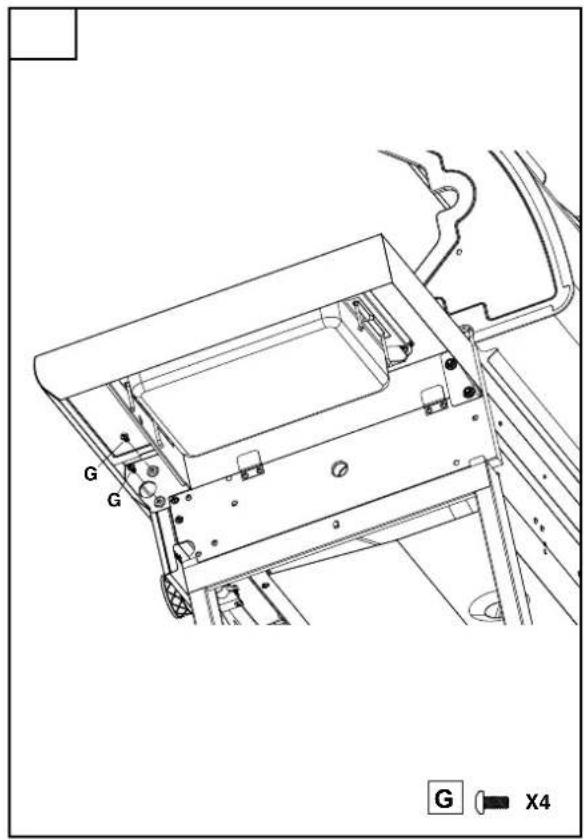
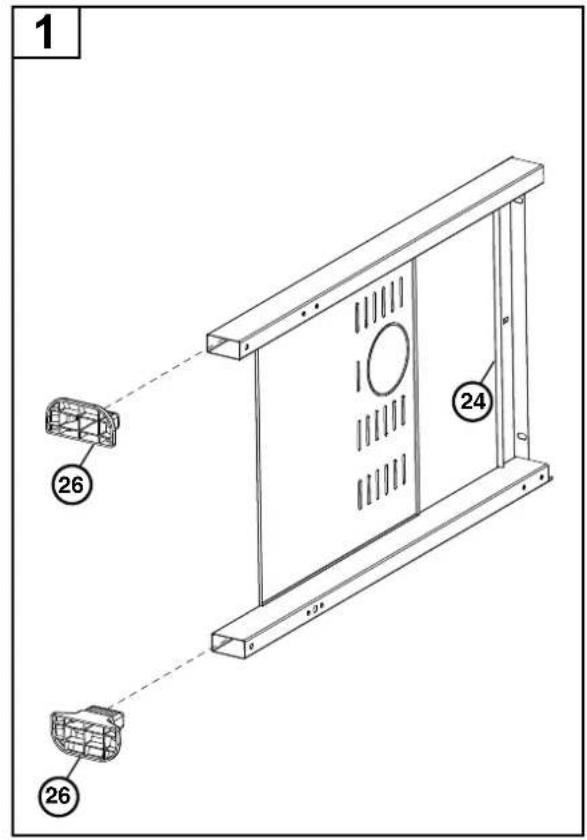
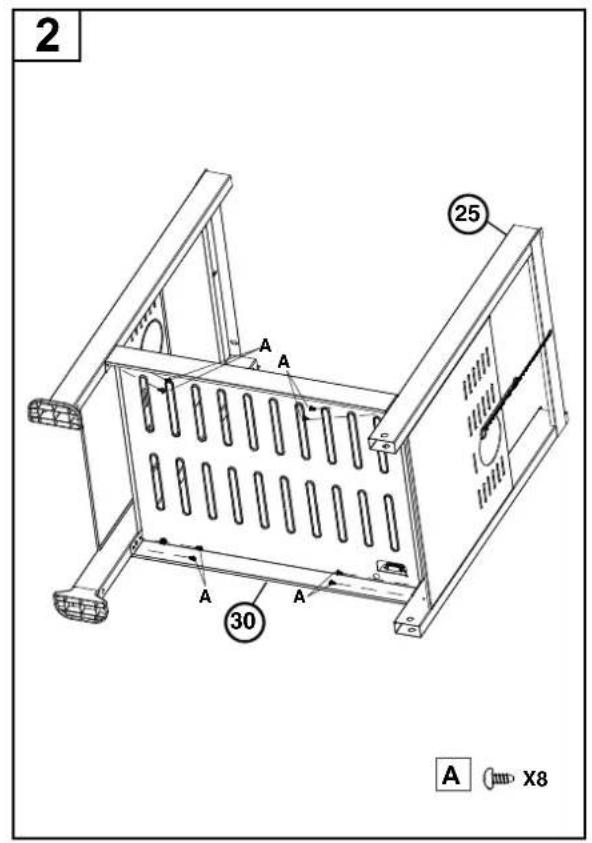
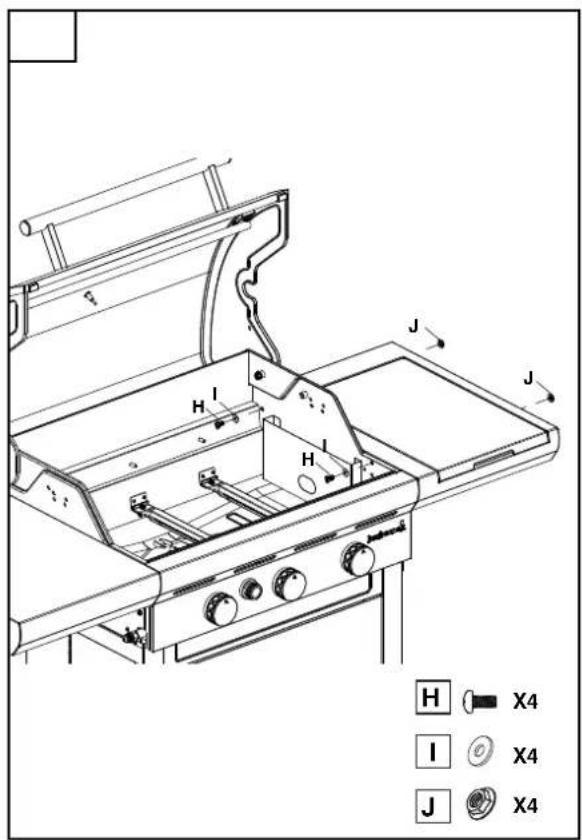
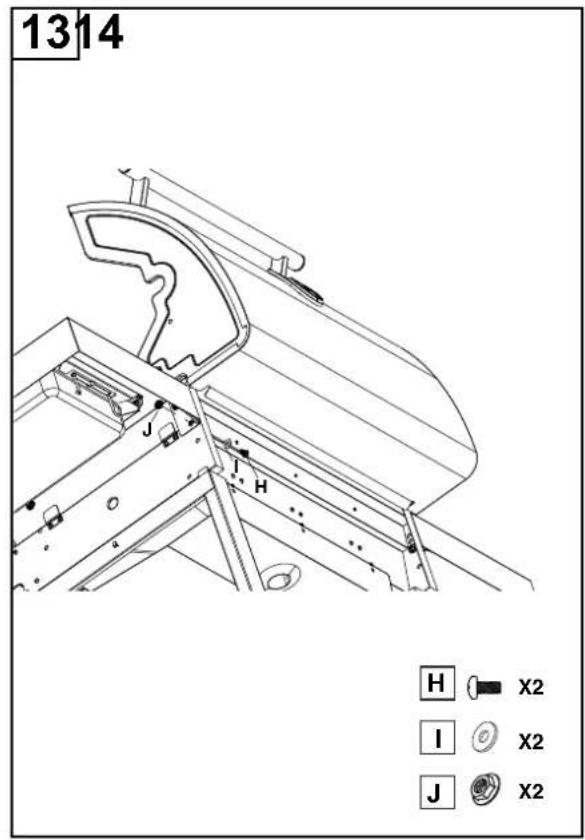
- Assemble the appliance as shown in the assembly drawings.

You can find the assembly drawings in the second part of this guide, after the exploded drawing of your appliance (see page 89).

Take care when assembling enameled parts. The tool and the screws may damage the enamel. Use the fiber washers supplied to protect the enamel around the screws.

The blister packaging may contain more screws than needed, in which case there will be some screws left over after assembly.

The package contains an emergency kit with spare parts (screws, bolts, fiber washers, etc.) that you can use if a part gets lost or breaks.
6. FITTING THE APPLIANCE WITH GAS
6.1. Which gas bottle, hose, and regulator?
To fit the appliance with gas, you will firstly need to purchase a gas bottle, a hose, and a pressure regulator. The table below indicates which gas bottle, hose, and regulator you should use. In Belgium (BE), for example, you must use a propane bottle with a hose and regulator for 37 mbar, or a butane bottle with hose and regulator for 28-30 mbar.
| Country | Gas bottle, hose,and regulator |  | |
| LU - NL - DK - FI- SE - CY - CZ -EE - LT - MT - SKSI - BG - IS - NO- TR - HR - RO -IT - HU - LV | 28-30 mbar | Propane,butane, ora mixtureof the two | |
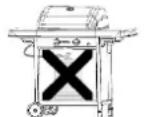 | |||
| BE - FR - IT - LU -IE - GR - PT - ES- CY - CZ - LT -SK - CH - SI - LV | 28-30 mbar | butane | |
| 37mbar | propane | ||

The appliance has been designed to be used with butane or propane bottles of 4.5 to 15 kg and equipped with an appropriate reducer valve. We recommend using propane with the appliance. Propane delivers high-quality combustion and is less sensitive to frost.
The height of the gas bottle must not exceed 70 cm, irrespective of the width or diameter D or the bottle.

Always purchase your pressure regulator and gas bottle together. Not all regulators fit all gas bottles.

Use only a gas hose and regulator with homologation for the country of use.
6.2. Safety instructions
- Never connect the gas hose directly to the appliance. Always fit a pressure regulator to the gas bottle first.
- Never modify pre-assembled or sealed parts of the gas bottle, hose, or pressure regulator.
- Ensure as short a hose as possible (max. 1.5 m) to prevent it being dragged over the ground.
- Never deform or fold/crease the gas hose. Check that the hose is neither stretched nor twisted. Ensure that the hose does not come into contact with parts that could become hot.
- The hose must be replaced if it becomes damaged or shows signs of tearing, if national regulations stipulate this or in accordance with their applicability.
- The gas bottle must always be upright.
- Never open the gas supply
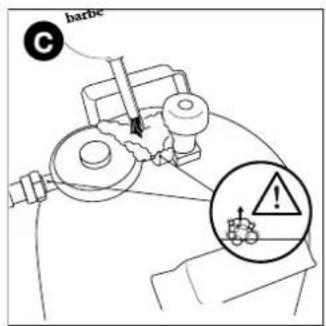
- Check for gas leaks whenever you make modifications to gas connections. See "7. Checking for gas leaks".
6.3. Connect the hose to the appliance
France:
The appliance can be used with 2 types of gas hose.
- Gas hose to be attached to the hose tails on the appliance and on the pressure regulator, secured with hose clamps (in accordance with XP D 36-110). Recommended length 1.25 m
- Gas hose (in accordance with XP D 36-112) equipped with a nut G 1/2 for direct connection to the appliance and a nut M20 x 1.5 m for direct connection to the pressure regulator, recommended length 1.25 m.
Other countries:
A flexible hose suitable for butane or propane gas is recommended. The hose must not be longer than 1.50 m. To be able to connect the gas hose to the appliance, fit a coupling to the gas tube on the appliance. The appliance is supplied with two different couplings intended for use in different countries.
| Country Coupling | |
| BE, CH, CZ, DK, ES,FI, GB, IE, IT, PT, SI | Coupling A |
| FR Coupling B |

If your country is not listed in the table, use the coupling that meets the standards that apply in your country.

6.3.1 Coupling A
You require a 19 mm wrench and a Phillips screwdriver.
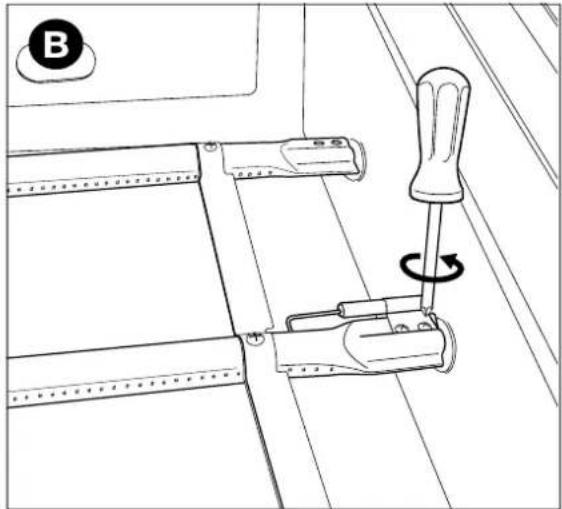
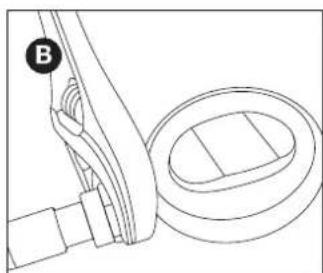
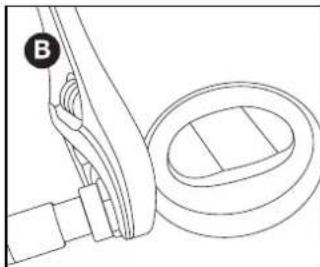
- Screw the coupling onto the gas tube on the appliance (A) and tighten it with a 19 mm wrench (B).


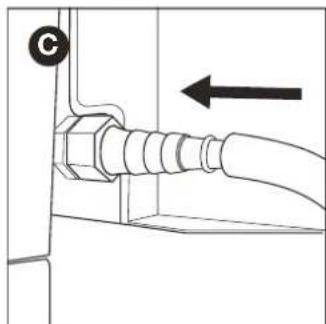
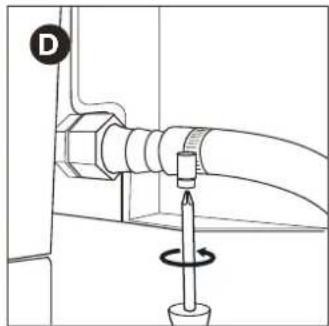
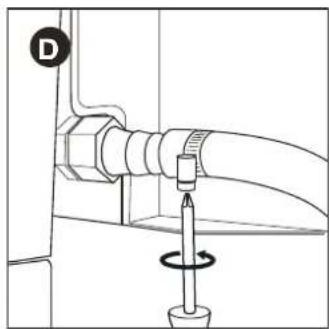
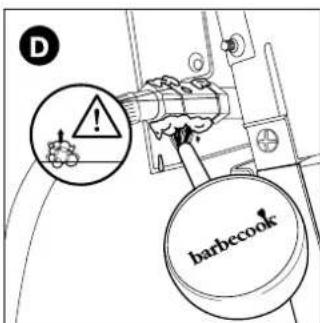
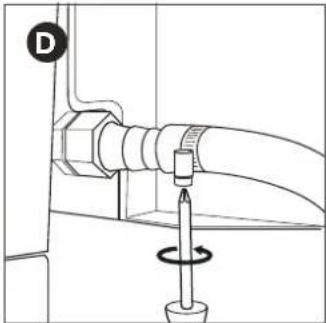
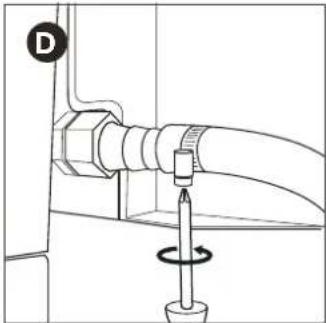
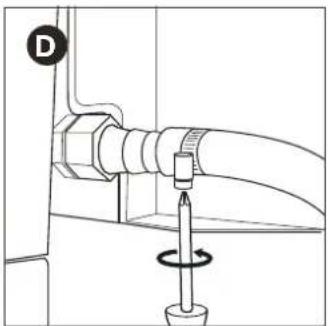
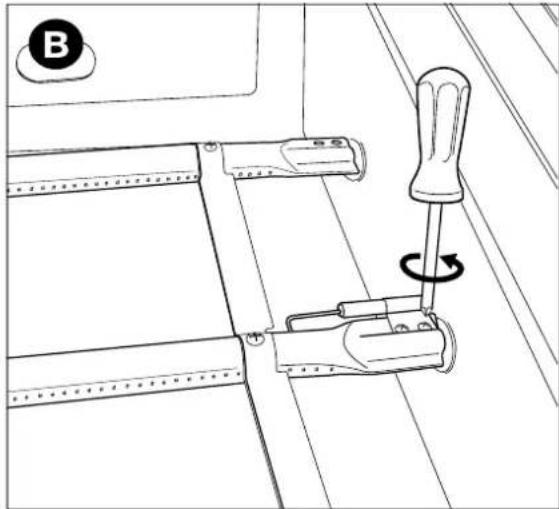
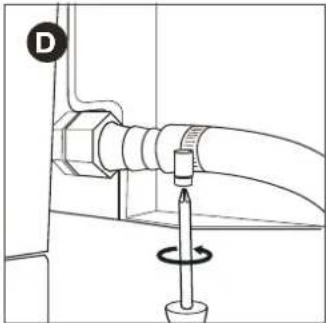
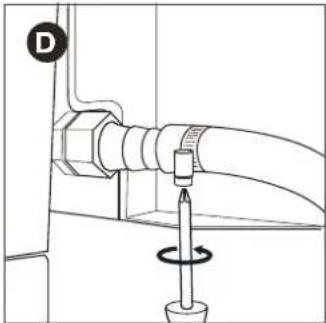
- Slide the hose over the coupling (C) and tighten the clamping ring with a Phillips screwdriver (D).

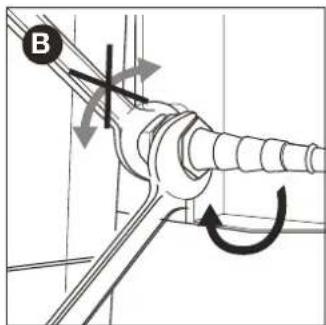
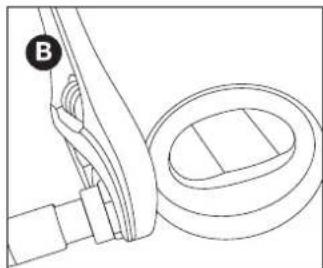
6.3.2 Coupling B
You require a 22 mm wrench and an adjustable wrench.
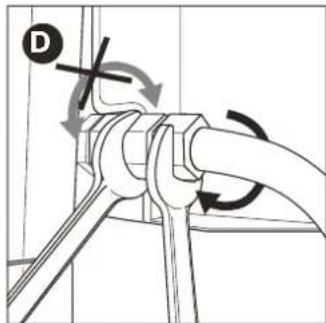
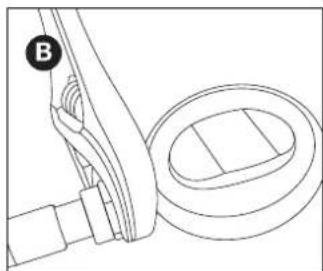
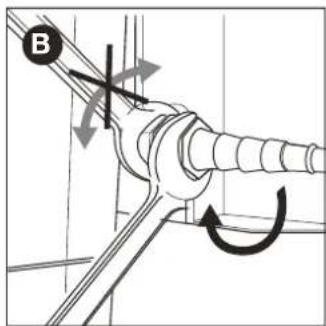
- Screw the coupling onto the gas tube on the appliance (A) and tighten it with a 22 mm wrench (B).


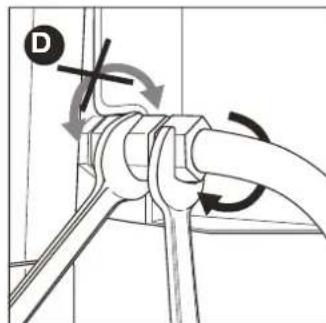
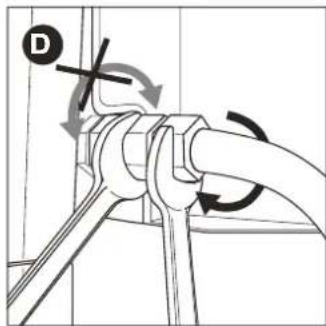
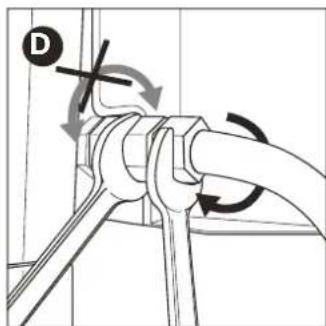
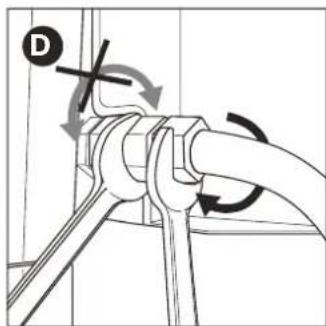
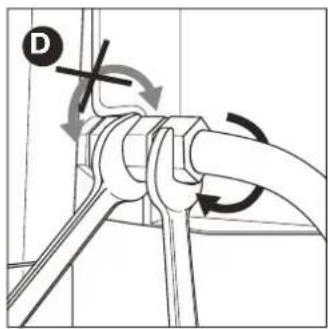
- Screw the gas hose onto the coupling (C) and secure it with two wrenches. Hold the coupling firm with one 22 mm wrench and tighten the hose with an adjustable wrench.

6.4. Connect the hose and gas bottle to the regulator.
You will require a Phillips screwdriver and/or an adjustable wrench depending on the type of regulator that you are using.
-
Connect the hose to the pressure regulator. Proceed as follows:
-
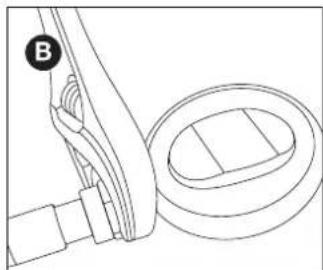
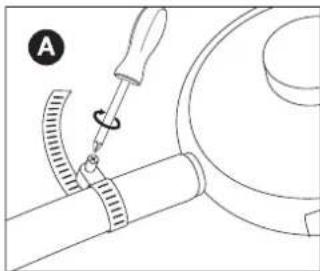
If the hose is fitted with a clamping ring, slide the hose over the regulator and tighten the clamping ring with a Phillip screwdriver (A).
- If the hose is fitted with a nut, screw the hose onto the regulator and tighten the nut with and adjustable wrench (B).

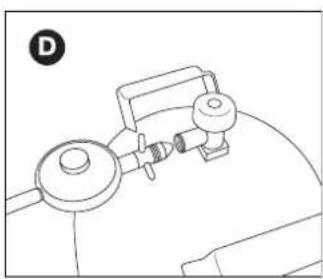
- Connect the pressure regulator to the gas bottle. Proceed as follows:
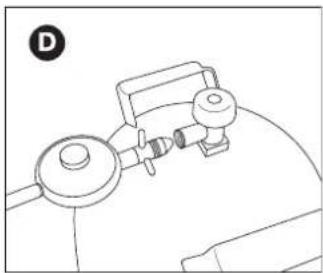
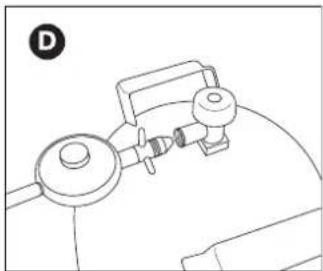
- If the regulator is fitted with a nut, screw the regulator onto the gas bottle clockwise and tighten the nut with an adjustable wrench (C).


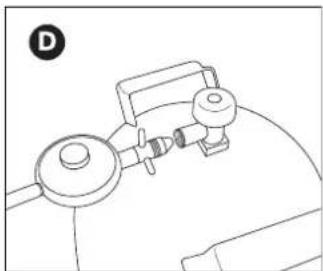
- If the regulator has a thread, screw the regulator onto the gas bottle counter-clockwise (D)

Only use regulators that satisfy EN 16129.
6.5. Replace the gas bottle
- Close the gas supply and set all control knobs to OFF.
- Disconnect the empty gas bottle and connect the full gas bottle.
- Check the gas bottle, the hose, and all gas connections for leaks. See "7. Checking for gas leaks".

Note that when replacing the gas bottle, you must always be well away from sources of ignition.
7.1. Why check for gas leaks?
Propane and butane are both heavier than air. This means that these gases will not drift away if they leak from the appliance. On still days, leaked gas can accumulate in and around the appliance and subsequently ignite and explode.
7.2. When to check for gas leaks?
- Before first use or after a lengthy period out of use.

Check that there are no gas leaks if the appliance has been assembled by the supplier.
- You should you do this whenever you replace a gas part.
- At least once annually, ideally at the start of the season.
7.3. Safety instructions
- Place the appliance outside in a well-ventilated location. Ensure that there are no flames or heat sources in the vicinity of the appliance.
- Never use a lighter or matches to check for gas leaks.
- Do not smoke or ignite the burners when checking for gas leaks.
7.4. What materials do I need?
To check for gas leaks, you require the following:
- A test fluid. You can use a ready-to-use leak spray or mixture of water (50%) and dish soap (50%).
- The leak testing tool supplied with the appliance. This fluid is used to suction up the test fluid and apply it to the gas parts or gas connections that you want to check.

7.5. Check for gas leaks
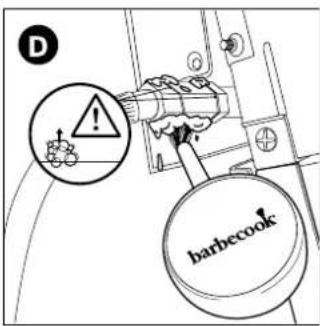
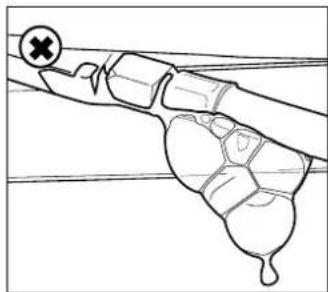
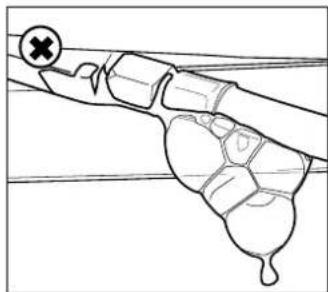
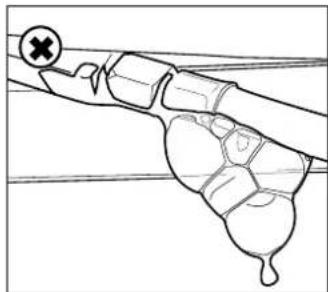
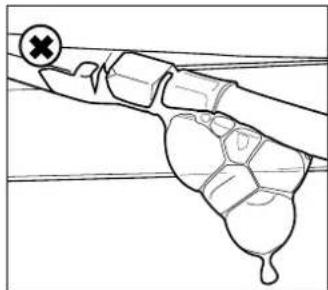
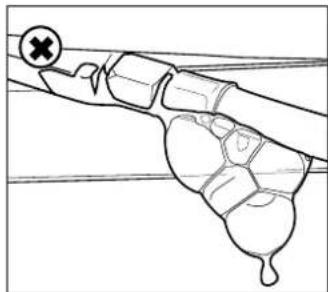
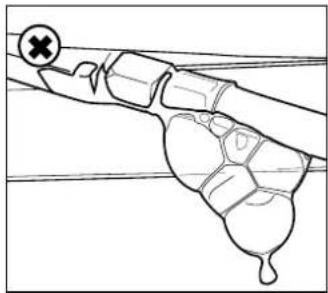
You can check for gas leaks by applying a test fluid to all gas parts and gas connections. If there are large bubbles on a specific part or connection, there is a gas leak.
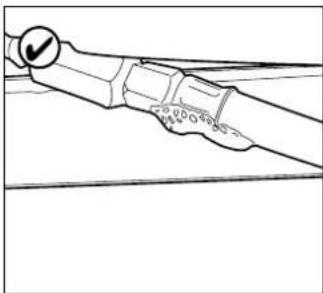
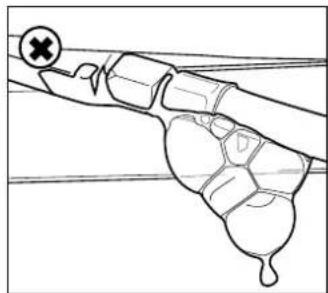
Proceed as follows to check for gas leaks:
- Place the appliance outside.
- Take the leak testing tool and test fluid (leak spray or water/dish soap mix)
- Open the lid and set all control knobs to OFF.
- Open the gas supply slightly. To do this, turn the valve on the gas supply just once.
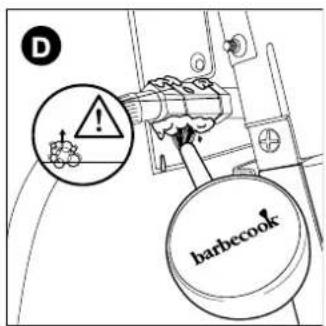
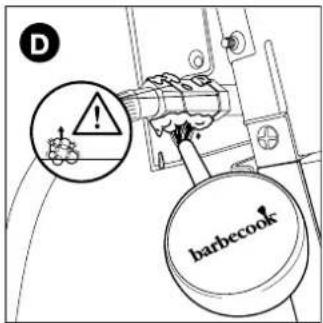
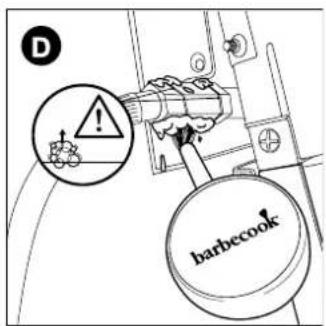
- Suction a small amount of test fluid with the leak testing tool and apply it to the zone that you want to check.
The following parts must be checked:
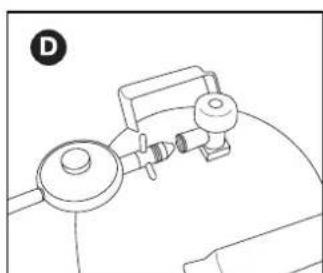
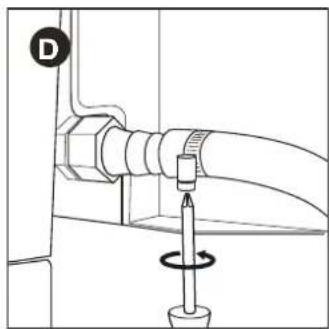
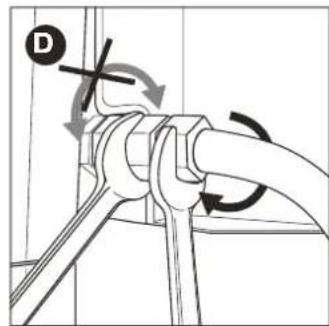
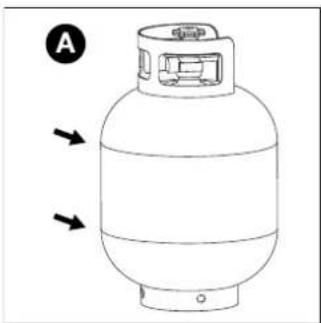
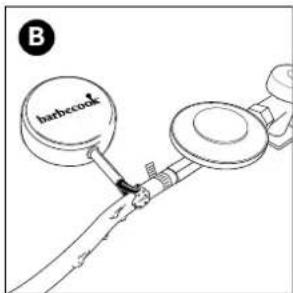
• The weld seams on the gas bottle (A) - The hose (B)
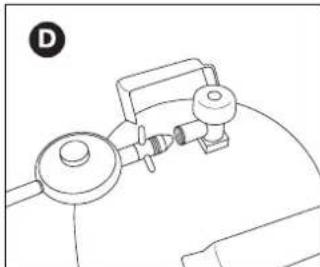
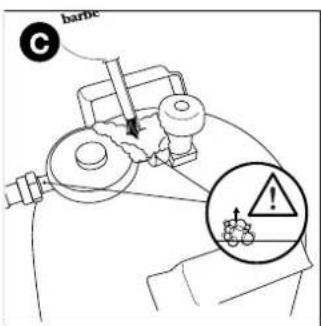
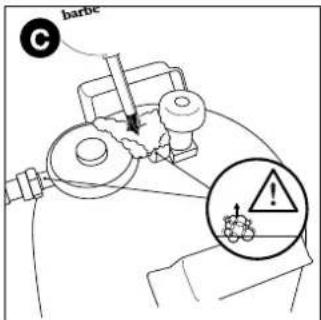
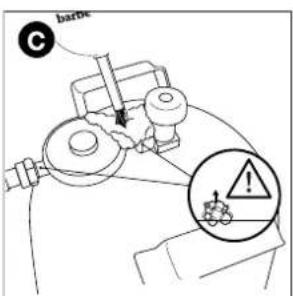
- The connections between the gas bottle and the pressure regulator and between the pressure regulator and the hose (C)
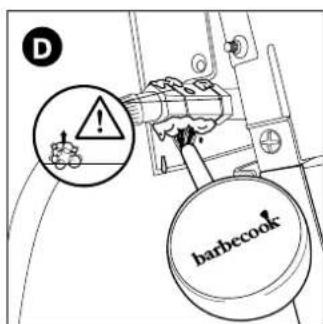
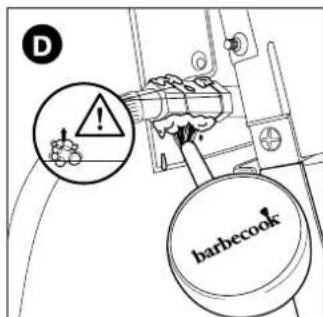
• The connection between the hose and the appliance (D)


The pressure regulator and coupling on your appliance may differ from the examples in the figures.
-
Proceed as follows:
-
If you detect a leak, follow the instructions in "7.6 In the event of a gas leak".
- If there are no leaks, close the gas supply, rinse all parts thoroughly with water, and dry them well.
7.6. In the event of a gas leak
- Close the gas supply and proceed as follows:
- If you have detected a leak on one of the connections, firmly tighten the connection in question.
- If you have detected a leak on the gas bottle or hose, replace the gas bottle or hose.
- Check the connection or part where you detected the leak again.
- If the leak has not been fixed, you must contact a Barbecook dealer. You must not start using the appliance until the leak has been fixed.

Consult www.barbecook.com or a list of Barbecook dealers near you.
8. PREPARING THE APPLIANCE FOR USE
8.1. Before each use
Whenever you use the appliance, you must ensure that:
- The appliance is set up in a suitable location. See "3.3 Choosing a suitable location".
- The hose does not drag over the ground and cannot come into contact with hot surfaces or dripping fat.
- The bowl is clean. We recommend cleaning the bowl after every use. See "11.2 Cleaning the bowl".
- The burners and venturi tubes are not blocked by insect nests or spider webs. See "11.3 Cleaning the burners and venturi tubes".
- The burners are correctly fitted. The venturi tubes must be situated above the openings of the gas valves.


To be absolutely certain that the gas connections are in order, you can check the appliance for gas leaks before each use. See "7. Checking for gas leaks".
8.2.
8.3. Before first use (or after a lengthy period out of use)
If you are using the appliance for the first time or after a lengthy period out of use, you must carry out some additional checks:
- Ensure that you have read all of the instructions in this guide, understood them, and checked them (before first use only).
- Check the appliance for gas leaks. See "7. Checking for gas leaks".

Check that there are no gas leaks if the appliance has been assembled by the supplier.
- Clean the burners and venturi tubes (only after a lengthy period out of use).
See "11.3 Cleaning the burners and venturi tubes". - Allow the appliance to "burn in" before placing any food on the grill (only before first use). See "8.3 Burning in the appliance".
8.4. Burning in the appliance
Burning in the appliance before first use helps to remove any manufacturing greases that may still be present.
Proceed as follows:
- Ignite the main burners and set the control knobs to HIGH. See "9.2 Igniting the main burners".
- Close the lid and allow the appliance to burn for 15 minutes. Do not put any food on the grill yet.
- After 15 minutes, open the lid and let the appliance burn for a further 5 minutes (control knobs still set to HIGH).
- After these 5 minutes, the appliance is ready for use and you can place food on the grill.
9. IGNITING THE BURNERS

To ignite the burners with the electric igniter, you must insert an AA battery into the igniter. The battery is not supplied with the appliance. The battery compartment for the igniter is located on the control panel for the appliance.
9.1. Safety instructions
- Before igniting the appliance, carry out all checks as specified in "8. Preparing the appliance for use".
- Ensure that the lid is open whenever you ignite a burner.
- Never bend directly over a burner when igniting it.
9.2. Igniting the main burners
9.2.1. Using the igniter
- Open the lid and set the control knobs for the main burners to OFF.
- If no other burner has yet been ignited, open the gas supply and wait for ten seconds for the gas to stabilize.
- Press the control knob for a burner, set it to HIGH, and leave it in place. The in-built igniter will create sparks, which will ignite the burner.

Start by igniting one main burner first. Never ignite all main burners at the same time.
- Continue to press the igniter and set the control knob for the burner with electrode to HIGH.

Never attempt to ignite a burner other than the burner with the electrode first, as this will cause gas to accumulate in the barbecue.
- If the burner does not ignite after three attempts, set the control knob for the burner to OFF, close the gas supply, and wait for 5 minutes to allow the accumulated gas to escape.
- Attempt to ignite the burner again. If it still does not ignite, attempt to ignite the burner with a match (see 9.2.2. "Using a match") or consult "14. Rectifying problems" in order to identify the cause of the problem.
- If the burner with electrode has been ignited, you can ignite the other burners by setting the relevant control knobs to HIGH (in which case you do not need to press the ignition button).
9.2.2 Using a match
-
- Place a match in the match holder.

- Open the lid and set the control knobs for the main burners to OFF.
- If no other burner has yet been ignited, open the gas supply and wait for ten seconds for the gas to stabilize.
- Strike the match and hold it around 13 mm away from the burner.

- Set the control knob for one burner to HIGH.

Start by igniting one main burner first. Never ignite all main burners at the same time.
- If the burner does not ignite within 5 seconds, set the control knob for the burner to OFF, close the gas supply, and wait for 5 minutes to allow the accumulated gas to escape.
- Attempt to ignite the burner again. If this does not work, consult "14. Rectifying problems" in order to identify the cause of the problem.
- If one burner has been ignited, you can ignite the other burners by setting the relevant control knobs to HIGH.
9.3. Switching the burners off
If the burners will not be used for some time, they must be switched off. Proceed as follows:
-
Close the gas supply.
-
Set the control knobs for the burners to OFF.

By closing the gas supply first, you ensure there is no longer any gas present in the appliance.
9.4. Re-igniting the burners
If a burner goes out in use, proceed as follows:
- Open the lid and close the gas supply.
- Set all control knobs to OFF and wait for 5 minutes for the accumulated gas to escape.
- Re-ignite the burner(s) as outlined in "9.2.1. Using the igniter".
9.5. Checking the flames
Whenever you ignite a burner, you must check its flames. A perfect flame will be almost blue, with a small amount of yellow at the top. Sporadic yellow flames are normal and safe. If there is a problem with the flames, take one of the following measures to rectify it:
| The flames are... Proceed as follows... | |
| Low and entirely yellow | 1. Close the gas supply immediately and set all control knobs to OFF.2. Consult "14. Rectifying problems" in orderto identify the cause of the problem. The venturi tubes are most likely blocked. |
| Higher than the bowl 1. | Close the gas supply immediately and set all control knobs to OFF.2. Wait for 5 minutes to allow the accumulated gas to escape.3. Re-ignite the burner(s).4. If this does not rectify the problem, consult "14. Rectifying problems" in order to identify the cause. |

10. USEFUL TIPS AND TRICKS
10.1. Pre-heating the appliance
Pre-heating the appliance ensures that the grill is hot enough when you come to place food on it. Proceed as follows:
-
Ignite the burner(s) and set the control knob(s) to HIGH.
-
Close the lid and allow the appliance to burn for 10 minutes.
- After ten minutes, open the lid and place the food on the grill.
- If you want less heat, set the control knob(s) to a lower heat.
10.2. Preventing food from sticking
To prevent your food from sticking to the grill:
- Oil the food lightly with a brush before placing it on the grill. You can also oil the grill itself.
- Pre-heat the appliance. The hotter the grill when you place the food on it, the less the chance of the food sticking.
- Do not turn the food too quickly. First allow it to heat up thoroughly.
10.3. Grilling directly and indirectly
You can grill directly or indirectly depending on the type of food that you want to cook and the way in which you want to do it:
| Method Description Use | ||
| Directly Place the food immediately above an ignited burner, choose a high heat with the control knob for the burner, and leave the lid open. | Searing meat and vegetables | |
| Method Description Use | ||
| Indirectly | Place the food next to an ignited burner, choose a medium/low heat with the control knob, and close the lid. | Pre-cook meat or further cook seared meat. |

If grilling with the lid closed, you must keep an eye on the lid thermometer to ensure that the appliance does not become too hot. See “10.5 Checking the temperature”.
10.4. Grilling with the lid closed
There are a number of benefits of grilling with the lid closed.
- The temperature of the grill will be higher and remain more consistent.
- The food will need to cook for less time and will remain more succulent.
- There will be fewer flare-ups and gas consumption will be lower.

If grilling with the lid closed, you must keep an eye on the lid thermometer to ensure that the appliance does not become too hot. See “10.5 Checking the temperature”.
10.5. Checking the temperature
The appliance is equipped with powerful burners, which means that you will be able to heat them up quickly, and can maintain a constant temperature. However, if you grill with the lid closed, you will need to ensure that the appliance does not become too hot.
You should check the lid thermometer regularly and take the following guidelines into account:
- A normal operating temperature is around 210° C. If the temperature is higher, there is a risk of dripping and caked fat igniting.
- The temperature must not exceed 300° C for more than five minutes. If it does, there is a risk of the appliance being damaged and becoming deformed.

If the appliance becomes too hot, allow it to cool by opening the lid, and choose a lower heat for the burners.
10.6. Using the heat zones
Once all burners have been ignited, the burner covers distribute the heat as evenly as possible over the grill. Even though heating is as even as possible, some zones will be warmer than others. You can use these heat zones for perfect grilling:
| Zone Warm Use for... | |
| For Warm Grilling delicate foods(shrimps, fish, etc.) | |
| Middle Warmer Preparing foods that need to cook for longer (sausages, chicken, etc.) | |
| Rear Warmest Searing meat and vegetables |

You can also create heat zones by playing with the power of the burners. For example, you could set a burner at a lower level and use the zone above the burner for delicate foods or foods that need to cook for longer.
10.7. Preventing flare-ups
Flare-ups may occur when grilling. This is a normal occurrence. However, an excess of flare-ups increases the temperature of the appliance and can ignite accumulated fat. Preventing flare-ups:
- Ensure that the bowl is clean before you start grilling. See "11.2 Cleaning the bowl".
- Check that the fat drain opening is clear at regular intervals and/or that the fat drip drawer is not full.
- When grilling, cut excess fat away from meat, close the lid, and set the burners to a medium or low heat.
11. MAINTAINING THE APPLIANCE
11.1. Cleaning the grill
We recommend cleaning the grill after each use with a Barbecook accessory.

You can also clean the grill with a mild cleaning agent or sodium bicarbonate. Never use oven cleaners to clean the grill.
11.2. Cleaning the bowl
We recommend cleaning the bowl after each use with a Barbecook accessory, metal sponge, and abrasive cleaning agent. Use these in the same way as for the grill.

Do not use any sharp objects and do not knock the appliance against hard surfaces.

Avoid contact with cold liquids while the appliance is still hot.
11.3. Cleaning the burners and venturi tubes
11.3.1. Why clean the burners and venturi tubes?
Spiders and insects can make webs and nests in the burners and venturi tubes, blocking the gas supply to the burners. Consequence:
- You cannot ignite the burners. If you do manage to ignite the burners, they will only produce smoky, yellow flames. The gas can ignite outside of the venturi tubes level with the control knobs. These flames are known as flashbacks and can cause serious injury and material damage.


Damage as a result of blocked burners and venturi tubes is considered poor maintenance and is not covered by the warranty.
11.3.2. When to clean the burners and venturi tubes?
Clean the burners and venturi tubes on the appliance as follows:
- Before first use after a lengthy period out of use.
- At least twice annually, once at the start of the season.
11.3.3. Cleaning the burners and venturi tubes
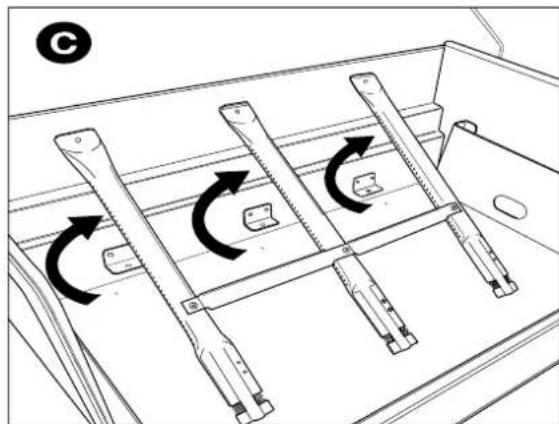
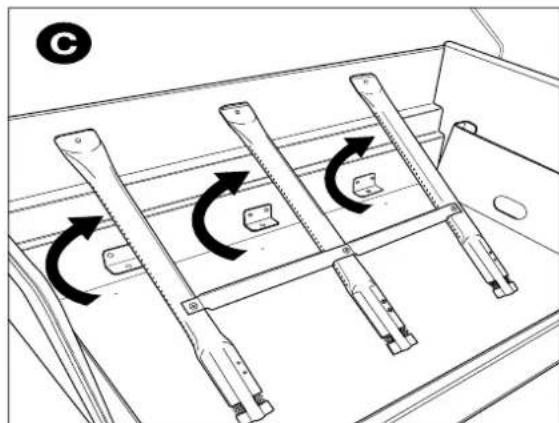
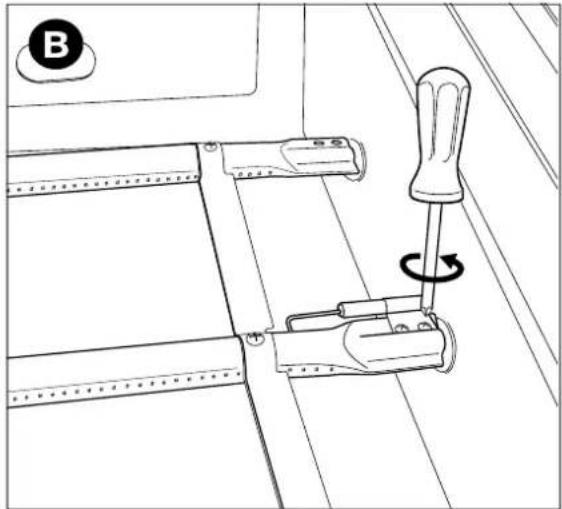
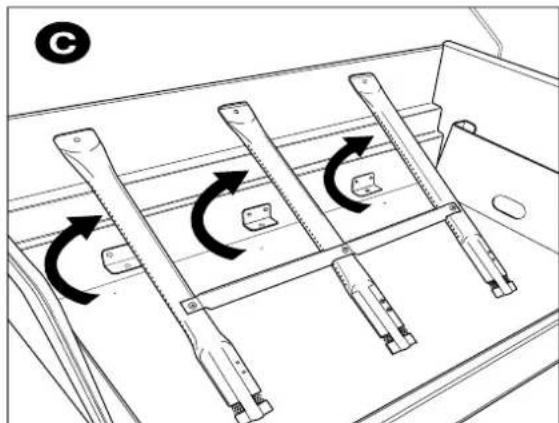
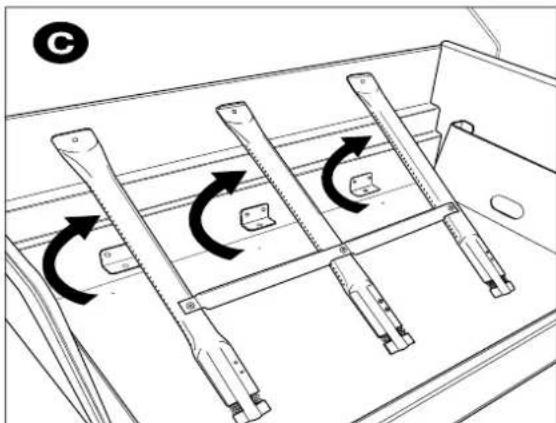
- Remove the burners from the appliance as shown in the figures. If you notice that a burner is damaged, you must replace it.
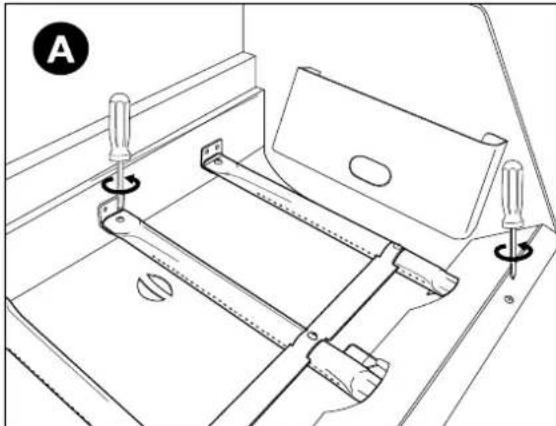


- Clean the burners and venturi tubes with a small brush of self-made pipe cleaner (an opened paper clip, pipe brush, etc.).
- Put the burners back in place. Ensure that the venturi tubes are situated above the openings of the gas valves.
11.4. Maintaining enamel, stainless steel, and powder coated parts
The appliance comprises enamel, stainless steel, and powder coated parts. Each material must be maintained differently:
| Material How to maintain this material | |
| Enamel • Do not use any sharp objects and do not knock the appliance against hard surfaces. Avoid contact with cold liquids while the appliance is still hot. You can use metal sponges and abrasive cleaning products. | |
| Stainless steel • Do not use aggressive, abrasive, or metal cleaning agents. Use mild cleaning agents and leave to work on the steel. Use a soft sponge or cloth. After cleaning, rinse the appliance thoroughly and allow the appliance to dry completely before storing. | |
| Powder coated • Do not use sharp objects. Use mild cleaning products and a soft sponge or cloth. After cleaning, rinse the appliance thoroughly and allow the appliance to dry completely before storing. |

To prevent rust formation on stainless steel parts, it is best to avoid contact with chlorine, salt, and iron.

Damage caused as a result of a failure to follow these instructions is considered poor maintenance and is not covered by the warranty.
You will find a list of the parts from which your appliance is assembled under the exploded drawing of your appliance (second part of the guide). This list contains a symbol to indicate the material of each part so that you can check how a certain part should be maintained. The parts list uses the following symbols:
| Symbol Material | |
| ● | Enamel |
| ■ | Stainless steel |
| ★ | Powder coated |
11.5. Storing the appliance
If you do not intend to use the appliance for a lengthy period of time, store it in a dry place. Before storing the device:
- Disconnect the gas bottle. Never store the appliance inside (not even in a garage or shed) if it is still connected to the gas bottle.
- Clean the burners and grills, wipe them with oil and wrap them in paper.
- Cover your appliance with a Barbecook cover. Register your appliance at www.barbecook.com to find out which cover you need.
11.6. Storing gas bottles
These instructions apply to both empty and full gas bottles.
- Always store gas bottles outside of the home in a well-ventilated space. Ensure that the bottles are not exposed to high temperatures or to direct sunlight.
- Never store a gas bottle where it can become excessively warm (such as in a car, on a boat, etc.).
- Never store your gas bottle or spare gas bottle in the cabinet of your appliance.
- Never store your spare gas bottle in the vicinity of a gas appliance that is in use.
• Always store gas bottles outside of the reach of children.
• Always store and transport gas bottles upright.
11.7. Ordering spare parts
Parts that are exposed to fire or intense heat will need to be replaced from time to time. How to order spare parts:
- Find the reference number of the part you need. There is a list of all reference numbers under the exploded drawings in the second part of this guide and at www.barbecook.com.

If you have registered your appliance online, the correct list will automatically appear in your MyBarbecook account. You can also order spare parts via your account.
- Order the spare part via www.barbecook.com or at your point of sale. Parts under warranty can only be ordered via your point of sale.
12. WARRANTY
12.1. Covered
Your appliance has a two-year warranty, starting from the date of purchase. This warranty covers all manufacturing defects, provided that:
- You have used, assembled, and maintained your appliance according to the instructions in this guide. Damage resulting from misuse, incorrect assembly, or improper maintenance is not regarded as a manufacturing defect.
- You can present the receipt and the unique serial number of your appliance. This serial number consists of 16 digits. You will find this number:
- On the cover of this guide.
- On the packaging that came with your appliance.
- On the inside of the lower front panel.
- The warranty only applies to personal use.
- The Barbecook quality department will confirm that the parts are defective and that they proved defective under normal use, correct assembly, and proper maintenance.
If one of these conditions is not fulfilled, you are not covered by the warranty. The warranty is limited to the repair or replacement of defective parts.
12.2. Not covered
The following damage and defects are not covered by the warranty:
- Normal wear and tear (rust, deformation, discoloration, etc.) of parts that are directly exposed to fire or intense heat. These parts will need to be replaced from time to time.
- Visual irregularities that are inherent to the manufacturing process. These irregularities are not regarded as manufacturing defects.
- All damage caused by inadequate maintenance, improper storage, incorrect assembly, or modifications made to the pre-assembled parts.
- All damage caused by the misuse of the appliance (not using it according to the instructions in this guide, using it for commercial purposes, etc.).
- All consequential damage caused by careless or non-compliant use of the appliance.
- Rust or discoloration as a result of external factors, use of aggressive cleaning agents, exposure to chlorine etc. This damage is not regarded as a manufacturing defect.
13. TECHNICAL INFORMATION
13.1. Type label
The type label bears all technical information for the appliance. You will find this number:
• In the second part of this guide.
- On the inside of the lower front panel.
13.2. Diameters of the injectors
• Main burner: 1.00 mm
- RECTIFYING PROBLEMS
| Problem Potential causes Solutions | ||
| Insufficient heat • Gas supply | not openVenturi tubes not situated above the openings of the gas valvesBurner openings blockedGas bottle (almost) emptyPressure regulator not correctly connected to bottle and/or hose | Open gas supplyPlace venturi tubes above the openings of the gas valvesClean burner openings or replace burnersReplace gas bottleReconnect pressure regulator to bottle and/or hose |
| Too hot and/or flare-ups • Food | too fattyFat drain openings blocked, fat in bowl, and/or on burnersTemperature too high | Cut off excess fat or select a lower heat for the burnersClean fat drain opening, bowl, and burnersSelect a lower heat for the burners and/or grill food indirectly |
| Heat not evenly distributed over grill surface | Some difference in heat is normal, see "1.7 Using the heat efficiently" and "10.6 Using the heat zones". Potential causes of considerable differences in heat:Appliance not pre-heated | Pre-heat appliance |
| Yellow flames • Burners or venturi tubes blocked | Salt on burnersAppliance connected to butane | Clean burners and venturi tubesClean burnersConnect appliance to propane and use a suitable pressure regulator |
| Incomplete flame • Burner blocked, pierced, or corroded • Clean or replace burner | ||
| Flashbacks (flames outside of venturi tubes/at control knobs) | Burners or venturi tubes blocked • Close the gas supply and set the burners to OFF.Allow the appliance to cool.Clean burners and venturi tubes. | |
| Flames higher than edge of bowl | WindGas bottle (almost) emptyFat in bowl and/or on burners | Turn rear of appliance to windReplace gas bottleClean bowl and burners |
| Pressure regulator buzzing • Warm weatherNew (full) gas bottle | No hazard or fault; stops automatically after a short period of time. | |
| Burner whistles when set to LOW | Gas injector, venturi tube, and/or burner soiled | Clean gas injector, venturi tube, and burner |
| Igniting burner fails (both with igniter and match) | Burner or venturi tube blockedNo gas supply | Clean burner and venturi tubeOpen gas supply and press safety button on pressure regulator (not present on all regulators) |
| Igniting burners fails with igniter | No battery inserted or battery inserted incorrectlyMiddle burner not ignited firstIgniter wiring not correctly connectedElectrode damagedIncorrect groundingDefective igniter | Re-insert/insert battery with correct polarityIgnite middle burner firstCheck all igniter connections and re-connectReplace electrodeCheck electrodes, burners, and igniter and re-assembleReplace igniter |
| No sparks or sound when pressing igniter | No battery inserted or battery inserted incorrectlyBattery depletedIgniter button not correctly fittedDefective spark generator | Re-insert/insert battery with correct polarityReplace batteryRe-fit igniter buttonReplace spark generator |
| Only sound (no sparks) when pressing igniter | Incorrect groundingBurner and electrode too far apart | Re-connect spark generator and electrodesBend electrode slightly to move it closer to burner |
| Sparks visible that do not reach burners | Defective wiring Replace wiring | |
| Sparks visible but not on all electrodes and/or not powerful enough | Incorrect groundingBattery (almost) depletedWet or defective electrodes | Re-connect spark generator and electrodesReplace batteryDry electrodes with kitchen paper or replace electrodes |
DE - BENUTZERHANDBUCH
1. REGISTRIEREN SIE IHR PRODUKT

6.3.2 Kupplung B






6.3.2 Manguito B

7.5. Comprobar fugas de gas




6.3.2 Raccordo B



9. ACCENSIONE DEI BRUCIATORI



6.3.2 Acoplamento B



6.3.2 Koppling B





| Symbol Material | |
| ● | Enamel |
| ■ | Stainless steel |
| ★ | Powder coated |
[NL]








17
18

LIV WISE
BARBECOOK®
is a registered brand
www.barbecook.com
2017年1月1日
Vaartlaan 9
9800 Deinze - Belgium
info@livwise.be
www.livwise.be
1.1
CE 2531/2021 PIN: 2531DL-0072
Read the instructions before using the appliance. WARNING: accessible parts may be very hot. Keep young children away.
barbecook®
THE TASTE OF FUN

www.barbecook.com
Register now and get access to:
• Online Product Manuals
• Personalised Grillspiration
• Product Tips & Tricks
- Spare Parts Lists
...
BARBECOOK®
is a registered brand
www.barbecook.com
f 📷 Barbecook
@barbecook
LivWise
Vaartlaan 9
9800 Deinze - Belgium
info@livwise.be
www.livwise.be
barbecook®
THE TASTE OF FUN
MANUAL
002
SPRING 3112
PART 2
BC-GAS-2002
Register your Barbecook® on
www.barbecook.com
and enjoy the full Barbecook® experience!
THIS IS YOUR UNIQUE SERIAL N°
FI - KÄYTTÖOPAS 4
DA - BRUGERVEJLEDNING 14
NO - BRUKERVEILEDNING 24
IS - NOTENDAHANDBÓK 34
LV - LIETOŠANAS INSTRUKCIJA 44
SK – POUŽÍVATELŠKÁ PRÍRUČKA 55
LT - NAUDOTOJO VADOVAS 65
ET - KASUTUSJUHEND 75
FI - KÄYTTÖOPAS
1. REKISTERÖI LAITTEESI
Kiitos Barbecook-grillin ostamisesta.

6.3.2 Liitäntä B




6.3.2 Kobling B

6.4. Tilslut slangen og gasflasken til regulatoren.

7.5. Kontrollere for gaslækager


Trykregulatoren og koblingen på dit apparat kan muligvis


Takk for at du kjøpte en Barbecook-grill.

6.3.2 Kobling B
6.4. Koble slangen og gassflasken til regulatoren.


- Hvis regulatoren har en gjeng, skrur du regulatoren mot klokken på gassflasken (D)

Bruk kun regulatorer som tilfredsstiller EN 16129.
6.5. Bytt ut gassflasken
- Lukk gassforsyningen og still alle betjeningstastene til OFF.
- Koble fra den tomme gassflasken og koble til den fulle gassflasken.
- Kontroller gassflasken, slangen og alle gassforbindelser for lekkasjer. Se «7. Se etter gasslekkasjer».

Vær oppmerksom på at du alltid må holde deg unna tennkilder när du bytter ut gassflasken.


- Still betjeningstasten for én brenner til HIGH.

11. VEDLIKEHOLD AV APPARATET


6.3.2 Samtenging B






9. KVEKJA Á BRENNURUNUM


6.3.2. Savienojums B

6.4. Savienojiet šlūteni un gāzes balonu ar regulatoru.




6.3.2 Spojka B

6.4. Pripojte hadicu a plynovú f'lašu k regulátoru.





6.3.2 B mova


3. OLULISED OHUTUSJUHISED



| Symbol Material | |
| ● | Enamel |
| ■ | Stainless steel |
| ★ | Powder coated |
[NL]




17

18
| A | B | CDEFGH | ||||||||||||
| G30 G31 | ||||||||||||||
| barbecook® | Spring 3112BC-GAS-2002Gas barbecue | LU - NL - DK - FI - SE - CY - CZ - EE - LT - MT - SKSI - BG - IS - NO - TR - HR - RO - IT - HU - LV | 28-30 mbar | propane, butane or their mixtures | I 3 B/P (30) | 1,5 V battery(not included) | 11,4 kW | 830 g/u | 815 g/u | |||||
| BE - FR - IT - LU - IE - GR - PT - ES - CY - CZLT - SK - CH - SI - LV | 28-30 mbar | butane | I 3 + (28-30/37) | 11,4 kW | 830 g/u | 815 g/u | ||||||||
| 37 mbar | propane | |||||||||||||
| Inspiuter hoofdbrander - Injecteur brilieur principale - Injector main burner - Injektor Haupthrenaer - Iniestore bruciatore capo - Invector para hcnilla principal - Injector queimator principal - Insprutningspumpen head gaabánnaren - Den store branders dysetype - Sustin palipolei-tenen - Tyska blavichih bafáli - Tyska barnych borikovType - Tyu - Tipo - Tyypal: 1.20 (28-30-32 nbar) | D: Gas druk - Pressian de gaz - Gasdruck - Gas Pressure - ravi noy, noarane - tlak plynu - gastryk - H. kieraj oepioa - la presión del gas - gaasi röhk - kaasun palne - tlak plina - Gáznyomás - duju stégio reguliavimo - gazes spiediena - gastryk - prestune gaz - pressione del gas - pressão de gás - tlak plynu - pritisk plina - GastrykE: Type gas - Type de gaz - Gastyp - Gas type - nuir ou - Druhr plynu - gastype - Tinor,ropion - tipo de gas - gasitiúop - kaatsatyppol -vrste plina - Cáz tipus - duju tipas - gazes tipus - gasttype - tip de gaz - tipo cí gas - tipo de gás - druh plynu - vrisa plina - gastypF: Gascategorie - Type de gaz - Gaskategorie - Gas category - Kareropies sa rasa - Kategorie plynu - Gas kategori - Kamyopio ykočso - Categoría de gas - Gasilik - Kaasukategoria - kategorija plina - Gaizategória - Categoría gas - Duju kategorija - Cázes kategorija - Gaskategorii - lodraj gazu - Tipo de gás - Categoría de gaz - Kategoría plynu - Kategorija plina - GaskategoriiG: Elektrische voorziening - Alimentation électrique - Snorversorgang - Electrical supply - elektronicco exspansane - elektrické napajeni - μπτορία - Elforsyningen - mopogí n'lektrokoí priúptroc - suministro eléctrica - elektritoire - stahktonystro - elektricno napajanje - áramel-láks - eleklos leikinas - elektrançade - stramforsyning - alimenture cu energie electrică - alimentazione electrică - alimentação eléctrica - elektricke napajarie - oskba z elektrino meigja - oskba z elektrino energijoH: Nominal vermogen - Capacité nominale - Nominal capacity - Nomiale Kapazlát - Capacita nominale - Capacidad nominal - Capacidad nominal - Nominal kapacitet - Nominal ydeise - Mitocietu kapasiteetistaUse outdoors only.Road the instructions before using the appliance.WARNINGS: accessible parts may be very hot. Keep young children away. | |||||||||||||
barbecook®
THE TASTE OF FUN

www.barbecook.com
Register now and get access to:
• Online Product Manuals
• Personalised Grillspiration
• Product Tips & Tricks
- Spare Parts Lists
...
barbecook®
THE TASTE OF FUN
MANUAL
002
SPRING 3112
PART 3
BC-GAS-2002
Register your Barbecook® on
www.barbecook.com
and enjoy the full Barbecook® experience!
THIS IS YOUR UNIQUE SERIAL N°
HR - KORISNIČKI PRIRUČNIK 4
SL - UPORABNIŠKI PRIROČNIK 14
CS - UŽIVATELSKÁ PŘÍRUČKA 24
MT - GWIDA GHALL-UTENT 34
EL - OΔΗΓΟΣ ΧΡΗΣΗΣ 44
BG – РЪКОВОДСТВО ЗА ПОТРЕБИТЕЛЯ 56
HU - HASZNÁLATI ÚTMUTATÓ 68
RO - MANUAL DE UTILIZARE 79
HR - KORISNIČKI PRIRUČNIK
1. REGISTRIRAJTE SVOJ PROIZVOD
Hvala što ste kupili roštilj Barbecook.
Nadamo se da ćete uživati u upotrebi i s njim provesti mnoge sretne trenutke! Kako biste svoj proizvod što bolje iskoristili, poželjno bi bilo da iskoristite i mogućnost registracije proizvoda putem interneta.
3. VAŽNE SIGURNOSNE UPUTE

- prebacite crijevo preko spojnice (C) i zategnite steznu obujmicu odvijačem Phillips (D).


6.3.2 Spojnica B
Potreban vam je ključ od 22 mm i podesivi ključ.
- pričvrstite spojnicu na plinsko crijevo na proizvodu (A) i zategnite ključem od 22 mm (B).


- pričvrstite plinsko crijevo na spojnicu (C) i učvrstite s pomoću dva ključa. Čvrsto držite spojnicu jednim ključem od 22 mm i zategnite crijevo podesivim ključem.


6.4. Spojite crijevo i plinsku bocu na regulator.
Trebat će vam odvijač Phillips i/ili podesivi ključ, ovisno o vrsti regulatora koji upotrebljavate.


- Ako regulator tlaka ima navoj, pričvrstite regulator tlaka na plinsku bocu okretanjem u smjeru suprotnom od kretanja kazaljki na satu (D).

Koristite samo regulatore tlaka koji zadovoljavaju odredbe norme EN 16129.
6.5. Zamjena plinske boce


Nikad nemojte pokušavati elektrodu zapaliti plamenik osim plamenika, jer će to dovesti do nakupljanja plina u roštilju.
- otvorite poklopac i postavite sve regulatore glavnih plamenika na OFF.
- ako još niti jedan plamenik nije upaljen, otvorite dovod plina i pričekajte deset sekundi da se plin stabilizira.
- zapalite šibicu i držite oko 13 mm udaljenu od plamenika.

- postavite regulator plamena za jedan plamenik na VISOKO.


Oštećenja nastala kao rezultat začepljenih plamenika i venturijeve cijevi smatraju se lošim održavanjem i nisu pokrivena jamstvom.
11.3.2 Kada treba očistiti plamenike i venturijeve cijevi?


.3.2 Spojka B
Potrebujete ključ širine 22 mm in nastavljiv ključ.
- Spojko privijte na plinsko cev na napravi (A) in jo zategnite s ključem širine 22 mm (B).


- Plinsko cev privijte na spojko (C) in jo pritrdite z obema ključema. Spojko čvrsto držite s ključem širine 22 mm, cev pa zategnite z nastavljivim ključem.


6.4. Priključitev cev in plinsko jeklenko na regulator.

- Če ima regulator navojno glavo, ga privijte pok.com
na plinsko jeklenko v nasprotni smeri urnega kazalca (D).

7.5. Preverjanje uhajanja plina


- Upravljalni gumb enega gorilnika nastavite v položaj »HIGH« (visoka temperatura).




6.3.2 Spojka B



MT - GWIDA GHALL-UTENT
1. IRREGISTRA L-APPARAT TIEGHEK
Grazzi talli xtrajt barbecue Barbecook.
Il-gass jghaddi mit-tubi venturi fi triqtu lejn il-burners. Il-gass jithallat mal-arja (u, ghalhekk, l-ossigenu)
mill-fethiet fil-ignub. Dan hu essenzjali ghal kombustjoni xierqa fil-burners: kombustjoni xierqa tehtieg it-tahlita korretta ta' gass / ossignu biex taghti fjammi sbieh.
4.2. Ghotjien tal-burners
L-ghotjien tal-burners huma ghotjien imqieghda fuq il-burners fuq l-apparat. Dawn jipprotegu I-burners mit-taqtir tax-xaham. Il-fethiet mghottija fuq il-ğnub tal-ghotjien iqassmu s-shana fuq il-gradilja sabiex tishon aktar malajr u b'mod aktar uniformi.
4.3. Enemel
5. L-IMMUNTAR TAL-APPARAT
6.3.2 Coupling B
Ghandek bżonn spanner ta' 22 mm u spanner agğustabbli.

6.4. Qabbad il-pajp u ć-ćilindru tal-gass mar-regolatur.
Se jkollok bżonn tornavit Phillips u/jew spanner aġgustabbli skond it-tip ta' regolatur li qed tuża.
- Qabbad il-pajp mar-regolatur tal-pressjoni. Ipprocedi kif ğej:
- Jekk il-pajp huwa mghammar b'holqa tal-ikklampjar, żerżaq il-pajp fuq ir-regolatur u ssikka l-ħolqa tal-ikklampjar b'tornavit Phillips (A).
- Jekk il-pajp ikun mghammar bi skorfina, invita l-pajp fuq irregolatur u ssikka l-iskorfina bi spanner agğustabbli (B).

- Qabbad ir-regolatur tal-pressjoni mać-cilindru tal-gass. Ipprocedi kif gej:
- Jekk ir-regolatur huwa mghammar bi skorfina, invita r-regolatur fuq ic-cilindru tal-gass lejn il-lemin u ssikka
I-iskorfina bi spanner aßgustabbli (C).


- Jekk ir-regolatur ghandu kamin, invita r-regolatur fuq ic-čilindru tal-gass lejn ix-xellug (D)

Uża biss regolaturi li jissodisfaw I-EN 16129.
6.5. Ibdel ic-čilindru tal-gass
- Aghlaq il-provvista tal-gass u poggi l-pumi tal-kontroll kollha fug OFF.
- Skonnettja ć-čilindru tal-gass il-vojt u qabbad ic-čilindru tal-gass il-mimli.
- Iččekkja ć-čilindru tal-gass, il-pajp, u l-konnessjonijiet kollha tal-gass ghall-hruğ tal-gass. Ara "7. Kif tiččekja ghall-hruğ tal-gass".

Innota li meta tibdel ic-čilindru tal-gass, ghandek dejjem tkun 'il boghod sew minn sorsi ta' tqabbid.
7. KIF TIČČEKJA GHALL-HRUĞ TAL-GASS
7.1. Ghaliex ghandek tiččekkja ghall-hruğ tal-gass?
Il-propan u l-butan huma t-tnejn itqal mill-arja. Dan ifisser li dawn il-gassijiet ma jitbieghdux jekk joħorgu mill-apparat. Fil-ħranet bla rih, il-gass li jkun ħareġ jista' jakkumula ğewwa u madwar l-apparat u sussegwentement jieħu n-nar u jisplodi.
7.2. Meta ghandek tiččekkja ghall-ħrug tal-gass?
- Qabel l-ewwel użu jew wara perjodu twil fejn l-apparat ma kienx qed jintuża.

Icčekkja li m'hemmx hruğ ta' gass jekk l-apparat ğie mmuntat mill-fornitur.
- Ghandek tagħmel dan kull meta tibdel parti tal-gass.
- Mill-inqas darba fis-sena, idealment fil-bidu talistagun.
7.5. Iččekkja ghall-hruğ tal-gass

Ipprocedi kif gej biex tivverifika l-hruğ tal-gass:
- Poğgi I-apparat barra.
- Hu l-ghodda ghall-ittestjar tal-hrug tal-gass u l-fluwidu tat-test (sprej apposta jew tahlita ta' ilma/sapun tal-platti)
- Iftah l-ghatu u poggi l-pumi tal-kontroll kollha fuq OFF.
- Iftah il-provvista tal-gass ftit. Biex taghmel dan, dawwar il-valv fuq il-provvista tal-gass darba biss.
- lgbed ammont żghir ta' fluwidu tat-test bl-ghodda ghall- ittestjar tal-hruğ tal-gass u applikah maż-zona li trid tiċċekkja. Il-partijiet li ğejjin għandhom jigu ĉċekkjati:
• Il-gonot tal-welding fuq ic-čilindru tal-gass (A)
• Il-pajp (B)
- Il-konnessjonijiet bejn ic-čilindru tal-gass u r-regolatur tal-pressjoni u bejn ir-regolatur tal-pressjoni u l-pajp (C)
• Il-konnessjoni bejn il-pajp u l-apparat (D)



Ir-regolatur tal-pressjoni u l-coupling fuq l-apparat tieghek jistghu
ivarjaw mill-eżempji fl-istampi.

Qatt m'ghandek tipprova tqabbad burner ghajr il-burner bl-elettrodu l-ewwel, ghax dan iwassal biex il-gass jakkumula fil-barbecue.
- Jekk il-burner ma jixghelx wara tliet tentattivi, issettja l-pum tal-kontroll tal-burner fuq OFF, aghlaq il-
provvista tal-gass, u stenna ghal 5 minuti biex thalli l-gass akkumulat joħroġ.
- Erga' pprova ixghel il-burner. Jekk xorta ma taqbadx, ipprova iqabbad il-burner bi tqabbil (ara 9.2.2. "BI-užu ta 'taqbila") jew ikkonsulta "14. Soluzzjoni ghall-problemi" fl-ordni biex tidentifika l-kawža tal-problema.
- Jekk il-burner bl-elettrodu jkun inxteghel, tista' tixghel il-burners l-oħra billi tissettja l-pumi tal-kontroll rilevanti fuq HIGH (f'liema każ m'għandekx bżonn tagħfas il-buttuna tat-tqabbid).
- Iftah l-ghatu u poggi l-pumi tal-kontroll ghall-burners ewlenin fuq OFF.
- Jekk l-ebda burner ieħor ikun għadu ma nxtegħel, iftħ il-provvista tal-gass u stenna għaxar sekondi biex il-gass jistabbilizza.
- Ixghel is-sulfarina u żommha madwar 13-il mm 'il bogħod mill-burner.

- Issettja I-pum tal-kontroll ghal burner wiehed fuq HIGH.

Ibda billi tqabbad burner ewlieni wiehed l-ewwel. Qatt tixghel il-burners ewlenin kollha fl-istess hin.
- Jekk il-burner ma jixghelx wara tliet tentattivi, issettja l-pum tal-kontroll ghall-burner fuq OFF, aghlaq il-provvista tal-gass, u stenna ghal 5 minuti biex thalli l-gass akkumulat joħroġ.
- Erga' pprova ixghel il-burner. Jekk dan ma jahdimx, ikkonsulta "14. Soluzzjoni ghall-problemi" fl-ordni biex tidentifika I-kawza tal-problema.
- Jekk burner wiehed ikun inxteghel, tista' tqabbad il-burners l-ohra billi tissettja l-pumi tal-kontroll rilevanti fuq HIGH.
9.3. Kif titfi I-burners
11. MANUTENZJONI TAL-APPARAT
11.1. Tindif tal-gradilja
Nirrakkomandaw li tnaddaf il-grill wara kull užu b'accessorju ta' Barbecook.

Tista' wkoll tnaddaf il-grill b'agent tat-tindif hafif jew bikarbonat tas-sodju. Qatt m'ghandek tuza detergenti tal-forn biex tnaddaf il-grill.
11.2. Tindif tar-recipient
Nirrakkomandaw li tnaddaf ir-reçipjent wara kull užu b'acèssorju ta' Barbecook, sponža tal-metall, u agent tat-tindif li jqaxxar. Uža dawn bl-istess mod bhal ma tagħmel għall-grill.


Hsara bhala rizultat ta' burners u tubi venturi imblukkati hija kkunsidrata bhala manutenzjoni hazina u mhix koperta mill-garanzija.
11.3.2. Meta ghandek tnaddaf il-burners u t-tubi venturi?


- Naddaf il-burners u t-tubi venturi bi xkupilja żghira tal-pajpijiet li tista' taghmel int stess (klipp tal-karti miftuña, pipe brush, ecc.).
- Poğgi l-burners lura f'posthom. Kun žgur li t-tubi venturi jinsabu fuq il-fethiet tal-valvi tal-gass.
11.4. Manutenzjoni tal-enemel, I-istainless steel u partijiet miksija bit-trab
L-apparat huwa maghmul mill-enemel, l-istainless steel u partijiet miksija bit-trab. Kull materjal ghandek tiehu hsiebu b'mod differenti:
| Materjal Kif tieħu ħsieb dan il-materjal | |
| Enemel • IIIUNTRANSLATED_CONTENT_STARTIIIDO not use any sharp objects and do not knock the appliance against hard surfaces.IIIUNTRANSLATED_CONTENT_ENDIIIEvita l-kuntatt ma' likwidi kesħin meta l-apparat ikun għadu sħun.Tista' tuża sponoż tal-metall u prodotti tat-tindif li joborxu. | |
| Azzar li ma jsaddadx(stainless steel) | Tużax agenti aggressivi, li joborxu jew li jnaddfu l-metall.Uża agenti tat-tindif ħfief u hallihom jħdmu fuq l-azzar.Uża sponża jew bićca ratba.Wara t-tindif, lahħaħ l-apparat sewwa u ħalli l-apparat jinxef kompletament qabel ma terfghu. |
| Miksi bit-trab • Tużax ogġetti li jaqtghu. Uża prodotti tat-tindif ħfief u sponża jew bićca ratba.Wara t-tindif, lahħaħ l-apparat sewwa u ħalli l-apparat jinxef kompletament qabel ma terfghu. | |

6.3.2 Σύνδεσμος Β




6.3.2 Myφa B






6.3.2. B csatlakozó




6.3.2 Cuplajul B


7.5. Verificarea scurgerilor de gaz



| Symbol Material | |
| ● | Enamel |
| ■ | Stainless steel |
| ★ | Powder coated |
[NL]



17

18

LIV WISE
BARBECOOK®
is a registered brand
www.barbecook.com
9800 Deinze - Belgium info@livwise.be www.livwise.be
(No text)
CE 2531/2021 PIN: 2531DL-0072
Register now and get access to:
• Online Product Manuals
• Personalised Grillspiration
• Product Tips & Tricks
- Spare Parts Lists
...



- 6.3.2 KOPPELING B
- 6.3.2 RACCORD B
- ABOUT THIS GUIDE
- IMPORTANT SAFETY INSTRUCTIONS
- READ AND FOLLOW THESE INSTRUCTIONS
- EXERCISE CAUTION WHEN HANDLING GAS
- CHOOSING A SUITABLE LOCATION
- SAFETY INSTRUCTIONS
- RECURRENT CONCEPTS
- VENTURI TUBES
- BURNER COVERS
- ENAMEL
- FLARE-UPS
- ASSEMBLING THE APPLIANCE
- TO ASSEMBLE THE APPLIANCE
- FITTING THE APPLIANCE WITH GAS
- WHICH GAS BOTTLE, HOSE, AND REGULATOR
- CONNECT THE HOSE TO THE APPLIANCE
- FRANCE
- OTHER COUNTRIES
- 6.3.1 COUPLING A
- 6.3.2 COUPLING B
- CONNECT THE HOSE AND GAS BOTTLE TO THE REGULATOR
- REPLACE THE GAS BOTTLE
- WHY CHECK FOR GAS LEAKS
- WHEN TO CHECK FOR GAS LEAKS
- WHAT MATERIALS DO I NEED
- CHECK FOR GAS LEAKS
- IN THE EVENT OF A GAS LEAK
- PREPARING THE APPLIANCE FOR USE
- BEFORE EACH USE
- BEFORE FIRST USE (OR AFTER A LENGTHY PERIOD OUT OF USE)
- BURNING IN THE APPLIANCE
- IGNITING THE BURNERS
- IGNITING THE MAIN BURNERS
- USING THE IGNITER
- 9.2.2 USING A MATCH
- SWITCHING THE BURNERS OFF
- RE-IGNITING THE BURNERS
- CHECKING THE FLAMES
- USEFUL TIPS AND TRICKS
- PRE-HEATING THE APPLIANCE
- PREVENTING FOOD FROM STICKING
- GRILLING DIRECTLY AND INDIRECTLY
- GRILLING WITH THE LID CLOSED
- CHECKING THE TEMPERATURE
- USING THE HEAT ZONES
- PREVENTING FLARE-UPS
- MAINTAINING THE APPLIANCE
- CLEANING THE GRILL
- CLEANING THE BOWL
- CLEANING THE BURNERS AND VENTURI TUBES
- WHY CLEAN THE BURNERS AND VENTURI TUBES
- WHEN TO CLEAN THE BURNERS AND VENTURI TUBES
- MAINTAINING ENAMEL, STAINLESS STEEL, AND POWDER COATED PARTS
- STORING THE APPLIANCE
- STORING GAS BOTTLES
- ORDERING SPARE PARTS
- WARRANTY
- COVERED
- NOT COVERED
- TECHNICAL INFORMATION
- TYPE LABEL
- DIAMETERS OF THE INJECTORS
- DE - BENUTZERHANDBUCH
- REGISTRIEREN SIE IHR PRODUKT
- 6.3.2 KUPPLUNG B
- 6.3.2 MANGUITO B
- COMPROBAR FUGAS DE GAS
- 6.3.2 RACCORDO B
- ACCENSIONE DEI BRUCIATORI
- 6.3.2 ACOPLAMENTO B
- 6.3.2 KOPPLING B
- LIV WISE
- CE 2531/2021 PIN: 2531DL-0072
- BARBECOOK®
- THE TASTE OF FUN
- REGISTER NOW AND GET ACCESS TO
- FI - KÄYTTÖOPAS
- REKISTERÖI LAITTEESI
- 6.3.2 LIITÄNTÄ B
- 6.3.2 KOBLING B
- TILSLUT SLANGEN OG GASFLASKEN TIL REGULATOREN
- KONTROLLERE FOR GASLÆKAGER
- KOBLE SLANGEN OG GASSFLASKEN TIL REGULATOREN
- BYTT UT GASSFLASKEN
- VEDLIKEHOLD AV APPARATET
- 6.3.2 SAMTENGING B
- KVEKJA Á BRENNURUNUM
- SAVIENOJUMS B
- SAVIENOJIET ŠLŪTENI UN GĀZES BALONU AR REGULATORU
- 6.3.2 SPOJKA B
- PRIPOJTE HADICU A PLYNOVÚ F'LAŠU K REGULÁTORU
- 6.3.2 B MOVA
- OLULISED OHUTUSJUHISED
- HR - KORISNIČKI PRIRUČNIK
- REGISTRIRAJTE SVOJ PROIZVOD
- VAŽNE SIGURNOSNE UPUTE
- 6.3.2 SPOJNICA B
- SPOJITE CRIJEVO I PLINSKU BOCU NA REGULATOR
- ZAMJENA PLINSKE BOCE
- 11.3.2 KADA TREBA OČISTITI PLAMENIKE I VENTURIJEVE CIJEVI
- 3.2 SPOJKA B
- PRIKLJUČITEV CEV IN PLINSKO JEKLENKO NA REGULATOR
- PREVERJANJE UHAJANJA PLINA
- MT - GWIDA GHALL-UTENT
- IRREGISTRA L-APPARAT TIEGHEK
- GHOTJIEN TAL-BURNERS
- ENEMEL
- L-IMMUNTAR TAL-APPARAT
- QABBAD IL-PAJP U Ć-ĆILINDRU TAL-GASS MAR-REGOLATUR
- IBDEL IC-ČILINDRU TAL-GASS
- KIF TIČČEKJA GHALL-HRUĞ TAL-GASS
- GHALIEX GHANDEK TIČČEKKJA GHALL-HRUĞ TAL-GASS
- META GHANDEK TIČČEKKJA GHALL-ĦRUG TAL-GASS
- IČČEKKJA GHALL-HRUĞ TAL-GASS
- KIF TITFI I-BURNERS
- MANUTENZJONI TAL-APPARAT
- TINDIF TAL-GRADILJA
- TINDIF TAR-RECIPIENT
- META GHANDEK TNADDAF IL-BURNERS U T-TUBI VENTURI
- MANUTENZJONI TAL-ENEMEL, I-ISTAINLESS STEEL U PARTIJIET MIKSIJA BIT-TRAB
- 6.3.2 ΣΎΝΔΕΣΜΟΣ Β
- 6.3.2 MYΦA B
- B CSATLAKOZÓ
- 6.3.2 CUPLAJUL B
- VERIFICAREA SCURGERILOR DE GAZ
Brand : BARBECOOK
Model : Spring 3112
Category : Barbecue