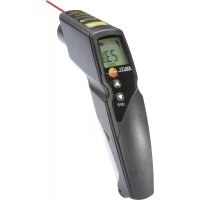
830T1 - Thermometer Testo - Free user manual and instructions
Find the device manual for free 830T1 Testo in PDF.


| Product type | Compact infrared thermometer |
| Brand | Testo |
| Model | 830T1 |
| Infrared measurement range | -30 to +400 °C |
| Resolution | 0.1 °C |
| Infrared accuracy | ±1.5 °C or 1.5 % (0.1 to +400 °C); ±2 °C or 2 % (-30 to 0 °C) |
| Adjustable emissivity | 0.1 to 1.0 |
| Optical ratio (distance:measurement area) | 10:1 |
| Measurement rate | 0.5 s |
| Power supply | 9 V battery (20 h battery life) |
| Display | Digital with backlight |
| Laser | 1 class 2 laser, <1 mW, 645-660 nm |
| Functions | Hold, Min/Max, acoustic and visual alarm, emissivity adjustment, auto-off (1 min) |
| Operating temperature | -20 to +50 °C |
| Storage temperature | -40 to +70 °C |
| Housing | ABS |
| Dimensions (L x W x H) | 190 x 75 x 38 mm |
| Warranty | 2 years |
| CE standard | 2004/108/EC |
| Maintenance | Clean the housing with a damp cloth; lens with a cotton swab moistened with water or medical alcohol |
| Safety | Do not measure on live parts; avoid exposure to laser beam; do not use in medical environment |
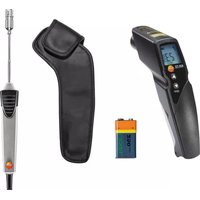
| Optional accessories | Surface probe, protective socket, emissivity adhesive tape |
Frequently Asked Questions - 830T1 Testo
User questions about 830T1 Testo
0 question about this device. Answer the ones you know or ask your own.
Ask a new question about this device
Download the instructions for your Thermometer in PDF format for free! Find your manual 830T1 - Testo and take your electronic device back in hand. On this page are published all the documents necessary for the use of your device. 830T1 by Testo.
USER MANUAL 830T1 Testo
PykoBOIDCTBO NOIb3OBaTeJIra
Handleiding nI
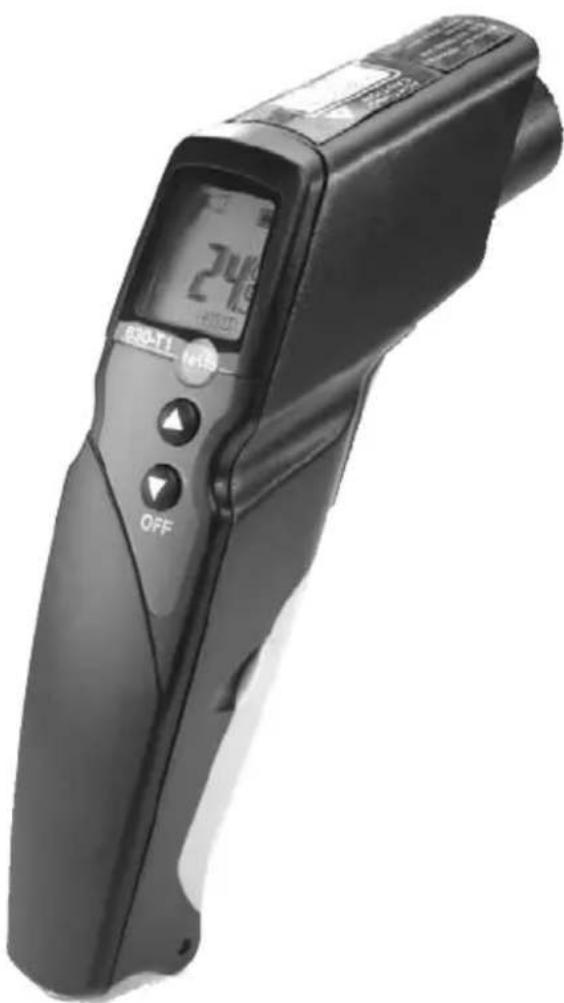
Please read this document through carefully and familiarise yourself with the operation of the product before putting it to use. Keep this documentation to hand so that you can refer to it when necessary.
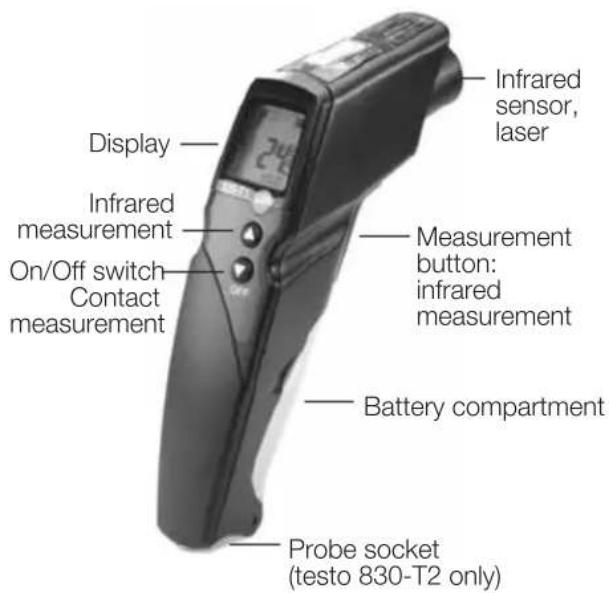
2. Product Description
Accessories
Name Item no.
| Water-tight immersion/penetration probe, -60 to +400°C/ -76 to +752°F 0602 1293 |
| Quick-reaction surface probe, -60 to +300°C/ -76 to +572°F 0602 0393 |
| Robust air probe, -60 to +400°C/ -76 to +752°F 0602 1793 |
| Leather protection sleeve 0516 8302 |
| Emissivity adhesive tape ε=0.95 0554 0051 |
3. Safety Information

Avoid electrical hazards:
- Contact measurement: Do not measure on or near live parts. Infrared measurement: Please adhere to the required safe distance when measuring on live parts.

Preserving product safety/warranty claims:
- Operate the instrument properly and according to its intended purpose and within the parameters specified. Do not use force.
Do not expose to electromagnetic radiation (e.g. microwaves, induction heating systems), static charge, heat or extreme fluctuations in temperature.
Do not store together with solvents (e.g. acetone). - Open the instrument only when this is expressly described in the documentation for maintenance purposes.

Laser radiation!
Do not look into laser beam.

Ensure correct disposal:
- Dispose of defective rechargeable batteries and spent batteries at the collection points provided.
- Send the instrument directly to us at the end of its life cycle. We will ensure that it is disposed of in an environmentally friendly manner.
4. Intended Use
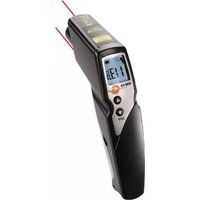
testo 830 is a compact infrared thermometer for the non-contact measurement of surface temperatures. Using testo 830-T2, it is possible to carry out additional contact measurements by attaching probes.

Not suitable for diagnostic measurements in the medical sector!
5. Technical Data
| Feature testo 830-T1 testo 830-T2 | |
| Parameter °C/°F | |
| Infrared measurement range -30 to +400°C/ -22 to +752°F | |
| Infrared resolution 0.1°C/0.1°F | |
| Infrared accuracy ±1.5°C/ 2.7°F or 1.5% of reading (+0.1 to +400°C/ +32 to +752°F) (at 23°C) +/- 1 digit ±2°C/ 3.6°F or 2% of reading (-30 to 0°C/ -22 to +31.9°F) | |
| Emissivity 0.1 to 1.0 adjustable | |
| Infrared measurement rate 0.5s | |
| Temp. sensor - Thermocouple Type K (attachable) | |
| Measurement range of temp sensor - -50 to +500°C/ -58 to +932°F | |
| Resolution of temp. sensor - 0.1°C/ 0.1°F | |
| Accuracy of temp. sensor (±1 digit) | ±0.5°C/0.9°F+0.5% of reading at rated temperature 22°C/ 72°F |
| Measuring rate of temp. sensor | 1.75s |
| Optics (90% value) | 10:12 12:12 |
| Laser type | 1 x laser 2 x laser |
| Operating temperature | -20 to +50°C/ -4 to +122°F |
| Transport/Storage temperature | -40 to +70°C/ -40 to +158°F |
| Power supply | 9V block battery |
| Battery life | 20 h 15 h |
| Housing | ABS |
| Dimensions (LxHxB) | 190 x 75 x 38mm/7.5 x 3.0 x 1.5in |
| CE guideline | 2004/108/EEC |
| Warranty | 2 years |
| Laser | |
| Laser type | 1 x laser 2 x laser |
| Power | < 1 mW |
| Wavelength 645 to 660 nm | |
| Class | 2 |
| Standard | DIN NE 60825-1:2001-11 |
1 the larger value applies
^2 + Opening diameter of the sensor (16mm/0.6in)
6. Initial Operation
Insert battery: See 9.1 Changing the battery.
7. Operation
7.1 Connecting probe (testo 830-T2 only)
Connect temperature probe to probe socket. Observe + / - !
7.2 Switching on/off
- Switch on instrument: Press measurement button.
- All display segments light up briefly. The instrument changes to the infrared mode (lights up).
The display light remains for 10 seconds every time a button is activated.
- Switch off instrument: Keep pressed until display darkens.
The device switches off automatically after 1 min (IR measurement view) or 10 mins (contact measurement view, only testo 830-T2) without the button being pressed.
7.3 Measuring
! Observe information on infrared measurement (chapter 11) / contact measurement (chapter 12).
With IR measurement, the min./max. values are reset by pressing the measurement button, and with contact measurement, this is done when the device is switched off or when you switch to the IR measurement view.
- The instrument is switched on.
Infrared measurement
1 Start measurement: Hold down measurement button.
2. Locate object to be measured using laser point.
testo 830-T1: laser marks the centre point of the measurement spot.
testo 830-T2: Laser marks the upper and lower end of the measurement spot.
- The current reading is shown (2 measurements per second)
3 End measurement: Release button.
-
HOLD lights up. The last measured value and min./max. value are saved until the next measurement.
-
Switch between min., max. and recorded value: Press
- Restart measurement: Press measurement button.
Contact measurement (testo 830-T2 only)
- Temperature probe was connected before the measuring instrument was switched on.
1 Position contact thermometer in/on the measurement object and activate the measurement: Press
- The instrument changes to the contact measurement mode (lights up). The current reading is shown.
2 End the measurement: Press .
-
HOLD lights up. The last measured value and min./max. value are saved until the next measurement.
-
Switch between min., max. and recorded value: Press
Restart measurement: Press
Back to infrared measurement view: Press measurement button.
Setting the emissivity
- Instrument is in the infrared measurement mode.
! If no button is pressed for 3 s in the emissivity mode, the instrument switches to the infrared measurement mode.
1 Press for 3 s.
2 Set emissivity: Press

- The instrument switches to the infrared measurement mode.
8. Settings
- Instrument is switched off.
If no button is activated in the setting mode for 3 s, the instrument changes to the next mode.
1 Press for 3s.
- The device switches to settings mode.
2 Set lower alarm value (ALARM): Press or Hold the button down to go forward quickly.
3 Set upper alarm value (ALARM): Press o. Hold the button down to go forward quickly.
4 Set alarm function on / oFF: Press or .
5 Select parameter (^ / ^) : Press or
- The device returns to IR measurement view.
The alarm function is only available for IR measurement. If the set alarm values are exceeded/not reached, a visual and acoustic alarm is output.
9. Service and Maintenance
9.1 Changing the battery
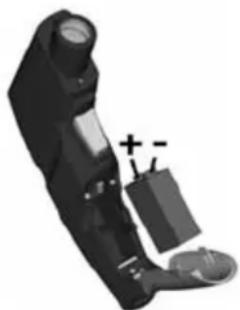
Instrument must be switched off!
1 Open battery compartment: Open up cover.
2 Remove used battery and insert new one. Observe + / - . The minus should be visible once the battery is inserted.
3 Close battery compartment: Close cover.
9.2 Clean instrument
Do not use abrasive cleaning agents or solutions.
Clean the housing with a damp cloth (soap water).
- Carefully clean the lens with water or cotton buds dipped in water or medical alcohol.
中
10. Questions and Answers
| Query Possible causes Possible solution | |
| Display is no longer illuminated - Low battery. Change battery. | ▶ |
| lights up. - Battery empty. Change battery. | ▶ |
| Instrument cannot be - Battery empty. Change battery. switched on | ▶ |
| Infrared measurement mode: - Readings outside - - - - lights up. measurement range. | |
| Contact measurement mode: - Readings outside - (testo 830-T2 only) measurement range. - - - lights up. | - No probe connected. Connect probe. - Probe damaged. Change probe. |
If we have not answered your question, please contact your local distributor or Testo's Customer Service.
11. Information on infrared measurement
11.1 Measurement method
Infrared measurement is an optical measurement
- Keep lens clean.
Do not measure with clouded lens. - Keep measurement field (area between instrument and object being measured) free of interferences: no dust and dirt particles, no moisture (rain, steam) or gases.
Infrared measurement is a surface measurement
If there is dirt, dust, frost etc. on the surface, only the top layer will be measured, i.e. the dirt.
In the case of shrinkwrapped foodstuffs, do not measure in air pockets.
If values are critical, always subsequently measure using a contact thermometer. Particularly in the food sector, the core temperature should be measured with a penetration/immersion thermometer.
Adaptation time
If the ambient temperature changes (change of location, e.g. inside/outside measurement) the instrument needs an adaptation time of 15 minutes for infrared measurement.
11.2 Emissivity
Materials have different emissivities, i.e. they emit different levels of electromagnetic radiation. The emissivity of testo 830 is set in the factory to 0.95. This is the ideal value for measuring nonmetals (paper, ceramics, plaster, wood, paints and varnishes), plastics and food
Bright metals and metal oxides are only suited to a limited extent to infrared measurement on account of their low or nonuniform emissivity.
- Apply emissivity enhancing layers such as varnish or emission adhesive tape (Item no. 0554 0051) to the object being measured. If this is not possible, measure with the contact thermometer.
Emissivity table of the most important materials (typical values)
| Material (Temperature) \( \varepsilon \) | |
| Aluminium, bright-rolled (170°C/ 338°F) 0.04 | |
| Cotton (20°C/ 68°F) 0.77 | |
| Concrete (25°C/ 77°F) 0.93 | |
| Ice, smooth (0°C/ 32°F) 0.97 | |
| Iron, polished (20°C/ 68°F) 0.24 | |
| Iron with cast skin (100°C/ 212°F) 0.80 | |
| Iron with rolled skin (20°C/ 68°F) 0.77 | |
| Plaster (20°C/ 68°F) 0.90 | |
| Glass (90°C/ 194°F) 0.94 | |
| Rubber, hard (23°C/ 73°F) 0.94 | |
| Rubber, soft grey (23°C/ 73°F) 0.89 | |
| Wood (70°C/ 158°F) 0.94 | |
| Cork (20°C/ 68°F) | 0.70 |
| Material (Temperature) & | |
| Heat sink, black anodised (50°C/ 122°F) | 0.98 |
| Copper, lightly tarnished (20°C/ 68°F) | 0.04 |
| Copper, oxidised (130°C/ 266°F) | 0.76 |
| Plastics: PE, PP, PVC (20°C/ 68°F) | 0.94 |
| Brass, oxidised (200°C/ 392°F) | 0.61 |
| Paper (20°C/ 68°F) | 0.97 |
| Porcelain (20°C/ 68°F) | 0.92 |
| Black paint, matt (80°C/ 176°F) | 0.97 |
| Steel,heat-treated surface (200°C/ 392°F) | 0.52 |
| Steel, oxidised (200°C/ 392°F) 0.79 | |
| Clay, fired (70°C/ 158°F) | 0.91 |
| Transformer paint (70°C/ 158°F) | 0.94 |
| Brick, mortar, plaster (20°C/ 68°F) | 0.93 |
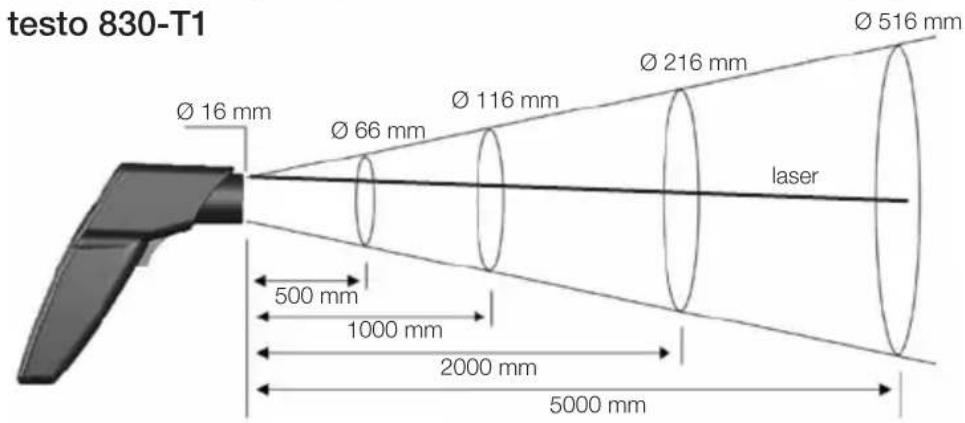
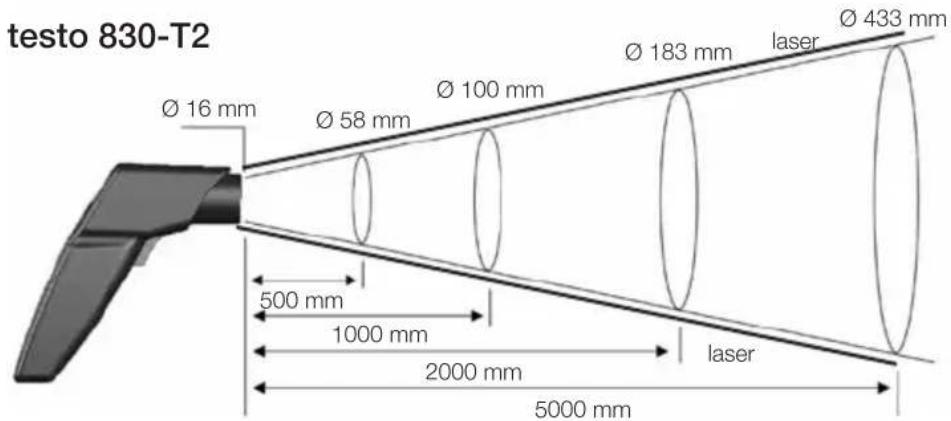
11.3 Measurement spot, Distance
A specific spot is determined depending on the distance from the measuring instrument to the object being measured.
Measurement optics (Ratio Distance : Measurement spot)
enfr
12. Information on contact measurement
Observe minimum penetration depth in immersion/penetration probes: 10 × probe diameter
- Avoid applications in corrosive acids or bases.
Do not use spring-loaded surface probes on sharp edges.
1. Informations generales
1 Maintain enonce 3 sec.
1 Maintain enonce 3 sec.
10. Questions/Reponses
IpoUHbI BO3dUwHbI 3OHN,
-60...+400°C 0602 1793
KoXaHbI 3aUHTbI
zhexion 05168302
Hakneika C NOCTOHHbIM
e=0,9505540051
KoHTaKTbIe n3MepeHn: He npOBOnTe n3MepeHn Ha o6OpyDoBaHN, HaxOJaUcEMc POn HApJxKeHnE.
IK-N3Mepenra:CobioaTe 6e3oNaChyIO DnCTaHcNIO OT ObOpydoBaHna, HaxOJaIeOcR NOd HapJxKeHEm.

CoxpaHHocTb npi6opa/rapaHTn:
- IcnoIb3yIte np6op TOnbKO no eO npMOMy Ha3HaueHnIO n B DoNYCTmBIX npedeJax n3MepaEMbIX napaMeTPOB. He ncNoIb3yIte cnly.
H36eraIte 3JIeKTPOMaRHTHO rN3JyUeHnra (HaNP.CBY, INdKyIOHHbIe HArpeBaTeIN), cTaNueCKOrO 3aprda, npeerpeBa u pe3Knx nepenadOB TEMnepaTypbl.
He xpaHnTe npnbop BmecTe c pactbOpntJlAmn (HaNP. aUeTOH).
OtKpbBaTb npn6Op dOnyCTmO TOnbKO ecN 3TO OROBapuBaETcBA HactoueHnCTpykun.
Ja3epHoe n3nyeHne!
He cMoTpnte B Ia3epHbI N3nyaTeJIb.

Co6IoudaIte npabVna yTnIin3aun:
Ytuiu3npyIe CTapbIe NIN NCIOJIb3OBAHHbIe AKKMyJIaTOpbl/6aTapeiKN TOJIbKO B INPeJHa3NaueHHbIX IIN 3TOrO MeCTax.
Pocm BicnAToCnyxBn np6op o6pHo Ham. Mbl no3a60TMcO ero npabNbHO yTNIIN3aUN.
4. Ha3naYeHne np6opa
testo 830 - komnakthbI NK-Tepmometp, npedha3naeHHbI dIy 6e3KoHTaKTHO I3Mepenra TeMnpaTpyi NobepxHocTN. NcnoIb3yra Testo 830-T2, BO3MOXHO DOnIOHNtJIbHOE KOHTaKTHOe I3MepeHne TEMpePaTpyi NOcOeDINHReEMbIM 3OHdOM.

EcnB npocce yctahOBKn He haxmTaB KHOpkn B TeeyHn 3 ckyHd,
npnbop nepenet K cneyioeMy nyHKty yCTaHOBOK.
1 Haxmnte u ydepknBaBte B TeueHne 3 ckyHKnOHky
- Pnp6op nepeiTeB pexm yctaHOKn.
2 YctahOBITE HIXHIOI OpaHNUO IpaHNUO INaHcN CnHHaJI TpeBOrN (ALARM): NII
U. YdepxnBaIe KhoNkY HaxaToI JIb6bICTpO YcTaHOBKn.
3 YctaHOBInTe BepxHIOI rpaHnU npaun CnHaJa TpeBOrN (ALARM):
JINn VepxnbaiTe KhoNkY hXaToi dIy 6bICTpoYcTaHOBKn.
4 BkIIOHTe (on)/OTKIOHTe (oFF): Onn
5 Bb6epnte pa3mepnoctb (^ nnn ^):0 nn
11.1 MeToD n3MepeHnA
IK-n3MepeHne -3TO ONTNueckoe n3MepeHne
CoepKnTe JINH3y B YNCTOTE.
He npoBOUNTe n3MepeHnC 3aqr3HeHHoN JIN 3aNoTeBWeJ LInH30J.
ПлоцадиЗмерени(Мжду пибором и n3меряемои NOBepxHOCtю)doJnxHa 6bIb CBO6OdHa OT: nbInи ГрзИ,ВlaIg (doXdb,pap) nIN ra3OB.
IK-N3MepeHne-3TO N3MepeHne NOBepxHOCTN.
EcnIOBepxHOCTb Tp3Haj, PbIbHaj, NOKpbTa HHeEM nT.D., pOBeJa I3MpeHnra, Bbl NOJyHTe TemNepaTyPbOBepXHOCTn, To eCt b Tp3n nT.D.
Ecn ynaKOBka npOyKTOB nHTaHn CBO6oHa, He npOBoIte n3MepeHn BO3dyHNOJIOCTm MEXdy npOyKTAMn UyNAKOkO.
Ecn nokaznna KpntuHbI, Bcerda CbepeTne IX, npOBeda KOHTaKThbIe n3MepeHn. Ppr n3MepeHn npOyKTob nITaHn, OCHOBhie n3MepeHn npoBOJrTc nOrpyXhblM/npoHnKaIOUIM KOHTaKTHbIM 3OHdOM.
Bpem aadTauu/NbIepxKn
EcInn3MeHnIacb TemnepaTypa OkpyxaIOUeRO B03dyxa (N3MeHnIOcb MeCTO n3MepHn, HapnIMep B/BHe NOMEuEHH), pnpOp Heo6xoIMMo BbIepKxTb B HOBoI TemnepaType OKo15 MmHyT nepei NK-n3MepHnAIM.
11.2 Ko3ΦΦnIeHT n3JIyueHn/3MnCCnn
Kaxdbm MaTePnAImeET CBOI KO3ΦPhiUeHT N3JyueHn, TO eCTb OHN N3JyauOT pa3InuHb yPOBeH bJIeKTPomarHnTHoH paDnauHn. Ha np6opax testo 830 npeDyCTaHOBLeH KO3ΦPhiUeHT 0.95. 3TO nDeaIbHa BELINuHa dIg N3MepeHn HEMetAnIOB (6ymaRn, KepAMnK, aJe6actpa, DepeBa, JAKOB N Kpack), PIACTNkA IN PPOdyKTob NITaHn.
I3MepeHne 6JIeCTaIIx MetaJIINueCKNX I OKCnIbIX IOBepXHOCTeI ORpaHnueHo, B CBA3N C INX Hn3KIM M HeOДHOPoIDhBM KOaΦmUHeNTOM N3JyEHHa.
B 3Tnx Cnyaex npimeHnTe CneuaHbIe HakJeKn Ira NOBepXHOCTN C fHKcnpoBaHHbIM KO3ΦnUHeTOM 3MnCCnn (KaT. N0 0554 0051). Ecn 3TO HeBO3MOxHO, PPOBeINTE KOHTaKTHbIe N3MepeHnI.
Ta6JIiua TINHbIX KO3ΦΦIeHTOB IN3JyEHHaP3JIuHbIX MaTePnaIIOB