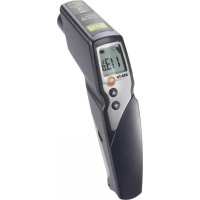
830 - Thermometer Testo - Free user manual and instructions
Find the device manual for free 830 Testo in PDF.


| Product type | Infrared and contact thermometer |
| Brand | Testo |
| Model | 830 |
| Category | Thermometer |
| Dimensions (W x D x H) | 190 x 75 x 38 mm |
| Power supply | 9 V battery |
| Battery life | Approx. 15 hours |
| Infrared measuring range | -30 °C to +400 °C |
| Infrared resolution | 0.1 °C |
| Infrared accuracy | ±1.0 °C or 1.0 % of reading (0 to +400 °C), ±1.5 °C or 1.5 % of reading (-20 to 0 °C), ±2.0 °C or 2.0 % of reading (-30 to -20.1 °C) |
| Contact measuring range (type K probe) | -50 °C to +500 °C |
| Contact resolution | 0.1 °C |
| Contact accuracy | ±0.5 °C + 0.5 % (at 22 °C) |
| Adjustable emissivity | 0.1 to 1.0 |
| Optics (distance-to-spot ratio) | 30:1 |
| Laser | Class 2, < 1 mW, 645-660 nm |
| Main functions | IR and contact measurement, backlight, auto-off, HOLD function, min/max alarm |
| Warranty | 2 years |
| Standard | CE |
| Operating temperature | -20 °C to +50 °C |
| Storage temperature | -40 °C to +70 °C |
| Cleaning | Housing with damp cloth, lens with water or alcohol |
| Safety | Do not measure on live components, avoid laser exposure, do not use in medical environment |
| Spare parts | 9 V batteries, spare probes (part no. 0602 0393, 0602 1793, etc.) |
| Included contact probe | Type K thermocouple (range -50 to +500 °C) |
Frequently Asked Questions - 830 Testo
User questions about 830 Testo
0 question about this device. Answer the ones you know or ask your own.
Ask a new question about this device
Download the instructions for your Thermometer in PDF format for free! Find your manual 830 - Testo and take your electronic device back in hand. On this page are published all the documents necessary for the use of your device. 830 by Testo.
USER MANUAL 830 Testo
Please read this document through carefully and familiarise yourself with the operation of the product before putting it to use. Keep this documentation to hand so that you can refer to it when necessary.
2. Product Description
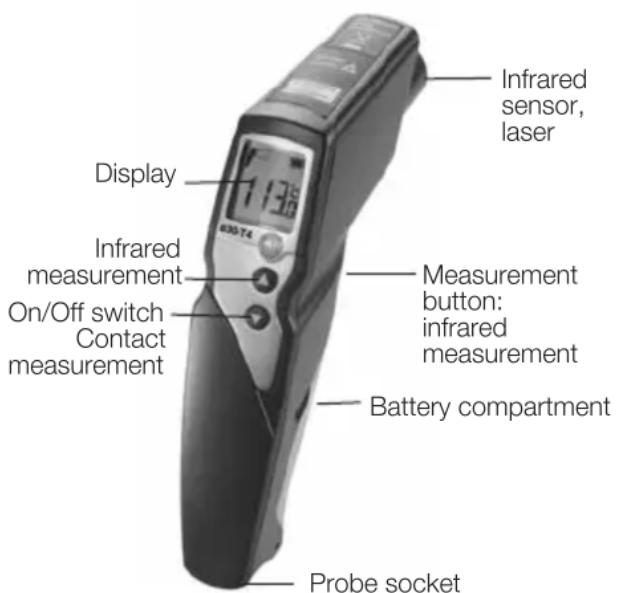
Accessories
Name Item no.
Water-tight
immersion/penetration
probe,
-60 to +400°C/
-76 to +752°F 0602 1293
Quick-reaction
surface probe.
-60 to +300^/
-76 to +572°F 0602 0393
Robust air probe,
-60 to +400^
-76 to +752°F 0602 1793
Leather protection
sleeve 0516 8302
Emissivity adhesive tape
= 0.9505540051
3. Safety Information

Avoid electrical hazards:
- Contact measurement: Do not measure on or near live parts. Infrared measurement: Please adhere to the required safe distance when measuring on live parts.

Preserving product safety/warranty claims:
- Operate the instrument properly and according to its intended purpose and within the parameters specified. Do not use force.
- Do not expose to electromagnetic radiation (e.g. microwaves, induction heating systems), static charge, heat or extreme fluctuations in temperature.
- Do not store together with solvents (e.g. acetone).
- Open the instrument only when this is expressly described in the documentation for maintenance purposes.

Laser radiation!
- Do not look into laser beam. Laser class 2.

Ensure correct disposal:
- Dispose of defective rechargeable batteries and spent batteries at the collection points provided.
- Send the instrument directly to us at the end of its life cycle. We will ensure that it is disposed of in an environmentally friendly manner.
4. Intended Use
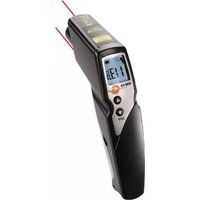
testo 830 is a compact infrared thermometer for the non-contact measurement of surface temperatures. A contact measurement can additionally be made with a connected probe.

Not suitable for diagnostic measurements in the medical sector!
5. Technical Data
| Feature testo 830-T4 | |
| Parameter °C/°F | |
| Infrared measurement range -30 to +400°C/-22 to +752°F | |
| Infrared resolution 0.1°C/0.1°F | |
| Infrared accuracy ±1.0°C/1.8°F or 1.0% of reading (+0.1 to +400°C/+32 to +752°F) (at 23°C/73°F) ±1.5°C/2.7°F or 1.5% of reading (-20 to 0°C/-4 to +32°F) +/- 1 digit ±2.0°C/3.6°F or 2.0% of reading (-30 to -20°C/-22 to -4°F) | |
| Emissivity 0.1 to 1.0 adjustable | |
| Infrared measurement rate 0.5s | |
| Temp. sensor Thermocouple Type K (attachable) | |
| Measurement range of temp sensor -50 to +500°C/-58 to +932°F | |
| Resolution of temp. sensor | 0.1°C/0.1°F |
| Accuracy of temp. sensor ±0.5°C/0.9°F+0.5% of reading (±1 digit) at rated temperature 22°C/72°F | |
| Measuring rate of temp. sensor | 1.75s |
| Optics (90% value) | 30:1 (regarding the distance of 1,0 m to measuring object typically)2 |
| Operating temperature | -20 to +50°C/-4 to +122°F |
| Transport / Storage temperature | -40 to +70°C/-40 to +158°F |
| Power supply | 9V block battery |
| Battery life | 15 h |
| Housing | ABS |
| Dimensions (LxHxB) | 190 x 75 x 38mm/ 7.5 x 3.0 x 1.5in |
| CE guideline | 2004/108/EEC |
| Warranty | 2 years |
| Laser | |
| Laser type | 2 x laser |
| Power | < 1 mW |
| Wavelength 645 to 660 nm | |
| Class | 2 |
| Standard | DIN NE 60825-1:2001-11 |
1 the larger value applies
^2 + Opening diameter of the sensor (16mm/ 0.6in)
6. Initial Operation
- Insert battery: See 9.1 Changing the battery.
7. Operation
7.1 Connecting probe
Connect temperature probe to probe socket. Observe + / - !
7.2 Switching on/off
- Switch on instrument: Press measurement button.
- All display segments light up briefly. The instrument changes to the infrared mode (lights up). The display light remains for 10 seconds every time a button is activated.
- Switch off instrument: Keep pressed until display darkens.
The device switches off automatically after 1 min (IR measure -ment view) or 10 mins (contact measurement view) without the button being pressed.
7.3 Measuring
! Observe information on infrared measurement (chapter 11) / contact measurement (chapter 12).
With IR measurement, the min./max. values are reset by pressing the measurement button, and with contact measurement, this is done when the device is switched off or when you switch to the IR measurement view.
- The instrument is switched on.
Infrared measurement
1 Start measurement: Hold down measurement button.
2. Locate object to be measured using laser point: Laser marks the upper and lower end of the measurement spot (at distance to measurment object from 1,0m ; see chapter 11.3 measurement spot, distance).
- The current reading is shown (2 measurements per second)
3 End measurement: Release button.
- HOLD lights up. The last measured value and min./max. value are saved until the next measurement.
- Switch between min., max. and recorded value: Press
Restart measurement: Press measurement button.
Contact measurement
- Temperature probe was connected before the measuring instrument was switched on.
1 Position contact thermometer in/on the measurement object and activate the measurement: Press
- The instrument changes to the contact measurement mode (fights up). The current reading is shown.
2 End the measurement: Pr ess
- HOLD lights up. The last measured value and min./max. value are saved until the next measurement.
Switch between min., max. and recorded value: Press
Restart measurement: Press
Back to infrared measurement view: Press measurement button.
Setting the emissivity
- Instrument is in the infrared measurement mode.
If no button is pressed for 3 s in the emissivity mode, the instrument switches to the infrared measurement mode.
1 Press for 3 s.
2 Set emissivity: Press.
- The instrument switches to the infrared measurement mode.
8. Settings
- Instrument is switched off
If no button is activated in the setting mode for 3 s, the instrument changes to the next mode.
1 Press for 3 s.
- The device switches to settings mode.
2 Set lower alarm value (ALARM): Press or Hold the button down to go forward quickly.
3 Set upper alarm value (ALARM): Press OK. Hold the button down to go forward quickly.
- Set alarm function on / oFF: Press O or O.
5 Select parameter (^ / ^) : Press or
- The device returns to IR measurement view.
The alarm function is only available for IR measurement. If the set alarm values are exceeded/not reached, a visual and acoustic alarm is output.
9. Service and Maintenance
9.1 Changing the battery
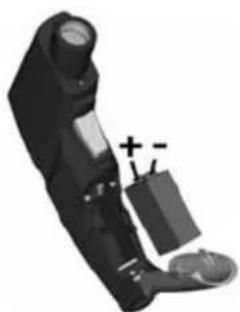
Instrument must be switched off!
1 Open battery compartment: Open up cover.
2 Remove used battery and insert new one. Observe + / - . The minus should be visible once the battery is inserted.
3 Close battery compartment: Close cover.
9.2 Clean instrument
Do not use abrasive cleaning agents or solutions.
Clean the housing with a damp cloth (soap water).
- Carefully clean the lens with water or cotton buds dipped in water or medical alcohol.
中
10. Questions and Answers
| Query Possible causes Possible solution |
| Display is no longer illuminated - Low battery. Change battery.▶ |
| lights up. - Battery empty. Change battery.▶ |
| Instrument cannot be - Battery empty. Change battery. switched on▶ |
| Infrared measurement mode: - Readings outside - - - lights up. measurement range. |
| Contact measurement mode: - Readings outside - - - lights up. measurement range. - No probe connected. Connect probe. - Probe damaged. Change probe.▶ |
If we have not answered your question, please contact your local distributor or Testo's Customer Service.
11. Information on infrared measurement
11.1 Measurement method
Infrared measurement is an optical measurement
- Keep lens clean.
- Do not measure with clouded lens.
- Keep measurement field (area between instrument and object being measured) free of interferences: no dust and dirt particles, no moisture (rain, steam) or gases.
Infrared measurement is a surface measurement
If there is dirt, dust, frost etc. on the surface, only the top layer will be measured, i.e. the dirt.
In the case of shrinkwrapped foodstuffs, do not measure in air pockets.
If values are critical, always subsequently measure using a contact thermometer. Particularly in the food sector, the core temperature should be measured with a penetration/immersion thermometer.
Adaptation time
If the ambient temperature changes (change of location, e.g. inside/outside measurement) the instrument needs an adaptation time of 15 minutes for infrared measurement.
11.2 Emissivity
Materials have different emissivities, i.e. they emit different levels of electromagnetic radiation. The emissivity of testo 830 is set in the factory to 0.95. This is the ideal value for measuring nonmetals (paper, ceramics, plaster, wood, paints and varnishes), plastics and food.
Bright metals and metal oxides are only suited to a limited extent to infrared measurement on account of their low or nonuniform emissivity.
- Apply emissivity enhancing layers such as varnish or emission adhesive tape (Item no. 0554 0051) to the object being measured. If this is not possible, measure with the contact thermometer.
Emissivity table of the most important materials (typical values)
| Material (Temperature) \( \varepsilon \) | |
| Aluminium, bright-rolled (170°C/ 338°F) 0.04 | |
| Cotton (20°C/ 68°F) 0.77 | |
| Concrete (25°C/ 77°F) 0.93 | |
| Ice, smooth (0°C/ 32°F) 0.97 | |
| Iron, polished (20°C/ 68°F) 0.24 | |
| Iron with cast skin (100°C/ 212°F) 0.80 | |
| Iron with rolled skin (20°C/ 68°F) 0.77 | |
| Plaster (20°C/ 68°F) 0.90 | |
| Glass (90°C/ 194°F) 0.94 | |
| Rubber, hard (23°C/ 73°F) 0.94 | |
| Rubber, soft grey (23°C/ 73°F) 0.89 | |
| Wood (70°C/ 158°F) 0.94 | |
| Cork (20°C/ 68°F) | 0.70 |
| Material (Temperature) \( \varepsilon \) | |
| Heat sink, black anodised (50°C/ 122°F) | 0.98 |
| Copper, lightly tarnished (20°C/ 68°F) | 0.04 |
| Copper, oxidised (130°C/ 266°F) | 0.76 |
| Plastics: PE, PP, PVC (20°C/ 68°F) | 0.94 |
| Brass, oxidised (200°C/ 392°F) | 0.61 |
| Paper (20°C/ 68°F) | 0.97 |
| Porcelain (20°C/ 68°F) | 0.92 |
| Black paint, matt (80°C/ 176°F) | 0.97 |
| Steel, heat-treated surface (200°C/ 392°F) | 0.52 |
| Steel, oxidised (200°C/ 392°F) 0.79 | |
| Clay, fired (70°C/ 158°F) | 0.91 |
| Transformer paint (70°C/ 158°F) | 0.94 |
| Brick, mortar, plaster (20°C/ 68°F) | 0.93 |
11.3 Measurement spot, Distance
A specific spot is determined depending on the distance from the measuring instrument to the object being measured.
Measurement optics (Ratio Distance : Measurement spot)
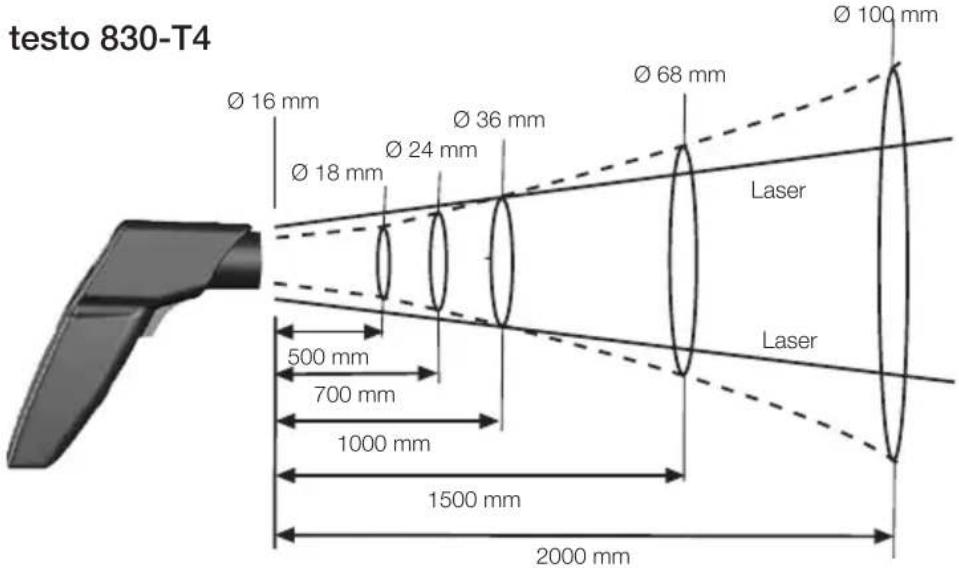
enfr
12. Information on contact measurement
Observe minimum penetration depth in immersion/penetration probes: 10 × probe diameter
Avoid applications in corrosive acids or bases.
Do not use spring-loaded surface probes on sharp edges.
1. Informations generales
10. Questions/Reponses
KoHTaKTbIe n3MepeHn: He npOBoIte n3MepeHn Ha obOpyIOBaHn, HaxOJaUcEMc rNdHaNPxKeHnE.
IK-n3mepeHn:Co6IIOdaTe 6e3oNaChyIO dNCTaHcNIO OT o6OpyIOBaHn, HaxOJaIeOcR NOI HApJxKeHnEM.

CoxpaHHocTb npnbopa/rapaHTn:
IcnoB3yIte np6op TolbKO no erO npMOMy Ha3HaueHnIO n B DoNcyTmblx npedexn3MepeMbx napametpoB. He ncnoB3yIte cnny.
H36eraIte 3JIeKTPomarHHTHO rN3JyHeHn (HaNP.CBY, INHyKUHOHHhe HArpeBaTei), cTAtuYeCKOrO 3apRJa, neperpeBa n pe3Knx nepenadOB TEMnepaTypbl.
He xpaHnTe npnbop BmecTe c pactbOpntjIaMn (HaNP. aUeToH).
OTKpbBaTbp6OpDOnyCTM0TOJbKOecn3TO OROBapNBaETCBAHACTOJIeMHCTpyKcnn.
Ja3epHoe n3nyeHne!
He cmOTpnte B Ia3epHbI n3nyaTeJIb. KJIacc Ia3epa 2.

Co6IoudaIte npabvna ytnin3aunn:
Ytun3npyTe CTapbIe NIN NCNOB3OBAHHbIe AKKymyIaTOpbI/6aTapeKn TOJbKO B INPeHa3HaueHHbIX DnIg 3TOrO MeCTax.
Ppocm BbICnA Tb OTCnyXnBnI np6Op 6paTHo Ham. Mbl n03a6OTmCra O erO npabNbHO yTNIN3aun.
4. Ha3naHene np6opa
testo 830 - komnakthbN IK-TepMometp, npedha3hauehhbI dny 6e3KoHTaKTHOU n3MepeHn TEmpeatpybI NOBepxHocTn. Bo3MOXHO DOJONHITeJIbHOE KOHTaKTHOE n3MepeHne TEmpeatpybI NOCDOEINHReEMbIM 3OHDM.

- KoHTaKTbI 3oHd TemnepaTypbI DOJXeH 6bITb NOKJIIOueH Do BKJIIOUeHIN npi6opa.
1 PnscIohnte n3MepntelbHyIO rOIOBky KOHTaKTHOrO 30Hda K O6beKtY n3MepeHnI aKTHBnpyTe n3MepeHnI: HaxmTe
-ПиборперейдтВ ржим контхьхизмерен(ropnt cIMBOI). OTo6paxaIoTcTeKyuSne n3mpeHHbte 3HaueHnra.
23aBepuNTe n3MepeHn: HaxmTe.
- TOpNT HAdnncb HOLD. NocJeHHee 3MepeHHoe 3HaueHne MmH./MaKc. 3HaueHncoxpaHraTcdo CNeDyIOUeO 3MepeHn.
IJIa IpeKJIIOueHnMexy MmH., MaKC. 3aINcaHHbIM 3HaueHHeM: HaxMITE
YtO6bI CHOBA HaayTb N3MepeHn: HaxMITE
ДяВОЗВРATAВржIMИК-ИЗМЕЧEN:HAXMITEKHONKY“ИЗМЕЧEN”. YCTAHOBKa KOaФнцeHTa N3JyueHry/AmnCCN.
-Пибов В рекиме ИК-измерши.
EcnB npocce yctaHOBKn KOaΦmneHTa He HaxnMaTb KhoNk B TeyeHne 3 ckynd, np6op nepeiTe K NK-n3MepenrM.
1 Haxmte n ydepxnbaiTe B teueHne 3 ckynd KhoNky.
2 YctaHOBnTe KO3ΦΦnIeHt: KhONkAMn n.
-ПиборперацьВрекИК-ИЗмерени.
8. YctaHOBKn/HaCTpOoiKn np6opa
-Пибор Вькlioун.
EcnB npocce yctahOBKn He haxmabKHOKN B TeeyHn 3 ckyH, np6op nepeiDet K CledyioeMy NHykTy yCTaHOBOK.
1 Haxmnte u ydepxnbaiTe B TeueHne 3 ckynd KhoNky
- Pnp6op nepeiTeB pexm yctaHOKn.
2 YctaHOBNTe HnXHIOI rpaHnU y nOaun CnHana TpeBOrN (ALARM): Nnn. YdepxNBaTe KhoNkY haxaToJ dIy 6bICTpOY cTaHOBKn.
3 YctaHOBNTe BepxHIOI rpaHnU y noaun CnHaJa TpeBOrN (ALARM): NIN VepXNBaTe KONKy HaxaToJ Dja 6bICTPOY YCTaHOBKN.
4 BkIIOHTe (on)/OTKIOHTe (oFF): O nnn
5 Bb6epnte pa3mepnoctb (^ nnn ^):0 nn
EcnBbI He HauJIN OTBET Ha BaI BOpOC, CBXKITecb C CeBnCHoCnyk60I testo.
11.Инфорmaцьо IK-n3mepenyx
11.1 MeToD n3MepeHnA
NK-n3MepeHne -3TO ONTNueckoe n3MepeHne
CoepKnTe JINH3y B YNCTOTE.
He npoBOUNTe n3MepeHnC 3aqr3HeHHo NJIN 3aNToBWeJ JINH30J.
ПлоцадиЗмереня (Мжду пибором и n3мерайю nobepxhoCTbIO)doJXHa 6blc CBO6OHa OТ: nbIи ng3N, BlaIg (doJxdb, nap) nIIN ra3OB.
IK-n3MepeHne-3TO n3MepeHne NOBepxHOCTn.
Ecni NOBepxHOCTb Tp3Ha, PbIbHa, NOKpbTa HHeem nT.D., PPOBeJa 13MepeHn, Bbl NoJIyHTe TemNepaTyP NOBepXHOCTn, To eCt b Tp3n nT.D.
Ecn ynaKOBka npOyKTOB nHTaHn CBO6oHa, He npOBoIte n3MepeHn BO3dyHoN pIoCTn MExdy npOyKTamn uYnaKOBkO.
Ecn noka3aHnKpNTuHbI, BcERda CBepeYte nx, npOBeJr KOHTaKThbIe n3MepeHn. Ppr n3MepeHn npOyKTOB pTahn, OCHOBhIE n3MepeHn npoBOJrTc nOrpyXhblM/npoHnKaIOUIM KOHTaKThbIM 3OHdOM.
Bpem aadTaaun/BydeppKn
EcInn3MeHnIacb TemnepaTypa OkpyxaIOUeRO B03dyxa (N3MeHnIOCb MeCTO n3MepHn, HapnIMep B/BHe NOMEuEHH), pnpOp Heo6xoIMMo BbIepxKaTb HOBoi TemnepaType OKo15 MmHyT nepei NK-n3MepHnAIM.
11.2 Ko3ΦΦnIeHT n3nyeHn/3MnCCnn
Kaxdb MaTePnAImeET CBoI KOaΦnUeHT N3JyueHn,TO eCTb OHn N3JyauOT pa3nHbI yPoBeH 3JIeKtpomarHnTHoH paHaun. Ha npnbopax testo 830 npeDyctahOBHeN Ko3ΦnUeHT 0.95. 3To nJealbHa BcInuHa dIra N3MepeHn HEmetAnIOB (6ymaH, KepamKn, aIe6acTpa, DepeBa, JaKOB n Kpack), pIaCTnKa n PPOdyKTOB nITAHn.
I3MepeHne 6IeCTauxMetaJIINueCKNXIOKcNDbIX IOBepxHOCTeOraHnueHo, B C8r3nC IN HIN3KIMM IHEODHOPoDHBIM KOaΦmUHeHTOM N3JyHeHn.
B 3Tnx Cnyaax npimeHnTe CneuaHbIe HaKJIeKN DnI NOBepXHOCTN C fHKcnpoBaHHbIM KO3ΦHnUHeHTo 3MnCCnn (KaT. No 0554 0051). Ecn 3TO HeBO3MOxHO, PPOBeINTE KOHTaKTHbIe N3MEpeHnI.
Ta6JIua TINHbIX KO3ΦΦnueHTOB IN3JyHeHHa3JIuHbIX MaTePnaIIOB

- Product Description
- Accessories
- Safety Information
- Avoid electrical hazards:
- Preserving product safety/warranty claims:
- Laser radiation!
- Ensure correct disposal:
- Intended Use
- Technical Data
- Initial Operation
- Operation
- Connecting probe
- Switching on/off
- Measuring
- Infrared measurement
- Contact measurement
- Setting the emissivity
- Settings
- Service and Maintenance
- Changing the battery
- Clean instrument
- Questions and Answers
- Information on infrared measurement
- Measurement method
- Adaptation time
- Emissivity
- Emissivity table of the most important materials (typical values)
- Measurement spot, Distance
- Information on contact measurement
- Informations generales
- Questions/Reponses
- Ha3naHene np6opa
- YctaHOBKn/HaCTpOoiKn np6opa
- 11.Инфорmaцьо IK-n3mepenyx
- MeToD n3MepeHnA
- Ko3ΦΦnIeHT n3nyeHn/3MnCCnn
Brand : Testo
Model : 830
Category : Thermometer