IAN 322143 - Barbecue Playtive - Free user manual and instructions
Find the device manual for free IAN 322143 Playtive in PDF.



User questions about IAN 322143 Playtive
0 question about this device. Answer the ones you know or ask your own.
Ask a new question about this device
Download the instructions for your Barbecue in PDF format for free! Find your manual IAN 322143 - Playtive and take your electronic device back in hand. On this page are published all the documents necessary for the use of your device. IAN 322143 by Playtive.
USER MANUAL IAN 322143 Playtive

$ git merge "git-base repository/.git"
Git commit: 1.0.227777
Commit: 1.0.227777
Commit: 1.0.227777
IAN322143_1901


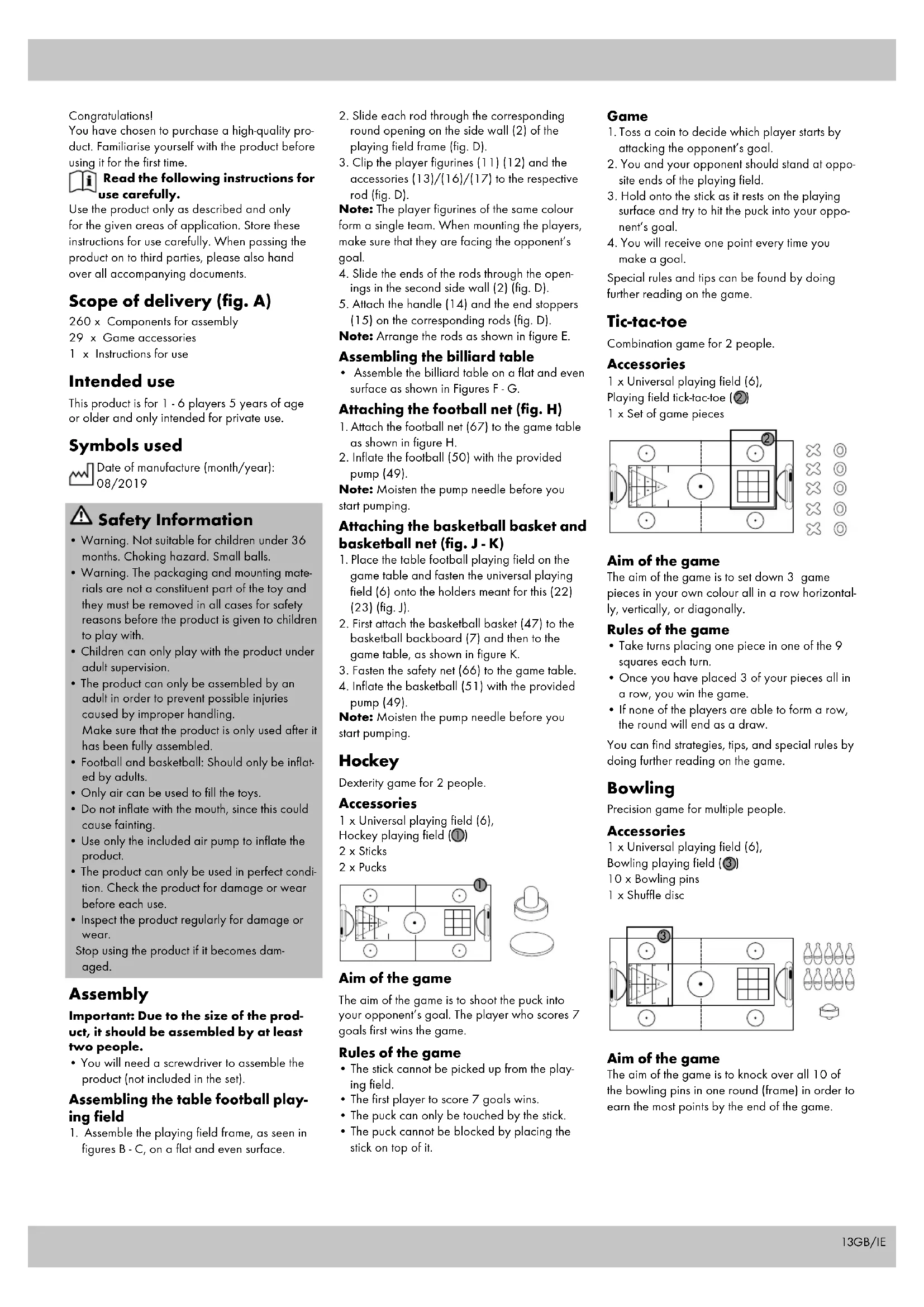
16-IN-1 MULTIFONTNSSPELISSCHT
TABLE DE JEUX MULTIFONTION 16 EN 1


IAN 322143_1901


DE AT CH
Lieferumfang 7
Scope of delivery 13
Intended use 13
Symbols used 13
Safety information 13
Assembly 13
Attaching the football net 13
Attaching the basketball basket and basketball net 13
Hockey 13
Tic-tac-toe 13
Bowling 13-14
Shuffleboard 14
Table football 14-15
Billiards 15
Table tennis 15-16
Chess 16
Draughts 16-17
Backgammon 17
Accessories and other games 17
Storage, cleaning 17
Disposal 17
Notes on the guarantee and service handling 17
FR BE
Indications concerning la
You have chosen to purchase a high-quality product. Familiarise yourself with the product before using it for the first time.
Read the following instructions for use carefully.
Use the product only as described and only for the given areas of application. Store these instructions for use carefully. When passing the product on to third parties, please also hand over all accompanying documents.
Scope of delivery (fig. A)
260 × Components for assembly
29 x Game accessories
1 x Instructions for use
Intended use
This product is for 1-6 players 5 years of age or older and only intended for private use.
Symbols used

Date of manufacture (month/year): 08/2019

Safety Information
- Warning. Not suitable for children under 36 months. Choking hazard. Small balls.
- Warning. The packaging and mounting materials are not a constituent part of the toy and they must be removed in all cases for safety reasons before the product is given to children to play with.
Children can only play with the product under adult supervision.
The product can only be assembled by an adult in order to prevent possible injuries caused by improper handling. Make sure that the product is only used after it has been fully assembled. - Football and basketball: Should only be inflated by adults.
Only air can be used to fill the toys. - Do not inflate with the mouth, since this could cause fainting.
- Use only the included air pump to inflate the product.
- The product can only be used in perfect condition. Check the product for damage or wear before each use.
- Inspect the product regularly for damage or wear.
Stop using the product if it becomes damaged.
Assembly
Important: Due to the size of the product, it should be assembled by at least two people.
- You will need a screwdriver to assemble the product (not included in the set).
Assembling the table football playing field
-
Assemble the playing field frame, as seen in figures B-C, on a flat and even surface.
-
Slide each rod through the corresponding round opening on the side wall (2) of the playing field frame (fig. D).
- Clip the player figurines (11) (12) and the accessories (13)/(16)/(17) to the respective rod (fig. D).
Note: The player figurines of the same colour form a single team. When mounting the players, make sure that they are facing the opponent's goal.
-
Slide the ends of the rods through the openings in the second side wall (2) (fig. D).
-
Attach the handle (14) and the end stoppers (15) on the corresponding rods (fig. D).
Note: Arrange the rods as shown in figure E.
Assembling the billiard table
- Assemble the billiard table on a flat and even surface as shown in Figures F-G.
Attaching the football net (fig. H)
-
Attach the football net (67) to the game table as shown in figure H.
-
Inflate the football (50) with the provided pump (49).
Note: Moisten the pump needle before you start pumping.
Attaching the basketball basket and basketball net (fig. J-K)
- Place the table football playing field on the game table and fasten the universal playing field (6) onto the holders meant for this (22) (23) (fig. J).
- First attach the basketball basket (47) to the basketball backboard (7) and then to the game table, as shown in figure K.
- Fasten the safety net (66) to the game table.
- Inflate the basketball (51) with the provided pump (49).
Note: Moisten the pump needle before you start pumping.
Hockey
Dexterity game for 2 people.
Accessories
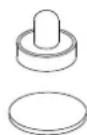
1 x Universal playing field (6), Hockey playing field (①)
2 × Sticks
2 x Pucks

Aim of the game
The aim of the game is to shoot the puck into your opponent's goal. The player who scores 7 goals first wins the game.
Rules of the game
- The stick cannot be picked up from the playing field.
The first player to score 7 goals wins.
The puck can only be touched by the stick. - The puck cannot be blocked by placing the stick on top of it.
Game
- Toss a coin to decide which player starts by attacking the opponent's goal.
- You and your opponent should stand at opposite ends of the playing field.
- Hold onto the stick as it rests on the playing surface and try to hit the puck into your opponent's goal.
- You will receive one point every time you make a goal.
Special rules and tips can be found by doing further reading on the game.
Tic-tac-toe
Combination game for 2 people.
Accessories
1 × Universal playing field (6),
Playing field tick-tac-toe (2)
1 x Set of game pieces

Aim of the game
The aim of the game is to set down 3 game pieces in your own colour all in a row horizontally, vertically, or diagonally.
Rules of the game
Take turns placing one piece in one of the 9 squares each turn.
Once you have placed 3 of your pieces all in a row, you win the game.
If none of the players are able to form a row, the round will end as a draw.
You can find strategies, tips, and special rules by doing further reading on the game.
Bowling
Precision game for multiple people.
Accessories
1 x Universal playing field (6),
Bowling playing field (3)
10 x Bowling pins
1 x Shuffle disc

Aim of the game
The aim of the game is to knock over all 10 of the bowling pins in one round (frame) in order to earn the most points by the end of the game.
Starting set-up

- Set the pins in the starting position (see fig.).
- Stand at the end of the game board opposite the pins.
Rules of the game
- Every player gets a maximum of two throws of the ball per frame.
- A game consists of 10 frames.
During the game, the knocked over bowling pins (points) are counted and added up to determine the total point count at the end of the game.
The player with the most points wins.
Game
- Toss a coin to decide which player will start first.
- Get the shuffle disc rolling across the game board surface towards the bowling pins.
- If some of the bowling pins are still standing after the first throw, then throw again.
- If you have knocked down all bowling pins after the first throw, you have earned a "strike". It is the next player's turn.
Strike
- You achieve a "strike" if you knock over all 10 bowling pins in the first throw.
- When you get a strike, you do not get to throw again.
- A strike counts for 10 points. The number of bowling pins that you knock over in the next two throws will be added to that as well.
Spare
- You achieve a "spare" if you knock over all 10 bowling pins by the second throw.
- A spare counts for 10 points plus the number of bowling pins you knock down in the next throw.
Open Frame
- You achieve an open frame if you don't knock down all of the 10 bowling pins in one frame.
- An open frame is worth the bowling pins you knock over in both throws.
Special rules, strategies, and tips can be found by doing further reading on the game.
Shuffleboard
Precision game for 2 people.
Accessories
1 x Universal playing field (6),
Shuffleboard playing board (3)
2× Shuffle discs, blue
2 x Shuffle discs, red

Aim of the game
The aim of the game is to earn points with your own shuffle discs, block your opponent, or knock your opponent's shuffle discs into the 10 OFF zone.
Game set-up
- Distribute the shuffle discs. Every player should receive 2 shuffle discs of the same colour.
- Toss a coin to decide which player will start first.
Rules of the game
- Players stay at one end of the playing field.
Every player must launch 2 shuffle discs towards the point triangle each round.
In order to earn points, a shuffle disc must stop fully within a field of the point triangle. - The number of points written in the field of the points triangle where the disc stops are counted.
Each player can try to knock their opponent's discs out of the points triangle. - When a player's shuffle disc ends up in the 10 OFF zone, 10 points will be subtracted from this player's score.
- Points are added to or subtracted from the players' scores after each round.
The game continues until the previously agreed point count has been reached (max. 90).
Game
- Position your disc at the end of the playing field opposite the points triangle (playing field ③).
-
Launch the shuffle disc so it slides across the table and repeat until all of the discs have been launched.
-
Count the number of points earned.
- Collect the discs and play the next round.
You can find strategies, tips, and special rules by doing further reading on the game.
Table football
Dexterity game for 2 people or 2 teams of two.
Accessories
1 × Table football playing field (1)
3 x Table footballs

Aim of the game
The aim of the game is to shoot a certain number of balls into your opponent's goal using the player figurines attached to the rotatable grip rods.
Rules of the game
- A set consists of at least 6 and no more than 10 goals.
- Once the set has been completed, players must switch sides. Both players/teams may agree not to switch sides.
The team of two that gets to put in the ball is the first to decide the position of the players. Each player plays with two rods and must stay in the same position for the entire game.
- When only 2 players play against each other, each player must play on all of the rods for their own team.
Game
- Toss a coin to decide which player or team will start first.
- If you get to put in the ball, throw in a table football ball through the ball serving hole on the playing field. The ball is "in play".
- Move the ball from row to row by rotating the respective rods.
- Continue to pass the ball until you are able to shoot for a goal.
Note: If the ball rolls past the goal line, this is scored as a goal even if the ball bounces back onto the playing field.
Putting the ball into play
- The ball is put into play at the beginning of the match or after a successful goal by throwing it through the ball serving hole. The person putting in the ball may try to influence the course taken by the ball.
- Players are not allowed to touch the ball once it is in play in the playing area.
The ball is in play as soon as it touches the playing field. Only then can the ball be played with.
The team putting in the ball cannot shoot a goal before the ball has touched a player.
The ball cannot be put in before all players have confirmed that they are ready to play.
Subsequent put ins
The following put ins are performed by the team/player against which the last goal was made.
In a match with several sets, the first put in is always done by the losing team.
Ball in play
- Once the ball has been put in, it must remain in play.
- A ball that rolls into the ball serving hole and then back onto the playing field is considered to be in play.
Ball out of play
- The ball is considered to be out of play when it touches an object outside of the playing area. It is put back into play by the player/ team that originally threw the ball in.
Dead ball
- A ball is considered a "dead ball" when it lies absolutely still and none of the player figurines can reach it.
- If the ball is declared a "dead ball" while it is located between the goal and the next 2-player rod (28), it is placed in the closest corner and rolled onto the playing field.
- If the ball is declared a "dead ball" while it is located between the two 5-player rods (30), it is put into play again through the serving hole by the team that originally put it in.
Time out
Every team/player gets two time outs per set.
A time out cannot exceed 30 seconds.
- A time out can only be used when the ball is not moving.
- During the time out, touching the ball is forbidden. A violation of this rule will lead to loss of the ball.
- During a time out, the players of a team can switch positions.
Turning the rods
- The rods cannot be spun. Any rotation of the player figurine before or after contact with the ball that exceeds 360^ is against the rules.
- If a ball set in motion by a spinning rod goes into the goal, it does not count as a goal.
- If a team shoots the ball into their own goal by spinning the rods, the goal counts toward the opponent's score.
Interference with the table
- Shaking or lifting the table is forbidden.
- Touching the opponent's rods is forbidden.
- Excessive force in passing or shooting is forbidden.
Technical foul
After one of the rules has been broken, a technical foul can be declared.
- The game is disrupted for a technical foul. The opponent receives the ball and is allowed a goal kick from the 3-player rod (29). As soon as the ball leaves the opponent's defence zone, is stopped, or goes into the goal, the technical foul is over. The ball is put back into play.
You can find strategies, tips, and special rules by doing further reading on the game.
Billiards
A game for 2 players or 2 teams of two promoting strategic thinking and dexterity.
Accessories
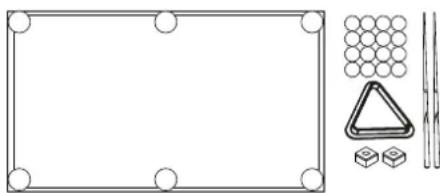
1 × Billiard playing surface (5)
2 x Cue sticks
1xTriangle
2x Cut chalks
16 x Billiard balls
Aim of the game
The aim of the game is to pocket all of your coloured balls (either all "solid" or all "stripe" coloured balls) in the holes before your opponent. The player who then properly pocket the 8 ball wins.
Starting set-up

- Place the triangle on the playing field with the tip in the middle.
- Arrange all of the balls except the white ball inside the triangle.
Note: Make sure that the 8-ball is located in the middle of the second row of the triangle. A solid and a stripe ball must be located at the two back corners of the triangle. The number one ball must be at the top of the triangle (see figure).
Rules of the game
- Players can play from any side of the playing field. The only exception is the opening shot.
- When striking the ball, the player should stand with at least one leg firmly planted on the ground.
- One player plays with the solid balls and the other with the stripe balls.
- The balls can only be hit once per turn and only with the tip of the cue.
- A strike can only be made once all of the balls have come to a rest.
- A player can only pocket the 8-ball once none of the other balls of the player's own colour are left on the playing field.
- The player must declare which hole they are aiming for before pocket the 8-ball.
If a player hits an 8-ball into a hole even though some of their balls are still left out on the playing field, they will lose the game.
The player will also lose the game if they pocket the 8-ball into a hole other than the one they have declared.
Game
- Remove the triangle and place it to the side.
- Place the white ball on an imaginary line (2) between the middle holes (1) and equally spaced between the tip of the triangle and the edge of the field directly across from the tip of the triangle.
- Strike the white ball so it hits the ball aligned at the tip of the triangle.
- In the process, try to pocket a solid or half ball in one of the holes.
Note: The ball you pocket first decides the colour you play with ("stripe" or "solid").
Note: If you pocket multiple balls of different colours during the opening shot, pick one of the colours.
Note: If you don't pocket a ball during the opening shot, but at least four of the balls have touched the edges of the field, you get another turn.
Note: If you don't pocket a ball during the opening shot and fewer than four balls touch the edges, it is then the other player's turn. The other player can decide to return the balls to the starting position and start all over again.
5. Once you pocket all of your balls, pocket the 8-ball.
Note: Before you take the shot, you must decide which hole you are going to shoot the 8-ball into.
Foul
There is a player switch after every foul.
- A fouloccurs when a ball jumps off the table.
- A foul occurs when the tip of the cue touches the white ball while it is in contact with a coloured ball.
- A foul occurs when the white ball is pocket.
- A foul occurs when the white ball doesn't touch any coloured balls.
- A foul occurs when the white ball touches a ball of the opponent first.
Table tennis
Reaction game for 2 people.
Accessories
1 x Universal playing field (6),
Game board for backgammon and chess
2 x Rackets
1 x Table tennis net
3 x Table tennis balls

Installing the table tennis net (fig. 1)
- Place the universal playing field (6) on the playing table with the "chess" and "backgammon" game board facing up.
- Insert the net rods (53a) in the holes (1) intended for this purpose on the frame.
- Attach the table tennis net (53b) on the net rods (53a).
Aim of the game
The aim of the game is to win more sets than your opponent.
Rules of the game
- A game generally consists of 3 sets. A maximum of 5 sets can be played.
- If the game remains tied, then the last set determines the winner.
Set
- The player who is the first to earn eleven points wins the set.
- Players switch sides after each set. In the last set, players switch sides once one player has earned five points.
Note: If you and your opponent both have ten points, the set will be extended. The person leading by two points wins the set.
Serve
- Throw the ball up vertically behind the table.
- Hit the ball so that it first bounces once in your half of the playing field and then in your opponent's half.
If the ball touches the net, it is considered a "net serve". Repeat the serve. - If you fail to hit the ball during a serve, your opponent will receive a point.
- You serve twice, then it is the other person's turn. When a set is extended, however, players take turns serving every time.
Rally
- Play the ball directly into the opponent's half, not into your own half first as you would with a serve.
- Only hit the ball if it first touches your half of the field.
- Don't hit the ball in mid-air before it touches your half ("volley").
-
The ball can only be allowed to touch the net or the net post before it reaches the opponent's half. Other body parts, objects such as clothing, or walls are not allowed. If the ball touches one of these, it counts as an error.
-
A point is only earned if the ball touches the top surface of the table and not the side.
Special rules and tips can be found by doing further reading on the game from the extensive literature available.
Chess
Strategic board game for 2 people.
Accessories
1 × Universal playing field (6),
Game board chess (4)
16 × Dark chess pieces
16 × Light chess pieces

16xPawns
4xRooks
4xKnights
4xBishops
2xQueens
2xKings
Aim of the game
The aim of the game is to capture the opponent's king or, in other words, put him in check mate.
Starting set-up
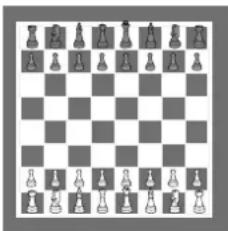
Each player has 8 pawns, 2 rooks, 2 knights, 2 bishops, 1 queen, and 1 king.
- Place the chess pieces in the starting position (see figure).
Note: The field is positioned for the players such that the left white rook should be standing on a black square. - The player with the white pieces starts the game. Only one piece can be moved per turn.
Note: The "castling" move is an exception (see the point about "Castling"). - Move the pieces according to their individual movement rules. If a player moves their piece to a square already occupied by an opponent's piece, they capture the opponent's piece.
- Remove the captured piece from the game board.
Movements of the chess pieces
Rook

Only move the rook horizontally or vertically. It cannot jump over other pieces.
Bishop

Only move the bishop diagonally across the game board. It cannot jump over other pieces.
Queen

The queen is the piece with the greatest freedom of movement. Move the queen horizontally, vertically, and diagonally. It cannot jump over other pieces.
King

Move the king one square in any direction, as long as the destination square is not already occupied or threatened by an opponent's piece.
Knight


Move the knight two fields in the horizontal or vertical direction and one field to the left or right. The knight is the only piece that can jump over other pieces (occupied squares).
Pawn
You can only ever move the pawn ahead one space.

Note: One exception is when capturing the opponent's pieces with the pawn. If the square diagonally in front of the pawn to the left or right is occupied by an opponent's
piece, the pawn can capture this piece.
The pawn can also make the following special moves:
Double move
When a pawn is moved for the first time, it can be moved two squares toward the front. The two squares must be empty.
En passant
This move can only be made directly after the double move.

If a player executes a double move and their pawn ends in a square right next to a pawn belonging to the opponent, the opponent can move their own pawn diagonally behind
the pawn that has just completed the double move and thus capture it "en passant".
Pawn promotion
If the player succeeds in moving a pawn to the last row on the opponent's side of the board, the pawn can be promoted to become a (another) knight, bishop, rook, or another queen, regardless of whether these pieces have already been captured during the course of the game.
Castling
- Castling is a single move in chess whereby two pieces can be moved at the same time.
- During this move, the king moves two squares to the left or right from its initial position and the rook jumps over the king and comes to rest in the neighbouring square.
Requirements for casting:
- Neither the king nor the respective rook can move at all during the game beforehand.
- There cannot be any pieces between the king and rook.
- The king cannot be threatened by check before castling and it cannot travel over or land in a square threatened by check during castling.
Chess
- When a player threatens an opponent's king, they declare "check".
- The threatened king must be immediately rescued from the situation by capturing the threatening piece or moving out of danger. If this is impossible, because the king would only be moving to another threatened square, then check mate has been achieved. The game has been lost.
- If a player is not threatened by check, but doesn't have any feasible moves, this is called a stalemate - the game ends as a draw.
The history of the game of chess goes back many hundreds of years. Today, chess is one of the most popular board games in Europe. There is a wide variety of types, tips, and strategies. There is a great deal of literature on chess.
Draughts
Strategic board game for 2 people.
Accessories
1 x Universal playing field (6),
Game board chess (4)
12 x Dark game pieces
12 x Light game pieces


Aim of the game
The aim of the game is to take away all of the other player's move options, so to block or capture all of the opponent's game pieces.
Game set-up
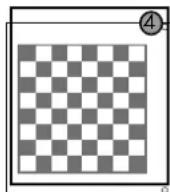
- The player lays out their pieces on the dark squares in the first three rows.
- Pieces can only be played on the black squares.
- Black starts.
Rules of the game
- The pieces can only be moved forward diagonally to the left or the right by one square.
When the opportunity arises, you must jump over the opponent's pieces. These pieces are then removed from the game board once the turn is over. You must attack if you can!
If one of your pieces reaches the last row of the opponent's side, this piece can be crowned a king. When this happens, a second piece is stacked on top of the first.
- The king can be moved diagonally either backwards or forwards by as many squares as desired. If you can capture multiple pieces belonging to the opponent with the king, you must do so.
- Once the king has captured the last piece, it must be placed on the square directly behind it.
If there are multiple options for capturing pieces, the player is free to decide which piece will be used.
- If it is no longer possible for a player to make a move, they have lost. When it is no longer possible for a player to win, the game ends in a draw.
Special rules, strategies, and tips can be found by doing further reading on the game.
Backgammon
Strategy/dice game for 2 people.
Accessories
1 × Universal playing field (6),
Backgammon game board (5)
15 x Dark game pieces
15 x Light game pieces
2 x Dice

Aim of the game
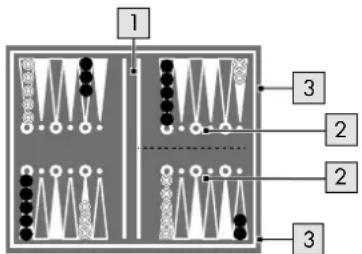
The aim of the game is to be the first player to move all of your pieces home (2) and then "bear off" (3) or move them out through a throw of the dice (see figure). The player who is the first to achieve this wins the game. Pieces that have been "hit" are placed on the middle line of the game board (bar) (1). During a turn, the stones must be moved in a certain direction and there are rules for movement.
Game set-up
Place the pieces in the starting formation (see figure).

- White plays from the top right in the anti-clockwise direction toward the bottom right "home" (and bears off from there).
- Black plays from the lower right in the clockwise direction toward its home (and then bears off).
Rules of the game
- A throw of the dice determines who will take the first turn. Each player must throw one die for this. The player with the higher number starts.
From now on, always throw both dice at once. - Decide now if you would like to make the move made possible by the dice with one or two pieces.
- You cannot move to a point containing one or more of the opponent's pieces.
- If you decide to use both die numbers for one piece, the numbers on the die cannot simply be added. You must play each number separately and the piece must land in a field where it is allowed each time.
In general, both numbers thrown must be played. If you can play one or the other, but not both, the die with the higher number must be played. - If you throw a double (the same number on both dice), the result is doubled. This means that this number is played four times with one, two, three, or four pieces.
- If a piece lands on a point containing just one of the opponent's pieces, this piece is hit and moved to the middle line (bar).
- A player with one or more of their own pieces on the bar must first bring the pieces back into play before they can make any moves with any of their other pieces. Pieces from the bar are put back into play via the opponent's home - based on the numbers rolled on the dice and the allowed points on the points 1 - 6.
Prime
One way to make the game more difficult for your opponent is to form a prime.
- Multiple adjacent points are each occupied by at least two pieces in order to block the opponent from landing in the area.
- If six neighbouring points are each occupied, this is called a full prime and constitutes an insurmountable blockade.
- Once all of the pieces have reached the home position, you can start bearing out. If a piece is hit, it must first be brought back into play and moved back to the home position before bearing out can continue.
- Pieces are born out by moving them out of the board from a home position via the last field. If the numbers on the dice are not enough to bear out, the pieces are simply moved by the corresponding number.
- If the number on the die is greater than the number required by the furthest piece, it can be removed.
The player wins once all of their stones have been born out.
You can find strategies, tips, and special rules by doing further reading on the game.
Accessories and other games
1 x Card deck
1 x Ring throwing game
1 x Horseshoe game
2 x Throwing rod with suction cup
Storage, cleaning
When not in use, always store the product clean and dry at room temperature.
Wipe clean with a dry cloth only.
IMPORTANT! Never clean the product with harsh cleaning agents.
Disposal
Dispos of the article and the packaging materials in accordance with current local regulations. Packaging materials such as foil bags are not suitable to be given to children. Keep the packaging materials out of the reach of children.

Dispose of the products and the packaging in an environmentally friendly manner.

The recycling code is used to identify various materials for recycling. The code consists of the recycling symbol - which is to reflect the recycling cycle - and a letter which identifies the material.
Notes on the guarantee and service handling
The product was produced with great care and under constant supervision. You receive a three-year warranty for this product from the date of purchase. Please retain your receipt.
The warranty applies only to material and workmanship and does not apply to misuse or improper handling. Your statutory rights, especially the warranty rights, are not affected by this warranty.
With regard to complaints, please contact the following service hotline or contact us by e-mail. Our service employees will advise as to the subsequent procedure as quickly as possible.
We will be personally available to discuss the situation with you.
Any repairs under the warranty, statutory guarantees or through goodwill do not extend the warranty period. This also applies to replaced and repaired parts.
Repairs after the warranty are subject to a charge.
IAN:322143_1901
GB Service Great Britain
Tel.: 0800 404 7657
E-Mail: deltasport@lidl.co.uk
IE Service Ireland
Tel.: 1890 930 034
(0,08 EUR/Min., (peak))
(0,06 EUR/Min., (off peak))
E-Mail: deltasport@lidl.ie
Felicitations!