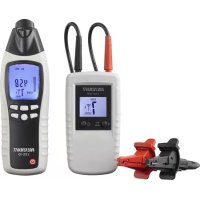
VOLTCRAFT LSG10 - Detector

LSG10 - Detector VOLTCRAFT - Free user manual and instructions

Find the device manual for free LSG10 VOLTCRAFT in PDF.

📄 104 pages English EN 💬 AI Question
Notice VOLTCRAFT LSG10 - page 28
View the manual : Français FR Deutsch DE English EN Nederlands NL

Download the instructions for your Detector in PDF format for free! Find your manual LSG10 - VOLTCRAFT and take your electronic device back in hand. On this page are published all the documents necessary for the use of your device. LSG10 by VOLTCRAFT.
USER MANUAL LSG10 VOLTCRAFT

Dear customer, Thank you for purchasing this product. This product complies with statutory national and European requirements. To maintain this status and to ensure safe operation, please observe these operating instructions! These operating instructions are part of this product. They contain important information on setting up and handling the product. Also consider this if you pass on the product to any third party. For this reason, retain these operating instructions for future reference. If there are any technical questions, please contact: www.conrad.com/contact

2. Explanation of symbols

The symbol with the lightning in the triangle is used if there is a risk to your health, e.g. due to an electric shock. The symbol with the exclamation mark in the triangle is used to indicate important information in these operating instructions. Always read this information carefully. The arrow symbol indicates special information and advice on operation.29

This product is intended to measure and display electrical voltages in the range of overvoltage category III (up to max. 300 V against earth potential, pursuant to EN 61010-1) and all lower categories. The measuring device and equipment must not be used in the overvoltage category CAT IV (e.g. at the low voltage installation source). - Displays direct and alternating voltages up to a maximum of 400 V - Contact-free cable search in powered-down and live installations in the wall, oor or ground - Trace the signal through transmitter and receiver - Find cable breaks and short circuits - Assign and nd fuses and their circuits - Find and trace metal pipes - Contact-free tracing of live lines through the receiver - Torch The cable detector consists of a transmitter and a receiver. Both devices are powered by a common 9 V alkaline battery block. The device may only be operated with the specied batteries. You can use as many as 7 cable detectors (transmitter and receiver) at the same time. The search signal is selective and can be encoded from 1 to 7. The devices must not be operated when open, i.e., with an open battery compartment or when the battery compartment cover is missing. Live measuring in damp rooms or in unfavourable ambient conditions is not permitted. Unfavourable ambient conditions include: - Damp environments or high air humidity - Dust or ammable gases, vapours or solvents - Thunderstorms or similar conditions such as strong electrostatic elds. For safety reasons, only use measuring cables or accessories which are adjusted to the specications of the multimeter. The product is intended for indoor use only. Do not use it outdoors. Contact with moisture, e.g. in bathrooms, must be avoided under all circumstances. For safety and approval purposes, you must not rebuild and/or modify this product. If you use the product for purposes other than those described above, the product may be damaged. In addition, improper use can result in short circuits, res, electric shocks or other hazards. Read the instructions carefully and store them in a safe place. Make this product available to third parties only together with its operating instructions. All company names and product names are trademarks of their respective owners. All rights reserved.30

  • 2x 9 V battery block
  • Operating instructions 1Up-to-date operating instructions Download the latest operating instructions at www.conrad.com/downloads or scan the QR code shown. Follow the instructions on the website.

5. Features and functions

  • The cable detector consists of a transmitter and a receiver. The transmitter generates a modulated current signal that creates an electromagnetic eld around a connected conductor. This electromagnetic eld is detected and evaluated by the receiver.
  • In the receiver, three receiver coils are used in automatic and manual mode. These enable position-independent operation.
  • All parameters are indicated on the transmitter and receiver display.
  • The receiver can be used as a contact-free voltage detector and a torch independently of the transmitter. A voltage test is only performed for grid alternating currents.
  • The display features a backlight to facilitate work in poorly lit conditions.
  • The transmitter and receiver switch off automatically if they are not operated for an extended period of time. This saves battery power and extends the period of operation. The cable detector can be used for DIY or professional applications.31

6. Safety instructions

Read the operating instructions carefully and especially observe the safety information. If you do not follow the safety instructions and information on proper handling in this manual, we assume no liability for any resulting personal injury or damage to property. Such cases will invalidate the warranty/guarantee. a) General information

  • The device is not a toy. Keep it out of the reach of children and pets.
  • Do not leave packaging material lying around carelessly. This may become dangerous playing material for children.
  • Protect the appliance from extreme temperatures, direct sunlight, strong jolts, high humidity, moisture, ammable gases, steam and solvents.
  • Do not place the product under any mechanical stress.
  • If it is no longer possible to operate the product safely, take it out of operation and protect it from any accidental use. Safe operation can no longer be guaranteed if the product: - is visibly damaged, - is no longer working properly, - has been stored for extended periods in poor ambient conditions or - has been subjected to any serious transport-related stresses.
  • Please handle the product carefully. Jolts, impacts or a fall even from a low height can damage the product.
  • Consult an expert when in doubt about the operation, safety or connection of the appliance.
  • Maintenance, modications and repairs must only be completed by a technician or an authorised repair centre.
  • If you have questions that remain unanswered by these operating instructions, contact our technical support service or other technical personnel. b) Connected devices
  • Also observe the safety and operating instructions of any other devices which are connected to the product. c) LED light
  • Attention, LED light: - Do not look directly into the LED light! - Do not look into the beam directly or with optical instruments!32 d) (Rechargeable) batteries
  • Correct polarity must be observed while inserting the (rechargeable) batteries.
  • The (rechargeable) batteries should be removed from the device if it is not used for a long period of time to avoid damage through leaking. Leaking or damaged (rechargeable) batteries might cause acid burns when in contact with skin, therefore use suitable protective gloves to handle corrupted (rechargeable) batteries.
  • (Rechargeable) batteries must be kept out of reach of children. Do not leave (rechargeable) batteries lying around as there is risk that children or pets swallow them.
  • All (rechargeable) batteries should be replaced at the same time. Mixing old and new (rechargeable) batteries in the device can lead to (rechargeable) battery leakage and device damage.
  • (Rechargeable) batteries must not be dismantled, short-circuited or thrown into re. Never recharge non-rechargeable batteries. There is a risk of explosion!
  • Never operate the measuring device when it is open. !RISK OF FATAL INJURY!
  • Do not leave at batteries in the device. Even batteries protected against leaking can corrode and thus release chemicals that may be detrimental to your health or destroy the device.
  • Do not leave batteries lying around carelessly. They could be swallowed by children or pets. If swallowed, consult a doctor immediately.
  • Remove the batteries if the device is not used for longer periods of time to prevent leaking.
  • Leaking or damaged batteries may cause alkali burns if they come in contact with the skin. Therefore, use suitable protective gloves.
  • Make sure that the batteries are not short-circuited. Do not throw batteries into the re.
  • Batteries must not be recharged or dismantled. Danger of explosion! e) Operation
  • The unauthorized conversion and/or modication of the product is inadmissible for reasons of safety and approval (CE).
  • Consult an expert when in doubt about the operation, safety or the connection of the device.
  • Meters and accessories are not toys and must be placed out of the reach of children.
  • On industrial sites, accident prevention regulations for electrical equipment and utilities must be followed.
  • In schools, training centres, computer and self-help workshops, the handling of meters must be supervised by trained personnel.
  • The voltages indicated in the technical data are nominal and must not be exceeded.
  • The voltage between the measuring instrument connection points and earth must never exceed 300 V DC/AC in CAT III.
  • The measuring probes must be removed from the measured object each time the measuring range is changed.
  • Be especially careful when dealing with voltages higher than 50 V AC or 75 V DC. Even at these voltages, it is possible to receive a fatal electric shock if you touch electrical conductors.
  • Check the measuring device and its measuring cables for damage before each measurement. Never carry out any measurements if the protecting insulation is defective (torn, ripped off, etc.)33
  • To avoid an electric shock, do not touch the connections/measuring points directly or indirectly when taking measurements.
  • When taking measurements, do not grip beyond the grip range markings on the measuring probes.
  • Do not use the device shortly before or after a thunderstorm.
  • Make sure that your hands, shoes, clothing, the oor, switches and switching components are dry.
  • Do not operate the product near: - Strong magnetic or electromagnetic elds. - Transmitter aerials or HF generators.
  • These may affect the measurement.
  • If you have reason to believe that the device can no longer be operated safely, disconnect it immediately and make sure it is not used unintentionally. It must be assumed that safe operation is no longer possible if: - There are visible signs of damage to the device. - The device no longer works. - The device was stored under unfavourable conditions for a long period of time. - The device was exposed to serious stress during transport.
  • Do not switch on the meter immediately after it has been brought from a cold to a warm environment. The condensation that forms may destroy the device. Allow the device to reach room temperature before switching it on.
  • Do not leave the packaging material lying around carelessly, as it may become a dangerous toy in the hands of children.
  • In addition, follow the safety information in each chapter of these instructions. f) Taking measurements
  • Do not exceed the maximum permitted input values. Do not touch any circuits or parts of circuits if there could be voltages higher than 50 V ACrms or 75 V DC present within them.
  • Before measuring, check the connected measuring accessories for damage such as cuts or cracks. Never use defective measuring equipment!
  • When taking measurements, do not grip beyond the grip range markings on the test probes.
  • Only take measurements when the battery and fuse compartment is closed.34

LSG-10 receiver: 1 Sensor probe 2 LED torch 3 Display 4 “NCV” button for switching between cable detection mode and contact-free AC voltage detection 5 Button for torch function (On/Off, switches off automatically after approx. 1 min.) 6 Down button for manual sensitivity settings 7 MODE buttons for toggling between automatic and manual mode 8 Button for switching the beep tones and backlight on and off 9 Up button for manual sensitivity settings 10 Power button (On/Off) 11 Battery compartment (rear side) LSG-10B transmitter 12 “Phase/+” connection socket 13 Connection socket reference potential (earth) 14 Display 15 Button for signal level settings (level I, II or III) and backlight (press for 2s) 16 Power button (On/Off) 17 Battery compartment (rear side) LSG-10 receiver display: a Signal strength display b Grid voltage indicator c Display for manual sensitivity selection d Transmission code display e Signal level display (I, II or III) f Acoustic tones are disabled g Signal strength display h Sensitivity display (many arches = low sensitivity; few arches = high sensitivity) i Backlight enabled j Automated sensitivity selection enabled k Battery status indicator (4 bars = battery full; <1 bar = battery empty) l Contact-free AC voltage detection enabled LSG-10B transmitter display m Voltage display n Transmission code display o Signal level (I, II or III) display p Battery replacement indicator q Grid voltage indicator36

a) Switching the devices on and off Press the power button (10 or 16) to switch on the devices. To switch the devices off, hold down the power button (10 or 16) for about 2 seconds. Note: Before working with the cable detector, insert the enclosed batteries. b) Measuring methods The cable detector can be operated in three different modes. The receiver has a visual and an audible indicator in all modes.

  • Automatic Mode Automatic mode facilitates fast cable detection. No settings need to be congured. The receiver automatically sets the sensitivity to achieve the best measuring results.
  • Manual Mode Manual mode is ideal for selecting cables or performing measurements at a higher sensitivity. The sensitivity must be set manually. Press “MODE” to switch to manual mode. “SENSE” will be displayed. The arrows (6 and 9) are used to set sensitivity. The arches displayed correspond to the sensitivity (few arcs = high sensitivity, many arches = low sensitivity). Pressing the “MODE” button again will take you back to automatic mode.37
  • Contact-free AC grid voltage detection (“NCV”) The receiver makes it possible to nd and follow grid-voltage conducting cables in walls, under plaster, etc. The signal strength is indicated on the left-hand side of the display. More bars indicate a stronger AC signal. To activate this function, press the “NCV” button (4). Pressing the button again will take you back to automatic mode.
  • Singe-Pole Measurement The cable detector can also follow a signal in interrupted circuits by using a high-frequency input signal. This method makes it possible to nd cable breaks, cable knots, loose outlets, etc. The device must be connected to a cable. The reference potential is implemented through a known earth potential (water line, heating pipe, etc.). Note: - The detection depth is 0–2 metres, depending on the wall material. - The applicable safety provisions for working with voltages must be followed.
  • Two-Pole Measurement Two-pole signal tracing is used for correctly connected electrical circuits without an error point or for localising fuses, line courses, etc. It can be performed on powered-down or live cables. The transmitter is voltage-proof up to 400 V. The connection must always be between phase (L1) and neutral (N). When the protective conductor (PE) is used, proper function of the protective conductor must be assured. Advance tests are not required.38 Note: - If the current error protection switch is triggered when the transmitter is connected, a low error current is likely causing the trigger to switch rather than the test current. Have the system checked by an electrician. The applicable safety provisions for working with voltages must be followed. - The detection depth is 0–0.5 metres, depending on the wall material. Switching the signal level from level I to III increases the signal range by about ve times its initial value. c) Device Functions
  • Display backlight The display features a backlight to allow you to work in poorly lit environments. To switch on the transmitter (LSG-10B) backlight, hold down the button with the light icon (15) for about 2 seconds. Repeat this step to switch the backlight off. Switch off the display backlight manually when you no longer need it. Briey press the button with the light icon (8) on the receiver (LSG-10). Repeat this step to switch the backlight off. Switch off the display backlight manually when you no longer need it.
  • Switching on the torch The receiver features a built-in LED torch. Press the button with the torch icon (5) to switch the torch on or off. After approx. 1 minute, the LED light will switch off automatically to protect the battery.
  • Disabling acoustic signals on the receiver By default, acoustic signals are always on. These signals can be switched off for use in quiet areas (e.g. ofces, theatres, etc.). Hold down button with the sound icon (8) for about 2 seconds. The display will show a crossed-out speaker symbol. To switch acoustic signals back on, hold down the button again for about 2 seconds. The speaker symbol will disappear.
  • Auto power off function The transmitter and receiver switch off automatically after a certain time if no button is pressed. This function protects the battery, saves battery power and extends the service life. Auto-off time for receiver: approx. 10 minutes. Auto-off time for transmitter: approx. 1 hour.39 d) Setting the Signal Code The default setting for the signal code is 1. If you want to use several transmitters in one cable test, the transmitter code can be changed to a value between 1 and 7.
  • To set the signal code, proceed as follows: Switch off the transmitter. Hold down the “LEVEL” (15) button and turn on the transmitter. Then release the power button (16). The pre-determined signal code will appear on the display. Now release the “LEVEL” button. Press the “LEVEL” button again to switch to the next code. When you have set the desired code, briey press the power button (16). The transmitter will return to the normal operating mode. The selected code is now active and will appear on the display. e) Performing Test Measurements Before using the cable detector for the rst time, familiarise yourself with its function. This works best with a simulated error source. Take a piece of 3-pole installation cable (approx. 5 meters) and attach it temporarily to a wall that is accessible from the front and back. Remove the jacket isolation approx. 1.5 m away from the cable end. Cut one of the cable’s conductors. Connect the transmitter to the test cable as indicated. Connect the interrupted conductor to the red measuring socket, and then connect the other conductors to the black socket. Also connect the black socket to the earth potential. Switch on the transmitter and receiver. Move the receiver along the cable until the interruption is detected. Repeat this on both sides of the wall. For optimal test results, vary the signal strength at the transmitter or the sensitivity at the receiver (manual mode).40 f) Application examples The following are examples of the applications the cable detector can be used for:
  • Tracing Cables/Finding Outlets Switch off the fuse and power down the electrical circuit. The protective and neutral conductors must be properly connected. Switch on the transmitter and connect it to phase and the protective conductor (earth) as illustrated. Move the receiver’s sensor head along the wall. Note: Crossing or parallel cable branches can also be detected with this method.
  • Finding Cable Breaks Switch off the fuse and power down the electrical circuit. Proceed as described for the test measurement. Connect the lines you do not need to the same socket with the earth. Move the receiver over the wall in a circular motion until you have found the interruption. Note: The cable break must be high-impedance (>100 kOhm).41
  • Finding Cable Breaks with 2 Transmitters Switch off the fuse and power down the electrical circuit. This method makes it possible to locate the error from two sides. A different signal code is set for each transmitter. The receiver can be used to determine the respective signal direction. The transmitter number is indicated accordingly. Advantage: The two search signals will not interfere with each other. When you have found the location of the fault, the receiver will no longer show any signal code, because both signals have the same strength. Note: The cable break must be high-impedance (>100 kOhm).
  • Finding Errors in Electrical Floor Heating Ensure that there is no insulating foil/mat with an earth connection above the heating wires. If required, disconnect this earth connection before measuring, or the error site will not be easy to locate. The signal should be fed from both sides. For best results, use a second transmitter unit with a different signal code.
  • Finding Cable Knots in Installation Tubes Switch off the fuse and power down the electrical circuit. Power down any other cables in the tube and connect them to the earth potential. Insert a cable probe (copper wire) or a draw wire up to the bottleneck of the installation tube.42 Connect the cable probe with a transmitter socket. Connect the second measuring socket to the earth potential. Determine the error site by moving the receiver in slow circles. The sensitivity can be adapted accordingly.
  • Finding Fuses and Electrical Circuits Observe safety provisions when measuring under grid voltages! Connect the transmitter to a live grid outlet at the phase (L1) and neutral (N) conductors. Trace the search signal in the sub-distributor. Where required, reduce the sensitivity to nd the right fuse. Turn the receiver by 90° longitudinally to reliably detect the different circuit breakers (solenoid coil direction). To achieve a better result, you should measure right at the connections. Warning! The cover must only be removed by electricians.
  • Finding Short Circuits in Cables Switch off the fuse and power down the electrical circuit. Connect the transmitter to the damaged cables as indicated. Note: The short circuit must be low-impedance (<20 Ohm). If necessary, check this again with a multimeter.43 If the line resistance exceeds 20 Ohm, you can try using the search method described for a cable break.
  • Tracing Installer Water Pipes Disconnect the water pipes to be traced from the potential balancer rail. Switch off the fuse and power down the system. Connect one measuring socket of the transmitter to the potential balancer. Place the second connection right on the water pipe/metal pipe to be traced. Trace the pipe’s course with the receiver.
  • Finding Heating Tubes in the Floor For optimal results, the heating pipes should be disconnected from the earth connection. Connect the transmitter to the heater’s metal pipe and an earth connection. Note: Suitable earth connections are any power outlet protective conductors. Trace the pipe’s course with the receiver.44
  • Localising a Complete Electronic Installation Note: Switch off the fuses and power down the whole system. This measurement requires manipulating the main electrical distribution system and must only be performed by an electrician. With the cable detector, all present outlets and cables can be determined and checked for contact. Remove the main distribution bridge between the protective conductor “PE” and the neutral conductor “N”. Connect the transmitter to the distribution main of “N” and “PE”. The neutral conductor can be traced through the complete system with the receiver.
  • Tracing Lines at a Deeper Position Switch off the fuse and power down the electrical circuit. For the two-pole measuring method, interference signals from nearby cables can inuence readings. This is reected in a lower search depth. To prevent this problem, you can use an additional power cable for the return (e.g., an extension, cable drum, etc.).45 The distance between the lines in either direction must be at least 2 metres to ensure that the electrical eld can spread sufciently.
  • Tracing Lines in the Ground Switch off the fuse and power down the electrical circuit. The distance between the clamp or earth cable and the connected earth potential must be as large as possible. When the distance is too small, the earth cable cannot be detected reliably. Move the receiver over the ground very slowly. The highest signal strength indicates the course of the earth cable. The signal strength decreases in line with the distance.
  • Increasing Sensitivity when Measuring under Voltage Note: Observe safety provisions when measuring under grid voltages! For the two-pole measuring method under voltage, interference signals from nearby cables can inuence readings. This is reected in a lower search depth. To prevent this problem, you can use an additional power cable for the return (e.g., an extension, cable drum, etc.). The distance between the lines in either direction should be at least 2 metres. This ensures that the electrical eld can spread sufciently and the auxiliary line does not inuence the search signal. Connect the transmitter to a connection at the outlet to be found.46 The second connection can be attached, e.g., to a cable drum connected to another outlet in the same circuit. This greatly increases the sensitivity.47
  • Identication of Placed Power Cables Switch off the fuses and power down the electrical circuits. The different wires in the cable must be twisted on one side so that they are electrically conductive. Connect the transmitter with two poles to the cable to be tested at the open cable side. When several transmitters are used, every transmitter needs a separate signal code. Move the receiver along the cable’s twisted side. The respective signal code for identifying the cable will be shown on the display.
  • Finding an Interruption in Grid Lines This test does not require a transmitter. The mains cable must be under a mains voltage. Place the transmitter into contact-free voltage test mode (“NCV”). Move the receiver along the mains cable, starting at the outlet. When the mains voltage is recognised, a signal will sound and the bar display will be activated. When the break is reached, the sound will turn off and the bar display will disappear. Note: The tone pitch and number of bars depends on the distance and voltage of the mains cable. Repeat the test with the mains plug turned by 180°. This prevents overlooking an interruption of the neutral conductor. A higher tone is no replacement for a precise voltage measurement. A reliable voltage measurement is only possible with a suitable measuring device with a value display.48 g) Inserting and changing the batteries The device requires a 9 V battery (e.g. 1604A). Insert a new, charged battery prior to rst use or when the battery change symbols appear on the display. Proceed as follows to insert or change the batteries: 1 Separate the connected measuring lines from the measuring circuit and the measuring device. Switch off the device. 2 Open the battery compartment on the rear. 3 Replace the empty battery with a new battery of the same type. Place the new battery into the battery compartment (11 or 17), observing the correct polarity. 4 Close the housing carefully. h) Troubleshooting In purchasing this cable detector, you have acquired a product that has been designed using the latest technology. Nevertheless, problems or errors may still occur. The following section shows you how you can eliminate possible malfunctions yourself. Error Possible cause Remedy The device does not work. The battery is empty. Check the battery status. No or very weak output signal from the transmitter. The internal fuse is defective. Replace the batteries. Check the fuse in the LSG-10B transmitter: The integrated fuse protects the transmitter from improper operation or overload. The ceramic high-performance fuse must only be replaced by a specialist. The following section explains how to reliably recognise a defective fuse: Disconnect all the measuring lines from the measuring circuits. Switch on the transmitter and select signal level 1. Connect a measuring cable to the red measuring socket. Switch on the receiver and move the sensor tip to the measuring cable. Plug the open end of the measuring line into the black measuring socket on your transmitter. If the signal level doubles, the fuse is functional. If the signal level at the receiver does not change, the internal fuse is defective.49

9. Care and cleaning

Do not use any aggressive cleaning agents, rubbing alcohol, or other chemical solutions as they can cause damage to the housing and functioning of the product.

  • Disconnect the product from the mains before each cleaning.
  • Clean the product with a dry, bre-free cloth.

a) Product Electronic devices are recyclable waste and must not be disposed of in the household waste. At the end of its service life, dispose of the product in accordance with applicable regulatory guidelines. Remove any inserted (rechargeable) batteries and dispose of them separately from the product. b) (Rechargeable) batteries You as the end user are required by law (Battery Ordinance) to return all used (rechargeable) batteries. Disposing of them in the household waste is prohibited. Contaminated (rechargeable) batteries are labeled with this symbol to indicate that disposal in domestic waste is forbidden. The designations for the heavy metals involved are: Cd = Cadmium, Hg = Mercury, Pb = Lead (name on (rechargeable) batteries, e.g. below the trash icon on the left). Used (rechargeable) batteries can be returned to collection points in your municipality, our stores or wherever (rechargeable) batteries are sold. You thus fulll your statutory obligations and contribute to the protection of the environment.50

Manual assistant
Powered by ChatGPT
Waiting for your message
Product information

Brand : VOLTCRAFT

Model : LSG10

Category : Detector