868625 - Drill SILVERLINE - Free user manual and instructions
Find the device manual for free 868625 SILVERLINE in PDF.



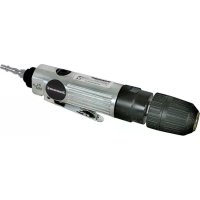
| Product Type | Straight pneumatic drill |
| Brand | Silverline |
| Model | 868625 |
| Maximum working pressure | 6.3 bar |
| Air consumption | 113 L/min |
| Air inlet | 1/4" BSP connection (with quick couplings EN-6 and EQ-4) |
| Minimum hose diameter | 9.5 mm |
| No-load speed | 20000 min⁻¹ |
| Chuck capacity | 9.5 mm |
| Chisel shank | 10.2 mm (round) |
| Weight | 0.70 kg |
| Sound pressure level | 89.7 dB(A) |
| Sound power level | 100.7 dB(A) |
| Sound uncertainty | K = 3 dB |
| Vibration value (a h) | 0.89 m/s² |
| Vibration uncertainty | K = 1.5 m/s² |
| Warranty | 3 years |
| Power source | Compressed air |
| Rotation direction | Reversible |
| Compatible accessories | Drills, burrs, brushes (max shank 9.5 mm) |
| Maintenance | Regular cleaning and lubrication |
| Safety | Mandatory protective equipment (glasses, gloves, ear muffs) |
Frequently Asked Questions - 868625 SILVERLINE
User questions about 868625 SILVERLINE
0 question about this device. Answer the ones you know or ask your own.
Ask a new question about this device
Download the instructions for your Drill in PDF format for free! Find your manual 868625 - SILVERLINE and take your electronic device back in hand. On this page are published all the documents necessary for the use of your device. 868625 by SILVERLINE.
USER MANUAL 868625 SILVERLINE
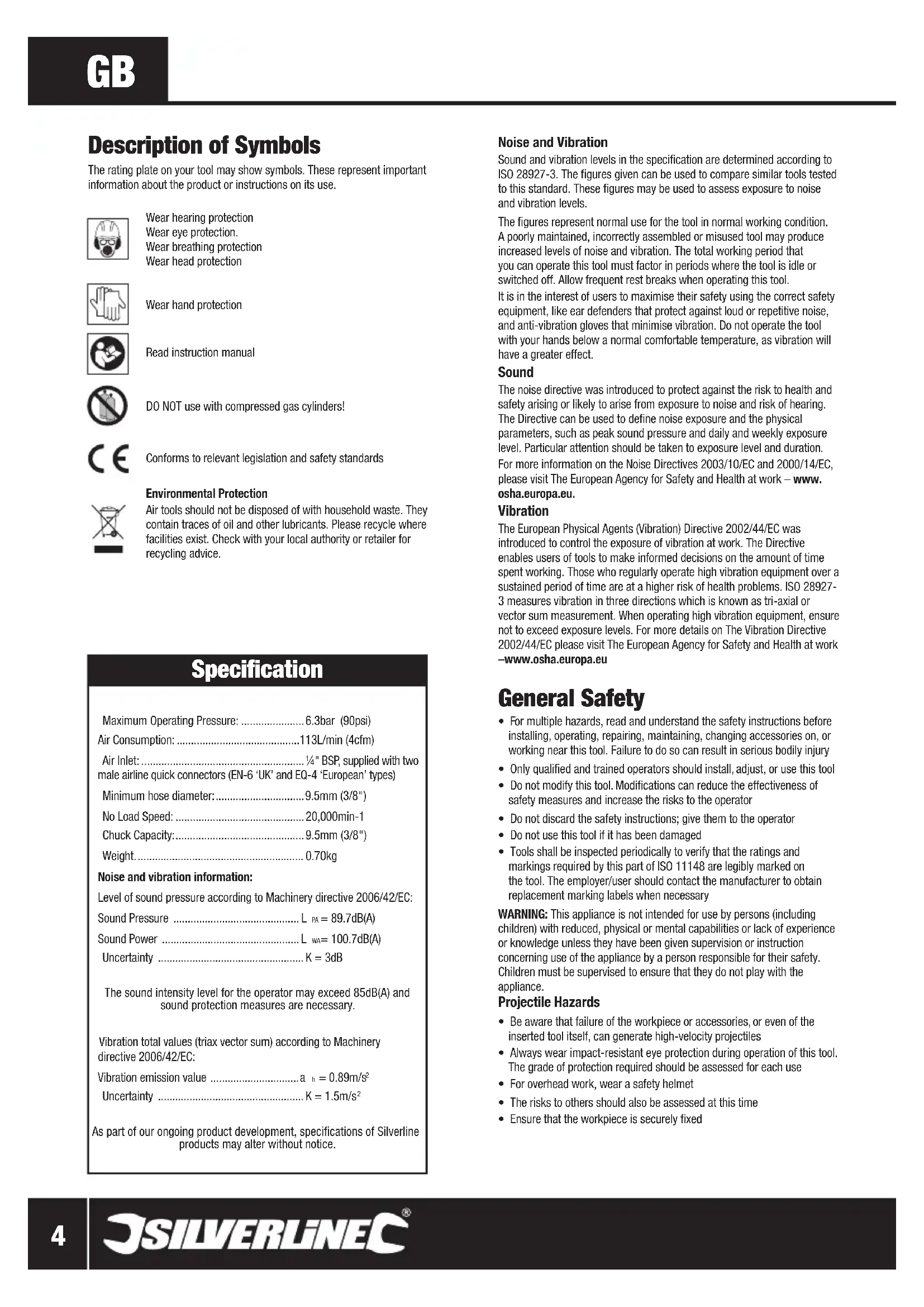
Description of Symbols
The rating plate on your tool may show symbols. These represent important information about the product or instructions on its use.

Wear hearing protection
Wear eye protection.
Wear breathing protection
Wear head protection

Wear hand protection

Read instruction manual

DO NOT use with compressed gas cylinders!

Conforms to relevant legislation and safety standards

Environmental Protection
Air tools should not be disposed of with household waste. They contain traces of oil and other lubricants. Please recycle where facilities exist. Check with your local authority or retailer for recycling advice.
Specification
Maximum Operating Pressure: 6.3bar (90psi)
Air Consumption: 113L/min (4cfm)
Air Inlet: 1/4" BSP, supplied with two
male airline quick connectors (EN-6 'UK' and EQ-4 'European' types)
Minimum hose diameter: 9.5mm (3/8")
No Load Speed: 20,000min-1
Chuck Capacity: 9.5mm (3/8")
Weight 0.70kg
Noise and vibration information:
Level of sound pressure according to Machinery directive 2006/42/EC:
Sound Pressure ....L PA = 89.7dB(A)
Sound Power .... L wa=100.7dB(A)
Uncertainty K = 3dB
The sound intensity level for the operator may exceed 85dB(A) and sound protection measures are necessary.
Vibration total values (triax vector sum) according to Machinery directive 2006/42/EC:
Vibration emission value ....a h = 0.89m/s²
Uncertainty K = 1.5m/s ^4
As part of our ongoing product development, specifications of Silverline products may alter without notice.
Noise and Vibration
Sound and vibration levels in the specification are determined according to ISO 28927-3. The figures given can be used to compare similar tools tested to this standard. These figures may be used to assess exposure to noise and vibration levels.
The figures represent normal use for the tool in normal working condition. A poorly maintained, incorrectly assembled or misused tool may produce increased levels of noise and vibration. The total working period that you can operate this tool must factor in periods where the tool is idle or switched off. Allow frequent rest breaks when operating this tool.
It is in the interest of users to maximise their safety using the correct safety equipment, like ear defenders that protect against loud or repetitive noise, and anti-vibration gloves that minimise vibration. Do not operate the tool with your hands below a normal comfortable temperature, as vibration will have a greater effect.
Sound
The noise directive was introduced to protect against the risk to health and safety arising or likely to arise from exposure to noise and risk of hearing. The Directive can be used to define noise exposure and the physical parameters, such as peak sound pressure and daily and weekly exposure level. Particular attention should be taken to exposure level and duration. For more information on the Noise Directives 2003/10/EC and 2000/14/EC, please visit The European Agency for Safety and Health at work – www.osha.europa.eu.
Vibration
The European Physical Agents (Vibration) Directive 2002/44/EC was introduced to control the exposure of vibration at work. The Directive enables users of tools to make informed decisions on the amount of time spent working. Those who regularly operate high vibration equipment over a sustained period of time are at a higher risk of health problems. ISO 28927-3 measures vibration in three directions which is known as tri-axial or vector sum measurement. When operating high vibration equipment, ensure not to exceed exposure levels. For more details on The Vibration Directive 2002/44/EC please visit The European Agency for Safety and Health at work
- www.osha.europa.eu
General Safety
- For multiple hazards, read and understand the safety instructions before installing, operating, repairing, maintaining, changing accessories on, or working near this tool. Failure to do so can result in serious bodily injury
- Only qualified and trained operators should install, adjust, or use this tool
- Do not modify this tool. Modifications can reduce the effectiveness of safety measures and increase the risks to the operator
- Do not discard the safety instructions; give them to the operator
- Do not use this tool if it has been damaged
- Tools shall be inspected periodically to verify that the ratings and markings required by this part of ISO 11148 are legibly marked on the tool. The employer/user should contact the manufacturer to obtain replacement marking labels when necessary
WARNING: This appliance is not intended for use by persons (including children) with reduced, physical or mental capabilities or lack of experience or knowledge unless they have been given supervision or instruction concerning use of the appliance by a person responsible for their safety. Children must be supervised to ensure that they do not play with the appliance.
Projectile Hazards
- Be aware that failure of the workpiece or accessories, or even of the inserted tool itself, can generate high-velocity projectiles
- Always wear impact-resistant eye protection during operation of this tool. The grade of protection required should be assessed for each use
- For overhead work, wear a safety helmet
- The risks to others should also be assessed at this time
- Ensure that the workpiece is securely fixed
Entanglement Hazards
- Choking, scalping and/or lacerations can occur if loose clothing, personal jewellery, neck wear, hair or gloves are not kept away from the tool and its accessories
Operating Hazards
- Use of the tool can expose the operator's hands to hazards, including cuts, abrasions and heat
- Wear suitable gloves to protect hands
- Operators and maintenance personnel should be physically able to handle the bulk, weight and power of the tool
- Hold the tool correctly; be ready to counteract normal or sudden movements and have both hands available
- Maintain a balanced body position and secure footing
- Release the start-and-stop device in the case of an interruption of the energy supply
- Use only lubricants recommended by the manufacturer
- Personal protective safety glasses should be used; suitable gloves and protective clothing are recommended
- Avoid direct contact with moving parts in order to prevent pinching or cutting of hands or other body parts. Wear suitable gloves to protect hands
- Never start or stop the tool when the tool or accessory is in contact to the workpiece
- There is a risk of electrostatic discharge if used on plastic and other non-conductive materials
- Potentially explosive atmospheres can be caused by dust and fumes resulting from sanding or grinding
- Always use dust extraction or suppression systems which are suitable for the material being processed
Repetitive Motions Hazards
- When using this tool to perform work-related activities, the operator can experience discomfort in the hands, arms, shoulders, neck or other parts of the body
- While using this tool, the operator should adopt a comfortable posture whilst maintaining secure footing and avoiding awkward or off-balance postures. The operator should change posture during extended tasks; this can help avoid discomfort and fatigue
- If the operator experiences symptoms such as persistent or recurring discomfort, pain, throbbing, aching, tingling, numbness, burning sensations or stiffness, these warning signs should not be ignored. The operator should inform the employer and consult a qualified health professional
Accessory Hazards
- Disconnect the tool from the energy supply before fitting or changing the inserted tool or accessory
- Avoid direct contact with the inserted tool during and after use, as it can be hot or sharp
- Use only sizes and types of accessories and consumables that are recommended by the manufacturer of this tool; do not use other types or sizes of accessories or consumables
- Check that the maximum operating speed of the inserted tool is higher than the rated speed of the tool
Workplace Hazards
- Slips, trips and falls are major causes of workplace injury. Be aware of slippery surfaces caused by use of the tool and also of trip hazards caused by the air line or hydraulic hose
- This tool is not intended for use in potentially explosive atmospheres and is not insulated against contact with electric power
- Ensure that there are no electrical cables, gas pipes, etc., which can cause a hazard if damaged by use of the tool
Dust and Fume Hazards
- Dust and fumes generated when using this tool can cause ill health (for example cancer, birth defects, asthma and/or dermatitis); risk assessment and implementation of appropriate controls for these hazards are essential
- Risk assessment should include dust created by the use of the tool and the potential for disturbing existing dust
- Operate and maintain this tool as recommended in these instructions, to minimise dust or fume emissions
- Direct the exhaust so as to minimise disturbance of dust in a dust-filled environment
- Where dust or fumes are created, the priority should be to control them at the point of emission
- All integral features or accessories for the collection, extraction or suppression of airborne dust or fumes should be correctly used and maintained in accordance with the manufacturer's instructions
- Select, maintain and replace the consumable/inserted tool as recommended in the instruction handbook, to prevent an unnecessary increase in dust or fumes
- Use respiratory protection in accordance with employer's instructions and as required by occupational health and safety regulations
Noise Hazards
- Exposure to high noise levels can cause permanent, disabling hearing loss and other problems, such as tinnitus (ringing, buzzing, whistling or humming in the ears). Therefore, risk assessment and implementation of appropriate controls for these hazards are essential
- Appropriate controls to reduce the risk can include actions such as damping materials to prevent workpieces from ‘ringing’
- Use hearing protection in accordance with employer's instructions and as required by occupational health and safety regulations
- Operate and maintain this tool as recommended in the instruction handbook, to prevent an unnecessary increase in the noise level
- Select, maintain and replace the consumable/inserted tool as recommended in the instruction handbook, to prevent an unnecessary increase in noise
- If the tool has a silencer, always ensure it is in place and in good working order when the tool is being operated
Vibration Hazards
This information shall draw attention to vibration hazards that have not been eliminated by design and construction and remain as residual vibration risks. It shall enable employers to identify the circumstances in which the operator is likely to be at risk from vibration exposure If the vibration-emission value obtained using ISO 28927-3 does not adequately represent the vibration emission in the intended uses (and foreseeable misuses) of the machine, additional information and/or warnings shall be supplied to enable the risks arising from vibration to be assessed and managed.
- Exposure to vibration can cause disabling damage to the nerves and blood supply of the hands and arms
- Wear warm clothing when working in cold conditions and keep your hands warm and dry
- If you experience numbness, tingling, pain or whitening of the skin in your fingers or hands, stop using the machine, inform your employer and consult a physician
- Operate and maintain the machine as recommended in the instruction handbook, to prevent an unnecessary increase in vibration levels
- Hold the tool with a light but safe grip, taking account of the required hand reaction forces, because the risk from vibration is generally greater when the grip force is higher
Additional Safety Instructions for Pneumatic Power Tools
Air under pressure can cause severe injury:
- Always shut off air supply, drain hose of air pressure and disconnect tool from air supply when not in use, before changing accessories or when making repairs
- Never direct air at yourself or anyone else
- Whipping hoses can cause severe injury. Always check for damaged or loose hoses and fittings
- Whenever universal twist couplings (claw couplings) are used, lock pins should be installed and whipcheck safety cables should be used to safeguard against possible hose-to-tool or hose-to-hose connection failure
- Do not exceed the maximum air pressure stated on the tool
• Never carry an air tool by the hose
Additional Safety for Drills
- Important: It is imperative to follow all national safety regulations concerning installation, operation and maintenance
- Do not allow anyone under the age of 18 years to use this tool, and ensure that operators are qualified and familiar with the operating and safety instructions
- When using the drill, use safety equipment including safety glasses or shield, ear defenders, and protective clothing including safety gloves. Wear a dust mask if the drilling operation creates dust
- Use metal and voltage detectors to locate concealed electric, water or gas lines. Avoid touching live components or conductors
- Ensure that the lighting is adequate
- Ensure that the drill bit is securely fixed in the chuck. Insecure drill bits can be ejected from the machine causing a hazard
- Ensure that the drill bit is in NOT contact with the workpiece prior to starting up the tool
- Before drilling, check that there is sufficient clearance for the drill bit under the workpiece
- Use both hands when operating this tool
- Do not put excessive pressure on the tool, to do so would shorten its service life
- Drill bits get hot during operation, allow to cool prior to handling them
- Never use your hands to remove sawdust, chips or waste close by the bit
- If you are interrupted when operating the drill, complete the process and switch off before looking up
- Where possible, use clamps or a vice to hold your work
• Always disconnect the drill from the air supply before changing a bit - Examine the chuck regularly for signs of wear or damage. Have damaged parts repaired by a qualified Silverline service centre
- Always wait until the drill has come to a complete stop before putting it down
- On completion of the work, disconnect the tool from the air source and remove bit from the machine
- Periodically check all nuts, bolts and other fixings and tighten where necessary
Product Familiarisation
1 Quick Connector
2 Trigger
3 Safety Catch
4 Keyless Chuck
5 Handle
Unpacking Your Tool
- Carefully unpack and inspect your tool. Fully familiarise yourself with all its features and functions
- Ensure that all parts of the tool are present and in good condition. If any parts are missing or damaged, have such parts replaced before attempting to use this tool
Intended Use
One speed drill, powered by compressed air from a compressor. Uses drill bits and other compatible accessories with a shaft diameter up to 9.5mm (3/8").
Note: This air drill does not feature a torque clutch and must therefore not be used for screw driving or similar applications.
Before Use
Fitting the quick connector
Note: This tool is supplied with two different male airline quick connectors:
EQ-4 – commonly used in Europe
EN-6 – mainly used in the UK
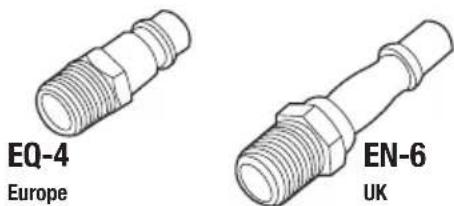
- Please choose the connector that is compatible with the airline system you are using, and install as outlined below:
- Apply some PTFE tape (not included) to the screw threads of the Quick Connector (4). This will help to maintain an air tight seal
Note: Apply PTFE tape tightly and in a clockwise direction, so it does not come off when the thread is screwed into the tool. - Remove the protective plug from the air inlet
- Using a spanner (not included) screw the quick connector into the air inlet located at the base of the handle
- Connect to airline, pressurise carefully and carry out a leak check (e.g. by spraying small amounts of soapy water on to the outside of the connectors)
- Air lines fitted with matching female quick connectors will now be a push fit to the tool
Air supply connection
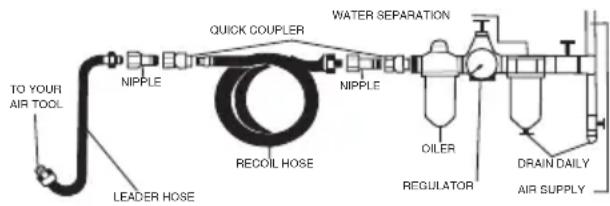
- This tool should be connected to a clean, dry air supply with inline oiler and water separator
- Do not allow supply pressure to exceed the maximum stated (see 'Specifications')
- Ensure that water is drained from air system daily
- Ensure that all parts of the system (hoses, couplers, etc.) are correctly rated for the air pressure to be used
Fitting and removing drill bits and accessories
WARNING: Always disconnect the tool from the air supply before fitting or removing drill bits or other accessories.
WARNING: NEVER run the drill while tightening the chuck or changing the direction.
WARNING: Never install accessories with a maximum speed rating below the no load speed of this tool.
- Open the chuck by rotating the chuck collar anticlockwise
- Insert the required drill bit or accessory
- Close the chuck by rotating it clockwise. Tighten by hand
Note: Ensure the drill bit or accessory runs centrally and repeat above steps to correct the position of the bit in the chuck if necessary.
Setting tool power
- The maximum tool speed/power can be adjusted by reducing/increasing the air supply pressure within the range specified in 'Specifications'
Operation
Note: DO NOT allow the tool to run in 'idle rotation' for an extended period of time. This will shorten its life.
- Grip the tool firmly
- Disengage the Safety Catch (3) and press the Trigger (2) to start the tool
- Allow the tool to reach full speed before bringing the drill bit or other accessory into contact with the workpiece
- Remove the drill bit or accessory from the work piece before switching the tool off
- Release the throttle lever to stop the tool
Note: The air exhaust is located at the bottom of the handle. During operation, air will escape directly next to the air inlet connection.
WARNING: Be aware that air tools may hold residual pressure after use. Always bleed air pressure from the tool after shutting off air supply.
Accessories
- Accessories for this tool, including drill and countersink bits, wire cup brushes and more, are available from your Silverline stockist. Spare parts can be obtained from your Silverline dealer or www.toolsparesonline.com
Maintenance
WARNING: Always disconnect from the air supply and depressurise before cleaning or carrying out any maintenance.
Cleaning
- Keep your tool clean at all times. Dirt and dust will cause internal parts to wear quickly, and shorten the machine's service life. Clean the body of your machine with a soft brush, or dry cloth
IMPORTANT: There is very little that can go wrong with your air tool and it should be noted that when an air tool fails to work it is generally because the internal workings have corroded due to dirty, wet air and failure to follow the instructions given below.
Daily maintenance procedure: Disconnect from the air supply, pour the equivalent of a tablespoon of oil into the air intake. Operate the machine at low speed to thoroughly lubricate all internal workings.
- If the machine is in constant use or used for long periods at a time, a combined filter/lubricator must be fitted. There must be an air filter fitted at all times
- Use air tool oil. DO NOT UNDER ANY CIRCUMSTANCES USE NORMAL ENGINE OIL
- Failure to comply with the operating and maintenance instructions may invalidate the guarantee
Storage
- Store this tool carefully in a secure, dry place out of the reach of children
Disposal
- As with other power tools, air tools should not be disposed of with household waste
- Air tools may contain traces of tool oil and other lubricants and so must be recycled accordingly
- Contact your local waste disposal authority for information on the correct way to dispose of power tools
Troubleshooting
| Problem Possible Cause Solution | ||
| Tool operating slowly | Pressure incorrect Set the correct air pressure according to the specification | |
| Dirt within the mechanism Pour oil into air inlet as per maintenance instructions | ||
| Air blockage Operate tool in short bursts to clear blockage | ||
| Air leak Check all fittings and hose for air leaks and correct issue by re-tightening, using PTFE tape or replacing | ||
| Blockage in gauze mesh filter Remove Quick Connector and clean mesh filter | ||
| Tool seized | Dirt or rust in mechanism Try ‘Tool operating slowly’ solutions | |
| Dirt or rust in mechanism Tap tool gently with a soft mallet | ||
| Dirt or rust in mechanism Free mechanism by rotating drive manually when disconnected from air line | ||
| Tool will not stop after trigger is fully released | Throttle valve O-ring or valve seat damaged Have the tool repaired at an authorised Silverline service centre | |
| If the above troubleshooting solutions fail, contact your dealer or an authorised Silverline service centre. | ||
Silverline Tools Guarantee
This Silverline product comes with a 3 year guarantee
Register this product at silverlinetools.com within 30 days of purchase in order to qualify for the 3 year guarantee. Guarantee period begins according to the date of purchase on your sales receipt.
Registering your purchase
Registration is made at silverlinetools.com by selecting the Guarantee Registration button. You will need to enter:-
- Your personal details
• Details of the product and purchase information
Once this information is entered your guarantee certificate will be created in PDF format for you to print out and keep with your purchase.
Terms & Conditions
Guarantee period becomes effective from the date of retail purchase as detailed on your sales receipt.
PLEASE KEEP YOUR SALES RECEIPT
If this product develops a fault within 30 days of purchase, return it to the stockist where it was purchased, with your receipt, stating details of the fault. You will receive a replacement or refund.
If this product develops a fault after the 30 day period, return it to:
Silverline Tools Service Centre
PO Box 2988
Yeovil
BA21 1WU, UK
The guarantee claim must be submitted during the guarantee period.
You must provide the original sales receipt indicating the purchase date, your name, address and place of purchase before any work can be carried out.
You must provide precise details of the fault requiring correction.
Claims made within the guarantee period will be verified by Silverline Tools to establish if the deficiencies are related to material or manufacturing of the product.
Carriage will not be refunded. Items for return must be in a suitably clean and safe state for repair, and should be packaged carefully to prevent damage or injury during transportation. We may reject unsuitable or unsafe deliveries.
All work will be carried out by Silverline Tools or its authorized repair agents.
The repair or replacement of the product will not extend the period of guarantee
Defects recognised by us as being covered by the guarantee shall be corrected by means of repair of the tool, free of charge (excluding carriage charges) or by replacement with a tool in perfect working order.
Retained tools, or parts, for which a replacement has been issued, will become the property of Silverline Tools.
The repair or replacement of your product under guarantee provides benefits which are additional to and do not affect your statutory rights as a consumer.
What is covered:
The repair of the product, if it can be verified to the satisfaction of Silverline Tools that the deficiencies were due to faulty materials or workmanship within the guarantee period.
If any part is no longer available or out of manufacture, Silverline Tools will replace it with a functional replacement part.
Use of this product in the EU.
What is not covered:
Silverline Tools does not guarantee repairs required as a result of:
Normal wear and tear caused by use in accordance with the operating instructions eg blades, brushes, belts, bulbs, batteries etc.
The replacement of any provided accessories drill bits, blades, sanding sheets, cutting discs and other related items.
Accidental damage, faults caused by negligent use or care, misuse, neglect, careless operation or handling of the product.
Use of the product for anything other than normal domestic purposes.
Change or modification of the product in any way.
Use of parts and accessories which are not genuine Silverline Tools components.
Faulty installation (except installed by Silverline Tools).
Repairs or alterations carried out by parties other than Silverline Tools or its authorized repair agents.
Claims other than the right to correction of faults on the tool named in these guarantee conditions are not covered by the guarantee.
CE Declaration of Conformity
The undersigned: Mr Darrell Morris
as authorised by: Silverline Tools
Declares that the
Identification code: 868625
Description: Air Drill Straight
Conforms to the following Directives:
• Machinery Directive 2006/42/EC
• EN 11148-3:2010
Notified body: Intertek Testing Services, Shanghai, China
The technical documentation is kept by: Silverline Tools
Date: 08/07/13
Signed by:
Director
Name and address of the manufacturer:
Powerbox International Ltd, Boundary Way, Lufton Trading Estate, Yeovil,
Somerset, BA22 8HZ United Kingdom
Silverline Tools Service Centre
PO Box 2988
Yeovil
natural_image
Technical line drawing of a threaded pipe fitting labeled EN-6 UK (no additional text or symbols)Powerbox International Ltd, Boundary Way, Lufton Trading Estate, Yeovil,
Powerbox International Ltd, Boundary Way, Lufton Trading Estate, Yeovil,
Somerset, BA22 8HZ, Regno Unito
Powerbox International Ltd, Boundary Way, Lufton Trading Estate, Yeovil,
natural_image
Close-up of a metallic cylindrical device with black and white casing, no visible text or symbols on the body.
3 Year Guarantee
*Register online within 30 days. Terms & Conditions apply