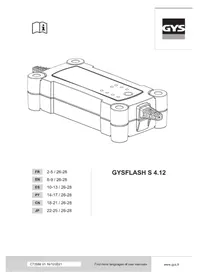
Gysflash S 4.12 - Battery charger GYS - Free user manual and instructions
Find the device manual for free Gysflash S 4.12 GYS in PDF.



| Product Type | Battery Charger |
| Brand | GYS |
| Model | Gysflash S 4.12 |
| Input Voltage | 100-127 Vac, 50-60 Hz |
| Charge Current | 0.8 A (Charge 0 mode) / 4 A (Charge mode) |
| Charge Voltage | 14.4 V (standard), 14.7 V (cold/AGM), 13.6 V (supply mode) |
| Compatible Battery Types | Lead 12 V: GEL, AGM, WET, MF, Calcium |
| Battery Capacity (charge) | 1.2 Ah to 90 Ah |
| Battery Capacity (maintenance) | Up to 130 Ah |
| Charge Modes | Charge 0 (0.8 A), Charge (4 A), Supply 13.6 V (4 A) |
| Charge Cycle | 7 automatic steps: analysis, recovery, test, desulfation, charge, absorption, maintenance |
| Protections | Reverse polarity, short-circuit, anti-spark, thermal, overload |
| Double Insulation | Yes (class II) |
| On-board Electronics Compatibility | Yes, suitable for CAN-BUS systems |
| Warranty | 2 years (parts and labor) |
| Included Accessories | Clamps, terminals (depending on version) |
| Maintenance and Cleaning | Disconnect before cleaning; do not use abrasive products |
| Safety | Do not charge non-rechargeable batteries; use in a ventilated area; avoid flames |
| Spare Parts and Repairability | A damaged power cable must be replaced by a professional |
| General Information | Manufactured by GYS, France; compliant with European, British, Moroccan standards |
Frequently Asked Questions - Gysflash S 4.12 GYS
User questions about Gysflash S 4.12 GYS
0 question about this device. Answer the ones you know or ask your own.
Ask a new question about this device
Download the instructions for your Battery charger in PDF format for free! Find your manual Gysflash S 4.12 - GYS and take your electronic device back in hand. On this page are published all the documents necessary for the use of your device. Gysflash S 4.12 by GYS.
USER MANUAL Gysflash S 4.12 GYS
| FR | 2-5 / 26-28 |
| EN | 6-9 / 26-28 |
| ES | 10-13 / 26-28 |
| PT | 14-17 / 26-28 |
| CN | 18-21 / 26-28 |
| JP | 22-25 / 26-28 |
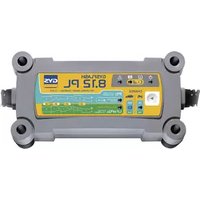
GYSFLASH S 4.12
INSTRUCTIONS DE SÉCURITÉ

ANOMALIES, CAUSES, REMÈDES
CONDITIONS DE GARANTIE
This manual contains safety and operating instructions.
Read it carefully before using the device for the first time and keep it in a safe place for future reference. This machine should only be used for charging and / or power supply operations comprised within the limits indicated on the machine and in the instruction manual. The operator must respect the safety precautions. In case of inedaquate or unsafe use, the manufacturer cannot be held liable.
This unit can be used by children aged of at least 8 years and by people with reduced physical, sensory or mental capabilities or lack of experience or knowledge, if they are properly monitored or if instructions for using the equipment safely was given to them and if they have been made aware of the risks. Children must no play with the product. Cleaning and maintenance should not be performed by unsupervised children.
Do not use to charge small batteries or non rechargeable batteries.
Do not operate the device with a damaged power supply cord or a damaged mains plug.
Do not use the device if the charging cable appears to be damaged or assembled incorrectly in order to avoid any risk of short circuiting the battery.
Never charge a frozen or damaged battery.
Do not cover the device
Do not place the device near a fire or subject it to heat or to longterm temperatures exceeding 50° C
The operating mode of the automatic charger and the restrictions applicable to its use are explained below in this manual.

Fire and explosion risks!
A charging battery can emit explosive gases.
- During the charge, the battery must be placed in a well ventilated area.
- Avoid flames and sparks. Do not smoke.
- Protect the electrical contacts of the battery against short-circuiting.
Do not leave a charging battery unattended for a long time
Connection / disconnection:
- Ensure that the charger's power supply is disconnected before plugging or unplugging the connections on the battery.
- Always ensure the Red clamp is connected to the «+» battery terminal first. If it is necessary to connect the black clamp to the vehicle chassis, make sure it is a safe distance from the battery and the fuel/exhaust pipe. The charger must be connected to the mains.
- After charging, disconnect the charger from the mains, then disconnect the clamp from the car body and then disconnect the clamp from the battery, in the indicated order.

Connection:
- Class II device
- The connection to the power supply must be carried out in compliance with national standards.

Maintenance:
- If the power cable is damaged, it must be replaced by the manufacturer, its after sales service or an equally qualified person to prevent danger.
• Service should be performed by a qualified person - Warning! Always remove the power plug from the wall socket before carrying out any work on the device.

Regulations:
• Machine compliant with European directives.
- The certificate of compliance is available on our website.
• EAC Conformity marking (Eurasian Economic Community)
- Equipment in compliance with British requirements. The British Declaration of Conformity is available on our website (see home page).
• Equipment in conformity with Moroccan standards.
- The declaration C° (CMIM) of conformity is available on our website (see cover page).

Waste management:
- This product should be disposed of at an appropriate recycling facility. Do not throw away in a domestic bin.


Do not operate on 230V - risk of explosion!
GENERAL DESCRIPTION
The GYSFLASH S 4.12 is ideal to charge most lead-acid batteries, often used for cars and many other vehicles. These batteries can be of many types eg: GEL (gel electrolyte), AGM (absorbed glass mat), WET, MF (Maintenance Free), CA (Calcium)... This charger has been designed to charge 12V batteries (6*2V elements) from 1.2 Ah to 90 Ah, or for floating charge up to 130 Ah.
START UP
- Connect the charger to the battery using the proper accessory (clamps, lugs, etc...).
- Plug the charger to the mains (single phase 100-127 Vac 50-60Hz).
- Select the mode by pressing the button. After roughly 5 seconds, the charge starts automatically.
- During the charge, the device indicates the charge's progress. When the indicator OK blinks, the battery is ready to start the vehicle. Once the indicator stays on, the battery is completely charged.
- The charge can be interrupted at any time by unplugging the mains plug or pressing the button.
- After charging, disconnect the charger from the mains, then disconnect the charger's connections from the battery.
CHARGE MODES
- Modes and Options:

CHARGE mode (14.4V/0.8A) :
Mode designed for lead-acid batteries, 12V from 1.2 Ah to 15Ah. 7 step automatic maintenance cycle.

CHARGE mode (14.4V/4A) :
Mode designed for lead-acid batteries, 12V from 15 Ah to 90 Ah and up to 130 Ah for floating charge. 7 step automatic maintenance cycle.

AGM
COLD/AGM Option (14.7V) :
Modifies the charging voltage at 14.7V to charge the battery during cold weather (Less than 5°C) or for some AGM batteries or batteries with caps.
SUPPLY Mode (13.6 V/4 A):
This mode enables to use the charger as a stabilised power supply, with a voltage regulated at 13.6 V. This mode is designed for providing a power supply to demonstration vehicles and can also be used to replace a vehicle's battery while maintaining the system's memory. With this mode, there is no time limit.

When the OK indicator is on, the voltage is properly regulated. If the ▲ indicator blinks, this means that the current absorbed by the battery is higher than the charger's maximum current (4 A) and that the battery might end up being discharged.
To access to this mode, press 5 seconds on the button. When this mode is selected, the three blue indicators for mode selection light on. And after roughly 5 seconds, the charge starts automatically.
- Charging curve :
The GYSFLASH S 4.12 use an 7 step charging curve which guarantees optimal performance for your battery.
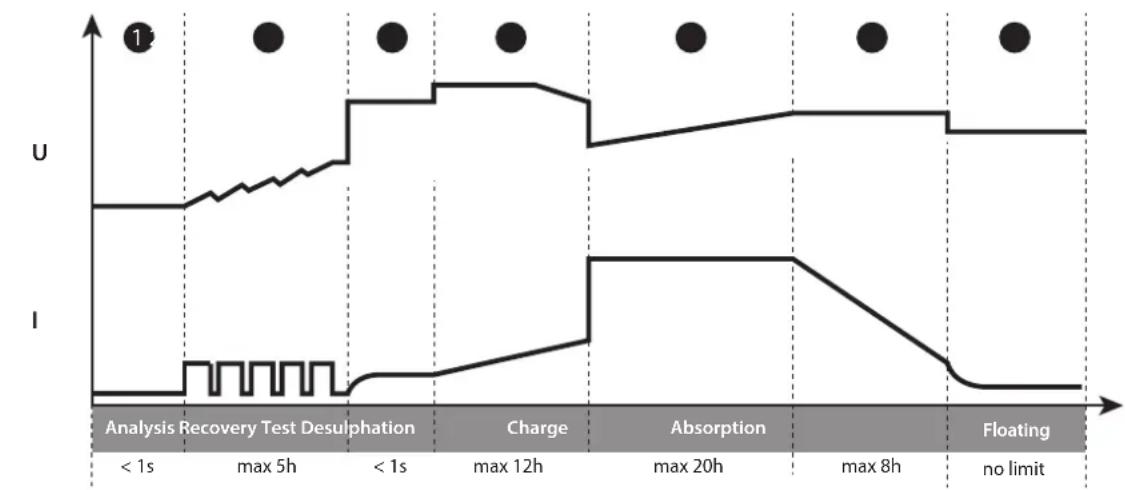

Step 1: Analysis
Analyses the battery state (charge level, polarity inversion, wrong battery...)
Step 5: Charge (63A 4A)
Fast charge with maximum current that can reach 80% charge level.
Step 2 : Recovery (05A 2A)
Damaged elements recovery due to an extended deep discharge algorithm.
Step 6 : Absorption (14.4V or 14.7V with AKM option)
Constant voltage charge to reach a 100% charge level.
Step 3 : Test
Sulfated battery test.
Step 7 : Floating charge (13.6V)
Maintains battery charge level at its maximum.
Step 4 : Desulfation (15.8V)
Battery desulfation algorithm.
| • Estimated charge time | |||
| Battery capacity 2Ah 8Ah 15Ah 18Ah 50Ah | 90Ah | ||
| Charging time 20% >>> 80% | 2h | 6h | 11h |
| 3h | 8h | 14h |

If the motorbike is fitted with a 12V plug, the GYSFLASH S 4.12 can charge the battery via this plug with the CAN-BUS system, without switching the dashboard on. In this setup, connect the cigarette lighter adapter on the charger and on the motorbike's 12V socket then follow the «start up » procedure on the previous page. In certain cases, it is possible that the charge will only start 2 minutes after performing the connections.
- Protections :

The GYSFLASH S 4.12 has several features to protect it against short-circuits or polarity inversion. It has an anti-spark feature which prevents sparks whilst connecting the device to the battery. This charger has double insulation and is compatible with vehicle's onboard electronics.
The GYSFLASH S 4.12 is fitted with an integrated temperature probe that ensures that the charging current is adapted to the ambient temperature to prevent internal electronics' overheating.
TROUBLESHOOTING
| Symptoms | Causes | Remedies | |
| 1 | The indicator  | · Polarity inversion· Battery voltage is too high· Clamps in short-circuit | · Check that the clamps are properly connected.· Check that it is a 12V battery. |
| 2 | The indicator  | Charge failure, battery non recoverable. | Change the battery and press to restart a charge. |
| 3 | The indicator  on even after pressing the on even after pressing the  | Thermal protection. | Ambient temperature is too high (>50°C), cool the room and let the charger cool down. |
| 4 | The indicator  | Charger in sleep mode. | Press the button or connect a battery to the charger to exit sleep mode. |
| 5 | The indicator  | Charge interrupted by pressing the button. | Press again to restart the charge. |
WARRANTY
The warranty covers faulty workmanship for 2 years from the date of purchase (parts and labour).
The warranty does not cover:
- Transit damage.
- Normal wear of parts (eg. : cables, clamps, etc..).
- Damages due to misuse (power supply error, dropping of equipment, disassembling).
- Environment related failures (pollution, rust, dust).
In case of failure, return the unit to your distributor together with:
- The proof of purchase (receipt etc ...)
- A description of the fault reported
Etapa 1 : Análisis

Passo 1 :Análise
ステップ①: 分析
| FR | EN | ES | PT | CN | JP | |
| 1 | Bouton de sélection | Selection button | Botón de selección | Botão de escolha | 选择键 | 選択 ボタン |
| 2 | Veille | Sleep mode | En espera | posição de espera | 待机 | スタンバイ |
| 3 | Charge en cours | Charging | En proceso de carga | Carga em progresso | 正在充电 | 充電中 |
| 4 | Charge terminée | Charge finished | Carga terminada | Carga completa | 充电完成 | 充電終了 |
| 5 | Défaut | Fault | Fallo | defeito | 故障 | デフォルト |
| 6 | Mode Charge | Charge mode | Modo Carga | Modo Carga | 充电模式 | 充電モード |
| 7 | Mode Charge | Charge mode | Modo Carga | Modo Carga | 充电模式 | 充電モード |
| 8 | Option Froid/ AGM | Cold/AGM option | Opción Frío/AGM | Opção Frio/AGM | 冷/AGM选项 | コールド/ A G M オプション |
| 9 | Pinces de charge | Charge clamps | Pinzas de carga | Pinças de carga | 充电夹 | 充 電クランプ |
| 10 | Oeillets de charge | Charge terminals | Terminal de carga | Ilhós de carga | 充电孔 | 充電端子 |
| 11 | Prise secteur | Mains plug | Clavija de corriente | Tomada sector | 电源插座 | 主電源 |
GYS France
Siège social / Headquarter


- GYSFLASH S 4.12
- INSTRUCTIONS DE SÉCURITÉ
- CONDITIONS DE GARANTIE
- FIRE AND EXPLOSION RISKS
- CONNECTION / DISCONNECTION
- CONNECTION
- MAINTENANCE
- REGULATIONS
- WASTE MANAGEMENT
- DO NOT OPERATE ON 230V - RISK OF EXPLOSION
- GENERAL DESCRIPTION
- START UP
- CHARGE MODES
- MODES AND OPTIONS
- CHARGING CURVE
- STEP 1: ANALYSIS
- STEP 5: CHARGE (63A 4A)
- STEP 2 : RECOVERY (05A 2A)
- STEP 6 : ABSORPTION (14.4V OR 14.7V WITH AKM OPTION)
- STEP 3 : TEST
- STEP 7 : FLOATING CHARGE (13.6V)
- STEP 4 : DESULFATION (15.8V)
- PROTECTIONS
- WARRANTY
- ETAPA 1 : ANÁLISIS
- PASSO 1 :ANÁLISE
- ステップ①: 分析
- GYS FRANCE
Brand : GYS
Model : Gysflash S 4.12
Category : Battery charger