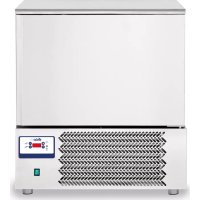
USER MANUAL 232170 Arktic
You should read this user manual carefully before using the appliance.
Keep these instructions with the appliance.
For indoor use only.
Thank you for purchasing this Hendi appliance. Before using the appliance for the first time, please read this manual carefully, paying particular attention to the safety regulations outlined below.
1. Safety regulations
- This appliance is intended for commercial use only and must not be used for household use.
- The appliance must only be used for the purpose for which it was intended and designed. The manufacturer is not liable for any damage caused by incorrect operation and improper use.
- Keep the appliance and electrical plug away from water and any other liquids. In the event that the appliance should fall into water, immediately remove plug from the socket and do not use until the appliance has been checked by a certified technician. Failure to follow these instructions could cause a risk to lives.
- Never attempt to open the casing of the appliance yourself.
- Do not insert any objects in the casing of the appliance.
- Do not touch the plug with wet or damp hands.
- Danger of electric shock! Do not attempt to repair the appliance yourself. In case of malfunctions, repairs are to be conducted by qualified personnel only.
- Never use a damaged appliance! Disconnect the appliance from the electrical outlet and contact the retailer if it is damaged.
- Warning! Do not immerse the electrical parts of the appliance in water or other liquids. Never hold the appliance under running water.
- Regularly check the power plug and cord for any damage. If the power plug or power cord is damaged, it must be replaced by a service agent or similarly qualified persons in order to avoid danger or injury.
- Make sure the cord does not come in contact with sharp or hot objects and keep it away from open fire. To pull the plug out of the socket, always pull on the plug and not on the cord.
- Ensure that the cord (or extension cord) is positioned so that it will not cause a trip hazard.
- Always keep an eye on the appliance when in use.
- Warning! As long as the plug is in the socket the appliance is connected to the power source.
- Turn off the appliance before pulling the plug out of the socket.
- Never carry the appliance by the cord.
- Do not use any extra devices that are not supplied along with the appliance.
- Only connect the appliance to an electrical outlet with the voltage and frequency mentioned on the appliance label.
- Connect the power plug to an easily accessible electrical outlet so that in case of emergency the appliance can be unplugged immediately. To completely switch off the appliance pull the power plug out of the electrical outlet.
-
Always turn the appliance off before disconnecting the plug.
-
Never use accessories other than those recommended by the manufacturer. Failure to do so could pose a safety risk to the user and could damage the appliance. Only use original parts and accessories.
- This appliance is not intended for use by persons (including children) with reduced physical, sensory or mental capabilities, or lack of experience and knowledge.
- This appliance must not be used by children under any circumstances.
- Keep the appliance and its cord out of reach of children.
- Always disconnect the appliance from the mains if it is left unattended or is not in use, and before assembly, disassembly or cleaning.
- Never leave the appliance unattended during use.
2. Special safety regulations
- This appliance is designed for quick chilling or freezing prepared dishes. Do not store any other materials in the appliance. Do not place any dangerous products, such as fuel, alcohol, paint, flammable or explosives, etc. inside or near the appliance.
- This appliance must be installed, commissioned and services by a qualified or trained person. And this appliance is intended to be used by trained or qualified personnel such as kitchen or bar staff.
- WARNING: Do not use mechanical devices or other means to accelerate the defrosting process, other than those recommended by the manufacturer.
- WARNING: Do not damage the refrigerant circuit.
- Caution! Risk of fire! The refrigerant used is R404a or R507 in this appliance. It is a highly flammable refrigerant.
- WARNING: Keep all ventilation openings in the appliance enclosure clear of obstruction. Provide sufficient ventilation in the surrounding structure when building-in.
- WARNING: Do not use electrical appliances inside the food storage compartments of the appliance, unless they are of the type recommended by the manufacturer.
- Place the appliance on a clean, stable, dry, level surface only.
- Keep the appliance away from any hot surfaces and open flames. Protect the appliance against heat, dust, direct sunlight, moisture, dripping and splashing water.
- Allow at least 10cm surrounding spacing for ventilation purpose during use.
- Do not place articles on top of the appliance. Do not place objects with open sources of fire (e.g. candles) on top or beside the appliance. Do not place objects filled with water (e.g. vases) on or near the appliance.
- Never cover the appliance during use. This may cause a fire hazard.
- Do not wash the appliance with water. Washing can cause leakages and increase the risk of electric shock.
- Do not make any additional openings on the appliance. Do not install any gadgets in the appliance.
- Do not overload the shelves inside to avoid damage. Max. loading of each shelf is about 4 kg. Place the food evenly on each shelf.
3. Introduction
Positioning of blast chiller
Before unloading/ loading and positioning the blast chiller inside the shop/kitchen, you are kindly requested to read carefully the instruction manual in the different chapters regarding the unloading/
Transport
Do not superimpose blast chiller packing (allowed only if there is wooden crate packing option). We recommend you to transport the blast chiller always in the upright position (as mention on the packing). If the blast chiller with built in condensing unit was inclined during transportation we suggest you to keep the product in the suggested upright position for at least 8 hours, before switching it on. In this way, you will allow the oil to flow in all the components, lubricating them again. Afterwards you can proceed with the start.
Unloading/Dimensions/Weight
The unloading/ loading procedures should be executed by pallet-jack or by forklift driven by skilled and authorized staff. We decline any liability for failing to comply with safety rules currently in force. Before starting the unloading, positioning and installation procedures of the blast chiller freezer
Packing
At the delivery please check that the packing is intact and that during transportation no damage was occurred. Remove the external carton-box; remove the fastener that keeps still the blast chiller/freezer to its pallet, put it in the correct position and then remove the adhesive white protection of the stain
Condensate water draining /draining connection
The blast chiller is available with a built in condensing unit complete with a removable condensate water basin with manual defrost (without defrost heat
Positioning and feet regulation
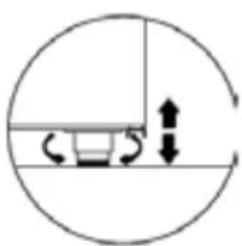
Place the blast chiller in a perfect horizontal position, acting if necessary on the screw type adjustable feet. Use a spirit level to check it. The blast chiller must be placed in order to operate properly and allow the correct defrost condensate water drain
loading, dimensions, weight, evaporating water basin, adjustable feet, electric connections and maintenance procedures of the blast chiller subjected in the present manual.

inside the shop/kitchen according to the model of the blast chiller, please read carefully the information showed in the dimensions and weights list.
The manufacturer declines any responsibilities due to operations performed without adopting the above safety precautions.
less steel. The recovery and the recycling of the packing materials such us, plastic, iron, carton box, wood help the saving of row material and reduce the waste. Please consult your area address book for disposal of materials and authorized garbage dump.
er]. The basin is assembled in the lower part, under the condensing unit.
ing. In this way you will avoid noisy vibrations of the condensing unit. Check the correct positioning of the condensate water basin and its draining.
Installation inside your shop
We suggest you to install the blast chiller/freezer inside an air-conditioned room. We kindly remind you that without this facility, malfunction may occur [for example condensation etc].

ATTENTION!
In order to allow a good functioning of the blast chiller/freezer please draw attentions to the following instructions.
Verify that in the installation room there is enough air turnover, even during closing and rest hours. In this way the expansion/condensing unit will work correctly.
Minimum wall distance

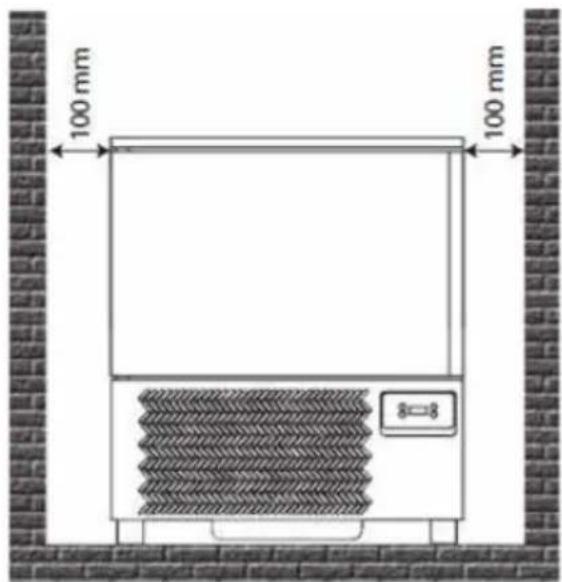
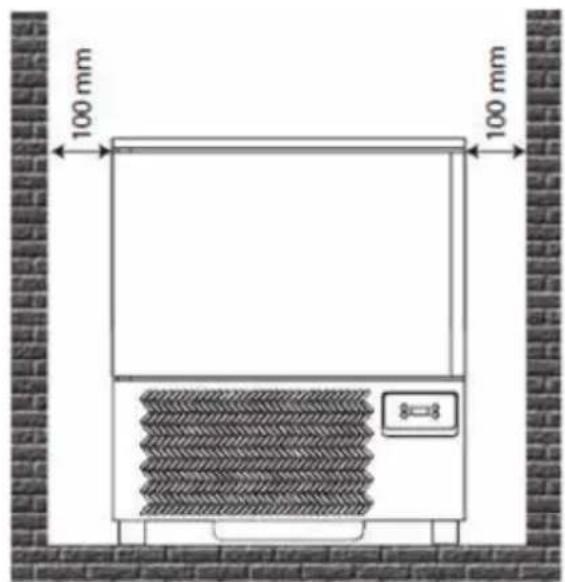
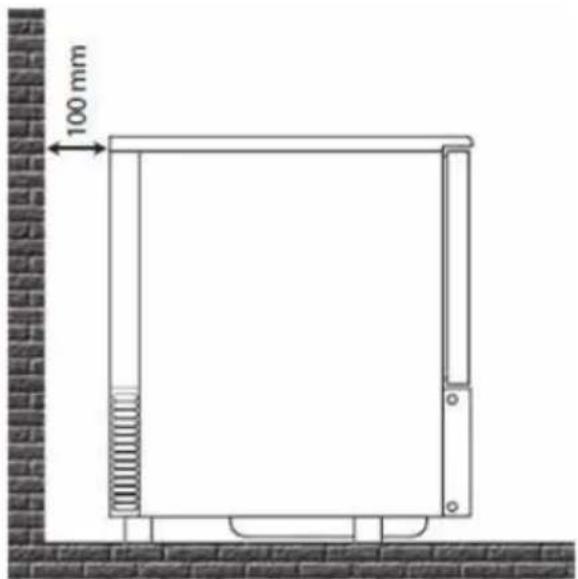
In order to allow a good blast chiller functioning and a correct air circulation, during the positioning you have to respect some minimum wall distance as follows:
Blast chiller with built in condensing unit
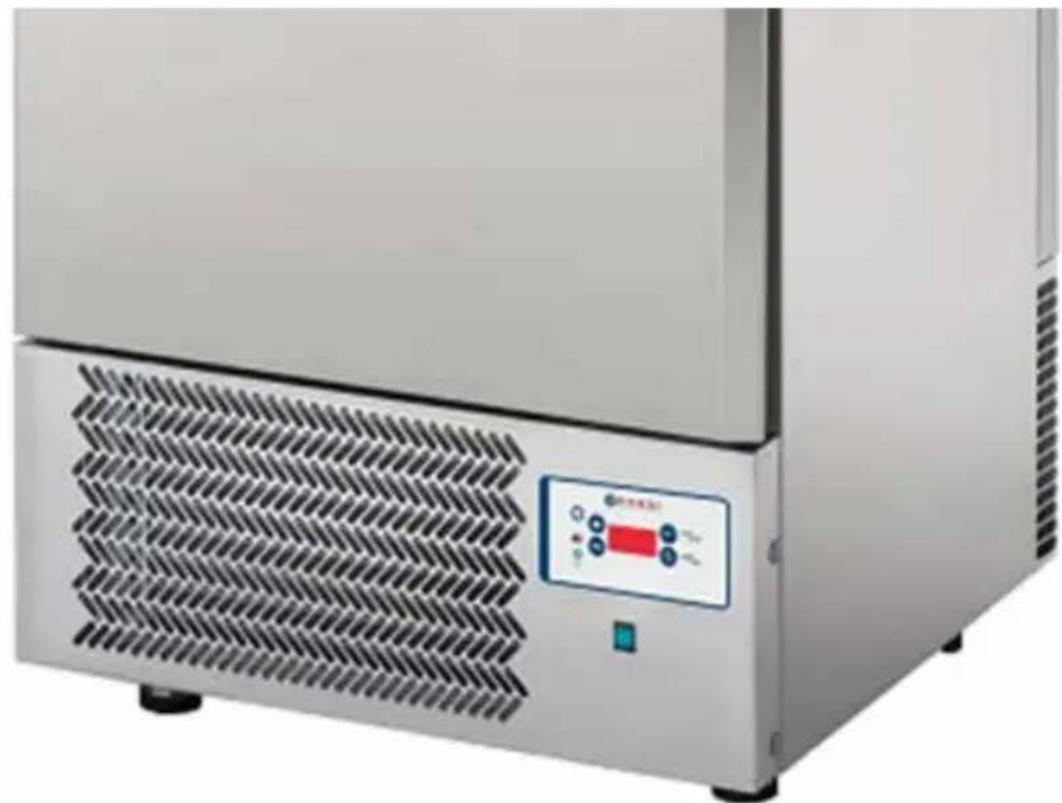
The blast chiller is provided with built in condensing unit, therefore it is necessary not to obstruct the blast chiller air inlet corresponding to the front grid for the air extraction in order to allow a proper air circulation. Keep clear the whole blast chiller perimeter. We remind you that room temperature rises or insufficient quantity of air to the unit condenser, reduce the blast chiller performances with
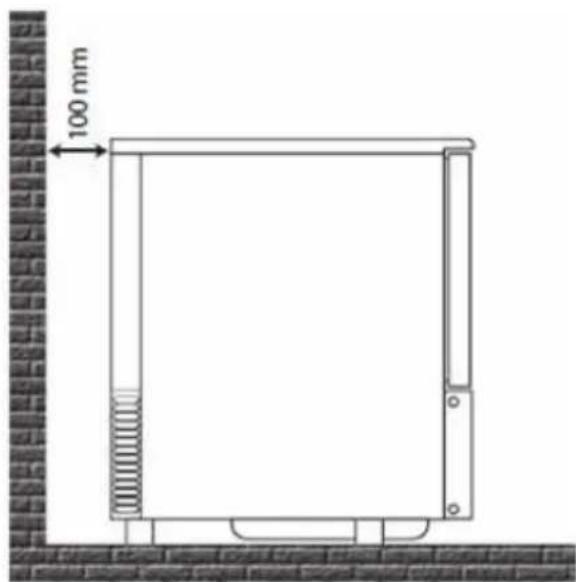
- Keep a minimum distance, corresponding to the door opening length, from the front unit grid view.
- Keep a minimum 10cm distance of the blast chiller back from the wall.
possible deterioration of the products and more energy consumption. If the blast chiller with built in condensing unit was leant on the side during transportation we suggest you to keep the product in upright position for at least 8 hours, before switching it on. In this way, you will allow the oil to flow in all the components, lubricating them again. Afterwards you can proceed with the starting.
Technical data
| 232163 | 232170 | 232194 | 232187 | 232491 | 232507 |
| Dimensions [WxDxH mm] (with feet) | 750x740x720 (750) | 750x740x850 (880) | 750x740x1260 (1290) | 750x740x1260 (1290) | 750x740x1850 | 750x740x2080 |
| Net weight [kg] | 50 | 71 | 90 | 102 | 120 | 150 |
| Chamber dimensions [WxDxH mm] | 600x400x280 | 610x400x410 | 760x630x410 | 760x630x410 | 610x410x1120 | 610x410x1360 |
| Capacity [No. of tray] | 3x GN 1/1 or 3x 600x400 mm | 3x GN 1/1 or 3x 600x400 mm | 3x GN 1/1 or 3x 600x400 mm | 3x GN 1/1 or 3x 600x400 mm | 3x GN 1/1 or 3x 600x400 mm | 3x GN 1/1 or 3x 60Ox400 mm |
| Space between trays [mm] | 70 70 105 70 70 70 |
| Blast chilling performance [+3°C] | 14 kg 20 kg 25 kg 25 kg 45 kg 50 kg |
| Blast freezing performance [+18°C] | 11 kg 15 kg | 20 kg 20 kg 35 kg 40 kg |
| Gas [Type] | R404a/R507 R404a/R507 R404a/R507 R404a/R507 R507 | R507 |
| Test details [°C / RH] | +43 / 65% | +43 / 65% | +43 / 65% | +43 / 65% | +43 / 65% | +43 / 65% |
| Absorbed power [W] | 1150 | 1424 | 1490 | 1490 | 1820 | 2040 |
| Power supply [V-P-Hz] | 230-I-50 | 230-I-50 | 230-I-50 | 230-I-50 | 400-3-50 | 400-3-50 |
The manufacturer and dealer is not liable for any inaccuracies due to printing errors or transcription, in this manual. In line with our policy of continuous improvement products, we reserve the right to
make modification of the product, packaging and specifications contained in the Documentation without prior notice.
4. Electrical connection and earthing
Electrical power supply

The installation and the electrical connections must be carried out in conformity with the electrical rules in
force. These operations must be carried out by qualified staff. The company declines any responsibilities originated from the no observance of the above rules in force.
See the blast chiller electric diagrams at the end of this manual.
Before plugging in the blast chiller, it is necessary to proceed with its complete and careful cleaning, using warm water with no aggressive detergents and drying with a soft cloth all the humid parts [read with attention the chapter regarding the blast chiller cleaning].
In order to carry out a correct plug in you must proceed as follow:
- Prearrange a thermal magnetic circuit breaker switch and be sure that the frequency/tension of the line corresponds to that shown on the blast chiller serial number label (see the label placing).
- Verify the supply tension at the socket, it must be between + / - 10% when you start the compressor.
Starting the blast chiller

ATTENTION!
The first start up must be carried out by qualified staff.
Before switching on the blast chiller, be sure that:
- Your hands must be dry
- The surface of the blast chiller must be dry
- The floor and the electrical socket must be dry
Furthermore, be sure that:
- The build in condensing unit blast chiller must be carried only in upright position. If it had leaned, we recommend to wait at least 8 hours before proceeding with the start so that the oil will flow in all the components, lubricating them again.
For the temperature setting make reference to the
- We recommend you to install a bipolar-switch (or 4 square pole switch) with contact opening of at least 3mm , at the head of the socket. This switch is obligatory if the loading is over 1000W or when the blast chiller is connected directly without the use of the plug. The mag thermic switch has to be placed nearby the blast chiller in order to be well seen by the technician in case of maintenance.
It is necessary that the power supply cable section is adequate to the unit power consumption.

The earthing of the appliance is compulsory in conformity with the law. Therefore it is necessary to connect it to an efficient
earthing system. If the power supply cable was, it must be substituted by the technical qualified staff. It is strongly recommended to avoid the use of electrical appliance inside the blast chiller compartment.
- If the compressor is damaged, it must be replaced exclusively by qualified staff, in order to prevent any risks. In case of breakdown we suggest to unplug the appliance and to use a high sensitivity mag thermic anti-electrical shock switch.
corresponding chart about product categories/ usage temperature, in addition For the working parameters regulation refer to the user instructions of the control panel enclosed to this current manual.
Once the blast chiller is connected with the power cable (see the previous paragraph), proceed powering it with the switch closing.
For the built in unit, before plugging it in, verify that the selector is open in 0, OFF or green position. Insert the socket and then turn off the switch. Before placing inside the food to be chilled or frozen, it is necessary to clean the chamber of the appliance (see chapter about cleaning) and afterwards it will
be required to chill in advance the chamber before starting the positive or negative processes.
For regulating the functioning parameters consult the instructions for the instrument panel enclosed to the current manual.
5. Cleaning
All the procedures must be carried out with the stationary unit removing the tension from both the re
Cleaning of the blast chiller
The maintenance of the blast chiller must include at least one daily cleaning of the loading zone, in order to prevent the development and the accumulation of bacteria.
Before cleaning the blast chiller room, carrying out the defrosting keeping the door open and removing the lid of the drainage pipe.

ATTENTION!
It is essential to keep daily clean the blast chiller in order to prevent the development and the accumulation of bacteria. Before cleaning the chamber of the blast chiller, you must execute a defrosting process, by removing the lid of the drainage basin.
- Do not flush directly the inner parts of the blast
Cleaning the probe
The maintenance of the blast chiller must include at least one daily cleaning of the temperature core probe.
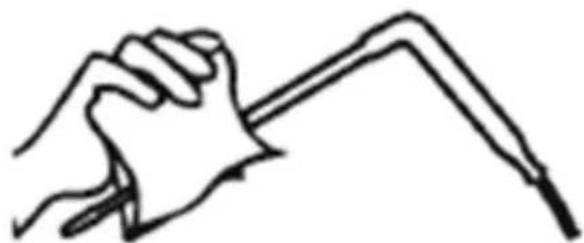
It is essential to keep daily clean the blast chiller room probe. All the procedures must be carried out with the stationary unit removing the tension from both the refrigerated item and the condensing unit. We recommend to rinse carefully the probe with clean water and with hygienized solution. Refer to
frigerated item and the condensing unit.
chiller because the electrical parts could get damaged.
- Do not use any hard metal tools to remove the ice.
- For the cleaning use only warm water (not hot) with no-aggressive detergents, taking care of drying the wet parts with a soft cloth.
- Avoid to use products that contain chlorine or diluted solutions, caustic soda, abrasive detergents, muriatic acid, vinegar, bleach or other products that might scratch or grind.
We recommend to clean the device at least once a month, when it used for deep-frozen products.

Attention, during the cleaning operations it is recommended to use work gloves.
EN
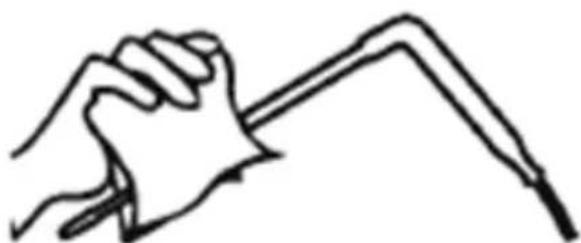
the same methods and detergents for cleaning named in the previous paragraph.
6. Recommendations and warnings
We recommend to make a daily cleaning of the external part of the blast chiller, including the internal
side of the door near the gaskets.
Manual defrosting
The blast chiller has manual defrosting and can be made with open door or closed door (in this case the time of defrosting will be longer).

ATTENTION!
When the blast chiller has finished the process, it is necessary to remove the lid of the water drainage
Maximum shelf load and storage

ATTENTION!
The blast chiller is suitable to drop the temperature of already cooked food (see the chart with the temperatures according to the products which must be dropped).
Do not introduce into the blast chiller products which are just taken out of the oven. Wait few minutes before placing the products inside the room and then start the cycle. We remind you that the blasting time to reach the requested temperature, depends on different factors such as:
EN
Modalities selection of the process time
The modalities selection of the blast chiller are:
- Time cycle, when the process time is specified. When the time cycle phase finishes, the conservation modality automatically starts.
pipe in order to allow the water draining into the basin. The drainage pipe is useful also for the draining of other liquids from the product.
At the end of the process, check the level of the water and, if it necessary, empty the basin.
- The shape, the type, the thickness and the material in which the food to be chilled is contained.
- The usage of lids above the containers.
- The physical features of the product, density, water and fat contents.
- The temperature condition of the food to be chilled.
The setting of the time for the positive chilling and negative blasting must be set according to the type and the weight of the food to be treated.
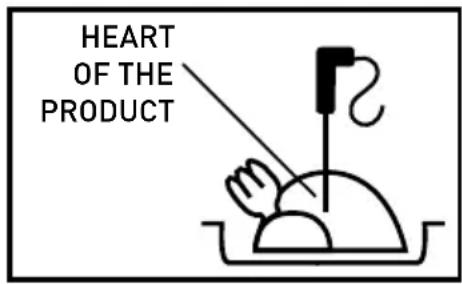
- With core probe, it is sufficient to set the temperature of the product to be chilled of frozen; the probe records the temperature and after the acoustic signal the device will pass into the conservation modality (see position of core probe).
Type of process Type of cycle Type of product
Loadable Thicness Cycle at the product code
| Postive Full speed | for dense food or thick size | 4 kg each tray maximum | 50 mm +3°C MAX 90 min |
| Negative Full Speed | for dense food or thick size | 3 kg 40 min | until -18°C (240min) |
| - Reduced speed | delicate products, vegetables, crème, sponge dessert, small size products | --- | |
Measuring the temperature at the product core
When the thickness of the products allows it, always use the core probe to know exactly the reached temperature at the product core, and do not interrupt the cycle before the temperature of +3^ and -18^ is reached. For a correct function of the blast chiller, it is necessary that the products contained inside are well placed in the middle, in order to allow a good circulation of the air in the blast chiller. Do not obstruct the blast chiller/freezer air inlets inside the device
For a correct function of the Blast Chiller, it is necessary that the products contained inside are well placed in the middle, in order to allow a good circulation of the air in the Blast Chiller.
Conservation of the food cooked and blast freezed
The food cooked and blast freezed can be preserved in the fridge keeping the organoleptic qualities up to 5 days from the date of treatment.
It is important to respect the cold chain, keeping
Conservation of the food cooked and deep frozen The food cooked and deep frozen can be preserved in the fridge keeping the organoleptic qualities up to several months from the date of treatment. It is important to respect the cold chain, maintaining during the conservation a stead temperature from 0^ to 4^ , according to the kind of the food. Using the vacuum technique, the conservation time can be raised until about 15 days.
The food which is subject to negative cycle can be safely preserved for a period of time from 3 to 18 months, according to the food treated.
It is important to respect the conservation temperature equal or below -20^
Blast chiller starting up procedures
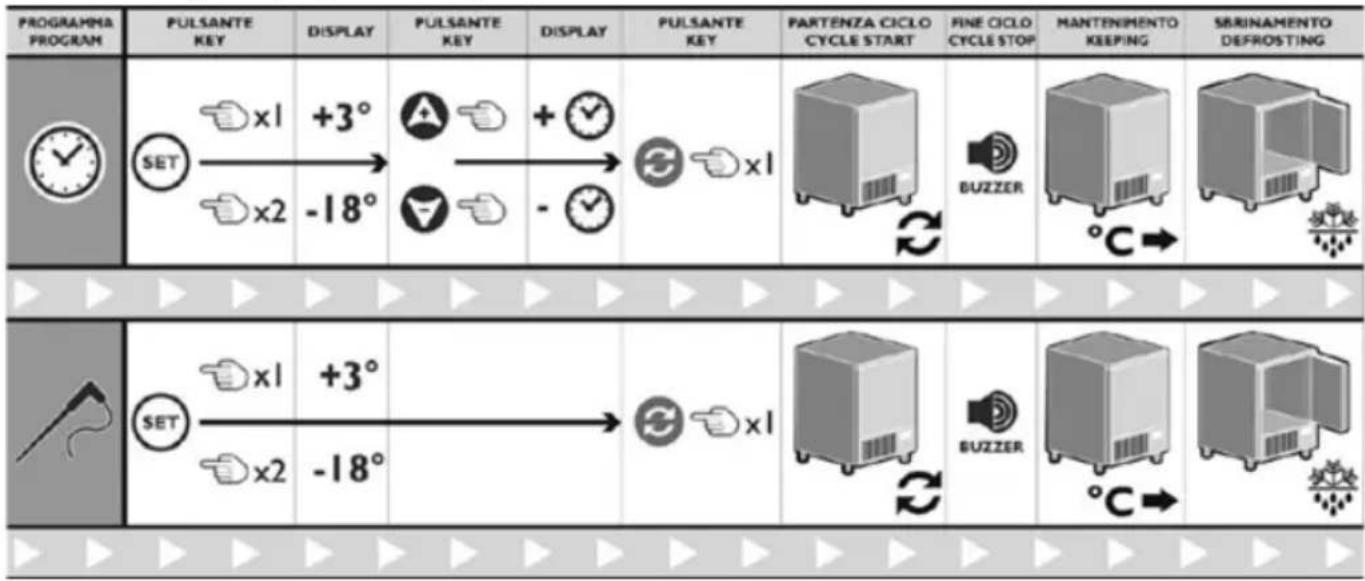
Blasting cycle with core probe
- Push the green button.
- Push the button "SET" to select the temperature +3^ or -18^ .
- Afterwards, push the button "START/STOP" to start the cycle.
ATTENTION!
Children must be kept away from the Blast Chiller.
during the conservation a stead temperature between 0^ and 4^ , according to the food.
Using the technique of vacuum packing, the time of conservation can be raised until about 15 days.
ATTENTION!
- Avoid leaving at room temperature the food cooked and to be blast frozen.
- Avoid humidity loss, at risk of the food fragrance.
The blast frozen food must be protected by a protective fi lm (better if vacuum packed) and provided with adhesive label on which must be indicated:
The content
The day of preparation
The assigned expired date
ATTENTION!
Once the food is defrosted, it cannot be frozen again.
- At the end of the cycle (when the buzzer starts to ring), the machine passes automatically into the conservation phase.
- To stop the cycle, press "START/STOP".
Blasting cycle at time
- Push the green button.
- Push the button "SET" to select the temperature +3^ or -18^ .
-
Afterwards, push the button "UP", "DW" to set the requested time for the blasting cycle.
-
Push the button "START" to start the cycle.
- At the end of the cycle (when the buzzer starts to ring), the machine passes automatically into the conservation phase.
- To stop the cycle, press "START/STOP"
Conservation time (in months) for blast chilled-shock frozen food
In the chart below there are the preservation times of some deep-frozen food.

| Food | Freezing -18°C | Freezing -25°C | Freezing -30°C |
| Dairy products |
| Cheese 4 6 6 | | | |
| Butter 8 12 15 | | | |
| Poultry and meat |
| Beef 9 12 18 | | | |
| Veal 6 12 18 | | | |
| Lamb 6 12 18 | | | |
| Pork | 4 | 12 | 15 |
| Poultry | 5-9 | 12 | 18 |
| Rabbit,goose | 4-6 | - | - |
| Duck, turkey | 4-6 | - | - |
| Game | 6-10 | 12 | 12 |
| Fish |
| Lean | 6-8 | 12 | 15 |
| Fat (eat, mackerel, salmon, herring) | 3-4 | 7-8 | 8-9 |
| Shellfish with pincers | 3-4 | 12 | 17 |
| Shellfish | 2-3 | 10 | 12 |
| Vegetables and fruits |
| Vegetables | 12 | 18 | 24 |
| Fruits | 12 | 18 | 24 |
| Pastry |
| Cakes | 2-4 | 8 | 12 |
| Pre-cooked food |
| Pre-cooked food | 2-4 | 6 | 6 |
Remark: Above table is just for reference only. In determining the storage period, always suggesting the local sanitary-epidemiological regulations and HACCP.
7. Blast-chilling/shock freezing time
| Food Pan | | Maximum
loading capacity | Product
thickness | Blast-freezing
time | Cycle used |
| First course |
| White sauce GN1/1 (H)60 6 L 4 cm 70 minutes POSTIVE |
| Meat Stock | GN1/1 (H)110 | 7 L | 6-7 cm | 90 minutes | POSTIVE |
| Cannelloni GN1/1 (H)40 4 Kg 3-4 cm 40 minutes POSTIVE |
| Veagable soup | GN1/1 (H)100 | 5 L | 5 cm | 90 minutes | POSTIVE |
| Fresh pasta | GN1/1 (H)40 | 1 Kg | 5 cm | 30 minutes | NEAGTIVE |
| Meat and tomato sauce | GN1/1 (H)60 | 5 Kg | 5 cm | 90 minutes | POSTIVE |
| Bean soup | GN1/1 (H)60 | 5 Kg | 5 cm | 90 minutes | POSTIVE |
| Fish soup | GN1/1 (H)60 | 4 Kg | 5 cm | 90 minutes | POSTIVE |
| Poultry and meat |
| Roast | GN1/1 (H)60 | 7 Kg | 10 cm | 90 minutes | POSTIVE |
| braised beef | GN1/1 (H)60 | 7 Kg | 15 cm | 90 minutes | POSTIVE |
| Boiled beef | GN1/1 (H)60 | 6 Kg | 12-18 cm | 90 minutes | POSTIVE |
| Chicken breast | GN1/1 (H)40 | 7 Kg | 4-5 cm | 30 minutes | POSTIVE |
| Roast beef | GN1/1 (H)40 | 4 Kg | 10-15 cm | 80 minutes | POSTIVE |
| Fish |
| Grouper | GN1/1 (H)40 | 3 Kg | 5-10 cm | 90 minutes | POSTIVE |
| Sea cicada | GN1/1 (H)40 | 2 Kg | 3 cm | 25 minutes | POSTIVE |
| Vacuum-packed moules | GN1/1 (H)60 | 2 Kg | max. 3-4 cm | 20 minutes | POSTIVE |
| Fish salad | GN1/1 (H)40 | 4 Kg | 3-4 cm | 30 minutes | NEAGTIVE |
| Boiled polyp | GN1/1 (H)60 | 5 Kg | - | 60 minutes | POSTIVE |
| Humid cuttle fish | GN1/1 (H)60 | 4 Kg | 4-5 cm | 60 minutes | POSTIVE |
| Vegetables and fruits |
| Carrot | GN1/1 (H)60 | 4 Kg | 4-5 cm | 60 minutes | POSTIVE |
| Mushroom | GN1/1 (H)60 | 4 Kg | 4-5 cm | 60 minutes | POSTIVE |
| Courgettes | GN1/1 (H)60 | 3 Kg | 4-5 cm | 90 minutes | POSTIVE |
| Pastry |
| Vanila and chocolate pudding | GN1/1 (H)60 | 6 L | 4-5 cm | 90 minutes | POSTIVE |
| English cream | GN1/1 (H)60 | 3 L | 4-5 cm | 90 minutes | POSTIVE |
| Custard cream | GN1/1 (H)60 | 3 L | 4-5 cm | 90 minutes | POSTIVE |
| Creamy sugary pudding | GN1/1 (H)40 | 3 L | 6 cm | 60 minutes | POSTIVE |
| Semifreddo | GN1/1 (H)40 | 3 Kg | 4-6 cm | 50 minutes | POSTIVE |
| Tiramisù | GN1/1 (H)60 | 5 Kg | 4-5 cm | 45 minutes | POSTIVE |
THE MANUFACTURE HAS THE RIGHT TO MAKE TECHNICAL CHANGES WITHOUT WARNING.
8. Control panel
Description
The control panels manages the basic functions of the device:
Thanks to some parameters is possible to erase some functions or change others.
The final user (the cook) can select the type of cycle and the chilling time when the core probe is not selected.
Interface
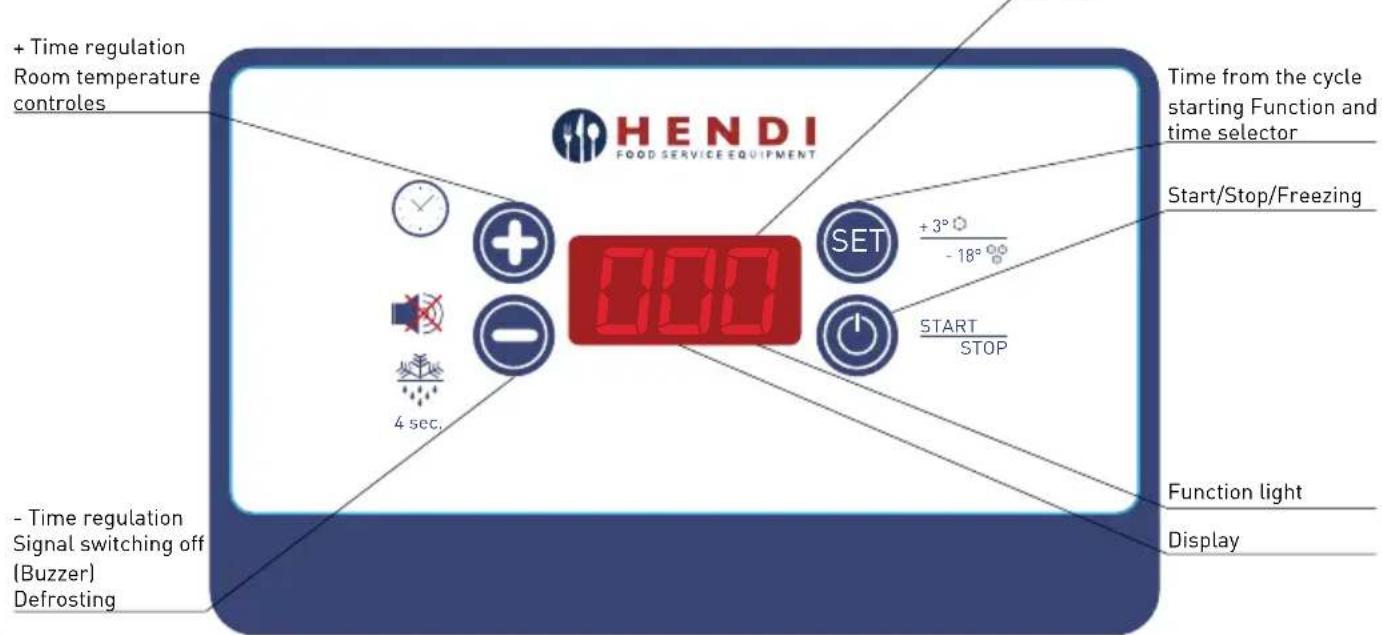
There is a 5 seconds lamp-test when the control stats, after that it places in Operative position.
Keys
The front panel stops in stand by functions if the button "SET" is pressing for 4seconds when the
blasting cycles have been stopped.
Time and core probe program setting
Stop - Display
When the time cycle is selected the display shows the time (in hours and minutes) or the records of the core probe if the probe cycle is selected.
The upper point of the second display shows the selection in case of negative process.

Stop - Keys
- Set, Up Down keys permit to enter the cycle setting.
- Set to go automatically to the negative and positive probe cycle process.
- Press Set key for 4 sec the control panel is in stand-by.
Start - Display
The display shows the remaining time (in hours and minutes), when the time cycle is selected or the records of the core probe if the probe cycle is selected.
- Press Up or Down to set automatically time cycle if previously was selected the core probe cycle, otherwise set +/- for the time cycle.
- If the buzzer is on, pressing Down to turn it off.
- Press Start/Stop to start the cycle.
If the presence of door is on (PI = I) and the contact is not well closed, on the display appears "dr" which shows that the door is open.
Start - Keys
-
Pressing the "SET" key the display shows the time passed from the starting of the cycle or the time of the time cycle, in order to reach the cycle temperature, if it is in conservation modality.
-
Pressing Up, the temperature recorded by the room probe is shown. This data lasts 5 seconds.
If the buzzer is on, pressing Down turn it off.
- Press Start/Stop to start the cycle.

ATTENTION!
At the end of the positive process phase, the conservation program is set automatically at the temperature of 0 to +3^ .
At the end of the negative process phase, the con
Alarms
The existing alarms are those related to the probes. They are shown only when it is required the view of the relative probe. "Er" Generic or internal error of the probes.
"Er" generic error or inside the probe
"Erl" room probe error
"Er2" core probe error
Regulations
Compressor
The compressor can be active only in START function when the room probe has no error.
If the presence of door is on (PI = I) ,the door must be closed to permit the starting of the compressor only if P6 = 0 .With P6 = 0 the compressor is active even if the door is open and with arrested fan. The compressor starts according to the SET POINT on, corresponding to the selected cycle and according to the differential of temperature set (Parameter P8).
Manual defrosting
servation program is set automatically at the temperature of -22 to -25^ .
In order to respect the chilling and freezing time provided by law, while a cycle is in progress, it is strongly advised against opening the door of the device.
If one program is in progress and an error is generated, the cycle passes to time process even if the error continues to be on.
The protection time for the compressor are:
- P9: minimum delay that must exist between the switching off and the next starting up of the compressor. This parameter is used also like reset of the card.
- P10: minimum delay that must exist between 2 consecutive starting ups of the compressor.
The defrosting is carried out with open door, without the use of neither the heater nor the hot gas.
Parameters
Pressing contemporarily Up and Down to enter the parameter setting for at least 4 sec.
At this point on the display appears the number itself of the parameter (P0). Pressing the SET key, it is possible to see the value of the parameter itself and modify it.
The keys Up and Down, when the parameter setting is on, allow to pass to the next/former parameter; when the value of the parameter is on, they modify it.
| 0 Permit to enter into the conservation function: the buzzer rings for 60 sec. 011 - |
| 1 Door present 0=door absent; 1=door present 011 - |
| 2 Fan during he process 0=together with the compressor; 1=always on 011 - |
| 3 Permit to enter the core probe function 011 - |
| 4 Permit to enter the negative process 011 - |
| 5 Permit to enter the defrosting 010 - |
| 6 | Stopping functions when the door is open 0=compressor+fans; 1=fans | 0 | 1 | - |
| 7 Configuration RL2=defrosting; 1=fan+defrosting | 011 - | | |
| 8 | Hysteresis of regulation | 0 | 20 | 3 °C |
| 9 | Protection of the compressor Off/On (also valid as reset) | 0 | 99 | 2 min |
| 10 | Protection of the compressor Off/On | 0 | 99 | 3 min |
| 11 | Defrosting duration | 0 | 99 | 10 min |
| 12 | Dripping duration | 0 | 99 | 3 min |
| 13 | Core probe for the positive process | -50 | 99 | 3 °C |
| 14 | Core probe for the negative process | -50 | 99 | -18 °C |
| 15 | Room probe for the positive process | -50 | 99 | -2 °C |
| 16 | Room probe for the negative process | -50 | 99 | -40 °C |
| 17 | Room probe for the positive conservation process | -50 | 99 | 0 °C |
| 18 | Room probe for the negative conservation process | -50 | 99 | -25 °C |
| 19 | Postive time process duration | 0 | 599 | 90 min |
| 20 | Negative time process duration | 0 | 599 | 270 min |
| 21 | Set condenser temperature for second fan | 60 | -50 | 99 °C |
| 22 | Enable controller for secondary fan | 1 | 0 | 1 - |
9. Maintenance - disposal of materials
All maintenance operations and reparations of the appliance must be carried out with stationary unit, removing the tension from both the refrigerated item and the condensing unit. All the operations must be carried out by qualified and specialized staff.
Periodical checks
At regular intervals [at least once a year], it is important to make a complete system check by qualified staff only. Please check that:
- the water drainage system works properly.
- there are no refrigerating gas leaks and the complete refrigerating system works properly.

ATTENTION!
All cleaning ordinary and extraordinary operation are described in chapter "CLEANING".
- the maintenance state of the electrical system is completely safe.
- the door gaskets and the door itself close properly.
- the condenser of refrigerating unit is clean.
If the device is provided with a fan motor and it is necessary to remove it, it is important to taking off the tension, verify the label with technical data of
Substitution of the compressor / refrigerated gas
In case of compressor damaging and/or replacing, save its refrigerating gas and oil and avoid dispers
Requesting spare parts
When requesting spare parts, please say clearly:
- Model of the item
- Serial number of the item
the fan motor and substitute it with one of identical power, voltage and frequency.
sing it in the environment.
- Quantity of the spare part
Possibly, enclose also a picture of the part to be ordered.
10. Maintenance - disposal of materials
Message Breakdown Malfunction Error Solutions
| ER | Ensure that all the cables are included in the terminal | Generic error or/ internal error of the probe | If the cable is tore off. insere it again and screw it up |
| ER1 | Ensure that all the cables are included in the terminal | Error of the room probe | If the cable is tore off. insere it again and screw it up |
| ER2 | Ensure that all the cables are included in the terminal | Error of the room probe | If the cable is tore off. insere it again and screw it up |
| Blasting time too long | Check if the evaporator is blocked with ice | Leave the door open for at least 15 min to melt the ice |
| Check if the product is loaded correctly and does not exceed | Lighten the load of trays and grills |
| Check if the internatl fan is spinning | Contact rhe assisatnce |
| Ensure that the laboratory temperature is not too high and with high percentage of humidity | Contact rhe assisatnce |
| Failed conservation of the food at he end of the blasting cycle | | Contact rhe assisatnce |
| ER2 | Ensure that all the cables are included in the terminal | Error of the room probe | If the cable is tore off. insere it again and screw it up |
| DR | The door is open The door is open | | Check that the door is properly closed |
11. Warranty
Any defect affecting the functionality of the appliance which becomes apparent within one year after purchase will be repaired by free repair or replacement provided the appliance has been used and maintained in accordance with the instructions and has not been abused or misused in any way. Your statutory rights are not affected. If the appliance is claimed under warranty, state where and
12. Discarding & Environment
When decommissioning the appliance, the product must not be disposed of with other household waste. Instead, it is your responsibility to dispose to your waste equipment by handing it over to a designated collection point. Failure to follow this rule may be penalized in accordance with applicable regulations on waste disposal. The separate collection and recycling of your waste equipment at the time of disposal will help conserve natural re
when it was purchased and include proof of purchase (e.g. receipt).
In line with our policy of continuous product development we reserve the right to change the product, packaging and documentation specifications without notice.
sources and ensure that it is recycled in a manner that protects human health and the environment. For more information about where you can drop off your waste for recycling, please contact your local waste collection company. The manufacturers and importers do not take responsibility for recycling, treatment and ecological disposal, either directly or through a public system.
EN
- Model of the item
- Serial number of the item

ATTENTION!
All cleaning ordinary and extraordinary operation are described in chapter "CLEANING".
Quantity of the spare part
Possibly, enclose also a picture of the part to be ordered.
Melding Defect storing Fout Oplossing
HaKaJIbBaHnRA BbICOKoM OuHocTn, Neuei, paIaTOPOB OTOpJIeHnI.
3anpeaetcyaCTaHaBnBaTb aannapat wokoboy 3amop03KN B6n3N BbIXoOB IN ppoEMOB, B TOM YncIe DBepei, OKOH, BeHTnJIaNoHHbIX OTBep-CTNI KOnDnCnoHepOB.
- 3anpeuaeTcra 3aKpbIbTaB BxOndHoe OTBepCTne annapata wokobov 3amOp03Kn.
3aPpeaetcnoMeaTbIIO6bIeMaTePnaJIbHa aannapat WOKOBOzAMOp03Kn. IJa oBeCneueHnHaJNeXaUeIuPKyIaUN Bo3dyxa Heo6xoDnMo oBeCneuNTb OTCyTCTBNE npenrTCTBn IO Bcemy nepimEtpy aannapata WOKOBOzAMOp03KN.
3anpeaetcyaTahabnBaTb aannapat WOKOB 3amop03Kn B NOMEeHnX C BbICOKo OTHOCTeNbHO BnaXHoCTbHO (BO3MOxHO 6pa3OBAHne KOHeHCata)
3aPpeaaetcyaTahabnBaTb annapat wokob03amop03KN B 3akpbItbIe npoembl. Be3 Hndnka-1uei npkyrauB03dyxa xolodnbHoe yctpoiCTBO He 6ydt 3phiKTHBHO pa60TaTb.
3anpeaetcraTbTb Topyne noDOnhblnnnoHocbHa Kpbkky annapata WOKOBON3amOp03kn.
Heo6xOJMo y6eHTbcB DocTaTOHOB BeHTnIaIuI NOMEueHna, rJe yCTaHbINBaETcAannapat, B TOM uNcJIe B Hepa6Oue Yacbl. 3To Heo6xOJMo IJa HaJNeKaUe pa60TbI pacWnpTeNbHorO 6aka / 6loka KOHDeHcaun.
MnHmAlbHoe paCCToHne ot CteHbl
Iln HOpMaJIbHOH pa6Otbl annapata WOKOB03aMop03KNn HAnLexKaUeN CHPKJyUu BO3DyXHa He-06xOIMo CO6JIIODaTb ONpeDeJeHHoe MmHMmaJIb-Hoe paccToHHe OT CTeHbI:
CnepeHcTOpOnbIdoJXHo6bITbObeCneyeHO MInHmAlbHoe Cbo6oHoe pacCToHHe,coOTBeTCTBVIOOe DJIHHe OTKpBITnIBepuI.
3aHnra cTOpHa aannapaTa WOKOBn 3amop03Kn DOJXHa HaxoNTbcn Ha paCCTOHN He MeHee 10 CMOTCTehn
RU
AnnapaT WOKOBI 3AMOP03KNC BCTPOEHbIM 6JOKOM KOHdEHCauN
AnnapaT WOKOBO 3aMOp03Kn IMeET BCTpoEHbI 6JOK KOHDeHcaUIN, IN CCB3N C 3TIM Heo6XoIMo He 3aKpbIBaTb OTBepCTne IJI NODaUN BO3dyxa, COOTBeTcByIOUe e nepedHe peWetKe, IJI OBeCneueHHaNDexaSeuPKyJauuIN BO3dyxa. Becb NepiMeTp annapaTa WOKOBO 3aMOp03Kn DoJXeH 6blb YnCTbIM. HanomHaem, QTO B Cnyae NOBbI-WeHHaTHo TEMnpaTypbl NN HeoctatoHOn NODaUN BO3dyxa Ha 6Jok KOHDeHcaUIN PpON3-BOHTeNbHocTB aNnapaTa WOKOBO 3aMOp03Kn
MOKET CHN3NTbC, qTO MOKET npNBecT N K nopue npOyKTOB uYBeJIuYeHnO 3HeprOnoTpe6JIeHn. EcIa annapat WOKOBON 3amOp03Kn C BCTpoEHhbIM yCTpOInCTBOM KOHNcHCAUIN JExkAn Ha 6oky npi TpaHCnOpTnpOBKe, Mbl peKOMeHnDyEm DepXaTB erO nepeB BKIOUeHnEM BepTKaJIbHOM NIOJoxEHN He Mehee 8 Yacob. 3To oBeCneuyt NonaDaHne Macna Ha BCE KOMNoHEnTbI dJa IN HAJNeJkaUe cMa3Kn. PocJe 3TOrO MOxHO BKIOUcA Tb annapat.
TexHnueckne daHHbIe
| 232163 | 232170 | 232194 | 232187 | 232491 | 232507 |
| Размерbl[ШхДВ мь](с похками) | 750x740x720(750) | 750x740x850(880) | 750x740x1260(1290) | 750x740x1260(1290) | 750x740x1850 | 750x740x2080 |
| Маса.netто[kг] | 50 | 71 | 90 | 102 | 120 | 150 |
| РazмерblКамерbl[ШхДВ мь] | 600x400x280 | 610x400x410 | 760x630x410 | 760x630x410 | 610x410x1120 | 610x410x1360 |
| Вмости -юсты[K-волотков] | 3x GN 1/1 пи3x 600x400MM | 3x GN 1/1 пи3x 600x400MM | 3x GN 1/1 пи3x 600x400MM | 3x GN 1/1 пи3x 600x400MM | 3x GN 1/1 пи3x 600x400MM | 3x GN 1/1 пи3x 60Ox400MM |
| Расстяниемождуюстам[MM] | 70 70 105 70 70 70 |
| Зф ekтов -юстwoювого охлaxдени[+3°C] | 14 кг 20 кг 25 кг 25 кг 45 кг | 50 кг |
| Зф ekтов -юстwoюв озморозkn[+18°C] | 11 кг | 15 кг 20 кг 20 кг 35 кг 40 кг |
| Га:[Tи] | R404a/R507 | R404a/R507 | R404a/R507 | R404a/R507 | R507 | R507 |
| Деталиисьтанин[°C / 0B] | +43 / 65% | +43 / 65% | +43 / 65% | +43 / 65% | +43 / 65% | +43 / 65% |
| Погlioцae -маяюсты[Bт] | 1150 | 1424 | 1490 | 1490 | 1820 | 2040 |
| Источникп�туниу[B-Ф-Гц] | 230-I-50 | 230-I-50 | 230-I-50 | 230-I-50 | 400-3-50 | 400-3-50 |
Pon3BOJTeIbN DnJIepe He HecyT OTBeTCTBeHHoCTn 3a HToUHOCTn B HactOaIe MpyKOBoDCTBe, CB3aHHbIe C OUn6kAm N neaTu NIN TpaHcKpUncEiB COOTBeTCTBUN C HaSeN POnITKoN IocTOrH-Horo COBepWeHCTBOBaHNA IpOdyKcN, Mbl OCTaB-
JЯEM 3a co6oB npaBO BHOCTb N3MeHeHnB npOdyKuHIO, ynaKOBky n CneuNΦnKaun, copePka- uHecra B DOKyMeHTaun 6e3 npedBapntelbHoro npedynpexdHn.
HΦopMaIIO no peryIinpoBaHnIO pa6OuNX npaMetpoB MoXHO HAIITN B INCTpyKunx K nAneJnynpaBLeHn, npIlaRaEmbIX K HactoJeMy pykoBODCTBy.
5. Oučstka
Bce npoueypbI dOJXHbI npoBOaNTbc8 co ycTpoiCTBOM B cTaUHOAPHom noloxeHN 6e3 noDaun
OuicTka annapata rIy6oko3amOp03Kn
06cnykBaHne annapaTa rIy6oko3amopo3Kn doJxHo BkIouaTb He MeHee OndHn IpOceDypbl exEHDHBn OuncTK 3OHbI NOrpy3Kn IJI npedOTBpaSeHn cKOpLeHn n pa3MHOxHn 6aKTePn. Ipeed ouNCTko KamepbI annapata rIy6oko3a-Mop03Kn Heo6XODmO npOBecTN pa3MopaxkBaHn, depka DBepu OTKpbToN i ChraB KpbUkky dpenKaHNo Tpy6Kn.

BHIMAHNE!
Heo6xOJIMO npoBOuNTb exeJeHBeBHyIO ouNcTKy annapata rIy60kO 3amOp03Kn dIJI npedOTbpaue-Hnra pa3MHOKeHnra n cKoJIeHnra 6aKTeprn. IpeXJde yem OUHaaTb KaMepy annapata rIy60kO 3amOp03Kn, Heo6xOJIMO npOBecTu pa3MopaxNBaHne, dJIa Yero HxKHO ChrTb KpbIwKy dpEHaXHoRO KOHTeHepa.
- 3anpeaetcHnprmyo npombibatb BHyTpehnHe qactn annapata, NocKobky 3To MoKeT npnBeCTN K NOBpeXdEHNIO 3JIeKTpueeCKNX KOMno-HeHTOB.
Ha npjxhen Ha oxlaXdaemb my oBeKT n 6nok KOH deHcaun.
3anpeaetcnoB30BaTbTBepdbieMeTaJIH-ueckne HnctpyMeHTbldnydaJeHnJaDa.
-Дяоунctkn pa3pewaeTcЯ nCnoJb3OBaTb TOnb-Ko TeNnyIO (He ropaIyIO) Body 6e3 arpeccnBbIX MoUxxCpeDCTB, BnaKHbIe YacTn CneJeT npToTnpaTb cyXoN TKaHbIO.
- Cnédyet n36eRaTb nCnoB30BaHnra npOyKTOB, coedePkaauxx xlop nIpa36abNeHHbIe paCTBOpbl, kayctnueckyIO cOly, a6pa3nHBhIe moIoUne cpeIcTBa, coJMyHO KNCIoTy, yKCyc, oTbeJIbAteJIb nIIN dpyrIe npOyKTbI, KOToPbIE MOYr Bbl-3BaTb zapaanHbI nIIN weepoxOBaTOCTb NOBepXHoCTeI.
MbI peKOMeHdyem npoBOaNTb OuNCKy yCTpoi-CTBa HpeXe, Yem pa3 B MecaU, npn erO nCNoB-30BaHnn IJIyIy60KOJ 3aMOp03Kn npOdyKTOB.

Pn ouncKe peKoMeHdyetc HcNoIb30- Batb pa6OuHe nepaTkn.
OuIncKa 3oHda
06cnyxHBaHne annapata rny6oko3amop03KndoJXHO npedymatpnbTb ouncTkTy TempepatypHoro 3OHda He pexe, yem Odnn pa3 B deHb.
DaTnK KOMHaTHo TEMpepaTyb B annapate He- 06xOIMO OuHaaTb EKeJHeBHO. Bce npoueypbI DOJIKNbI PPOBOINbC8 Co yCTpOInCTBOM B cTaUHO-HaPHOM NIOXeHN 6e3 NODaun HApJxHnna HaOxJaembl OBeKT N 6LOK KOHdEhCaUN. Mbi peKOMeHdyem TuaTeNbHo npOMbIBaTb 3OHd YnCTToB BOOn I rNfneHueckm pactBopom. Ppr 3tOM He- 06xOIMO nCnoJIb3OBaTb Te Xe MeTOdbI n C6JIIO DaTb Te Xe OrpaHnueHn, YTO ONiCAHbIB ppeDbIy- uem a63aue.
6. Pekomehdaun npedynpejckdneH
PekomeHdyetcexeHHeBHO ouuatab HapyKHyIO nobepxHoctb annapata rny6oko 3amop03Kn, B
PyuHoe pa3MOpaxKnBaHne
Annapat rny60kO 3amop03Kn nCnoJb3yeT pyHoe pa3MopaxKuBaHne, KOtopoe MoXe TpoBOaNTbcra npn OTKpbIToN nn 3akpbIToN dBepue (npn 3akpbIToN dBepue pa3MopaxKuBaHne 3aHmaeT 6oJIbWe BpemeH).
Tom Yucne BHyTpeneHHIO CTOpOHy DBePcbl Bo3ne npoknaDOK.

BHIMAHNE!
Iocne 3aBepweHn npoceDpybI Heo6xOdmo cHartb KpbIky C dpEhaxHoTpy6Kn, YTO6bl Boda CTeKna B KOHTeHep. DpeHaxHa Tpy6ka TaKxe None3Ha IJIra CInBa dpynx XnDkoCTe npOdykTa.
IooKoHuaHnn npoueDypbl cneDyET npoBepntb ypoBeHb BOdbn npn Heo6xOaMocTn CInTb KOHTeHep.
MaKcImaJIbHaHaHarpy3Ka Ha noIky I xpaHeHne

BHUMAHNE!
- Annapat wokoboi 3amop03kn moxet nCnoB3o-BaTbCn Jn CHNXeHn TEmnepaTypbI rTOOBbIX npOdyKToB (cm. Ta6nuy coOTBeTCTBn TEmnepaTp n npOdyKToB).
3anpeaetcnoMeaB aannapat npdyktb, T0lbko yTo n3BneueHHbIe n3 neu. Ipexde yem NOMEaTb npOyKTb B KOHTeHep n 3anyckaT uKJI, HxKHO nooXdaTb HeCKoJbKO MnHyT. HanomHaem, yTO BpMa oKOBn 3amOp03Kn Do XeJaEMo TeMnepaTypbI 3abncnt OT pra da fak-TopoB, B TOM YNCJIe:
-ΦopMa,TnT,TOJUHaN MaTePnaJI KOHTeHepa, B KOTOpOM CoJepXHTc3aMopaxNBaeMbI npoDyKT.
- Haneluhe KpbiUkN Ha KOHTeHepe.
- ΦиЗичecкнхаразКерпстИКи пpoДуКТа,пnot-HocTb, coДржанHe BODы И Киpa.
TemnepaTypa 3amopaxnBaemoro npoNyKta.
Bpem oxnaKeHn n 3amOp03Kn yctHaBnBaetc B 3aBncmocTn OT Tnna n Maccbl 6pa6aTbIbAeMoro npodykta.
Bb6oppeKImaIJIaBpeMeHnO6pa6oTKN
Bb6op peKIma annapaTa rIy6oko3amOp03Kn:
BpeMeHHoI zIKI, KOrda yKa3aHO BpeM o6pa6oTkn. Iocne 3aBepseHnBpeMeHHoro zIKla aBTOMaTnueckn 3aNyckaetcpeXIM KOHcepBaun.
- При Налочи TempepaTpyHOro 30Hda
ДocTaToUHо 3aJaTb TempepaTpy
3aMopaxnBaemorO nIIN OXnaJdaemOr npodykTa. 3oHd pernctpnpyET TemnepaTpy, I nocJIe akyctnueckoro cnHaJa ycToPcTB0 nepexoINT B pexm KOhcepBaun (cm. noLoxKeHne 3oHda).
Tn o6pa6oTk Tn zukna Tnpodykta
3arpykaembI TOnuHa 1nKn no KoNy npOdyKTa
napaMeTpa, KOTopoe MoXHO N3MeHHTb.
KhoNKn BBepx Bn3 npn BKNoyeHNOHa- cTpoKe npaMeTpOB n03BOJIoT BblnoHHTb nepeXoI K cIeDyUoSeMy IInn PpeDbIyUeMy npaMeTppy; KOrDa npaMeTp BkNoueH, OHN erO n3MeHraT
OnncanHe Mm.
MaKc. DeΦ. Hnua
To axnμa, o tunoç, to naxoc kal to uλiko σto
Xapaktnploktiké enlloync xpvou eNExepyiaic
Hendi Food Service Equipment GmbH
Central Barn, Hornby Road
Lancaster, LA2 9JX, United Kingdom
Tel: +44 (0)333 0143200
Email: sales@hendi.co.uk
Hendi Food Service Equipment Romania Srl
PKS Hendi South East Europe SA
5 Metsovou Str.
18346 Moschato, Athens, Greece
Tel: +30 210 4839700
Email: office.greece@hendi.eu
Hendi HK Ltd.
1208, 12/F Exchange Tower
33 Wang Chiu Road, Kowloon Bay, Hong Kong
Tel: +852 2154 2618
Email: info-hk@hendi.eu
FindHendi on internet:
www.hendi.eu
www.facebook.com/HendiFoodServiceEquipment
www.linkedin.com/company/hendi-food-service-equipment-b.v.
www.youtube.com/HendiEquipment
- Changes, printing and typesetting errors reserved.
- Änderungen und Druckfehler vorbehalten.
Wijzigingen en drukfouten voorbehonden.
- Producent zastrzega sare prawo do zmian oraz btedow drukarskich winstrukcji.
-
Variations et fautes d'impression réservés.
-
Errori di cambiamenti, di stampa e di impaginazione riservati.
- Drepturi rezervate cu privire la modificari si gresei de imprimare.
-ImMeHeHn,neaTnBepCTKnOuN6Kn3auiuHbI.
-Me enupaen aaiayaw,aaewkrtunwoc koiotouxeioeiaq.