Super Finish 23 Plus - Paint spray WAGNER - Free user manual and instructions
Find the device manual for free Super Finish 23 Plus WAGNER in PDF.



User questions about Super Finish 23 Plus WAGNER
0 question about this device. Answer the ones you know or ask your own.
Ask a new question about this device
Download the instructions for your Paint spray in PDF format for free! Find your manual Super Finish 23 Plus - WAGNER and take your electronic device back in hand. On this page are published all the documents necessary for the use of your device. Super Finish 23 Plus by WAGNER.
USER MANUAL Super Finish 23 Plus WAGNER
Airless high-pressure spraying unit
natural_image
Technical line drawing of a spray gun and spray gun assembly (no text or symbols)2334 424
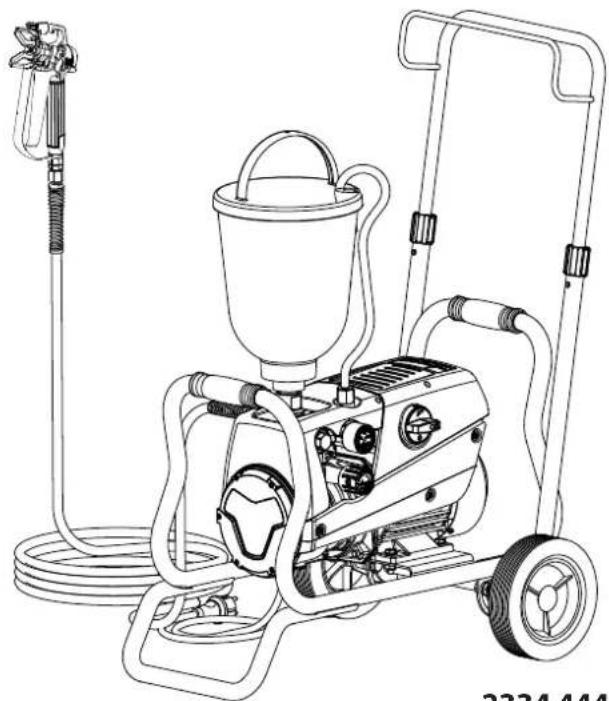
natural_image
Line drawing of a spray sprayering machine with hoses and control panel (no text or symbols)2334 444
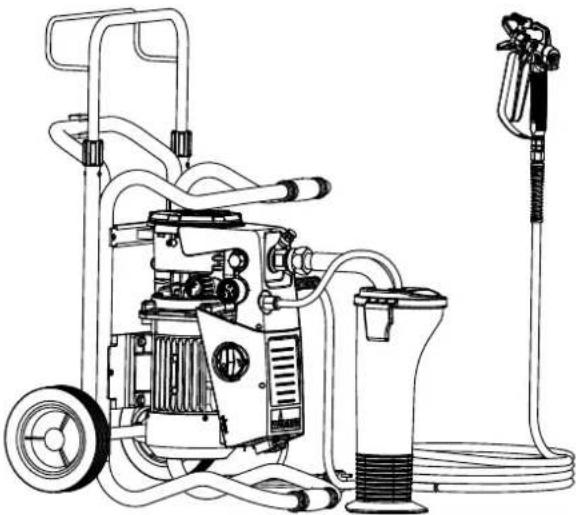
natural_image
Technical line drawing of a pressure pump assembly with hoses and control panel (no text or labels)2341576
03 / 2016
2356 372
Warnung!
10 REPARATUREN AM GERÄT 16
1.2 EXPLOSIONSSCHUTZ

Gefahr
natural_image
Line drawings of three different industrial pump machines on a flat surface (no text or symbols)text_image
Technical diagram of a spray gun with labeled components including a manual pump, hose, and spray gun.text_image
Technical diagram of a mechanical assembly with numbered parts labeled 1 through 5natural_image
Technical line drawing of a mechanical clamp or bracket assembly with no visible text or symbolstext_image
Technical diagram of a spray gun with numbered components for identification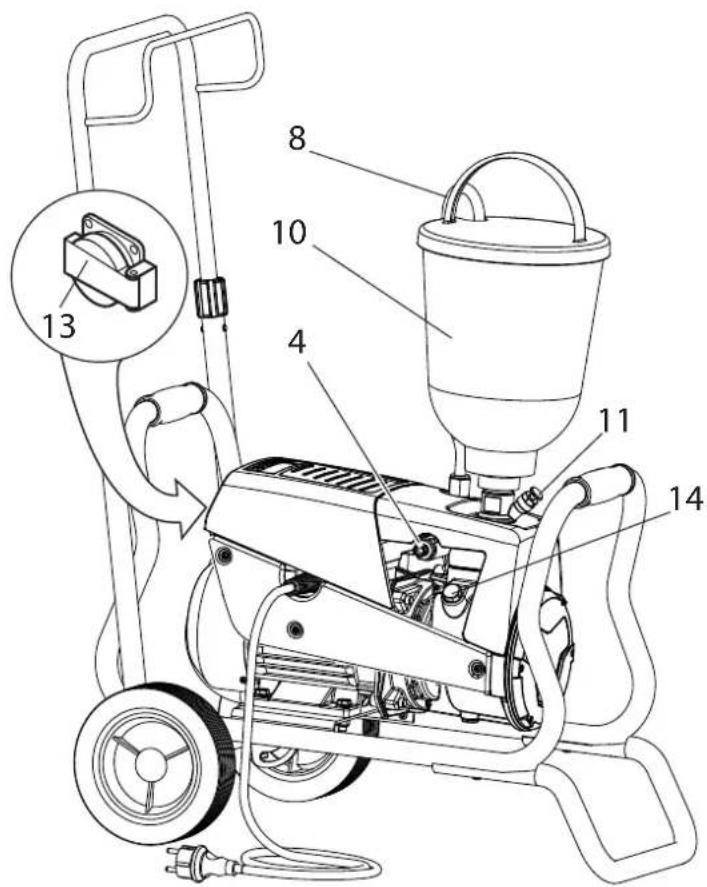
text_image
Technical diagram of a cleaning or dust purifier with numbered components labeled 4 through 143.5 WAGENUMBAU

natural_image
Technical line drawing of a vehicle's lower body frame with visible wheels, sensors, and structural components (no text or symbols)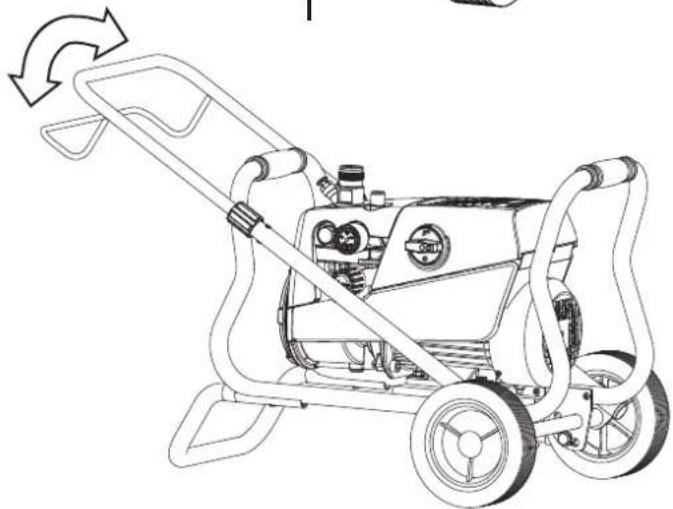
natural_image
Line drawing of a portable lawn mower with a side-mounted fan and wheels (no text or symbols)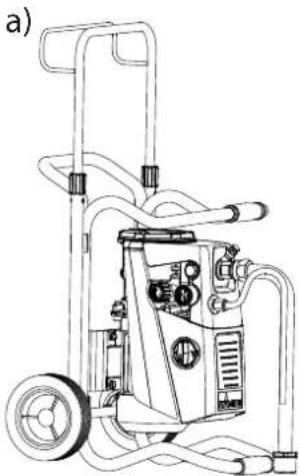
natural_image
Line drawing of a mechanical pump or lift device with wheels and pipes (no text or symbols)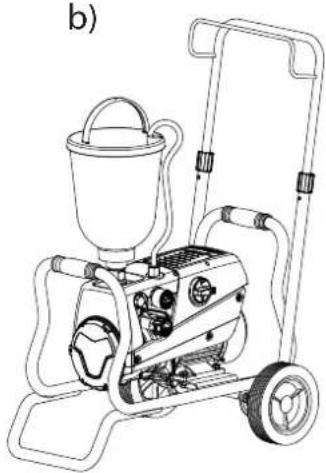
natural_image
Line drawing of a portable electric mixer with bucket and wheels (no text or symbols)text_image
Technical diagram of a spray gun pump system with numbered components for identificationtext_image
Technical diagram of a vehicle's internal components with numbered parts and labeled partstext_image
Technical diagram of a spray gun with labeled parts and directional arrows indicating motion or movement.10 REPARATUREN AM GERÄT

text_image
Technical diagram of a mechanical assembly with labeled parts and component annotations10.2 EINLASSVENTIL
text_image
Technical diagram of a mechanical component with numbered parts, including a wrench and valve assembly.10.3 AUSLASSVENTIL
text_image
Technical diagram of a mechanical device with numbered parts for identification and assembly reference.10.4 DRUCKREGELVENTIL

natural_image
Technical line drawing of a vehicle dashboard with gauges and control panel (no text or symbols)text_image
Technical diagram of a mechanical device with labeled parts, showing internal components and assembly structure.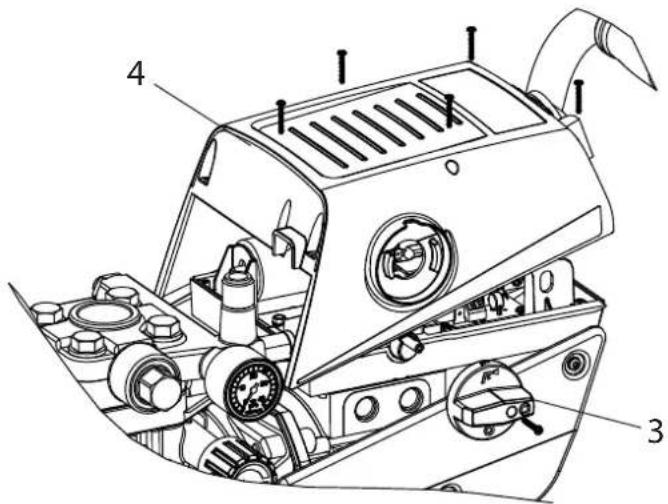
text_image
Technical diagram of a mechanical device with numbered parts labeled 3, 4, and a valve mechanism.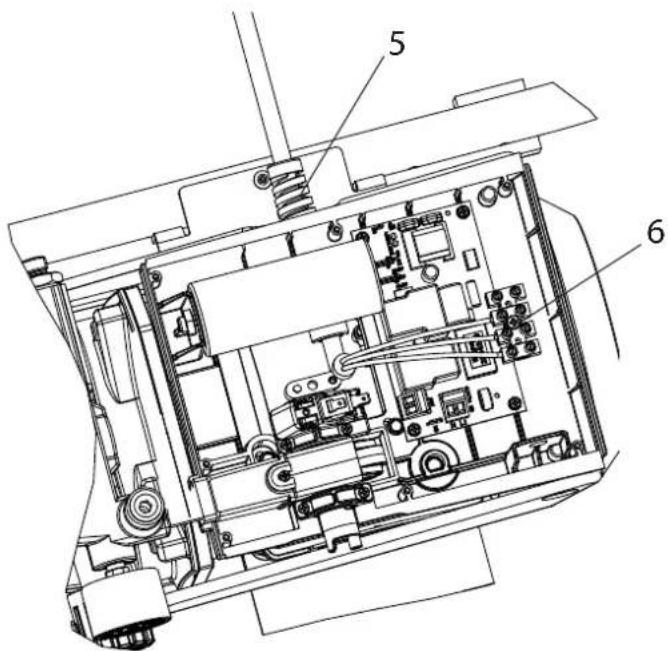
text_image
Technical diagram of a mechanical device with labeled parts 5 and 610.7 SCHALTPLAN
text_image
Technical diagram of a mechanical assembly with numbered parts for identification11.3 ERSATZTEILLISTE HOCHDRUCKFILTER (ZUBEHÖR)
text_image
Technical diagram of a mechanical assembly with numbered components for identificationtext_image
Technical diagram of a wheeled cart with numbered components for identificationtext_image
Technical diagram of a mechanical device with numbered parts labeled 1 to 4text_image
Technical diagram of a water filter device with labeled parts including a pump, drain, and inlet/outlet ports.text_image
Technical diagram of a water purifier with numbered components and labeled partswww.wagner-group.com/profi-guarantee.
Division Professional Finishing
Otto Lilienthal Strasse 18
88677 Markdorf
Translation of the original operating instructions
WARNING!
Attention, danger of injury by injection!
Airless units develop extremely high spray pressures.
  Danger Danger | |
| 1 | Never bring fingers, hands or other body parts into contact with the spray jet!Never point the spray gun at yourself, other persons or animals.Never use the spray gun without spray jet safety guard.Do not treat a spray injury as a harmless cut. In case of injury to the skin by coating material or solvents, consult a doctor for quick and correct treatment. Inform the doctor about the coating material or solvent used. |
| 2 | The following points are to be observed in accordance with the operating manual before every start-up:Faulty units may not be used.Secure a Wagner spray gun with the securing lever at the trigger guard.Ensure earthing.Check the permissible operating pressure of the high-pressure hose and spray gun.Check all the connecting parts for leaks. |
| 3 | Instructions for regular cleaning and maintenance of the unit are to be observed strictly.Observe the following rules before any work on the unit and at every working break:Relieve the pressure from the spray gun and high-pressure hose.Secure a Wagner spray gun with the securing lever at the trigger guardSwitch the unit off. |
Ensure safety!
Contents
1 SAFETY REGULATIONS FOR AIRLESS SPRAYING 36
1.1 Flash point ____
1.2 Explosion protection ____
1.3 Danger of explosion and fire from sources of ignition during spraying work ____ 36
1.4 Danger of injury from the spray jet 36
1.5 Secure spray gun against unintended operation _ 36
1.6 Recoil of spray gun 36
1.7 Breathing equipment as protection against solvent vapors ____ 36
1.8 Prevention of occupational illnesses ____ 36
1.9 Max. operating pressure 37
1.10 High-pressure hose 37
1.11 Electrostatic charging (formation of sparks or flames) ____ 37
1.12 Use of units on building sites and workshops ____ 37
1.13 Socket at the unit 37
1.14 Ventilation when spraying in rooms ____ 37
1.15 Suction installations
1.16 Earthing of the object 37
1.17 Cleaning the unit with solvents 37
1.18 Cleaning the unit 37
1.19 Work or repairs at the electrical equipment ____ 37
1.20 Work at electrical components 38
1.21 Setup on an uneven surface 38
2 GENERAL VIEW OF APPLICATION 38
2.1 Application
2.2 Coating material ____
2.2.1 Coating materials with sharp-edged additional materials 38
2.2.2 Filtering 39
3. DESCRIPTION OF UNIT 39
3.1 Airless process ____
3.2 Functioning of the unit 39
3.3 Explanatory diagram
3.4 Transportation
3.5 Trolley backfitting 41
3.6 Technical data 41
4 STARTUP 42
4.1 Unit with suction system 42
4.2 unit with upper hopper (5 litres) ____ 42
4.3 high pressure hose and spray gun 42
4.4 Connection to the mains network 42
4.5 Socket on unit (not included in all models) ____ 43
4.6 Cleaning preserving agent when starting-up of operation initially ____ 42
4.7 Ventilate unit (hydraulic system) if the sound of inlet valve is not audible ____ 42
4.8 Taking the unit into operation with 36 coating material ____ 42
5 SPRAYING TECHNOLOGY 44
6 HANDLING THE HIGH-PRESSURE HOSE 44
7 INTERRUPTION OF WORK 44
8 CLEANING THE UNIT 45
8.1 Cleaning the unit from the outside 46
8.2 Suction filter 46
8.3 High-pressure filter
8.4 Cleaning the Airless spray gun 47
9 SERVICING 47
9.1 General servicing 47
9.2 High-pressure hose ____
10 REPAIRS AT THE UNIT 48
10.1 Inlet valve Pusher 48
370.2 Inlet valve 48
10.3 Outlet valve 49
10.4 Pressure control valve 49
10.5 Replacing the power cable ____ 50
10.6 Typical wear parts 50
10.7 Connection diagram 51
10.8 Remedy in case of faults 52
11 SPARE PARTS AND ACCESSORIES 53
11.1 Super Finish 23 PLUS accessories 53
38.2 Spare parts list Super Finish 23 PLUS ____ 58
11.3 Spare parts list high-pressure filter ____ 60
11.4 Spare parts List Trolley 60
11.5 Spare parts List frame 61
11.6 Spare parts list suction system (rigid) ____ 61
11.7 Spare parts list hopper 5l 62
11.8 Spare parts list hopper with TopClean 62
40 Testing of the unit 63
Important information on product liability 63
Note on disposal 63
Guarantee declaration 63
CE - declaration 129
European service network 132
1 SAFETY REGULATIONS FOR AIRLESS SPRAYING
All local safety regulations in force must be observed.
The following sources are just a sample of those containing safety requirements for Airless spraying.
a) The European Standard „Spray equipment for coating materials – safety regulations „ (EN 1953).
The following safety regulations are to be observed in order to ensure safe handling of the Airless high-pressure spraying unit.
1.1 FLASH POINT

Only spray coating materials with a flash point of 21 °C or higher.
The flash point is the lowest temperature at which vapors develop from the coating material. These vapors are sufficient to form an inflammable mixture over the air above the coating material.
1.2 EXPLOSION PROTECTION

Do not use the unit in work places which are covered by the explosion protection regulations. The unit is not designed to be explosion protected. Do not operate the device in explosive areas (zone 0, 1 and 2). Explosive areas are, for example, places where paints are stored and locations in direct proximity to the object being sprayed. Keep the device at least 3 m from the object you are spraying.
1.3 DANGER OF EXPLOSION AND FIRE FROM SOURCES OF IGNITION DURING SPRAYING WORK

There must be no sources of ignition such as, for example, open fires, lit cigarettes, cigars or tobacco pipes, sparks, glowing wires, hot surfaces, etc. in the vicinity.
1.4 DANGER OF INJURY FROM THE SPRAY JET

Attention, danger of injury by injection! Never point the spray gun at yourself, other persons or animals.
Never use the spray gun without spray jet safety guard.

The spray jet must not come into contact with any part of the body.
In working with Airless spray guns, the high spray pressures arising can cause very dangerous injuries. If contact is made with the spray jet, coating material can be injected into the skin. Do not treat a spray injury as a harmless cut. In case of injury to the skin by coating material or solvents, consult a doctor for quick and correct treatment. Inform the doctor about the coating material or solvent used.
Always secure the spray gun when mounting or dismounting the tip and in case of interruption to work.
1.6 RECOIL OF SPRAY GUN

When using a high operating pressure, pulling the trigger guard can effect a recoil force up to 15 N.
If you are not prepared for this, your hand can be thrust backwards or your balance lost. This can lead to injury.
1.7 BREATHING EQUIPMENT AS PROTECTION AGAINST SOLVENT VAPORS
Wear breathing equipment during spraying work.
A breathing mask is to be made available to the user.
1.8 PREVENTION OF OCCUPATIONAL ILLNESSES
Protective clothing, gloves and possibly skin protection cream are necessary for the protection of the skin.
Observe the regulations of the manufacturer concerning coating materials, solvents and cleaning agents in preparation, processing and cleaning units.
The permissible operating pressure for the spray gun, spray gun accessories, unit accessories and high-pressure hose must not fall short of the maximum operating pressure of 25 MPa (250 bar or 3625 psi).
1.10 HIGH-PRESSURE HOSE

Attention, danger of injury by injection! Wear and tear and kinks as well as usage that is not appropriate to the purpose of the device can cause leakages to form in the high-pressure hose. Liquid can be injected into the skin through a leakage.
- High-pressure hoses must be checked thoroughly before they are used.
- Replace any damaged high-pressure hose immediately.
- Never repair defective high-pressure hoses yourself!
- Avoid sharp bends and folds: the smallest bending radius is about 20 cm.
- Do not drive over the high-pressure hose. Protect against sharp objects and edges.
- Never pull on the high-pressure hose to move the device.
- Do not twist the high-pressure hose.
- Do not put the high-pressure hose into solvents. Use only a wet cloth to wipe down the outside of the hose.
- Lay the high-pressure hose in such a way as to ensure that it cannot be tripped over.

Only use WAGNER original-high-pressure hoses in order to ensure functionality, safety and durability.
1.11 ELECTROSTATIC CHARGING (FORMATION OF SPARKS OR FLAMES)

Electrostatic charging of the unit may occur during spraying due to the flow speed of the coating material. These can cause sparks and flames upon discharge. The unit must therefore always be earthed via the electrical system. The unit must be connected to an appropriately-grounded safety outlet.
An electrostatic charging of spray guns and the high-pressure hose is discharged through the high-pressure hose. For this reason the electric resistance between the connections of the high-pressure hose must be equal to or lower than 1 MΩ.
1.12 USE OF UNITS ON BUILDING SITES AND WORKSHOPS
The unit may only be connected to the mains network via a special feeding point with a residual-current device with INF ≤ 30 mA.
1.13 SOCKET AT THE UNIT
Do not load the socket with more than 1500 Watt. Unroll any connected cable drum completely.
1.14 VENTILATION WHEN SPRAYING IN ROOMS
Adequate ventilation to ensure removal of the solvent vapors has to be ensured.
1.15 SUCTION INSTALLATIONS
The are to be provided by the unit user in accordance with the corresponding local regulations.
1.16 EARTHING OF THE OBJECT
The object to be coated must be earthed. (Building walls are usually earthed naturally)
1.17 CLEANING THE UNIT WITH SOLVENTS

When cleaning the unit with solvents, the solvent should never be sprayed or pumped back into a container with a small opening (bunghole). An explosive gas/air mixture can arise. The container must be earthed.
1.18 CLEANING THE UNIT

Danger of short-circuits caused by water ingression! Never spray down the unit with high-pressure or high-pressure steam cleaners.
1.19 WORK OR REPAIRS AT THE ELECTRICAL EQUIPMENT
These may only be carried out by a skilled electrician. No liability is assumed for incorrect installation.
1.20 WORK AT ELECTRICAL COMPONENTS
Unplug the power plug from the outlet before carrying out any repair work.
1.21 SETUP ON AN UNEVEN SURFACE
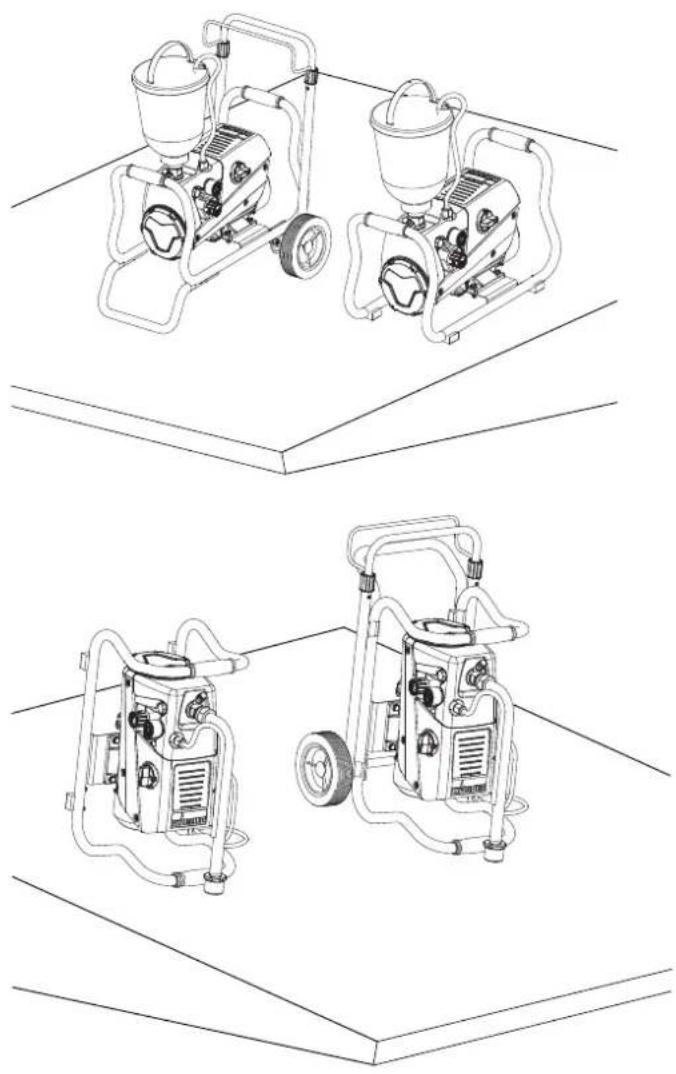
The front end must always point downwards in order to avoid sliding away.
If possible do not use the unit on an inclined surface since the unit tends to wander through the resulting vibrations.
natural_image
Line drawings of three different electric pump machines in a row, no text or symbols present2 GENERAL VIEW OF APPLICATION
2.1 APPLICATION
Super Finish 23 PLUS is an electric driven unit for the airless atomization of different painting materials. Also it is able to feed the internal feeded paint roller, which is available as accessory.
Super Finish 23 PLUS is made for jobs in the workshop and on the building site.
The unit performance is conceived so that its use is possible on building sites for small- to middle-area dispersion work.
When painting, the device is suitable for all kinds of typical painting jobs, e.g.:
doors, door frames, balustrades, furniture, woodencladding, fences, radiators (heating) and steel parts.
We recommend using the top container for paintwork.
2.2 COATING MATERIAL
Diluting lacquers and paints or those containing solvents, two-component coating materials, dispersion and latex paints.
No other materials should be used for spraying without WAGNER's approval.

Pay attention to the Airless quality of the coating materials to be processed.
The unit is able to process coating materials with up to 20,000 mPas. If highly viscous coating materials cannot be taken in or the performance of the unit is to low, the paint must be diluted in accordance with the manufacturer's instructions.

Attention: Make sure, when stirring up with motor-driven agitators that no air bubbles are stirred in. Air bubbles disturb when spraying and can, in fact, lead to interruption of operation.
2.2.1 COATING MATERIALS WITH SHARP-EDGED ADDITIONAL MATERIALS
These particles have a strong wear and tear effect on valves and tips, but also on the heating hose and spray gun. This impairs the durability of these wearing parts considerably.
2.2.2 FILTERING
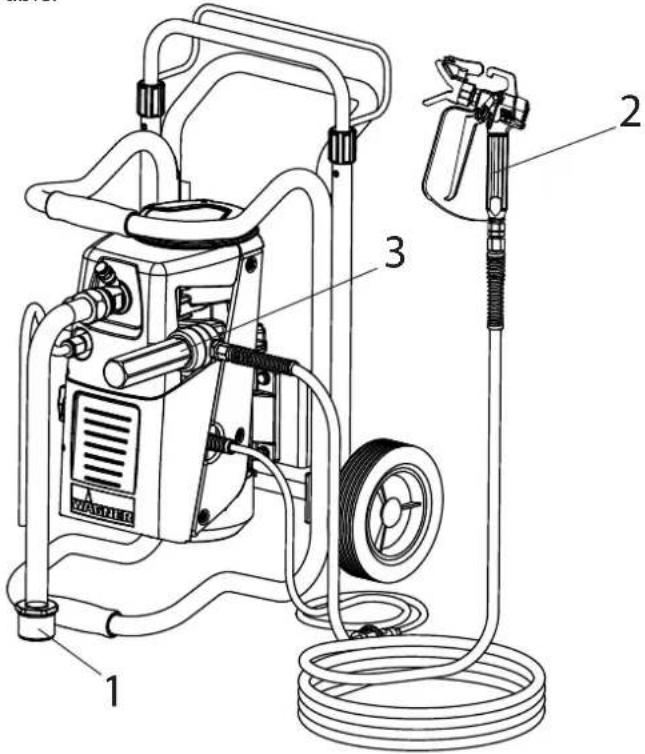
Sufficient filtering is required for fault-free operation. To this purpose the unit is equipped with a suction filter (Item 1) and an insertion filter in the spray gun (Item 2). Regular inspection of these filters for damage or soiling is urgently recommended.
A high-pressure filter (Item 3) -available as accessory- is rising up the filtering surface and will make the work more comfortable.
text_image
Technical diagram of a gas purifier with labeled components including pump, spray gun, and coiled hose3. DESCRIPTION OF UNIT
3.1 AIRLESS PROCESS
The main area of application are thick layers of highly viscous coating material.
At the Super Finish 23 PLUS unit a diaphragm pump takes in the coating materials and transports it via a high-pressure hose to the spray gun with the airless tip. Here the coating material atomizes since it is pressed through the tip core at a maximum pressure of 25 MPa (250 bar, 3625 psi). This high pressure has the effect of micro fine atomisation of the coating material.
As no air is used in this process, it is described as an AIRLESS process.
This method of spraying has the advantages of finest atomisation, cloudless operation (depending of a correct unit adjustment) and a smooth, bubblefree surface. As well as these, the advantages of the speed of work and convenience must be mentioned.
3.2 FUNCTIONING OF THE UNIT
The following section contains a brief description of the technical construction for better understanding of the function:
Super Finish 23 PLUS is an electrically driven high-pressure paint spraying equipment.
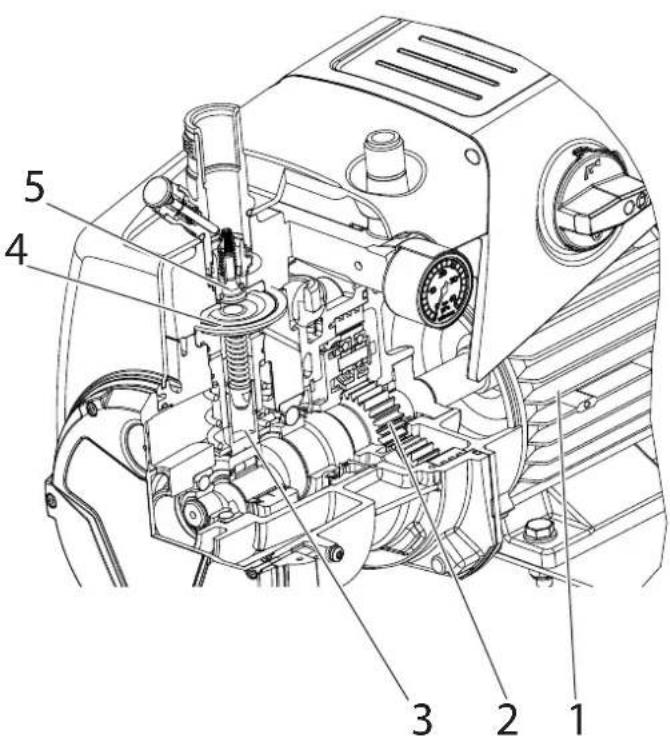
The electric motor (1) drives the hydraulic pump via planetary gears (2). A piston (3) is moved up and down so that hydraulic oil is moved under the diaphragm (4) which then moves.
In detail:
The downwards movement of the machine opens the disk inlet valve (5) automatically and coating material is sucked in.
During the upwards movement of the diaphragm, the coating material is displaced and the outlet valve opens while the inlet valve is closed.
The coating material flows under high pressure through the high-pressure hose to the spray gun and is atomized when it exists from the tip.
The pressure control valve limits the set pressure in the hydraulic oil circuit and thus also the pressure of the coating material.
A pressure change when the same tip is used also leads to a change in the amount of paint atomized.
text_image
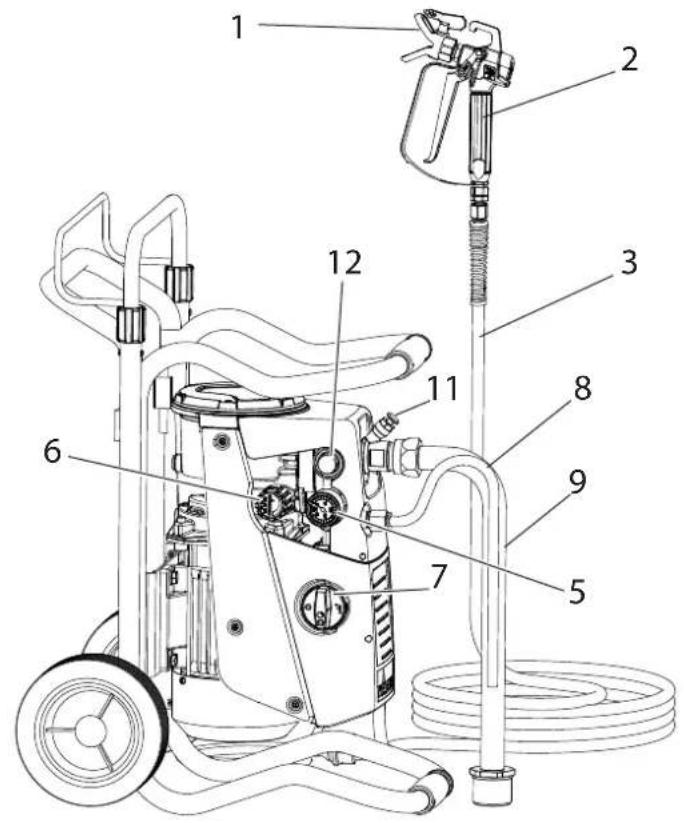
Technical diagram of a mechanical assembly with numbered parts for identification3.3 EXPLANATORY DIAGRAM
1 Tip guard with airless tip
2 Spray gun
3 High-pressure hose
4 Connection for high-pressure hose
5 Pressure gauge
6 Pressure control valve
7 Multifunction switch
Symbols (shown in the recess of the switch):
0 OFF

ON / Circulation

ON / Spraying
8 Return tube
9 Suction tube
10 Hopper
11 Inlet valve button
12 Outlet valve
13 Socket, max. load 1500 Watt*
14 Oil measuring stick
*not included in all models
3.4 TRANSPORTATION
Unroll high-pressure hose and lay it over the shaft.
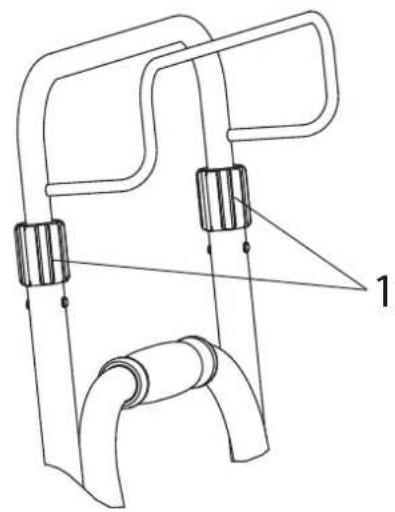
Loosen terminal sleeves (item 1) on the shaft ( open). Extract shaft to the desired length. Tighten terminal sleeves again by hand ( closed).
natural_image
Technical line drawing of a mechanical clamp or bracket assembly with no visible text or symbolsTransportation in vehicle
Secure the unit in the vehicle by means of suitable fasteners. The device can be placed on its side if necessary. In this case, please ensure that no attachments can be damaged. Attention: Paint or solvent residues can escape from the connections!
text_image
Technical diagram of a spray gun with numbered components for identification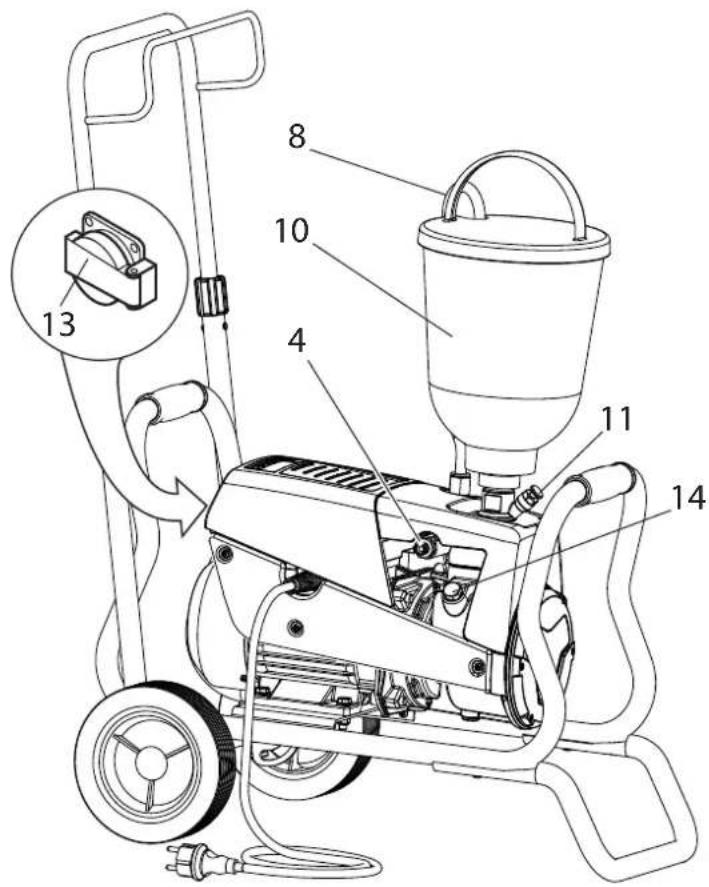
text_image
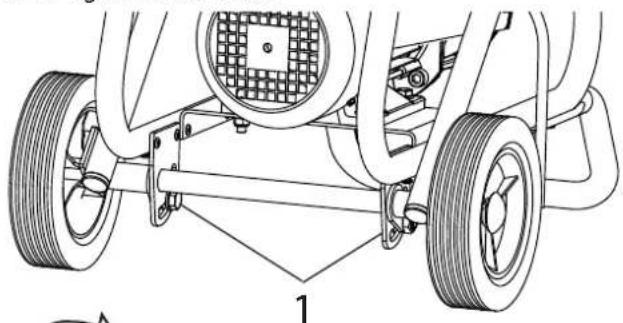
Technical diagram of a power tool with numbered parts labeled for identificationBefore start with the backfitting, pull of main plug of socket, disassemble suction system and high pressure hose
When changing between the top container and the suction system, the carriage needs to be altered.
- Unscrew the screws (pos. 1) with the attached wrench (17 mm).
- Tilt the shaft and align the Super Finish 23 PLUS in the required position:
a) Operate with suction system
b) Operate with top container
- Re-tighten the screws.
natural_image
Technical line drawing of a vehicle's lower body frame with visible tire, wheel, and dashboard components (no text or symbols)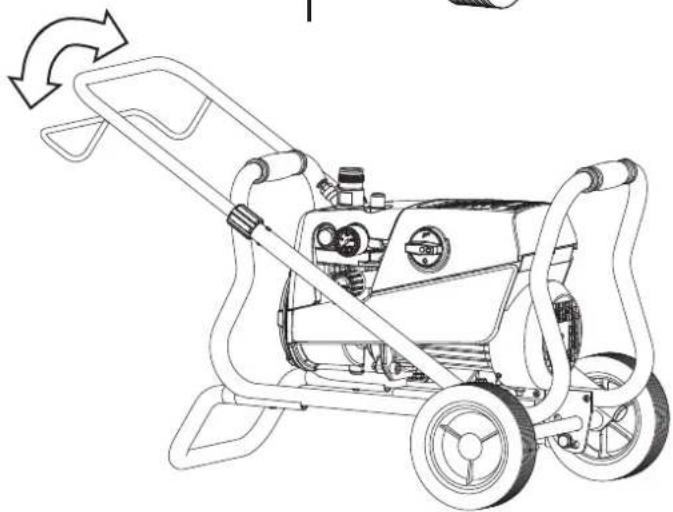
natural_image
Line drawing of a portable lawn mower with wheels and control panel (no text or symbols)a) b)
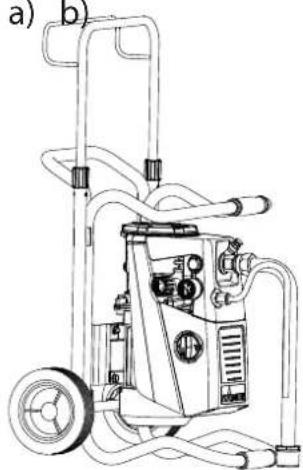
natural_image
Line drawing of a mechanical pump or filter unit with hoses and control panel (no text or symbols)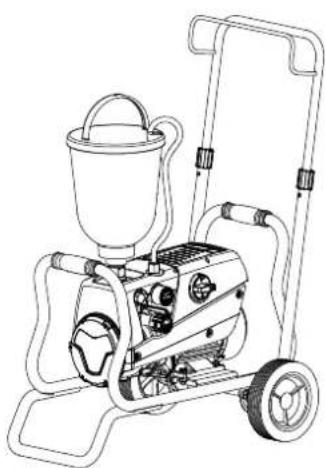
natural_image
Line drawing of a portable electric pump with bucket and wheels (no text or symbols)3.6 TECHNICAL DATA
Voltage : 230 V AC, 50 Hz
Fuses : 16 A time-lag
Unit connecting line : 6 m long, 3 x 1.5 mm ^2
Max. current consumption: 7.4 A
Degree of protection : IP 44
Rated input of device: 1.3 kW
Max. operating pressure : 25 MPa (250 bar)
Max. volume flow : 2.6 l/min
Volume flow at 12 MPa
(120 bar) with water : 2.3 l/min
Max. temperature of the
coating material : 43 °C
Max. viscosity : 20,000 mPas
Empty weight
Model including carriage: 29 kg
Model on frame: 24 kg
Hydraulic oil filling
quantity :
Hydraulics housing 1.15 liter
Gears 0.05 liter
Plug connection on device (not
included in all models): 230 Volt \~, 50 Hz
max. connection: 1500 W
Max. vibration at the spraygun: lower than 2.5 m/s ^4
Max. sound pressure level: 74 dB (A)*
*Place of measurement: 1 m distance from unit and 1.60 m above floor, 12 MPa (120 bar) operating pressure, reverberant floor
4 STARTUP
4.1 UNIT WITH SUCTION SYSTEM
- Ensure that the sealing surfaces of the connections are clean.
Ensure that the red inlet (1) is inserted in the coating material inlet (4).
- Use the enclosed 41 mm wrench to screw the union nut (2) at the suction hose (3) onto the coating material inlet (4) and tighten it.
- Screw the union nut (5) at the return hose (6) to the connection (7) (22mm).
4.2 UNIT WITH UPPER HOPPER (5 LITRES)
- Ensure that the sealing surfaces of the connections are clean. Ensure that the red inlet (1) is inserted in the coating material inlet (4).
- Screw the union nut (5) on the return pipe (6) onto the connection (7).
- Screw the upper hopper (8) onto the coating material inlet (4).
if using hopper with cleaning ring (TopClean) step 4 and 5
- Fix TopClean on hopper upside
- Plug in return pipe into TopClean and screw on union nut
4.3 HIGH PRESSURE HOSE AND SPRAY GUN
- Screw the high pressure hose (9) onto the hose connection
- Screw the spray gun (10) onto the high pressure hose
- Tighten all union nuts on high pressure hose so that no coating material can escape.
- Screw the tip holder with the selected tip onto the spray gun, align tip and tighten union nut.

Attention
When unscrewing the high pressure hose, hold firmly on the hose connection with a 22mm wrench.
4.4 CONNECTION TO THE MAINS NETWORK

Attention
Connection must always be carried out via an appropriately grounded safety outlet with residual-current-operated circuit-breaker.
Before connecting the unit to the mains supply, ensure that the line voltage matches that specified on the unit's rating plate.
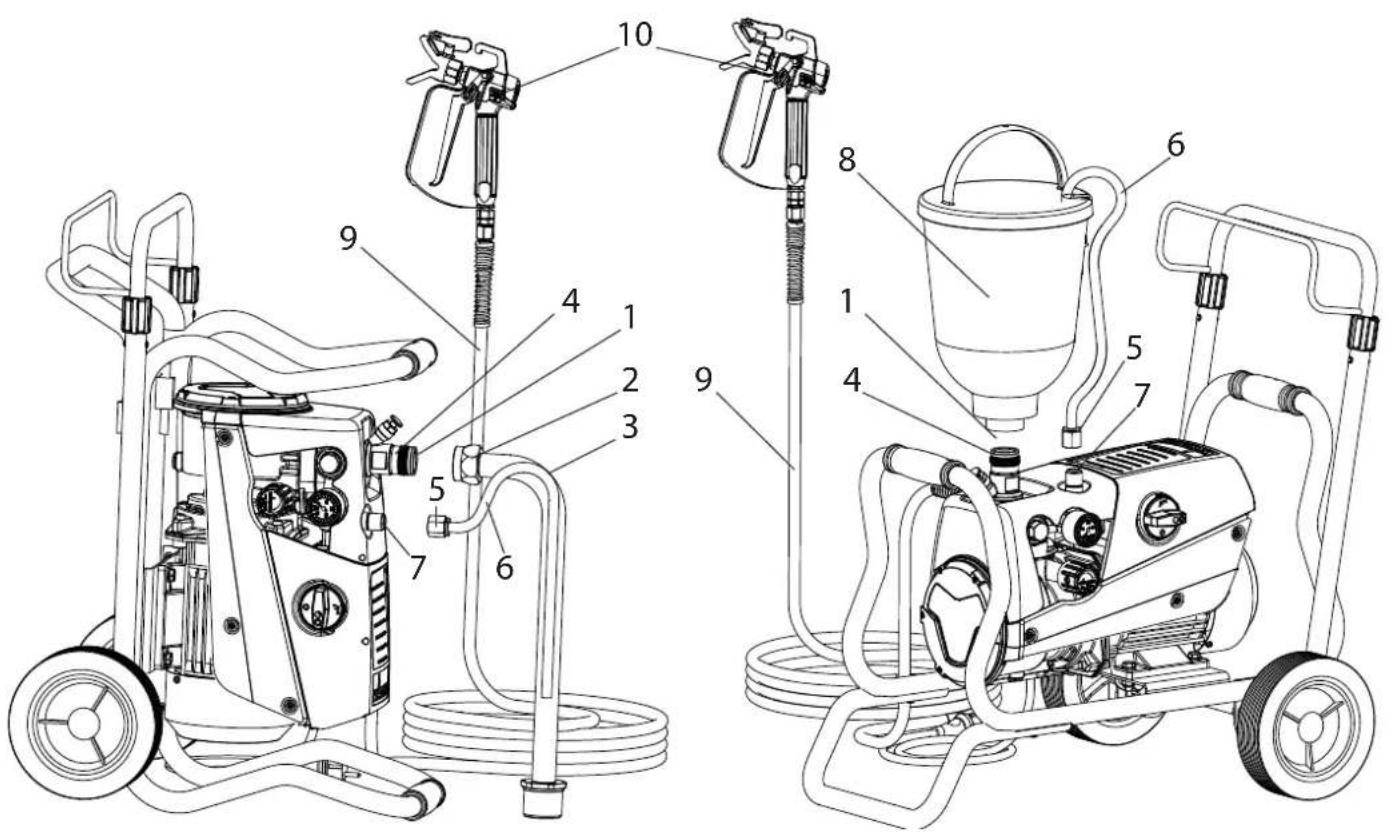
text_image
Technical diagram of a spray gun pump system with numbered components for identification4.5 SOCKET ON UNIT
(NOT INCLUDED IN ALL MODELS)
It is possible, for example, to connect an agitator, a working lamp etc with a maximum of 1500 Watt.

Always switch on the Super Finish 23 PLUS unit first and then the connected unit. Otherwise the fuse protection of 16 A inside the unit will react.
4.6 CLEANING PRESERVING AGENT WHEN STARTING-UP OF OPERATION INITIALLY
Unit with suction tube
Unit with hopper
- Immerse the suction system into a container filled with a suitable cleaning agent (recommendation: water).
- Fill up hopper with a suitable cleaning agent (recommendation: water).
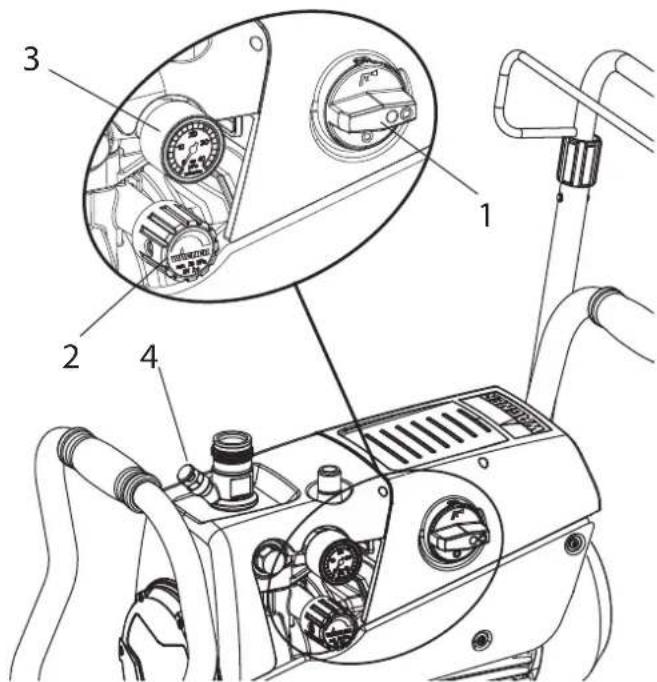
- Set multifunction switch (1) to ○ (ON-circulation); the unit commences to run.
- Turn the pressure regulating knob (2) to the right until the stop is reached.
- Wait until cleaning agent is emitted from the return hose.
- Turn the pressure regulating knob (2) back approx. one rotation.
- Set multifunction switch (1) to spray. Pressure is rising up inside the high pressure hose (visible at pressure gauge)
- Point the tip of the spray gun into an open collecting container and pull the trigger guard at the spray gun.
- The pressure is increased by turning the pressure regulating knob (2) to the right. Set approx. 10 MPa (100 bar) at the pressure gauge.
- Spray the cleaning agent out of the unit for approx. 1 - 2 min. (\~5 litres) into the open collecting container.
4.7 VENTILATE UNIT (HYDRAULIC SYSTEM) IF THE SOUND OF INLET VALVE IS NOT AUDIBLE
- Switch on the unit.
- Turn pressure regulating knob (2) three revolutions to the left.
- Set multifunction switch (1) to ⚙ (ON – circulation). The hydraulic system is ventilated. Leave the unit on for two to three minutes.
- Then turn pressure regulating knob (2) to the right until stop.
- Press inlet valve pusher (4).
Sound of the inlet valve is audible.
- If not, repeat points 2 and 4
text_image
Technical diagram of a vehicle's internal components with numbered parts, including dashboard, air vent, and control panel.4.8 TAKING THE UNIT INTO OPERATION WITH COATING MATERIAL
Unit with suction tube
- Immerse the suction system into a container filled with coating material.
Unit with hopper
- Fill coating material into the hopper.
- Press inlet valve pusher (4) several times to release possibly clogged inlet valve
- Set multifunction switch (1) to ON - circulation); the unit will start.
- Turn the pressure regulating knob (2) to the right until the stop is reached.
When the noise of the valves changes, the unit is bled and takes in coating material.
- If coating material exits from the return hose, turn the pressure regulating knob (2) back approx. 1 rotation.
- Set multifunction switch (1) to spray. Pressure is rising up inside the high pressure hose (visible at pressure gauge (3)).
- Pull of the spray gun and spray into an open collecting container in order to remove the remaining cleaning agent from the unit. When coating materials exits from the tip, close the spray gun.
- Adjust the spraying pressure by turning the pressure regulating knob (2).
- The unit is ready to spray.
5 SPRAYING TECHNOLOGY
Move the spray gun evenly during the spraying process. If this is not observed, an irregular spraying appearance will be the result. Carry out the movement with the arm, not with the wrist. A parallel distance of approx. 30 cm between the tip and the surface to be coated should always be observed. The lateral limitation of the spray fan should not to be too distinct. The edge of spraying should be gradual to facilitate overlapping of the next coat. The spray gun should always be held at an angle of 90^ to the surface to be coated. A spray fan aimed obliquely at the surface to be coated leads to an unwanted spray cloud.
To achieve perfect surfaces at varnishing works, special accessories are available at Wagner, e.g. FineFinish tips or an AirCoat gun set. Your Wagner dealer will advise you.
6 HANDLING THE HIGH-PRESSURE HOSE
The unit is equipped with a high-pressure hose specially suited for diaphragm pumps.
| Danger | Danger of injury through leaking high-pressure hose. Replace any damaged high-pressure hose immediately.Never repair defective high-pressure hoses yourself! |
The high-pressure hose is to be handled with care. Avoid sharp bends and folds: the smallest bending radius is about 20 cm. Do not drive over the high-pressure hose. Protect against sharp objects and edges.
Never pull on the high-pressure hose to move the device. Make sure that the high-pressure hose cannot twist. This can be avoided by using a Wagner spray gun with a swivel joint and a hose system.
| When using the high-pressure hose while working on scaffolding, it is best to always guide the hose along the outside of the scaffolding. |
| The risk of damage rises with the age of the high-pressure hose.Wagner recommends replacing high-pressure hoses after 6 years. |
| Only use WAGNER original-high-pressure hoses with internal heating in order to ensure functionality, safety and durability. |
7 INTERRUPTION OF WORK
- Switch off unit, set multifunction switch to relief, circulation), then to 0 (OFF).
essure - Pull trigger guard of spray gun to decrease the pressure of the high pressure hose and the spray gun.
- Secure the spray gun, refer to the operating manual of the spray gun.
- Remove tip from tip holder and store the tip in a small vessel with suitable cleaning agent.
- Leave the suction system immersed in the coating material or immerse it in the corresponding cleaning agent. The suction filter and unit should not dry out.
- Cover the material container in order to prevent the paint from drying.

| In using quick-drying or two-component coating materials, do not fail to rinse unit through with a suitable cleaning agent during the processing period. |
8 CLEANING THE UNIT
A clean state is the best method of ensuring operation without problems. After you have finished spraying, clean the unit. Under no circumstances may coating material rests dry and harden in the unit. The cleaning agent used for cleaning (only with a flash point above 21 °C) must be suitable for the coating material used.
- Secure the spray gun, refer to the operating manual of the spray gun.
Remove and clean the tip.
- Unit with suction system
- Set multifunction switch to Ⓞ (ON - circulation).
- Remove suction tube from the material container, the return tube remains over the material container.
- Immerse the suction system into a container filled with a suitable cleaning agent
-
Turn the pressure control valve back in order to set a minimal spraying pressure.
-
Set multifunction switch to (spray).
-
Pull the trigger guard of the spray gun in order to pump the remaining coating material from the suction hose, high-pressure hose and the spray gun into an open container (if appropriate, increase the pressure at the pressure control valve slowly in order to obtain a higher material flow).

The container must be earthed in case of coating materials which contain solvents.

Caution! Do not pump or spray in container with small opening (bunghole)! See safety regulations.
- Set multifunction switch to ⬇ (ON - circulation).
- Pump suitable cleaning agent in the circuit for several minutes.

The cleaning effect is increased by alternatively opening and closing the spray gun.
- Set multifunction switch to (spray).
- Pump the remaining cleaning agent into an open container until the pump is empty.
- Switch off the unit

Warm water improves the cleaning effect in the case of water-dilutable coating materials.
• Unit with upper hopper
- Set multifunction switch to Ⓗ (ON - circulation).
- Turn the pressure control valve back in order to set a minimal spraying pressure.
- Set multifunction switch to (spray).
- Pull the trigger guard of the spray gun in order to pump the remaining coating material from the hopper, high-pressure hose and the spray gun into an open container (if appropriate, increase the pressure at the pressure control valve slowly in order to obtain a higher material flow).

The container must be earthed in case of coating materials which contain solvents.

Caution! Do not pump or spray in container with small opening (bunghole)! See safety regulations.
- Fill up hopper with suitable cleaning agent.
- Set multifunction switch to ⬇ (ON - circulation).
- Pump suitable cleaning agent in the circuit for several minutes.
with cleaning ring (TopClean) step 8 up to 12
- Switch reverser knob into a horizontal position.
The cleaning agent will flow around the circumference of the inner hopper wall and will clean it in some minutes, depending of the fouling
- Switch reverser knob into the upright position.
Cleaning agent is flowing directly into the hopper

Do not switch the reverser knob at the cleaning ring into the horizontal position when the pump is loaded with coating material. The holes could be plugged.
As a result the cleaning function will be reduced, as the cleaning ring has to clean itself first.
- Set multifunction switch to (spray).
- Pump the remaining cleaning agent from the hopper, high-pressure hose and the spray gun into an open container
- Set multifunction switch to Ⓗ (ON - circulation).
- Switch off unit
CLEANING THE UNIT
8.1 CLEANING THE UNIT FROM THE OUTSIDE
First unplug the power plug from the outlet.
Danger of short-circuits caused by water ingression! Never spray down the unit with high-pressure or high-pressure steam cleaners.
Do not put the high-pressure hose into solvents. Use only a wet cloth to wipe down the outside of the hose.
Wipe down unit externally with a cloth which has been immersed in a suitable cleaning agent.
8.2 SUCTION FILTER
Clean filters always ensure maximum volume, constant spray pressure and problem-free functioning of the unit.
8.3 HIGH-PRESSURE FILTER
- Switch off unit - set multifunction switch to 0 (OFF).
- Open the high-pressure filter and clean the filter insert. To do so:
- Unscrew the filter housing (1) by hand.
- Remove the filter insert (2) and pull out the bearing spring (3).
- Clean all the parts with the corresponding cleaning agent. If compressed air is available – blow through the filter insert and bearing spring.
- When mounting the filter ensure that the bearing ring (4) in the filter insert is positioned correctly and check the O-ring at the filter housing for damage.
- Screw on the filter housing by hand until it stops (a higher tightening force only impedes later dismantling).
2
1
suction tube 5l hopper
Unit with suction system
- Unscrew the filter (Item 1) from the suction tube.
- Clean or replace the filter.
Carry out cleaning with a hard brush and a corresponding cleaning agent.
Unit with hopper
- Release screws with a screwdriver (Item 2).
- Lift and remove filter disk with a screwdriver
- Clean or replace the filter disk.
Carry out cleaning with a hard brush and a corresponding cleaning agent.
8.4 CLEANING THE AIRLESS SPRAY GUN
- Rinse the Airless spray gun with a suitable cleaning agent under lower operating pressure.
- Clean the tip thoroughly with a suitable cleaning agent so that no suitable coating material rests remain.
- Do not store the tip in solvent because this reduces the durability considerably.
- Clean the outside of the Airless spray gun thoroughly.
text_image
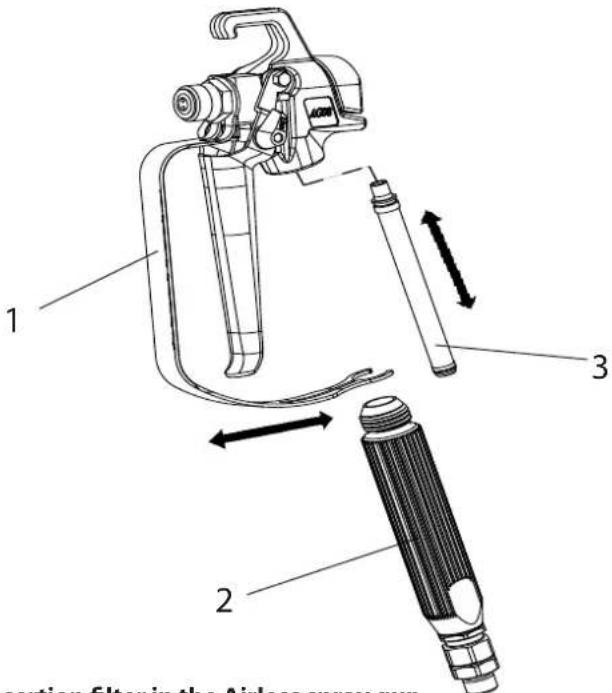
1 2 3 Aireless spray gunInsertion filter in the Airless spray gun
Removal
- Pull the protective bracket (1) forwards.
- Screw the grip (2) out of the gun housing. Pull out the insertion filter (3).
- If the insertion filter is clogged or defective, replace it.
Installation
- Slide the insertion filter (3) with the longer cone into the gun housing.
- Screw the grip (2) into the gun housing and tighten it.
- Latch in the protective bracket (1).
9 SERVICING
9.1 GENERAL SERVICING
 | We strongly recommend having an annual check carried out by technicians for safety reasons. Please observe all the applicable national regulations. |
 | You can servicing of the unit carried out by the Wagner Service. Favourable conditions can be agreed with a service agreement and/or maintenance packages. |
Minimum check before every startup:
- Check the high-pressure hose, spray gun with rotary joint, power supply cable with plug for damage.
- Check whether the pressure gauge can be read.
Check at periodical intervals:
- Check inlet and outlet valve according wear. Clean it and replace worn out parts.
- Check all filter inserts (spray gun, suction system) clean it and replace if necessary.
9.2 HIGH-PRESSURE HOSE
Inspect the high-pressure hose visually for any notches or bulges, in particular at the transition in the fittings. It must be possible to turn the union nuts freely. A conductivity of less than
1 MΩ must exist across the entire length.
| Attention | Have all the electric tests carried by the Wagner Service. |
| The risk of damage rises with the age of the high-pressure hose.Wagner recommends replacing high-pressure hoses after 6 years. |
10 REPAIRS AT THE UNIT
| Danger | Switch the unit off.Before all repair work: Unplug the power plug from the outlet. |
10.1 INLET VALVE PUSHER
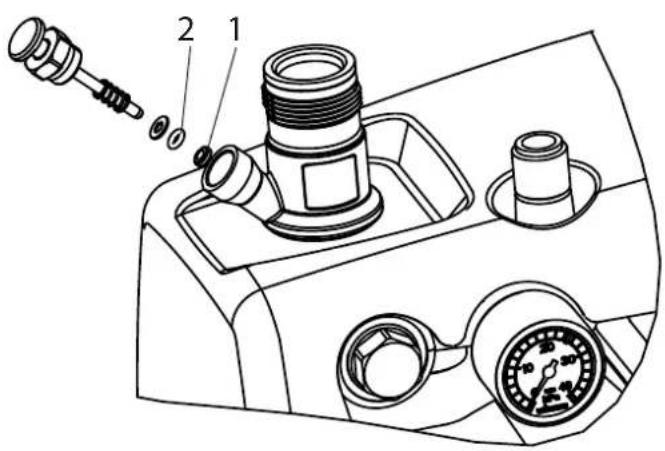
- Use a 17 mm spanner to screw out the inlet valve button.
- Replace the wiper (1) and O-ring (2).
text_image
Technical diagram of a car intake manifold with labeled parts and component annotations10.2 INLET VALVE
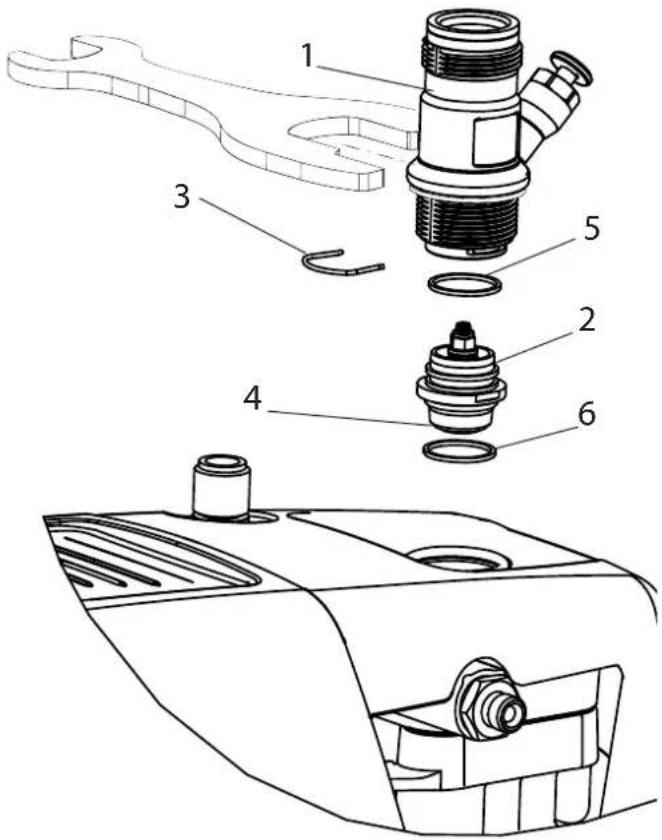
- Place the enclosed 30 mm wrench on the trigger housing (1).
- Loosen the trigger housing (1) with light blows of a hammer on the end of the wrench.
- Screw out the trigger housing with the inlet valve (2) from the paint section.
- Pull of the clasp (3) using the enclosed screwdriver.
- Place the enclosed 30 mm wrench on the inlet valve (2). Turn out the inlet valve carefully.
- Clean the valve seat (4) with a cleaning agent and brush (ensure that no brush hairs are left behind).
- Clean the seals (5, 6) and check for damage. Replace, if necessary.
- Check all the valve parts for damage. In case of visible wear replace the inlet valve.
Installation
- Insert the inlet valve (2) into the trigger housing (1) and secure with the clasp (3). Ensure that the (black) seal (5) is mounted in the trigger housing.
- Screw the unit from the trigger housing and the inlet valve into the paint section. The same (black) seal (6) has to be mounted in the paint section.
- Tighten the trigger housing with the 30 mm wrench and tighten with three light blows of the hammer on the end of the wrench. (Corresponds to approx. 90 Nm tightening torque).
text_image
Technical diagram of a mechanical component with numbered parts, including a wrench and valve assembly.10.3 OUTLET VALVE
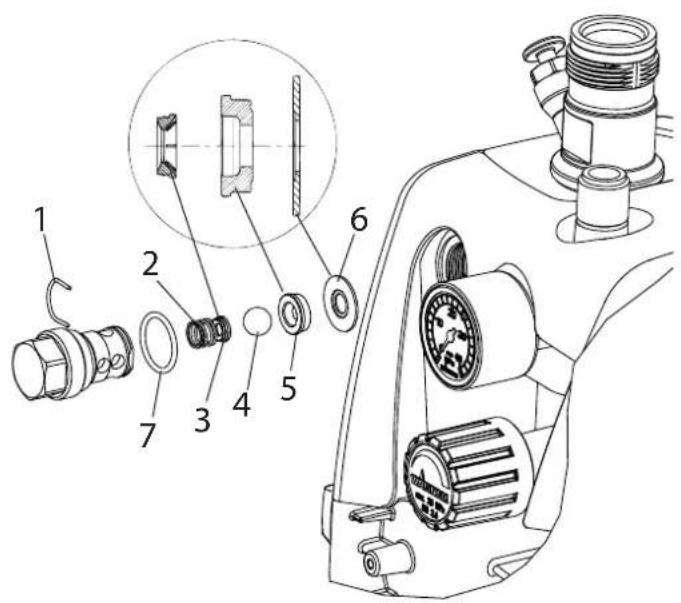
- Use a 22 mm wrench to screw the outlet valve from the paint section.
- Carefully pull of the clasp (1) using the enclosed screw-driver. The compression spring (2) presses ball (4) and valve seat (5) out.
- Clean or replace the components.
- Check the O-ring (7) for damage.
- Check the installation position when mounting the spring support ring (3) (clipped onto spring (2)), outlet valve seat (5) and seal (6), refer to figure.
text_image
Technical diagram of a mechanical device with numbered parts for identification and assembly reference.10.4 PRESSURE CONTROL VALVE

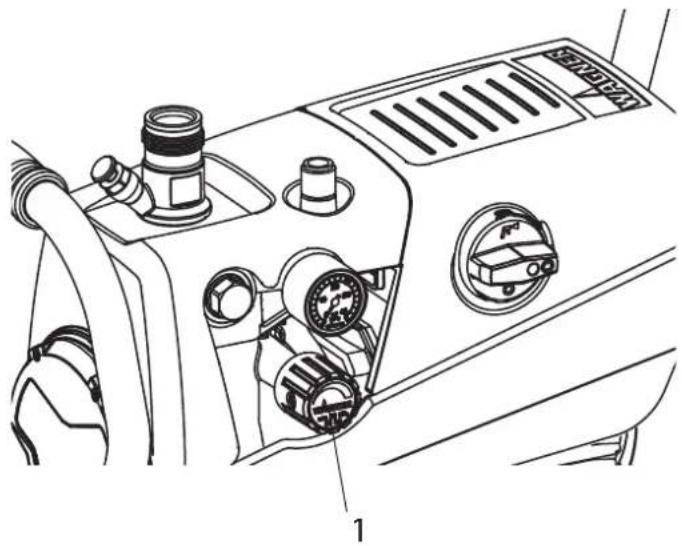
Only have the pressure control valve (1) replaced by the customer service.
The max. operating pressure has to be reset by the customer service.
natural_image
Line drawing of a vehicle dashboard with gauges and control panel (no text or symbols)10.5 REPLACING THE POWER CABLE
| Danger | This may only be carried out by a skilled electrician. No liability is assumed for incorrect installation.Switch the unit off.Before all repair work: Unplug the power plug from the outlet. |
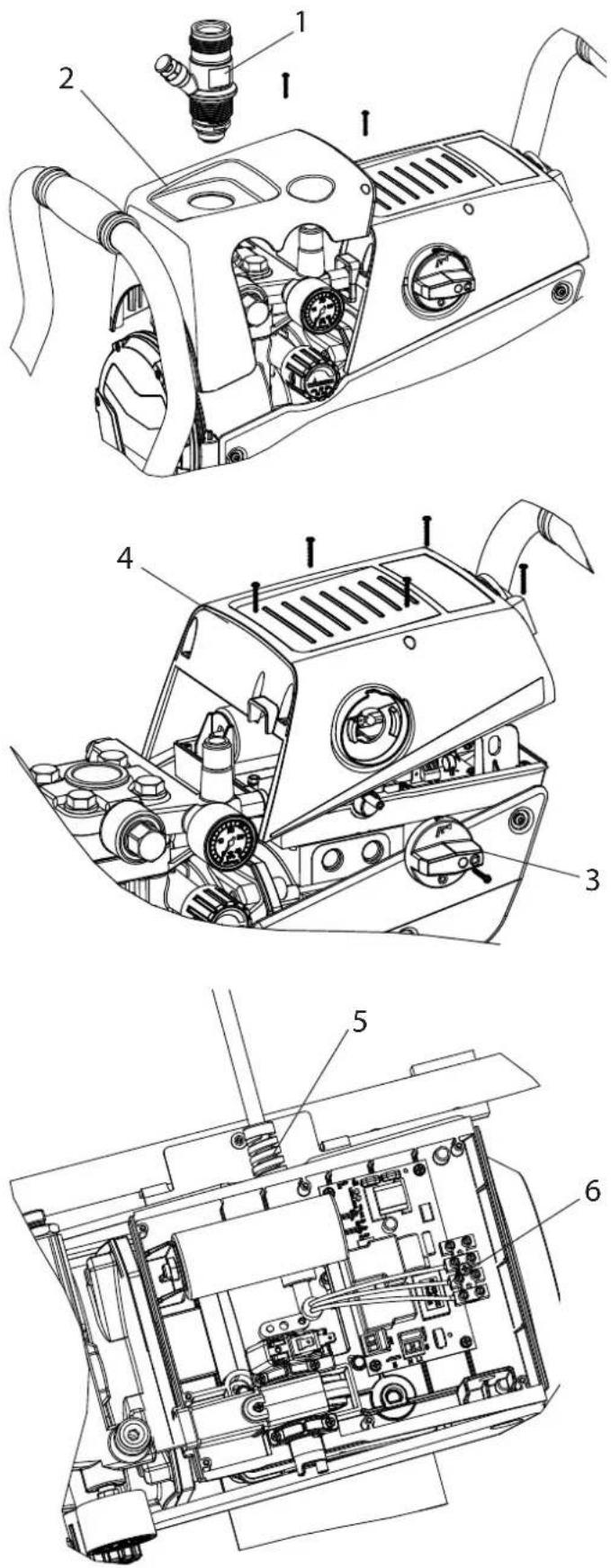
- In models with a front cover unscrew the trigger housing with inlet valve (1) from the paint section (see inlet valve, 10.2, sections 1 to 3) and remove the front cover (2) by unscrewing the screws.
- Remove the multi-function switch (3) by unscrewing the screws.
- Remove the rear cover (4) by loosening the screws.
- Loosen the cable threaded joint (5).
- Loosen the wires in the mains terminal (6).
- Replace the unit connecting line.
(only an approved power cable with the designation H07-RNF with a splash-proof plug may be used).
- Connect the green/yellow wire to the contact with the PE sign.
- Remount the covers carefully (do not squeeze any cables!)
- Screw the trigger housing back into place (see inlet valve, 10.2, sections 3)
10.6 TYPICAL WEAR PARTS
Despite the use of high-quality materials the highly abrasive effect of the paints means that wear can occur at the following parts:
Inlet valve (spare part Order No.: 0344700)
For replacing refer to Section 10.2
(failure becomes noticeable through performance loss and/or poor or no suction)
Outlet valve (spare part Order No.: 0341702)
For replacing refer to Section 10.3
(failure becomes noticeable through performance loss and/or poor suction) The outlet valve is usually considerably more durable than the inlet valve. Thorough cleaning may already help here.
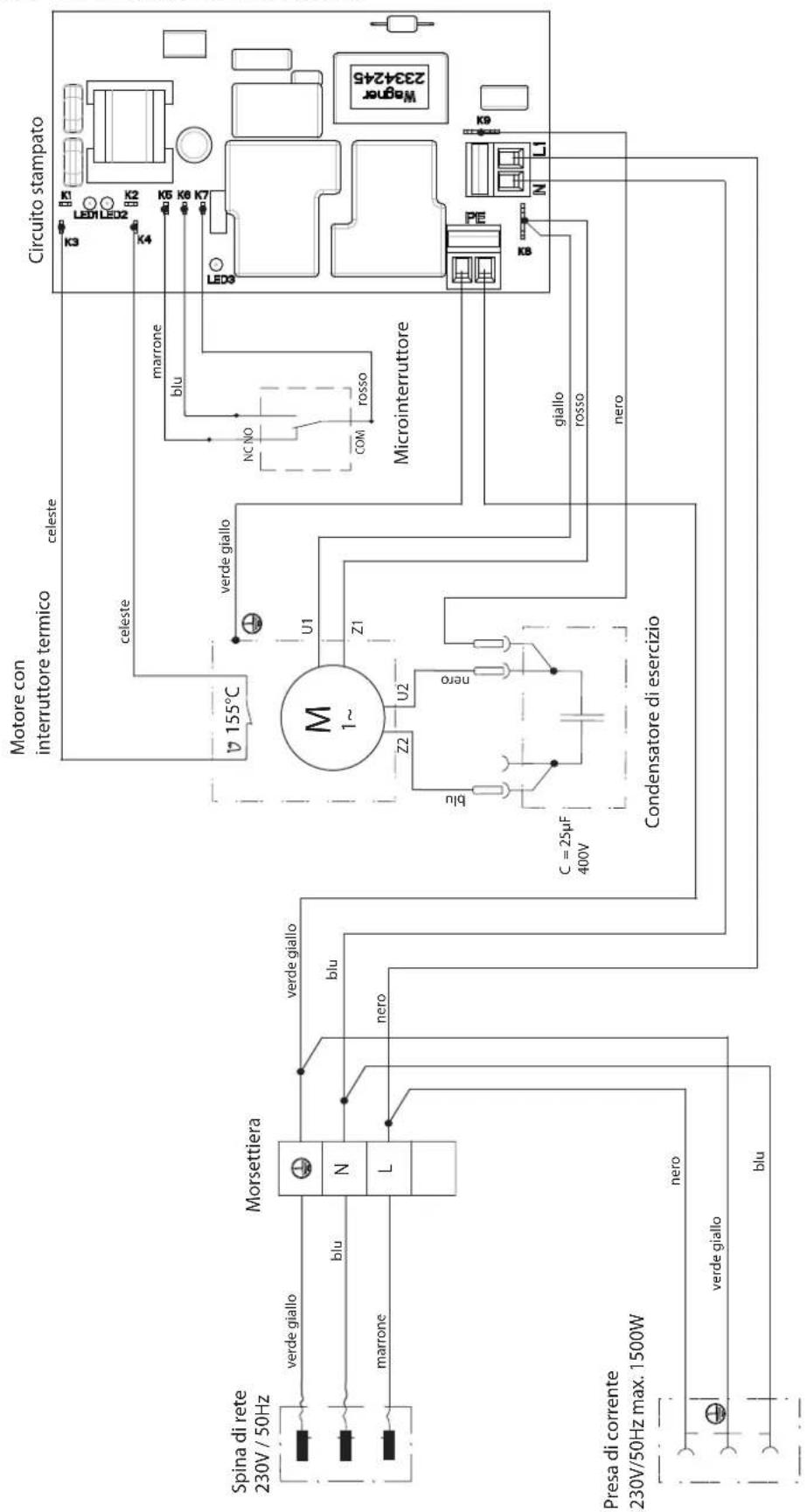
10.7 CONNECTION DIAGRAM
| TYPE OF MALFUNCTION W | WHAT ELSE? POSSIBLE CAUSE MEASURES FOR ELIMINATING THE MALFUNCTION | ||
| Unit does not start Multifunction switch can not switched on | No voltage applied Check voltage supply | ||
| Unit fuse has triggered Let the motor cool down | |||
| Multi-function switch not set back previously to „0" Set multi-function switch to „0" and then switch back on | |||
| Unit does not suck in Air bubbles do not exit at the return hose | Inlet valve clogged Press the inlet valve button until the stop is reached several times by hand | ||
| Inlet/outlet valve soiled / foreign bodies (e.g. threads) drawn in / worn | |||
| Pressure control valve turned down completely | |||
| Air bubbles exit from the return hose | Unit is sucking in outside air | ||
| Unit does not generate pressure | Unit has sucked in Air in the oil circuit Bleed the oil circuit in the unit by turning the pressure control valve completely to the left (until overturning) and let it run approx. 2 - 3 min. Then turn the pressure control valve to the right and set the spraying pressure (repeat process several times, if necessary). Process is assisted by positioning the unit vertically. | ||
| Unit reached pressure, but the pressure collapses, also at the pressure gage, during spraying. | Suction filter clogged Check the suction filter. If necessary, clean/replace | ||
| Paint cannot be worked in this state. Due to its properties the paint clogs the valves (inlet valve) and the delivery rate is too low. | Dilute the paint | ||
| Unit reached pressure, but the pressure collapses during spraying. pressure gage still shows high pressure | Clogged filter do not let enough paint pass | Check/clean the (high-pressure filter) gun filter | |
| Tip clogged | Clean the tip (-> refer to Section 10.1) | ||
| Unit does not generate the max. pressure possible. Paint nevertheless exits at the return hose. | Relief valve defective | Please contact Wager Customer Service | |
11 SPARE PARTS AND ACCESSORIES
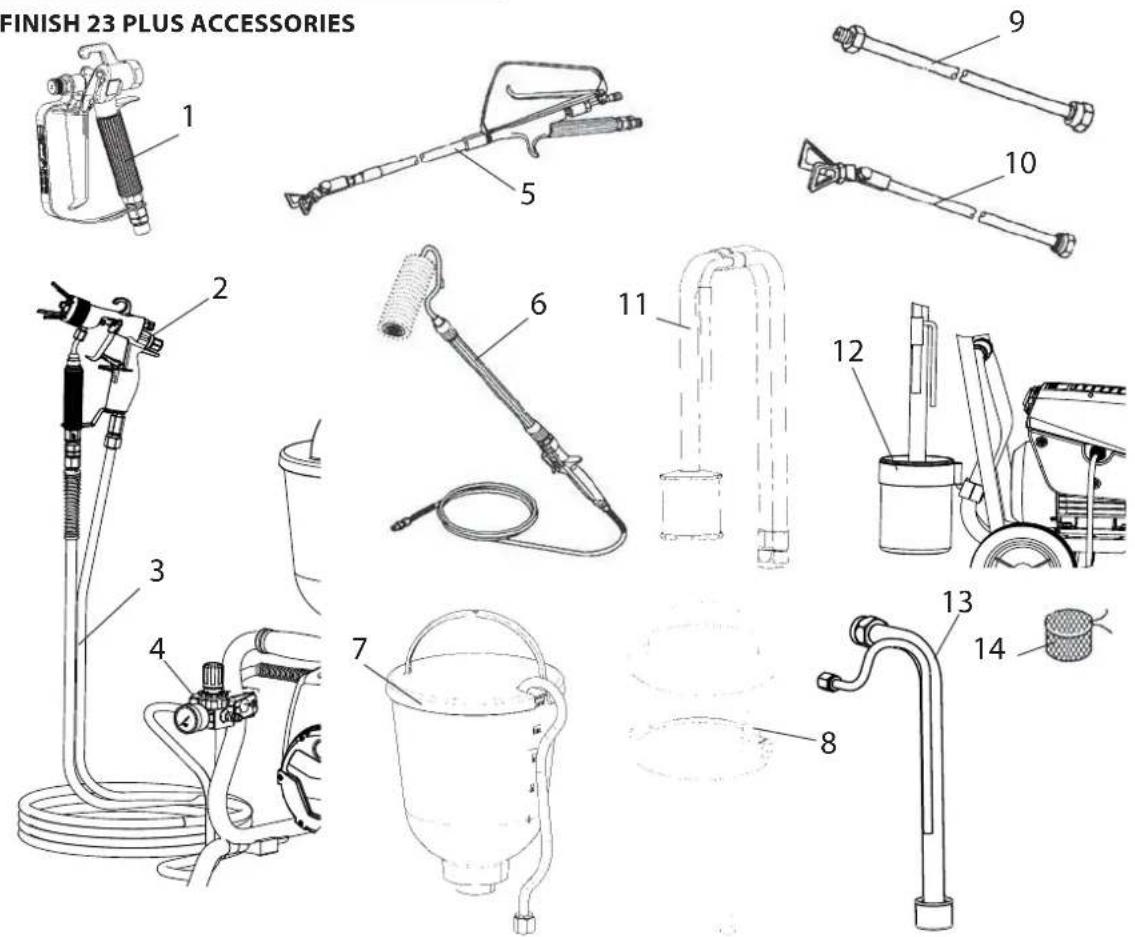
11.1 SUPER FINISH 23 PLUS ACCESSORIES
text_image
FINISH 23 PLUS ACCESSORIES 1 2 3 4 5 6 7 8 9 10 11 12 13 14Accessories:
| ITEM DESIGNATION ORDER NO. | |
| 1 Spray gun AG-14(stainless steel)Spray gun AG-08(aluminium made) | 0502 1660296 388 |
| 2 AirCoat spray gun AC 4600 (blue) 0394 156 | |
| 3 Double hose 9984 564 | |
| HP hose DN-3, 7.5 m 9984 583 | |
| 4 AirCoat-controller set 0340 250 | |
| 5 Pole gunLength 120cm; G thread 7/8"Length 120cm; F thread 11/16"Length 200cm; G thread 7/8"Length 200cm; F thread 11/16 | 0296 4410296 4430296 4420296 444 |
| 6 Inline Roller 0345 010 | |
| 7 Hopper 5l 0341 265 | |
| 8 Hopper cleaning ring (TopClean) 0340 930 |
| ITEM. DESIGNATION | ORDER NO. | |
| 9 | Tip extensionLength 15 cmLength 30 cmLength 45 cmLength 60 cm | 0556 0510556 0520556 0530556 054 |
| 10 | Tip extension withSlewable knee jointLength 100 cmLength 200 cmLength 300 cm | 0096 0150096 0160096 017 |
| 11 | Suction system (flexible)for dispersionen | 0034 630 |
| 12 | Cleaning container for suction systemwith holder (only for flexible suctionsystem) | 2343 481 |
| 13 | Suction system (rigid) for dispersions | 2342 879 |
| 14 | Filter bag, mesh width 0,3 mm | 0097 531 |
Airless tip table
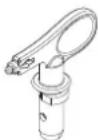
Wagner
TradeTip 3 tip
up to 270 bar
(27 MPa)
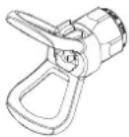
without tip
F thread (11/16 - 16 UN)
for Wagner spray guns
Order no. 0289391
without tip
G thread (7/8 - 14 UN)
for Graco/Titan spray guns
Order no.0289390

All of the tips in the table below are supplied together with the appropriate gun fi Iter.
| Application Tip marking Spray | angle | Bore inch / mm | Spraying width mm 1) | Gun fi Iter Order no. | ||
| Water-thinnable and solvent-based paints and varnishes, oils, separating agents | 107 | 10^ | 0.007 / 0.18 | 100 | red | 0553107 |
| 207 | 20^ | 0.007 / 0.18 | 120 | red | 0553207 | |
| 307 | 30^ | 0.007 / 0.18 | 150 | red | 0553307 | |
| 407 | 40^ | 0.007 / 0.18 | 190 | red | 0553407 | |
| 109 | 10^ | 0.009 / 0.23 | 100 | red | 0553109 | |
| 209 | 20^ | 0.009 / 0.23 | 120 | red | 0553209 | |
| 309 | 30^ | 0.009 / 0.23 | 150 | red | 0553309 | |
| 409 | 40^ | 0.009 / 0.23 | 190 | red | 0553409 | |
| 509 | 50^ | 0.009 / 0.23 | 225 | red | 0553509 | |
| 609 | 60^ | 0.009 / 0.23 | 270 | red | 0553609 | |
| Synthetic-resin paintsPVC paints | 111 | 10^ | 0.011 / 0.28 | 100 | red | 0553111 |
| 211 | 20^ | 0.011 / 0.28 | 120 | red | 0553211 | |
| 311 | 30^ | 0.011 / 0.28 | 150 | red | 0553311 | |
| 411 | 40^ | 0.011 / 0.28 | 190 | red | 0553411 | |
| 511 | 50^ | 0.011 / 0.28 | 225 | red | 0553511 | |
| 611 | 60^ | 0.011 / 0.28 | 270 | red | 0553611 | |
| Paints, primersFillers | 113 | 10^ | 0.013 / 0.33 | 100 | red | 0553113 |
| 213 | 20^ | 0.013 / 0.33 | 120 | red | 0553213 | |
| 313 | 30^ | 0.013 / 0.33 | 150 | red | 0553313 | |
| 413 | 40^ | 0.013 / 0.33 | 190 | red | 0553413 | |
| 513 | 50^ | 0.013 / 0.33 | 225 | red | 0553513 | |
| 613 | 60^ | 0.013 / 0.33 | 270 | red | 0553613 | |
| 813 | 80^ | 0.013 / 0.33 | 330 | red | 0553813 | |
| FillersRust protection paints | 115 | 10^ | 0.015 / 0.38 | 100 | yellow | 0553115 |
| 215 | 20^ | 0.015 / 0.38 | 120 | yellow | 0553215 | |
| 315 | 30^ | 0.015 / 0.38 | 150 | yellow | 0553315 | |
| 415 | 40^ | 0.015 / 0.38 | 190 | yellow | 0553415 | |
| 515 | 50^ | 0.015 / 0.38 | 225 | yellow | 0553515 | |
| 615 | 60^ | 0.015 / 0.38 | 270 | yellow | 0553615 | |
| 715 | 70^ | 0.015 / 0.38 | 300 | yellow | 0553715 | |
| 815 | 80^ | 0.015 / 0.38 | 330 | yellow | 0553815 | |
| Rust protection paintsLatex paintsDispersions | 117 | 10^ | 0.017 / 0.43 | 100 | white | 0553117 |
| 217 | 20^ | 0.017 / 0.43 | 120 | white | 0553217 | |
| 317 | 30^ | 0.017 / 0.43 | 150 | white | 0553317 | |
| 417 | 40^ | 0.017 / 0.43 | 190 | white | 0553417 | |
| 517 | 50^ | 0.017 / 0.43 | 225 | white | 0553517 | |
| 617 | 60^ | 0.017 / 0.43 | 270 | white | 0553617 | |
| 717 | 70^ | 0.017 / 0.43 | 300 | white | 0553717 | |
| 817 | 80^ | 0.017 / 0.43 | 330 | white | 0553817 | |
| Rust protection paintsLatex paintsDispersions | 219 | 20^ | 0.019 / 0.48 | 120 | white | 0553219 |
| 319 | 30^ | 0.019 / 0.48 | 150 | white | 0553319 | |
| 419 | 40^ | 0.019 / 0.48 | 190 | white | 0553419 | |
| 519 | 50^ | 0.019 / 0.48 | 225 | white | 0553519 | |
| 619 | 60^ | 0.019 / 0.48 | 270 | white | 0553619 | |
| 719 | 70^ | 0.019 / 0.48 | 300 | white | 0553719 | |
| 819 | 80^ | 0.019 / 0.48 | 330 | white | 0553819 | |
| 919 | 90^ | 0.019 / 0.48 | 385 | white | 0553919 | |
| Flame retardant 221 | 20^ | 0.021 / 0.53 | 120 | white | 0553221 | |
| 321 | 30^ | 0.021 / 0.53 | 150 | white | 0553321 | |
| 421 | 40^ | 0.021 / 0.53 | 190 | white | 0553421 | |
| 521 | 50^ | 0.021 / 0.53 | 225 | white | 0553521 | |
| 621 | 60^ | 0.021 / 0.53 | 270 | white | 0553621 | |
| 721 | 70^ | 0.021 / 0.53 | 300 | white | 0553721 | |
| 821 | 80^ | 0.021 / 0.53 | 330 | white | 0553821 | |

All of the tips in the table below are supplied together with the appropriate gun fi Iter.
| Application Tip marking Spray | angle | Bore inch / mm | Spraying width mm 1) | Gun fi Iter Order no. | ||
| Roof coatings 223 | 20° | 0.023/0.58 | 120 | white | 0553223 | |
| 323 | 30° | 0.023/0.58 | 150 | white | 0553323 | |
| 423 | 40° | 0.023/0.58 | 190 | white | 0553423 | |
| 523 | 50° | 0.023/0.58 | 225 | white | 0553523 | |
| 623 | 60° | 0.023/0.58 | 270 | white | 0553623 | |
| 723 | 70° | 0.023/0.58 | 300 | white | 0553723 | |
| 823 | 80° | 0.023/0.58 | 330 | white | 0553823 | |
| Thick-fi Im materials, Corrosion protection Spray fi Iler | 225 | 20° | 0.025/0.64 | 120 | white | 0553225 |
| 325 | 30° | 0.025/0.64 | 150 | white | 0553325 | |
| 425 | 40° | 0.025/0.64 | 190 | white | 0553425 | |
| 525 | 50° | 0.025/0.64 | 225 | white | 0553525 | |
| 625 | 60° | 0.025/0.64 | 270 | white | 0553625 | |
| 725 | 70° | 0.025/0.64 | 300 | white | 0553725 | |
| 825 | 80° | 0.025/0.64 | 330 | white | 0553825 | |
| 227 | 20° | 0.027/0.69 | 120 | white | 0553227 | |
| 327 | 30° | 0.027/0.69 | 150 | white | 0553327 | |
| 427 | 40° | 0.027/0.69 | 190 | white | 0553427 | |
| 527 | 50° | 0.027/0.69 | 225 | white | 0553527 | |
| 627 | 60° | 0.027/0.69 | 270 | white | 0553627 | |
| 827 | 80° | 0.027/0.69 | 330 | white | 0553827 | |
| 229 | 20° | 0.029/0.75 | 120 | white | 0553229 | |
| 329 | 30° | 0.029/0.75 | 150 | white | 0553329 | |
| 429 | 40° | 0.029/0.75 | 190 | white | 0553429 | |
| 529 | 50° | 0.029/0.75 | 225 | white | 0553529 | |
| 629 | 60° | 0.029/0.75 | 270 | white | 0553629 | |
| 231 | 20° | 0.031/0.79 | 120 | white | 0553231 | |
| 331 | 30° | 0.031/0.79 | 150 | white | 0553331 | |
| 431 | 40° | 0.031/0.79 | 190 | white | 0553431 | |
| 531 | 50° | 0.031/0.79 | 225 | white | 0553531 | |
| 631 | 60° | 0.031/0.79 | 270 | white | 0553631 | |
| 731 | 70° | 0.031/0.79 | 300 | white | 0553731 | |
| 831 | 80° | 0.031/0.79 | 330 | white | 0553831 | |
| 233 | 20° | 0.033/0.83 | 120 | white | 0553233 | |
| 333 | 30° | 0.033/0.83 | 150 | white | 0553333 | |
| 433 | 40° | 0.033/0.83 | 190 | white | 0553433 | |
| 533 | 50° | 0.033/0.83 | 225 | white | 0553533 | |
| 633 | 60° | 0.033/0.83 | 270 | white | 0553633 | |
| 235 | 20° | 0.035/0.90 | 120 | white | 0553235 | |
| 335 | 30° | 0.035/0.90 | 150 | white | 0553335 | |
| 435 | 40° | 0.035/0.90 | 190 | white | 0553435 | |
| 535 | 50° | 0.035/0.90 | 225 | white | 0553535 | |
| 635 | 60° | 0.035/0.90 | 270 | white | 0553635 | |
| 735 | 70° | 0.035/0.90 | 300 | white | 0553735 | |
| 439 | 40° | 0.039/0.99 | 190 | white | 0553439 | |
| 539 | 50° | 0.039/0.99 | 225 | white | 0553539 | |
| 639 | 60° | 0.039/0.99 | 270 | white | 0553639 | |
| Heavy duty applications | 243 | 20° | 0.043/1.10 | 120 | green | 0553243 |
| 443 | 40° | 0.043/1.10 | 190 | green | 0553443 | |
| 543 | 50° | 0.043/1.10 | 225 | green | 0553543 | |
| 643 | 60° | 0.043/1.10 | 270 | green | 0553643 | |
| 445 | 40° | 0.045/1.14 | 190 | green | 0553445 | |
| 545 | 50° | 0.045/1.14 | 225 | green | 0553545 | |
| 645 | 60° | 0.045/1.14 | 270 | green | 0553645 | |
| 451 | 40° | 0.051/1.30 | 190 | green | 0553451 | |
| 551 | 50° | 0.051/1.30 | 225 | green | 0553551 | |
| 651 | 60° | 0.051/1.30 | 270 | green | 0553651 | |
| 252 | 20° | 0.052/1.32 | 120 | green | 0553252 | |
| 455 | 40° | 0.055/1.40 | 190 | green | 0553455 | |
| 555 | 50° | 0.055/1.40 | 225 | green | 0553555 | |
| 655 | 60° | 0.055/1.40 | 270 | green | 0553655 | |
| 261 | 20° | 0.061/1.55 | 120 | green | 0553261 | |
| 461 | 40° | 0.061/1.55 | 190 | green | 0553461 | |
| 561 | 50° | 0.061/1.55 | 225 | green | 0553561 | |
| 661 | 60° | 0.061/1.55 | 270 | green | 0553661 | |
| 263 | 20° | 0.063/1.60 | 120 | green | 0553263 | |
| 463 | 40° | 0.063/1.60 | 190 | green | 0553463 | |
| 565 | 50° | 0.065/1.65 | 225 | green | 0553565 | |
| 665 | 60° | 0.065/1.65 | 270 | green | 0553665 | |
| 267 | 20° | 0.067/1.70 | 120 | green | 0553267 | |
| 467 | 40° | 0.067/1.70 | 190 | green | 0553467 | |
1) Spray width at about 30 cm to the object and 100 bar (10 MPa) pressure with synthetic-resin paint 20 DIN seconds.
2SpeedTip
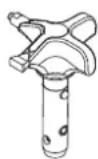
The innovative changeover nozzle from WAGNER combines two nozzle cores into one nozzle.
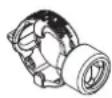
2 Speed Tip holder Order no. 0271065
Tip table
| Object size Painting material | |||
| Lacquer (L) Emulsion (D) Filler (S) | |||
| Small | D5Nozzles: 111 / 415Order no. 0271 062 | S5Nozzles: 225 / 629Order no. 0271 064 | |
| D7Nozzles: 113 / 417Order no. 0271 063 | |||
| L10Nozzles: 208 / 510Order no. 0271 042 | D10Nozzles: 111 / 419Order no. 0271 045 | S10Nozzles: 527 / 235Order no. 0271 049 | |
| Medium | L20Nozzles: 210 / 512Order no. 0271 043 | D20Nozzles: 115 / 421Order no. 0271 046 | S20Nozzles: 539 / 243Order no. 0271 050 |
| Large | L30Nozzles: 212 / 514Order no. 0271 044 | D30Nozzles: 115 / 423Order no. 0271 047 | S30Nozzles: 543 / 252Order no. 0271 051 |
| X-Large | D40Nozzles: 117 / 427Order no. 0271 048 | ||
| Recommended gun fi iter red white - | |||
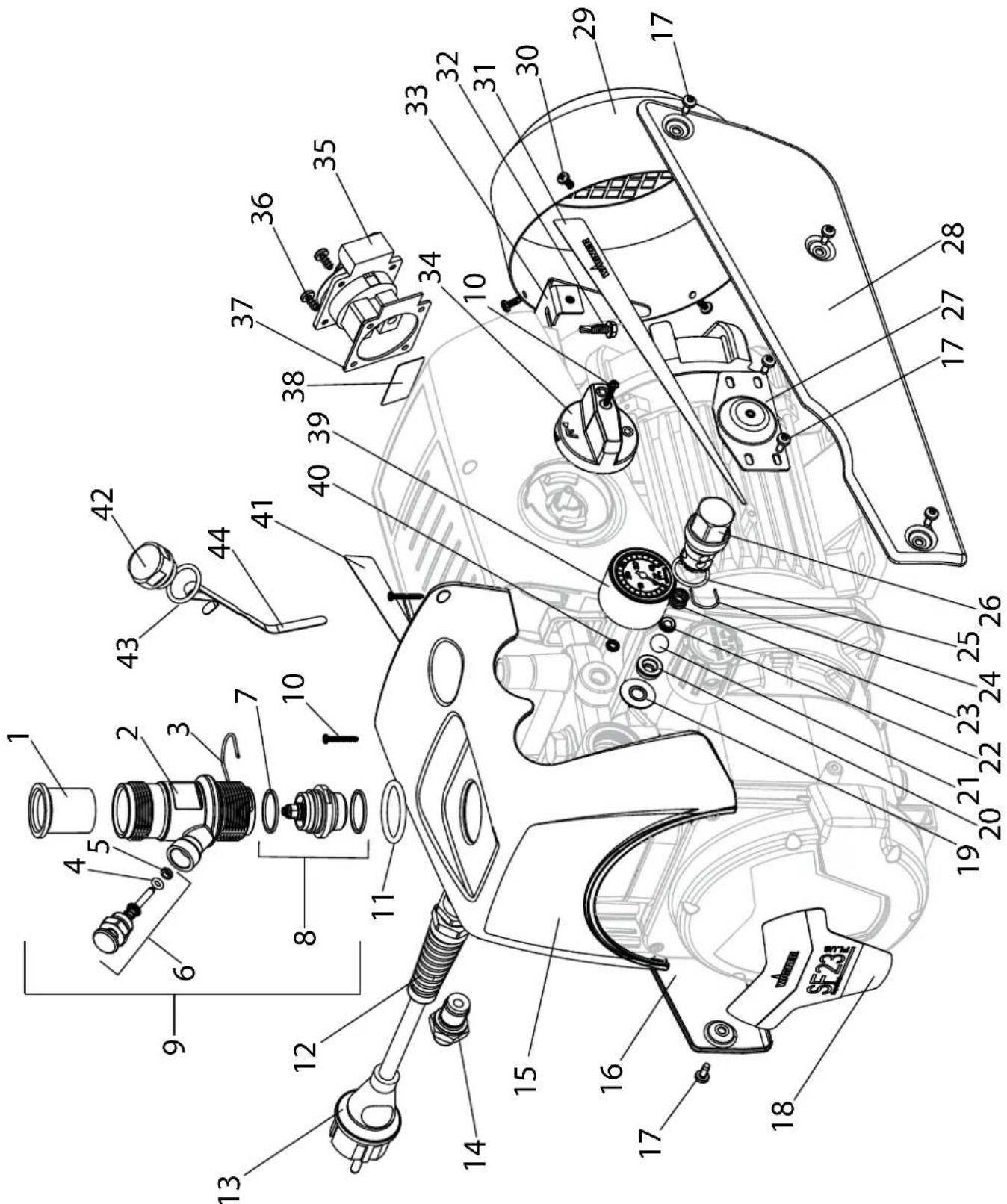
11.2 SPARE PARTS LIST SF 23 PLUS
| ITEM | ORDER-NO DESIGNATION | |
| 1 0340 | 339 Inlet | |
| 2 2334 | 383 Inlet valve | trigger housing |
| 3 0341 | 336 Clasp | |
| 4 9971 | 486 O-ring | |
| 5 0341 | 316 Wiper | |
| 6 2337 | 033 Inlet valve | trigger (incl. pos. 4, 5) |
| 7 0341 | 331 Sealing ring | |
| 8 0344 | 700 Inlet valve (incl. pos.7 (2x)) | |
| 9 2334 | 402 Inlet valve | complete. (pos. 1,2,3,6,8) |
| 10 0421 | 328 Oval head screw 3, 17x20 | |
| 11 2337 | 138 O-ring 3 | 1.4 x 3.55 |
| 12 9952 | 685 Cable threaded joint | |
| 13 | 0261 352 | Mains cableH07-RNF 3x 1.5mm ^2 , 6m long |
| 14 0344 | 336 Double socket NPS 1/4" | |
| 15 2334 | 038 Cover | |
| 16 2334 | 044 | Cover (right) |
| 17 2315 | 382 Oval head screw M4x10 | |
| 18 2339 | 570 Label SF | 23 PLUS |
| 19 0341 | 347 Sealing ring | |
| 20 0341 | 327 | Outlet valve seat |
| 21 9941 | 501 Ball 10 | |
| 22 0253 | 405 Spring support ring | |
| 23 0341 | 326 Pressure spring | |
| 24 0341 | 328 Clasp | |
| 25 9971 | 470 | O-ring 20x2 |
| 0341 702 Outlet valve, service set (pos. 19-25) | ||
| 26 2342 | 946 Outlet valve complete (incl. pos.19-25) | |
| 27 2334 | 046 Connecting plate | |
| 28 2334 | 042 Cover (left) | |
| 29 2337 | 557 Fan cover | |
| 30 9902 | 225 | Oval head screw 3.5x9.5 |
| 31 2341 | 466 Label (left) | |
| 32 9903 | 348 Self drilling screw | |
| 33 2337 | 484 | Connecting plate |
| 34 2342 | 501 | Multi-function switch |
| 35 9950 | 241 Socket | |
| 36 9905 113 Oval head screw 5x10 | |
| 37 9950 242 Seal | |
| 38 2342 535 | Label |
| 39 2343 666 Pressure gauge | |
| 40 9970 218 Sealing ring | |
| 41 2341 465 | Label (right) |
| 42 0341 349 Oil cap screw | |
| 43 9971 146 O-ring | |
| 44 2362 313 Oil measuring stick | |
text_image
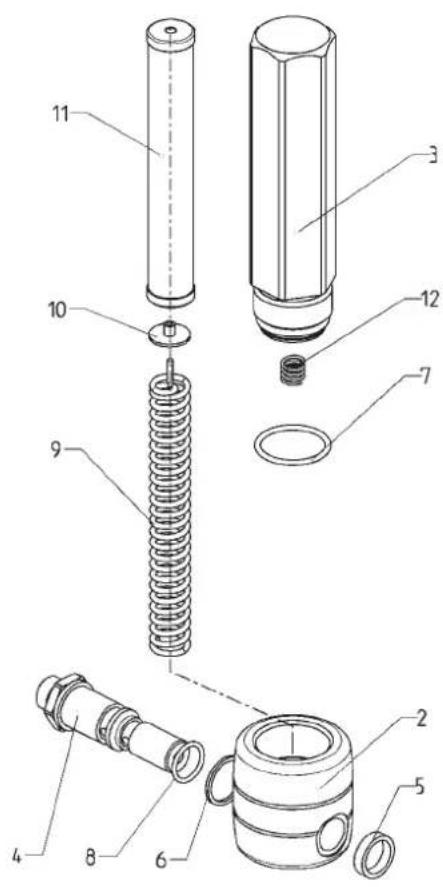
Technical diagram of a mechanical assembly with numbered parts for identification11.3 SPARE PARTS LIST HIGH-PRESSURE FILTER
| ITEM | ORDER NO. DESIGNATION | |
| 1 0097 | 121 High-pressure filter HF-01 compl. | |
| 2 0097 | 301 Filter block | |
| 3 0097 | 302 Filter housing | |
| 4 0097 | 303 Hollow screw | |
| 5 0097 | 304 Seal ring | |
| 6 9970 | 110 Seal ring | |
| 7 9974 | 027 O-ring 30x2 (PTFE) | |
| 8 9971 | 401 O-ring 16x2 (PTFE) | |
| 9 0508 | 749 Bearing spring | |
| 10 0508 | 603 Bearing ring | |
| 11 | 0508 748 | Filter insert 60 meshesOptional:Filter insert 100 meshesFilter insert 30 meshes |
| 0508 450 | ||
| 0508 449 | ||
| 12 9994 | 245 Pressure spring | |
text_image
Technical diagram of a mechanical assembly with numbered components for identificationSpare parts diagram high-pressure filter
text_image
Technical diagram of a wheeled cart with numbered components for identificationSpare parts diagram trolley SF 23 PLUS
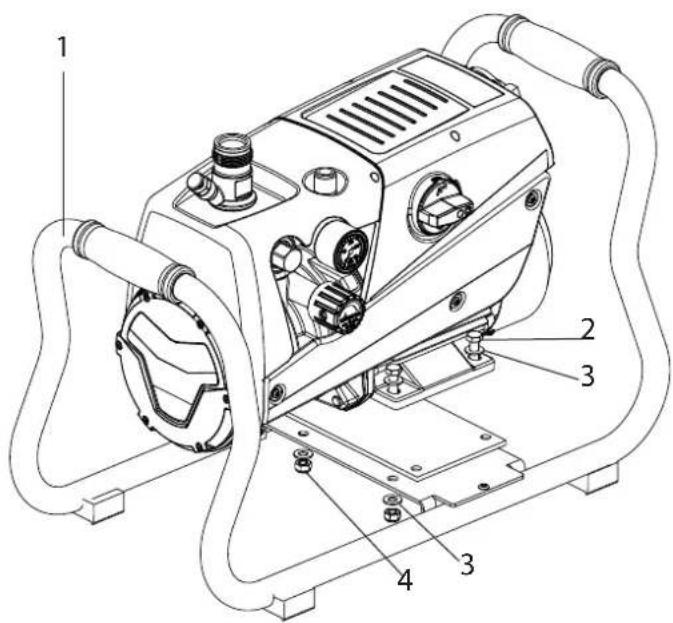
11.5 SPARE PARTS LIST FRAME
| ITEM | ORDER NO. | DES | GNATION |
| 1 | 2343 | 637 Frame complete | |
| 2 | 9900 | 118 Hexagon | screw M8x30 |
| 3 | 9920 | 102 Washer A | 8.4 |
| 4 | 9910 | 208 Hexagon | nut M8 |
text_image
Technical diagram of a mechanical pump assembly with numbered components labeled 1 to 4Spare parts diagram frame
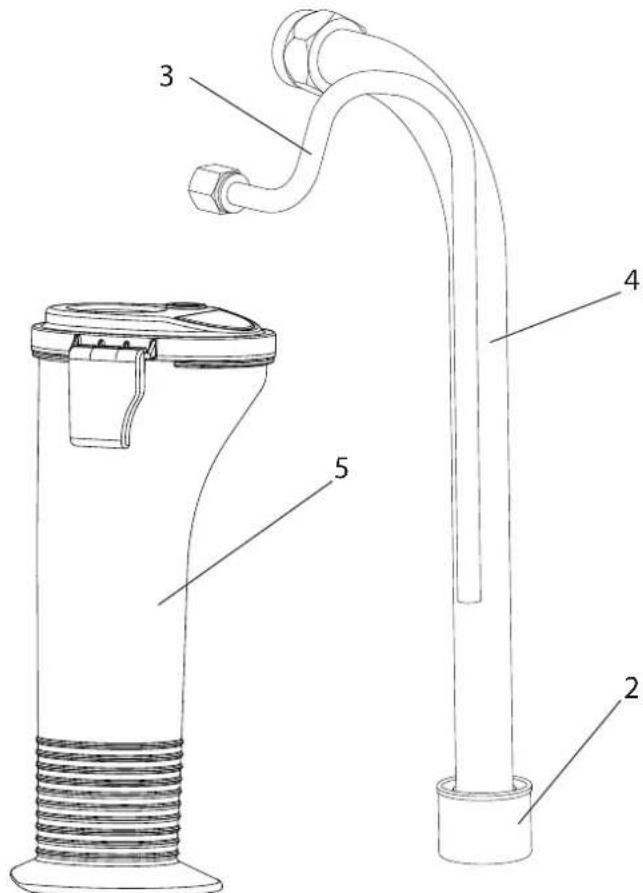
11.6 SPARE PARTS LIST SUCTION SYSTEM (RIGID)
| ITEM | ORDER NO. DES | GNATION |
| 1 2342 | 879 Suction system assy. (incl. pos. 2-4) | |
| 2 | 2323 3250250 245 | Filter, mesh width 1 mmOptional:Filter, mesh width 0,8 mm |
| 3 | 2343 688 Return pipe | |
| 4 | 2342 682 | Suction tube |
| 5 2306 | 987 | PumpRunner |
text_image
Technical diagram of a water filter device with labeled parts including a pump, tubing, and base.Spare parts diagram suction system (rigid)
11.7 SPARE PARTS LIST HOPPER 5L
| ITEM | ORDER-NO DESIGNATION | |
| -0341 | 265 Hopper 5l, assy. | |
| 10340 | 901 Cover | |
| 2 | 0037 607 | Filter disk, mesh width 0,8 mmOptional:Filter disk, mesh width 0,4 mm |
| 0003 756 | ||
| 39902 | 306 Sheet metal screw 3,9x13 (2) | |
| 40340 | 904 Hopper | |
| 50340 | 908 Return pipe | |
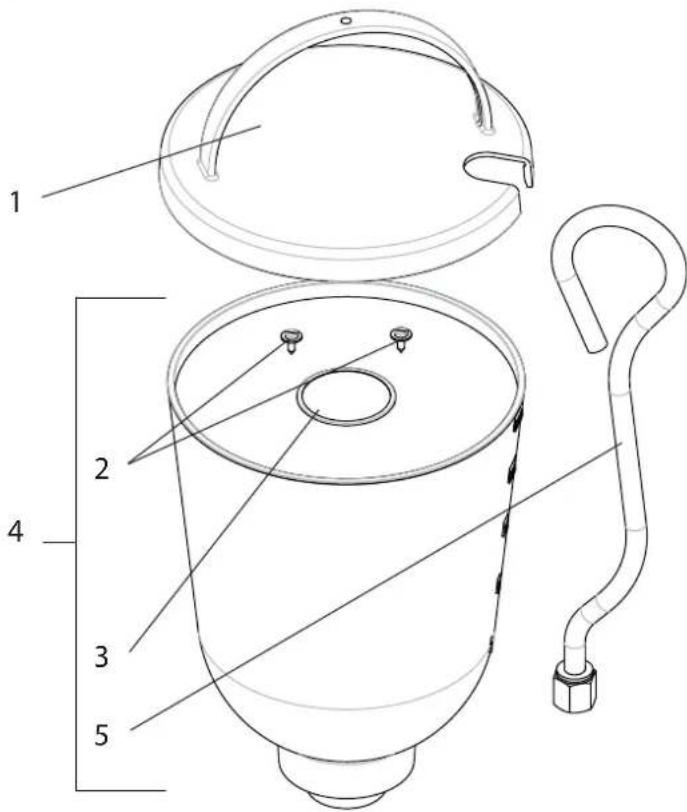
text_image
1 2 3 4 5Spare parts diagram hopper
11.8 SPARE PARTS LIST HOPPER WITH TOPCLEAN
| ITEM | ORDER-NO DESIGNATION |
| -0341 | 268 Hopper 5l with TopClean, assy. |
| 10340 | 904 Hopper 5l (filter disc see 11.7) |
| 20340 | 901 Cover |
| 30340 | 271 TopClean, assy. |
| 40340 | 270 Return pipe |
| 50340 | 499 Screwing |
| 60340 | 466 Distributor ring |
| 70340 | 500 Rotary valve shaft |
| 89971 | 486 O-ring 4x2 (FFPM) |
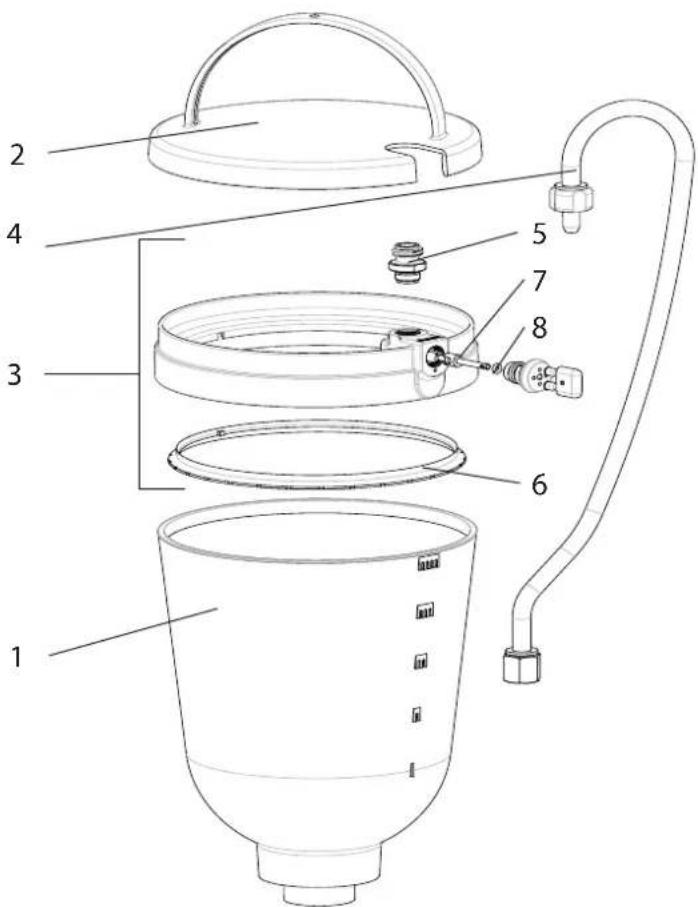
text_image
Technical diagram of a mechanical device with numbered parts for identificationSpare parts diagram hopper with TopClean
TESTING OF THE UNIT
For safety reasons, we would recommend having the device checked by an expert as required but at least every 12 months to ensure that it can continue to operate safely.
In the case of unused devices, the check can be postponed until they are next started up.
All (potentially deviating) national inspection and maintenance regulations must also be observed.
If you have any questions, please contact the customer service team at Wagner.
IMPORTANT INFORMATION ON PRODUCT LIABILITY
According to an EU directive, the manufacturer is only liable without limitation for faults in the product if all parts come from the manufacturer or have been approved by the manufacturer and have been mounted to the device and are operated properly. If third-party accessories or spare parts are used, the manufacturer is exonerated wholly or partly from his/her liability if use of the third-party accessories or spare parts have caused a defect in the product. In extreme cases, the relevant authorities can completely prohibit using the entire device.
With original WAGNER accessories and spare parts, compliance with all safety regulations is guaranteed.
NOTE ON DISPOSAL
In observance of the European Directive 2002/96/EC on waste electrical and electronic equipment and implementation in accordance with national law, this product is not to be disposed of together with household waste material but must be recycled in an environmentally friendly way!

Wagner or one of our dealers will take back your used Wagner waste electrical or electronic equipment and will dispose of it for you in an environmentally friendly way. Please ask your local Wagner service centre or dealer for details or contact us direct.
GUARANTEE DECLARATION
(Status 01.02.2009)
1. Scope of guarantee
All Wagner professional colour application devices (hereafter referred to as products) are carefully inspected, tested and are subject to strict checks under Wagner quality assurance. Wagner exclusively issues extended guarantees to commercial or professional users (hereafter referred to as “customer”) who have purchased the product in an authorised specialist shop, and which relate to the products listed for that customer on the Internet under www.wagner-group.com/profi-guarantee.
The buyer's claim for liability for defects from the purchase agreement with the seller as well as statutory rights are not impaired by this guarantee.
We provide a guarantee in that we decide whether to replace or repair the product or individual parts, or take the device back and reimburse the purchase price. The costs for materials and working hours are our responsibility. Replaced products or parts become our property.
2. Guarantee period and registration
The guarantee period amounts to 36 months. For industrial use or equal wear, such as shift operations in particular, or in the event of rentals it amounts to 12 months.
Systems driven by petrol or air are also guaranteed for a 12 month period.
The guarantee period begins with the day of delivery by the authorised specialist shop. The date on the original purchase document is authoritative.
For all products bought in authorised specialist shops from 01.02.2009 the guarantee period is extended to 24 months providing the buyer of these devices registers in accordance with the following conditions within 4 weeks of the day of delivery by the authorised specialist shop.
Registration can be completed on the Internet under www.wagner-group.com/profi-guarantee.
The guarantee certificate is valid as confirmation, as is the original purchase document that carries the date of the purchase. Registration is only possible if the buyer is in agreement with having the data being stored that is entered during registration.
When services are carried out under guarantee the guarantee period for the product is neither extended nor renewed.
Once the guarantee period has expired, claims made against the guarantee or from the guarantee can no longer be enforced.
3. Handling
If defects can be seen in the materials, processing or performance of the device during the guarantee period, guarantee
claims must be made immediately, or at the latest within a period of 2 weeks.
The authorised specialist shop that delivered the device is entitled to accept guarantee claims. Guarantee claims may also be made to the service centres named in our operating instructions. The product has to be sent without charge or presented together with the original purchase document that includes details of the purchase date and the name of the product. In order to claim for an extension to the guarantee, the guarantee certificate must be included.
The costs as well as the risk of loss or damage to the product in transit or by the centre that accepts the guarantee claims or who delivers the repaired product, are the responsibility of the customer.
4. Exclusion of guarantee
Guarantee claims cannot be considered
-for parts that are subject to wear and tear due to use or other natural wear and tear, as well as defects in the product that are a result of natural wear and tear, or wear and tear due to use. This includes in particular cables, valves, packaging, jets, cylinders, pistons, means-carrying housing components, filters, pipes, seals, rotors, stators, etc. Damage due to wear and tear that is caused in particular by sanded coating materials, such as dispersions, plaster, putty, adhesives, glazes, quartz foundation.
-in the event of errors in devices that are due to non-compliance with the operating instructions, unsuitable or unprofessional use, incorrect assembly and/or commissioning by the buyer or by a third party, or utilisation other than is intended, abnormal ambient conditions, unsuitable coating materials, unsuitable operating conditions, operation with the incorrect mains voltage supply/frequency, over-operation or defective servicing or care and/or cleaning.
-for errors in the device that have been caused by using accessory parts, additional components or spare parts that are not original Wagner parts.
-for products to which modifications or additions have been carried out.
-for products where the serial number has been removed or is illegible
-for products to which attempts at repairs have been carried out by unauthorised persons.
-for products with slight deviations from the target properties, which are negligible with regard to the value and usability of the device.
-for products that have been partially or fully taken apart.
5. Additional regulations.
The above guarantees apply exclusively to products that have been bought by authorised specialist shops in the EU, CIS, Australia and are used within the reference country.
If the check shows that the case is not a guarantee case, repairs are carried out at the expense of the buyer.
The above regulations manage the legal relationship to us concludingly. Additional claims, in particular for damages and losses of any type, which occur as a result of the product or its use, are excluded from the product liability act except with regard to the area of application.
Claims for liability for defects to the specialist trader remain unaffected.
German law applies to this guarantee. The contractual language is German. In the event that the meaning of the German and a foreign text of this guarantee deviate from one another, the meaning of the German text has priority.
J. Wagner GmbH
Division Professional Finishing
Otto Lilienthal Strasse 18
88677 Markdorf
Federal Republic of Germany
Subject to modifications · Printed in Germany
natural_image
Line drawings of three different electric pump machines in a row, no text or symbols presenttext_image
Technical diagram of a gas purifier with labeled components including pump, hose, and spray gun3 DESCRIPTION DE L'APPAREIL
3.1 PROCÉDÉ AIRLESS
text_image
Technical diagram of a mechanical assembly with numbered parts for identification3.3 ILLUSTRATIONS DU MATÉRIEL
natural_image
Technical line drawing of a mechanical clamp or bracket assembly with no visible text or symbolstext_image
Technical diagram of a spray gun with numbered components for identification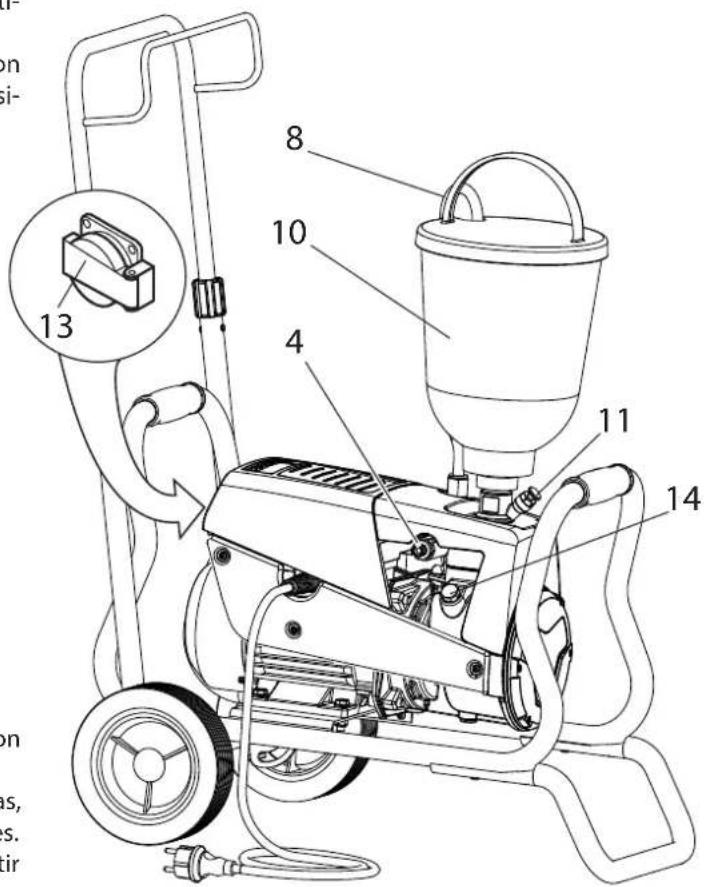
text_image
Technical diagram of a cleaning or dust purifier with numbered components and an inset showing a component labeled 13.3.5 TRANSFORMATION DU CHARIOT
natural_image
Technical line drawings of a golf mower and its power pump, showing front and side views (no text or symbols)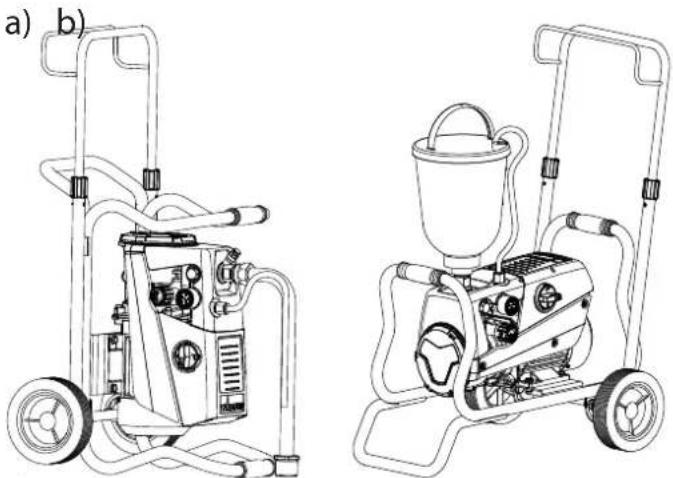
natural_image
Technical line drawings of two industrial machines, one with a pump and motor, the other with a bucket (no text or symbols)3.6 CARACTÉRISTIQUES TECHNIQUES
Tension: 230 volts \~, 50 Hz
Fusible: 16 A lent
text_image
Technical diagram of a spray gun pump system with numbered components for identification4.5 PRIS E ÉLECTRIQUE SUR LE GROUPE (SEULEMENT SUR CERTAINS MODÈLES)
text_image
Technical diagram of a vehicle's internal components with numbered parts and labeled parts4.8 MISE EN SERVICE DE L'APPAREIL AVEC LE PRODUIT DE REVÊTEMENT
text_image
Technical diagram showing a mechanical assembly with labeled parts and a circular component, including directional arrows.text_image
Technical diagram of a spray gun with labeled parts including lever, handle, and griptext_image
Technical diagram of a mechanical device with labeled parts including cylinder, valve, and pressure gauge10.2 VANNE D'ASPIRATION
text_image
Technical diagram of a mechanical component with numbered parts, including a wrench and valve assembly.10.3 CLAPET DE REFOULEMENT
text_image
Technical diagram of a mechanical device with numbered parts for identification and assembly reference.10.4 VANNE DE RÉGLAGE DE PRESSION

natural_image
Line drawing of a vehicle dashboard with gauges and control panel (no text or symbols)10.5 REMPLACEMENT DU CORDON D'ALIMENTATION

Danger
text_image
Technical diagram of a mechanical device with labeled parts, showing internal components and assembly structure.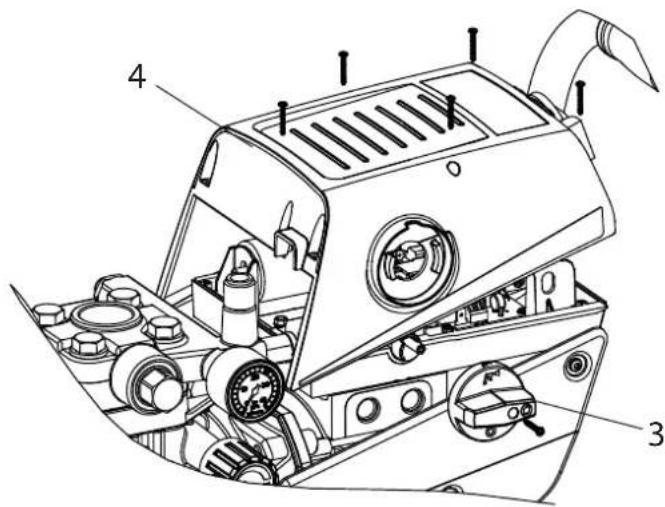
text_image
Technical diagram of a mechanical device with numbered parts labeled 3, 4, and others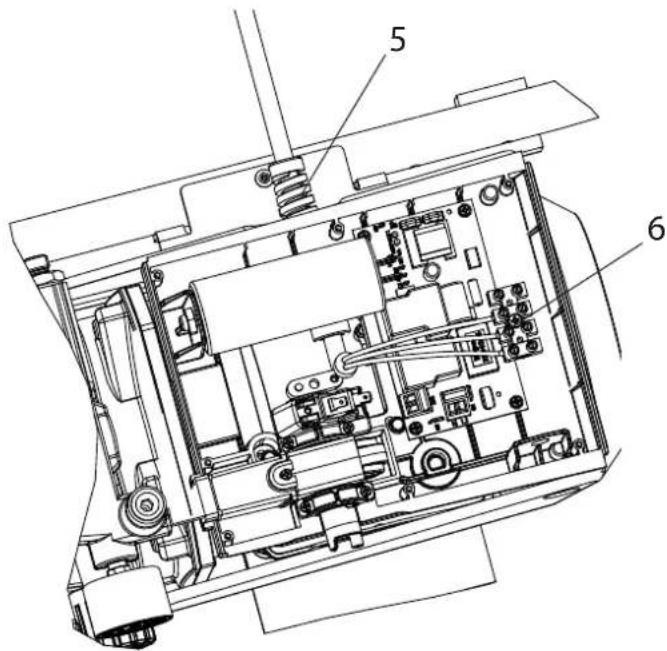
text_image
Technical diagram of a mechanical device with numbered components labeled 5 and 610.7 SCHÉMA ÉLECTRIQUE
2 Speed Tip support Réf. No. 0271065
Tableau des buses
| Taille de chantiers Produits applicables | |||
| Laque (L) Peinture (D) Enduit (S) | |||
| Petit | D5Buse: 111 / 415Réf. No. 0271 062 | S5Buse: 225 / 629Réf. No. 0271 064 | |
| D7Buse: 113 / 417Réf. No. 0271 063 | |||
| L10Buse: 208 / 510Réf. No. 0271 042 | D10Buse: 111 / 419Réf. No. 0271 045 | S10Buse: 527 / 235Réf. No. 0271 049 | |
| Moyen | L20Buse: 210 / 512Réf. No. 0271 043 | D20Buse: 115 / 421Réf. No. 0271 046 | S20Buse: 539 / 243Réf. No. 0271 050 |
| Grand | L30Buse: 212 / 514Réf. No. 0271 044 | D30Buse: 115 / 423Réf. No. 0271 047 | S30Buse: 543 / 252Réf. No. 0271 051 |
| Très grand | D40Buse: 117 / 427Réf. No. 0271 048 | ||
| Tamis de crosse recommandé rouge | blanc - | ||
11.2 LISTE DE PIÈCES DE RECHANGE SF 23 PLUS
text_image
Technical diagram of a mechanical assembly with numbered parts for identification11.3 LISTE DE PIÈCES DE RECHANGE FILTRE HAUTE PRESSION (ACCESSOIRES)
text_image
Technical diagram of a mechanical assembly with numbered components for identificationtext_image
Technical diagram of a wheeled cart with numbered components for identificationtext_image
Technical diagram of a mechanical pump assembly with numbered components labeled 1 to 4text_image
Technical diagram of a water dispenser with labeled parts including handle, valve, and basetext_image
Technical diagram of a water filter device with numbered components for identificationINDICATION DE MISE AU REBUT
Division Professional Finishing
Otto Lilienthal Strasse 18
88677 Markdorf
3.3 Figure illustrative
3.4 Trasporto 10
natural_image
Line drawings of three different industrial machines with wheels and gauges, shown from top to bottom views (no text or symbols)2 PANORAMICA SULL'IMPIEGO
text_image
Technical diagram of a gas purifier with labeled components including pump, hose, and spray gun3 DESCRIZIONE DELL'APPARECCHIO
3.1 METODO AIRLESS
text_image
Technical diagram of a mechanical assembly with numbered parts for identification3.3 FIGURE ILLUSTRATIVE
natural_image
Technical line drawing of a mechanical clamp or bracket assembly with no visible text or symbolstext_image
Technical diagram of a spray gun with numbered components for identification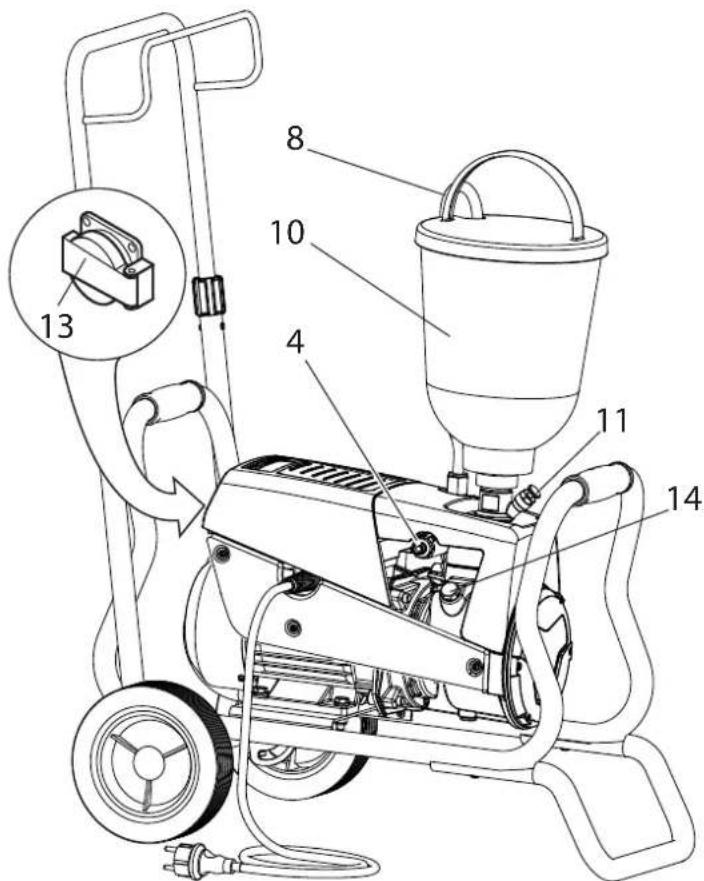
text_image
Technical diagram of a cleaning or dust purifier with numbered components labeled 4 through 14natural_image
Technical line drawing of a vehicle's lower body frame with visible wheels, sensors, and structural components (no text or symbols)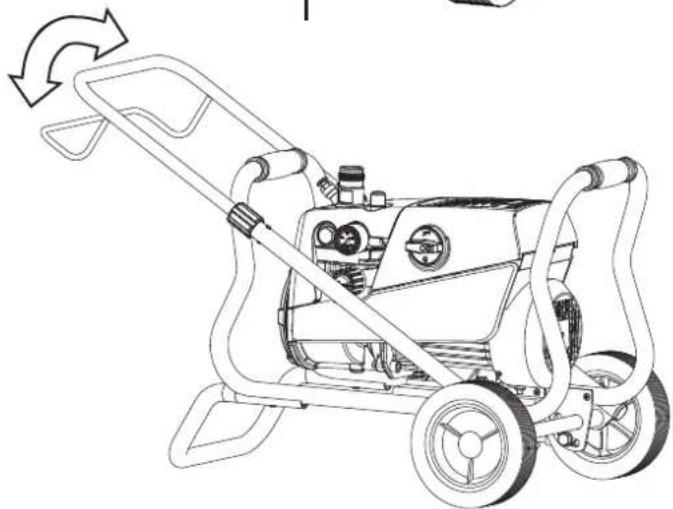
natural_image
Line drawing of a portable lawn mower with wheels and a side-mounted fan (no text or symbols)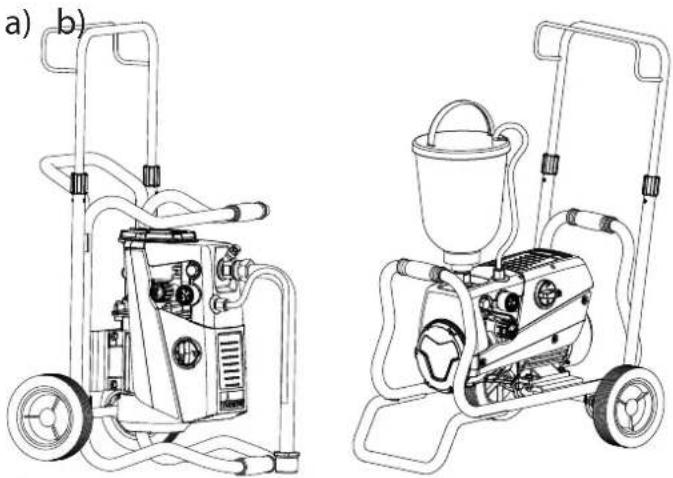
natural_image
Technical line drawings of two different industrial machines, one with a bucket and labeled (a), the other without any text or symbols.3.6 DATITECNICI
Tensione: 230 V AC, 50 Hz
text_image
Technical diagram of a spray gun pump system with numbered components for identification4.5 PRESA DI CORRENTE SULL'APPARECCHIO (NON PRESENTE IN TUTTI I MODELLI)
text_image
Technical diagram of a vehicle's internal components with numbered parts, including dashboard, air purifier, and control panel.4.8 MESSA IN FUNZIONE DELL'APPARECCHIO CON MATERIALE DI COPERTURA
text_image
Technical diagram of a spray gun with labeled parts and directional arrows indicating motion or movement.text_image
Technical diagram of a mechanical assembly with labeled parts, including a disassembled component and pressure gauge.10.2 VALVOLA DI ENTRATA
text_image
Technical diagram of a mechanical component with numbered parts, including a wrench and internal parts with threaded ports.10.3 VALVOLA DI SCARICO
text_image
Technical diagram of a mechanical device with numbered parts for identification and assembly reference.10.4 VALVOLA REGOLATRICE DELLA PRESSIONE

natural_image
Technical line drawing of a vehicle dashboard with gauges and control panel (no text or symbols)10.5 SOSTITUIRE IL CAVO DI ALIMENTAZIONE ELETTRICA

Pericolo
text_image
Technical diagram of a mechanical device with labeled parts 1 and 2, showing internal components like valves and gauges.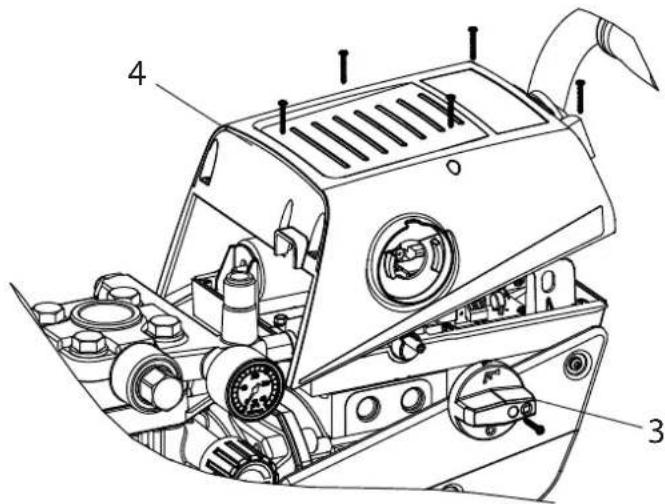
text_image
Technical diagram of a mechanical device with numbered parts labeled 3, 4, and internal components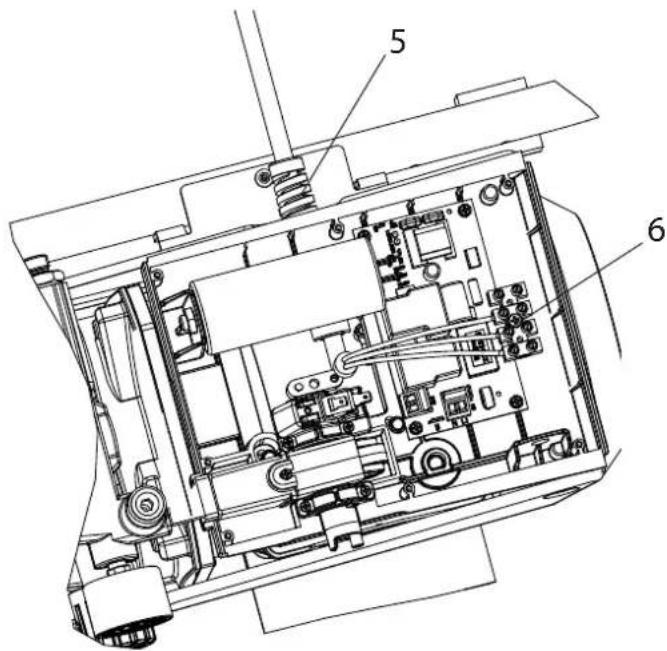
text_image
Technical diagram of a mechanical device with numbered components labeled 5 and 610.7 SCHEMA ELETTRICO
A) SUPER FINISH 23 PLUS CON PRESA DI CORRENTE
11 RICAMBI ED ACCESSORI
11.1 ACCESSORI PER SUPER FINISH 23 PLUS
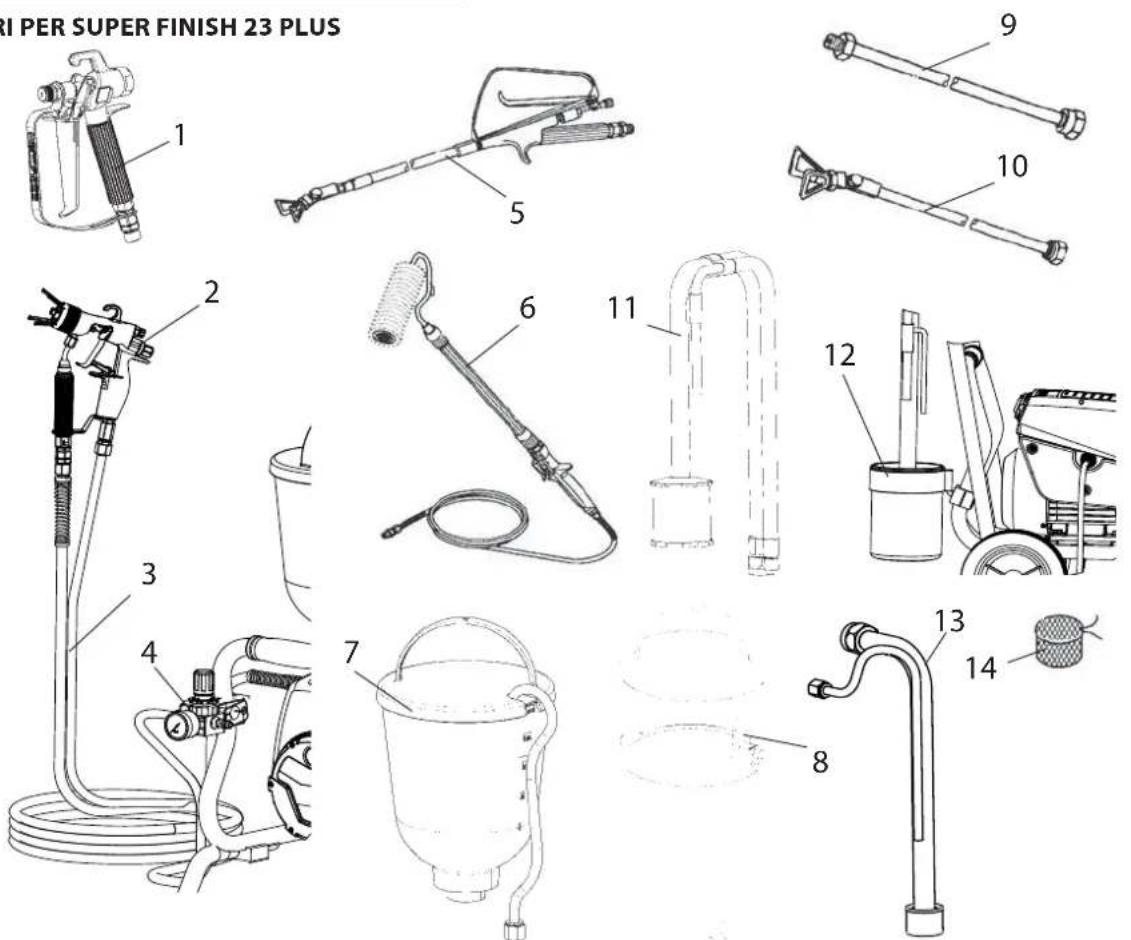
text_image
PI PER SUPER FINISH 23 PLUS 1 2 3 4 5 6 7 8 9 10 11 12 13 14Accessori
text_image
Technical diagram of a mechanical assembly with numbered parts for identificationtext_image
Technical diagram of a mechanical assembly with numbered components for identificationtext_image
Technical diagram of a wheeled cart with numbered components for identificationtext_image
Technical diagram of a mechanical pump assembly with numbered components labeled 1 to 4text_image
Technical diagram of a water filter device with labeled parts including a pump, drain, and internal structure.text_image
Technical diagram of a device with numbered parts, showing internal components like a container and tubing assembly.Division Professional Finishing
Otto Lilienthal Strasse 18
88677 Markdorf
CE Declaration of conformity
Herewith we declare that the supplied version of
Airless high-pressure spraying unit
I
2006/42 CE, 2004/108 CE
2006/42 CE, 2004/108 CE
complies with the following provisions applying to it:
2006/42 EC, 2004/108 EC
Applied harmonized standards, in particular:
Signature Senior Vice President Global Product Strategy & Planning
Responsible person for documents
2006/42 EG,2004/108 EG 2006/42 EF, 2004/108 EF 2006/42 EC, 2004/108 EC 2006/42 CE, 2004/108 CE 2006/42 CE, 2004/108 CE
text_image
cs Vice President EngineeringHr. J. Ulbrich (Mr.)
Senior Vice President Global Product Strateg
GB Wagner Spraytech (UK) Limited
The Coach House
2 Main Road
Middleton Cheney OX17 2ND
Great Britain
UK-Helpline 01295 714200
Fax 01295 710100
enquiries@wagnerspraytech.co.uk
B WSB Finishing Equipment
Veilinglaan 56-58
1861 Meise-Wolvertem
Belgium
Tel. +32/2/269 46 75
Telefax +32/2/269 78 45
info@wagner-wsb.nl
NL WSB Finishing Equipment BV
De Heldinnenlaan 200,
3543 MB Utrecht
Netherlands
Tel. +31/ 30/241 41 55
Telefax +31/ 30/241 17 87
info@wagner-wsb.nl
D J. Wagner GmbH
Telefax 04.42.53.44.36