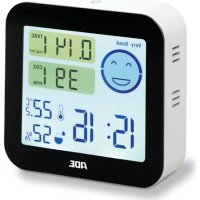
WS 1908 - Measuring equipment ADE - Free user manual and instructions
Find the device manual for free WS 1908 ADE in PDF.




| Product Type | Indoor Air Quality Monitor |
| Brand | ADE |
| Model | WS 1908 |
| Dimensions (L × W × H) | 81 × 81 × 25 mm |
| Power Supply | 2 LR03 (AAA) batteries 1.5 V or USB cable (5 V) |
| Display | Digital screen with touch backlight |
| Temperature measurement range | -10 °C to 50 °C |
| Humidity measurement range | 20% to 97% |
| Available measurements | TVOC, CO₂, temperature, humidity |
| Clock function | Yes, adjustable 12/24 h format |
| Backlight | Touch activation, 8 seconds duration |
| Sensors | TVOC, CO₂, humidity, temperature sensors |
| Connectivity | USB DC 5 V port |
| Wall mounting | Suspension eyelet on back |
| Package contents | Sensor, 2 LR03 batteries, USB cable, instruction manual |
| Maintenance | Clean with a soft, dry cloth; do not immerse |
| Safety | Keep batteries out of reach of children, observe polarity, avoid heat |
| Warranty | 2 years from date of purchase (repair or replacement) |
| Compliance | Directive 2014/30/EU and 2011/65/EU |
| Manufacturer / Distributor | Waagen-Schmitt GmbH, Hamburg, Germany |
| Disposal | Comply with local regulations; do not dispose of with household waste |
| Repairability | Repairs only by a specialized workshop |
Frequently Asked Questions - WS 1908 ADE
User questions about WS 1908 ADE
0 question about this device. Answer the ones you know or ask your own.
Ask a new question about this device
Download the instructions for your Measuring equipment in PDF format for free! Find your manual WS 1908 - ADE and take your electronic device back in hand. On this page are published all the documents necessary for the use of your device. WS 1908 by ADE.
USER MANUAL WS 1908 ADE
2x LR03 (AAA), 1,5 V ---
USB: 5,0 V DC, 500mA
(ca. 14^ - 122^
Luftfeuchtigkeit:
20-97%
22143 Hamburg, Germany
You have chosen to purchase a high-quality ADE brand product, which combines intelligent functions with an exceptional design. The many years of experience of the ADE brand ensure a high technical standard and proven quality.
We wish you much pleasure!
Your ADE Team
General information
about this operating manual

This operating manual describes how to operate and maintain your product safely.
Keep this operating manual in a safe place for future reference. If you pass this product on to someone else, pass on this operating manual as well. Failure to observe this operating manual may result in injuries or damage to your product.
-Pull the protective film off the display.
Explanation of symbols

This symbol combined with the word DANGER warns of serious injuries.

This symbol combined with the word WARNING warns of moderate and mild injuries.

This symbol combined with the word NOTE warns of material damage.

This symbol indicates additional information and general notes.
Table of Contents
General information. 33
Intended use 36
Safety 36
Overview 40
Scope of delivery. 42
Start-up 42
Display indications 45
Calibrating TVOC values. 51
Other functions. 53
Cleaning. 55
Fault and remedy 55
Technical data. 56
Declaration of Conformity 57
Warranty 58
Disposal 58
Intended use
This device is used to monitor the air quality in enclosed spaces. The device is not suitable for commercial purposes.
Safety
- This product may be used by children aged 8 and above, as well as by persons with reduced physical, sensory, or mental capacities or lacking experience and knowledge if they are supervised or have been instructed in the safe use of the product and understand the risks that may arise.
- Children must not play with the product.
-
Cleaning and user maintenance must not be carried out by children, unless they are 8 years of age or older and are being supervised.
-
Batteries, when swallowed, can be life-threatening. Keep the product and batteries out of reach of small children. If batteries have been swallowed, seek medical help immediately.
DANGER for children
- Keep children away from packaging material. There is a risk of choking if swallowed.
RISK of fire/burning and/or explosion
-
There is a risk of explosion if the batteries are replaced improperly. Replace the batteries only with the same or an equivalent battery type. Observe the "Technical data".
-
Batteries must not be recharged, reactivated by other means, dismantled, thrown into fire, or short-circuited.
Otherwise, there is an increased risk of explosion and leakage; furthermore, gases may escape!
- Avoid contact of the battery fluid with skin, eyes, and mucosa. In case of contact, immediately rinse the affected areas with plenty of clean water and consult a doctor.
BEWARE of material damage
-
Protect the alarm clock from strong shocks, vibrations, and moisture.
-
Remove the batteries from the item when they are exhausted or if you will not use the alarm clock for an extended period of time. This prevents damage that may be caused by leakage.
-
When inserting and changing batteries, pay attention to the correct polarity (+/-).
- Do not expose the batteries to extreme conditions, for example, by storing them on radiators or under direct sunlight. Increased risk of leakage!
- Clean the battery and device contacts, as needed, before inserting the battery.
- Only use batteries of the same type. Do not use different types or used and new batteries together.
- Do not make any changes to the product. Only allow repairs to be carried out by a specialist workshop. Repairs carried out improperly can considerably endanger the user.
Overview
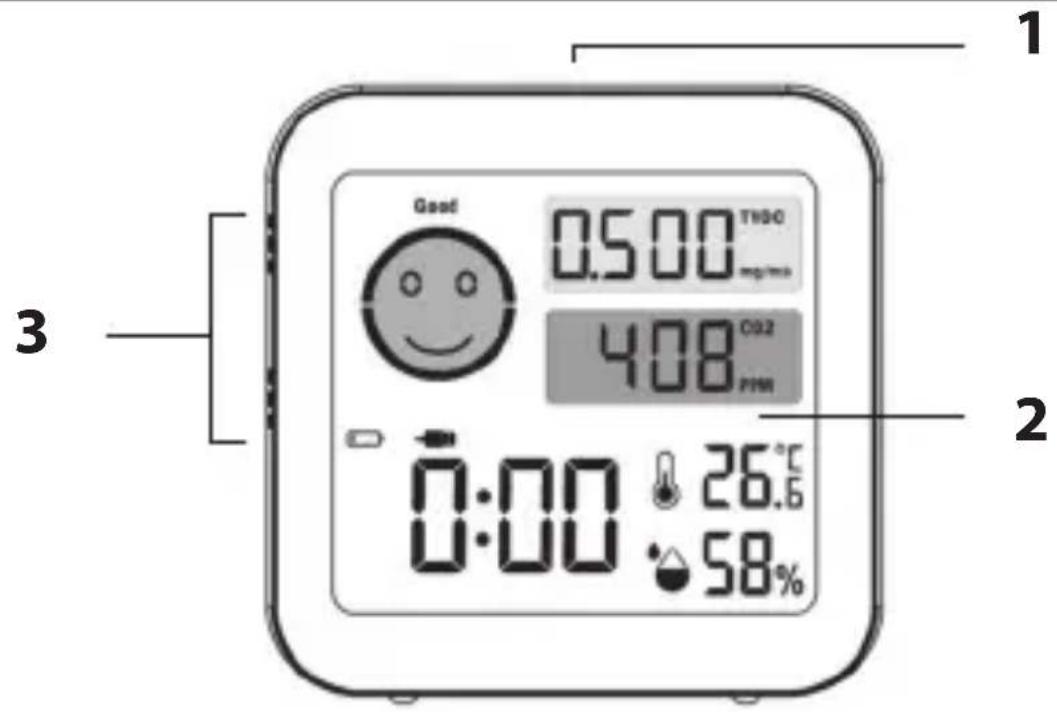
1 Turn on display lighting
Manually restart air quality measurement
2 Display
3 Sensors for measuring TVOC and CO
Not depicted:
USB cable, 2x LR03 (AAA) batteries
Z
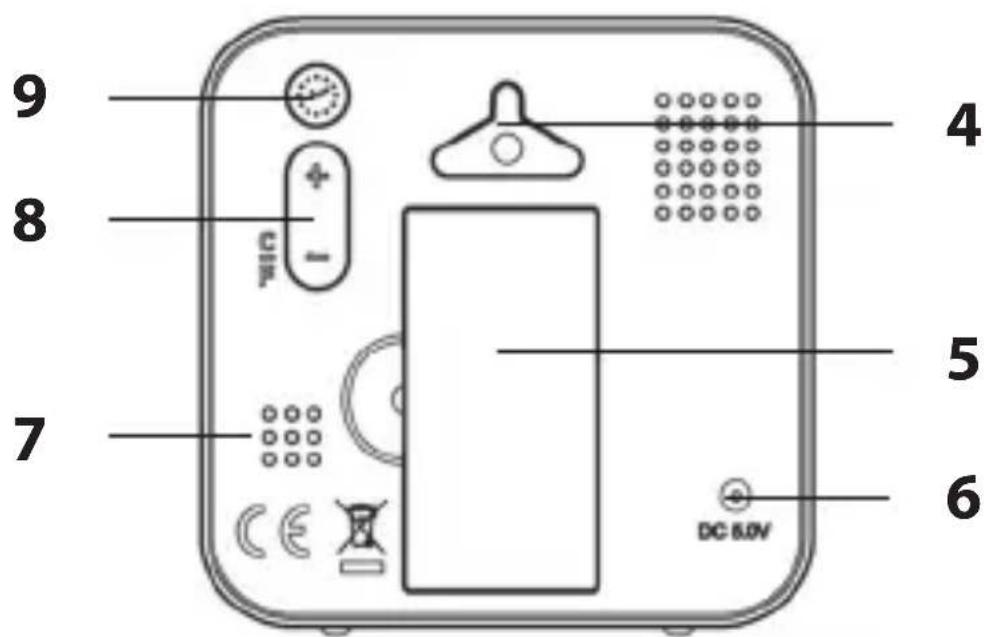
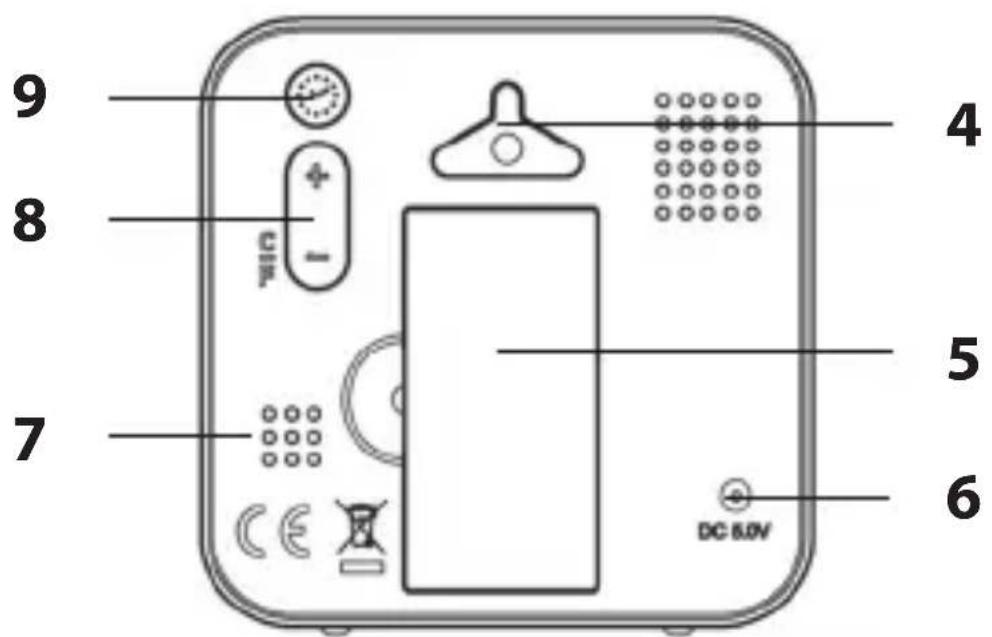
4 Hanging loop
5 Battery compartment, 2x LR03 (AAA)
6 USB cable connection port
7 Humidity and temperature measurement sensors
8 Button+: 12- or 24-hour display
Button -: °C or °F display
9 Setting the time
Scope of delivery
Air quality monitor
- 2x LR03 (AAA) batteries, 1.5 V
- USB cable and operating manual
Start-up
You can operate the device using batteries or USB connection.
Battery operation
For use, you will need two LR03 (AAA), 1.5 V batteries.
- Press the locking tab of the battery compartment cover down and remove the battery compartment cover.
-
Insert the batteries as shown on the bottom of the battery compartment. Pay attention to the correct polarity (+ / -) .
-
Replace the battery compartment cover. The locking tab must audibly engage.
USB operation
- Connect the included USB cable to the device's USB connector DC 5.0V and to a USB port of a computer (PC, tablet, laptop) or a USB adapter.

If a USB connection is used, power is always supplied via USB even if batteries have been inserted.
Once power is supplied to the device, the display will show the temperature and humidity. A five-minute countdown starts concurrently. This is the amount of time the device needs to collect and analyse air data.

We recommend that you do not set the time until these five minutes have elapsed.
Setting the time

Press and hold down or speed up the progress of the displayed values in increasing or decreasing order.
- Press and hold down the button until the hour digit flashes on the display.
- Use the - or + buttons to set the current hour.
- Briefly press the key . The minute digit flashes on the display.
- Use the or buttons to set the current minute time, if necessary.
- Finally, press briefly. The time has been set.
Display indications
General
In addition to the time, temperature and humidity, the display shows the TVOC value and CO_2 content.
To ensure values are measured as accurately as possible, please pay attention to the following:
- Do not touch the sensor openings on the side and back of the device and make sure they are clean.
- Do not place the device near highly fragrant objects and do not store it in odour-intensive packaging when not in use.
- When starting the device after a period of disuse, operate it in a well-ventilated environment for one hour first to ensure accurate readings.
Measurements
Temperature and humidity measurements are automatically updated once a minute.
Measurement of TVOC and CO_2 values must be started manually.
- To start the measurement process, press and hold down the sensor field for approx. 3 seconds. This triggers a five-minute countdown and air data analysis.
Pay attention to the following:
- Frequent TVOC and CO_2 measurements consume much battery power. If the measurement display shows , be sure to change the batteries or connect the device to a power supply using USB connection (see also "Changing batteries").
Operation of the device via USB connection increases measurement accuracy.
TVOC display

Follow the section
"Calibrating TVOC values".
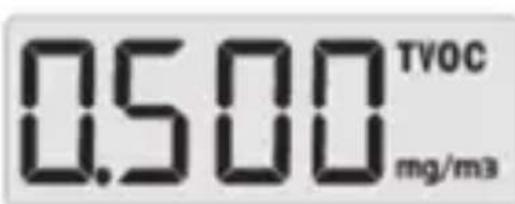
TVOC stands for total volatile organic compounds.
Background:
- The problem when measuring highly volatile foreign substances indoors is that a complex mixture which is often temporally and spatially variable is what is being evaluated.
-
There is insufficient toxicological data for many substances.
It is virtually impossible to assess the potential interactions of different substances and their effects. -
Measurements can increase sharply if the device is exposed to normal processes such as cooking, cleaning and strong temperature and humidity drops. If the device is no longer exposed to the aforementioned processes and the TVOC value decreases quickly again, this is normal.
TVOC is not toxicologically sound and therefore cannot be directly used as a criterion for assessing health effects. However, it is used to assess the overall situation.
Level Concentration Evaluation
$$ 1 \leq 0. 3 \mathrm {m g} / \mathrm {m} ^ {3} $$
Hygienically safe.
Generally no issues.
$$ 2 > 0. 3 - 1 \mathrm {m g} / \mathrm {m} ^ {3} \text {S t i l l h y g i e n i c a l l y s a f e}. $$
| 3 > 1-3 mg/m3 | Hygienically noteworthy. Only limited use in spaces that are regularly used is acceptable (< 12 months). |
| 4 > 3-10 mg/m3 | Hygienically dubious. Only limited use in spaces that are regularly used is acceptable (< 1 month). |
| 5 > 10 mg/m3 | Hygienically unacceptable. Avoid use of this space as much as possible. Use of the space should be limited to at most hourly intervals/temporarily a day. You must refrain from using the space if values exceed 25 mg/m3. |
CO_2 display
- In Germany, the concentration of CO_2 around 408.8 ppm (measured in 2018 at the highest point above sea level) is somewhat lower than the global average (ppm = parts per million).
- The sensor does not measure carbon dioxide in the environment directly, but through calculation of other relevant parameters.
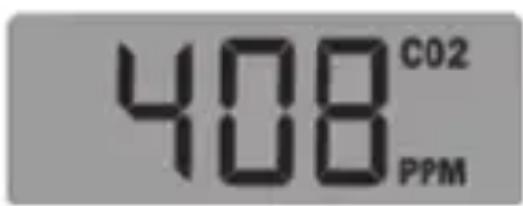
The measured CO_2 content is displayed as a numerical value and a smiley.

Room air quality is very good 400 600 ppm

Room air quality is good 601 800 ppm

Room air quality is average 801 1000 ppm

Room air quality is poor 1001 2000 ppm

Room air quality is very poor >2001 ppm
Calibrating TVOC values
Recalibrating TVOC values
The factory-set TVOC value should be recalibrated if the displayed values seem incorrect. Pay attention to the following:
- Calibrate the device via the USB interface and do not disconnect it during calibration.
- Calibration should be carried out in a clean and well-ventilated area.
Procedure:
- Press and hold down the + button. The display shows "CALI".
- To start the process, press The calibration process lasts approx. 2 hours.
Restoring factory calibration
- Press and hold down the button. The display shows "reSt".
- Press
The procedure has been completed.
Other functions
Selecting the time format
-Briefly press the key +
If the display shows "AM" or "PM", the 12-hour format is set.
Illuminating the display

The display remains continually lit when powered via USB.
-Briefly press the sensor field to turn on the display light for approx. 8 seconds.
Change temperature measuring unit
-Briefly press the -button to switch between ^ C and ^ F .
Changing batteries
If there is no longer anything on the display or it shows the battery change icon, you will need to change the batteries.
-Please follow the instructions under "Setup". Notes on changing the battery:
- Only use the battery type specified in the "Technical Data".
Always replace all batteries. - Dispose of old batteries in an environmentally friendly manner, see "Disposal".
Cleaning

Do not submerge the device in water or other fluids. Do not use rough, scratching or abrasive cleaning agents.
-Dust the device with a soft, dry cloth or wipe with a slightly damp cloth when necessary.
Fault and remedy
No function.
- Are the batteries empty or inserted the wrong way around?
Values seem unrealistic.
- Check the location. Device should not be placed next to highly fragrant items, for example. Restart air quality measurement if necessary (press and hold the sensor field for approx. 3 seconds).
The display shows "LL.L" or "HH.H".
- Temperature measurement is below (approx. -9.9^ ) or above ( >50^ ) the measuring range.
Technical data
Model: WS 1908
Battery: 2x LR03 (AAA), 1.5 V
USB: 5.0 V DC, 500 mA
Measuring range: Temperature:
approx. -10^ C - 50^ C
(approx. 14^ F - 122^ F )
Humidity:
20-97%
Dimensions: approx. 81 × 81 × 25 ~mm
Distributor (no service address):
Waagen-Schmitt GmbH
Neuer Höltigbaum 15
22143 Hamburg, Germany
Our products are constantly being developed and improved.
For this reason, design and technical modifications are possible at any time.
Declaration of Conformity
Waagen-Schmitt GmbH hereby declares that the WS 1908 air quality monitor complies with the Directives 2014/30/EU and 2011/65/EU.
This declaration loses its validity if any modification is made to the item that has not been agreed with us in advance.
Hamburg, May 2021
Waagen-Schmitt GmbH

Warranty
Waagen-Schmitt GmbH warrants for 2 years from the purchase date the cost-free rectification of defects in material and workmanship through repair or exchange.
In the event of a warranty claim, please return the product with the proof of purchase (specifying the reason for claim) to your dealer.
Disposal
Disposing of the packaging

Dispose of the packaging with similar materials. Dispose of cardboard with waste paper and of films with recyclable materials.
Disposing of the product
Dispose of the product in accordance with the regulations that apply in your country.
Devices must not be disposed of in normal household waste
At the end of its life, the product must be disposed of in an appropriate way.
In this way, valuable materials contained in the device will be recycled and the burden on the environment avoided. Bring the old device to a collection point for electronic waste or to a recycling depot. For more information, contact your local waste disposal firm or your local administrative body.
Standard and rechargeable batteries should not be disposed of along with household waste
All batteries and rechargeable batteries must be brought to a local or district collection point or to the retailer. Such batteries and rechargeable batteries can thus be disposed of in an environmentally friendly way.
Z
Cable USB, 2 pilas LR03 (AAA)
USB: 5,0 V DC / 500 mA
Piles: 2x LR03 (AAA), 1,5 V
USB : 5,0 V DC, 500 mA
USB: 5,0 V DC, 500 mA
(ca. 14^ - 122^
USB: 5,0 V DC, 500 mA
- General information
- about this operating manual
- Explanation of symbols
- Table of Contents
- Intended use
- Safety
- DANGER for children
- RISK of fire/burning and/or explosion
- BEWARE of material damage
- Overview
- Scope of delivery
- Start-up
- Battery operation
- USB operation
- Setting the time
- Display indications
- General
- Measurements
- TVOC display
- Background:
- Level Concentration Evaluation
- CO_2 display
- Calibrating TVOC values
- Recalibrating TVOC values
- Procedure:
- Restoring factory calibration
- Other functions
- Selecting the time format
- Illuminating the display
- Change temperature measuring unit
- Changing batteries
- Cleaning
- Fault and remedy
- Technical data
- Declaration of Conformity
- Warranty
- Disposal
- Disposing of the packaging
- Disposing of the product
- Devices must not be disposed of in normal household waste
- Standard and rechargeable batteries should not be disposed of along with household waste
Brand : ADE
Model : WS 1908
Category : Measuring equipment