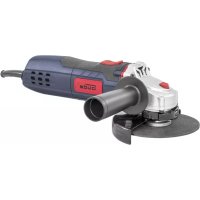
WS 125900 - Grinder Güde - Free user manual and instructions
Find the device manual for free WS 125900 Güde in PDF.

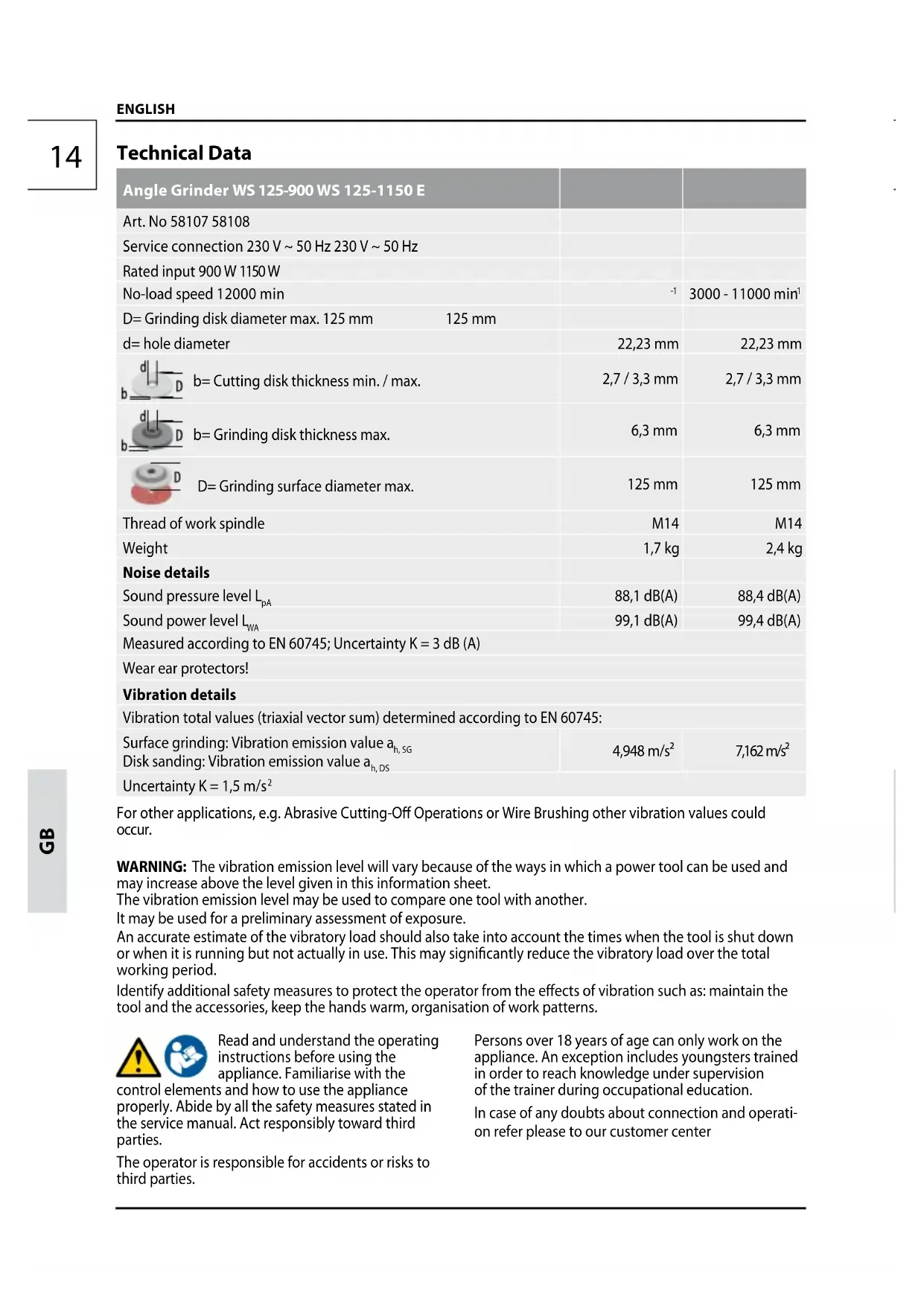


| Product type | Angle grinder (grinder) |
| Brand | Güde |
| Model | WS 125900 |
| Rated power | 900 W |
| No-load speed | 12 000 min⁻¹ |
| Max grinding wheel diameter | 125 mm |
| Bore diameter | 22.23 mm |
| Cutting disc thickness min./max. | 2.7 / 3.3 mm |
| Polishing disc thickness max. | 6.3 mm |
| Shaft thread | M14 |
| Weight | 1.7 kg |
| Power supply | 230 V ~ 50 Hz |
| Protection class | II (double insulation) |
| Sound pressure level LpA | 88.1 dB(A) |
| Sound power level LWA | 99.1 dB(A) |
| Vibration emission value (grinding) | 4.948 m/s² |
| Vibration emission value (sanding) | 7.162 m/s² |
| Main functions | Grinding, cutting, sanding (dry) |
| Maintenance | Clean the ventilation openings regularly; use a damp cloth; do not use solvents |
| Safety | Wear glasses, hearing protection, dust mask, gloves; use protective guard; maintain safety distance |
| Spare parts | Available at www.guide.com |
| Intended use | Grinding and cutting of metals, stone, ceramics; sanding |
| Restart protection | Yes (after power failure) |
Frequently Asked Questions - WS 125900 Güde
User questions about WS 125900 Güde
0 question about this device. Answer the ones you know or ask your own.
Ask a new question about this device
Download the instructions for your Grinder in PDF format for free! Find your manual WS 125900 - Güde and take your electronic device back in hand. On this page are published all the documents necessary for the use of your device. WS 125900 by Güde.
USER MANUAL WS 125900 Güde
ENGLISH Please read the instructions carefully before starting the machine.
For other applications, e.g. Abrasive Cutting-Off Operations or Wire Brushing other vibration values could occur.
WARNING: The vibration emission level will vary because of the ways in which a power tool can be used and may increase above the level given in this information sheet.
The vibration emission level may be used to compare one tool with another.
It may be used for a preliminary assessment of exposure.
An accurate estimate of the vibratory load should also take into account the times when the tool is shut down or when it is running but not actually in use. This may significantly reduce the vibratory load over the total working period.
Identify additional safety measures to protect the operator from the effects of vibration such as: maintain the tool and the accessories, keep the hands warm, organisation of work patterns.


Read and understand the operating instructions before using the appliance. Familiarise with the
control elements and how to use the appliance properly. Abide by all the safety measures stated in the service manual. Act responsibly toward third parties.
The operator is responsible for accidents or risks to third parties.
Persons over 18 years of age can only work on the appliance. An exception includes youngsters trained in order to reach knowledge under supervision of the trainer during occupational education.
In case of any doubts about connection and operation refer please to our customer center
Specified Conditions Of Use
The angle grinder is used for grinding and cutting metal, stone and ceramic materials, as well as for sanding.
Use the cutting guard from the accessories range for cutting application.
Please refer to the instructions supplied by the accessory manufacturer.
The machine is suitable only for working without water. Do not use this product in any other way as stated for normal use. Not observing general regulations in force and instructions from this manual does not make the manufacturer liable for damages.
Emergency procedure
Conduct a first-aid procedure adequate to the injury and summon qualified medical attendance as quickly as possible. Protect the injured person from further harm and calm them down. If you seek help, state the following pieces of information: 1. Accident site, 2. Accident type, 3. Number of injured persons, 4. Injury type(s)
Symbols
| WARNING / Caution! |
| Read the operating instructions to reduce the risk of injury. |
| Wear eye protective goggles! Wear ear protectors! |
| Wear a suitable dust protection mask. |
| Wear gloves! |
| Unplug the machine before any work on it. |
| Keep bystanders a safe distance away from work area. Anyone entering the work area must wear personal protective equipment. |
| Class II tool. |
| CE marking |
| Any damaged or disposed electric or electronic devices must be delivered to appropriate collection centres. |
WARNING Read all safety warnings and all instructions. Failure to follow the warnings and instructions may result in electric shock, fire and/or serious injury. Save all warnings and instructions for future reference.
Angle Grinding SafetyWarnings
SafetyWarnings Common for Grinding, Sanding or Abrasive Cutting-Off Operations:
a) This power tool is intended to function as a grinder, sander or cut-off tool. Read all safety warnings, instructions, illustrations and specifications provided with this power tool. Failure to follow all instructions listed below may result in electric shock, fire and/or serious injury.
b) Operations such as wire brushing and polishing are not recommended to be performed with this power tool. Operations for which the power tool was not designed may create a hazard and cause personal injury.
c) Do not use accessories which are not specifically designed and recommended by the tool manufacturer. Just because the accessory can be attached to your power tool, it does not assure safe operation.
d) The rated speed of the accessory must be at least equal to the maximum speed marked on the power tool. Accessories running faster than their rated speed can break and fly apart.
e) The outside diameter and the thickness of your accessory must be within the capacity rating of your power tool. Incorrectly sized accessories cannot be adequately guarded or controlled.
f) Treaded mounting of accessories must match the grinder spindle thread. For accessories mounted by flanges, the arbour hole of the accessory must fit the locating diameter of the flange. Accessories that do not match the mounting hardware of the power tool will run out of balance, vibrate excessively and may cause loss of control.
g) Do not use a damaged accessory. Before each use inspect the accessory such as abrasive wheels for chips and cracks, backing pad for cracks, tear or excess wear, wire brush for loose or cracked wires. If power tool or accessory is dropped, inspect for damage or install an undamaged accessory. After inspecting and installing an accessory, position yourself and bystanders away from the plane of the rotating accessory and run the power tool at maximum noload speed for one minute. Damaged accessories will normally break apart during this test time.
h) Wear personal protective equipment. Depending on application, use face shield, safety goggles or safety glasses. As appropriate, wear dust mask, hearing protectors, gloves and shop apron capable of stopping small abrasive or workpiece fragments. The eye protection must
be capable of stopping flying debris generated by various operations. The dust mask or respirator must be capable of filtrating particles generated by your operation. Prolonged exposure to high intensity noise may cause hearing loss.
i) Keep bystanders a safe distance away from work area. Anyone entering the work area must wear personal protective equipment. Fragments of workpiece or of a broken accessory may fly away and cause injury beyond immediate area of operation.
j) Hold the power tool by insulated gripping sur faces only, when performing an operation where the cutting accessory may contact hidden wiring or its own cord. Cutting accessory contacting a "live" wire may make exposed metal parts of the power tool "live" and could give the operator an electric shock.
k) Position the cord clear of the spinning accessory. If you lose control, the cord may be cut or snagged and your hand or arm may be pulled into the spinning wheel.
I) Never lay the power tool down until the accessory has come to a complete stop. The spinning accessory may grab the surface and pull the power tool out of your control.
m) Do not run the power tool while carrying it at your side. Accidental contact with the spinning accessory could snag your clothing, pulling the accessory into your body.
n) Regularly clean the power tool's air vents. The motor's fan will draw the dust inside the housing and excessive accumulation of powdered metal may cause electrical hazards.
o) Do not operate the power tool near flammable materials. Sparks could ignite these materials.
p) Do not use accessories that require liquid coolants. Using water or other liquid coolants may result in electrocution or shock.
Kickback and RelatedWarnings
Kickback is a sudden reaction to a pinched or snagged rotating wheel. Pinching or snagging causes rapid stalling of the rotating wheel which in turn causes the uncontrolled power tool to be forced in the direction opposite of the wheel's rotation at the point of the binding.
For example, if an abrasive wheel is snagged or pinched by the workpiece, the edge of the wheel that is entering into the pinch point can dig into the surface of the material causing the wheel to climb out or kick out. The wheel may either jump toward or away from the operator, depending on direction of the wheel's movement at the point of pinching. Abrasive wheels may also break under these conditions.
Kickback is the result of power tool misuse and/or incorrect operating procedures or conditions and can be avoided by taking proper precautions as given below.
a) Maintain a firm grip on the power tool and position your body and arm to allow you to resist kickback forces. Always use auxiliary handle, if
provided, for maximum control over kickback or torque reaction during start-up. The operator can control torque reactions or kickback forces, if proper precautions are taken.
b) Never place your hand near the rotating accessory. Accessory may kickback over your hand.
c) Do not position your body in the area where power tool will move if kickback occurs. Kickback will propel the tool in direction opposite to the wheel's movement at the point of snagging.
d) Use special care when working corners, sharp edges etc. Avoid bouncing and snagging the accessory. Corners, sharp edges or bouncing have a tendency to snag the rotating accessory and cause loss of control or kickback.
e) Do not attach a saw chain woodcarving blade or toothed saw blade. Such blades create frequent kickback and loss of control.toothed saw blade.
SafetyWarnings Specific for Grinding and Abrasive Cutting-Off Operations:
a) Use only wheel types that are recommended for your power tool and the specific guard designed for the selected wheel. Wheels for which the power tool was not designed cannot be adequately guarded and are unsafe.
b) The grinding surface of the centre depressed wheels must be mounted below the plane of the guard lip. An improperly mounted wheel that projects through the plane of the guard lip cannot be adequately protected.
c) The guard must be securely attached to the power tool and positioned for maximum safety, so the least amount of wheel is exposed towards the operator. The guard helps to protect the operator from broken wheel fragments, accidental contact with wheel and sparks that could ignite clothing.
d) Wheels must be used only for recommended applications. For example: do not grind with the side of cut-off wheel. Abrasive cut-off wheels are intended for peripheral grinding, side forces applied to these wheels may cause them to shatter.
e) Always use undamaged wheel flanges that are of correct size and shape for your selected wheel. Proper wheel flanges support the wheel thus reducing the possibility of wheel breakage. Flanges for cut-off wheels may be different from grinding wheel flanges.
f) Do not use worn down wheels from larger power tools. Wheel intended for larger power tool is not suitable for the higher speed of a smaller tool and may burst.
Additional SafetyWarnings Specific for Abrasive Cutting-Off Operations:
a) Do not "jam" the cut-off wheel or apply excessive pressure. Do not attempt to make an excessive depth of cut. Overstressing the wheel increases the loading and susceptibility to twisting or binding of the wheel in the cut and the possibility of kickback or wheel breakage.
b) Do not position your body in line with and behind the rotating wheel. When the wheel, at the point of operation, is moving away from your body, the possible kickback may propel the spinning wheel and the power tool directly at you.
c) When wheel is binding or when interrupting a cut for any reason, switch off the power tool and hold the power tool motionless until the wheel comes to a complete stop. Never attempt to remove the cut-off wheel from the cut while the wheel is in motion otherwise kickback may occur. Investigate and take corrective action to eliminate the cause of wheel binding.
d) Do not restart the cutting operation in the workpiece. Let the wheel reach full speed and carefully re-enter the cut. The wheel may bind, walk up or kickback if the power tool is restarted in the workpiece.
e) Support panels or any oversized workpiece to minimize the risk of wheel pinching and kickback. Large workpieces tend to sag under their own weight. Supports must be placed under the workpiece near the line of cut and near the edge of the workpiece on both sides of the wheel.
f) Use extra caution when making a "pocket cut" into existing walls or other blind areas. The protruding wheel may cut gas or water pipes, electrical wiring or objects that can cause kickback.
SafetyWarnings Specific for Sanding Operations:
a) Do not use excessively oversized sanding disc paper. Follow manufacturers recommendations, when selecting sanding paper. Larger sanding paper extending beyond the sanding pad presents a laceration hazard and may cause snagging, tearing of the disc or kickback.
Additional Safety and Working Instructions
When grinding metal, flying sparks are produced. Take care that no persons are endangered. Because of the danger of fire, no combustible materials should be located in the vicinity (spark flight zone). Do not use dust extraction.
Avoid flying sparks and sanding dust hit your body.
Never reach into the danger area of the machine when it is running.
Chips and splinters must not be removed while the machine is running.
Immediately switch off the machine in case of considerable vibrations or if other malfunctions occur. Check the machine in order to find out the cause.
Do not let any metal parts reach the airing slots - danger of short circuit!
Under extreme conditions (e.g. smooth-grinding metals with the arbour and vulcanized fibre grinding wheel), significant contamination can build up on the inside of the angle grinder. For safety reasons, in such conditions the inside should be cleaned thoroughly of metal deposits and a motor circuit-breaker must be connected in series. If the motor
circuit-breaker trips the machine must be sent for repair.
For accessories intended to be fitted with threaded hole wheel, ensure that the thread in the wheel is long enough to accept the spindle length.
Always use and store the cutting and grinding disks according to the manufacturer's instructions.
Always use the correct guard for cutting and grinding.
Always use guard with cutting guide from the accessories range for cutting stone.
The adjusting nut must be tightened before starting to work with the machine.
Always use the auxiliary handle.
The workpiece must be fixed if it is not heavy enough to be steady. Never move the workpiece towards the rotating disk by hand.
STARTUP PROTECTION
58107: Machines with a lockable switch are supplied with a restart cutout. This prevents the machine restarting by itself after a power failure. When resuming work, switch the machine off and then switch it back on again.
Mains Connection
Operation is only allowed with a safety switch against stray current (RCD max. stray current of 30mA ).
Connect only to single-phase AC system voltage as indicated on the rating plate. It is also possible to connect to sockets without an earthing contact as the design conforms to safety class II.
Only plug-in when machine is switched off.
Maintenance
Unplug the machine before any work on it.
Repairs and works specified in these Instructions may only be performed by qualified authorised staff.
Use only original accessories and original spare parts.
Keep the device, in particular the air vents, clean at all times. Never spray water on the device body!
Do not clean the plastics with solvents, flammable or toxic fluids. For cleaning, use a damp cloth only.
Caution! If the power cord of the appliance gets damaged, it must be replaced by the manufacturer or its customer service or a similarly qualified person to avoid danger.
Only a regularly maintained and treated appliance can serve as a satisfactory aid. Insufficient maintenance and care can lead to unforeseen accidents and injuries.
If necessary, a list of spare parts can be found at www.guide.com.
\section*{Caracteristiques Techniques}
PanaTe ce ot IeTaeu nckpn u nnfoBvch npax.
He 6bpkaTe B 30HaTa Ha onaCHOCT Ha pa6oTeaTa MaunHa.
CtpyKn nIOnOTUynEnH napyeTa da He ce OTCTpaHraBaT, DOKaTO MaunHa pa6OtN.
Bednara n3knioyete MaunHaTa, aKO ce noBrt 3NaHTeHNn Bn6paun nn 6bDat yCTaHOBeHn dpyrHepeNHOctn. PpOBepTe MaunHaTa 3a da yCTaHOBnTe npuHaTa.
BbB BeHTnlaOHHHe ⅢnH He 6BaJa nonaTaMTaJIHn Yactn NopaOn OnaCHOCT OT KbCO CbeINHeHne.
PnEckpMaHnYcNoBnHaekCnloaTaunna (Ha np. npi rnaKO uinΦOBaHe Ha MeTaN C onOpHnI dNCK NBykAnHn6bPhNTe uinΦOBuHN dNCKOBe) MoKe Da Ce HATpyNa CnHNO 3AmbPCBaHe BbB bTpewHOCTTa Ha bTNOBOTO uinΦOBbUHO yctpoiCTBO. PnTaknBa EKcnnoatauOnHHyCNoBnOTrJedHaTOUYKa Ha CNpyHOCT e Heo6xOdmo OCHOBnIOuNCtBaHe Ha BbTpewHOCTTa OT MeTaNOr TaRaHn I3aBbXInTeH NopeDbapntEnHO BKlIOvBaHe Ha 3aUnTeH npeKbcBaay a YeueH ToK FI.CneI 3aJeIcTBAHe Ha 3aUnTHnraFl-npKbcBaay MaunHATA Tp8Ba Da ce n3npaTn 3a peMOHT.
Pn a6pa3uBn MaTeepnaHn, KOnTo Tp86Ba da 6bDat Cha6deHn C dNcK C pe36a, Tpr6Ba Da ce rapaHTnpa, Ye pe36aTa B dNcKa e DocTaTbUHO bJIra 3a WnnHdela.
PexeInte nIuNfoBaunTe IuCKOBe BnHaTn da ce 13no3BAt n CbXpaHbAT Cbo6pa3Ho INHCTpyKUnTe Ha npou3BOUInTe.
Pn rpy6o wlnfoBaHe n p3aHe da ce pa60Tu BnHaTn CbC 3aunTeH WlEM.
Pn p3aHe Ha KaMbK 3aDbNkUTeJIHO Da Ce n3NoI3Ba BOeuaTa WeHa.
Ppei nycKaHe Ha MaunHata fnaHcObaTa raKa Ta6Ba Da 6bda 3aterHata.
BnHa n da ce n3noJ3Ba dOnbHnHTenHaTa pbKoXBaTka. Toba BaXn CbIIO npu MaunHn C npEJa3e HcBeiHNHTe, NOHEKe TOJ ce 3aJeCTBa camo npN 6IoknpaHe Upe3 Nmnync.
06pa6oTbAHnI T TaH Tp6Ba Da 6bJe fKcnpaH 3dpabo, aKO He e DocTaBHy ToXbK, 3a Da CTOn Cta6uHNO OT CO6CTBeHOT CN TerNo. Hnkora He BODeTe DeTaHa c pbKa Cpeu Dncka.
3AUNTA OT NOBTOPHIYCKAHE
58107:MaunHnTe c 6noknpaC ne pBkIouBaTe ca o6OpyDbaHn CbC 3auNTa OT NOBtOHO nycKaHe. Ta3aunta npedOTbpaTBA NOBtOPHO nysKaHe Ha MaunHaTa CneD CNIPAHe HA eNEKTPuYeCKOTO 3axpaHbAHe. 3a npoDbJxKaBaHe Ha pa6oTa TbpBO N3KIOUcTe MaunHaTa H CneD TOBA OTHOB Ra BKIOUcTe.
3aunTa Ha Dbratena B 3abucmocT OHaTobapBaHeTo
Pa6oTa e pa3peWeHa cAmO c npedna3eH n3KIOuBaTeI npOTnB norpeWeH TOK (RCD mKc. norpeWeH TOK 30mA).
Ia ce Cbbp3Ba cAmO KbM eHNOfoa3eH npOMEHnIB TOK n Camo KbM MPexKoBO HaPpeXeHne, NOCOeHO Bbpxy 3aBOckata Ta6eJka. Bb3MOxHo e n Cbbp3BaHe KbM KOHTaKT, KOITo HE e OT TIN "UyKO", NOHEKe KOHCTpyKuYraTa e OT 3auNTen Knac II.
Cbbp3BaIte MaunHaTa KbM KOHTaKTa cMo B n3KJIIOUeHO NIOJOKeHne.
NoapbKka
Ipeu n3BbPwBaHe Ha KaKBaTo N da 6nlo pa60ta no ypea BnHaHn n3BaTe eencena ot cnncenHaTkytn.
PemOHn pa6oTn, KOTo He ca OnUcaHb TOBa yNbTBaHe, MoKe Da n3BbPwBa cAmO KbALINΦuPaH oTopu3npaH nepcoHaI.
Ja ce n3nol3BaT cmo opunHaHnA kcecoapuOpunHaHn pe3epBn qactn.
IodbpxaKeMaunHaTa,OCo6eHO BeHTnlauONHHTe OTBOpN,BHArN B uCTo CbCTOHNHe Hnkora He npckaTe KOpnyca Ha MaunHaTa c B0Da!
He nouCTBaIte pnaCTMaCOBnTe yactn C pa3TbOpNTeIN, 3aapanmN INN TOKcHn TeHocTn. 3a NOUCTBaHe n3NON3BaITe BIAJHa Kbpna.
BhImaHne! Ako ce noBpeDn 3axpaHbauuKa6en Ha To3n ypeD, pOni3BOJNTeJr Tnn HeROBnT cepBn3 3a 06CnyKBaHe Ha KIneHTn nn PoDo6Ho KBaIINphiNpuHO Nlue Tp86Ba da ro CMeHn, 3a da ce n36erHe onaCHOCT.
Camo peoBHO noIbpxKaH IO6cnyKBaH ypeJ MoKe da 6bJe 3aIOBOJIteNHO NOMarano. HeIOCTaTbUHaTa IPOIpbXka I rPnxKa MOKe da IOBeJe DO HeOuaKBAHN INHCnDEHTN 3ILONONyKn.
B cnuyaHn Heo6xOJIMocT ige Hamepnte CnncbK Ha pe3epBHNTE qactn Ha nHTepHet cTpaHncaTa www.guide.com.
Date Tehnice
Translation of the EC-Declaration of Conformity
We, hereby declare the conception and construction of the below mentioned appliances correspond - at the type of construction being launched - to appropriate basic safety and hygienic requirements of EC Directives.
In case of any change to the appliance not discussed with us the Declaration expires.
Notified Body Name: No: Adress:
Type Ex. Cert.-No.:

97/68/EC_
Emission No.:

2000/14/EC_2005/88/EC
Harmonised standards used | Normes harmonisées applicables | Applicate norme armonizzate | Použité harmonizované normy | Primijenji harmonizirani standardi | Gebruiktte harmoniserende normen | Használt harmonizált normák | Kullanilan uyum normali | Wykorzystane zharmonizowane normy | Primijenji harmonizirani standardi | Korišteni usklažene norme | Anvendte harmoniserede standarder | Normas armonizadas aplicadas | Norme armonizate folosite | Исторовнихарmonицениюрм | Бернштейноргий | | --- | --- | --- | --- | --- | --- | --- | --- | --- | --- | --- | --- | --- | --- | --- | --- | --- | --- | --- | --- | --- | --- | --- | --- | --- | --- | --- | --- | --- | --- | --- | --- | --- | --- | --- | --- | --- | --- | --- | --- | --- | --- | --- | --- | --- | --- | --- | --- | --- | --- | ---
EN 60745-1:2009+A11:2010
EN 60745-2-3:2011
ZEK01.4-08
EN 55014-1:2006+A1:2009+A2:2011
EN 55014-2:1997+A1:2001+A2:2008
EN 61000-3-2:2006+A1:2009+A2:2009
EN 61000-3-3:2008

- Specified Conditions Of Use
- Emergency procedure
- Symbols
- Angle Grinding SafetyWarnings
- Kickback and RelatedWarnings
- SafetyWarnings Specific for Grinding and Abrasive Cutting-Off Operations:
- Additional SafetyWarnings Specific for Abrasive Cutting-Off Operations:
- SafetyWarnings Specific for Sanding Operations:
- Additional Safety and Working Instructions
- STARTUP PROTECTION
- Mains Connection
- Maintenance
- \section*{Caracteristiques Techniques}
- 3AUNTA OT NOBTOPHIYCKAHE
- 3aunTa Ha Dbratena B 3abucmocT OHaTobapBaHeTo
- NoapbKka
- Translation of the EC-Declaration of Conformity
Brand : Güde
Model : WS 125900
Category : Grinder