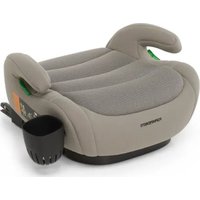
Next iSize - Car seat Foppapedretti - Free user manual and instructions
Find the device manual for free Next iSize Foppapedretti in PDF.



User questions about Next iSize Foppapedretti
0 question about this device. Answer the ones you know or ask your own.
Ask a new question about this device
Download the instructions for your Car seat in PDF format for free! Find your manual Next iSize - Foppapedretti and take your electronic device back in hand. On this page are published all the documents necessary for the use of your device. Next iSize by Foppapedretti.
USER MANUAL Next iSize Foppapedretti
natural_image
Black and white baby stroller with red trim, featuring a white cushion and gray body (no text or symbols visible)EN PUSHCHAIR - Assembly instructions - Complies with EN1888-2:2018
EN. IMPORTANT - READ CAREFULLY AND KEEP FOR FUTURE REFERENCE.
FR. IMPORTANT - A LIRE ATTENTIVEMENT ET A CONSERVER POUR REFERENCE ULTERIEURE.
DE. WICHTIG - BITTE SÖRGFÄLTIG LESEN UND FÜR SPÄTERES NACHLESEN UNBEDINGT AUFBEWAHREN.
ES. IMPORTANTE - LEER DETENIDAMENTE Y MANTENERLAS PARA FUTURAS CONSULTAS.
natural_image
Mechanical device with labeled parts, no visible text or symbols on the device itself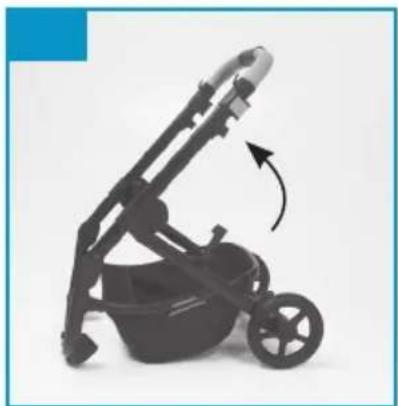
natural_image
Black stroller with open lid and wheels, no visible text or symbols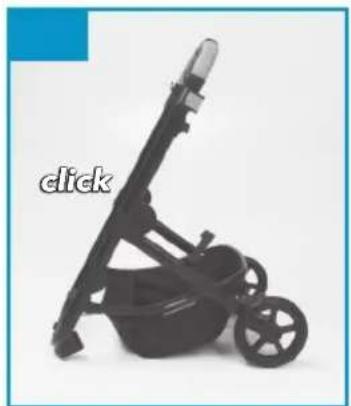
text_image
click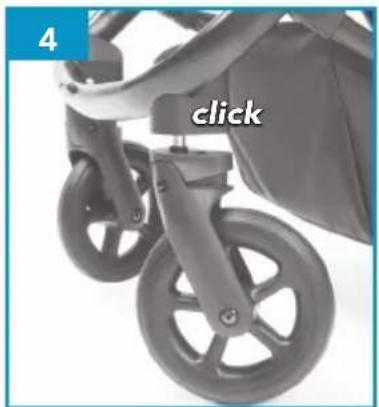
text_image
4 click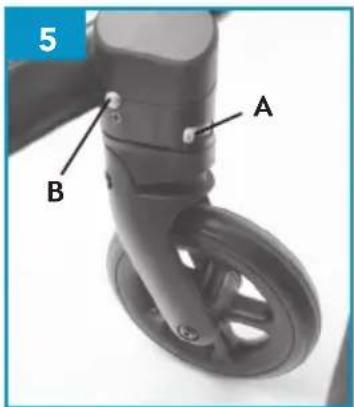
text_image
5 A B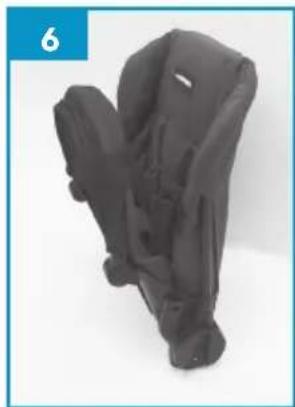
natural_image
Black plastic mechanical component with no visible text or symbols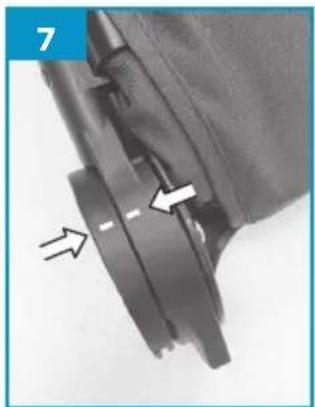
natural_image
Close-up of a mechanical component with arrows indicating a specific feature (no text or symbols visible)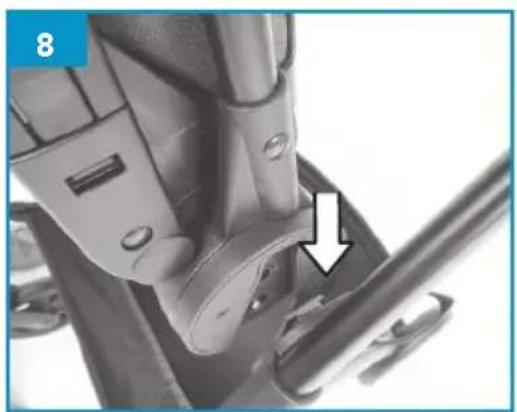
natural_image
Close-up of a mechanical component with a white arrow pointing to a detail (no visible text or symbols)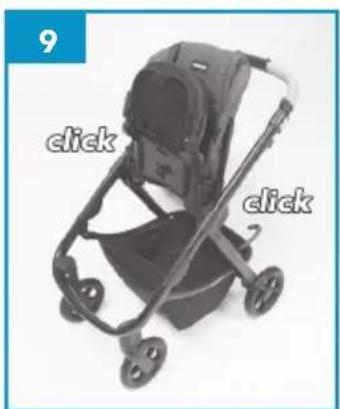
text_image
9 click click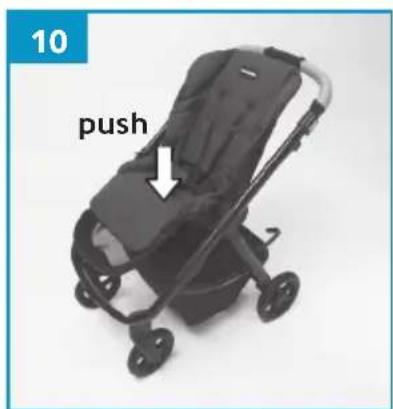
text_image
10 push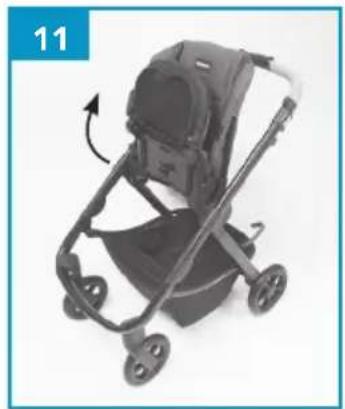
natural_image
Black stroller with backpack and wheels, no visible text or symbols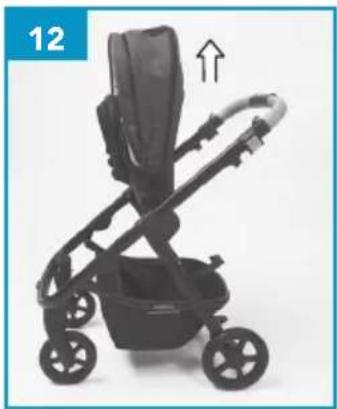
natural_image
Black stroller with four wheels and a seat cover, no visible text or symbols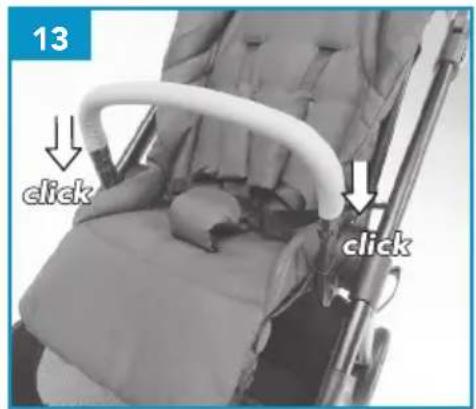
text_image
13 click click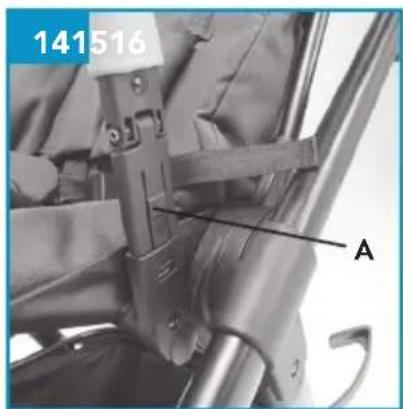
text_image
141516 A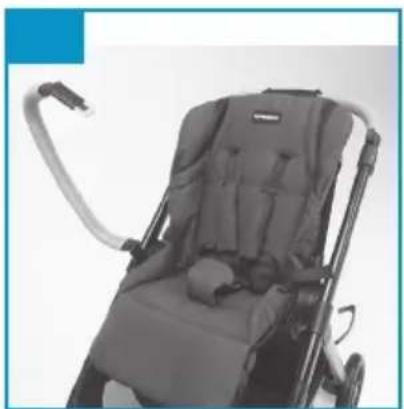
natural_image
Black and white photo of a baby seat with a horizontal cord and seatbelt, no visible text or symbols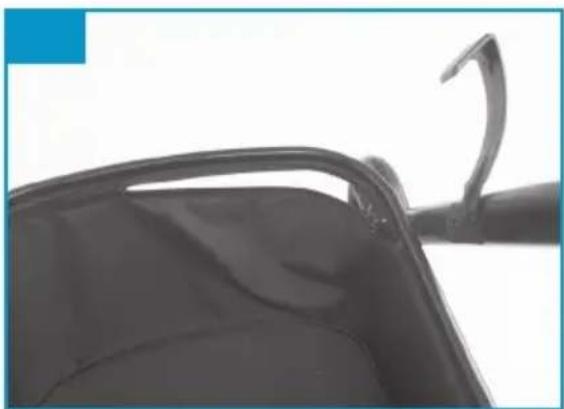
natural_image
Close-up of a black ergonomic chair cover with a curved handle attachment (no text or symbols visible)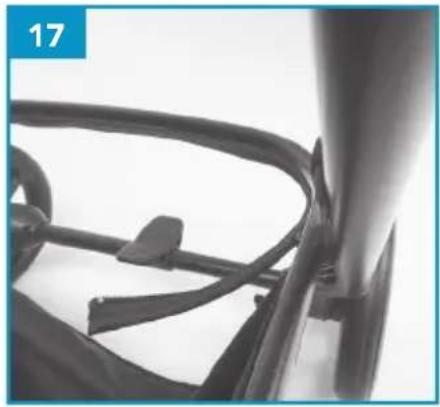
natural_image
Close-up of a car's front wheel and side arm (no visible text or symbols)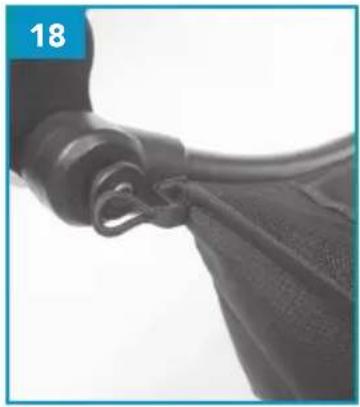
natural_image
Close-up of a black cable with coiled cable and connectors, no visible text or symbols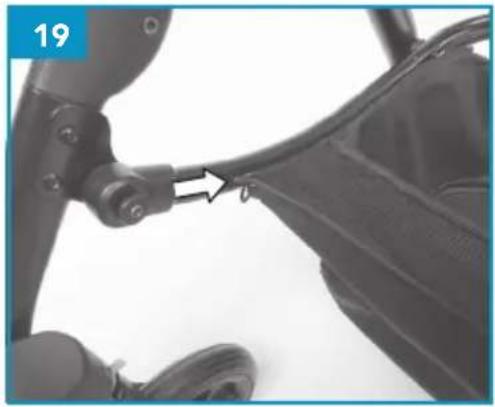
natural_image
Close-up of a mechanical component with a blue arrow pointing to a detail (no visible text or symbols)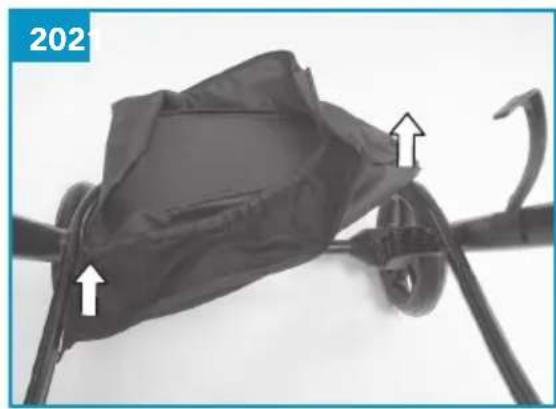
natural_image
Close-up of a black fabric bag with a curved handle and arrow indicator (no text or symbols)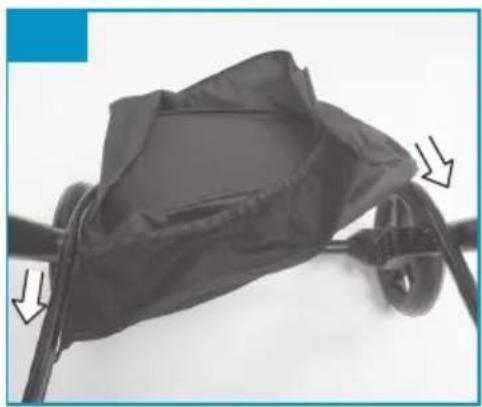
natural_image
Close-up of a black fabric or cushion component with a curved handle and arrow indicators (no text or symbols)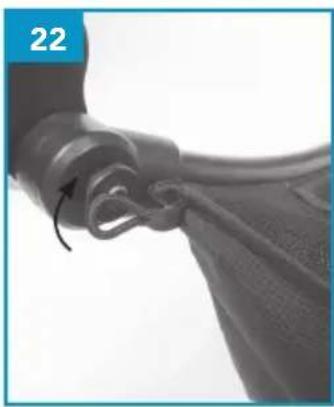
natural_image
Close-up of a knitted cable with a curved wire and arrow indicating direction (no text or symbols)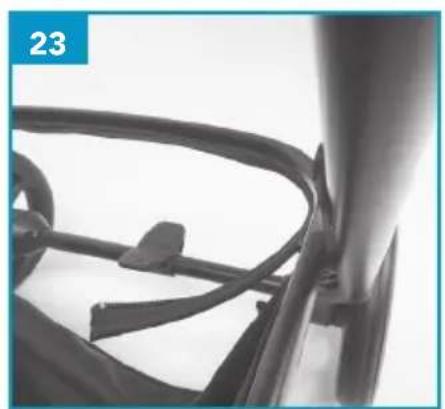
natural_image
Close-up of a black bicycle steering wheel frame (no text or symbols visible)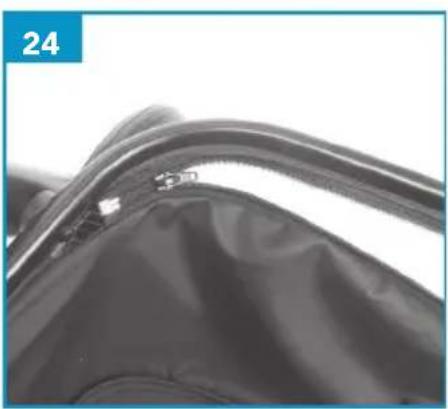
natural_image
Close-up of a black fabric or mesh material with visible folds and a small inset detail (no text or symbols)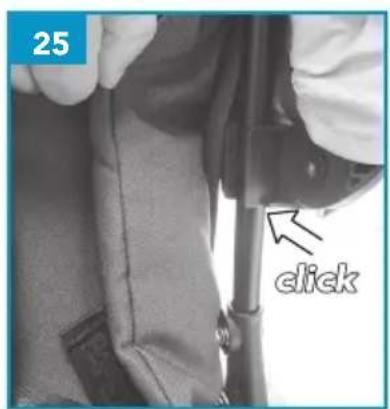
text_image
25 click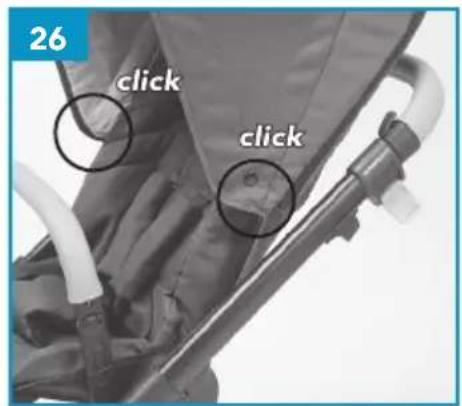
text_image
26 click click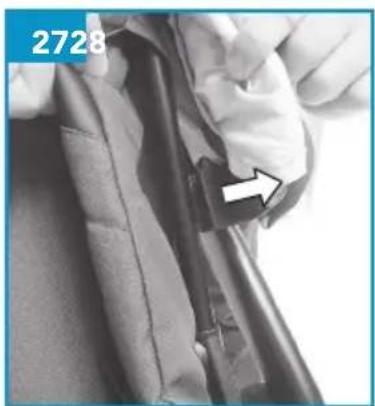
natural_image
Close-up of a hand adjusting a car seatbelt with a white arrow pointing to the seat (no text or symbols visible)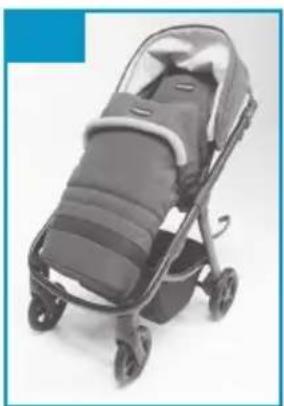
natural_image
Black and white photo of a baby stroller with a transparent hood and matching frame (no text or symbols visible)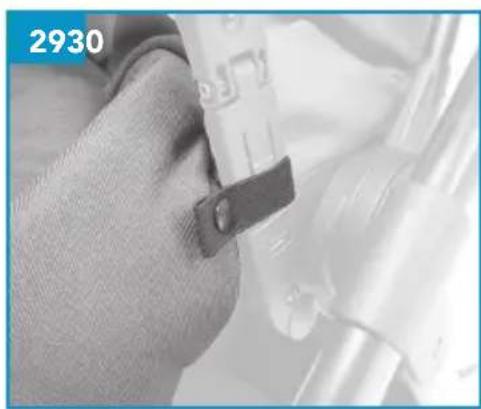
natural_image
Close-up of a hand holding a small mechanical clip, no visible text or symbols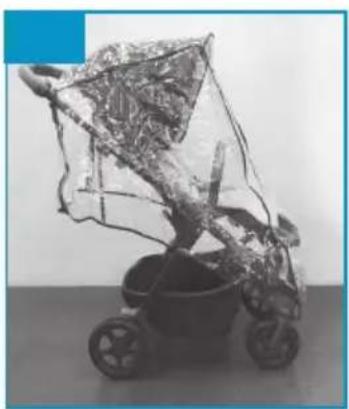
natural_image
Black-and-white photo of a small transparent wire sculpture made from paper, mounted on a black wheeled cart (no text or symbols visible)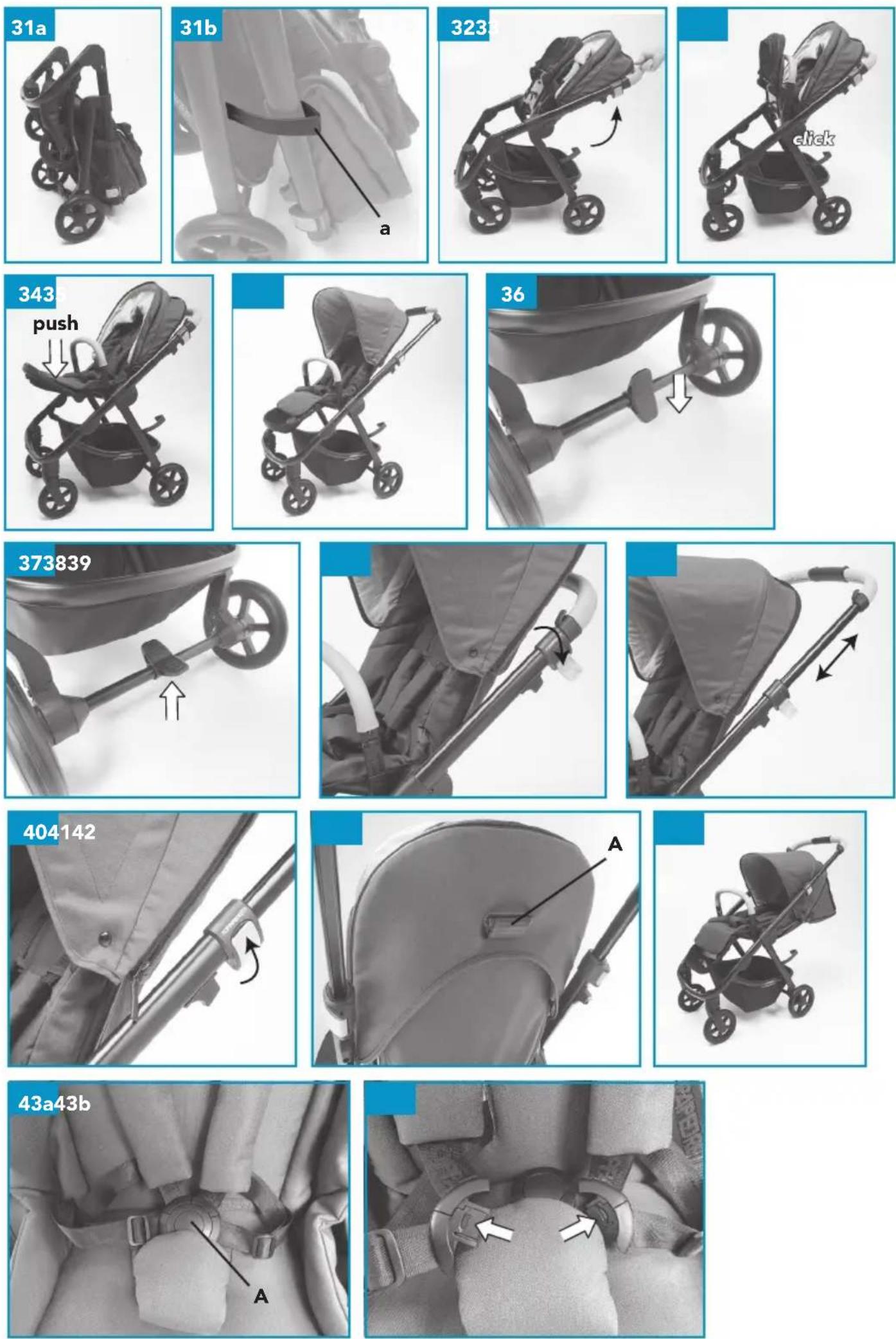
natural_image
Close-up of a person's seatbelt and belt, showing straps and fabric (no text or symbols visible)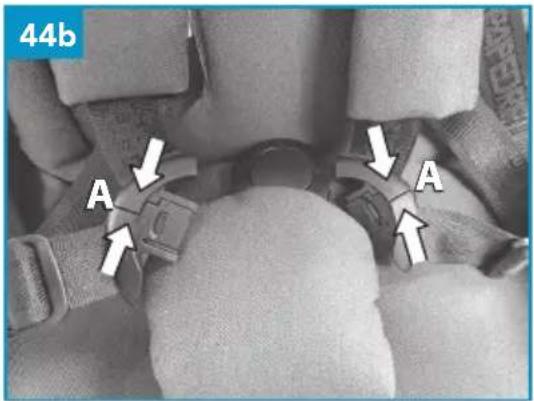
text_image
44b A A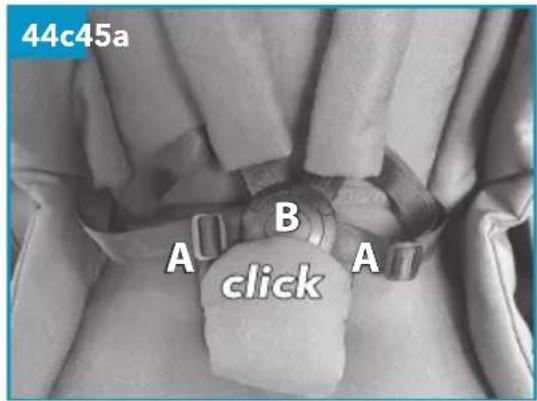
text_image
44c45a A B A click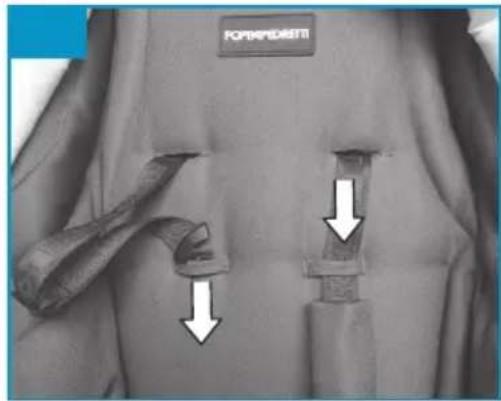
text_image
FORMERI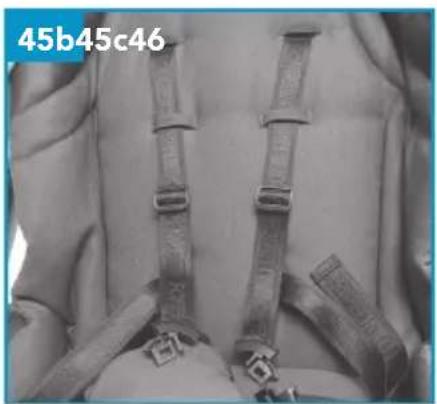
natural_image
Close-up of a person's back wearing a seatbelt with straps (no visible text or symbols)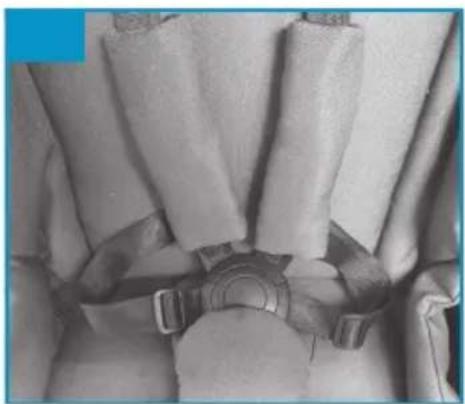
natural_image
Close-up of a metallic belt buckle with a circular buckle, partially covered by white fabric (no text or symbols visible)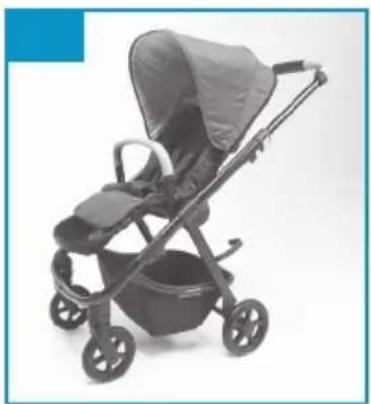
natural_image
Product photo of a baby stroller with a canopy and matching seat (no text or symbols visible)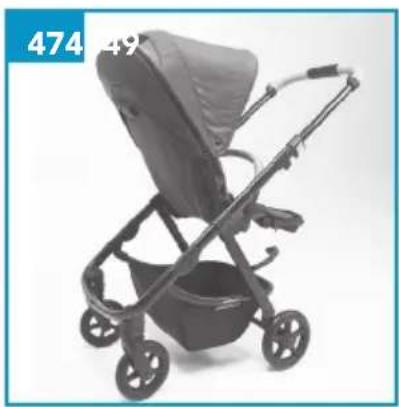
natural_image
Product photo of a baby stroller with visible frame and wheels (no text or symbols)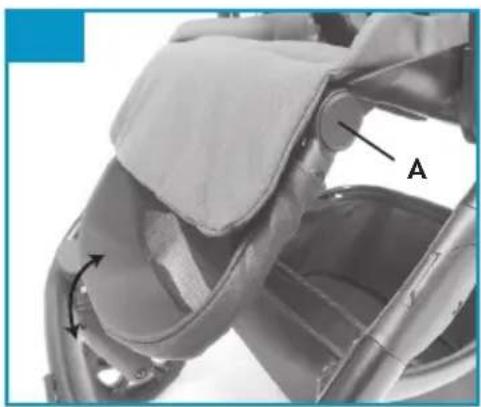
natural_image
Close-up of a bicycle seatbelt mechanism with labeled component A (no text or symbols beyond label)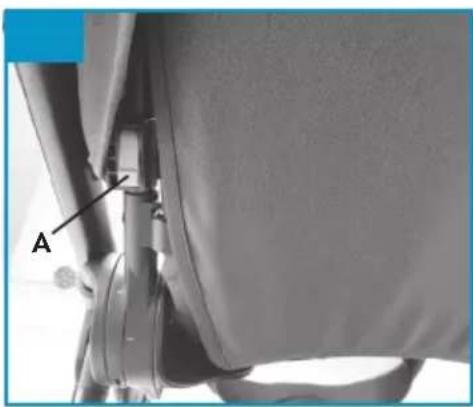
natural_image
Close-up of a mechanical component with labeled section A, showing textured surfaces and a curved pipe (no readable text or symbols)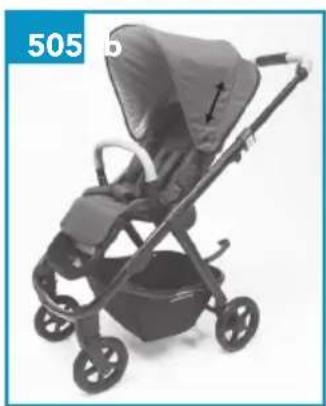
natural_image
Product photo of a baby stroller with a black body and gray canopy, no visible text or symbols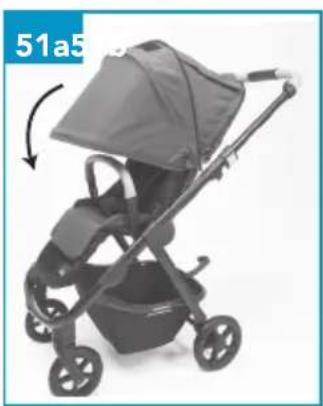
natural_image
Model of a baby stroller with a curved arrow indicating rotation (no text or symbols visible)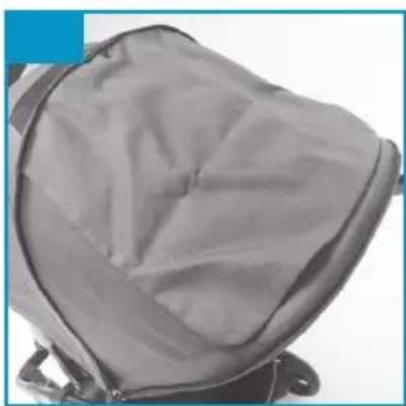
natural_image
Close-up of a gray athletic bag with visible spine and shoulder details (no text or symbols)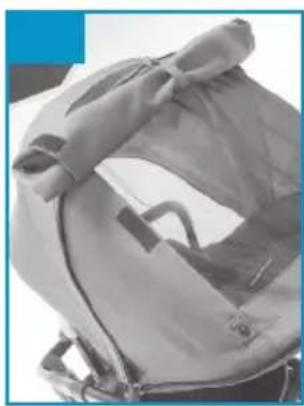
natural_image
Close-up of a gray backpack with straps and straps (no visible text or symbols)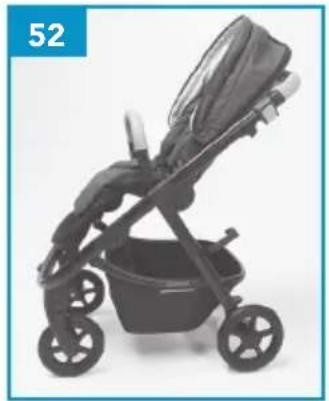
natural_image
Black stroller with four wheels and a bucket, no visible text or symbols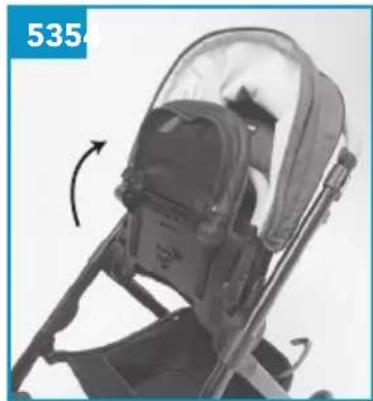
natural_image
Close-up of a baby stroller with a curved arrow indicating rotation (no text or symbols visible)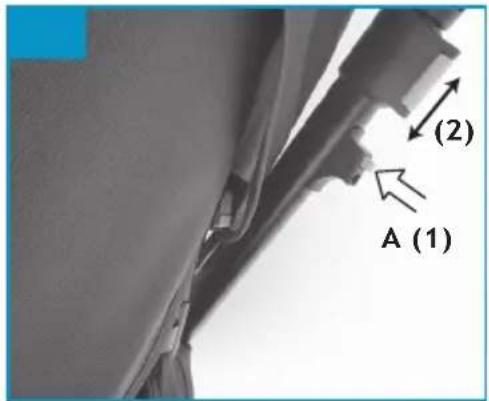
text_image
(2) A (1)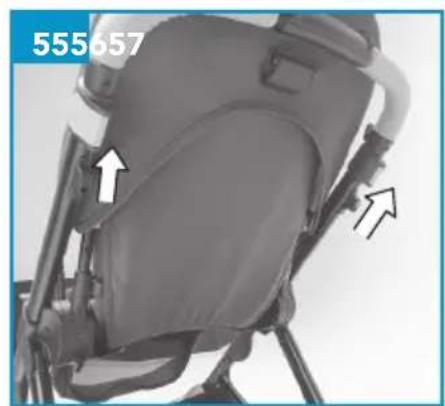
natural_image
Close-up of a gray athletic device backrest with directional arrows indicating movement or force (no text or symbols)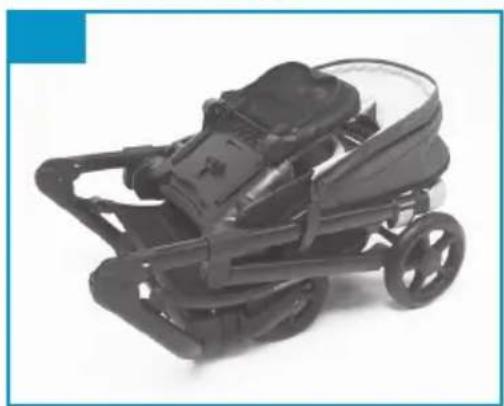
natural_image
Black plastic stroller with visible frame and wheels (no text or symbols)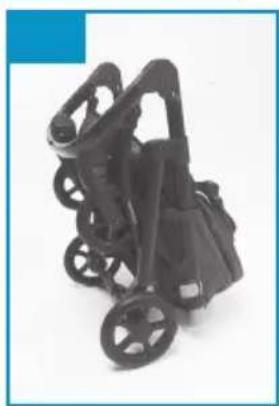
natural_image
Black stroller with wheels and a small backpack, isolated on white background (no text or symbols)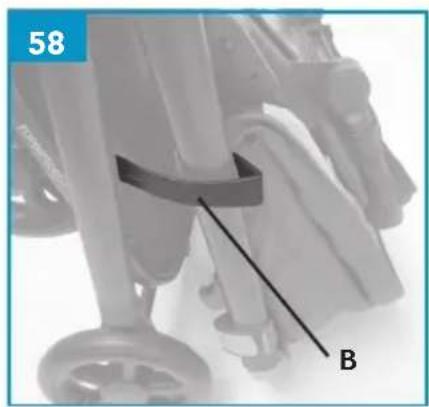
natural_image
Close-up of a stroller with a black handle and labeled component 'B' (no text or symbols beyond label)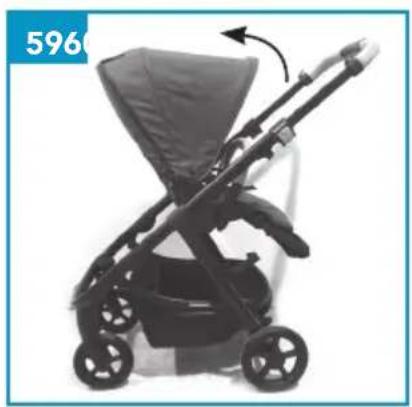
natural_image
Black and white photo of a baby stroller with a curved arrow indicating motion (no text or symbols)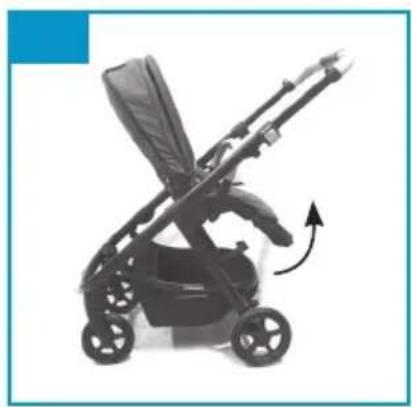
natural_image
Side view of a baby stroller with a curved arrow indicating motion (no text or symbols)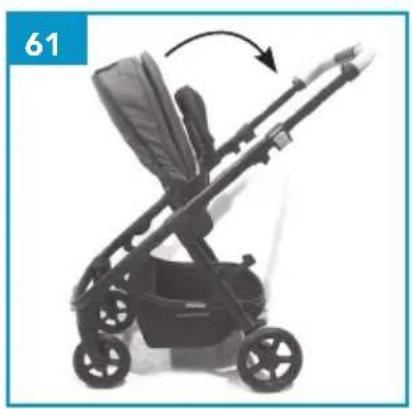
natural_image
Side view of a baby stroller with a curved arrow indicating motion (no text or symbols)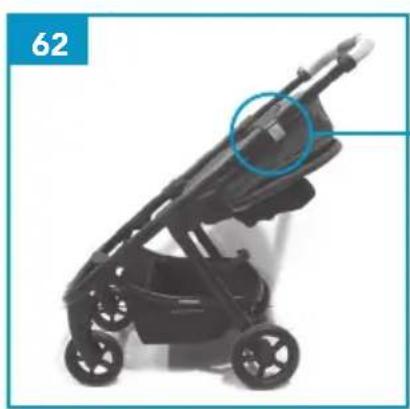
natural_image
Black stroller with blue circular highlight on front wheel (no text or symbols visible)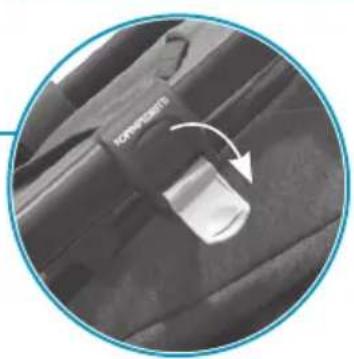
natural_image
Close-up of a car seatbelt with a white button labeled 'KONKESIEN' and an arrow indicating rotation (no additional text or symbols)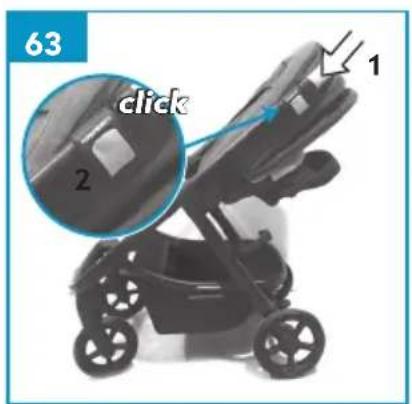
text_image
63 click 1 2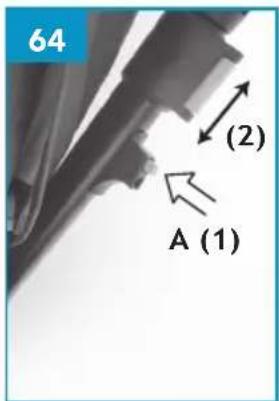
text_image
64 (2) A (1)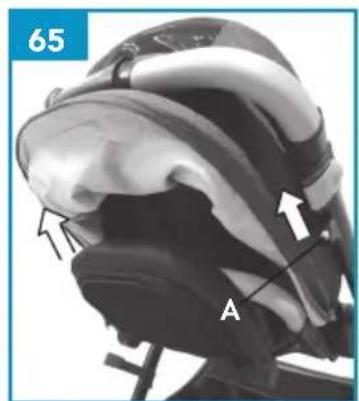
natural_image
Close-up of a mechanical component with labeled parts A and directional arrows (no readable text or symbols)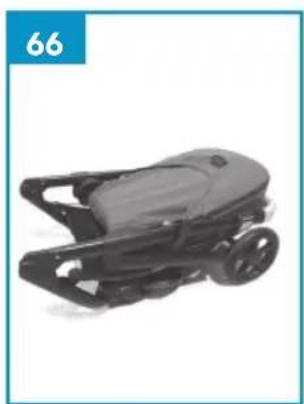
natural_image
Black plastic car shaker with wheels, no visible text or symbols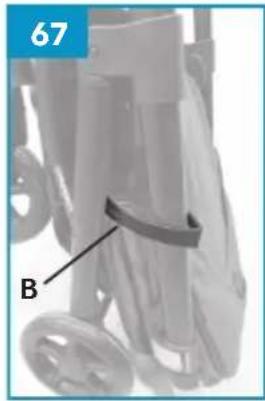
natural_image
Close-up of a stroller with labeled component B, no visible text or symbols beyond label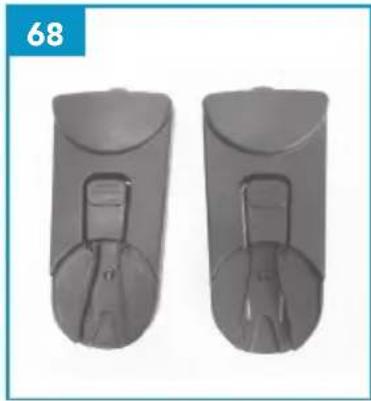
natural_image
Two gray plastic container holders with handles, no visible text or symbols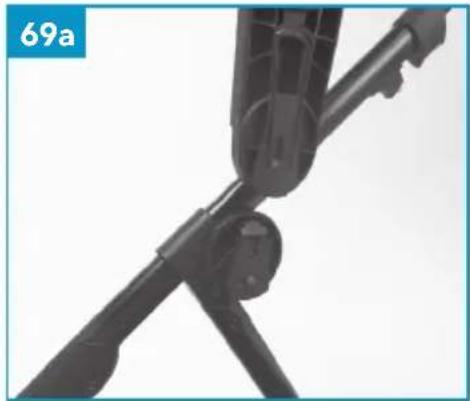
natural_image
Close-up of a black tripod-mounted device with adjustable arms and legs (no visible text or symbols)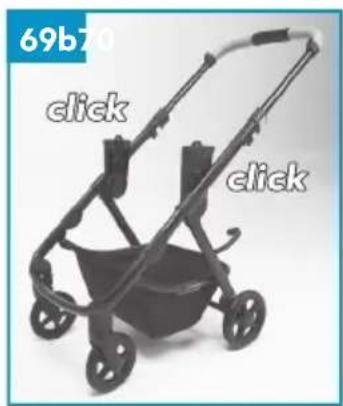
text_image
69b70 click click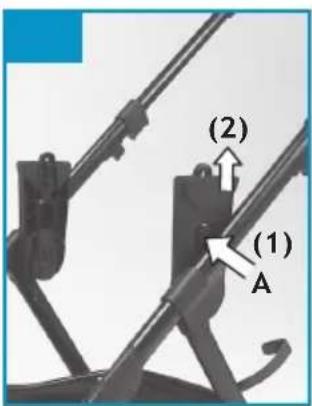
text_image
(2) (1) A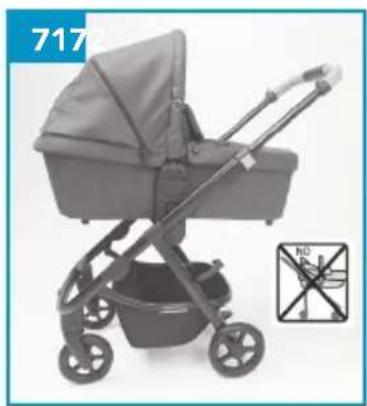
natural_image
Product photo of a baby stroller with a backrest, shown with a small inset image showing a crosshair symbol (no text or labels)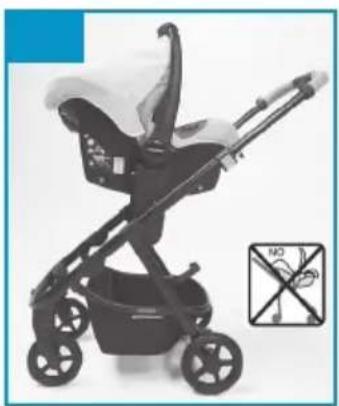
natural_image
Black baby stroller with floral design and a small inset showing cross-section of height measurement (no text or symbols)
natural_image
Black and white baby stroller with twin arms, no visible text or symbols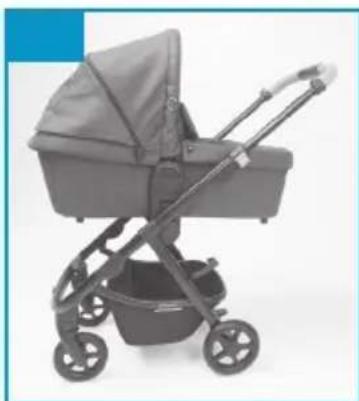
natural_image
Exterior view of a baby stroller with a canopy cover (no text or symbols visible)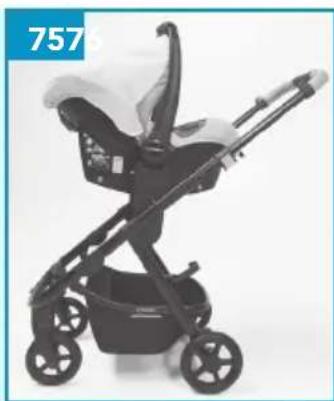
natural_image
Black and white stroller with floral design, no visible text or symbols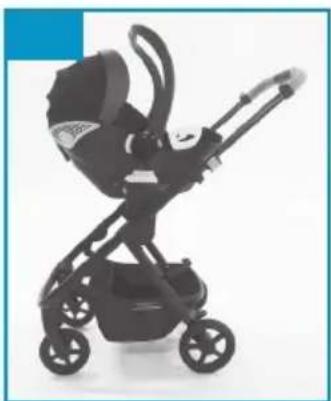
natural_image
Black stroller with twin arms and a seatbelt, shown in studio setting (no text or symbols visible)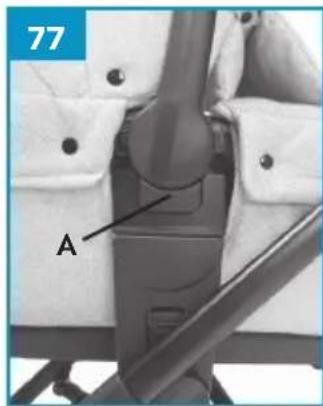
text_image
77 A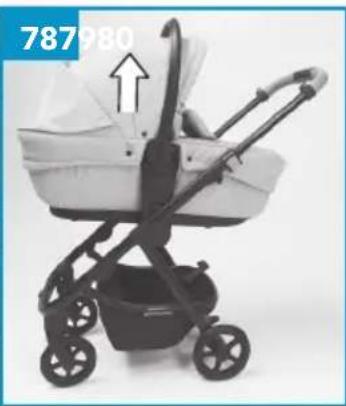
natural_image
Product photo of a baby stroller with visible frame and body structure (no text or symbols)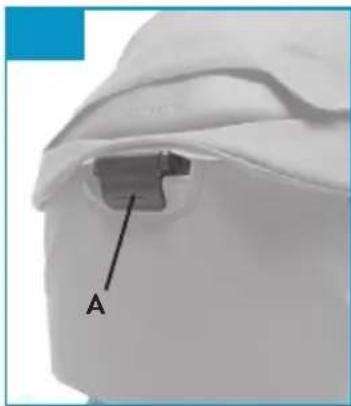
natural_image
Close-up of a medical or anatomical component with labeled point A, no visible text or symbols beyond the label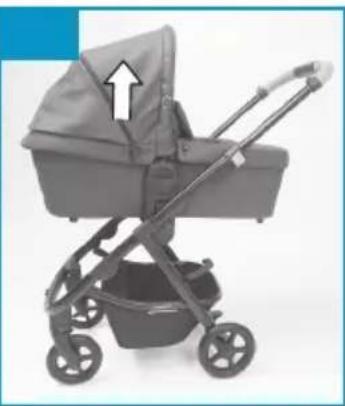
natural_image
Product photo of a baby stroller with a white arrow pointing to the front panel (no text or symbols visible)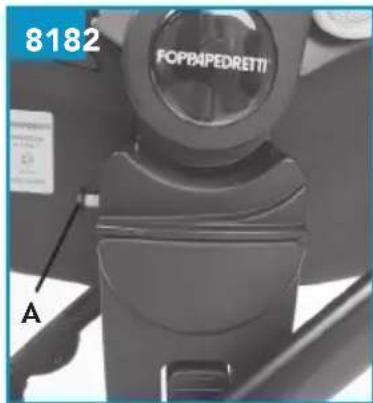
text_image
8182 FOPBAPEDRETTI A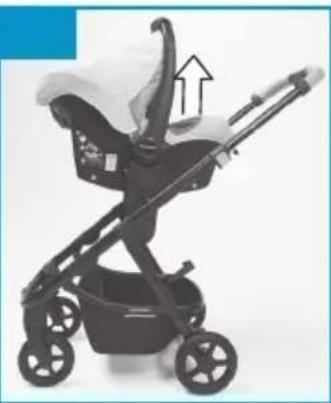
natural_image
Model of a baby stroller with a white seat and black body, no visible text or symbols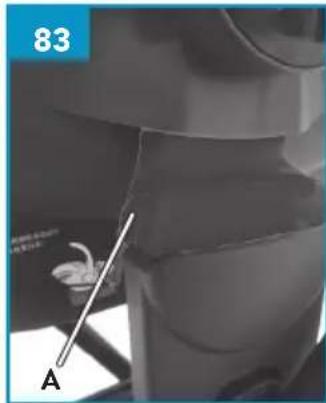
natural_image
Close-up of a mechanical component with a metal rod inserted, labeled 'A' and page number 83 (no readable text or symbols beyond labels)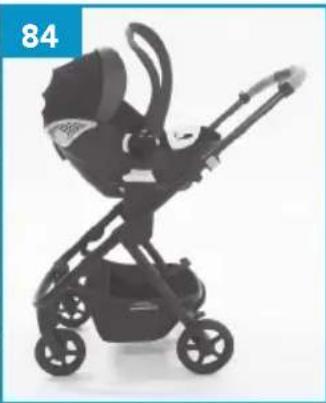
natural_image
Black stroller with twin canopy and wheels, no visible text or symbolsA. Capottina
B. Cinture
text_image
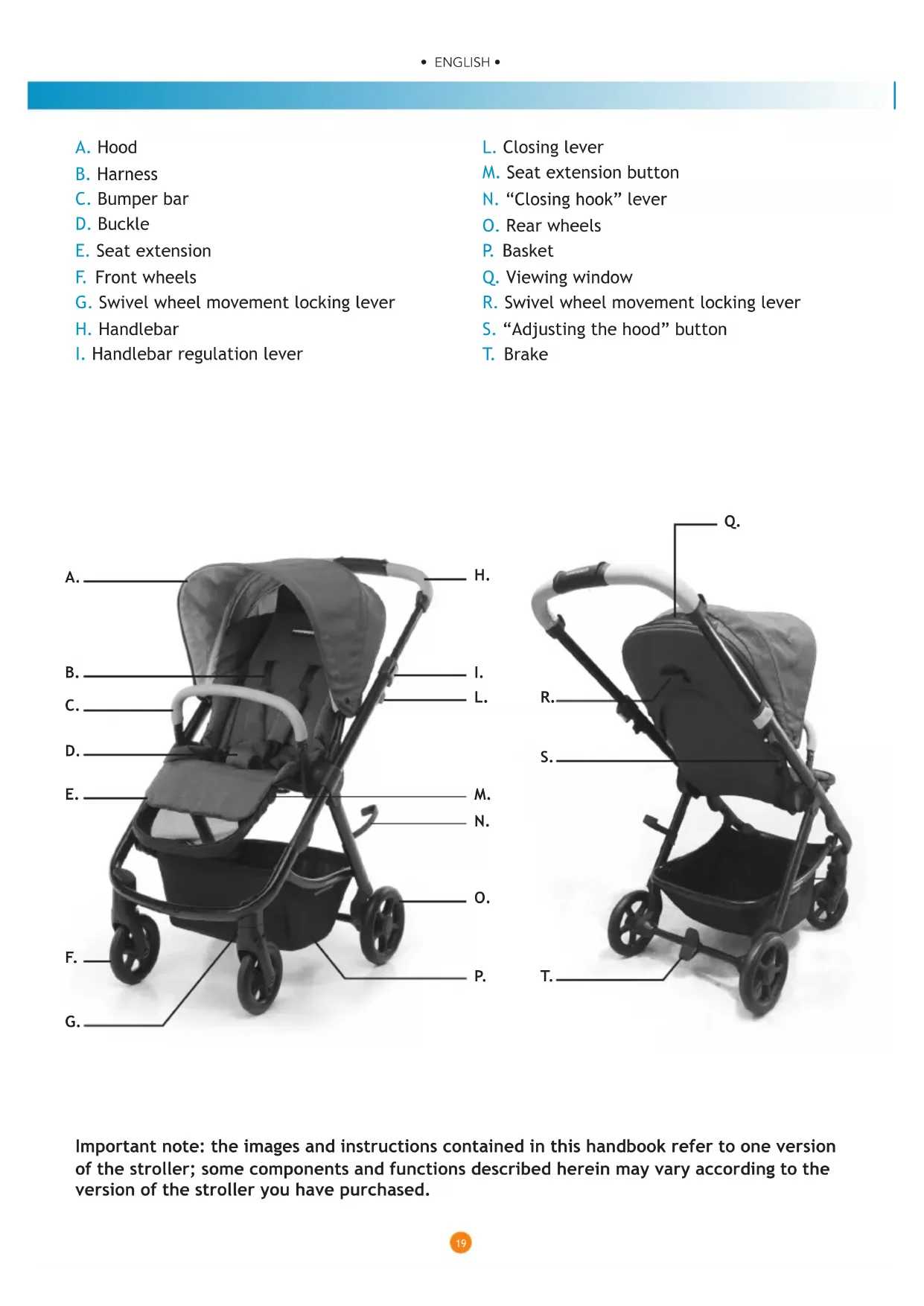
Q. R. S. T.A. Hood
B. Harness
C. Bumper bar
D. Buckle
E. Seat extension
F. Front wheels
G. Swivel wheel movement locking lever
H. Handlebar
I. Handlebar regulation lever
L. Closing lever
M. Seat extension button
N. "Closing hook" lever
0. Rear wheels
P. Basket
Q. Viewing window
R. Swivel wheel movement locking lever
S. "Adjusting the hood" button
T. Brake
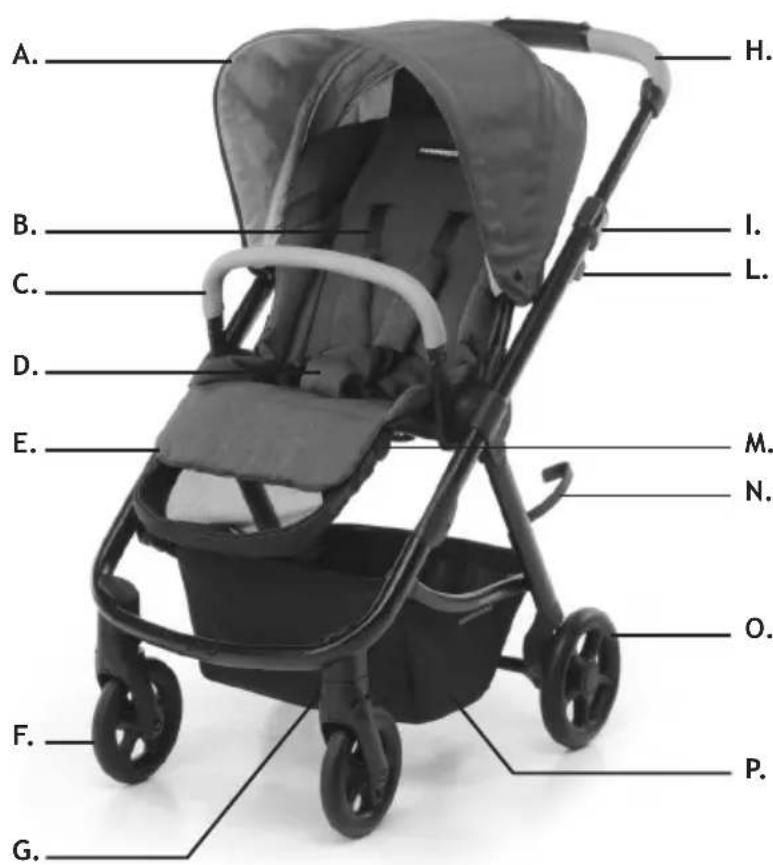
text_image
A. B. C. D. E. F. G. H. I. L. M. N. O. P.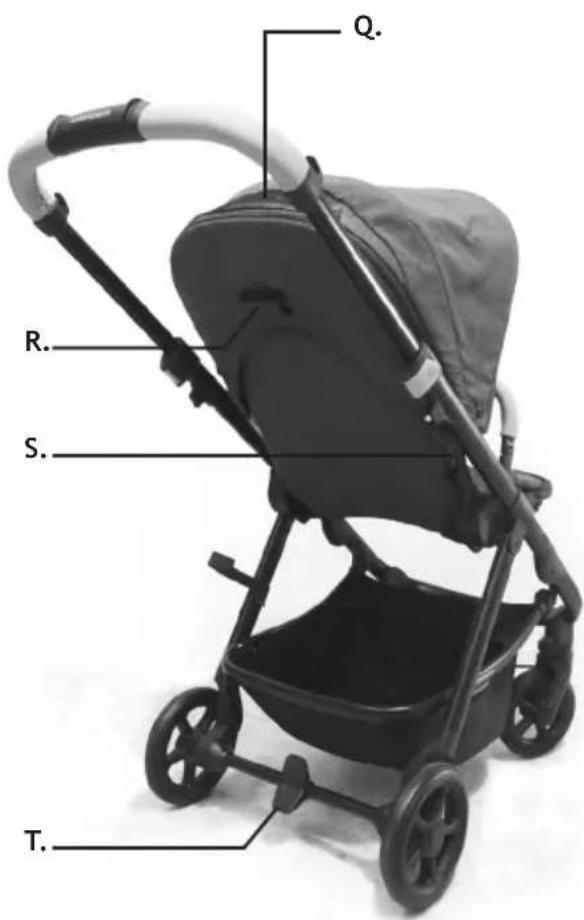
text_image
Q. R. S. T.Important note: the images and instructions contained in this handbook refer to one version of the stroller; some components and functions described herein may vary according to the version of the stroller you have purchased.
UNFOLD THE STROLLER (fig.1, 2, 3)
CAUTION: make sure that the child, and any other children, are at a safe distance away when carrying out this step.
The moving parts of the stroller must not for any reason come into contact with the child's body.
Move the closing lever "a", as shown in the figure (fig.1).
Lift the handlebar until the chassis opens completely. A click will indicate that is has been fastened.
Before using the stroller, make sure it is opened properly and the mechanisms are properly locked (fig.3).
INSTALL FRONT WHEELS
Fitting the front wheels (fig. 4): Insert the end bushing into the slot situated in the center of the wheel block.
A click will indicate that it is inserted correctly.
Check that both the wheels have been fastened correctly, if they are pulled downwards they should not be released.
Move lever “a” outwards to block the swivel movement, and inwards to activate the swivel movement (fig. 5).
Removing the front wheels (fig.5): Press the steel button "b" front wheel released.
INSTALL REAR WHEELS (fig.5 a 13)
Refer to the kit instruction manual "REMOVING THE REAR WHEELS".
FASTENING THE SEAT
The seat can be mounted either in a forward-facing configuration (fig. 46) or facing the parent (fig. 47).
Assembling the seat: Close up the seat against the backrest, as shown in the figure 6.
Check that both seat connectors (right and left side) are oriented in a vertical position and that the symbols “- -” are aligned, this indicates that the connector is correctly oriented (fig. 7).
If the symbols are not aligned, manually rotate the external connector to correctly align the “- -” symbols. If the connector is locked, lift up the backrest recline lever and at the same time rotate the connector to align the symbols.
Line up and insert the plastic connectors of the seat in the slots provided on the pushchair chassis (fig. 8). Press until a click is heard indicating that it has been fastened correctly (fig. 9).
To lower the seat into a horizontal position (fig. 10).
WARNING: Before use, always check that both the seat supports are fastened correctly to the chassis. When the seat is lifted upwards, it must not detach from the chassis.
Removing the seat: adjust the footrest to a horizontal position. Adjust the backrest to a vertical position, operating the recline lever (paragraph “Reclining the seat”) and at the same time close up the seat in contact with the backrest. Lift the seat to remove it from the frame (fig. 11, 12).
Fitting the bumper bar (fig.13): line the bumper bar up with the slots and press on both sides. A click indicates that it has been fastened correctly.
Removing the bumper bar (fig.14): press button A on both sides of the bumper bar and at the same time pull to remove it.
Opening the bumper bar on just one side (fig.15): press button "A" on one side of the bumper bar and pull to open it like a gate.
STORAGE BASKET (fig.from 16 to 24)
Disassembly: open the rear zip and remove the rear fabric flap on the basket by pulling it off one end of the metal trim.
Unhook the elastic loops on the fabric in the front of the basket.
Slide the fabric towards the back, pulling off the top edge with strengthened lining, from the housing along the front trim of the metal ring (fig. 19, 20).
Assembly: Insert the top edge of the basket, with strengthened lining, into its housing along the front metal trim on both sides. Attach the elastic loops (fig. 21, 22). Insert the rear fabric flap, with strengthened lining, into its housing along the rear trim, paying attention when it is mounted that the zip slider attachment side is on the right of the stroller (when observing the stroller in use mode). Hook and close the zipper (fig. 24).
FITTING THE HOOD
Fitting the hood (fig. 25, 26): fasten the hood support to both sides of the chassis.
Fasten the press fasteners of the hood behind the backrest.
Removing the hood (fig.27): pull and release the hood support from both sides of the chassis.
FITTING THE FOOTMUFF (fig.28, 29)
Insert the lower part of the footmuff on the seat of the chassis.
Secure the footmuff to the chassis of the pushchair using the press fasteners (fig. 29).
FITTING THE PUSHCHAIR RAINCOVER (fig.30)
Fit the raincover over the hood.
Fasten the edges at the back of the raincover using the Velcro tabs.
Fasten the front of the raincover to the chassis of the pushchair using the Velcro tabs.
USE
HOW TO OPEN THE PUSHCHAIR (fig.31, 32, 33, 34)
Move the closing lever “a”, as shown in the figure (fig.31a, 31b).
Lift the handlebar until the chassis opens completely. A click will indicate that is has been fastened.
To lower the seat into a horizontal position (fig.34).
WARNING: Before use, pull the seat upwards to check that it has been fastened correctly to the chassis.
Before using the stroller, make sure it is opened properly and the mechanisms are properly locked (fig. 35).
PARKING BRAKE
To apply the brake (fig.36): Press the brake lever, push the pushchair forward gently to ensure the brake has been applied correctly.
To release the brake (fig.37): lift the lever.
TO ADJUST THE HANDLEBAR (fig. 38, 39, 40)
Release the locking lever on both sides and extend the handlebar to the desired position (fig. 38, 39).
Attach the locking lever on both sides to lock the handlebar in the chosen position (fig. 40).
Make sure that the handlebar is properly locked in the new position.
USE
TO REGULATE THE BACKREST (fig. 41)
Lift the regulating lever located behind the backrest and recline the backrest to the required position. Release the lever and make sure the backrest is secured in position.
WARNING (fig.42): For babies under 6 months of age, the backrest must only be in the fully reclined, horizontal position at all times.
SAFETY HARNESS (fig. 43, 44, 45)
Apply the brake before placing your baby in the pushchair.
Release the buckle (fig. 43a/b): press button "A" and remove the components
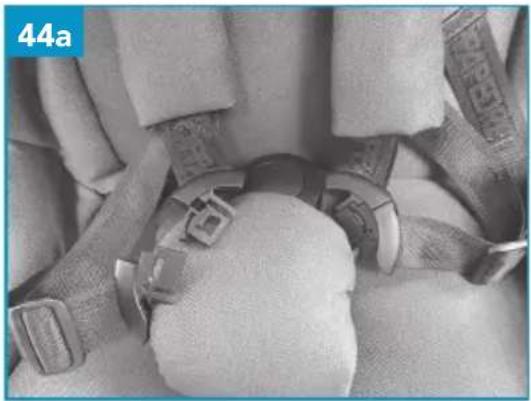
Fasten the buckle (fig. 44a/b/c): by inserting part A in part B, a click will indicate that it has been fastened correctly.
WARNING: If baby is less than 6 months old, the harness belts must first be inserted through the lower slots and then through the rings of the harness regulating buckle (45/b/c).
WARNING: for babies under 6 months of age, the backrest must be only in the fully reclined, horizontal position at all times, seat reaward facing.
WARNING: Never use the crutch strap without the lap belt.
REVERSIBLE SEAT (fig. 46, 47)
Remove the seat by lifting it, see the paragraph "INSTALL THE SEAT".
Position the seat so that it is forward facing or parent-facing.
Replace the seat on the chassis of the pushchair, see the paragraph “fitting the seat” for correct assembly.
ADJUSTING THE FOOTREST (fig.48)
Press buttons "A" and adjust the footrest in the required position.
ADJUSTING THE HOOD (fig.49, 50, 51)
The hood can be adjusted to 3 different heights.
Press the button on the back of the hood (fig. 49), on both sides, and raise or lower the hood to position it at the desired height.
Make sure that the hood is locked in the new position at both sides.
Unfold the hood according to your needs, to protect the child from sunlight.
Note: babies' skin is very delicate. NEVER leave baby under direct sunlight. Always make sure that the hood has been adjusted correctly.
Unfold the canopy as needed to protect your child from the sun.
Ventilation (fig. 51a/b/c): Unhook the press studs and lift up the rear fabric flap.
STROLLER CLOSURE (fig.from 52 to 58)
The seat can be oriented facing forwards or facing the parent.
Seat oriented facing forwards
Before folding the pushchair, make sure that (fig. 52):
- The hood must be set in the lowest position;
- The handle must be adjusted to the least-extended position;
- The backrest is adjusted in the upright position;
• The hood is folded.
Close up the seat against the backrest (fig. 53).
Press button “A”, (fig. 54) on the underneath of the right lever and keeping it pressed down, slide both the left and right levers upwards (fig. 55). Close the stroller (fig. 56, 57, 58).
Check that closing lever "B" is engaged.
Seat oriented facing the parent (fig. from 59 to 67)
Notes: It is NOT possible to close the stroller with the accessories, car seat and carrycot attached to the frame.
USE WITH ACCESSORIES
The EUREKA stroller can be used with the following accessories: the CLASSIC carrycot, the SMART carrycot, the ACTION car seat and the Next i-Size car seat.
Remove the seat from the chassis (see the paragraph "Fitting the seat").
FITTING THE RIGHT AND LEFT ADAPTER (fig.68, 69a/b)
Line up and insert the right and left adapter in the slots provided on the chassis of the pushchair.
Press until a click is heard indicating that the adapter has been secured correctly.
WARNING: Before use, always make sure that both the adapters have been secured correctly to the chassis. When lifted they must not detach from the chassis.
REMOVING THE ADAPTERS (fig.70): press button "A" to remove the adapter.
USING THE INFANT CAR SEAT AND CARRYCOT TRAVEL SYSTEM ACCESSORIES
IMPORTANT: the travel system accessories must be secured to the chassis only in the parent-facing position (fig. 71, 72).
Fitting the accessory (fig.73, 74, 75, 73): Line up the locking mechanism fitted on the accessory with the adapters and press downwards until a click is heard indicating that the accessory has been fastened correctly to the pushchair chassis complete with adapters. Make sure that the accessory has been fastened correctly on both sides.
WARNING: Before use, always make sure that the accessory has been secured correctly. When the accessory is lifted upwards it must not detach from the pushchair chassis.
Disassembly of CLASSIC carrycot accessory (fig. 77, 78): Grasp the carrycot handle and, pressing release button “A” on one connector, slightly lift up the carrycot from the side of the unhooked connector. Press button “A” on the opposite connector and lift up the accessory using the handle.
Disassembly of SMART carrycot accessory (fig. 79, 80): Grasp the carrycot handle and lift up release lever “A” on the rear side. Remove the accessory by lifting it up using the handle.
Disassembly of ACTION car seat accessory (fig. 81, 82): Grasp the car seat handle and, pressing release button “A” on one connector, slightly lift up the car seat from the side of the unhooked connector. Press button “A” on the opposite connector and lift up the accessory using the handle.
PRODUCT MAINTENANCE
Disassembly of NEXT i-Size car seat accessory (fig. 83, 84): Grasp the car seat handle and, pressing release button “A” on one connector, slightly lift up the car seat from the side of the unhooked connector. Press button “A” on the opposite connector and lift up the accessory using the handle.
PRODUCT MAINTENANCE
- This pushchair requires a minimum amount of regular maintenance.
- The lifetime of the pushchair will be increased if the moving parts are lubricated and it will also make the opening and folding operations easier.
- If any of the parts of the pushchair should become stiff or difficult to operate, apply a small quantity of spray lubricant, for example WD 40. Do not use oil or grease. The WD 40 should not be used to lubricate the removable wheels. If necessary, the wheels must be removed and cleaned with a soft, dry cloth.
- Check the locking mechanisms, the brakes, the wheels, the harnesses, the levers, the seat regulators, the joints and the securing devices regularly to make sure that they are fastened correctly and in good operating order.
- The wheels are subject to wear and should be replaced if necessary.
- Carry out a careful inspection to check the pushchair is in good operating condition after 18 months of use, after a long period of storage and before using it for another baby.
- Clean the fabric with water, neutral detergent and a sponge.
- Clean the fabric using warm water, a sponge and a neutral detergent.
- The plastic and metal parts can be cleaned with warm water, a sponge and a neutral detergent.
- Never use abrasive products for cleaning or ammonia based products, bleach or turpentine.
- Brush the fabric rather than wash it.
WARNING
- IMPORTANT - READ CAREFULLY AND KEEP FOR FUTURE REFERENCE.
- WARNING: NEVER LEAVE THE CHILD UNATTENDED.
- WARNING: ENSURE THAT ALL THE LOCKING DEVICES ARE ENGAGED BEFORE USE.
- WARNING: TO AVOID INJURY, ENSURE THAT THE CHILD IS KEPT AWAY WHEN UNFOLDING AND FOLDING THIS PRODUCT.
- WARNING: DO NOT LET THE CHILD PLAY WITH THIS PRODUCT.
- WARNING: ALWAYS USE THE RESTRAINT SYSTEM.
- WARNING: CHECK THAT THE PRAM BODY OR SEAT UNIT OR CAR SEAT ATTACHMENT DEVICES ARE CORRECTLY ENGAGED BEFORE USE.
- WARNING: THIS PRODUCT IS NOT SUITABLE FOR RUNNING OR SKATING.
- WARNING: A CHILDS SAFETY IS YOUR RESPONSIBILITY.
- WARNING! Ensure that all the locking devices are engaged before use.
- WARNING: Always keep child in view when in stroller.
- WARNING: This product is suitable for child from birth up to 22 kg or 4 years, whichever comes first.
- For babies under 6 months of age, only use the pushchair with the backrest fully reclined or fit the travel system accessory using the adapters provided.
- If the pushchair is used with the accessory, make sure it has been fastened correctly.
- WARNING: If the pushchair is used with the travel system accessory, make sure it has been fastened correctly.
- For new born baby, do not recline seat back to sitting position (should be in full reclining position) as the baby doesn't have ability to control its head.
- WARNING: Use seat belt, avoid serious injury from falling or sliding out Always.
- WARNING: Ensure your child wears a correctly fitted and adjusted harness at all times.
- Verify regularly that the safety belts are correctly fastened, not damaged or frayed.
- WARNING: Only one child for one stroller.
- WARNING: This product is not suitable for running or skating.
- WARNING: Check that the seat unit attachment devices are correctly engaged before use.
- WARNING: Do not place or hang parcels, bags or accessories on any part of the stroller including the handle. Failure to comply with this warning may cause, hazardous, unstable conditions to exist.
- WARNING: Always make sure that the brake is engaged when positioning the child into the stroller seat or taking him/her out.
- WARNING: Always use the parking brake, even when standing still for only a few moments.
- WARNING: When parking check if the brake is properly engaged by moving forward/rearward the stroller.
- WARNING: Never fold the stroller, not even partly, when your child is in it.
- A basket is provided for the carriage of 4kg of goods, evenly distributed.
- The product must be assembled by an adult.
- Only the minder can operate the recline adjuster.
- Never use the stroller if any part of it is damaged or any component is missing.
- Do not allow children to play with or hang onto the stroller.
- This vehicle requires regular maintenance by the user.
- Do not use replacement parts or accessories other than those approved by the supplier as they may
WARNING
render the pushchair unsafe.
- Any load applied to the handle and/or the backrest and/or laterally to the product can compromise the stability of the product.
- Do not overload this pushchair with additional children, goods or accessories. Bags and other items must not be hung from the handle.
- Ensure all users are familiar with the products operation. It should always open and fold easy. If it does not, do not force the mechanism - stop and read the instructions.
- Do not use your pushchair in a manner for which it is not designed.
- Do not allow your child to climb unassisted into, play with or hang onto your pushchair.
- Hold on to your pushchair when close to moving road vehicles or trains. Even with the brake on the draught from the vehicle may move the pushchair.
- Exercise caution when mounting or dismounting a kerb.
- Remove your children and fold the pushchair when ascending or descending stairs or escalators.
- Ensure the folded pushchair is stored away from children so that it does not fall and cause injury.
- Do not use replacement parts or accessories, e.g. child seats, bags, hooks, trays, rain covers etc. other than those approved by the supplier, they may render the pushchair unsafe.
- Never carry a second child on your pushchair.
- Do not use any platforms or attachments that allow transportation of the child.
- CARE: Your pushchair has been designed to meet safety standards and with correct use and maintenance will give many years of trouble free performance.
- The chassis is strong but will weaken should the back wheels be bumped down stairs or kerbs. continual impact will cause damage.
- If your child wears hard shoes these might damage the soft fabric.
- Storing a damp pushchair will encourage mildew to form.
- After exposure to damp conditions, dry off with a soft cloth, open fully and allow to dry thoroughly before storing.
- Store your pushchair in a dry, safe place.
- Do not leave the pushchair in sunlight for prolonged periods - some fabrics may fade.
- For car seats used in conjunction with a chassis, this vehicle does not replace a cot or a bed. Should your child need to sleep, then it should be placed in a suitable pram body, cot or bed. The infant car seat is not designed for long periods of sleep.
RAINCOVER
WARNING!
- Use under an adult surveillance.
- When in use make sure the rain cover does not come in contact with the face of the child as it may cause suffocation
- Don't use the raincover on the product without a hood that can hold it.
- Never leave rain covers on indoors, in a hot atmosphere or near a heat source as the baby could overheat.
- Do not use on products other than those recommended by the Manufacturer.
- Hand wash at 30^ .
The contents of this document as stated below will come into effect as from 01.01.2005 and replace, on every account and in full, any previous message referring to the guarantee provided by Foppa Pedretti S.p.A.
FORMAL GUARANTEE
Foppa Pedretti S.p.A. the head office of which is located at n. 11 Via Volta, Grumello del Monte (Italy), guarantees directly to the Consumer that this brand new product is free of faults with regard to the materials, design and manufacture and that it complies with the characteristics as declared by the manufacturer.
This formal guarantee is valid in all Member Countries of the European Union and it neither excludes nor limits the Consumer's rights in accordance with mandatory measures provided for by the law with regard to the Retailer of the Product.
To take advantage of this formal guarantee, the Consumer must return the faulty product to the Retailer, presenting to the same the proof of purchase of the Product which must clearly show the Retailer's address, the date of purchase of the Product with the Retailer's stamp and signature and an indication of the Product itself or, alternatively, the receipt which must not have been altered and which must clearly show the same information as that referred to above. The formal guarantee is valid for twelve (12) months from the date of purchase of the Product. During this period, Foppa Pedretti S.p.A. will repair or replace the faulty product, at its own discretion. The formal guarantee is granted to the end buyer of the Product (Consumer) and it neither excludes nor limits the mandatory rights of the Consumer as provided for by the law and/or the rights that the Consumer may have with regard to the Dealer/Retailer of the Product.
EXCLUSIONS TO THE FORMAL GUARANTEE.
The formal guarantee is excluded in the case of damage caused to the Product for the following reasons: if the product is used in a way that does not comply with the information contained in the use and assembly instruction sheet, if the product is knocked or dropped, if the Product is exposed to humidity or extreme heat or environmental conditions, or to sudden changes in the same, corrosion, oxidization, unauthorized alterations or repairs to the Product, repairs using unauthorised spare parts, improper use, improper maintenance or failure to carry out the same, improper maintenance compared to the information given on the use and assembly instruction sheet, incorrect assembly, accidents, damage caused by food or drink, damage caused by chemical products, cases of force majeure.
In any case, Foppa Pedretti S.p.A. declines all responsibility for damage caused to persons or to property, other than the Product, when such damage is caused by a failure to comply with the instructions/advice/warnings cont a ined in the manua l or, alternatively, in the use and assembly instruction sheet provided with each Product for the owner/user. (Purely as an example, in the case of a cot : “Check your baby constantly. Make sure that the sheets and blankets do not cover the baby’s head...”).
Furthermore, Foppa Pedretti S.p.A. declines all responsibility for damage to persons and to property when the breakage of its products is due to a deterioration in the components of the Product that are subject to wear. All the components of the Product made of plastic are considered to be components subject to wear.
text_image
Q. R. S. T.EXCLUSIONS DE LA GARANTIE CONVENTIONNELLE.
text_image
Q. R. S. T.text_image
Q. R. S. T.text_image
Q. R. S. T.text_image
Q. R. S. T.text_image
Q. R. S. T.Važna napomena: slike i upute sadržane u ovom priručniku odnose se na jednu verziju kolica; neke ovdje opisane komponente i funkcije mogu se razlikovati ovisno o verziji kolica koju ste kupili.
SASTAVLJANJE
RASKLAPANJE KOLICA (SLIKA 1, 2 i 3)
OPREZ: pri provedbi ovog koraka budite sigurni da je Vaše dijete i svako drugo dijete na sigurnoj udaljenosti.
natural_image
Blue baby car with open lid and black buttons (no text or symbols visible)EN CARRY COT - Assembly instructions Suitable for children under 6 months of age
natural_image
A grayscale image of a fabric swan with a curved handle and a black ring, labeled 'click' with an arrow pointing to it (no other text or symbols)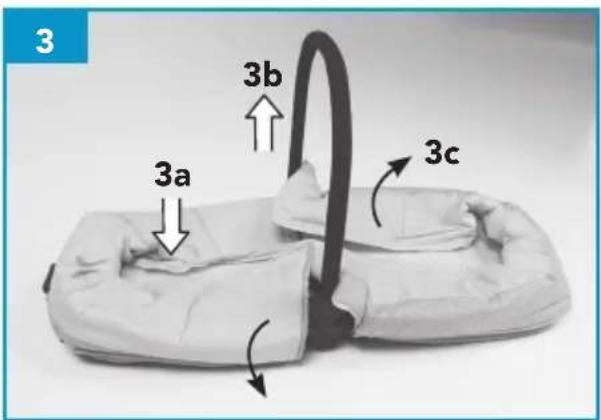
text_image
3 3a 3b 3c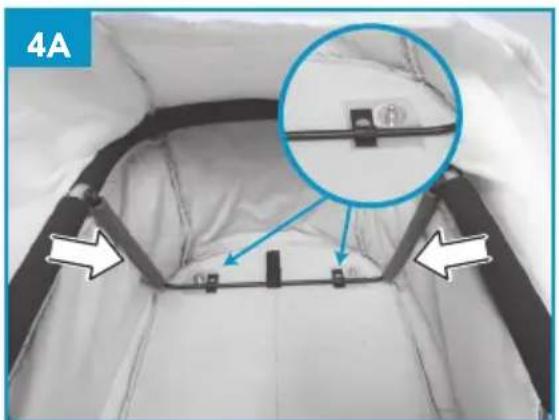
natural_image
Close-up of a medical or laboratory setup with a blue circle highlighting a component, no visible text or symbols
text_image
4B5A click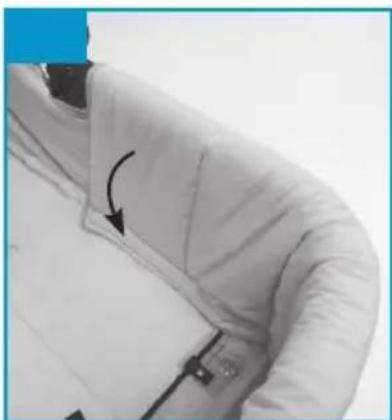
natural_image
Close-up of a garment sleeve with a curved arrow indicating a seam or fold, no visible text or symbols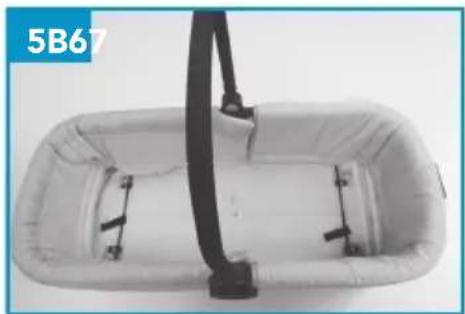
natural_image
Interior view of a rectangular basin with black cables and support brackets (no text or symbols visible)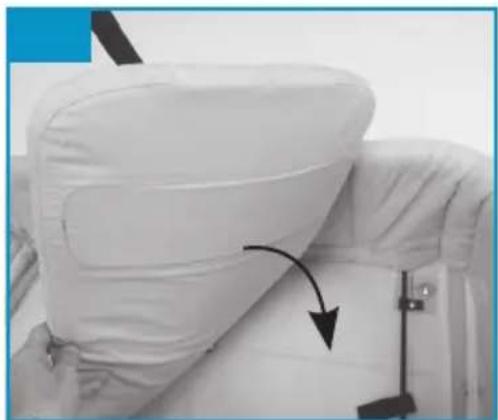
natural_image
Close-up of a white cream cream cream cream cream cream cream cream cream cream cream cream cream cream cream cream cream cream cream cream cream cream cream cream cream cream cream cream cream cream cream cream cream cream cream cream cream cream cream cream cream cream cream cream cream cream cream cream cream cream cream cream cream cream cream cream cream cream cream cream cream cream cream cream cream cream cream cream cream cream cream cream cream cream cream cream cream cream cream cream cream cream cream cream cream cream cream cream cream cream cream cream cream cream cream cream cream cream cream cream, with no visible text or symbols.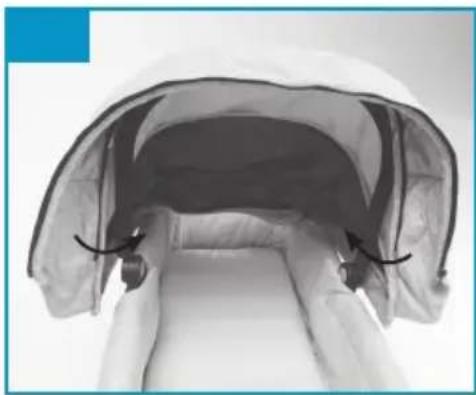
natural_image
Close-up of a white, layered object with a dark central band and two side connectors (no visible text or symbols)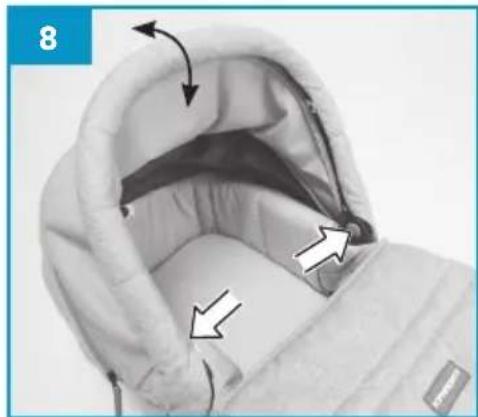
natural_image
Close-up of a person's pocket with arrows indicating movement or pressure points (no text or symbols)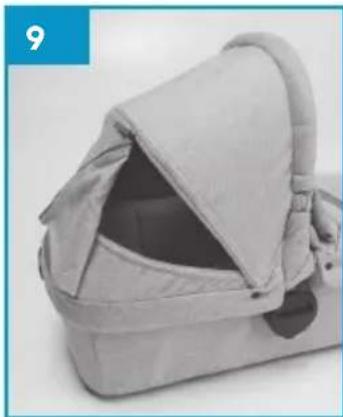
natural_image
Exterior view of a gray backpack with a triangular cover and open lid (no text or symbols visible)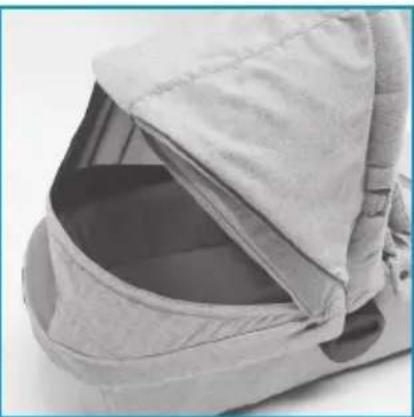
natural_image
Close-up of a beige fabric or cushion with visible folds and a folded top (no text or symbols)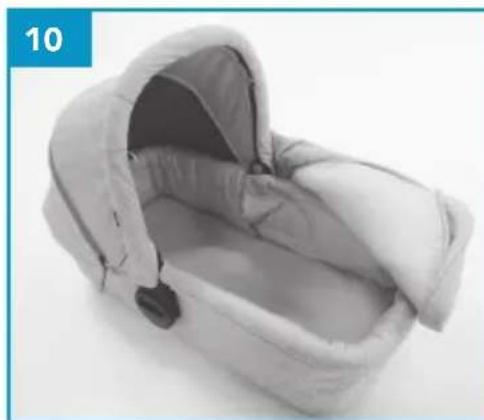
natural_image
Interior view of a gray baby coat with a blue label '10' in the top-left corner (no other text or symbols)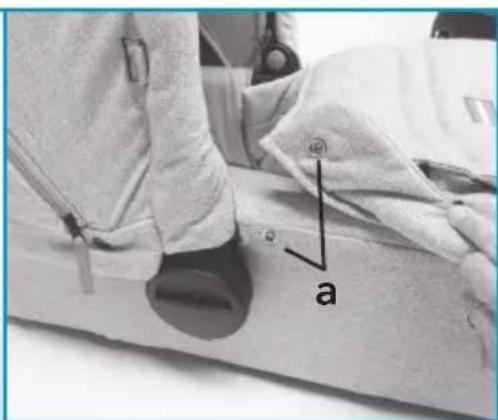
text_image
a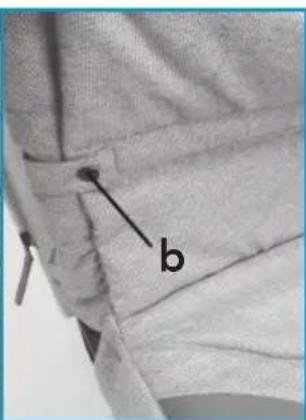
text_image
b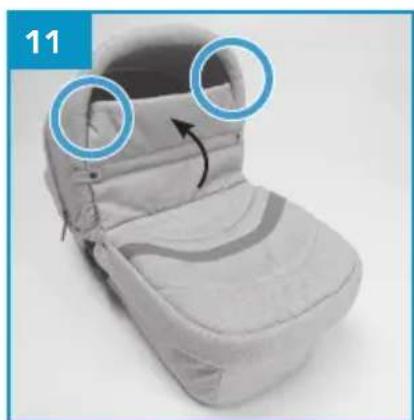
natural_image
Close-up of a gray ergonomic chair with two blue circular annotations highlighting the seat area (no text or symbols on the chair itself)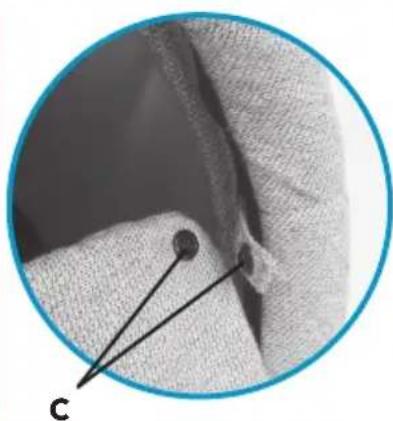
natural_image
Close-up of fabric with a pointed seam and labeled point 'C' (no other text or symbols)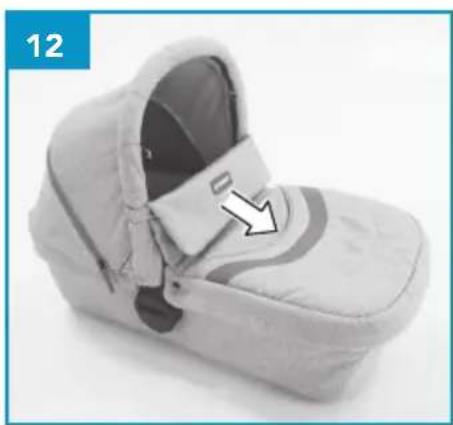
natural_image
Close-up of a white athletic shoe with a zipper and arrow indicator (no text or symbols)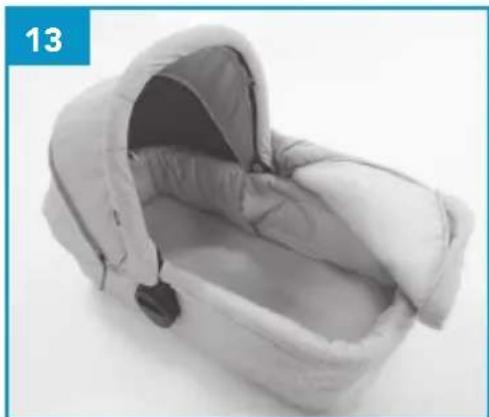
natural_image
Interior view of a baby bottle with a hooded seat and open lid (no text or symbols visible)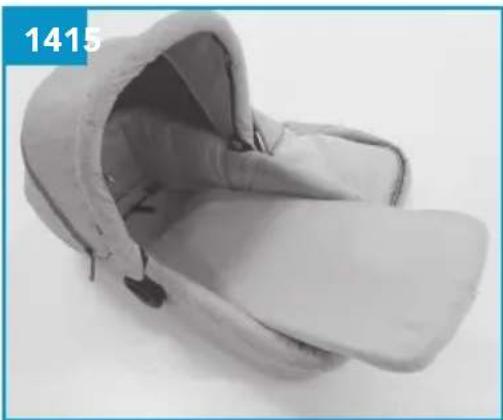
natural_image
Close-up of a plain white leather or cushioned object with a dark opening, no visible text or symbols.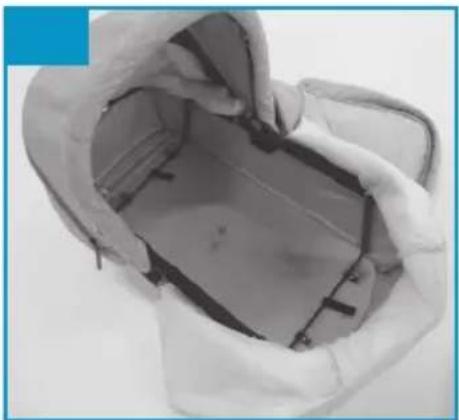
natural_image
Interior view of a white plastic bag with visible internal structure and straps (no text or symbols)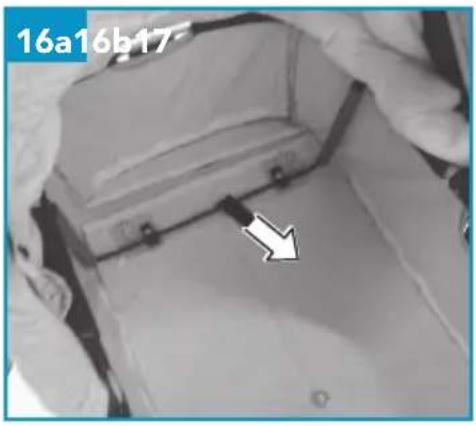
natural_image
Close-up of a small electronic device with a black arrow pointing to a component, no visible text or symbols on the device itself.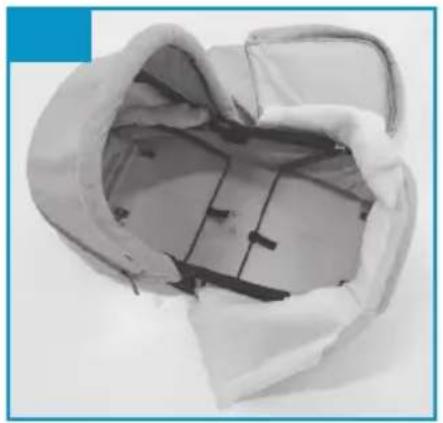
natural_image
Top-down view of a white plastic bag with internal compartments and a small rectangular object inside (no text or symbols visible)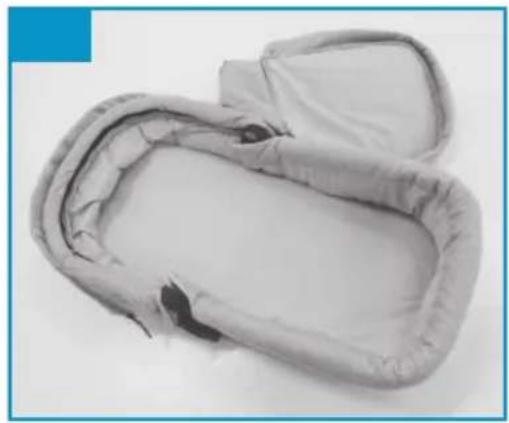
natural_image
Close-up of a pair of white fabric or mesh material with visible seam details and dark spots (no text or symbols)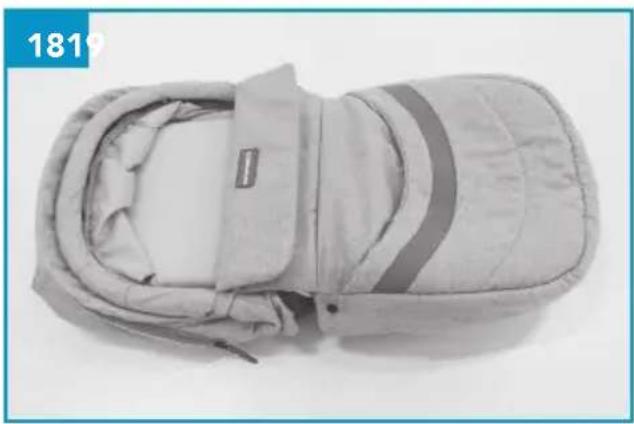
natural_image
Top-down view of a white hard hat with a strap and patterned cover, placed on a plain surface (no text or symbols visible)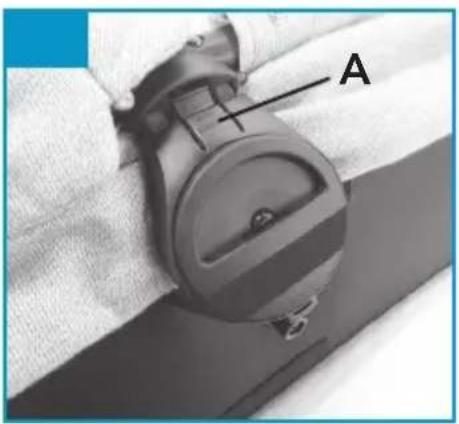
natural_image
Close-up of a mechanical component with labeled section A, resting on fabric (no visible text or symbols)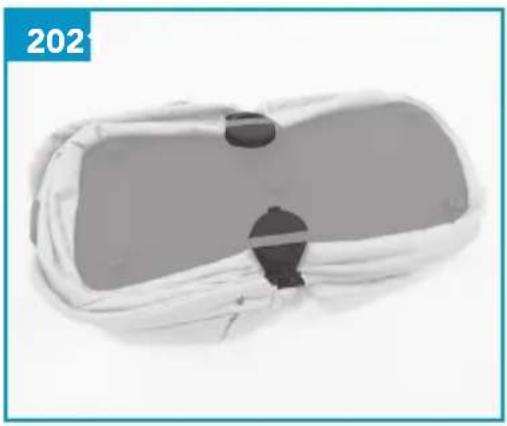
natural_image
Close-up of a white, textured object with a dark circular opening and a small black component, labeled '202' in the top-left corner (no other text or symbols)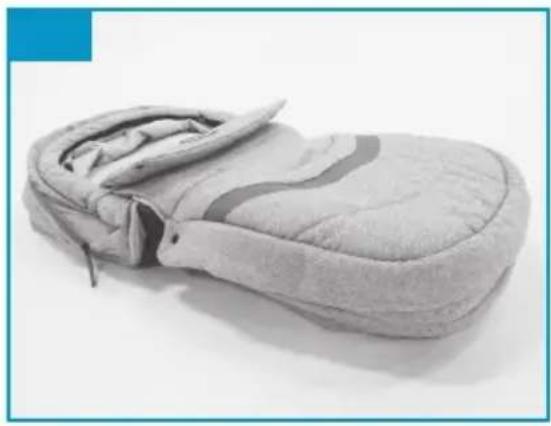
natural_image
Close-up of a gray knitted glove with visible stitching and straps (no text or symbols)AVVERTENZE
Important note: the images and instructions contained in this handbook refer to one version of the carrycot; some components and functions described herein may vary according to the version of the stroller you have purchased.
Read the instructions carefully before use and keep for future reference.
Your baby's safety may be at risk unless these instructions are followed carefully.
- WARNING: THIS PRODUCT IS ONLY SUITABLE FOR A CHILD WHO CANNOT SIT UP UNAIDED.
- WARNING: ONLY USE ON A FIRM, HORIZONTAL LEVEL AND DRY SURFACE.
- WARNING: DO NOT LET OTHER CHILDREN PLAY UNATTENDED NEAR THE CARRYCOT.
- WARNING: DO NOT USE IF ANY PART OF THE CARRY COT IS BROKEN, TORN OR MISSING.
- WARNING: YOU ARE RESPONSIBLE FOR YOUR BABY'S SAFETY.
- WARNING: Never leave child unattended. Always keep baby under supervision when he is in the carrycot.
- WARNING: This product is suitable only for a child who cannot sit up unaided, roll over and cannot push itself up on its hands and knees. Maximum weight of the child: 9Kg.
• WARNING: Suitable for children under 6 months of age. - WARNING: Make sure that all the locking devices have been fastened correctly before use.
- Do not use spare parts or accessories other than those supplied or approved by the manufacturer, as they may make the product unsafe.
• Make sure that everyone using the product is familiar with how it works. - WARNING - It is dangerous to bring the product close to heat sources (gas or electric appliances), which can create fire hazards.
- Before lifting or transporting the carrycot, check that the carrying handle is in a vertical position and correctly attached on both sides.
- Before use, make sure that the crib is correctly assembled, the internal support brackets must be attached to the 4 clips.
- Before use, make sure that the lining is correctly assembled on the frame, and that the internal support brackets are correctly attached to the clips on the bottom of the carrycot.
- To avoid injuries, make sure that the child is at a safe distance away when opening and closing the carrycot.
- The handles and the bottom of the crib must be inspected regularly to check for signs of wear and damage.
- When the child is in the carrycot, their head must never be lower than their body.
- Do not add mattresses other than the one supplied with the carrycot or approved by the manufacturer.
- RISK OF SUFFOCATION: the carrycot could tip over on soft surfaces and suffocate the child. NEVER place the carrycot on beds, sofas or other soft surfaces.
- Check regularly that the crib is intact, do not use if a part is damaged, worn or missing.
- Only use the spare parts approved by the manufacturer.
COMPONENTS
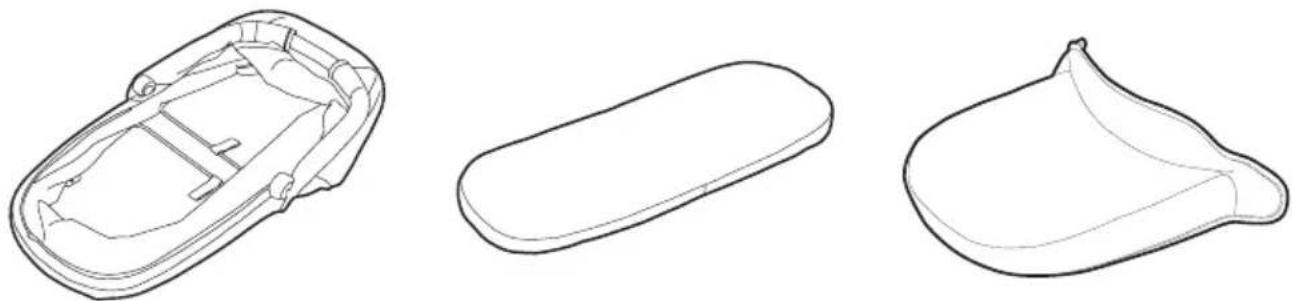
1 x Carrycot frame 1 x Mattress 1 x Footmuff
ASSEMBLING THE FRAME
- Release both connectors from the elastic locking band and rotate them 90^ outwards. A click will indicate that they have opened correctly.
- Lift up the handle, a click will indicate that it is locked in the vertical position. Make sure that it is locked.
- Press the bottom of the carrycot downwards and at the same time pull the handle upwards to raise the sides of the carrycot (fig. 3a/b). Unhook the Velcro and lift up the fabric along the side on the inside (fig. 3c).
- Pull the frame support brackets towards the outside of the carrycot, using the straps, until they lock into the 4 clips. Make sure that the brackets are locked into the 4 clips.
- Fold the fabric on the side towards the inside of the carrycot, attach the Velcro in the lower part along the inner edge. Make sure that the fabric is properly secured with Velcro and that there are no openings along the side.
- Place the mattress inside the carrycot.
ASSEMBLING THE HOOD
Place the hood on the handle, wrap the front fabric of the hood around the handle, attach and close the zip. Attach the press studs (fig. 7).
ADJUSTING THE HANDLE/HOOD
Press the side buttons and adjust the handle to the new position, release the buttons and make sure that it is locked (fig. 8).
Ventilation: Open the zip on the back of the hood and lift up one flap or both flaps to increase the ventilation inside the carrycot (fig. 9).
COVER
Fix the cover along the sides with the press studs (a), attach the flaps with the press studs to the hood (b), (fig. 10).
Lift up the front fabric flap of the cover for added protection (c), attach the press studs (fig. 11).
The cover has a storage pocket (fig. 12).
CLOSING THE CARRYCOT
- Remove the cover.
- Take out the inner mattress.
- Unhook the Velcro and lift up the fabric along the side on the inside.
- Grasp the belt and, pulling towards the inside of the carrycot, release the support bracket from the clips and close it towards the inside of the carrycot. Repeat this process also on the second support bracket.
- Place the handle in a horizontal position. Press on the upper ring to close the carrycot. Insert the mattress inside the carrycot.
- Place the cover on the frame and attach the press studs at the sides.
- Press the plastic release button "A" and at the same time fold the hinge inwards.
- Lock the folded hinge with the elastic band on the bottom. Repeat this process also with the second hinge.
MAINTENANCE AND CLEANING
Check the carrycot regularly and make sure that there are no damaged or worn parts.
Replace the carrycot if there are damaged parts.
Lining
• The fabric parts can be washed following the instructions on the washing label.
- Clean the fabric with water, a mild soap and a sponge.
• Never use abrasive or ammonia, bleach or white spirit-based cleaning products.
- Clean the fabric with a brush rather than washing it.
- Do not store the product if it is still wet and do not leave it in humid environments since mildew may form.
• Store the product in a dry place.
- Protect the product against weather agents, water, rain or snow; moreover, continuous and prolonged exposure to sunlight can cause changes in the colour of many materials.
- It is recommended to wash the lining separately from other items.
- Follow the lining washing instructions on the labels.
• Dry the textile lining completely before using or storing it.
• To prevent formation of mildew, it is advisable to air the carrycot periodically.
Removing the fabric:
- Release the support brackets from the clips.
- Unhook the Velcro and lift up the fabric along the side on the inside.
- Detach the press studs along the top edge and remove the metal frame from the fabric.
- To remove the rigid bottom from the fabric, unscrew the screws with a tool and remove the support feet.
- Remove the panel from the fabric.
Replacing the fabric:
- If removed, insert the panel into the pocket on the fabric bottom and secure the 5 feet by tightening the screws. Make sure that the panel is inserted correctly. The side with the clips further away from the short side is the head side.
- Place the metal ring inside the fabric.
- Attach the press studs to the frame and fold the fabric, wrapping up the metal ring, from the outside to the inside.
- Fold the fabric along the inner side and attach the Velcro on the bottom.
- Place the mattress inside the carrycot (fig. 17).
The contents of this document as stated below will come into effect as from 01.01.2005 and replace, on every account and in full, any previous message referring to the guarantee provided by Foppa Pedretti S.p.A.
FORMAL GUARANTEE
Foppa Pedretti S.p.A. the head office of which is located at n. 11 Via Volta, Grumello del Monte (Italy), guarantees directly to the Consumer that this brand new product is free of faults with regard to the materials, design and manufacture and that it complies with the characteristics as declared by the manufacturer.
This formal guarantee is valid in all Member Countries of the European Union and it neither excludes nor limits the Consumer's rights in accordance with mandatory measures provided for by the law with regard to the Retailer of the Product.
To take advantage of this formal guarantee, the Consumer must return the faulty product to the Retailer, presenting to the same the proof of purchase of the Product which must clearly show the Retailer's address, the date of purchase of the Product with the Retailer's stamp and signature and an indication of the Product itself or, alternatively, the receipt which must not have been altered and which must clearly show the same information as that referred to above. The formal guarantee is valid for twelve (12) months from the date of purchase of the Product. During this period, Foppa Pedretti S.p.A. will repair or replace the faulty product, at its own discretion. The formal guarantee is granted to the end buyer of the Product (Consumer) and it neither excludes nor limits the mandatory rights of the Consumer as provided for by the law and/or the rights that the Consumer may have with regard to the Dealer/Retailer of the Product.
EXCLUSIONS TO THE FORMAL GUARANTEE.
The formal guarantee is excluded in the case of damage caused to the Product for the following reasons: if the product is used in a way that does not comply with the information contained in the use and assembly instruction sheet, if the product is knocked or dropped, if the Product is exposed to humidity or extreme heat or environmental conditions, or to sudden changes in the same, corrosion, oxidization, unauthorized alterations or repairs to the Product, repairs using unauthorised spare parts, improper use, improper maintenance or failure to carry out the same, improper maintenance compared to the information given on the use and assembly instruction sheet, incorrect assembly, accidents, damage caused by food or drink, damage caused by chemical products, cases of force majeure.
In any case, Foppa Pedretti S.p.A. declines all responsibility for damage caused to persons or to property, other than the Product, when such damage is caused by a failure to comply with the instructions/advice/warnings cont a ined in the manua l or, alternatively, in the use and assembly instruction sheet provided with each Product for the owner/user. (Purely as an example, in the case of a cot : “Check your baby constantly. Make sure that the sheets and blankets do not cover the baby’s head...”).
Furthermore, Foppa Pedretti S.p.A. declines all responsibility for damage to persons and to property when the breakage of its products is due to a deterioration in the components of the Product that are subject to wear. All the components of the Product made of plastic are considered to be components subject to wear.
AVERTISSEMENT
EXCLUSIONS DE LA GARANTIE CONVENTIONNELLE.
natural_image
Product photo of a baby car seat with blue and black casing, no visible text or symbolsIT SEGGIOLINO AUTO - Istruzioni di montaggio
Per bambini fino a 13 kg - Conforme alla Norma ECE R129-00
EN CAR SEAT - Assembly instructions
For children up to 13 kg - Complies with ECE R129-00
FR SIEGE AUTO - Notice d'utilisation
Pour les enfants jusqu'à 13 kg - Conforme à la Norme ECE R129-00
DE AUTOSITZ - Montageanweisungen
Für Kinder bis 13 kg - Entspricht der Norm ECE R129-00
ES ASIENTO DE COCHE - Manual de instrucciones
Para los niños de hasta 13 kg - Conforme a la Norma ECE R129-00
EL ΠΑΙΔΙΚΟ ΚΑΘΙΣΜΑ ΑΥΤΟΚΙΝΗΤΟΥ - Εγχειρίδιο χρήσης
Για τα και παιδιά έως 13 kg - Σύμφωνο με τον κανονισμό ECE R129-00
RU АВТОКРЕСЛО - Инструкция по установке
Для детей до 13 кг - Соответствует стандарту ECE R129-00
IT. IMPORTANTE!
LEGGERE ATTENTAMENTE E
CONSERVARE PER FUTURE REFERENZE
EN. IMPORTANT!
READ THE INSTRUCTIONS CAREFULLY AND KEEP FOR FUTURE REFERENCE
FR. IMPORTANT!
LIRE ATTENTIVEMENT ET CONSERVER SOIGNEUSEMENT A PORTEE DE MAIN POUR UNE UTILISATION ULTERIEURE
DE. WICHTIG!
natural_image
Line drawing of a medical device with a blue cap and red arrow indicating a finger placement (no text or symbols)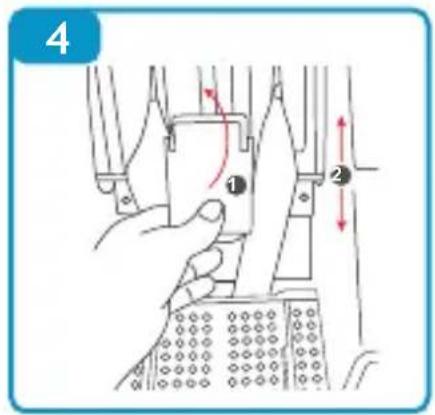
text_image
4 ① ②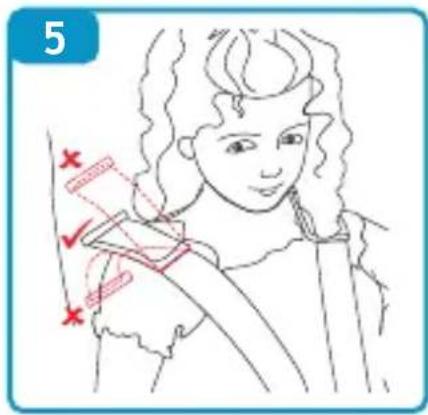
text_image
5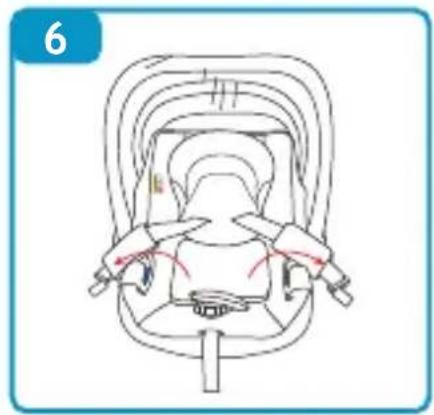
natural_image
Line drawing of a car seat with visible seats and seatbelt (no text or symbols)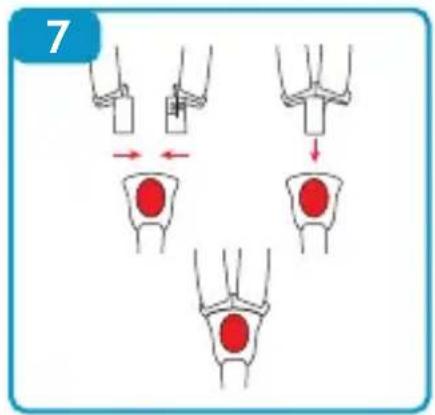
text_image
7
natural_image
Illustration of a baby in a baby car seat with a hand holding a tool, no text or symbols present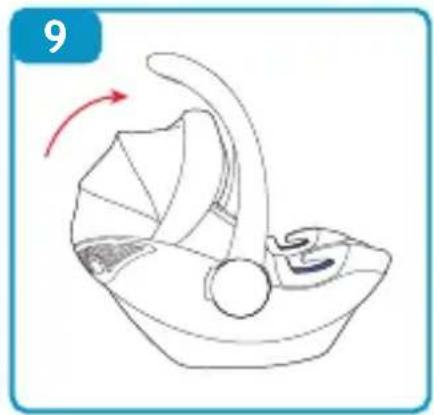
natural_image
Line drawing of a stylized object resembling a boat or container with a curved handle and a circular base, no text or symbols present.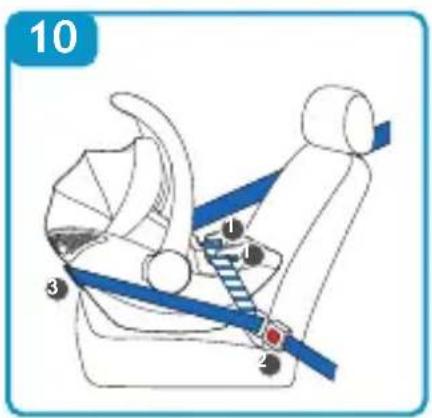
text_image
10 ① ② ③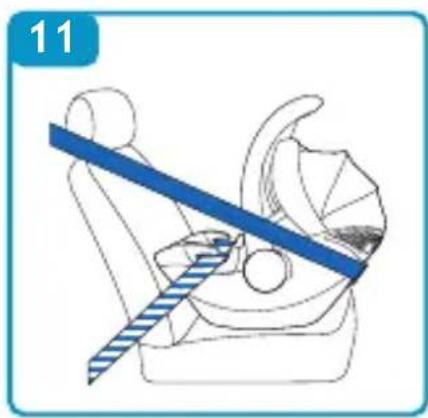
natural_image
Illustration of a car seatbelt with a blue diagonal stripe (no text or symbols)
natural_image
Line drawing of a car seat with blue belt and number 12 label (no text or symbols on the diagram itself)text_image
Diagram of a car seat with numbered labels pointing to different compartments or parts.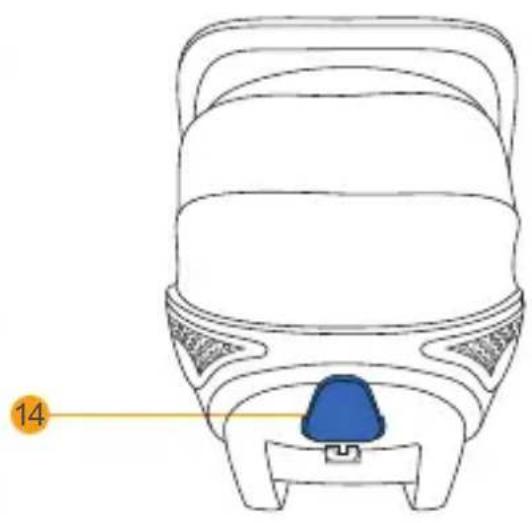
natural_image
Line drawing of a stylized object with a blue central component, no text or symbols presentnatural_image
Line drawing of a stylized object resembling a hat or umbrella with a curved handle and a small sphere (no text or symbols)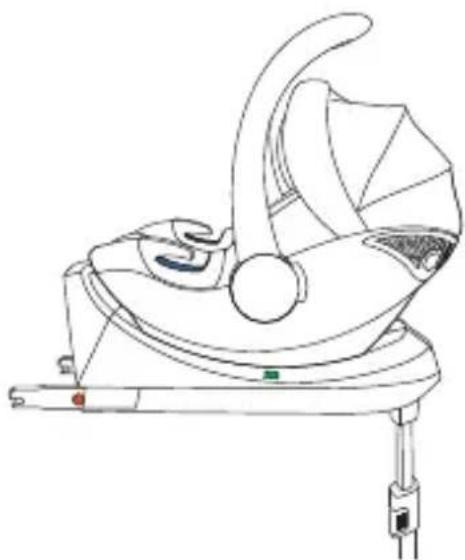
natural_image
Line drawing of a medical or laboratory device with no visible text, numbers, or symbolsnatural_image
Simple icon of a person sitting in a chair, enclosed in a rounded square frame (no text or symbols)natural_image
Diagram of a mechanical component with orange and yellow parts, enclosed in a circular frame (no text or symbols)natural_image
Top-down line drawing of a car seat with hands positioned at the front wheel (no text or symbols)text_image
base NEXT i-SizePULIZIA
natural_image
Illustration of a hand using a belt buckle to adjust the seat (no text or symbols present)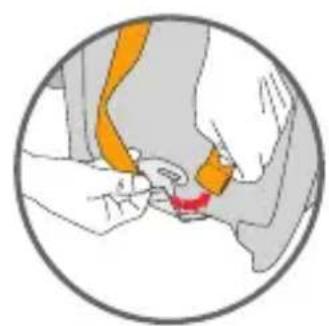
natural_image
Medical illustration showing a surgical procedure on pelvic anatomy (no text or labels)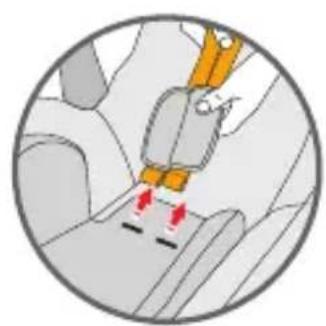
natural_image
Illustration of a robotic arm cutting down a car's seat with red arrows indicating motion (no text or symbols)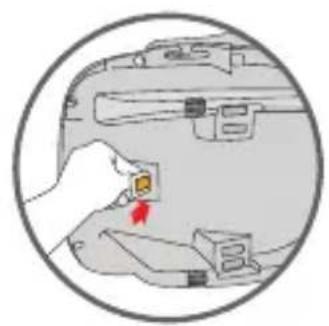
natural_image
Illustration of a hand inserting a small electronic component into a device (no text or symbols visible)Come rimuovere l'imbracatura
Car seat components PAG 23
USE - WARNING PAG 24
Checks before use PAG 29
- Installation in the vehicle PAG 30
1.1 With 3-point belt PAG 31
- USE PAG 32
2.1 Using the reducer PAG 32
2.2 Adjusting the handle PAG 33
2.3 Loosening the straps PAG 33
2.4 Adjusting the headrest PAG 33
2.5 Using the harness PAG 33
2.6 Tightening the harness PAG 34
2.7 Checking that the fastening is correct PAG 34
2.8. Canopy PAG 34
- INSTALLING THE CAR SEAT IN THE VEHICLE PAG 35
Car seat maintenance and care PAG 37
FORMAL GUARANTEE PAG 38
CAR SEAT COMPONENTS
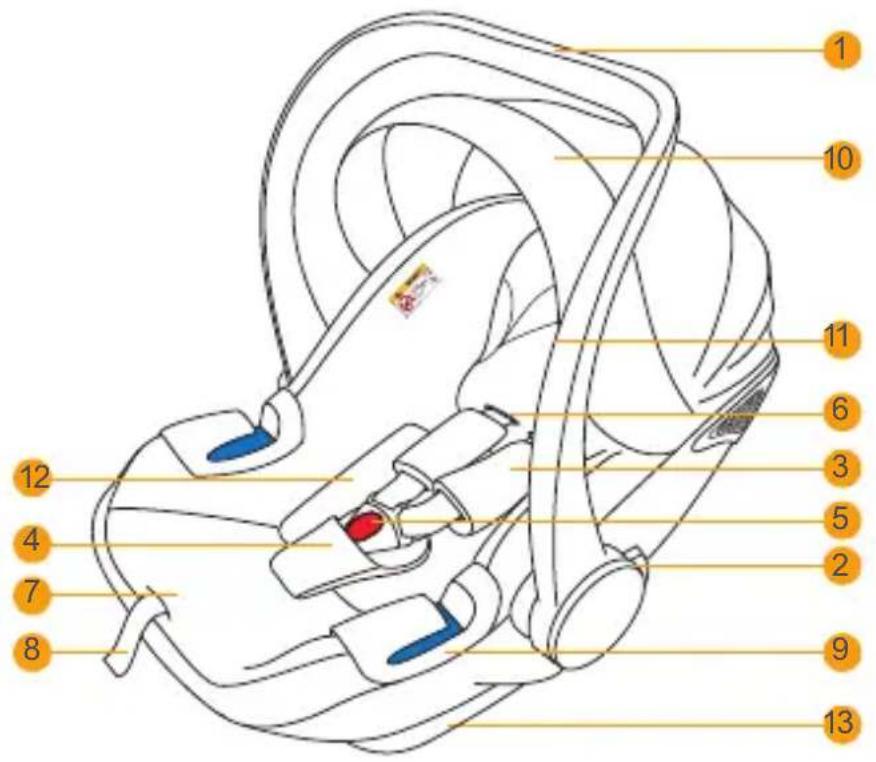
text_image
Diagram of a car seat with numbered labels pointing to different compartments or parts.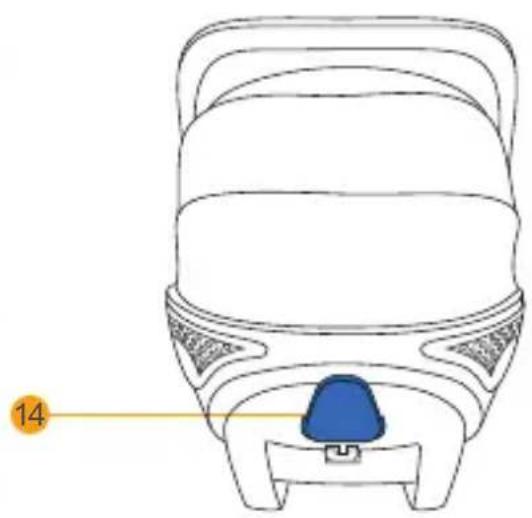
natural_image
Line drawing of a stylized object resembling a helmet or device with a blue knob at the base (no text or symbols)- Handle
- Handle release
- Shoulder pads
- Buckle crotch pad
- Buckle
- Harness
- Adjuster button
- Adjuster strap
-
Lap belt guide
-
Canopy
- Had support
- Infant pad
- Shell
- Shoulder belt guide
USE - WARNING
CATEGORIES OF USE
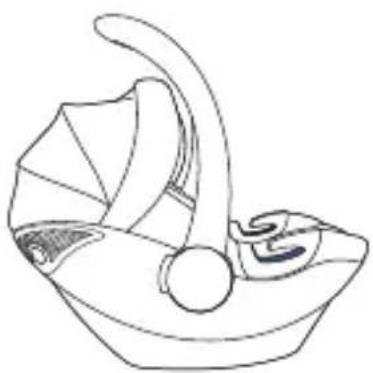
natural_image
Line drawing of a stylized object resembling a hat or umbrella with a curved handle and circular base (no text or symbols)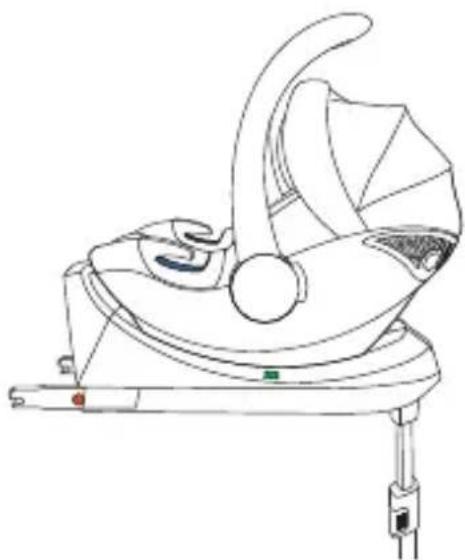
natural_image
Line drawing of a medical or laboratory device with no visible text, numbers, or symbols| Next i-Size CAR SEAT Next i- | i-Size CAR SEAT with I-Size base |
| The Next i-Size car seat is fixed in the car with the 3-point seat belt. | The Next i-Size car seat is attached to the Next i-Size base and fixed to the passenger seat with the ISOFIX connectors.Consult the Next i-Size base instruction manu correct installation in the car. |
Warning
-
This is an "i-Size" child restraint device approved in accordance with regulation no. 129 to be used on the passenger seats of "i-Size-compatible" vehicles, as indicated by vehicle manufacturers in the vehicle user manual.
-
If in doubt, contact the manufacturer of the child restraint device, or the retailer.
natural_image
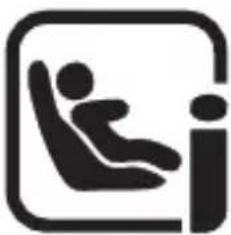
Icon depicting a person sitting in a car seat, enclosed in a rounded square frame (no text or symbols)IMPORTANT: the Next i-Size car seat, together with the i-Size Base, is an i-Size restraint system approved according to the ECE R129 Regulation, for children between 40 and 80~cm in height with a maximum weight of 13kg .
IMPORTANT
Please read all instructions in this manual and in the vehicle owner related to child safety seats carefully and understand them. Install and use the child safety seat as described in the instruction manual. Failure to do this could result in serious injury or death of your child. These operating instructions must be kept in the specific compartment in the car seat during the period of use for future reference.
IMPORTANTE
- Because of potential medical issues inherent in low birth weight and premature infants, always have a trained professional doctor, or hospital staff member assess the suitability of the child restraint prior to leaving the hospital or using the child restraint.
- WARNING! Install the NEXT i-Size car seat in the REAR-FACING POSITION ONLY.
- The Next i-Size car seat can be installed on the NEXT i-Size base in i-9 compatible passenger seats, as indicated by the manufacturer in the vehicle manual.
- If the vehicle used does not have an i-Size-compatible passenger seat, the installation is approved on ISOFIX passenger seats in the vehicles indicated in the attached Vehicle List, also available on the website www.foppapedretti.it.
- The NEXT i-Size car seat alone can also be installed with the 3-point static or retractor seat belt alone, approved according to regulation UN/ ECE other equivalent standards.
- Before proceeding with the purchase, check that the car seat is compatible with your car. If in doubt, consult the manufacturer of the car seat or the dealer.
WARNINGS
- Use the child safety seat only on the vehicle seats that face forward. According to accident statistics, children are safer when properly restrained in the rear seating positions than in the front seating positions.
• After an accident, the car seat may no longer meet the safety requirements because of the damage sustained, even if this is not immediately visible. It is therefore recommended that you replace it. Only the manufacturer can ensure that it complies with the safety requirements, provided it is an original product.
• Make sure that luggage or other objects inside the vehicle are reduce the risk of injury in the event of an accident. - The rigid and plastic components on the child restraint must be positioned and secured so as not to get trapped between the passenger seats or in a car door during daily use of the product.
- DO NOT remove any labels on the child safety seat. Important information is contained on the labels.
• DO NOT use a child safety seat with damaged or missing parts.
• DO NOT use damaged or frayed harness straps or vehicle belt.
• DO NOT modify or attempt to modify the child safety seat in any way. - DO NOT take apart or attempt to take apart this child safety seat except as instructed in this manual.
- DO NOT use a child safety seat that has been in a crash. A crash can cause damage to the child safety seat that you cannot see.
DO NOT replace the child seat cover or harness with any other than the ones we recommend as these parts are integral to the child safety seat's performance. - DO NOT use a second-hand child seat or child seat whose history you do not know.
MAKE sure that the child safety seat does not become trapped by folding or moveable passenger seat or in the door of your car.
• DO NOT USE in any configuration not shown in the instructions.
• NEVER use this child safety seat with 2 point vehicle belts.
• DO NOT use belt routing methods not shown in these instructions.
• DO NOT allow children to play with or adjust the child safety seat.
• Always check the tightness of the restraint and the harness before each use.
WARNINGS
- DO NOT use this child safety seat in a passenger seat with an active airbag unless the vehicle manufacturer confirms that it is safe.
- This child restraint should be securely belted in the vehicle even when not in use. In a crash or sudden stop, an unsecured child safety seat may injure other occupants.
• Make sure to properly secure any loose objects, such as luggage or books, in your car as they may cause injuries in the event of an accident.
• NEVER leave your child unattended in a car even for a short time.
• NEVER take your child out of the child safety seat when the vehicle is moving.
• NEVER use this child safety seat without the car seat cover. - HOT! Cover the child safety seat when left in direct sunlight. Parts of a child safety seat may become too hot for the child's skin. Always check su before placing a child in the child seat.
- DO NOT use any load bearing contact points other than those described in the instructions and marked in the child restraint.
- The rigid items and plastic parts of a child restraint must be so located and installed that they are not liable, during everyday use of the vehicle to become trapped by a movable seat or in a door of the vehicle.
- We recommended that any straps holding the restraint to the vehicle should be tight, that any straps restraining the child should be adjusted to the child's body, and that straps should not be twisted.
- IMPORTANT! Please ensure that any lap strap is worn low down, so that the pelvis is firmly engaged.
- NEVER use this child restraint with any other base except ones manufacturer permits.
- ALWAYS make sure all vehicle belts and harness straps are not twisted before each use.
- NEVER leave the child in the child seat when the harness straps are loose or undone.
• DO NOT leave your child in this child restraint for an extended period of time.
• ALWAYS install the child safety seat in a rear-facing position.
• NEVER install the child safety seat forward-facing.
• DO NOT use alternative routings not shown in these instructions.
• MAKE SURE all folding passenger seats are property latched.
WARNINGS
- ALL occupants of the vehicle should be correctly restrained. Unres passengers may be thrown into other passengers and cause serious injury or death in a crash.
- ALWAYS MAKE SURE the handle is properly locked in the upright carry position before carrying a child in the child seat.
- NEVER place the car seat or infant carrier near the edge of an elevated surface or on a soft such as a seat cushion or mattress. The car seat or infant carrier could fall off these surfaces and cause serious injury or death.
• NEVER use the child safety seat with a shopping cart.
Inspect:
• child restraint free of damage
Verify Child within Size Range:
• weight between 0-13kg
Install Child Restraint Rearward-facing in Safe Location in Vehicle:
• vehicle seats that face front of vehicle only
• handle locked in specified position
• child facing rear of vehicle
• position with NO active airbag
• 3 point (shoulder/lap) belt used
- seat belt not twisted
- belt path followed
• tight against vehicle seat
Secure Child Properly in Child Restraint:
• correct shoulder strap height
- harness not twisted
- harness low across hips
- harness secure and tight
INSTALLATION IN THE VEHICLE
1. USE IN THE CAR
text_image
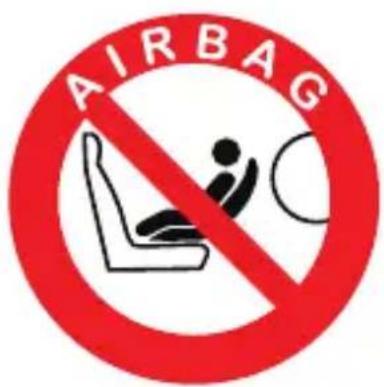
AIRBAGDO NOT USE THE CAR SEAT PLACED ON A PASSENGER SEAT FITTED WITH AN AIRBAG.
Danger! If the airbag explodes it may hit the cause serious injury to the child, if not death.
Follow the instructions in the vehicle owner's manual for the use of child seats.
NEVER use a 2-point seat belt to fix the child's car seat to the passenger seat. Use only 3-point seat belts.
Comply with the regulations in force in your own country.
NEVER use a 2-point seat belt to fix this child's car seat to the passenger seat.
Only suitable for use in vehicles equipped with 3-point static or retractor belts, approved according to regulation UN/ECE 16 or other equivalent standards.
Never use this car seat on a front passenger seat fitted with an active front airbag.
EHICLE
1.1 With 3-point car seat belt
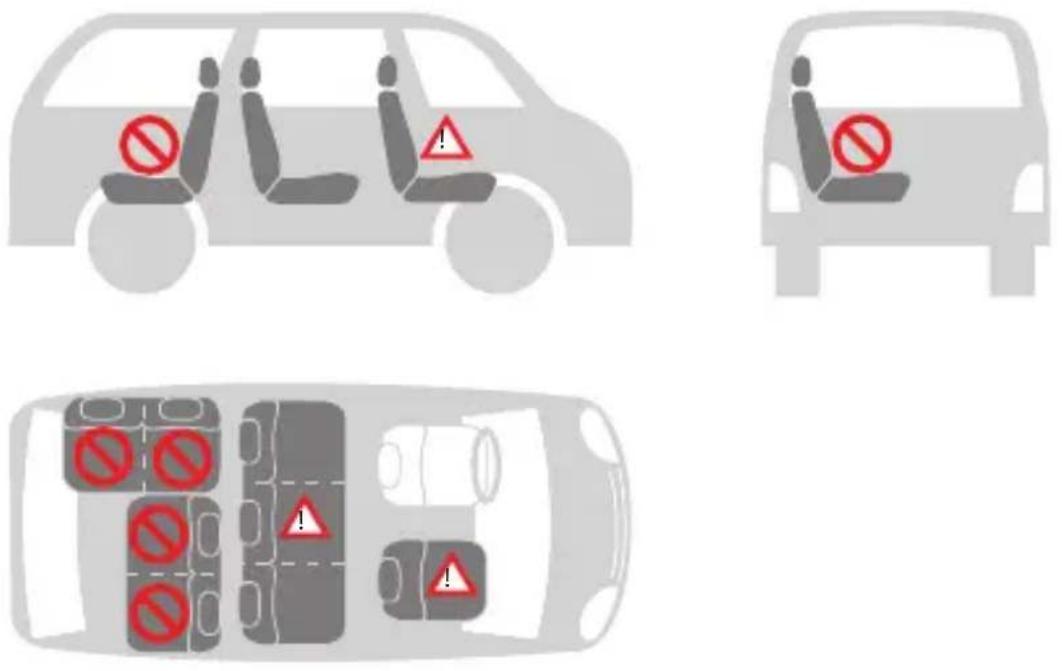
You can install the car seat as follows:
| in the direction of travel no | |
| in the opposite direction to the direction of travel | yes |
| with a 2-point belt | no 1) |
| with a 3-point belt | yes 2) |
| on the front passenger seat | yes 3) |
| on the side rear seat | yes |
| on the central rear seat | no 4) |
1) The use of a 2-point belt increases the risk of injury to the child in the
event of an accident.
2) The seat belt must be approved to ECE R 16 or to other equivalent standards.
3) Do not use on a front passenger seat fitted with an active front airbag.
4) It may be used if the central seat of the vehicle is equipped with a 3-point belt.
USING THE CAR SEAT
2. CHILD PROTECTION
2.1 Protecting the child by using the reducer

To protect your child
natural_image
Top-down line drawing of a car seat with two arms and a seatbelt, no text or symbols presentThe reducer gives your child greater support during the first months.
The reducer is used to ensure greater comfort to your children.
• Always secure the child with the belt when placed in the car seat
- Never leave the child unattended in the child seat when placed on high-up surfaces (such as tables, etc.).
• Make sure that the end of the belt does not get caught in moving parts (such as automatic doors, escalators, etc.).
- Warning! The plastic parts of the car seat can heat up in the sun, causing burns to the child. Protect the car seat from excessive heat, for example, by using a light covering.
- The car seat has only one installation position in the car, leaving always semi-reclined.
Take regular breaks when travelling on long journeys. Your child can get tired very easily. Avoid leaving the child in the car seat for too long.
USING THE CAR SEAT
2.2 Adjust the handle (fig. 1)
(A) For use in the car and for transport
(B) For placing the child in the seat
(C) For use as a bouncer with rocking movement locked.
To adjust, squeeze handle release buttons on both sides, then rotate the handle, The handle will lock into position.
WARNING:
Always make sure the handle is securely locked in the upright carrying position before carrying.
You should hear a click when the handle button is engaged and handle is locked into the upright carrying position.
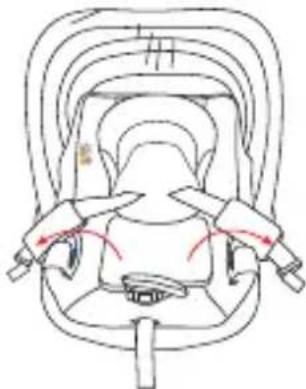
2.3 Loosening the straps (fig 2)
Press the adjuster button on the front center of the seat, and pull on both shoulder straps to loosen the harness.
2.4 Adjusting the headrest (fig.3)
A properly-adjusted headrest ensures the optimal position for the child sitting in the car seat.
The headrest should be positioned so that the straps are at the same level or slightly above the child's shoulders.
To adjust the headrest and straps:
Open the instruction holder compartment (fig. 3) by pressing the lever on the backrest under the diagonal belt guide loop.
Pull the harness adjustment lever upwards (1) and at the same tim adjuster (fig. 4) upwards or downwards until the chest straps are at the correct height (fig. 5).
Release the adjustment lever to lock the adjuster in the new position.
Make sure that the chest straps are properly locked and in the correct position.
2.5 Securing the child with the harness (fig. 6)
Loosen the straps.
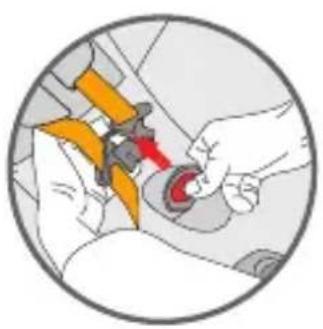
Press the red button on the buckle to release the shoulder straps and move them to the side.
USING THE CAR SEAT
Place child's bottom on the seat and the child's back flat against the child restraint. This will increase the child's comfort and allow the harness to properly secure the child. Slide shoulder straps over the child's shoulders.
Make sure that the straps are at the same height and positioned just above the child's shoulders.
Join together the two ends/ tabs of the straps to form a single connector.
Insert the connector into the central buckle until you hear a click.
Make sure that the straps are not twisted. Adjust the chest protect centre of the child's shoulders.
2.6 tightening the harness (fig. 8)
Pull the harness adjustment strap so as to tighten it properly against the body of the child. The harness is correctly tightened when the gap between the harness and the child is no greater than the thickness of your finger.
IMPORTANT! Pull the end of the adjuster strap outwards, not upwa downwards. During transport (especially when not in the car), the adjuster strap must be placed in the belt compartment.

Ensuring that your child is properly secured with the harness
2.7 To ensure the safety of your child, check that.....
- The straps are adjusted correctly at the height of the child's shoulders.
• The straps are not twisted.
• The tabs are properly engaged in the harness buckle. - The straps are properly tightened, as the gap between the harness and the child must not be greater than the thickness of your finger.
2.8 positioning the sun canopy (fig 9)
The sun canopy is easily adjustable.
It enables your child to rest peacefully and gives protection from the sun's rays.
To open: pull the plastic edge of the hood.
To close: push the edge back to the initial position.
To secure the car seat in the vehicle with the 3-point seat belt, proceed as follows:
Pass the horizontal seat belt (the lap belt) of the car through both belt guides (1) and fasten the buckle (2).
Pass the diagonal seat belt (the chest belt) of the car around the backrest of the car seat, passing through the diagonal belt guide (3).
If the vehicle's seat belt is too short, adjust its height to the lowest position.
If it is still too short, try another passenger seat.
WARNING:
- DO NOT route the vehicle belt using any other path when using the child seat. For assistant contact our Customer Service team.
• DO NOT use 2 point vehicle belt to install this child seat.
• ONLY install the child restraint rear-facing on forward-facing vehicle seats. - Make sure the child is properly secured in the child restraint, and the child restraint is tightly installed in the vehicle.

Check that the car seat has been installed correctly in the vehicle
To ensure the safety of your child, check that ...
- the car seat is installed so that the child is facing in the opposite direction to the direction of travel,
- the car seat is installed on the front passenger seat only if there is no AIRBAG or if this has been disabled,
• the car seat is secured with a 3-point seat belt only,
• the lap belt part passes through both the blue guides placed on the car seat, - the diagonal part of the belt passes round the back through the blue support guide and the car seat, the vehicle seat belt is tight enough and not twisted or rolled up.
INSTALLING THE CAR SEAT
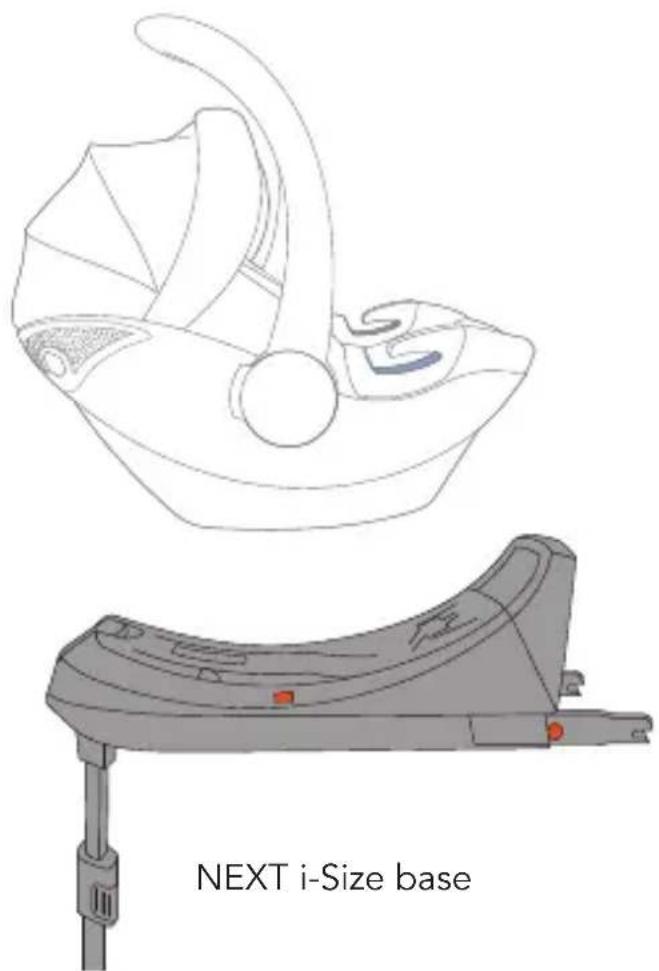
Optional Next i-Size base, sold separately.
text_image
NEXT i-Size baseMAINTENANCE
CLEANING
The upholstery and seat belts can be cleaned using a clean cloth, warm water and soap.
The plastic parts can be cleaned with mild soap and warm water.
Do not use harsh detergents such as solvents.
The car seat must not be used without the lining.
natural_image
Illustration of hands adjusting a car seatbelt with a red belt (no text or symbols)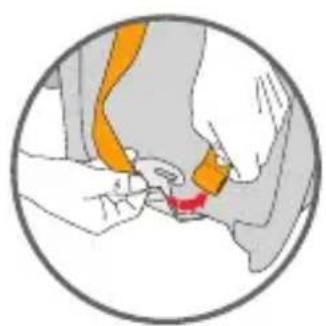
natural_image
Medical illustration showing a surgical procedure on pelvic anatomy (no text or labels)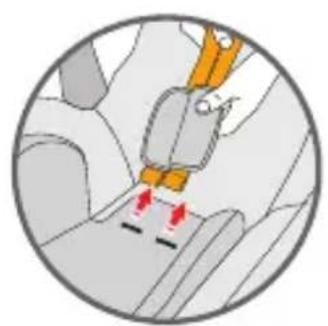
natural_image
Diagram of a mechanical or electrical component with red arrows indicating force or movement (no text or symbols present)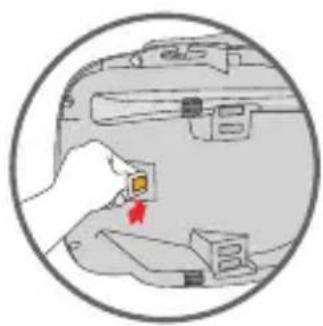
natural_image
Illustration of a hand inserting a small electronic component into a device (no text or symbols visible)How to remove the harness
• Unclip the harness buckle (press the red button).
- Unclip the shoulder straps from the belt-tightening device, located on the rear of the backrest.
• Pull both belts through the shell and the lining and remove the chest protectors.
- Locate the metal ring attached to the belt under the child restraint. Rotate the metal ring and remove it through the shell and the padding.
FORMAL GUARANTEE
The contents of this document as stated below will come into effect as from 01.01.2005 and replace, on every account and in full, any previous message referring to the guarantee provided by Foppa Pedretti S.p.A.
FORMAL GUARANTEE
Foppa Pedretti S.p.A. the head office of which is located at n. 11 Via Volta, Grumello del Monte (Italy), guarantees directly to Consumer that this brand new product is free of faults with regard to the materials, design and manufacture and that it complies with the characteristics as declared by the manufacturer.
EXCLUSIONS TO THE FORMAL GUARANTEE.
The formal guarantee is excluded in the case of damage caused to the Product for the following reasons: if the product is used in a way that does not comply with the information contained in the use and assembly instruction sheet, if the product is knocked or dropped, if the Product is exposed to humidity or extreme heat or environmental conditions, or to sudden changes in the same, corrosion, oxidization unauthorized alterations or repairs to the Product, repairs using unauthorised spare parts, improper use, improper maintenance or failure to carry out the same, improper
This formal guarantee is valid in all Member maintenance compared to the information Countries of the European Union and it given on the use and assembly instructic neither excludes nor limits the Consumer'sheet, incorrect assembly, accidents, damage rights in accordance with mandatory measures caused by food or drink, damage caused by provided for by the law with regard to chemical products, cases of force majeure. Retailer of the Product.
To take advantage of this formal guarantee, the Consumer must return the faulty product to the Retailer, presenting to the same proof of purchase of the Product which must clearly show the Retailer's address, the cost of purchase of the Product with the Retailer's stamp and signature and an indication of the Product itself or, alternatively, the receipt which must not have been altered and which must clearly show the same information that referred to above.
are any case, Foppa Pedretti S.p.A. declines all responsibility for damage caused to persons the to property, other than the Product, when such damage is caused by a failure to comply with the instructions/advice/warnings cont a ined in the manua l or, alternatively, in the use and assembly instruction sheet provided with each Product for the owner/user. (Purely as an example, in the case of a cot: "Check your baby constantly. Make sure that the sheets and blankets do not cover the baby's
The manufacturer's formal guarantee is validead...").
for twelve (12) months from the date of
purchase of the Product. During this period, Foppa Pedretti S.p.A. will repair or replace the faulty product, at its own discretion.
The formal guarantee is granted to the buyer of the Product (Consumer) and it neither excludes nor limits the mandatory rights of the Consumer as provided for by the law and/or the rights that the Consumer may have regard to the Dealer/Retailer of the Product.
Furthermore, Foppa Pedretti S.p.A. declines all responsibility for damage to persons and to property when the breakage of itsd products is due to a deterioration in the components of the Product that are subject to wear. All the components of the Product made of plastic are considered to be with components subject to wear.
text_image
Diagram of a car seat with numbered labels pointing to different compartments or parts.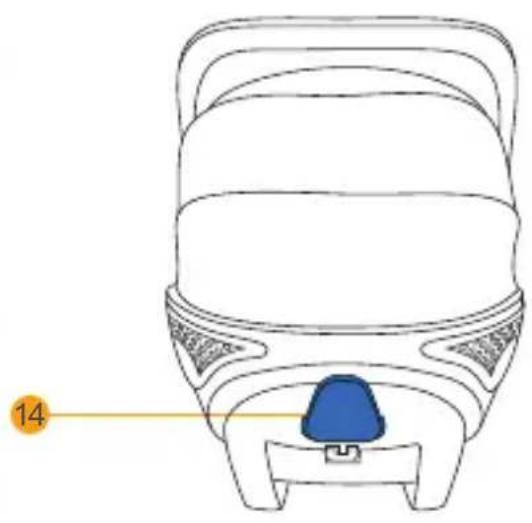
natural_image
Line drawing of a stylized object with a blue central component, no text or symbols presentnatural_image
Line drawing of a stylized object resembling a hat or umbrella with a curved handle and a small sphere (no text or symbols)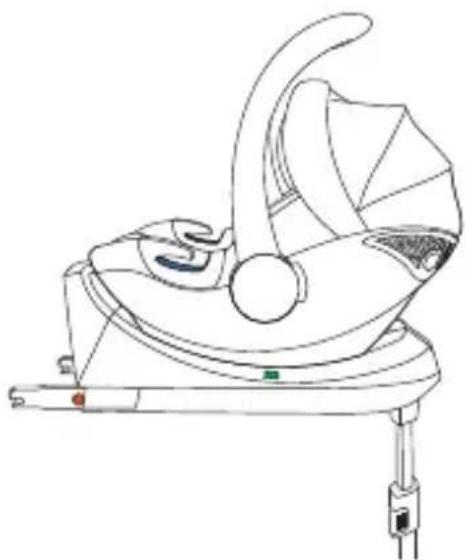
natural_image
Line drawing of a medical or laboratory device with no visible text, numbers, or symbolsnatural_image
Simple icon of a person sitting in a car seat, enclosed in a rounded square (no text or symbols)natural_image
Diagram of a mechanical component with orange and yellow parts, enclosed in a circular frame (no text or symbols)natural_image
Top-down line drawing of a car seat with two hands operating the wheel (no text or symbols)text_image
Base NEXT i-SizeENTRETIEN
NETTOYAGE
EXCLUSIONS DE LA GARANTIE CONVENTIONNELLE.
text_image
Diagram of a car seat with numbered labels pointing to different compartments or parts.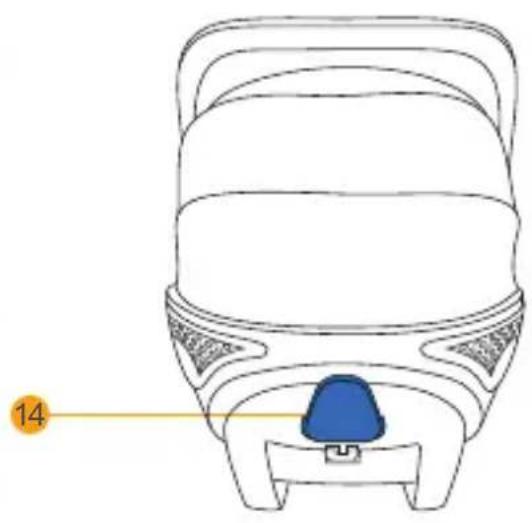
natural_image
Line drawing of a device with a blue component and numbered label (14), no text or symbols present.natural_image
Line drawing of a stylized object resembling a hat or umbrella with a curved handle and circular base (no text or symbols)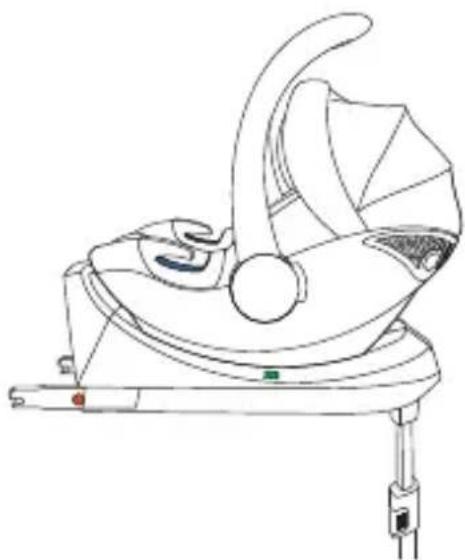
natural_image
Line drawing of a medical or laboratory device with no visible text, numbers, or symbolsnatural_image
Simple icon of a person sitting in a chair inside a square frame (no text or symbols)natural_image
Diagram of a mechanical component with orange and yellow parts, enclosed in a circular frame (no text or symbols)natural_image
Top-down line drawing of a person seated in a car seat, showing seatbelt and seatbelt (no text or symbols)natural_image
Close-up of a car seatbelt being adjusted for a red angle (no text or symbols visible)
natural_image
Illustration of a medical procedure showing hand placement and color-coded zones (no text or symbols)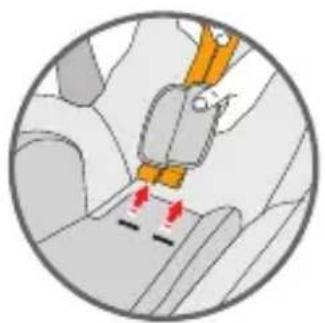
natural_image
Diagram of a mechanical assembly with orange tool and red arrows indicating motion or force (no text or symbols)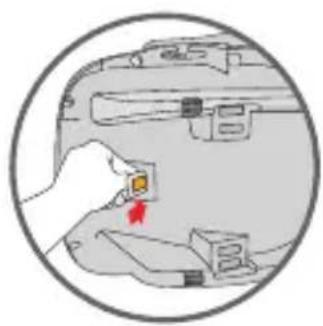
natural_image
Illustration of a hand inserting a small electronic component into a device (no text or symbols visible)text_image
Diagram of a car seat with numbered labels pointing to different compartments or parts.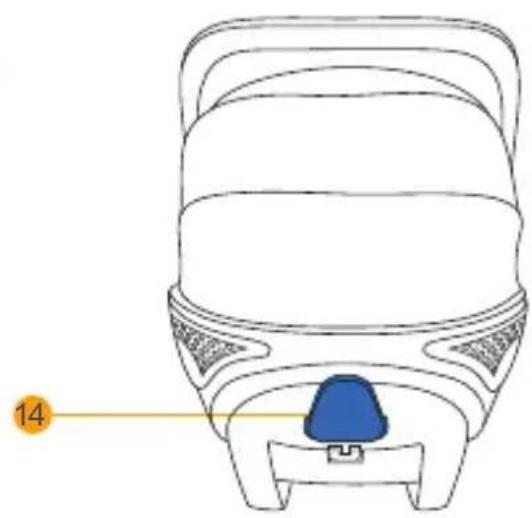
natural_image
Line drawing of a device with a blue component at the base, labeled with number 14 (no text or symbols on the diagram itself)natural_image
Line drawing of a stylized object resembling a hat or umbrella with a curved handle and circular base (no text or symbols)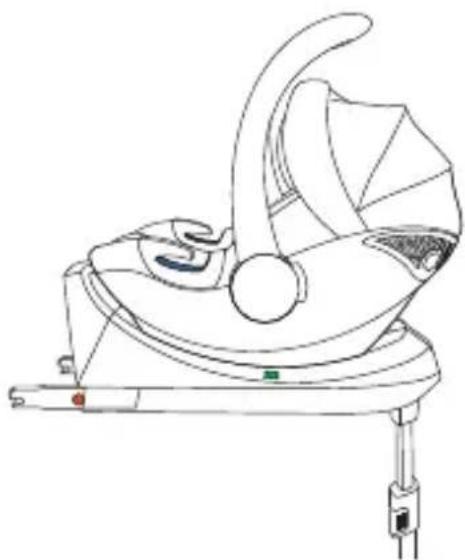
natural_image
Line drawing of a medical or laboratory device with a curved handle and attached tubing (no text or symbols)natural_image
Simple icon of a person sitting in a chair, enclosed in a rounded square frame (no text or symbols)natural_image
Diagram of a mechanical component with orange and yellow parts, enclosed in a circular frame (no text or symbols)natural_image
Top-down line drawing of a car's seat and driver seat (no text or symbols)text_image
base NEXT i-SizeMANTENIMIENTO
LIMPIEZA
natural_image
Illustration of a hand using a yellow belt switch to adjust a car seatbelt (no text or symbols present)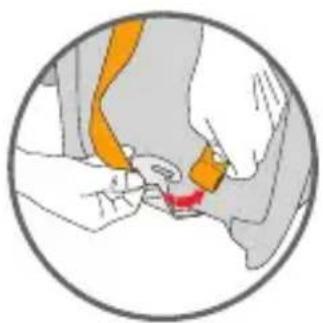
natural_image
Illustration of a medical procedure with hands performing a procedure (no text or symbols visible)
natural_image
Circular diagram showing a mechanical or electrical component with red arrows indicating motion or force direction (no text or symbols)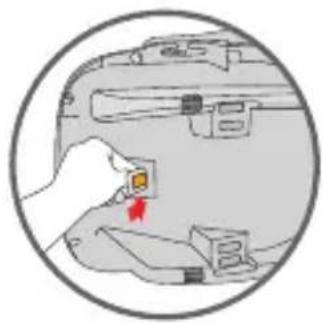
natural_image
Illustration of a hand inserting a small electronic component into a device (no text or symbols visible)text_image
Diagram of a car seat with numbered labels pointing to different compartments or parts.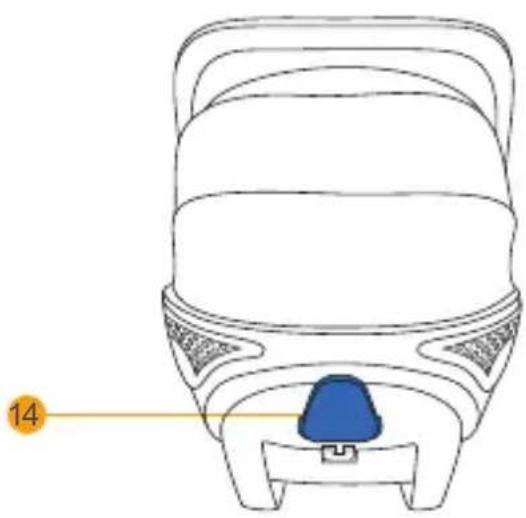
natural_image
Line drawing of a stylized object resembling a container or device with a blue handle and orange label (no text or symbols)natural_image
Line drawing of a stylized lamp or decorative object with a curved handle and circular base (no text or symbols)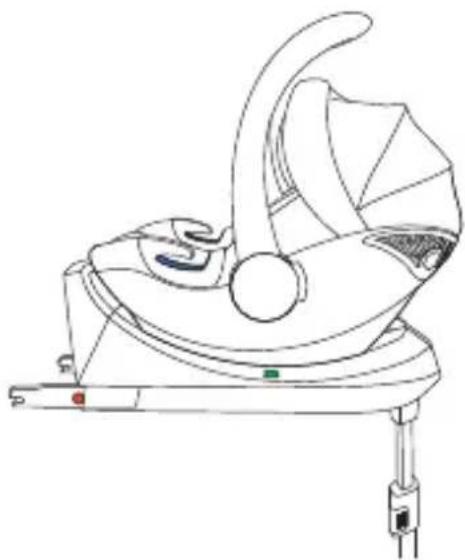
natural_image
Line drawing of a medical device with a curved handle and attached tubing (no text or symbols)natural_image
Icon of a person sitting in a chair inside a rectangular frame (no text or symbols)natural_image
Simple line drawing of a boat hull with orange hull and red hull, no text or symbols presentnatural_image
Top-down line drawing of a car seat with visible seats and side brackets (no text or symbols)text_image
Báon NEXT i-SizeΚΑΘΑΡΙΣΜΌΣ
natural_image
Close-up of hands using a belt switch to adjust a car seat (no text or symbols visible)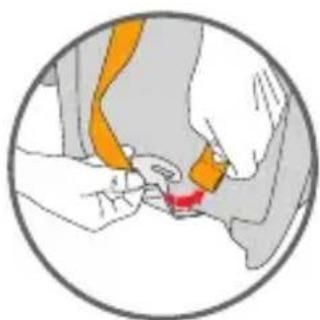
natural_image
Illustration of hands performing a medical procedure on a car seat (no text or symbols visible)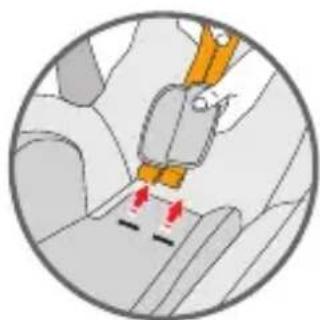
natural_image
Illustration of a mechanical device inserted into a car seat, showing red arrows indicating force or movement (no text or symbols present)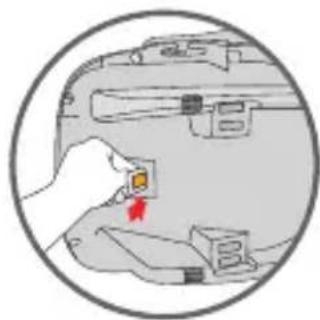
natural_image
Illustration of a hand holding a small electronic component, enclosed in a circular frame (no text or symbols)text_image
Diagram of a car seat with numbered labels pointing to different compartments or parts.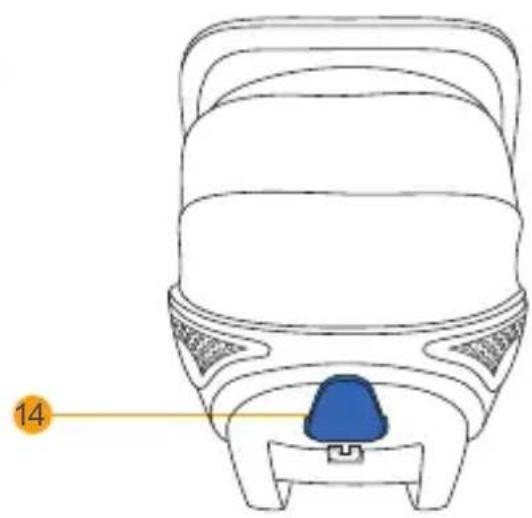
natural_image
Line drawing of a device with a blue component at the base, labeled with number 14 (no text or symbols on the diagram itself)natural_image
Line drawing of a stylized hat with a curved handle and a circular base (no text or symbols)
natural_image
Line drawing of a hairless machine with handle and control panel (no text or symbols)natural_image
Simple icon of a person sitting in a chair inside a rectangular frame (no text or symbols)natural_image
Diagram of a mechanical component with orange and yellow parts, enclosed in a circular frame (no text or symbols)text_image
Diagram showing car safety symbols: no sign, warning triangle, and warning sign inside a vehicle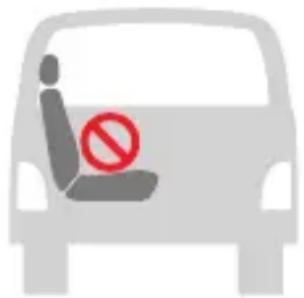
natural_image
Front view of a car with a red prohibition symbol on the seat (no text or numbers present)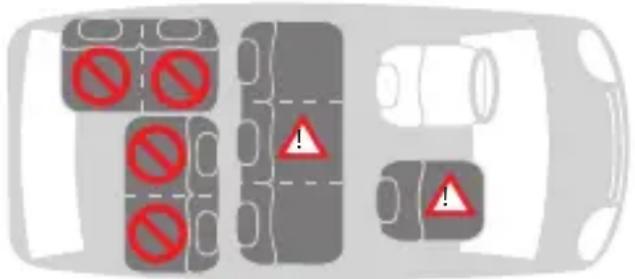
text_image
Diagram showing traffic lane with no signs and warning symbols on vehicles, including a car ahead view.natural_image
Top-down line drawing of a car seat with no text or symbolsnatural_image
Illustration of a car seatbelt being adjusted for a red angle (no text or symbols)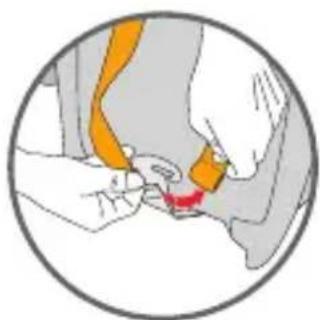
natural_image
Illustration of hands performing a car seatbelting operation (no text or symbols visible)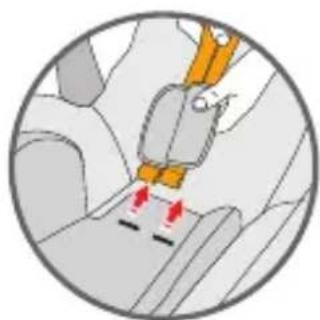
natural_image
Illustration of a car's seatbelt with red arrows indicating force or movement (no text or symbols)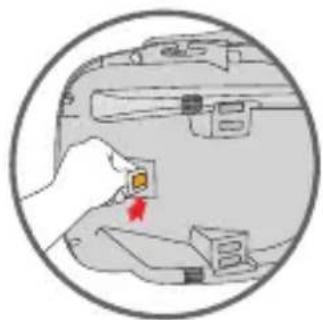
natural_image
Illustration of a hand holding a small electronic device with a red arrow pointing to it, inside a circular frame (no text or symbols)text_image
Diagram of a car with directional arrows and traffic symbols indicating no or yes actions, including 'No' and 'Yes' signs.VEHICLE APPLICATION LIST
Can only be installed on seats in vehicles indicated on this list. Please note that this list undergoes ongoing revision procedures, with changes and additions of vehicles accordingly. The up to date list can be consulted on our web site: www.foppapedretti.it
INFORMATION
- Do not place the front support leg on a floor storage compartment lid, the floor storage compartment lidsupport leg make a full&firm contact withthe veichle chassis.
- Please consult with the vehicle manufacturer regarding access to ISOFIX points.
- Because of the vehicle seat position care must be taken to correctly attach the child restraint system to the ISOFIX points.
- Vehicle seat (mid row) must be adjusted forward.
- Adjust the vehicle seat so that the base front support leg does not make contact with the floor storage compartment.
- Vehicle seat has to be fully adjusted to the rear most position.
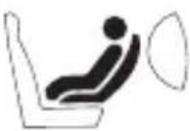
DO NOT USE ON A PASSENGER SEAT WITH A FRONT AIRBAG
CHECK
WARNING: before purchasing, consult the vehicle Use and Maintenance Guide to ensure the ISOFIX anchor is present, as this could be an optional.
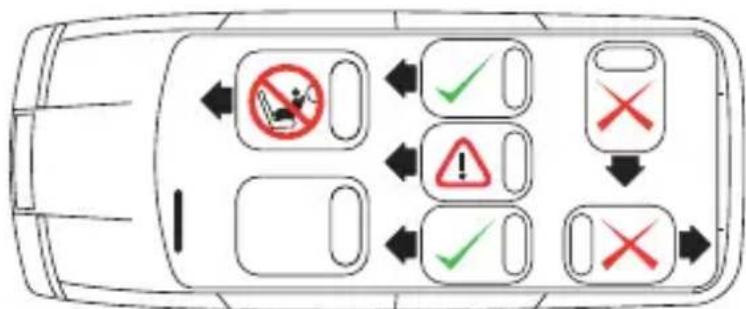
text_image
Diagram of a car with multiple directional and safety symbols indicating no or allowed actions, including no litter, check, and warning signs.LISTE DES VÉHICULES COMPATIBLES
text_image
Diagram of a car with multiple directional and safety symbols indicating vehicle safety or hazard zones.LISTE DER ZUGELASSENEN FAHRZEUGE
text_image
Diagram of a car with multiple directional and safety symbols indicating no or allowed use, including checkmarks, exclamation, and no errors.text_image
Diagram of a car with multiple directional and safety symbols indicating vehicle safety or hazard zones.text_image
Diagram of a car with multiple directional signs indicating traffic or safety rules, including no/no phone use, checkmarks, and warning symbols.ПРИЛАГАЕМЫЙ СПИСОК АВТОМОБИЛЕЙ
text_image
Diagram of a car with multiple directional signs indicating traffic or safety actions, including no phone use, checkmarks, and warning symbols.| Since |  | |
| ALFA ROMEO | ||
| 156 | 2003+ 2,4 | |
| 159 | 2005+ 2,4 | |
| Giulietta | 2010+ 2,4 | |
| GT | 2004+ 2,4 | |
| Mito | 2008+ 1,2,4 | |
| AUDI | ||
| A1 | 2010-2011 2,4 | |
| A2 | 1999+ 2,4 | |
| A3 | 1999+ 2,4 | |
| A3 Cabriolet ^3 | 2008-2013 2,4 | |
| A3 Cabriolet ^3 | 2014+ 1,2,4 | |
| A4,S4,RS4 | 1998-2015 2,4 | |
| A5 | 2007+ 2,4 | |
| A5 Cabrio | 2009+ 1,2,4 | |
| A5 Sportback | 2009+ 1,2,4 | |
| A6,S6,RS6 | 1997+ 2,4 | |
| A7 | 2010+ 2,4 | |
| A8,S8 | 2002+ 2,4 | |
| Q3 | 2010+ 2,4 | |
| Q5 | 2008-2012 2,4 | |
| Q5 | 2013+ 1,2,4 | |
| Q7 | 2005-2015 2,4 | |
| Q7 ^3 | 2015+ 2,3,4,5,7 | |
| TT | 2014+ 1 | |
| TTS | 2008+ 1 | |