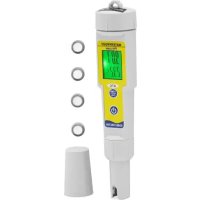
SBSPH150 - Measuring equipment STEINBERG - Free user manual and instructions
Find the device manual for free SBSPH150 STEINBERG in PDF.



| Product type | pH meter with temperature measurement |
| Model | SBS-PH-150 (SBSPH150) |
| Brand | Steinberg |
| pH range | 0 – 14 pH |
| pH resolution | 0.01 pH |
| pH accuracy | ± 0.1 pH |
| Temperature range | 0 – 50 °C |
| Temperature resolution | 0.1 °C |
| Temperature accuracy | ± 1 °C |
| Power supply | 4 LR44 batteries (1.5 V) |
| Dimensions (L × W × H) | 188 × 38.2 × 38.2 mm |
| Weight | 0.805 kg |
| Display | LCD screen |
| Main functions | pH and temperature measurement, automatic calibration, hold (Hold), °C/°F unit switch |
| Calibration | Automatic with buffer solutions pH 6.86, 4.01 and 9.18 |
| Maintenance and cleaning | Clean the probe with distilled water after each use, store in a cool and dry place, remove batteries if not used for a long time |
| Safety | Do not immerse above the maximum immersion level, do not use with wet hands, keep out of reach of children, follow the instructions in the manual |
| Spare parts and repairability | Repairs must be carried out only by the manufacturer's after-sales service. Use original spare parts |
| General information | Recyclable product, CE certified, manual available in several languages |
Frequently Asked Questions - SBSPH150 STEINBERG
User questions about SBSPH150 STEINBERG
0 question about this device. Answer the ones you know or ask your own.
Ask a new question about this device
Download the instructions for your Measuring equipment in PDF format for free! Find your manual SBSPH150 - STEINBERG and take your electronic device back in hand. On this page are published all the documents necessary for the use of your device. SBSPH150 by STEINBERG.
USER MANUAL SBSPH150 STEINBERG
HOLD-MODUS (MODELL SBS-PH-110)
This User Manual has been translated for your convenience using machine translation. Reasonable efforts have been made to provide an accurate translation; however, no automated translation is perfect nor is it intended to replace human translators. The official User Manual is the English version. Any discrepancies or differences created in the translation are not binding and have no legal effect for compliance or enforcement purposes. If any questions arise related to the accuracy of the information contained in the User Manual, please refer to the English version of those contents which is the official version.
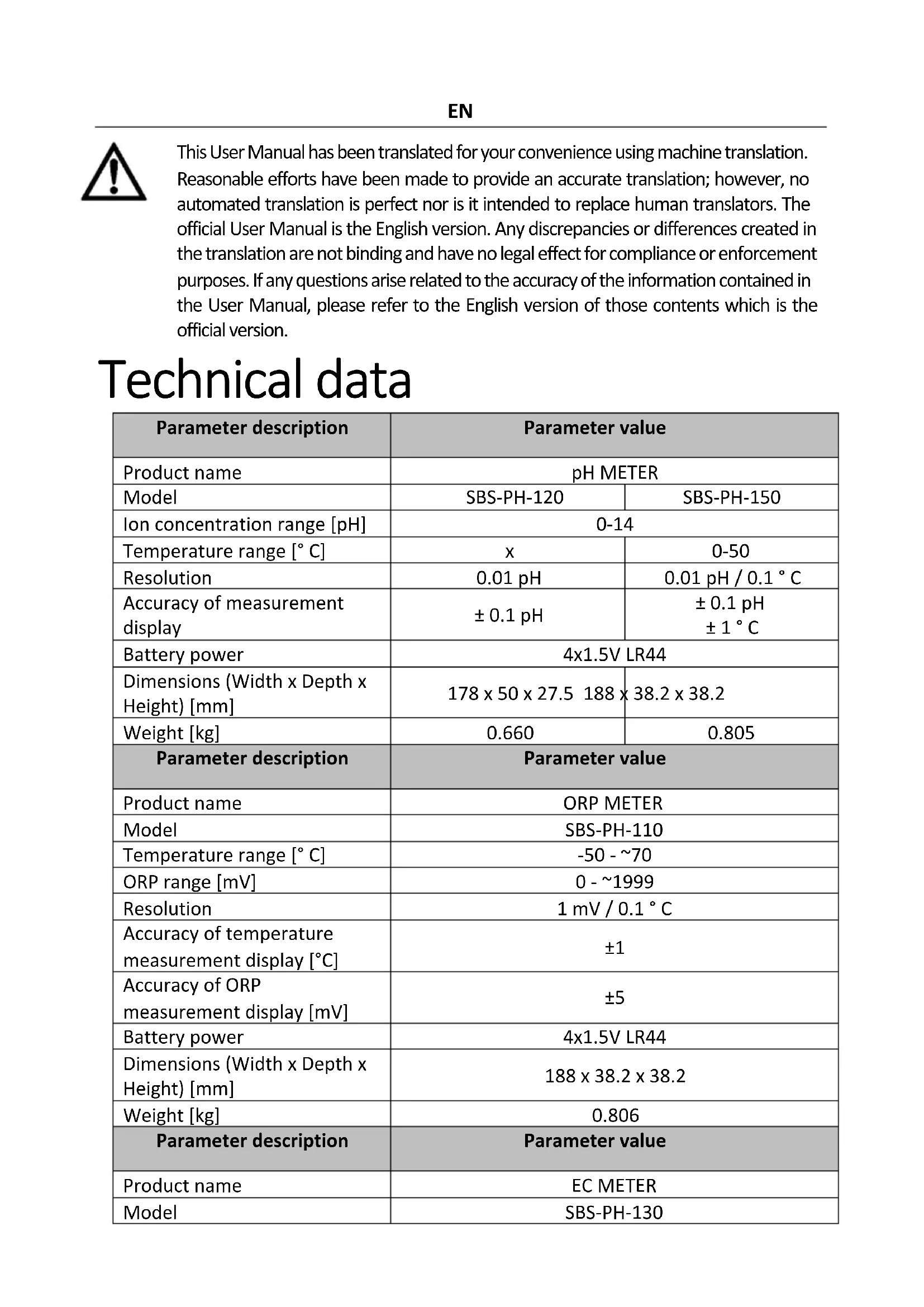
Technical data
| Parameter description | Parameter value | |
| Product name | pH METER | |
| Model | SBS-PH-120 | SBS-PH-150 |
| Ion concentration range [pH] | 0-14 | |
| Temperature range [°C] | x | 0-50 |
| Resolution | 0.01 pH | 0.01 pH / 0.1 °C |
| Accuracy of measurement display | ± 0.1 pH | ± 0.1 pH ± 1 °C |
| Battery power | 4x1.5V LR44 | |
| Dimensions (Width x Depth x Height) [mm] | 178 x 50 x 27.5 188 x 38.2 x 38.2 | |
| Weight [kg] | 0.660 | 0.805 |
| Parameter description | Parameter value | |
| Product name | ORP METER | |
| Model | SBS-PH-110 | |
| Temperature range [°C] | -50 - ~70 | |
| ORP range [mV] | 0 - ~1999 | |
| Resolution | 1 mV / 0.1 °C | |
| Accuracy of temperature measurement display [°C] | ±1 | |
| Accuracy of ORP measurement display [mV] | ±5 | |
| Battery power | 4x1.5V LR44 | |
| Dimensions (Width x Depth x Height) [mm] | 188 x 38.2 x 38.2 | |
| Weight [kg] | 0.806 | |
| Parameter description | Parameter value | |
| Product name | EC METER | |
| Model | SBS-PH-130 | |
| EC conductivity range [us/cm] | 0 - ~1999 | |
| Resolution | 1 us/cm | |
| Accuracy of conductivity measurement display | ± 2 FS | |
| Battery power | 4x1.5V LR44 | |
| Dimensions (Width x Depth x Height) [mm] | 159 x 64 x 29 | |
| Weight [kg] | 0.595 | |
1. General overview
This manual is intended to assist you in safe and reliable use. The product is designed and manufactured strictly according to technical specifications using the latest technology and components and maintaining the highest quality standards.
CAREFULLY READ AND UNDERSTAND THIS MANUAL BEFORE STARTING THE WORK.
To ensure long and reliable operation of the device, make sure to operate and maintain it properly in accordance with the guidelines in this instruction manual. The technical data and specifications in this manual are up-to-date. The manufacturer reserves the right to modifications for the purpose of quality improvement.
Explanation of symbols
| CE | The product complies with applicable safety standards. |
 | Read the manual before use. |
 | Recyclable product. |
 | CAUTION! or WARNING! or REMEMBER! General warning sign. |

CAUTION! Risk of electric shock!

CAUTION!
The figures in this manual are illustrative only and may
vary in some details from the actual appearance of the product.
2. Safety of use

CAUTION! Read all safety warnings and all instructions. Failure to follow the warnings and instructions may result in electric shock, fire and/or serious injury or death.
The term "device" or "product" in the warnings and in the description of the manual refers to the
Ph METER / ORP METER / EC METER
2.1. Safety in the workplace
a) Do not touch the device with wet or damp hands.
b) Keep the work area tidy and well lit. Disorder or poor lighting can lead to accidents. Be foresighted, watch what you are doing and use common sense when using the device.
c) If in doubt as to whether the product is working properly or found to be damaged, contact the manufacturer's technical service.
d) Only the manufacturer's service department may repair the appliance. Do not attempt to repair the product on your own!
e) Check the condition of the safety stickers regularly. Replace them if they are illegible.
f) Keep these instructions for use for future reference. If the product is to be handed over to a third party, hand it over with this user manual.
g) Keep packaging components and small installation parts out of the reach of children.
h) Keep the device away from children and animals.
i) When using this product together with other devices, also follow the other instructions for use.
2.2. Personal safety
a) Do not operate this device if you are tired, ill or under the influence of alcohol, drugs or medication that could impair your ability to operate the device.
b) The device is not intended to be used by persons (including children) with reduced mental, sensory or intellectual functions or persons who lack experience and/or knowledge unless they are supervised or have been instructed by a person responsible for their safety on how to operate the device.
c) The unit may be operated by persons who are physically fit, capable of operating it and appropriately trained, and who have read this instruction manual and have been trained in occupational safety and health.
d) Use caution and common sense when operating this unit. A moment's inattention during operation may result in serious personal injury.
e) Use personal protective equipment as required when operating the unit as specified in Section 1 of the explanation of symbols. The use of appropriate, approved personal protective equipment reduces the risk of injury.
f) The product is not a toy. Children should be watched to ensure that they do not play with the appliance.
2.3. Safe use of the device
a) Do not use the device if the ON/OFF switch does not function properly (does not turn on and off). Units that cannot be controlled by the switch are unsafe, cannot operate, and must be repaired.
b) Disconnect the device from the power supply before adjusting, cleaning, or servicing. This precaution reduces the risk of accidental start-up.
c) Keep unused product out of the reach of children and anyone unfamiliar with the device or this manual. Products are dangerous when used by inexperienced users.
d) Keep the product in good working order. Check before each use for general damage or damage to moving parts (cracks in parts and components or any other condition that may affect the safe operation of the device). If damaged, have the device repaired before use.
e) Keep the product out of the reach of children.
f) Repairs and maintenance should be carried out by qualified personnel using only original spare parts. This will ensure the safety of use.
g) To ensure the designed operational integrity of the device, do not remove factory-installed covers or loosen screws.
h) Clean the device regularly to prevent permanent dirt build-up.
i) The product is not a toy. Cleaning and maintenance must not be performed by children without adult supervision.
j) Do not tamper with the device to alter its performance or design.
k) Keep the unit away from sources of fire and heat.
provided to the user, there is still a slight risk of accident or injury when handling the product. Caution and common sense are advised when using the product.
3. Instructions for use
The device is designed to measure the temperature and pH / ORP / EC of test solutions.
The user is responsible for any damage resulting from misuse.
3.1. Product overview
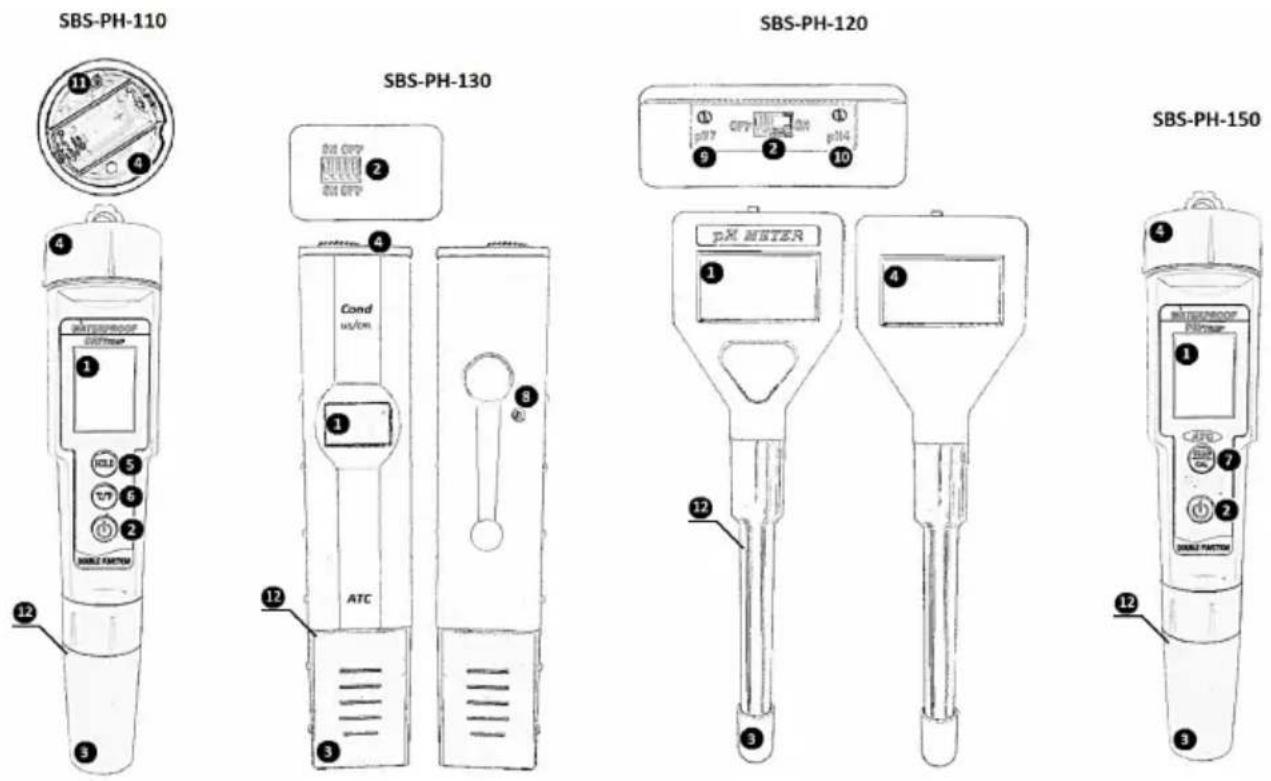
1 - LCD display
2 - Power switch
3 - Probe cover
4 - Battery compartment cover
5 - HOLD button
6 - Unit change button (°C/F)
7 - Unit change / calibration button 8 - Calibration trimmer
9 - pH 7 calibration trimmer
10 - pH 4 calibration trimmer
11 - Calibration trimmer
12 - Maximum immersion level
3.2. Working with the unit
When the probe tip is immersed in the test solution, air bubbles can settle on its surface, leading to errors in readings. Therefore, when measuring and calibrating
the device, it is recommended to slowly move the probe in a circular motion to minimize the occurrence of this issue.
If too large measurement deviations occur with a properly performed calibration, the measurement results do not reset, etc., clean the electrode with ethyl alcohol and check the battery charge level.
PERFORMING MEASUREMENTS
a) Remove the probe cover.
b) Before taking each measurement, clean the probe with distilled water. Dip it in the solution and then dry with a cotton cloth.
c) NOTE: It is forbidden to immerse the probe tip in the test solution above the immersion level (12). It may lead to damage!
d) Start the unit with the power switch.
e) NOTE: For model SBS-PH-120 / SBS-PH-130 the power switch is located on the top case of the unit. To start, set the switch to the "ON" position ("OFF" position - switch off).
f) Dip the probe tip into the solution to be tested.
g) Wait for the measurement to stabilize on the LCD, then read the correct value.
h) After carrying out a series of measurements, turn off the device using the proper switches.
i) Clean the probe as described in step b of this section.
j) Protect the probe with a cover.
DEVICE CALIBRATION
The calibration process should be performed after the following occur:
a) The first use of the device.
b) Device was inactive for a long time.
c) Measurement under specific conditions (strong solution).
d) Replacing the probe with a new one
MODEL SBS-PH-120
a) Immerse the probe tip in distilled water, remove it and dry with a cotton cloth.
b) Turn on the device with the power switch (2).
c) Immerse the probe tip in a pH 6.86 solution at 25°C.
d) Adjust the measurement reading with the pH7 calibration trimmer (9).
NOTE: The calibration trimmer for pH7 (9) and pH4 (10) is located on the top of the unit. Use the appropriate tool (included in the kit) and turn the regulator to set the value corresponding to the solution at a given temperature.
e) Clean the probe according to step (a) of this section.
f) Immerse the probe tip in a pH 4.01 solution at 25°C.
g) Adjust the measurement reading with the pH4 calibration trimmer (10).
NOTE: Perform the calibration in the same way as in point (d) of this subsection.
h) Clean the probe.
i) Check the correctness of the performed calibration. To do this, immerse the probe tip in a solution with pH 9.18. Wait until the measurement stabilizes on the LCD display. If the measurement is within the permissible error tolerance, the calibration should be considered correct. Otherwise, the calibration steps must be repeated.
MODEL SBS-PH-130
a) Immerse the probe tip in distilled water and leave for 1 hour. Remove the probe from the solution and dry it with a cotton cloth.
b) Start the unit with the power switch.
c) Immerse the probe tip in a dedicated 1413 us/cm calibration solution at 25°C.
d) Wait until the measurement stabilizes on the LCD display.
e) Adjust the measurement reading with the calibration trimmer (8).
NOTE: The calibration trimmer (8) is located on the back of the device. Use the appropriate tool (included in the kit) and turn the regulator to set the value of 1413 us/cm on the LCD display.
f) Clean the probe (immerse the probe tip in distilled water and dry it with a cotton cloth).
g) Check the correctness of the performed calibration. To do this, immerse the probe tip in a 152 m/cm solution. Wait until the measurement stabilizes on the LCD display. If the measurement is within the permissible error tolerance, the calibration should be considered correct. Otherwise, the calibration steps must be repeated.
MODEL SBS-PH-110
a) Immerse the probe tip in distilled water and leave for 1 hour. Remove the probe from the solution and dry it with a cotton cloth.
b) Start the unit with the power switch.
c) Immerse the probe tip in the dedicated 265 mV calibration solution.
d) Wait until the measurement stabilizes on the LCD display.
e) Adjust the measurement reading with the calibration trimmer (11).
NOTE: The calibration trimmer (11) is located in the battery compartment. Use the appropriate tool (included in the kit) and turn the regulator to set the value of 265 mV on the LCD display.
f) Clean the probe (immerse the probe tip in distilled water and dry it with a cotton cloth).
NOTE: In order to maintain the accuracy of the measurements, if the device is inactive, it is recommended to immerse the electrode in a solution of potassium chloride (every 15 days for several hours).
MODEL SBS-PH-150
a) Prepare calibration solutions of pH 6.86, pH 4, pH 9.18 and distilled water.
b) For accurate calibration, it is recommended to place the same calibration solution in two separate vessels. One is for the calibration and the other is for cleaning the probe.
c) Clean the probe in the pH 6.86 calibration solution that is to be tested. Dry it with cotton cloth.
d) Start the unit with the power switch.
e) Immerse the probe tip in the dedicated pH 6.86 calibration solution.
f) Wait until the measurement stabilizes on the LCD display.
g) Select and hold the unit/calibration button (7) for approximately 5 seconds to allow the device system to enter the automatic correction mode (the device automatically identifies the standard buffer solution).
h) Clean the probe in distilled water.
i) Check the correctness of the performed calibration. To do this, immerse the probe tip in other calibration solutions. Wait until the measurement stabilizes on the LCD display. If the displayed measurement has the same value as the calibration solution or is within error tolerance (+/- 0.1 pH), the calibration should be considered correct. Otherwise, the calibration steps must be repeated.
TEMPERATURE UNIT CHANGE (MODEL SBS-PH-150 / SBS-PH-110)
To adjust the temperature unit (°C/F), select the unit conversion button. The LCD will display the current temperature unit configuration.
HOLD MODE (MODEL SBS-PH-110)
This function is used to freeze the value on the display. To start, briefly press the HOLD button (5) during the measurement. Briefly pressing the button (5) again will cancel the hold.
3.3. Cleaning and maintenance
a) Store the appliance in a dry and cool place protected from moisture and direct sunlight.
b) Perform regular inspections of the unit checking technical fitness and any damages.
c) Do not leave the batteries in the unit when it will not be used for a long time.
d) Avoid touching the probe directly with your hand, this can damage it!
e) Always put the probe cover back on when the device will not be used for a long time.
INSTRUCTIONS FOR THE SAFE DISPOSAL OF BATTERIES.
The devices are equipped with 1.5V LR44 batteries.
To replace the battery, remove the battery compartment cover and install the required type of battery in accordance with polarity markings. Secure the installed batteries by putting on the cover.
Remove used batteries from the unit in the same way you put them in.
Return the batteries to a unit responsible for their disposal.
DISPOSAL OF WASTE APPLIANCES
At the end of its useful life, this product should not be disposed of with normal household waste but should be taken to a collection point for the recycling of electrical and electronic equipment. This is indicated by the symbol on the product, operating instructions or packaging. The materials used in this appliance are recyclable according to their marking. By reuse, recycling or applying other forms of use of waste machines, you make a significant contribution to the protection of our environment.
Your local administration will provide you with information about the appropriate disposal point for used appliances.

REŽIM HOLD (MODEL SBS-PH-110)
MODALITÀ HOLD (MODELLO SBS-PH-110)
HOLD ÜZEMMÓD (SBS-PH-110 MODELL)
PITOTILA (MALLI SBS-PH-110)
For the disposal of the device please consider and act according to the national and local rules and regulations.
CONTACT
expondo Polska sp. z o.o. sp. k.
- HOLD-MODUS (MODELL SBS-PH-110)
- General overview
- CAREFULLY READ AND UNDERSTAND THIS MANUAL BEFORE STARTING THE WORK.
- Explanation of symbols
- Safety of use
- Safety in the workplace
- Personal safety
- Safe use of the device
- Instructions for use
- Product overview
- Working with the unit
- PERFORMING MEASUREMENTS
- DEVICE CALIBRATION
- MODEL SBS-PH-120
- MODEL SBS-PH-130
- MODEL SBS-PH-110
- MODEL SBS-PH-150
- TEMPERATURE UNIT CHANGE (MODEL SBS-PH-150 / SBS-PH-110)
- HOLD MODE (MODEL SBS-PH-110)
- Cleaning and maintenance
- DISPOSAL OF WASTE APPLIANCES
- REŽIM HOLD (MODEL SBS-PH-110)
- MODALITÀ HOLD (MODELLO SBS-PH-110)
- HOLD ÜZEMMÓD (SBS-PH-110 MODELL)
- PITOTILA (MALLI SBS-PH-110)
- CONTACT
Brand : STEINBERG
Model : SBSPH150
Category : Measuring equipment