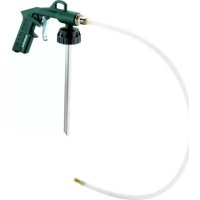
UBS 1000 - Screwdriver METABO - Free user manual and instructions
Find the device manual for free UBS 1000 METABO in PDF.



| Product type | Pneumatic combination gun |
| Brand | Metabo |
| Model | UBS 1000 |
| Intended use | Spraying of cavity sealants and underbody protection; compatible with screw-on cartridges (40 mm thread) |
| Supply | Purified compressed air, free of condensate and oil |
| Maximum admissible working pressure | See technical specifications (not provided in the extract) |
| Connection | 1/4" quick coupling |
| Recommended hose inner diameter | At least 10 mm |
| Main functions | Spraying underbody protection and cavity sealant |
| Included accessories | Spray nozzle, spray hose for sealant, reservoir for stripping product (not applicable for UBS 1000), reservoir for spray product (not applicable for UBS 1000), suction tube (not applicable for UBS 1000) |
| Wear parts | Spray nozzle, spray hose |
| Maintenance | Clean after use with appropriate product; oil valve stem and trigger lever; do not use halogenated solvents; do not immerse |
| Storage | In dry rooms |
| Safety | Wear safety glasses, hearing protection, gloves; do not use in explosive atmospheres; disconnect before maintenance; do not direct air flow at people |
| Repairs | Reserved for qualified technicians using original Metabo parts |
| Environment | Recycle tool, packaging and accessories according to national regulations |
| Weight | Not specified in the extract |
| Dimensions | Not specified in the extract |
Frequently Asked Questions - UBS 1000 METABO
User questions about UBS 1000 METABO
0 question about this device. Answer the ones you know or ask your own.
Ask a new question about this device
Download the instructions for your Screwdriver in PDF format for free! Find your manual UBS 1000 - METABO and take your electronic device back in hand. On this page are published all the documents necessary for the use of your device. UBS 1000 by METABO.
USER MANUAL UBS 1000 METABO
Original instructions
1. Declaration of Conformity
Under our sole responsibility, we hereby declare that these compressed-air sand blasting guns/ compressed air combo-spray guns/compressed air spray guns, identified by type and serial number *1), meet all relevant requirements of directives *2) and standards *3). Technical documents for *4)- see Page 3.
2. Specified Use
SSP 1000: This compressed air sand blasting gun is intended for the removal of rust and paint/varnish on metal and wood-based materials using a suitable abrasive.
SPP 1000: This compressed air spray gun is intended for injecting and spraying cleaner solvents, cleaning agents and spray oils as well as for waxing, sealing and impregnating in the professional sector.
UBS 1000: This compressed air combo-spray gun is intended for spraying cavity sealing and under-coating in the professional sector and can be used with standard, commercial screw cartridges.
The compressed air used must be cleaned and be free of condensate and oil.
This air tool must only be operated with a compressed air supply. The maximum supply pressure specified on the air tool must never be exceeded. The tool must not be operated using explosive, inflammable or hazardous gases. It must not be used as a lever, crushing tool or striking tool.
Any other use does not comply with the intended purpose. Unspecified use, modification of the air tool or use of parts that have not been tested and approved by the manufacturer can cause unforeseeable damage.
The user bears sole responsibility for any damage caused by improper use.
Generally accepted accident prevention regulations and the enclosed safety information must be observed.
3. General Safety Instructions

For your own protection and for the protection of your air tool, carefully observe all parts of the text that are marked with this symbol!

WARNING - Reading the operating instructions will reduce the risk of injury.

WARNING Read all safety warnings and instructions. Failure to follow all safety warn-and instructions may result in electric shock, nd/or serious injury.
Keep all safety instructions and information for future reference.
Pass on your air tool only together with these documents.
- The user or user's employer must evaluate the specific risks associated with each application of the tool.
- The safety instructions must be read and understood before installing, operating, repairing or maintaining the tool, and also before replacing any accessory parts or carrying out any work in the vicinity of the air tool. Failure to read and follow the instructions may lead to serious injury.
- Only qualified, trained operators are authorised to install, adjust or use the air tool.
- The air tool must not be modified. Any modifications implemented may reduce the efficiency of the safety measures and increase risks for the operator.
- Never use air tools that have been damaged. Look after your air tools carefully. Regularly check that all moving parts are functioning correctly and do not jam. Also ensure that no parts are broken or damaged to an extent that they affect the operation of the air tool. Check that all signs and labels are legible and intelligible. Have damaged parts repaired or replaced before using the device. Many accidents are caused by poorly maintained air tools.
4. Special Safety Instructions
4.1 Risks associated with ejected parts
- If either accessory parts or the air tool breaks, parts may be ejected at high speed.
- While operating, maintaining or repairing the air tool, or replacing accessory parts, you must always wear impact-resistant safety goggles. The degree of protection required for each individual task must be evaluated separately in each case.
- Ensure that the workpiece is securely attached.
- Disconnect the air tool from the compressed air supply before replacing the mounted tool or accessories, and also before carrying out maintenance, settings or cleaning.
- Also ensure that no other people are placed at risk.
4.2 Risks during operation
- The operator and maintenance staff must be physically capable of handling the size, weight and power output of the air tool.
- Ensure you are standing in a safe position and keep your balance at all times.
- Avoid accidental operation. If the air supply is interrupted, switch off the air tool using the On/Off switch.
- Wear personal protective equipment and always wear safety glasses. By wearing personal protective equipment such as gloves, protective clothing, a dust mask, non-skid safety shoes, a safety helmet or ear protectors, to suit the type of device and its use, you reduce the risk of injury. Wearing this equipment is recommended.
ENGLISHen
4.3 Risks associated with recurring movements
- When working with the air tool, you may experience an uncomfortable sensation in your hands, arms, shoulders, neck or other body parts.
- Make sure you are in a comfortable position to carry out work with the air tool, check that the tool is held securely, and avoid any awkward positions that make it difficult, for example, to keep your balance. If carrying out work over an extended period, you/the operator should change position occasionally. This should help to avoid fatigue and any unpleasant sensation.
- If the operator experiences persistent symptoms such as feeling unwell, aches, pains or throbbing, a prickling or burning sensation, loss of hearing, or joint stiffening, these warning signs must not be ignored. The operator should advise the employer of these symptoms and consult a qualified doctor.
4.4 Risks associated with accessory parts, consumable materials
- Disconnect the air tool from the air supply before securing or replacing the accessory part.
- Only use accessories or consumable materials that are designed for this tool and that fulfil the requirements and the specifications listed in these operating instructions.
4.5 Risks in the workplace
- Slipping, tripping and falling are the main reasons for accidents in the workplace. Pay attention to surfaces that may have become slippery as a result of using the air tool, and also be careful that the air hose does not cause someone to trip.
- Proceed carefully when working in unfamiliar environments. Power cables and other supply lines may represent a hidden risk.
- The air tool is not designed for use in explosive environments and is not insulated against contact with sources of electric power.
4.6 Risks associated with dust and vapours
- The dust and vapours generated when the air tool is used may carry health risks (e.g. cancer, birth defects, asthma and/or dermatitis); it is therefore imperative that a risk assessment is carried out in relation to these risks and that suitable controls are then implemented.
- The risk assessment should take into account both the dust generated while the air tool is used and any existing dust that may be raised during operation.
- The air tool must be operated in accordance with the recommendations set forth in these instructions and must be maintained in order to minimise the release of dust and vapours.
- The extracted air must be discharged in such a way that, in a dust-filled environment, the minimum of dust is raised.
- If dust or vapours are generated, the main priority is to control these at the point where they are released.
- To avoid increasing the amount of dust or vapours generated unnecessarily, the consumables must
be selected, maintained and replaced in accordance with these instructions.
- Use protective breathing apparatus in accordance with your employer instructions or in accordance with health and safety regulations.
- Working with certain materials causes emissions of dust and vapours that can give rise to potentially explosive conditions.
4.7 Additional safety instructions
- Compressed air can cause serious injury.
- When the air tool is not in use, and before replacing accessory parts or when carrying out repairs, you must ensure that air supply is shut off, that the air hose is depressurised and that the air tool is disconnected from the compressed air supply.
- Never direct the air jet at yourself or other people.
- Whiplashing hoses can cause serious injury. Therefore always check that the hoses and their fixtures are in good condition and that they have not become loose.
- Connect the air tool with quick-action coupling to the compressed air supply.
- If universal swivel couplings (claw couplings) are being used, locking pins are also required. You should also use whip check hose restraints in case there is a problem with the connection between the hose and air tool or between the hoses themselves.
- Ensure that the maximum pressure specified on the air tool is not exceeded.
- Never carry air tools by the hose.
4.8 Additional safety instructions
- If applicable, observe any special health and safety or accident prevention regulations governing the use of compressors and compressed air tools.
- Ensure that the maximum supply pressure specified in the Technical Specifications is not exceeded.
- Do not operate the tool unless you are completely focused. You must be alert, pay attention to what you are doing and proceed cautiously when working with an air tool. Never use a tool when you are tired or under the influence of drugs, alcohol or medication. Just one moment's carelessness when using the tool can cause serious injury.
- Make sure your workplace is clean and well lit. Untidy or poorly lit workplaces can cause accidents.
- Keep air tools away from children.
- Do not store the tool outdoors or in damp conditions without protection.
- Protect the air tool, especially the compressed air connection and the control elements from dust and dirt.
- Take suitable precautionary measures to protect yourself and your environment against accidents.
- The air tool is not suitable for treating food supplies and medication.
- Do not smoke, ignite sparks or light a fire.
- It is essential to ensure that the working area is well ventilated.
-
Always wear protective clothing, in particular, breathing protection with active carbon filter.
-
The air tool must only be used for the intended purpose.
- Caution with combustible materials.
- Only start work if you are well rested and focused.
- Never direct the air tool at persons or animals.
- The compressed air supply must be connected via a quick-action coupling.
- The supply pressure setting must be made via a pressure reducer.
- Never use oxygen or combustible gases as power sources.
- Prior to maintenance work and troubleshooting, disconnect the tool from the power source.
- Residual cleaning agent and paint must be disposed of in accordance with local environmental regulations.
- During operation, maintenance and cleaning of the air tool, always wear protective equipment approved for the application! Use suitable protective gloves, work clothing, safety goggles and breathing protection with a filter element suitable for the respective application!
- There is a risk of the injection of coating material or cleaning fluid (e.g. when changing nozzles or during cleaning)! Serious consequence can result if the protective equipment is inadequate (e.g. necroses, loss of limbs). There is also a risk in the case of inhalation, contact or absorption of coating materials or cleaning fluids. For this reason, always provide adequate technical or natural ventilation!
- Do not use the equipment in potentially explosive atmospheres. Do not process materials that can create potentially explosive atmospheres. Ensure that only suitable compressed air is used! Information in these operating instructions is categorised as shown below:

Danger! Risk of personal injury or environmental damage.

Caution. Risk of material damage
4.9 Symbols on the air tool

Read the operating instructions before starting to use the machine.

Wear safety goggles.

Wear ear protectors.
5. Overview
See Page 2.
1 Jet nozzle
2 Spray nozzle for undercoating or spraying agent*
3 L o c k n u t *
4 Spray hose for cavity sealing *
5 Trigg er
6 Plug-in nipple 1 / 4''
7 Container for blasting material
8 Container for spraying agent *
9 S u c t i o n h o s e *
- depending on features
6. Operation
6.1 Before using the tool for the first time
Insert plug-in nipple (6).
6.2 Preparing the air tool
SSP 1000
Screw off the container for the blasting material (7), fill with blasting material and fully screw it back on.
SPP 1000:
Connect the air tool with quick-action coupling to the compressed air supply. Actuate the trigger (5). Using your thumb, check the negative pressure at the suction hose. Turn the spray nozzle (2) until you achieve optimum gun suction. Use the lock nut (3) to retain this position.
UBS 1000:
Undercoating:
Attach the spray nozzle (2). Insert a standard, commercial undercoating cartridge (with 40mm round thread).
Cavity sealing:
Remove the nozzle (2). In its place, screw the spray hose (4) provided in as far as it will go.
6.3 Adjusting the air tool
(Only for SSP 1000)
The jet pressure of the jet nozzle can be changed depending on the workpiece and air pressure.
-
Release the lock nut (3).
-
Turn the spray nozzle (1) to adjust.
Secure this setting using the lock nut (3).
6.4 Using the air tool
To benefit from the air tool's full performance, always use compressed air hoses with an inner diameter of at least 10mm . Tool performance can be significantly impaired if the inner diameter is too small.

Caution. The compressed air line must not contain any water condensation.

Caution. The compressed air used must be cleaned and be free of condensate and oil.
- Adjust the supply pressure (this is measured at the air outlet while the air tool is switched on). For details of the maximum permissible supply pressure, see the section on "Technical Specifications".
- Preparing the air tool. See section 6.2.
- Connect the air tool with quick-action coupling to the compressed air supply.
- Actuate the trigger (5) to put the air tool into operation.
ENGLISHen
(Only for SSP 1000)
- Adjusting the air tool. See section 6.3.
- The distance between the air tool and workpiece should not exceed 20~cm
7. Cleaning, Maintenance and Care
Danger! Disconnect the compressed air connection before carrying out any work.
Danger! Repair and maintenance work other than the work described in this section should only be carried out by qualified specialists.
The air tool, and particularly the suction hose and the spray nozzle, must be cleaned with a suitable cleaning agent on completion of work. We recommend that you attach a container filled with cleaning agent to the air tool and flush the cleaning agent through the tool at low pressure. Spray the cleaning agent back into a closed container to ensure that it is collected and to avoid any unnecessary vapour. The valve pin and pivot point of the trigger of your spray gun must be oiled after each cleaning. Store the compressed air device in dry areas only.
If there is an unexpected blockage or the spray pattern is contaminated, please clean the nozzle.
- A clean air tool guarantees trouble-free handling during subsequent work.
- After use, clean and look after the air tool with extreme care.
Danger! Do not use halogen solvents containing hydrocarbons (1.1.1 Trichloromethyl, ethyl chloride, etc.) because this results in chemical reactions, some of which can be dangerous, with some air tool materials.
Caution. Never immerse the air tool completely in a solvent.
- All moving parts should be oiled from time to time.
- If the nozzle is removed for cleaning, the thread and the gasket must be coated with a light grease. Do not use lubricants containing silicone.
- Store your air tools/devices in dry areas only.
- Carry out regular maintenance to ensure the safety of the air tool.
- Check that all screw fittings are seated securely, and tighten if necessary.
- Avoid contact with dangerous substances that have accumulated on the tool. Wear suitable personal protective equipment and take appropriate measures to remove any dangerous substances before maintenance.
8. Accessories
Use only genuine Metabo accessories.
Only use accessories that are designed for this air tool and that fulfil the requirements and the specifications listed in these operating instructions.
The spray nozzle and spray hose are subject to wear and tear. It is therefore always recommended to have replacements.
For a complete range of accessories, see www.metabo.com or the catalogue.
9. Repairs
Danger! Repairs to air tools must only be carried out by qualified specialists, using original Metabo spare parts!
If you have Metabo air tools that require repairs, please contact your Metabo service centre. For addresses see www.metabo.com.
You can download spare parts lists from www.metabo.com.
10. Environmental Protection
Observe national regulations on environmentally compatible disposal and on the recycling of disused air tools, packaging and accessories. You must not cause risks to people or the environment.
11. Technical Specifications
Explanatory notes on the specifications on Page 3. Subject to change in line with technological advances.
V1 = Air requirement
pmax. = Maximum permissible supply pressure
p = Supply pressure
d_i = o s e d i a m e t er (inner)
C = Connecting thread
A = Dimensions:
Length x Width x Height
$$ m = \bar {W} e i g h t $$
The technical specifications quoted are subject to tolerances (in compliance with the relevant valid standards).
Emission values Using these values:
Using these values, you can estimate the emissions from this tool and compare these with the values emitted by other tools. The actual values may be higher or lower, depending on the particular application and the condition of the tool or mounted tool. In estimating the values, you should also include work breaks and periods of low use. Based on the estimated emission values, specify protective measures for the user - for example, any organisational steps that must be put in place.
Vibration (acceleration value, frequency-weighted according to EN 28927):
a_h =Vibration emission level
K_h = Measurement uncertainty (vibration)
Sound level (EN ISO 14462):
LpA =Sound pressure level
L_WA^P = Acoustic power level
K_PA , K_WA = Measurement uncertainty
Wear ear protectors!
Programa completeness of accessories véase www.metabo.com o CATALOGO.
9. Reparación

4.2 Farer under drift
IcnoJb3yEmbI CHaTbI B03dyx DoJIKeH 6bITb OuHSeH. OH He DoJIKeH CoDEpKaTb KOHDeHCaT MAcNo.
3KcNlyaTaun 3TOrO INHCTpyMeHTa DOnyCKaETC TToBko C nOdaue CxAToR OBo3dyxa. 3AnpeuaeT CnpeBbIaTb yKa3aHHoe Ha NHeBMOnHCTpyMeHTe MaHCmMaJIbHO DOnyCTHMoe pa6Oee DaBJIeHne. 3AnpeuaeTc 3KcNlyaTaun 3TOrO NHeBMOnHCTpyMeHTa CO B3PbIOONaCHbIM, RopUChMn HIn ONaCHbIMn DnA 3DOpOBBa r3aMn. He NcNoIb3oBaTb B KaueCTBe pbIHa, ydApHOro Hn DpO6MbHOro INHCTpyMeHTa.
IIO6oe dpyrooe nCNoIb3OBAHne yBIAETCn HeDOnyCTNMBIM. HcNoIb3OBAHne He No Ha3NaYeHNo, N3MeHENr KOHCTpyKUIN PHEBMONHCTpyMeHTa NII INcNoJIb3OBAHne DeTaJe, KOTOpBIE He 6bln IpOBepeHb IIN DOnyUeHb IpnON3BOIDNTeJEM, MOrYT NOBLeBy 3a CO6oHnpeDbNdeHHb MaTePnaJIbHbI yuep6!
3a yuep6, BO3HnKmB pe3yIbTaTe nCNoJb30BaHnHE NO Ha3HaueHIO, OTBETCTBEHHOCt b HecET TOJIbKO POJIb3OBATeJIb.
Heo6xOIMO CO6IIODaTb 6ObeepnHrTbe npabnla TexHNK 6e3OnaCHOCTN, a TaKHe yKa3aHn, npJIraeMbIE K DaHHOMy pyKOBOdCTBy.
3. 06uzhe yha3aHnno texHnke 6e3oNaChOCTn

ДяBaWeIco6CTBHeHNo6e3ONaCHOCTn ⅢaUHTbI BaWero INHEBMOnHCTpyMeHTa OT NOBpeKdEHN CO6JIoDaIte yKa3aHnA,OTMeueHHbIe daHHbIM
CHMBOJOM.

PNEyPENHEHNE!IJIa CHNKeHHn pNcKa TpaBMnPOBaHnI PPOHTHe pyKOBoDCTBO NO 3KcJIyaTaUH.

PNEyIPEXHEHNE! PnOuTHe Bce HNCTpyKcHm UyKa3aHnno TExHHKe
6e30nacHocTn. HeBbINOJIHeHne HNCTpyKuH N yKa3aHH NO TexHNKe 6e30NaCHOCTn MOKeT npNBecTH K NOPaHexHIO 3JIeKTPnueCHM TOKOM, BO3rOpAHIO HIN N K NOyueHIO TJKeJIbIX TpaBM.
CoxpaHnte Bce HnctpyKuH N yHa3aHnno TeXhNke 6e3oNaChOCTn.
IpeepaBaIte nHeBMOHcTpymeHT cIeDyIOUeMy BlaJeIbCuToIbKO BMeCTe C 3TUMN DOKymeHTaMn.
-Пользовател nb npa6oToaTeIbdoJIHbI OueHHTb BCE NOTeHuaJIbHbIe ONaCHOCTN, KOtOpbie MOrYT BO3HnKaTb npi KaJdOM HcNoJIb- 3OBaHH INHCTpyMeHTa.
- Ppeed Halaikon, 3KcIpyaTauee, pemOHToM, TexHnueckm O6cIyHbAHHeM n 3ameHo npHaJeHHoCTe, a TaKHe nepeed Haayalom pa60t B6IINn INeBMOHNCTpymeHTa CJeDyET O3HaKOMITbcr C yKa3aHnA rMn NO TexHnKe 6e3OanachocTn. B npOTNBHom clyuae BO3MOHNOJnyehne cepBe3hIx TeJeCHbIX NobpeXdEHH.
KHaJaKe,peryInpOBKeHINHCNoB3OBAHNIOHEBMOnHCTpyMeHTaDonyCKaETCToJbKO KBaJIHΦuIupOBaHHbI N O6yueHHbI nepcoHaJI.
- N3MeHeHnKoHCTpyKuH/MoDnΦnKaUn nHEBMOHNCTpyMeHTa He DOnyCKaIOTc. N3MeHeHnKoHCTpyKuH MOrYT CHN3NTb 3ΦΦeKTNBHOCTbMep NO 3aUnTe HIOBbICHTb CTeNeHb yrpo3bl dJIaNOJb3OBaTeJIa.
- Hateropnueckn 3anpeuaetcnaOpnb30BaTb NOBpeXDeHHbIe NHeBMOnHCTpyMeHTbl. BnHaMaTeJIbHO CJIeDInTE 3a COCTOHNHE MHeBMOnHCTpyMeHTOB.PeyIyIpaHO npOBepaHTe NCpPaBHocTb FyHKUHOHPoBAHnIOBnHbIX DeTaJIe, IERKOCTBHX XODa, CEIOCTHOCTbN OTCyTCTBne NOBpeXDeHn, KOTOpbIE MOJIb 6bl OTpuCaTeJIbHO cKa3aTbCn Ha pa6OTE NHeBMOnHCTpyMeHTa. PpoBepaTe HAIuHne n Pa36OpuBOCTb Ta6JIuYe n HADnCeI. CdabaIte nn 3ameHrTe NOBpeXDeHHbIe DeTAJIu INHCTpyMeHTa B pEmONT DO eTO NcNoB3OBAHn. PrpHuHO 60JIbUHNCTBa HeCuaCTbIX ClyuAeB YBIAETcR HECO6JIIODEHn EpaBnTexHnuecKOTo OScJyKINBaHn IHeBMOnHCTpyMeHTOB.
4. CneuaJIbHbIe yHa3aHnI no TexHnHe 6e3OpacHoCTn
4.1 Onachoctn BCJeCTBHe OTJeTaHnA DeTalei
Bcnyae noIOMKn npHaJeKHOCTn IIN NHEBMONHCTpyMeHTa DeTaN MOY OTJeTaTB Bpa3HbIe CTOpOBbl C BbICOKO CKOPoCTbIO.
-ПиЗКСЛУаТaцИ,Заме ПпИнАДLEЖHOCTea TaKKe B XOe peMOHTa ИИ NTEXHNUeCKORO6ClyJINBAHЯ ПHEBMOnHCTpyMeHTa CJIeDyETBcerIa HaDEBaTb yJaPONpOuHbIe 3aUHTbIe OUKN.CTepeHb Tpe6yEmo3aUHTbIcJIeDyETOueHNBaTb DnI KaJIOrO CJIyHa rOTdJIbHO.
- Y6eIITecb B TOM, yTO 3aROTOBka HaJeKHO 3aKpeIleHa.
- OToCoEiHnIe IHeBMOHCTpyMeHT OT CnCTEmbl NOdaun cKaTOro BO3Dyxa nepeJ 3aMeHOJ DeTaJe/NpHaJaNeJHKHOCTe, peRyInpOBKO, TexHnueckm ObcLyKHBaHNem HIN OYnCTKOH.
- Y6eIHTecb BOTCYTCTBnN OaCHOCTeI dJa Dpyrnx liu.
4.2 Onachoctn B xode 3Kcnnyatau
-Пользователи NBOCLNYKINBAIOUПИперсогалДОЛЖнbl 6blTb B COCTOЯн ИбрацаTBС C ПHEBMONHCTpyMeHTOM C yyeTOM erо pa3МePoB, BEcaN MOUHOCTN.
- PpIMHTe yCTOuHBOE NOLOXHeHne N OBeCneBtHaDeHHbI 3aXBaT HNCTpyMeHTa IJIa COxpaHHeHn paBHOBecnB B IIO6oB pa6Oey CNTyaUHN.
- I36eraIte HenpeHnAmepeHHoro BkHIOueHnI HEBMOHCTpyMeHTa. B clyuae npepbIBaHnI NOdaHn BO3dyXa BbIKHIOUHTe NHEBMOnHCTpyMeHTC NOMOUsBIO BbIKHIOUaTeJI.
-Пользунтус сретдвами ИндИндУально 3auntbIи BCERda NaDEBaNTe 3aunTHbIe OUYK. ИспOLTбОВане сретдВ ИнДИВdYaLBHOTaHTbI, HAnpIMeP 3aunTHbIX NepaTOK, 3auntHOJ OdeXdbI, peCnnpaTopa, HeCKoJIb- 3raeJ 3aunTHOJ O6yBN, 3aunTHoro WJIeMa IIN 3aunTHbIX HayuHKnOB, B 3aBNCIMOCTN OT BnDa I O6laTn PpIMeHEnH INHCTpyMeHTa CHNJaET PnCK TpaBMIpOBAHnI N03TOMy HAcTOTeJIbHO peKOMeHdyetc.
4.3 OnachocTH BCJIeCDTBHe NOBTOPOU-
-Пи ВьЮЛHeHn pa6OT c nHEBMOHnHCTpyMeHTOM BO3MOxHNOYBJIeHne HENpIaTHbIX OuYIeHn B KInCTaX pyK,пpeДлleYbAx,пLEayax,B oblaactn IeN ИИnpyRnx YacTEx TeHa.
-ПинмаTe npabHbHoe noLoXeHneДЯ pa6Otbl C nHEBMOnHCTpyMeHTOM,OBpaUaJIte BHNMaHHe Ha 6e30NaCHOCb Nn36eRaIte pa6Otbl B TaHnx NOLOXeHnIX,B KOTOpbIX Bam CLOXHO COxpaHNTb paBHOBecne N KOTOpbIe DOCTaBIAOT Bam DnCKOMΦoT.B XoJe HnpePpbIBHO pa6Otbl NOJb3OBaTeJIb DOJNoEh MeHrTb NOLOXeHne TeJa BO n36eKaHne NOABLeHnYCTaIOCTn I nDnCKOMΦoTa.
- Henb3nHropnoBaTb TaKHe CmMTombl KaNpOdoJXnteJIbHOe HeDOMOraHne, HapyuSeHnecepdu6neHnI, NOBLeHne 6oJIe, «MypaWeK», OHemEnra. Nolb3OBaTeJIb DoJKeH yBeDMNTb
06 3TOM CBOero pa6oToaTeIaN I npOKOHcyIbTHPOBaTbcra CBpaQOM-CneuaJIInCTOM.
4.4 Onachoctn BCJeCDTBne npHaJleHHoCTe, pacxOndbIX MaTePnaIIOB
-OTcoeINHnIte INHeBMOnHCTpyMeHT OT CnCTeMBI NOdaunCkAToRO BO3dyXa nepey yCTaHOBKOHNJN 3aMeHOI pInHaJIeKHOCTN.
IcnoJb3ynte ToIbKO Te npHaJIeKHOCTn I pacXoHbIe MaTePnaJIbI, KOTOpBIE CneuaJIbHO npEdHa3HaueHbI dIa 3TOrO INHeBMOnHCTpyMeHTa I OTBeuAOT Tpe6OBaHHaM I xapaKTepNCtIKaM, npINBOdIMbIM B HactToIeM pyKOBoDCTBE NO 3KcNlyaTaU.
4.5 Onachoctn Ha pa6ooyem MeCTe
-ПОСКАЛБ3БВАНЕ,СNOTБИКАнЕ И ПАDEHЯЕ YВЛЯ-ЮТСОCHOВБИМИ ПРУЧИНAMI TpaBMIPOBAHЯHa pa6OчEM MecTe.ОБрацайтЕ BHMaHЯп NOВЕРХНOCHTN, KOTOpbie B pe3YЛbTaTe HcNoJIb30BAHЯ NHEBMONHCTpyMeHTa MOrYT CTaTb CKOJIb-3KIMn,a TaHKe Ha ONaCHOCTh CBOTbIKaHЯ O BO3DyUHbI WJahr.
- PnBbINOJIHeHn pa6oT B He3HaKOMbIX ycNoBnX CO6IIOJaTe OCTOpOHHOCtB: BO3MOHHO HAIINHcCKpbITOn IPOBOIDKN IOd 3JIeKTPnHe-CKHM HAprrKeHNEM.
-ПпевMonHCTpymENT He npedHa3HaueHДЯ
ИСПОЛБ3OBaHINBO B3рьIBOONaCHOB03dUshOH
Срдe И He n3OJIIpOBaH OT KOHTaKTA C NcTOCHN-
Ками элктprnecKOrTo TOKa.
4.6 Onachoctb BCleDCTBne nbIIN napOB
-Bo3HnKaIOUe B XOe pa6oTbIC nHeBMOHCTpyMeHTOM NbIb H napb MOrY T npuHHITb BpeBaWemy 3OpOBbIO (HaNPmep, CnOCo6CTBOBaTb pa3BHTIO paka, PnpOaHBix HeDOCTaTHOB,actMbI N/INN NOBLeHNIO KOHHbIX BocNaJIeHN);B O6raTeNbHOM NopRdKe OueHNTe BO3MOKhbIEpNCnC yUeTOM 3TNX ONaCHOCTeN INPIMITE COOTBETCTByUOUne MEPbl PpeDcTOPOHXOCTN.
- Pn OueHKe pNCKOB, CBa3aHHbIX C BO3HKnHOBeHHe NblIN B XOJe BBINOJIHeHn pa6OT C NHeBMOHNCTpyMeHTOM, CNeDyET TaKHe yuHTbIBaTb N Ty PbIb, KOTOPa rYKe BO3MOKHO IMeJIacb B MecTe npoBeDeHn pa6OT n 6blIa NODHrTa B BO3dYx pa6OtaQmM INCTpyMeHTOM.
-ПНЕВМОИСHTРМЕNTСLEДYEET3KСПЛУАТПОВАТь
ИОБСЛУЖИВАТьВCOOTBETCTBиCpeKOMEнДа-
цЯМи,yKa3aHHbIMN BHaCTOЯшEMpyKOBODCTBE,
ДЯСBEDEHINK MInHIMMy BbICBO6OJDeHЯ
ОпаСыxДЯЗIDOPOBЯ ПылNi NnapOB.
- OTPa6oTaHHbI BO3dYx CJIeDyET OTBODHTb TaHIMOBpa3OM, YTO6bI CBECTN K MHNHMMy 3aBHXpeHHe Nbln B yCIOBnX CNJbHOH 3aNbJIeHHOCTNB MeCTe IPOBEdeHnPa6OT.
-При BO3нКHOBEHIN Пыл Ил NapOB OCHOBHON 3адаченяВЯETСОHTpoJb INX BbICBO6O- JDEHIN.
- Pacxodhble MaTepeNaIbI CJIeDyET Bbl6npaTb, 06CnyXHBaTb N3aMeHrTa COJIaCHO yKa3aHnAM n3 HAcToAeero pyKOBoDCTBa BO n36eKaHne HeHyXHO rYBeJIuYeHnRA bIle-nIIN napoo6pa3oBaHnra.
- IcnoIb3yIte 3aunTHbIe pecnnpaTOpbl COJIaCHO pON3BODCTBEHHbIM INHCTpyKUmNIN
B COOTBETCTBUN C Tpe6OBaHnMn PO OxpaHe Tpyda N Texhike 6e3onacHOCTN.
- O6pa60tKa onpeJeHbIX MaTePnaIob cOprrKeHa C BblJeHem Nbln I npa, KOTOpblcMOryT CO3dA Tb NOTeHuaJIbHO B3pbIBOONaCHyIO BO3dyUHyo CpeDy.
4.7 DoONHHTeJIbHbIe yKa3aHnNo TExHnKe 6e30NaCHOCTN
- CkaTbI B03dyx MoKeT CtaTb npuHOn cepbe3-HOrO TpaBMnPOBaHH.
- EcIn INheBMOHCTpyMeHT He IcNoIb3yEtC, a TaKHe nepeD 3aMeHOIN pInHaJIeJHKHOCTe HII npn BblIOJIHeHN pEMOHTHBIX pa6OT Bcerda 6IokHyTe NODaHy BO3dyXa, pa3rpyKaHTe OT DaBHeHNBO3dyWHbI WlaHr N OTCOEINHraIte INHEBMOHCTpyMeHT OT CnCTembl (NCTOCHNa) NODaHy CkAToRBO3dyXa.
- HnKOrda He HanpaBraIte BO3dyuHbI NOtOK Ha ce6r nn dpyrnx liu.
-OTIetaIOUneBCTOPOHyIJIaHnMOryTcTaTb npuHHoN cepbe3Horo TpaBMnPOBaHnR.B CBra3N C 3TNM Bcerda IPOBepaTe,He NOBpeKDeHbIIN IJIaAHn IN He NOBpeKDeHbI/pacfIKCnPOBaHbI INx KpeNeKhbIe 3JIemEHTbl.
-ПОДСОЕДИНITE ПНЕВМОИNCHТPyMeHT Yepe3 6bICTpopa3beMHyIO MyΦTy K NCTOчнky CЖАТORO BO3dYxa.
-Пи ИСПОЛБ3OBAHIN yHNBepcaJIbHbIX NOBOpOTHbIX (KJNAUKObIX) MyΦT HeO6XODIMOHCNOJIb3OBaTb CTONOPHbIe UTHΦTbI IN XOMyTbIWhipcheckДЯЗaUNTBI UHaHROB OT BOLOyeHn(3axIecTbIBaHn)В ueJx OBeCneueHn 6e3OnaCHOCTn Ha Clyuay pa3beDInHeHn UJaHroBbIX COeDInHeHn. - P03a60TbTecb O TOM,чTO6bl He DoNYCTnTB npeBbIeHnI NHeBMOnHCTpyMeHTOMyKa3aHHORo MaKcImaJIbHOrO daBJIeHnI.
- Hateropnueckn 3anpeaetc npepenocntb nHEBMOnHCTpyMeHTbl 3a WlaHr.
4.8 DoonHnTeIbHbIe yKa3aHnNo TeXnHe 6e3OnaCHOCTn
- Pn Heo6xOJHMOCTn Co6IHOaJIe OcO6bIe npEJnncaHn IIO 6e30nacHOCHTpyda HIN npEynpeKJDeHHIO pON3BOCDtBeHHORo TpaBMATn3Ma npN O6paUeHHN C KOMnPecCCopamn INHEBMOHNCTpyMeHTaMn.
- Y6eINTecb B TOM, YTO He NpeBbIaTcYka3aHHoe B TexHnueCkX XapaKTePncTHkaxMaKC. DOnyCTHMoe pa6Ooee DaBJIeHne.
- PpeKpaTInTe pa60Tu C 3TNm INHCTpyMeHTOM,ecnBac YTO-JN6O OTBNeKae! BybTe BHNMaTeJIbHbI, CNEINTE 3a CBOIMN DeINCTBnAMN IN cepBe3HOOTHCNTecb K pa60Te C NHEBMOnHCTpyMeHTOM. He NOJb3yInTeCb INHCTpyMeHTOM,ecn BblYCTaIIHaxODInTEcb NOD DeINCTBnEM HApKO-TNKOB, aIKORoIa IIN JekapCTB. HeBHnMaTeJIb-HOCtB npN pa60Te C INHEBMOnHCTpyMeHTOM MOKeT pInBeCTn K cepBe3HbIM TpaBMam.
- CneInte 3a uHCTOToH nOpRdKOM Ha cBOeM pa6oem MeTe. BeCnopraDOK Ha pa6ooyem MeTe n IIOXoe OCBWeHHe MOyT npHBecTn K HeCuaCTHbIM CnyaM.
-ДеркнTe ПНЕВМОИHCTPyMeHTbI B HeДОCTУПНOMДЯ DeTeMecTe.
-3anpeaaetcXpaHHeHnIHEBMOHCTpyMeHTa BHe NOMEuEHN IIN BO BLaXHBIX NOMEuEHNx 6e3 COOTBETCTByUoSe 3aUNTbl.
-3aunuainTe nheBMOHnCTpymEnT,OC6eHHo 17yucep noaun CKaTOrO BO3dyxa n Oprahbl ynpabLeHnO T nonaDaHnN PbIi N rpr3n.
-ПримпЕ COOTВETCTBYЮUиme Меры NO CBOeN 3aUNTEи 3aUNTE BHeUHNe CpeДbl OT BO3MOxHbIX ONaCHOCTeI.
-ПНЕВМОИNСТPyм ent He NOДхОДNT ДЯ образКИ ПИSUCEБВIX ПОДуKTOB И МEDИКAMeHTOB.
Hypntb, donyckaTb nckpo06pa3OBaHne, pa3Kn- rTaB OOrHb BO Bpem npoBeHnra60T C KpacKopacnbIInTeJem 3anpeuaetc!
- Y6eIntecb B OBeCneueHn HaJIeKaUeN BeHTNIJIaUN pa6Oye NOmeUeHn.
Hocnte 3aunthyOJeKny HcnoJb3yIpecnipatop C KlaapanHom-Φnltpom C aKTNBpoBaHHbIM yIem.
-He nCnoJIb3yIte IHeBMOHCTpyMeHT He no Ha3HaueHnIO.
-CobIouaIteOCTOPOKHOCbIpnOcbpaueHN C TropUChMn/BOcPnAmEHaIOUeHMnC MaTePhaIaMn.
- PnncTynaIte K pa6ote ToIbKO XopoOo OTdoXHyBwIM N C NOHOn KOHcHTpaCne BHNMaHnA.
- RaTeROpUeCKn 3aPpeuaeTcHnPaBtB nHeBMOnHCTpyMeHT Ha IIODe HIN JKNBOTHbIX.
- PoiKJIIOUeHHe CKaTOrO Bo3dYxa DoJHKHO BbIOnJI HHTbcraToJIbKO uepe3 6bICTpopa3bemHyIO MyΦTy.
- PerylnipobKa pa6oery DaBHeHn DOnKHa BblIOJIHrTbCra TOLbKO Upe3 peDyKcUOHbI KJanaH.
B KaueCTBe pa6oey Bo3dyuHoi cpebl 3anpe- uaeTcNpOJIb3OBaTb KNCLOPOd INI rOpUoyne ra3bl.
- Ipepe TexHnueckm 06cIyKbHaHnem n yctpaHeHnEM HeNCpabHocTe NTOCOeINHnTe HnCTpyMeHT OT hCTOuHNKa NOdau CkAToRo BO3dyxa.
- CpeIcTba OuHcTKn H ocTaTKn KpaCKn DJIJHKhbl yTHIN3HPOBaTbCRA 3KoJIoRnueeCKn 6e3OJaCHbIM cnOCO6OM.
Bxode pa60tbi, a TaKHe BO Bpemr TexHnueckoro 06cnykHBaHHn H pEmoHTa NHEBMOnHCTpyMeHTa BCerDa nCNoJIb3yIte DOnyUeHHbIe IJRA DaHHORO npIMeHHeN CpeDCTBa INDINBHydAJIbHOJ 3aunTb! NcNoJIb3yIte NOxDyIe 3aunTHbIe nepuATKn, pa6OuyIO ODeXdy, 3aunTHbIe OUYn IpecnnpaTOpbI c pInroDhbIM IJRA KOHKpeTHORO BNda pa60 TpO3JeMeHToM!
CyuEcTByeT ONaCHOCb IonoJaHnBHyTpbo PrHaHIm3Ma HaHOCIMoMaTepeNaJaI NOKpbITnI nn HnNDKOCTn DnOuNCTKn (HaNP. npn 3aMeHe cOneI nn BblNOJIHeHH pa60T no OuNCTKe)! Pnp HeNCNoJIb3OBaHH CpeDCTB INHINBnDAJbHOH 3aUNTbI 3TO MOKeT CTaTb IpnUHHoCepBe3HbIX TpaBM (HaNP. HeKpO3bl, NToEpa KOneHuOcTe). Hpome ToR, cyueCTByet ONaCHOCt b BCJeDCTBne BdbixAHn, KOHTaHTa IIn BnNTbIBaHH MaTepeNaIOB NOKpbITnI nn HnNDKocTe dnn OuNCTKn. PoOTomy Bcerda 3a60TbTEcb OdoCTaTOUHOB BEHTnJIaqnn KaK MexaHnueckO, TaK n eCTeCTBENHO!
- He nCnoB3yIe BO B3pbIBOONaCHO B03dyuHOn CpeJe. He o6pa6aTbIbAte MaTePnAbl, KOToPbIE MOrYCTaTb IpruHHoB 03HNKHOBeHHN B3pbIBOONaCHO BO3DyUHOn Cpebl. Y6eINTEcb B NcNoJIb3OBaHm TOJbKO COOTBeTCTBYIOHM O6pa3OM NOIROTOBHeHHORO CKaTOrO BO3dyxa!
PUCCHNru
HhOpmaunO6o3HaeHaBdaHHOMpyKOBODCTBeNo3KcNlyatauCJeDyUOUMO6pa30M:

Onachoctb! PpeDynpEeHneO6 onacHOCTn TpaBMnPOBaHNr NIn BpeDe IJRA OKpyKa-yn Cpebl.

BHHMaHHe!PpeDynpEeKdEHNoOBo3MOHOM MaTePnAJIbHOM yIep6e.
4.9 CnMBoJbI Ha nHeBMOHcTpymeHTe

IpeB BBOOM B 3KcNlyaTaUHIO npOHTe pyKOBOCTBO NO 3KcNlyatauH.

HaedeBaIte 3aunTHbIe OUYK!

HaedeBaTe 3aunTHbIe HayuHnKn!
5.0630p
CM.c.2.
1ΦopcyHka
2 Φόρсύнka Для aHTиKopa / paçnbɪŋeMOro coCTaBa *
3 KOnTpraJaKa
4 PaCnblnteIbHbI WlaHr Iy KOHcePbaCIN noIOCTeI*
5 CnyschoboB pyHar
6 CbeMHbH Hnnpelb 1/4"
7 Pe3epByap nIy necka
8 Pe3epByap dIy paCnblIeMOro MaTePnaIa
9 BcacbBaIOUa Tpy6a
- B 3aBnCmOCTH OT KOMJIeKtauN
6.Зкплуataць
6.1 Ipeep nepBbIM HcnoJIb3OBAHHeM
BBePHTe cBEmHbH HnInne6
6.2ПодгOTOBнпЕВМОнHCTpyMeHTaSSP1000
OTKpyTne pe3epByap Iy necka (7), 3anoJHnte ero n npKpyTne do ynpa.
SPP 1000:
IopcoeHNHTnHEBMOnHCTpyMeHT uepe3
6bICTpopa3bEmHyO MyΦTy K NCTOCHNYC XKaTOrO BO3dyxa. NObepHnTe BbITJHKHO pIur (5).
BoIbIIM naiIeM npOBepbTe BaKyyM BO BCaCbIBaHOSe Tpy6. NobopauHBAIte pacnblInTeIbHyOfOpcyHKy (2), noka nictoJeT He NaHcET ONTMaIbHo NOCaCbIBaTb. 3aΦHKcypuTe 3TO nIoJKeHHe KOHTprAkoKoN (3).
UBS 1000:
ANTHKOPPO3HbI COCTaB DIAHnua:
YCTaHOBnTe paCnblnteBHyIO φOpCyHky (2).
BkpyTte naTPOH c aHTIKOPOM (pe3b6a 40 MM).
HoncepBaunnooTei:
Chmnte fopcyHky (2).BmeCTO Hee do ynpa BkpyTHe BXoJauuB KOMnIeKr paCnblnteBHybN uHaR (4).
6.3 PerylupOBHa nHeBMOHcTpymeHTa
(TOJIbKO dIaSSP 1000)
B 3aBnCmOCTn OT 3aTOrOBKn I daBJIeHn BAo3Dyxa MoKHO peRyIInPoBaTb MOUHOCTb paCnblIN- TeBHOfOPcyHKn.
- Ocna6bTe KOHTprAyny (3).
- OtperyIpyTe MoUHocb paCbIInTeIbHOI opcyHKn (1), noKpyuBaJ eE.
3aФнсуп TepeRyInpOBky KOHTprAйКо (3).
6.4 Исторьанец пhevьоннструмени.
Дя обесенья NOJOH MOUHOCTN CBOEPOHEBMONHCTpyMeHTa BCErda NcNoJIb3yIte ПHEBMOWJIaHN C BHyTpEHNM DnAmETpOM MIn.10 MM.HeOCTaTOuHbIN BHyTpEHNIN DnAmETp MOKeT3aMeTHO CHN3HTb Ipon3BOJNTeJIbHOCTb INHCTpyMeHTa.

BHHMaHHe! B IlaHre nOdaun cKaTOro Bo3- dYxHa He DoJIKHHO 6bITb KOHDeHCaTa.

BHHMaHHe! NcNoJIb3yEmbl CxHaTbI B03- dYx DOJKeH 6bITb OUnSeH. OH He DoJKeH
COepeKaTb KOHdeHcT N MacNo.
- Otperynpye pepa0oee daBleHne (n3MepeHHoe Ha BXOe BO3dyxa npi BKIOUeHHOM nHeBMOnHCTpymhte).MaKc. dOyncTmoe pa6ooye daBleHne -cm. rIaby "TexHueckne xapaKTepnCTKN".
- Подг罗БытпневMonHCTpym ent. CM. rnaBy 6.2.
- ПдсоeннteпнБMonHCTpyMeHT uepe3 6blctpopa3bemHyO MyfTy K nctouHnky ChaTOro BO3dya.x.
- Nytem Haukataa cnysckoboro pbuara (5) npBedeNTe INHeBMOnHCTpyMeHT B DeIcTBne.
(TolbkoДЛЯSSP1000)
- OtperyIpyTe nHeBMOHcTpymeHT. Cm. rlaBy 6.3.
- PacCToRrHHe OT INHEBMOnHCTpyMeHTa Do 3arToBKn He doJnKHO npeBbIaTb 20 cm.
7. OuHCTHa, TexHnuechoe 6cIyHnBaHne n yXoD

Onachoctb! IpeepIIO6bIMn pa6oTaMn Ha INHCTpyMeHTe OTcoEINHJITe WtUcEp NODaHr TOrO Bo3dyxa.

Onachoctb! OncaHHbIe B HAcToHcE m pa3- DeJe pa6oTbI NO TexO6ClyKINBaHNIO pe- y DoJIHHbI BblONHrTbcra TOnbKO CneuHaUNn.
No 3aBepseHnO pa60TbI NHeBMOnHCTpyMeHT, Oc6eHHo BCacbIBaUOyIO Tpy6y n pacbIINTeIbHyIO fOpcyHKy /pacbIINTeIbHbI INaHr HyKHO OChNTb IOxOAnM YNCTaUM CpeCTBOM. PeKomeHdyem PnCOeDHNITb K NHeBMOnHCTpyMeHTy 6aOH C NCTaUM CpeCTBOM I
POMbITb IM NHEBMONHCTpyMeHT NOd He6OJIbIIM DaBHeHem. YnCTaUe CpeDcTBO CLeDyET paCblIaTb B 3aKpbItbI pe3epByap, YTObI He O6pa3OBbIBaJIncb HEnyHbIe Napbl. IocNe KaJDoN UcTKn HyKHO Cma3bIBaTb CTePKeHb KlaNaHa N IOBOPOTHyO Ocb BbITKaHOrO pbUra BaWero paCblIInTeMbHorO NtCToJeTa. XpaHnte NHEBMONHCTpyMeHT ToIbKO B cyXnx NOMeUeHNx.
B clyuae HeoKndaHNO 6IoknpOBKn IJI HKeaeeCTBeHHoro pncyHka HanbileHn Ounchnte CONIO.
OunuHbI INHEMOHNCTpyMeHT rapaHTnpyET OITMaJIbHyIO npOn3BOIDNTeJIbHOCTb npn eTO NocJeDyUoE M npImeHeHH.
-TsataTeIbHO OuHuaTe nHeBMOHCTpyMeHT cpa3y NocJe HcNoJIb3OBAHHJ.
Onachoctb! He nCnoB3yIte yrIeBOdoOpOu nraIoreHcOepKaUne pactBopnten (1.1.1 TpIXLOpMeTnI, XLOPNCtBn 3TNl N T.D.), T. K. OHN BCTyaIOT B XIMNUeCKNe peAKcN C HeKOTOpbIMN MaTePnaIaMn INHeBMOnHCTpyMeHTa, YTO MOKeT npINBeCTN K BO3HNKHOBeHNI ONaChbIX CNTyaCNI.

BHHMaHHe! He onyckaIte nHEBMOnHCTpyMeHT B paCTBOpNTeJI NOJIHOCTbIO.
-Bce noDBNKBHbIe DeTaJInepeNoDnueCKn CJIeDyET CMA3bIBaTb MaCLOM.
- Pn CHrTHn CONJa BO BpEmr OUnCTKn Ha pe3b6y, a TaKHe Ha ynIOTHeHne Heo6XoIMo HaHeCTn TOHKn CNo INaCTNuHcMaa3Kn. He nCnoJb- 3yInTe CNlNkoHOCOepKaUne Cma3Kn.
-XpaHHTe INHeBMOHCTpyMeHTbI TOJbKO B CyNXN NOMeUeHNX.
-PyTempernyapHoroTexHHeCKOrOobcLyBAHNAOBecneYbTe6e3OnaCHOCTbNHEBMONHCTpyMeHTa.
- PpOBepaTe HaJeXHoCTb pe3b6OBoBix CoeHNHeHn, pRn Heo6xOAnMoCTn 3aTARnBaHTe HX.
-HeOnyckaIte KOHTaKTa C OnacbIMn BeuecCTBAMN, KOTOpbIe MOrIN OTLOXHTbcra Ha INHCTpyMeIte. IcNoJIb3yIte NODxOJaUne CpeIcTba INDINuDyaJIbHOJ 3aIITbI N yCTpaHInTe ONaChbIEBEuecTBA NyTEM pInHrTnIOxOJaUnx MeppeTdexHnueckm O6ClyJnBaHnem.
8. Пинадлжноctn
IcnoJb3yIe ToJIbKO opnHnHaJIbHbIe npHaJaJIeK-HocTn Metabo.
HcnoIb3yIte TOLbKO Te npHaJdJeKHOCTN, KOtOpBle IpeDHa3HaueHbI DIA 3TOrO PHeBMOnHCTpyMeHTa N COOTBETCTBYKOT Tpe6OBaHNM INnapaMeTpam, pINBOIDMbIM B HAcTOrAeM pyKOBoDCTBE NO 3KcPnLyatauN.
PacnbIInTeJIbHaqOpcyHka n pacnbIInTeJIbHbI IlaHr RaJIaHTc8 6bICTpon3HaUNBaHOUMNCr DeTalMn. PoTOMy peKoMeHdyETcR Bcerda DepKaTaHarOTObe 3anachble.
Полины accoPTUMeNT npHnAJIeXHOCTeM CM. HacaiTe www.metabo.com ИнВ кataIore.
9. PemOH

Onachoctb! PEmoHT nHeBMOnHCTpyMeHTOB dOJIHHI pNOBOuNTb TOLbKO KBaJIHΦUPO
BaHHbIe CnEuaJIHcTbI C NcNoJIb3OBAHHeM OpUHHaJIbHbIX 3aIyAcTei Metabo!
$$ m = \text {M a c c a} $$
Ha yka3aHHbIe TexHnueckne xapaKTePncTnKn pacnpocTpahJIOCTc DOnyCKN, npEpyCMOTpeHHbIe DeiCTByUOUMCtAHdApTaMn.

3haeHnIyMaN Bn6paun
3HTN 3NaueHnI NO3BOJIAOT OceHNBaTb N CpaBHNBaTb Wm IN Bn6paunIO, CO3daBaemble npipap6ote pa3nHybIX nHEBMOnHCTpyMeHTOB. B3aBNCIMOCtN OT yCIOBn 3KcJIyatauIN, COCTOHN HNEBMOnHCTpyMeHTA INN CMeHHbIX INHCTpyMeHTOB fakTNueckaHaRpy3Ka MoKeT 6bITb BblWe INN HnKe. Pn ONpeDeJeHNn PrimepHoro yPobHn Wymn INB6paunYuHTbBAiTne nepepbIBBI Bpa6ote IN pAsbl pa60tbc NOHNKeHHoN (WymBOB)Harpy3kO. OnpeDenTe nepeeHb OpraHn3aUNOHbIX MEP NO 3aUNTe NOlb3ObaTeIc C yETOM Tex INN INhBX 3NaueHn Wymn IN Bn6paunN.
Bn6pauny (ycpeHHeHHoe 3o0fKeKTHBHOe 3HaueHne yckopeHn; EN 28927):
$$ a _ {h} = 3 \text {H a u c e H N E B N 6 p a} $$
$$ K _ {h} = \text {K o 3} \phi \Phi \text {n u n e h t n o r p e w h o c t n (B i n 6 p a u n a)} $$
$$ \text {Y p o B e H b l y m a (E N I S O 1 4 4 6 2) :} $$
$$ L _ {D A} = y p o B e H b 3 B y K O B O R O d a B l e H N I $$
$$ L _ {W A} ^ {\prime} = y p o B e n h 3 B y K O B O N M O U S H O C T N $$
$$ K _ {D A}, K _ {W A} = k o 3 \phi \Phi n i u n e H T n o r p e w h o c t n $$
$$ \begin{array}{c} \text {H a d e B a i n t e 3 a u n t h b l e H a y u n k n !} \ \end{array} $$
EAC
HΦopMaζηДIa nokynataTeIa:
CeptnuKAT COOTBETCTBNA:
CepTnФнкAT COOTBETCTBnA: No TC RU C-DE.AH30.B.01460, cpoK DeiCTBnA c 19.03.2015 no 18.03.2020 r., BbIaH opraHOM nO cePTnФнkaun npodyuKun «INBAHOBO-CEPTNФнkat» OOO «INbaHOBCnΦoHd CepTnФнkaun»; Adpec(lop. nФaKT.): 153032, PocsnckaJr Pheepaun, INbaHOBCnAOB, 6bl, r. INbaHOBO, yL. CTaHkoCTponTeJe, d. 1; TeI. (4932)23-97-48; phAcC (4932)23-97-48; E-mail: ivfs@mail.ru; ATTecTaT aHKpeDnTaun Np POCC RU.0001.11AN30 ot 20.06.14 r., BbIaH PheepaJIbHoJ cnJxboJ no aHKpeDnTaun
CtpaHa n3rOToBHeHn: Ntajn
ПОНЗВОДИТЕЛБ: "Metabowerke GmbH", Metaboallee 1, D-72622 Nuertingen, Германь.
3aBOD-n3rTOBNTeJIb:
'Metabowerke', Via Grandi, 8, I - 20 097 SAN DONATO MILANESE (MI), Итaliaя
ИмнорТер В Рocси:
OOO "MeTa6oЕВра3Я"
PocSry, 127273, Moscow
yI. Bepe3OBAa aIIeJ, I5 a, cTp 7, oФиc 106
TeI.: +7 495 980 78 41
ДаразпОНБОДСТВаЗAWINФРОВАнВ 10-3HAчHOM CериHOM HOMepe INHCTPуMeNTa,Уka3aHHOM Ha erошильдИke.1ЯцфраобОЗнЧаeT rOД, HAnpIMeR «4» obOЗнЧаeT,чTOИЗDEЛпрОз-ВeDEHoB 2014 rOу.2ЯИЗФрblOBОЗнЧаюT HOMeR MeсяcaВ rOуДу пОиЗБОДСТВа,Ha npIMeR «05» -MaJ
TapaHTnHbI cpoK:1 roDc daTbI npoDaJN
Cpok cnjckbI HnctpyMeHTa: 5 neT c daTbI n3roTOBJIeHNA




- Original instructions
- Declaration of Conformity
- Specified Use
- General Safety Instructions
- Special Safety Instructions
- Risks associated with ejected parts
- Risks during operation
- ENGLISHen
- Risks associated with recurring movements
- Risks associated with accessory parts, consumable materials
- Risks in the workplace
- Risks associated with dust and vapours
- Additional safety instructions
- Additional safety instructions
- Symbols on the air tool
- Overview
- Operation
- Before using the tool for the first time
- Preparing the air tool
- SSP 1000
- SPP 1000:
- UBS 1000:
- Adjusting the air tool
- Using the air tool
- Cleaning, Maintenance and Care
- Accessories
- Repairs
- Environmental Protection
- Technical Specifications
- Emission values Using these values:
- Reparación
- Farer under drift
- 06uzhe yha3aHnno texHnke 6e3oNaChOCTn
- CoxpaHnte Bce HnctpyKuH N yHa3aHnno TeXhNke 6e3oNaChOCTn.
- CneuaJIbHbIe yHa3aHnI no TexHnHe 6e3OpacHoCTn
- Onachoctn BCJeCTBHe OTJeTaHnA DeTalei
- Onachoctn B xode 3Kcnnyatau
- OnachocTH BCJIeCDTBHe NOBTOPOU-
- Onachoctn BCJeCDTBne npHaJleHHoCTe, pacxOndbIX MaTePnaIIOB
- Onachoctn Ha pa6ooyem MeCTe
- Onachoctb BCleDCTBne nbIIN napOB
- DoONHHTeJIbHbIe yKa3aHnNo TExHnKe 6e30NaCHOCTN
- DoonHnTeIbHbIe yKa3aHnNo TeXnHe 6e3OnaCHOCTn
- PUCCHNru
- CnMBoJbI Ha nHeBMOHcTpymeHTe
- 5.0630p
- 6.Зкплуataць
- Ipeep nepBbIM HcnoJIb3OBAHHeM
- 6.2ПодгOTOBнпЕВМОнHCTpyMeHTaSSP1000
- PerylupOBHa nHeBMOHcTpymeHTa
- Исторьанец пhevьоннструмени.
- OuHCTHa, TexHnuechoe 6cIyHnBaHne n yXoD
- Пинадлжноctn
- PemOH
- 3haeHnIyMaN Bn6paun
- EAC
- HΦopMaζηДIa nokynataTeIa:
Brand : METABO
Model : UBS 1000
Category : Screwdriver