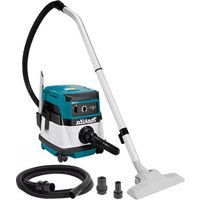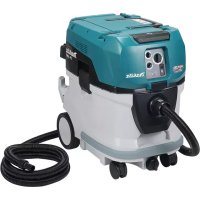
DVC156LZX1 - Cordless vacuum MAKITA - Free user manual and instructions
Find the device manual for free DVC156LZX1 MAKITA in PDF.


| Brand | Makita |
| Model | DVC156LZX1 |
| Product Type | Cordless Vacuum Cleaner |
| Usage | Commercial (hotels, schools, hospitals, factories, offices) |
| Tank Capacity | 15 L |
| Dimensions (L x W x H) | 366 mm x 334 mm x 421 mm |
| Net Weight (with battery) | 7.3 - 7.9 kg |
| Rated Voltage | 36 V DC |
| Compatible Batteries | BL1815N, BL1820B, BL1830B, BL1840B, BL1850B, BL1860B |
| Compatible Chargers | DC18RC, DC18RD, DC18RE, DC18SD, DC18SE, DC18SF, DC18SH, DC18WC |
| Max Air Volume (hose) | 2.1 m³/min (with BL1850B, hose ∅32 mm) |
| Max Air Volume (turbine) | 3.4 m³/min |
| Max Vacuum | 11 kPa |
| Standard Filter | Cloth filter (for dry dust) |
| Optional Filter | HEPA powder filter + pre-filter |
| Noise Level | ≤ 70 dB(A) (K=2.5 dB(A)) |
| Vibration | ≤ 2.5 m/s² (K=1.5 m/s²) |
| Protection Rating | IPX4 |
| Main Functions | Suction power adjustment, wheel lock, retractable handle, optional tool box, paper/polyethylene bag compatibility |
| Routine Maintenance | Clean the cloth filter by shaking it; wash the HEPA filter with water; empty the tank regularly |
| Safety | Overload, overheat, and deep discharge protection; do not vacuum liquids or flammable materials |
| Spare Parts | Filters, hoses, tubes, nozzles, bags, batteries, chargers available from Makita |
| Warranty | Use only genuine Makita parts to preserve the warranty |
Frequently Asked Questions - DVC156LZX1 MAKITA
User questions about DVC156LZX1 MAKITA
0 question about this device. Answer the ones you know or ask your own.
Ask a new question about this device
Download the instructions for your Cordless vacuum in PDF format for free! Find your manual DVC156LZX1 - MAKITA and take your electronic device back in hand. On this page are published all the documents necessary for the use of your device. DVC156LZX1 by MAKITA.
USER MANUAL DVC156LZX1 MAKITA
- This machine is not intended for use by persons including children with reduced physical, sensory or mental capabilities, or lack of experience and knowledge.
- Children should be supervised to ensure that they do not play with the cleaner.
- See the chapter "SPECIFICATIONS" for the type reference of the battery.
- See the section "Installing or removing battery cartridge" for how to remove or install the battery.
- When disposing the battery cartridge, remove it from the tool and dispose of it in a safe place. Follow your local regulations relating to disposal of battery.
- If the tool is not used for a long period of time, the battery must be removed from the tool.
- Do not short the battery cartridge.
- See the chapter "MAINTENANCE" for the appropriate details of precautions during user maintenance.
SPECIFICATIONS
| Model: DVC866L DVC156L | ||
| Standard filter type Cloth filter (for dry dust) | ||
| Maximum air volume at the end of hose(with BL1850B,ø32 mm x 1.7 m hose) | 2.1 m³/min | |
| Maximum air volume at turbine(with BL1850B) | 3.4 m³/min | |
| Vacuum(with BL1850B) | 11 kPa | |
| Recoverable capacity 8 L 15 L | ||
| Dimensions (L x W x H) 366 mm x 334 mm x 368 mm 366 mm x 334 mm x 421 mm | ||
| Rated voltage D.C. 36 V | ||
| Net weight 7.1 - 7.7 kg 7.3 - 7.9 kg | ||
| Protection degree IPX4 | ||
- Due to our continuing program of research and development, the specifications herein are subject to change without notice.
- Specifications and battery cartridge may differ from country to country.
- The weight does not include accessories but battery cartridge(s). The lightest and heaviest combination weight of the appliance and battery cartridge(s) are shown in the table.
Applicable battery cartridge and charger
| Battery cartridge | BL1815N / BL1820B / BL1830B / BL1840B / BL1850B / BL1860B |
| Charger | DC18RC / DC18RD / DC18RE / DC18SD / DC18SE / DC18SF / DC18SH / DC18WC |
- Some of the battery cartridges and chargers listed above may not be available depending on your region of residence.

WARNING: Only use the battery cartridges and chargers listed above. Use of any other battery cartridges and chargers may cause injury and/or fire.
Symbols
The followings show the symbols which may be used for the equipment. Be sure that you understand their meaning before use.

Read instruction manual.

Take particular care and attention.

Warning! The cleaner may contain hazardous dust.

Never stand on the cleaner.

Dust class L (light). The cleaners are capable of picking up dust class L. Follow your country's regulations relating to dusts and to occupational health and safety.

Ni-MH Li-ion
Only for EU countries
Due to the presence of hazardous components in the equipment, waste electrical and electronic equipment, accumulators and batteries may have a negative impact on the environment and human health. Do not dispose of electrical and electronic appliances or batteries with household waste!
In accordance with the European Directive on waste electrical and electronic equipment and on accumulators and batteries and waste accumulators and batteries, as well as their adaptation to national law, waste electrical equipment, batteries and accumulators should be stored separately and delivered to a separate collection point for municipal waste, operating in accordance with the regulations on environmental protection.
This is indicated by the symbol of the crossed-out wheeled bin placed on the equipment.
Intended use
The tool is intended for collecting dry dust. The tool is suitable for commercial use, for example in hotels, schools, hospitals, factories, shops, offices and rental businesses.
Noise
The typical A-weighted noise level determined according to IEC60335-2-69:
Model DVC866L
The noise level under working may exceed 80 dB (A).
NOTE: The declared noise emission value(s) has been measured in accordance with a standard test method and may be used for comparing one tool with another.
NOTE: The declared noise emission value(s) may also be used in a preliminary assessment of exposure.

WARNING: Wear ear protection.
WARNING: The noise emission during actual use of the power tool can differ from the declared value(s) depending on the ways in which the tool is used especially what kind of workpiece is processed.
WARNING: Be sure to identify safety measures to protect the operator that are based on an estimation of exposure in the actual conditions of use (taking account of all parts of the operating cycle such as the times when the tool is switched off and when it is running idle in addition to the trigger time).
Vibration
The vibration total value (tri-axial vector sum) determined according to IEC60335-2-69:
Vibration emission (a_h,M):2.5m / s^2 or less Uncertainty (K) 1.5m / s^2
NOTE: The declared vibration total value(s) has been measured in accordance with a standard test method and may be used for comparing one tool with another.
NOTE: The declared vibration total value(s) may also be used in a preliminary assessment of exposure.

WARNING: The vibration emission during actual use of the power tool can differ from the declared value(s) depending on the ways in which the tool is used especially what kind of workpiece is processed.

WARNING: Be sure to identify safety measures to protect the operator that are based on an estimation of exposure in the actual conditions of the site (taking account of all parts of the operating cycle such as the times when the tool is switched off and when it is running idle in addition to the trigger time).
Declarations of Conformity
For European countries only
The Declarations of conformity are included in Annex A to this instruction manual.
SAFETYWARNINGS
Cordless vacuum cleaner safety warnings

WARNING: IMPORTANT! READ CAREFULLY
all safety warnings and all instructions BEFORE
USE. Failure to follow the warnings and instructions may result in electric shock, fire and/or serious injury.
- Before use, make sure that this cleaner must be used by people who have been adequately instructed on the use of this cleaner.
- Before use, operators shall be provided with information, instruction and training for the use of the machine and the substances for which it is to be used, including the safe method of removal and disposal of the material collected.
- Always make sure that filters are correctly installed before use. Do not use the cleaner without filters in place. Replace a damaged filter immediately. It is recommended to have some spares as filters are consumable items.
- AVOID UNINTENTIONAL STARTING. Be sure switch is OFF when installing battery(ies).
- Do not attempt to pick up flammable materials, fireworks, lighted cigarettes, hot ashes, hot metal chips, sharp materials such as razors,
needles, broken glass or the like.
- NEVER USE THE CLEANER IN THE VICINITY OF GASOLINE, GAS, PAINT, ADHESIVES OR OTHER HIGHLY EXPLOSIVE SUBSTANCES. The switch emits sparks when turned ON and OFF. And so does the motor commutator during operation. A dangerous explosion may result.
- Never vacuum up toxic, carcinogenic, combustible or other hazardous materials such as asbestos, arsenic, barium, beryllium, lead, pesticides, or other health endangering materials.
- Always place the cleaner on a horizontal flat surface to prevent it from falling or moving unintentionally.
- Never use the cleaner outdoors in the rain.
- For Finland, this machine is not to be used outdoors at low temperature.
- Do not use close to heat sources (stoves, etc.).
- If the exhaust air is returned to the room, it is necessary to provide for an adequate air change rate in the room. Reference to National regulations is necessary.
- Do not block suction inlet/outlet/cooling vents. These vents permit cooling of the motor. Blockage should be carefully avoided otherwise the motor will burn out due to a lack of ventilation.
- Keep proper footing and balance at all times.
- Do not fold, tug or step on the hose.
- Stop the cleaner immediately if you notice poor performance or anything abnormal during operation.
- REMOVE THE BATTERY(IES). When not in use, before servicing, and when changing accessories.
- Clean and service the cleaner immediately after each use to keep it in tiptop operating condition.
- MAINTAIN THE CLEANER WITH CARE. Keep the cleaner clean for better and safer performance. Follow instructions for changing accessories. Keep handles dry, clean, and free from oil and grease.
- CHECK DAMAGED PARTS. Before further use of the cleaner, a guard or other part that is damaged should be carefully checked to determine that it will operate properly and perform its intended function. Check for alignment of moving parts, binding of moving parts, breakage of parts, mounting, and any other conditions that may affect its operation. A guard or other part that is damaged should be properly repaired or replaced by an authorized service center unless otherwise indicated elsewhere in this instruction manual. Have defective switches replaced by authorized service center. Don't use the cleaner if switch does not turn it on and off.
-
For user servicing, the machine shall be dismantled, cleaned and serviced, as far as is reasonably practicable, without causing risk to the maintenance staff and others.
-
The machine should be technically inspected by the manufacturer, or an instructed person, at least annually, consisting of, for example, inspection of filters for damage, air tightness of the machine and proper function of the control mechanism.
- When carrying out service or repair operations, all contaminated items which cannot be satisfactorily cleaned are to be disposed of; such items shall be disposed of in impervious bags in accordance with any current regulation for the disposal of such waste.
- REPLACEMENT PARTS. When servicing, use only identical replacement parts.
- When not in use, always store the cleaner indoors.
- Be kind to your cleaner. Rough handling can cause breakage of even the most sturdily built cleaner.
- Do not attempt to clean the exterior or interior with benzine, thinner or cleaning chemicals. Cracks and discoloration may be caused.
- Do not use cleaner in an enclosed space where flammable, explosive or toxic vapors are given off by oil-based paint, paint-thinner, gasoline, some mothproofing substances, etc., or in areas where flammable dust is present.
- Do not operate the cleaner or any tool while under the influence of drugs or alcohol.
- As a basic rule of safety, use safety goggles or safety glasses with side shields.
- Use a dust mask in dusty work conditions.
- This machine is not intended for use by persons including children with reduced physical, sensory or mental capabilities, or lack of experience and knowledge.
- Children should be supervised to ensure that they do not play with the cleaner.
- Never handle battery(ies) and cleaner with wet hands.
- Use extreme caution when cleaning on stairs.
- Do not use the cleaner as a stool or work bench. The machine may fall down and may result in personal injury.
- Do not pick up foam or soapy liquid. It can cause foam to come out of air exit, resulting in electric shock and damage to the cleaner.
Battery tool use and care
- Recharge only with the charger specified by the manufacturer. A charger that is suitable for one type of battery pack may create a risk of fire when used with another battery pack.
- Use power tools only with specifically designated battery packs. Use of any other battery packs may create a risk of injury and fire.
- When battery pack is not in use, keep it away from other metal objects, like paper clips, coins, keys, nails, screws or other small metal objects, that can make a connection from one terminal to another. Shorting the battery terminals together may cause burns or a fire.
- Under abusive conditions, liquid may be ejected from the battery; avoid contact. If contact accidentally occurs, flush with water. If
liquid contacts eyes, additionally seek medical help. Liquid ejected from the battery may cause irritation or burns.
- Do not use a battery pack or tool that is damaged or modified. Damaged or modified batteries may exhibit unpredictable behaviour resulting in fire, explosion or risk of injury.
- Do not expose a battery pack or tool to fire or excessive temperature. Exposure to fire or temperature above 130^ may cause explosion.
- Follow all charging instructions and do not charge the battery pack or tool outside the temperature range specified in the instructions. Charging improperly or at temperatures outside the specified range may damage the battery and increase the risk of fire.
SAVE THESE INSTRUCTIONS.
WARNING: DO NOT let comfort or familiarity with product (gained from repeated use) replace strict adherence to safety rules for the subject product. MISUSE or failure to follow the safety rules stated in this instruction manual may cause serious personal injury.
Important safety instructions for battery cartridge
- Before using battery cartridge, read all instructions and cautionary markings on (1) battery charger, (2) battery, and (3) product using battery.
- Do not disassemble or tamper with the battery cartridge. It may result in a fire, excessive heat, or explosion.
- If operating time has become excessively shorter, stop operating immediately. It may result in a risk of overheating, possible burns and even an explosion.
- If electrolyte gets into your eyes, rinse them out with clear water and seek medical attention right away. It may result in loss of your eyesight.
- Do not short the battery cartridge:
(1) Do not touch the terminals with any conductive material.
(2) Avoid storing battery cartridge in a container with other metal objects such as nails, coins, etc.
(3) Do not expose battery cartridge to water or rain. A battery short can cause a large current flow, overheating, possible burns and even a breakdown.
- Do not store and use the tool and battery cartridge in locations where the temperature may reach or exceed 50^ (122^) .
- Do not incinerate the battery cartridge even if it is severely damaged or is completely worn out. The battery cartridge can explode in a fire.
-
Do not nail, cut, crush, throw, drop the battery cartridge, or hit against a hard object to the battery cartridge. Such conduct may result in a fire, excessive heat, or explosion.
-
Do not use a damaged battery.
-
The contained lithium-ion batteries are subject to the Dangerous Goods Legislation requirements.
For commercial transports e.g. by third parties, forwarding agents, special requirement on packaging and labeling must be observed.
For preparation of the item being shipped, consulting an expert for hazardous material is required.
Please also observe possibly more detailed national regulations.
Tape or mask off open contacts and pack up the battery in such a manner that it cannot move around in the packaging.
- When disposing the battery cartridge, remove it from the tool and dispose of it in a safe place. Follow your local regulations relating to disposal of battery.
- Use the batteries only with the products specified by Makita. Installing the batteries to non-compliant products may result in a fire, excessive heat, explosion, or leak of electrolyte.
- If the tool is not used for a long period of time, the battery must be removed from the tool.
- During and after use, the battery cartridge may take on heat which can cause burns or low temperature burns. Pay attention to the handling of hot battery cartridges.
- Do not touch the terminal of the tool immediately after use as it may get hot enough to cause burns.
- Do not allow chips, dust, or soil stuck into the terminals, holes, and grooves of the battery cartridge. It may cause heating, catching fire, burst and malfunction of the tool or battery cartridge, resulting in burns or personal injury.
- Unless the tool supports the use near high-voltage electrical power lines, do not use the battery cartridge near high-voltage electrical power lines. It may result in a malfunction or breakdown of the tool or battery cartridge.
- Keep the battery away from children.
SAVE THESE INSTRUCTIONS.
CAUTION: Only use genuine Makita batteries. Use of non-genuine Makita batteries, or batteries that have been altered, may result in the battery bursting causing fires, personal injury and damage. It will also void the Makita warranty for the Makita tool and charger.
Tips for maintaining maximum battery life
- Charge the battery cartridge before completely discharged. Always stop tool operation and charge the battery cartridge when you notice less tool power.
- Never recharge a fully charged battery cartridge. Overcharging shortens the battery service life.
-
Charge the battery cartridge with room temperature at 10^ - 40^ (50°F - 104°F). Let a hot battery cartridge cool down before charging it.
-
When not using the battery cartridge, remove it from the tool or the charger.
- Charge the battery cartridge if you do not use it for a long period (more than six months).
PARTS DESCRIPTION
Fig.1: 1. Tank cover 2. Filter cage 3. Cloth filter 4. Tank
FUNCTIONAL DESCRIPTION
CAUTION: Always be sure that the tool is switched off and the battery cartridge is removed before adjusting or checking function on the tool.
Installing or removing battery cartridge
CAUTION: Always switch off the tool before installing or removing of the battery cartridge.
CAUTION: Hold the cleaner and the battery cartridge firmly when installing or removing battery cartridge. Failure to hold the cleaner and the battery cartridge firmly may cause them to slip off your hands and result in damage to the cleaner and battery cartridge and a personal injury.
CAUTION: Be careful not to pinch your fingers when opening or closing the battery cover. Failure to do so may cause personal injury.
To install the battery cartridge, release the lock first, and then open the battery cover. After that, insert the battery cartridge.
Fig.2: 1. Lock 2. Battery cover
Align the tongue on the battery cartridge with the groove in the housing and slip it into place. Insert it all the way until it locks in place with a little click. Then lock the battery cover.
Fig.3: 1. Battery cartridge
To remove the battery cartridge, slide it from the tool while sliding the button in front of the cartridge.
CAUTION: Always install the battery cartridge fully until the red indicator cannot be seen. If not, it may accidentally fall out of the cleaner, causing injury to you or someone around you.
CAUTION: Do not install the battery cartridge forcibly. If the cartridge does not slide in easily, it is not being inserted correctly.
NOTE: The cleaner does not work with only one battery cartridge.
Indicating the remaining battery capacity
Only for battery cartridges with the indicator
Press the check button on the battery cartridge to indicate the remaining battery capacity. The indicator lamps light up for a few seconds.
Fig.4: 1. Indicator lamps 2. Check button
| Indicator lamps Remaining | capacity | ||
| Lighted Off | Blinking | ||
| 75% to 100% | |||
| 50% to 75% | |||
| 25% to 50% | |||
| 0% to 25% | |||
| Charge the battery. | |||
| The battery may have malfunctioned. | |||
NOTE: Depending on the conditions of use and the ambient temperature, the indication may differ slightly from the actual capacity.
NOTE: The first (far left) indicator lamp will blink when the battery protection system works.
Indicating the remaining battery capacity
Fig.5: 1. Battery indicator 2. Check button
Fig.6
Press the check button to indicate the remaining battery capacities. The battery indicators correspond to each battery.
| Battery indicator status Remaining | battery capacity | ||
| On Off | Blinking | ||
| 50% to 100% | |||
| 20% to 50% | |||
| 0% to 20% | |||
| Charge the battery | |||
Tool / battery protection system
The tool is equipped with a tool/battery protection system. This system automatically cuts off power to the motor to extend tool and battery life. The tool will automatically stop during operation if the tool or battery is placed under one of the following conditions:
Overload protection
When the tool is operated in a manner that causes it to draw an abnormally high current, the tool automatically stops without any indication. In this situation, turn the tool off and stop the application that caused the tool to become overloaded. Then turn the tool on to restart.
Overheat protection
On Blinking


When the tool is overheated, the tool stops automatically, and the battery indicator blinks about 60 seconds. In this situation, let the tool cool down before turning the tool on again.
Overdischarge protection
When the battery capacity becomes low, the tool stops automatically. If the product does not operate even when the switches are operated, remove the batteries from the tool and charge the batteries.
Switch action
Fig.7: 1. Stand-by switch 2. Power button 3. Suction force adjusting knob
To start the cleaner:
-
Set the stand-by switch to the "I" side. The cleaner gets into stand-by state.
-
Press the power button.
To make the cleaner get into stand-by mode, press the power button again.
To turn off the cleaner, set the stand-by switch to the "O" side.
The suction power can be adjusted according to your work need.
Suction power can be increased by turning the suction force adjusting knob from the symbol to the symbol.
NOTICE: Always set the stand-by switch to the "O" side when not using the cleaner for long time. The cleaner consumes power during stand-by state.
Locking or unlocking the caster
▶ Fig.8: 1. Caster 2. Stopper lever 3. FREE position 4. LOCK position
Locking the caster is convenient when storing the cleaner, stopping the work on the way and keeping the cleaner still.
To operate the stopper, move it by hand.
To lock the caster with a stopper, lower the stopper lever and the caster no longer will rotate. To release the
caster from the locked position, raise the stopper lever.
NOTE: When moving the cleaner, make sure that the caster is unlocked. Moving the cleaner with the caster in the locked position may cause damage to the caster.
Carriage handle
When carrying the cleaner, carry it by holding the handle on the head. The handle is retractable at the head when not in use.
Fig.9
ASSEMBLY
CAUTION: Always be sure that the tool is switched off and the battery cartridge is removed before carrying out any work on the tool.
CAUTION: Always wear dust mask during assembly or maintenance.
Installing the powder filter (HEPA) and prefilter (for dry dust)
Optional accessory
CAUTION: Never pick up water or other liquids or wet dusts when using the powder filter. Picking up such things may cause the powder filter breakage.
To use powder filter:
- Remove the filter cage and cloth filter.
Fig.10: 1.Filter cage 2.Cloth filter - Place the prefilter in the tank while aligning the mounting position markings.
- Mount the damper on the powder filter and then place them in the prefilter while aligning the mounting position markings.
- Mount the tank cover and lock it.
Fig.11: 1. Tank cover 2. Powder filter (HEPA)
- Damper 4. Prefilter 5. Tank 6. Mounting position marking
NOTICE: Before using the powder filter, make sure that prefilter and damper are used together. It is not allowed to install powder filter alone.
Installing the paper pack
Optional accessory
WARNING: Before using the paper pack, make sure that the cloth filter or prefilter is used together. Failure to use the cloth filter / prefilter together may cause unusual noise and heat, resulting in a fire.
NOTICE: Never pick up water or other liquids or wet dusts when using the paper pack. Picking up such things may cause the paper pack breakage.
NOTICE: When using the cloth filter, make sure that the float and the float cage are attached on the tank cover.
NOTICE: When using the prefilter, make sure that the powder filter and the damper are used together.
- Extend the paper pack.
- Align the paper pack opening with the dust suction opening of the cleaner.
- Insert the cardboard part of the paper pack onto the holder so that it is positioned at the end beyond the detent protrusion.
Fig.12: 1. Paper pack 2. Holder
Installing the polyethylene bag
Cleaner can also be used without polyethylene bag. However, using polyethylene bag is easier to empty the tank without letting your hands dirty.
Spread the polyethylene bag in the tank. Insert it between the holder plate and the tank, and pull it to the hose inlet.
Fig.13: 1. Holder plate 2. Polyethylene bag
Spread the bag around the top of the tank so that the cloth filter / prefilter edge can catch and hold the bag securely.
Fig.14: 1. Cloth filter / prefilter
NOTE: A polyethylene bag available on the market can be used. 0.04mm or thicker one is recommended.
NOTE: Too much dust will tear the bag easily, so do not collect the dust more than the half of the bag capacity.
Emptying the polyethylene bag
WARNING: Always make sure that the cleaner is switched off and the battery cartridge is removed before emptying the polyethylene bag. Failure to do so may cause an electric shock and serious personal injury.
CAUTION: Do not apply a great impact on the tank. Applying a great impact may cause deformation and damage to the parts.
CAUTION: Empty the tank at least once a day although this depends on picked-up dust volume in the tank. Or, the suction force will weaken and the motor may be broken.
CAUTION: Do not grab the hook when emptying the tank. Grabbing the hook may cause the hook to break.
Unhook and lift up the tank cover.
Shake off the dust from the cloth filter / prefilter and then take the polyethylene bag out of the tank.
Fig.15
NOTE: Take the polyethylene bag carefully out of the tank so that the polyethylene bag cannot be caught and torn by the protrusion inside the tank when emptying it.
NOTE: Empty the polyethylene bag before it becomes full. Too much dust in the tank may cause the polyethylene bag to be torn.
Installing the tool box
- Release the lock of the battery cover, and open the battery cover.
- Set the rails on the tool box along the grooves on the housing.
- Close the battery cover and apply the lock.
Fig.16
The tool box is convenient for carrying batteries, pipe, or cuffs.
Fig.17
Connecting the hose
NOTICE: Never force the hose for bending or stamp it. Never move the cleaner by a hose. Forcing, stamping and pulling the hose may cause a breakage or deformation of the hose.
NOTICE: When picking up large wastes such as planer carvings, concrete dusts or similar other than small wastes, use the 38mm inner diameter hose (optional accessory). Using the 28mm inner diameter hose (optional accessory) may cause a hose stuffing and damage.
Insert the hose onto the mounting port of the tank and turn it clockwise until it locks.
Fig.18
Connecting the attachment with lock function
Optional accessory
Insert the attachment into the suction inlet until it clicks. To remove, pull the attachment while pushing the release button.
Fig.19: 1. Suction inlet with lock function 2. Release button 3. Attachment with lock function
NOTE: The attachment with lock function is available when using the suction inlet with lock function.
Fig.20: 1. Attachment with lock function 2. Suction inlet with lock function 3. Suction inlet without lock function
Adjusting the length of the slide-type extension wand
Optional accessory
With pressing the slide button, adjust the wand length. The length is locked when releasing the slide button.
Fig.21: 1. Slide button
MAINTENANCE
CAUTION: Always be sure that the tool is switched off and the battery cartridge is removed before attempting to perform inspection or maintenance.
NOTICE: Never use gasoline, benzine, thinner, alcohol or the like. Discoloration, deformation or cracks may result.
To maintain product SAFETY and RELIABILITY, repairs, any other maintenance or adjustment should be performed by Makita Authorized or Factory Service Centers, always using Makita replacement parts.
Storage of accessories
The pipes can be placed into the pipe holder when not using the cleaner for a short time.
Fig.22
Fig.23
The hose can be stored around the tool by connecting each ends.
Fig.24
Cleaning of cloth filter
Clogged cloth filter causes poor suction performance. Clean out the cloth filter from time to time.
To remove dust or particles adhering to the cloth filter, shake the frame bottom quickly several times.
Fig.25: 1. Cloth filter
Cleaning of powder filter (HEPA) and prefilter
Optional accessory
Clogged powder filter, prefilter and damper cause poor suction performance. Clean out the filters and damper from time to time.
To remove dust or particles adhering to the filters, shake the frame bottom quickly several times.
Occasionally wash the powder filter in water, rinse and dry thoroughly in the shade before use. Never wash filters in a washing machine.
Fig.26
NOTE: Do not rub or scratch the powder filter, the prefilter and the damper with hard objects such as a brush and a paddle.
NOTE: The filters wear out in course of time. It is recommended to have some spares for them.
OPTIONAL ACCESSORIES
CAUTION: These accessories or attachments are recommended for use with your Makita tool specified in this manual. The use of any other accessories or attachments might present a risk of injury to persons. Only use accessory or attachment for its stated purpose.
If you need any assistance for more details regarding these accessories, ask your local Makita Service Center.
Hose
- Front cuff (22, 24, 38)
- Straight pipe
- Extension wand
- Corner nozzle
- Round brush
- Powder filter, HEPA (for dry dust)
Damper
- Prefilter
- Nozzle assembly
- Bent pipe
Polyethylene bag
- Paper pack
- Holder set
- Makita genuine battery and charger
NOTE: Some items in the list may be included in the tool package as standard accessories. They may differ from country to country.
AVENTISSEMENT
ACCESSIONS EN OPTION
VEILIGHEIDSWAAR-SCHUWINGEN
OPTIONELE ACCESSOIRES
Móvo yia xwpe ts Eupwnns
Oi Anwoeic Sumuoppwoc npeiaaavovtai oTo Napapntma A oTo npov Exyeipioo odnyiwv.
ПОНТОПИЗЕI
AΣΦΑΛΕΙΑΣ
PpOeIoToiOnoEic aOpaAeiaC yia Tn ooptnn unxavn avappoFonns
A PPOEIAOIOIHsH: ZHMANTIKOIABAE TPOEKEKTIKA oAES TIG PPOEIDOTIOINOEIG YIA TIV aOaIaeia kai oAES TIG ONDYIECS IPIN ANO TH XPHsH. H nTnponTsw TPPOEIOTIOINoeWv KAI oNDyiw mTOpEi va kataaNcEi OE NkEKTpoTTnCi, TUPKayia n/kai σoβapó tpaumatio.
- Pniv aTn Tn xpno, BepaiwOeite oTI autn n unxavn 0a xpnoiopoInoIe i anto atoia oTa otioia exouv dooei eTnapkeic oOnyiec yia tn xpnoanuTns unxavics.
- Pniv Tn xpno, OTOUC xeiipotcG a dooouv
PAnpoopiecs, oynieCs kai EKTAIDeun yia Tn
XpnoTou mnxavnmuToC kai twv ouoiw v tC
OTIOIECS Ox npsoioTOnEi, OUMTEPIAubavo
MeVnc Tns aoaalouc eOboDou apapeoan Ck
DiTeocns Tou uAIKOu OuaLEx0ke. - Na nT a oT a i t p a exouv toTOBETnOeI Owot aTPO T xPnON.Mn xpnoIOIOIE TE N OKOUa Xwpic Ta i t p a va Bpiokovtai OTn 0Eon Touc.AvtikataoTnote auoeoc eva i t p o TouEv EUTOOTei Znua. Suviotatai va exete epeika avtaaaktia ETEIDn ta i t p a eivai avaalwoiqa vtikejueva.
- NA ANOΦEYFETE THN AOEAHTH ENEPRONOIHsz. Beaiωeite oti o biakottnc evai KAEI2TO2 otav too3e1e Tnv(Tic) μπatapia(εs).
- Mny EtnixieipnoTe va oullleEte eupkta uikia, Tnpotexvnpata, avmueva toiyapa, kautcstaxtcs, zetota metaalika opaoupata, aixnpaavtkieeva otwns lupapakia, bloves, ntaoEv yuai npapoia avtkiepeva.
- MH XPHESIMOIOEITE NOTE TH MHXANH KONTA ZE BENZINH, AEPIA, MNOTIA, KOANES H AANES YVHAA EKPHKTIKEOYIEZ. O dia-KoTTnC Tnpayei OTIVnpec otav EVepyoTOIEi TAI KAI ATVEpyoTOIEiTai. To iio kai o patoTneac potepkata ndiapkeia ncs aeitoupyiac. Mtopei va Ppokuie Etikivovn EkpnSg.
- Mny avappoape TOTe Toikka, kapkivoyova, kaouma n aaaa eTikovua uika, otwcauiavto, apoeviko, bapi0, npuAio, oauBdo, Evtouoktova n aaaa uika Tnou aToteAouv Kivduvo yia Tnv uyia.
- Na toTOnoTeEite TavTa Tn OKouTa Ae opiOvTiA EInTeBn EInPavEia, Yia va aToPoExxTei nTTwOan n n eTakivnOn tnc kata laoos.
- Mn xpoiouoieite nToe tn mXavn oE EwTe- piko Xwpo Otn Bpoxn.
- Tn avbia, auto to mxa vma 6v npetie va xpoiopointheta i e Ewtepkouc xwpouc e Xaunn theppokpia.
- Mn xnpoiopoioite Kovra e Tnyec θepuotntac (poupvoi, kTλ.).
- Av o aépaç égaywyns Eπiσtpeφει στο δματio,
Eiva aTapaiaTTO va povtroeYIA TO Etnapknpuo aalaync Tou aepa oTo AIO. Eiva aTapaiaTTO va avatpeEte OTouc eVkoC kavovioouc.
- Mny aooetra aoiymuata eioobou avappOoNc/Esobou/psiNc.Auta ta aoiymuataeITPteTouv nV uGn Tou potep. Oa pTei va aTOpeux9ei TPOOEKTIA to ppaigo, diaopepeTKaTO potep 0a KaeI loyw EAAeiusg aeipouu.
- Na otékeote Távta oTaθερa kai IooppoTnμéva.
- Mn διπλύνετε, μην τραβάτε και μην πατάτε τον εύκαμτιτο σωλήνα.
- AiaKoYTE aEosG Tn aeIToupyia Tns mXavns av npatnpnoTe AVtapKn ano0n n otioNTOTE aovnIOTo kata n aeitoupyia.
- BRAATE THN(TI) MNATAPIA(ES).OTav v xpnoiopoioieitai,piiv aTTO oepic kai otav aaacTe aegouap.
- KaopioTe kai ekteleote oepis otn unxavn aeoos meta atro kae xpon yia va biatnpei-Tai e apiotn aeitoupyikn kataoataon.
- DIATHPEITE TH MHXANH ME NPOOXH. Na δiatnpεite Tn μnxavn kaθapn γia tnv kaλuτepn Kai ασφαλεστepn απδoσn. Na ακολouθεite Tic oδnyieç γia tnv aλλayn twv αξεοouap. Na δiatnpεite Tc λαβες στεγνες, kaθapες, χωpiς λáδi kai yρασo.
- NA EAEIXETA MEPH ME ZHMIA. niv aTOn Tnv TepaIepw xpnoTnC mXavng, 0a TpeTcI va EeYXE TE PPOEKTiKA TUxov TPoOaTEUTiKa EApntmuata n aaA eaptnmaue zniia via va KaOpioTe av 0a Leitoupyoouv oWoTa kai av 0a npayatooioouv Tnv TpoopoiOevn Aeioupyia Touc. EeYfTe Tnv EUOuypauMIO Tuv KIVOUeVW UEPWv, Tnv EeUeepn KInon Tuv KIVOUeVW UEPWv, TO TUxov OTAOIO EApntmuTsw, Tn OtepewON KAI OTIOEoHNTote aAles ouvNkcs Tounu MTopei va Etnpeaoov Tn LEIToupyia Tou epyaleiou. Eva pOoTA-TEUTIKo n allo Eaptnmaue Zniua 0a PPTEI VA EINIOKEUAOTE i na VAtikataoTaei Owotra SE ESouoIbOtoNevo Kevtpo oepic EKToc av Dnawetai diaopepetik aTO npov Exyeipioo obnyiw. OI eattwupatiKoi diakOtTE cPPTe I VA AVTKaOIGTavtae EgouoIbOtoNevo Kevtpo oepic. Mn xpnoiOToIEITE tn mnxavn av O diaKoTTnc Dev Tnv EvpyoToiei Kai Dev Tnv aTVEpyoToiei.
- TiaTic epyaies eepis aTo To xpnoTn, to mXavma mtopei va anoovapapooynEi, va Kathetai kai va ouvtnpnEi, ooo evai elooya npaktikó, xwpic va TpoknEi kivduvoCto TpoosnKo ouvtnpnCkai e alouc.
- To mnxavma 0a pentei va unoketai o texvikn eTIOeewpon an tov kataoekuaotn, n aTO EVTEAHEVO aToO, Touaxiotov ETNOIwS, TEPIAaBavovtac, YIA napadeiyu, TNV EITeWpON TOW VIATPwV YIA Znui, TNV aepo- OTeyavOTnTA TOU mnxavnpaTOc KAI T N OWTN Aetoupyia TOU mnxavioou elEyxou.
- Otav dieyayetye epyaiec epbiic n ENI- Okeunc, ola ta loluupeva stoixia Tou dev mtropouv va kaapioiouv eikavotoiniko
Eik.21: 1. Koupi oiao ngns
SYNTHPHSEH
AIPPOOXH: Pniv Tnv EKTaleo n epyaoiwv ETIe- wpnong n ouvtnpon, naVTote va ebaWveote oTn OuaKEun aTVEpyoioinKke Kai n Kaetar mataipiwv exi aqapeei.
EIDONIOHs: Mny xnpoiouoite note bEvzivn, Tepelaiko aIepa, diautiko, akkooan n Taipopoiec ouiec. Mtopei va pokantheaoxpwatauoc, npapopawon npwye.
Tia Tn diatnpnTnC AΦAIAE KAI AEIONIETIA Tou TpoioVTOc,oi Etniokuec KAI OTIOADHNTOTE aAN epyaia ouvtnpnnc npuOmuNG PpTeVE aKTEAOvTu aTo EgouoioBDtneVA n EpyoostaikakéVtpa ESUTNPeTnC TnS Makita, xpnoiotoiWvTac Tavote avtaaaktika TnS Makita.