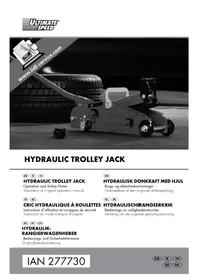
IAN 300443 - Jack ULTIMATE SPEED - Free user manual and instructions
Find the device manual for free IAN 300443 ULTIMATE SPEED in PDF.



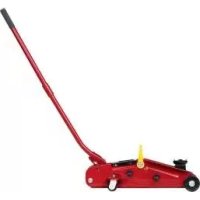
| Product type | Hydraulic jack |
| Brand | Ultimate Speed |
| Model | IAN 300443 |
| Load capacity | 3000 kg |
| Lifting height | Approx. 11.5 cm |
| Weight | Approx. 2.9 kg |
| Hydraulic oil | ISO VG 15 |
| Maximum actuating force | 380 N |
| Usage | For lifting and lowering vehicles (domestic use) |
| Package contents | 1 hydraulic jack, 1 lifting bar, 1 lowering valve rod, 1 instruction manual |
| Safety | Use with jack stands; do not exceed rated load; never work under a vehicle without support |
| Maintenance | Lubricate moving parts regularly; wipe with a slightly oiled cloth; bleed air from the hydraulic system if necessary |
| Warranty | 3 years |
| After-sales service France | Tel. 0800 904 879, email: owim@lidl.fr |
| After-sales service Belgium | Tel. 0800 710 11, email: owim@lidl.be |
| Standards | EN 1494/A1:2008, CE marking |
Frequently Asked Questions - IAN 300443 ULTIMATE SPEED
User questions about IAN 300443 ULTIMATE SPEED
0 question about this device. Answer the ones you know or ask your own.
Ask a new question about this device
Download the instructions for your Jack in PDF format for free! Find your manual IAN 300443 - ULTIMATE SPEED and take your electronic device back in hand. On this page are published all the documents necessary for the use of your device. IAN 300443 by ULTIMATE SPEED.
USER MANUAL IAN 300443 ULTIMATE SPEED
Operation and safety notes Translation of the original instructions
NL BE
HYDRAULISCHESTEMPELKRIK
GB/IEOperation and safety notesPage 13
ca./approx. /env. 18,5-36cm
Authorised Signatory
List of pictograms used
Introduction
Proper use. Page 14
Description of parts.. Page 14
Technical data.. Page 14
Included items
Safety notes.. Page 14
Use
Raising the vehicle. Page 16
Lowering the vehicle . Page 16
Cleaning and care
Maintenance and storage
Topping up the hydraulic oil/greasing.. Page 17
Removing air from the hydraulic system.. Page 17
Storing. Page 17
Troubleshooting
Disposal
Warranty
Warranty claim procedure.. Page 19
Service Page 19
EC Declaration of conformity
List of pictograms used

Read the instruction manual

ca./approx. /env. 18.5-36cm
Minimum and maximum possible height

CE mark indicates conformity with relevant EU directives applicable for this product.
Hydraulic bottle jack
Introduction
We congratulate you on the purchase of your new product. You have chosen a high quality product. Familiarise yourself with the product before using it for the first time. In addition, please carefully refer to the operating instructions and the safety advice below. Only use the product as instructed and only for the indicated field of application. Keep these instructions in a safe place. If you pass the product on to anyone else, please ensure that you also pass on all the documentation with it.
- Proper use
The hydraulic vehicle jack is intended for raising and lowering motor vehicles. Other uses or modification of the hydraulic vehicle jack shall be considered as improper use and may lead to injury or damage. The manufacturer will not accept liability for loss or damage arising from improper use. The product is not intended for commercial use.
Note: Reclose the release valve 5 after each use!
Description of parts
Support plate
2 Extension screw
3 Lifting handle socket
4 Safety valve
5 Release valve
Lifting handle (for pump mechanism)

Rod (for release valve)

Oil plug
Technical data
Stroke: approx. 11.5 cm
Maximum load: 3000kg
Weight: approx. 2.9kg
Hydraulic oil: Complies with ISO VG 15
Maximum
force on lever: 380N^
- Included items
1 Hydraulic bottle jack
1 Lifting handle
1 Rod for release valve
1 Operating instructions

Safety notes
DANGER! Follow the instructions below to avoid the threat of loss of life, injury, or damage to the product etc.
Always use axle stands and wheel chocks in addition to your hydraulic vehicle jack.
Never work under a raised vehicle unless you have taken additional safety precautions. This is intended to prevent the vehicle from rolling away, sliding off or overturning the jack.
Use the product on a solid, level surface only. Using the product on an unstable or uneven surface - such as a gravel surface - may lead to the load slipping.
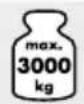
Ensure that you never exceed the allowable (rated) load capacity.
The person operating the jack must observe the jack and the load during all movements.
Never work under the raised load if it has not been made secure by suitable means.
Do not allow the hydraulic vehicle jack to be used by uninstructed or inexperienced persons.
Before using the hydraulic vehicle jack take precautions to prevent the vehicle from rolling away. Put the handbrake on, place the vehicle in gear (with automatic gearboxes set to "P") and chock the wheels.
Even with safety measures in place always remain alert and make a visual check that the support plate 1 is firmly seated against the vehicle jacking point.
Make sure that no petrol, battery acid or any other dangerous substance can flow out of the vehicle when the vehicle is being lifted.
Check that no person or object is under the vehicle before you lower it.
Lower the vehicle slowly.
Check that all parts have been assembled and fitted properly and are undamaged.
Before each use check that the hydraulic vehicle jack is working properly. Check the screws and valves of the hydraulic vehicle jack for correct seating and look out for hydraulic oil leaks in particular.
Never use the hydraulic vehicle jack for moving or loading a vehicle. Never use it to lift a whole vehicle completely off the ground.
It's not allowed to lift up people with the hydraulic jack and make sure that near located people keep enough distance to the vehicle when the hydraulic jack is in use.
Never change the setting of the safety valve. 4. It is preset to the correct setting in the factory and must never be readjusted later.
Do not use the hydraulic car jack if the sealing (safety valve 4) is damaged.
Before using the vehicle jack, the user must be made familiar with the device by an experienced person. The pump force and the
transferred force are equal to approximately 380N^*
If the markings on the product are damaged enough so as to be illegible then the vehicle jack must not be used until the markings are renewed.
No modifications may be carried out to the hydraulic bottle jack. Any physical modification of the device and its compliance with EN 1494/A1:2008.
The applied force when using the vehicle jack must not exceed 380N^ . The equates to a force on the lever of approximately 38kg
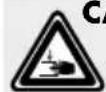
CAUTION! RISK OF SHEARING AND CRUSHING IN
JURY! Keep your fingers away
from the area of the lifting handle socket 3 while pumping. Failure to observe this advice may result in shearing and crushing injury.
The operating temperature of the hydraulic oil of this equipment is between -20^ to +40^ .
Do not use this equipment in rooms exposed to fire hazards, where flammable or explosive vapours or dusts may be present (e.g. in stables, barns or paint shops).
Only use this device to lift and lower the vehicle, not to keep the vehicle in a lifted position. Do not move it whilst raising or lowering.
Do not use the equipment if oil leaks are present.
After use return all parts used into their original position. Have the hydraulic oil or oil pump replaced by a professional if the parts can no longer be moved.
If you notice a spillage of oil, stop using the product and absorb the oil on the floor with a cloth. Any reparation must be done by a professional.
If the jack can not be lowered as wished, the car must be secured by jack stand against unintended lowering. Get a new jack, with which you can lift the car, so that the defect jack can be removed. If you are unsure, please ask for professional help.
- If the generated efforts exceed the value, the efforts shall be lowered by additional persons.
Use
Raising the vehicle
CAUTION! RISK TO LIFE! Check that the vehicle jack and axle stands are in an undamaged condition before you use them. Ensure that the hydraulic vehicle jack is used only in combination with axle stands. Have your axle stands to hand before raising the vehicle. If you do not use axle stands, the vehicle may tip over and cause a risk to life.
Follow these steps:
Ensure that the support plate is fully lowered and the extension screw is completely screwed in before you put away the vehicle jack.
Place the hydraulic vehicle jack in the desired position. In choosing the position, observe the provisions of the owner's manual for your vehicle.
If necessary screw out the extending screw 2 until it comes into contact with the underside of the vehicle (Fig. B).
Connect the rod to the lifting handle to extend the lifting handle.
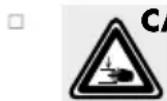
CAUTION! RISK OF SHEARING AND CRUSHING IN
JURY! Keep your fingers away from the area of the lifting handle socket 3 while pumping. Failure to observe this advice may result in shearing and crushing injury.
Guide the end of the lifting handle 6 into the lifting handle socket 3 and pump the vehicle up to the desired height (Fig. D).
Note: Pay attention on the slot on the handle socket 3. Make sure the lifting handle 6 locked into the slot correctly.
Place the axle stands under the designated jacking points under the vehicle.
Relieve the load from the vehicle jack by placing the rod with the oval opening
on to the release valve 5, then turning the rod 7 slightly anticlockwise before turning it back immediately. The support plate 1 drops slightly and the vehicle is held on the axle stands.
Lowering the vehicle
DANGER TO LIFE! Check that no person or object is under the vehicle before you lower it.
CAUTION! Lower the vehicle slowly, otherwise there is the danger of injury and damage to the product or to the vehicle.
First raise the vehicle slightly in order to be able to remove the axle stands. Proceed as described in the section on "Raising the vehicle".
Remove the axle stands.
Place the rod with oval opening on to the release valve and turn the rod slowly anticlockwise (Fig. C). The vehicle is lowered slowly.
Note: The more quickly the rod 7 is turned anticlockwise, the faster the vehicle is lowered. Therefore you should proceed very cautiously at first in order to get a feeling for the correct speed.
Lower the support plate 1 until it is no longer loaded. Then pull the vehicle jack out from under the vehicle. Press down on the support plate 1 until it is fully lowered.
- Close the release valve 5 by turning the rod 7 on the release valve 5 clockwise.
Take the rod 7 off the release valve 5.
If it is extended, screw the extension screw 2 back down into the jack body.
If the jack can no longer be lowered as desired, secure the vehicle at all costs using safety stands to prevent it unintentionally being lowered. Procure another jack to hoist the vehicle as far up as possible for you to be able to safely remove the defective jack. Seek professional help if you are uncertain.
- Cleaning and care
Liberally grease all external moving parts.
Clean the hydraulic trolley jack using a slightly oily cloth.
Never use harsh or corrosive cleaning agents.
- Maintenance and storage
- Topping up the hydraulic oil/greasing
Note: Use only hydraulic oil that complies with ISO VG 15.
Stand the vehicle jack upright on a level, flat surface.
Screw the extension screw completely down into the jack body.
Place the rod 7 with oval opening on to the release valve 5 and turn the rod anticlockwise (Fig. C) until the support plate 1 is fully lowered.
Pull the oil plug 8 out of the oil reservoir.
Introduce hydraulic oil from a suitable vessel into the oil reservoir. Fill the hydraulic oil reservoir up to the bottom edge of the filling opening.
Remove any air present in the hydraulic system. To do this follow steps 3-4 in section on "Removing air from the system".
Replace the oil plug 8 back into the oil reservoir opening.
Grease all moving parts on the vehicle jack regularly to prevent corrosion.
Top up with approximately 100-105 ml oil if all the oil has been used up.
Note: The lifetime of three years expires, if the car jack get not checked by qualified specialist.
Defective hydraulic vehicle jacks must be repaired by a specialist workshop only. Never attempt to repair the hydraulic vehicle jack yourself.
- Removing air from the hydraulic system
Air in the hydraulic system may detrimentally affect the proper functioning of the vehicle jack.
Proceed as follows to remove air from the hydraulic system:
- Place the rod 7 with oval opening on to the release valve 5 and turn the rod anticlockwise (Fig. C), apply a little pressure to press down the support plate until the support plate 1 is fully lowered.
- Pull the oil plug 8 out of the oil reservoir.
- Guide the lifting handle 6 into the lifting handle socket 3 and pump it up and down several times to allow any air to escape.
- Place the rod 7 with oval opening on to the release valve 5 and turn the rod clockwise (Fig.C). The release valve 5 is now closed again.
- Replace the oil plug 8 back into the oil reservoir opening.
- If necessary, repeat steps 1-5 until all the air has escaped.
Storing
Place the rod 7 with oval opening on to the release valve 5 and turn the rod anticlockwise (Fig. C) until the support plate 1 is fully lowered.
Screw the extension screw 2 completely down into the jack body.
Store the hydraulic vehicle jack and the lifting handle in a dry environment and protected from moisture.
Ensure that the support plate 1 is fully lowered and the extension screw 2 is completely screwed in before you put away the vehicle jack. This will prevent the oil escaping from the oil plug 8
Grease all moving parts on the vehicle jack regularly to prevent corrosion.
- Troubleshooting
= Fault
Cause
O = Remedy
The vehicle jack does not raise the vehicle at all or does not raise it high enough.
The release valve was not properly closed.
O = Close the release valve 5 completely (see the section on "Raising the vehicle").
There is not enough hydraulic oil in the vehicle jack.
O = Top up the hydraulic oil (see the section on "Topping up the hydraulic oil / greasing").
= There is too much hydraulic oil in the cylinder.
O = Remove the excess quantity of hydraulic oil from the cylinder.
= There is air in the hydraulic system.
O = Remove the air in the hydraulic system (see the section on "Removing air from the hydraulic system").
The vehicle jack gives way under load.
The release valve was not properly closed.
O = Close the release valve 5 completely (see the section on "Raising the vehicle").
= Hydraulic oil escapes.
= There is too much hydraulic oil in the cylinder.
O = Remove the excess quantity of hydraulic oil from the cylinder.
= The pump mechanism works only partially.
= There is too much hydraulic oil in the cylinder.
O = Remove the excess quantity of hydraulic oil from the cylinder.
= There is air in the hydraulic system.
O = Remove the air in the hydraulic system (see the section on "Removing air from the hydraulic system").
- Disposal
The packaging is made entirely of recyclable materials, which you may dispose of at local recycling facilities.
Contact your local refuse disposal authority for more details of how to dispose of your worn-out product.
Dispose of the hydraulic oil in an environmentally compatible manner. Ask your local repair garage to see to its disposal or find your nearest waste materials collection centre.
Warranty
The product has been manufactured to strict quality guidelines and meticulously examined before delivery. In the event of product defects you have legal rights against the retailer of this product. Your legal rights are not limited in any way by our warranty detailed below.
The warranty for this product is 3 years from the date of purchase. The warranty period begins on the date of purchase. Please keep the original sales receipt in a safe location. This document is required as your proof of purchase.
Should this product show any fault in materials or manufacture within 3 years from the date of purchase, we will repair or replace it - at our choice - free of charge to you. This warranty becomes void if the product has been damaged, or used or maintained improperly.
The warranty applies to defects in material or manufacture. This warranty does not cover product parts subject to normal wear, thus possibly considered consumables (e.g. batteries) or for damage to fragile parts, e.g. switches, rechargeable batteries or glass parts.
Warranty claim procedure
To ensure quick processing of your case, please observe the following instructions:
Please have the till receipt and the item number (IAN 373991_2104) available as proof of purchase.
You will find the item number on the rating plate, an engraving on the front page of the instructions for use (bottom left), or as a sticker on the rear or bottom of the product.
If functional or other defects occur, please contact the service department listed either by telephone or by e-mail.
You can return a defective product to us free of charge to the service address that will be provided to you. Ensure that you enclose the proof of purchase (till receipt) and information about what the defect is and when it occurred.
Service
GB Service Great Britain
Tel.: 08000569216
E-Mail: owim@lidl.co.uk
IE Service Ireland
Tel.:1800200736
E-Mail: owim@lidl.ie
C
EC DECLARATION OF CONFORMITY
IAN:
373991_2104
Product identification:
Ultimate Speed HYDRAULIC BOTTLE JACK
Model Number:
HG02971
The object of the declaration described above is in conformity with the relevant Union harmonisation legislation:
Directive 2006/42/EC
References to the relevant harmonised standards used or references to the other technical specifications in relation to which conformity is declared:
| N° / Parts |
| Directive 2006/42/EC |
| EN 1494:2000/A1:2008 |
Name and address of the manufacturer:
This declaration of conformity is issued under the sole responsibility of the manufacturer.
Legendede sptogrammesutilis e.. Page 22
Introduction
ca./approx. /env. 18,5-36cm
Directive 2006/42/EC
Directive 2006/42/EC
EN 1494:2000/A1:2008
Authorised Signatory
ca./approx. /env. 18,5-36cm
Directive 2006/42/EC
Directive 2006/42/EC
EN 1494:2000/A1:2008
Authorised Signatory
DEKLARACJA ZGODNOSCICI WE
IAN:
373991 2104
Nazwa produktu:
Ultimate Speed HYDRAULICZNY PODNOSNIK STEMPLOWY
Oznaczenia modelu:
HG02971
Directive 2006/42/EC
Directive 2006/42/EC
EN 1494:2000/A1:2008
ca./approx. /env. 18,5-36cm
Directive 2006/42/EC
Directive 2006/42/EC
EN 1494:2000/A1:2008
Jmeno a adresa virobce:
ca./approx. /env. 18,5-36cm
Directive 2006/42/EC
Directive 2006/42/EC
EN 1494:2000/A1:2008
Meno a adresa vyrobcu:
Authorised Signatory
ca./approx. /env. 18,5-36cm
Altura minima/maxima possible

Directive 2006/42/EC
Directive 2006/42/EC
EN 1494:2000/A1:2008
Authorised Signatory
ca./approx. /env. 18,5-36cm
Directive 2006/42/EC
| Nr. / Dele |
| Directive 2006/42/EC |
| EN 1494:2000/A1:2008 |