Stylus 100 wide - Camera OLYMPUS - Free user manual and instructions
Find the device manual for free Stylus 100 wide OLYMPUS in PDF.



| Product type | 35mm autofocus all-automatic camera with 28-100mm zoom |
| Dimensions (W x H x D) | 117 x 61.5 x 42.5 mm (excluding protrusions) |
| Weight | 220 g (without battery) |
| Power supply | One 3V lithium battery (CR123A or DL123A) |
| Film format | Standard 35mm DX-coded film (24 x 36 mm) |
| Lens | Olympus 28-100mm, F4.6-11.9, 7 elements in 7 groups |
| Shutter | Programmed electronic shutter |
| Focus | Passive multi-autofocus system (max. 11 points) with lock |
| Focus range | From 0.6 m to ∞ at wide angle, from 0.8 m to ∞ at telephoto |
| Exposure control | 3-zone metering, range -2.4 EV to 16 EV at wide angle |
| Viewfinder | Real-image zoom viewfinder with diopter adjustment |
| Frame counter | Displayed on LCD screen |
| Self-timer | Electronic, approximately 12-second delay |
| Film speed | Automatic setting for ISO 50-3200 (DX-coded films) |
| Film loading/advance/rewind | Automatic |
| Flash modes | Auto, Red-eye reduction, Fill-in, Flash-off, Night scene, Red-eye reduction + Night scene |
| Exposure modes | Auto, Spot metering, Infinity |
| Remote control (optional) | Infrared RC-300C, approximately 3-second delay, range approx. 5 m |
| Maintenance and cleaning | Avoid heat, humidity, salt, organic solvents; wipe with a soft cloth |
| Safety precautions | Do not disassemble, do not expose to fire, keep batteries out of reach of children |
| Spare parts repairability | Consult the retailer or Olympus after-sales service |
Frequently Asked Questions - Stylus 100 wide OLYMPUS
User questions about Stylus 100 wide OLYMPUS
0 question about this device. Answer the ones you know or ask your own.
Ask a new question about this device
Download the instructions for your Camera in PDF format for free! Find your manual Stylus 100 wide - OLYMPUS and take your electronic device back in hand. On this page are published all the documents necessary for the use of your device. Stylus 100 wide by OLYMPUS.
USER MANUAL Stylus 100 wide OLYMPUS
Germany, tel. 040-237730
(Lefelte, Postsch 104956, 2003 Hamburg, Germany)
CE EN This camera complies with EU directive 09395/EEC for CE marking.
DK Dette kamera overholder EU 90/836/EBD for CE marking.
4) Europa camera upolar ULL directly, RCHSLC or CL marjana.
natural_image
Line drawing of a Olympus digital camera with no text or symbols on the body
-

A
[Non-Text]
EN INSTRUCTIONS 4
Read this manual carefully before using your camera (especially "Care and Storage" on page 12).
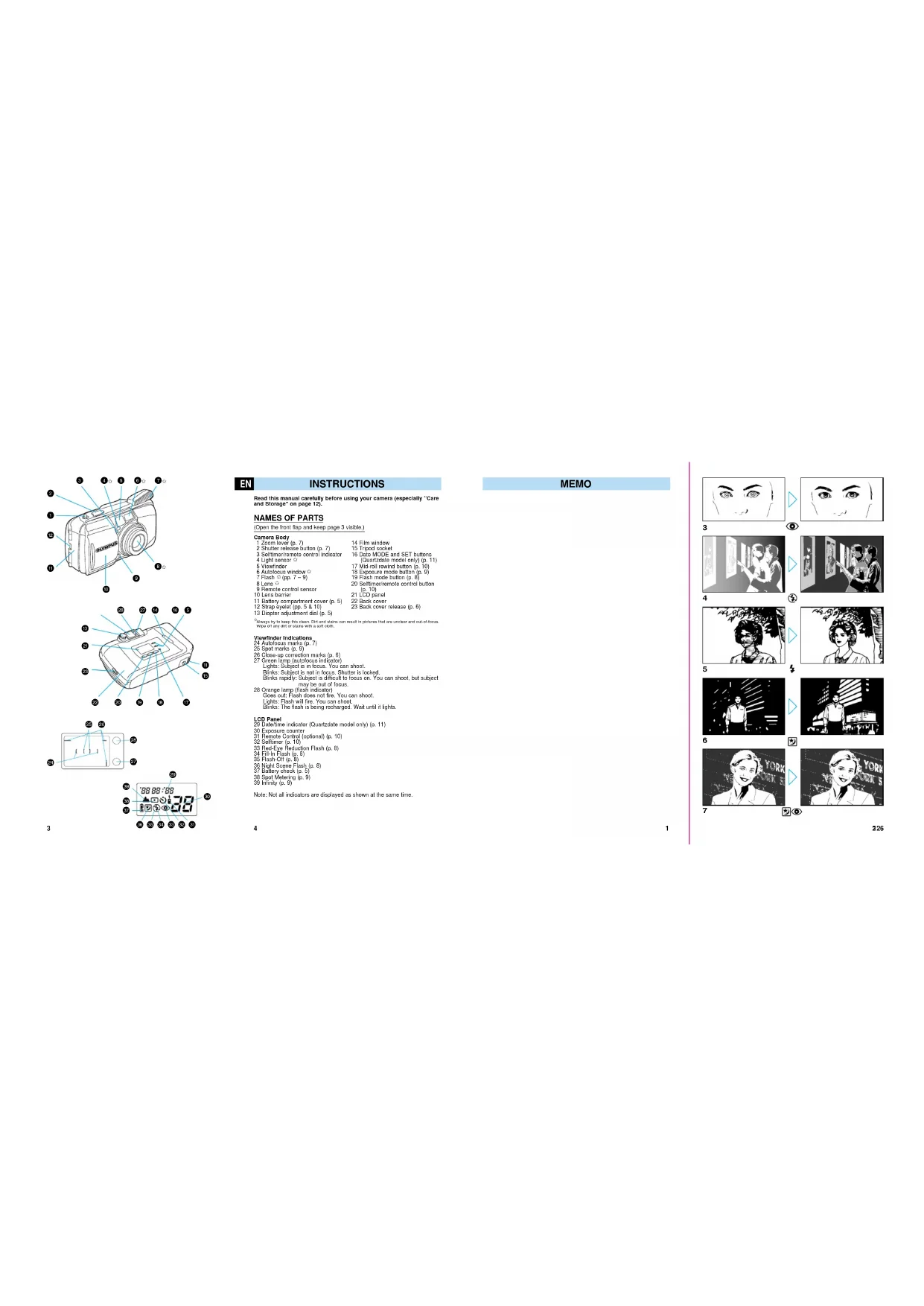
NAMES OF PARTS
(Open the front flap and keep page 3 visible.)
Camera Body
1 Zoom lever (in 7)
2 Shutter release bulgan (p. 7)
- Seltimarkamis central parlor
d Light scene
4 Digit 36180
a Viewfinder
6 Autococcus window
7 Flash C (pp. 7-9)
8 Lera
9 Female control server
10 Lens garrie
11 Railway commercial group (n. 5)
12 Stamp cyclot (an. 6, 8, 10)
- Di
13 Doppier ssozuren, dis (p. 5)
^2 (a) by to keep the 100% DFT and (4) is on C5 in polyposals, but not more and out of four.
Algo de la
Viewfinder Indications
24 Autologous marks Ip.
25 Spot marks (a. 9)
26 Close-up correction marks (p. 8)
27 Green lamp (autofocus indicator)
Lights. Subject is in focus. You can shoot
Elvis: Subject is not in focus. Shutter is indeed
Sister, student is fun in tasks. Small is missed. Billiers rank by: Subject is difficult to leave on. You can shoot, but subject
• Since Rapka, subject to almost 100% on. Too cold school, but out of us. may be out of news
May be all by OAS.
28 Orange lamp (laser) Induction
Goes out: Flash does not tre. You can shoot
Lights: Flash will live. You can shoot.
Blies: The flash is being recharged. Well until it lights.
LCD Panel
29 Date-time indicator (Quartzdale model only) [p. 11]
30 Exposure counter
- Bremie Control (Ingliavalt (p. 10))
32 September 10
- Post-Ex. Production: 100% (a. 3)
33 Red-Eye Reduction Hasin Ip. 5; 24 FL by Dash (p. 8)
34 Flt-11 Flash (p. 8)
35 H98-F-01 (3.6)
36 Night Scene Flash (p. B)
37 Battery check [p. 0]
36 Pool Melering (p. 9)
39 Infinity (p. 9)
Note: Not all indicators are displayed as shown at the same time.
MEMO


3
17


5
广力云智慧零售收银系统



7
EN
INSTRUCTIONS
Read this manual carefully before using your camera (especially "Care and Storage" on page 12).
NAMES OF PARTS
(Open the front flap and keep page 3 visible.)
Camera Body
1 Zoom lever (p. 7)
2 Shutter release button (p. 7)
3 Selftimer/remote control indicator
4 Light sensor ☆
5 Viewfinder
6 Autofocus window ☆
7 Flash ☆ (pp. 7 - 9)
8 Lens
9 Remote control sensor
10 Lens barrier
11 Battery compartment cover (p. 5)
12 Strap eyelet (pp. 5 & 10)
13 Diopter adjustment dial (p. 5)
* Always try to keep this clean. Dirt and stains can result in pictures that are unclear and out-of-focus. Wipe off any dirt or stains with a soft cloth.
Viewfinder Indications
24 Autofocus marks (p. 7)
25 Spot marks (p. 9)
26 Close-up correction marks (p. 6)
27 Green lamp (autofocus indicator)
Lights: Subject is in focus. You can shoot.
Blinks: Subject is not in focus. Shutter is locked.
Blinks rapidly: Subject is difficult to focus on. You can shoot, but subject may be out of focus.
28 Orange lamp (flash indicator)
Goes out: Flash does not fire. You can shoot.
Lights: Flash will fire. You can shoot.
Blinks: The flash is being recharged. Wait until it lights.
LCD Panel
29 Date/time indicator (Quartzdate model only) (p. 11)
30 Exposure counter
31 Remote Control (optional) (p. 10)
32 Selftimer (p. 10)
33 Red-Eye Reduction Flash (p. 8)
34 Fill-In Flash (p. 8)
35 Flash-Off (p. 8)
36 Night Scene Flash (p. 8)
37 Battery check (p. 5)
38 Spot Metering (p. 9)
39 Infinity (p. 9)
Note: Not all indicators are displayed as shown at the same time.
FIRST STEPS
EN
LOADING AND CHECKING THE BATTERY
Use one 3 V lithium battery (CR123A or DL123A).

text_image
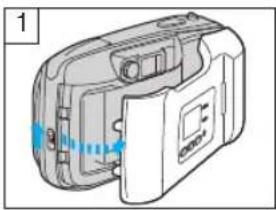
1 ② ①- While pressing the bottom of the battery compartment cover in direction
①, turn it in direction ② to open.
• Make sure the lens barrier is closed before opening the battery compartment cover.

text_image
2- Insert the battery correctly ①. Close the battery compartment cover ②.
natural_image
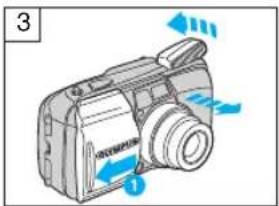
Illustration of a digital camera with blue directional arrows indicating motion (no text or symbols)- Slide the lens barrier in direction until it clicks. The lens comes out and the flash flips open. Check the remaining battery power on the LCD panel.
- A brand-new battery lasts for about 15 rolls of film.
| lights(turns off automatically). | Battery is OK. You can shoot. |
| blinks and other indicators are displayed normally. | Battery is low and should be replaced with a new one. |
| blinks and other indicators go out. | Battery is dead and should be replaced with a new one immediately. |
ATTACHING THE STRAP
Attach the strap as shown.

text_image
Diagram of a device with labeled parts, showing cable routing and component positioningDIOPTER ADJUSTMENT
Turn the diopter adjustment dial until the autofocus marks are clear.

natural_image
Close-up of a door handle with a blue circular indicator on the top (no text or symbols visible)EN
STANDARD FUNCTIONS
LOADING THE FILM

natural_image
Diagram of a device with internal components and a blue indicator arrow (no text or symbols)
natural_image
Diagram of a device interior showing a component with a blue arrow indicating rotation or movement (no text or symbols present)- Slide the back cover release upward to open the back cover.
- Do not touch the inside of the camera, especially the lens.
- Insert the film cartridge until it clicks into position.

text_image
3 A B- Align the film leader with the guide line (A), and place the film between the positioning guides (B). Then close the back cover until it clicks.
• The film automatically advances to the first frame. - Open the lens barrier until it clicks. Make sure the exposure counter on the LCD panel reads "A".
- If "E ^T blinks, reload the film.
FOCUSING AND WORKING DISTANCE

natural_image
Illustration of two figures standing outdoors with trees in the background (no text or symbols)This camera uses a wide multi-autofocus system that makes it easier for the camera to focus on subjects even if they are not in the center of the viewfinder. Shoot your subject from a distance of 0.6 m to ∞(infinity) at wide angle and from 0.8 m to ∞(infinity) at telephoto. Although the shutter will release when a subject is extremely close to the subject, the subject will be out of focus.
CLOSE-UP PHOTOGRAPHY

text_image
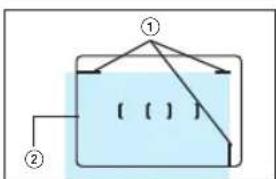
Diagram showing a container with liquid and two labeled ports, marked with numbers ① and ②.The picture area will move lower in the viewfinder as you get closer to the subject.
① Close-up correction marks (picture area at closest distance).
② Picture area at infinity.
STANDARD FUNCTIONS
EN
TAKING PICTURES

text_image
1 T G W
text_image
2 Autofocus marks
natural_image
Illustration of a hand holding a digital camera with a sensor icon and control panel (no text or symbols)- Open the lens barrier until it clicks. The lens will extend slightly and the LCD panel will turn on. Push the zoom lever to the "T" side for telephoto (100 mm) or to the "W" side for wide angle (28 mm).
- After about 4 12 minutes of inactivity, the lens retracts and the LCD panel goes out.
- Position the autofocus marks (AF) on your subject.
-
Do not look at the sun or other strong light sources through the viewfinder.
-
Press the shutter release button halfway to focus on the subject. Make sure that the green lamp lights; then press the shutter release button all the way to take the picture. After the shutter is released, the film automatically advances to the next frame.
AUTO FLASH - WORKING DISTANCE
(with color negative film)
When reversal film is used, the working range at the telephoto side will be reduced by about 30%.
| ISO | Wide angle (W) | Telephoto (T) |
| 100 | 0.6 to 4.6 m | 0.8 to 1.8 m |
| 200 | 0.6 to 6.5 m | 0.8 to 2.5 m |
| 400 | 0.6 to 9.2 m | 0.8 to 3.6 m |
FILM REWINDING AND UNLOADING

text_image
24 EThe camera automatically rewinds the film when you reach the end of a roll. Make sure the motor has stopped and that "£" is blinking; then open the back cover to remove the film.
EN
SPECIAL FEATURES
Open the back flap and keep page 126 visible.

Red Eyes in Flash Pictures –
RED-EYE REDUCTION FLASH
When taking flash photos of persons in the dark the flashlight falls into the wide-open iris. There the flashlight is reflected red from the retina. The Red-Eye Reduction Flash emits a series of low-power pre-flashes before the main flash. This gives the subject's eyes a chance to adapt to the bright light by making the iris smaller. Assuming that the subject looks into the pre-flashes, the eyes will not appear red in the picture (see figure 3 on page 126).
- Hold the camera securely. It takes about 1 second until the shutter releases.
-
Red-eye reduction may not be effective when the subject:
-
Is not looking at the flash from right in front.
- Is not watching the pre-flashes.
- Is too far from the camera.
The effectiveness of red-eye reduction varies depending on the individual characteristics of each subject.

No Flash Allowed or Flash Spoils Atmosphere – FLASH-OFF
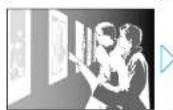
The Flash-Off is needed where flash photos are not allowed or where you want to keep the twilight or artificial light atmosphere unspoiled (see figure 4 on page 126).
- Since a slow shutter speed (as low as 2 seconds) is selected, use a tripod to prevent camera-shake.
- Have your subject stay still; otherwise, blurring may result.
Closing the lens barrier restores the Auto Flash mode.

Shadow on the Face – FILL-IN FLASH
When taking portrait photos in backlight or underneath a tree or roof, the subject's face may look too dark. The Fill-In Flash provides just the right amount of additional light to compensate for the shadow (see figure 5 on page 126) and for fluorescent light.
- Make sure your subject is within the flash working range (p. 7).
- Fill-in flash becomes ineffective in extremely bright conditions.
Closing the lens barrier restores the Auto Flash mode.

City at Night – NIGHT SCENE FLASH
When taking a walk in the city at night, you may want to take photos of your subject in the foreground with the city lights in the background. The Night Scene Flash takes care of this. The main flash lights the subject in the foreground while the shutter stays open up to 4 seconds to capture the city lights. You'll need to secure the camera on a tripod or other support to prevent camera shake (see figure 6 on page 126).
SPECIAL FEATURES
EN

Combination of the Two Modes -
Prevents the typical red eyes seen in pictures when shooting at night (see figure 7 on page 126). Both modes cannot be combined with the Spot Metering mode. Closing the lens barrier restores the Auto Flash mode.
SETTING THE FLASH MODES
| No display | Auto Flash |
| Red-Eye Reduction Flash | |
| Flash-Off | |
| Fill-In | |
| Night Scene Flash | |
| Red-Eye Reduction Night Scene Flash |
Press the flash mode button (✗). The mode switches in the order shown on the left. The selected mode is displayed on the LCD panel. Do not fire the flash right in front of the eyes of people and animals. Do not point the camera at a motorist and fire the flash.

High contrast – SPOT METERING
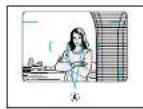
When taking photos in a high contrast environment (e.g. backlight portraits), the main subject may come out too dark or too bright. To make sure that the subject is exposed correctly use Spot Metering (see figure 1 on page 2). Position the spot marks (A) on the area where you want to measure the light. Press the shutter release button halfway; the green lamp lights and the focus and exposure are locked on that area. Reframe your subject and press the shutter release button all the way.

Shooting scenery – INFINITY
The camera automatically sets the workings distance at infinity. The flash does not fire except in the Fill-In Flash mode (see figure 2 page 2).
SETTING THE EXPOSURE MODES
| No display | Auto Exposure |
| Spot Metering | |
| Infinity |
Press the exposure mode button (☐)/▲. The mode switches in the order shown on the left. The selected mode is displayed on the LCD panel. Closing the lens barrier restores the Auto Exposure mode.
EN
SPECIAL FEATURES
SETTING THE SELFTIMER/REMOTE CONTROL
| No display | — |
| Selftimer | |
| Remote Control |
Press the selftimer/remote control button. The mode switches in the order shown on the left. The selected mode is displayed on the LCD Panel.

SELFTIMER
Secure the camera on a tripod or other support. Compose your shot in the viewfinder. Press the shutter release button halfway (the focus and exposure are locked at this time). Then press the shutter release button all the way. The selftimer indicator lights for about 10 seconds and then blinks for about 2 seconds. After this, the shutter will release.

REMOTE CONTROL RC-300C (Optional)
Compose your shot in the viewfinder. Position the autofocus frame on your subject. To take a picture, point the remote control at the camera and press the button on the remote control. The selftimer/remote control indicator starts blinking, and the shutter will release about 3 seconds later (see figure 8 on page 127).
OTHER OPERATIONS
REWINDING THE FILM MID-ROLL

natural_image
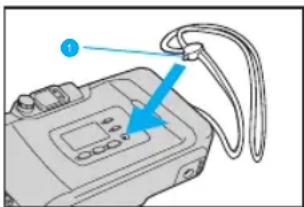
Illustration of a device with a blue arrow pointing to its top panel (no text or symbols present)Press the mid-roll rewind button with the protrusion on the strap buckle 1. Do not use an instrument with a sharp tip. Unload the film as described on page 7.
OTHER OPERATIONS
EN
PRINTING THE DATE/TIME (Quartzdate model only)

text_image
'03 10 23
flowchart
graph TD
    A["Day-hour-minute 23 15:59"] --> B["Day-month-year 23 10 '03"]
    B --> C["Month-day-year 10 23 '03"]
    C --> D["Year-month-day 10 23 10 23"]
    D --> E["None"]
First select the date/time mode you want to print. Press the MODE button. Each time you press it, the mode will switch in the order shown on the left. Keep the mode you want to print displayed. Date/time is imprinted in the lower right corner of the picture. If the date/time is superimposed on a bright color like white, orange, yellow, etc., it may be difficult to read. When black-and-white film is used, the date/time may not be printed.
CORRECTING THE DATE AND TIME
(Quartzdate model only)
Be sure to correct the date and time after the battery has been inserted or replaced.
- Keep the MODE button pressed until the "year" indicator starts blinking.
- Press the SET button to adjust the "year" indicator. If you press the button once, the number on the display will advance by 1. If you keep the button pressed, the numbers will run in rapid succession. If you pass the intended number, keep pressing to return to that number.
- Press the MODE button once more to make the "month" indicator blink. Press the SET button to adjust the "month" indicator. As you press the MODE button, the blinking indicator changes in the order of "year", "month", "day", "hour" and "minute".
- Repeat Steps 2 and 3 to set "hour" and "minute". Make sure the "minute" indicator is blinking.
- When "minute" has been set, press the MODE button. None of the indicators will be blinking and date/time correction is now complete.
REPLACING THE REMOTE CONTROL BATTERY
(Optional RC-300C)
If the selftimer/remote control indicator doesn't blink even when you press the button, replace the battery with a new one (CR2025).
- Turn the screw on the bottom of the remote control counterclockwise to loosen.
- Turn the remote control over, and remove the cover. With the battery facing up, remove the old battery and insert a new battery as shown.
- Replace the cover, turn the remote control over, and turn the screw on the bottom clockwise to tighten (see figure 9 on page 127).
EN
CARE AND STORAGE
- Do not leave the camera in any place exposed to excessive heat, humidity or direct sunlight – for example, in a car or on the beach.
- Do not expose the camera to formalin or naphthalene.
- If the camera gets wet, wipe it with a dry towel. The salt in seawater can be especially damaging.
- Do not use organic solvents such as alcohol or paint thinner when cleaning the camera.
- Do not leave the camera on or near a television, refrigerator or other appliance with a magnetic field.
- Do not expose the camera to dust or sand as this could cause serious damage.
- Do not shake or shock the camera.
- Do not apply excessive force to the zoom lens.
- Do not expose the camera to extreme heat (over 40 °C/104 °F) or to extreme cold (below -10 °C/14 °F). Low temperatures, even within this range may sometimes cause deterioration in battery performance, temporarily disabling the camera.
- Avoid leaving the camera unused for long periods of time. This can cause mold to grow on the camera as well as other problems. Try to press the shutter release button and check the operation of the camera before use.
- Some airport X-ray machines can damage the film in your camera. Try to avoid passing your camera through these machines. Give it to the security officer for manual inspection.
- Do not touch the front surface of the flash after using it continuously over a short period as the surface may be hot.
WARNING
KEEP THE BATTERIES AWAY FROM FIRE. NEVER TRY TO DISASSEMBLE, RECHARGE OR SHORT-CIRCUIT BATTERIES.
KEEP THE BATTERIES OUT OF THE REACH OF CHILDREN. IF A CHILD SWALLOWS A BATTERY, CONTACT A DOCTOR IMMEDIATELY.
NEVER ATTEMPT TO DISASSEMBLE THE CAMERA; IT CONTAINS A HIGH-VOLTAGE CIRCUIT. IF THE INTERNAL PARTS OF THE CAMERA ARE EXPOSED DUE TO DROPPING OR DAMAGE, REMOVE THE BATTERY IMMEDIATELY TO PREVENT FURTHER USAGE. IN CASE OF MALFUNCTION, CONSULT YOUR NEAREST OLYMPUS DEALER OR OLYMPUS SERVICE CENTER.
SPECIFICATIONS
EN
Type: Fully automatic 35 mm autofocus lens-shutter camera with built-in 28 mm \~ 100 mm zoom lens.
Film format: 35 mm standard DX-coded film (24 x 36 mm).
Lens: Olympus lens, 28 mm \~ 100 mm, F4.6 \~ 11.9, 7 elements in 7 groups.
Shutter: Programmed electronic shutter.
Viewfinder: Real image zoom view with diopter adjustment.
Focusing: Passive-type wide multi-autofocus system (max. 11 points). Focus lock possible.
Focusing range: 0.6 m \~ ∞ (infinity) at wide angle, 0.8 m \~ ∞ (infinity) at telephoto.
Exposure control: Programmed automatic exposure control, 3-zone light metering. Auto exposure range - EV2.4 (F4.6, 4-sec) \~ EV16 (F10.2, 1/630-sec) at wide angle, EV5.1 (F11.9, 4-sec) \~ EV17 (F18, 1/410-sec) at telephoto.
Exposure counter: Progressive type displayed on LCD panel.
Selftimer: Electronic selftimer with approx. 12-sec. delay.
Film speed range: Automatic setting with DX-coded film with ISO 50, 100, 200, 400, 800, 1600 or 3200. Other intermediate film speeds will be automatically set for next lower speed. Non-DX-coded film is set at ISO 100.
Film loading, advance, rewind: Automatic.
Flash: Built-in pop-up flash. Recycling time – approx. 0.5 \~ 5.5 sec. (at normal temperature, with new battery).
Flash modes: Auto Flash (low-light, backlight and fluorescent light), Red-Eye Reduction Flash, Flash-Off, Fill-In, Night Scene Flash and Red-Eye Reduction Night Scene Flash.
Exposure modes: Auto Exposure, Spot Metering and Infinity.
Power source: One 3 V lithium battery (DL123A or CR123A).
Dimensions: 117 (W) x 61.5 (H) x 42.5 (D) mm (excluding protrusions).
Weight: 220 g (without battery).
Other: All-weather design.
Remote Control Specifications (Optional)
Remote control system:
Infrared, with approx. 3-sec. delay.
Power source: One CR2025 battery.
Battery life: Approx. 5 years, with approx. 20,000 times.
Working distance: Approx. 5 m.
Dimensions: 56.5 x 35.0 x 6.5 mm.
Weight: 11 g (without battery).
SPECIFICATIONS ARE SUBJECT TO CHANGE WITHOUT NOTICE OR OBLIGATION ON THE PART OF THE MANUFACTURER. THE ACTUAL PRODUCT MAY DIFFER FROM ONES SHOWN IN THIS MANUAL.
DE
BEDIENUNGSANLEITUNG
natural_image
Illustration of a digital camera with blue directional arrows indicating motion (no text or symbols)text_image
Diagram of a device with labeled parts, showing a cable and connector with numbered annotations.DIOPTRIEAUSGLEICH
natural_image
Close-up of a computer monitor with a blue scroll wheel (no text or symbols visible)erkenn- bar ist.
DE
STANDARDFUNKTIONEN
EINLEGEN DES FILMS

natural_image
Diagram of a device with labeled parts, showing internal components and a blue dotted line indicating a measurement or adjustment (no text or symbols present)
natural_image
Diagram of a device interior showing a component with a blue arrow indicating rotation or movement (no text or symbols present)natural_image
Illustration of two people standing in a garden with trees and foliage (no text or symbols)NAHAUFNAHMEN

text_image
Diagram showing a container with liquid and two labeled ports, marked with numbers ① and ②.text_image
2 Autofocus-Messfeld
natural_image
Illustration of a hand holding a digital camera with a sensor emitting signal waves (no text or symbols)BLITZREICHWEITE
natural_image
Illustration of a device with a blue arrow pointing to its top panel (no text or symbols visible)natural_image
Mechanical component diagram showing a curved assembly with blue arrows indicating motion (no text or symbols)text_image
Diagram of a device with labeled parts, showing a cable and connector with blue arrows indicating motion or connection.REGLAGE DIOPTRIQUE
natural_image
Diagram of a device rear panel with a blue circular arrow pointing to the top-left corner (no text or symbols)FR
FONCTIONS STANDARDS
CHARGEMENT DU FILM

natural_image
Diagram of a device with internal components and a blue dotted line indicating a measurement or adjustment (no text or symbols present)
natural_image
Interior view of a device showing a component with a blue arrow indicating rotation or movement (no text or symbols visible)natural_image
Illustration of two people standing outdoors with trees in the background (no text or symbols)PHOTOGRAPHIE EN GROS-PLAN
text_image
Diagram showing a container with internal compartments and labeled parts, likely illustrating a filtration or separation process.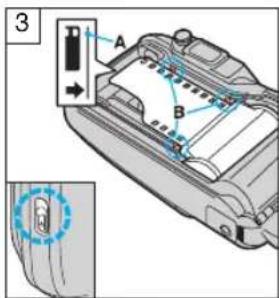
text_image
3 A Bnatural_image
Illustration of a device with a blue arrow pointing to its top panel (no text or symbols visible)natural_image
Mechanical component diagram showing a pin or grip with blue arrows indicating rotation (no text or symbols)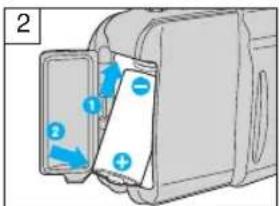
text_image
2
natural_image
Illustration of a digital camera with blue directional arrows indicating motion (no text or symbols)text_image
Diagram of a device with labeled parts, showing cable routing and component positioningAJUSTE DIÓPTRICO
natural_image
Close-up of a computer mouse head with a blue circular indicator on the left side (no text or symbols visible)ES
FUNCIONES ESTÁNDAR
CARGA DE LA PELÍCULA
natural_image
Diagram of a device casing with internal components and a blue indicator light (no text or symbols)
natural_image
Diagram of a device interior showing internal components with a blue arrow indicating rotation (no text or symbols present)natural_image
Two people standing in a forested area, viewed from behind (no text or symbols visible)
text_image
3 A Btext_image
Diagram showing a container with internal structures and labeled parts, likely illustrating a physics or engineering concept.natural_image
Illustration of a hand holding a digital camera with a sensor emitting sound waves (no text or symbols)natural_image
Illustration of a device with a blue arrow pointing to a button or connector (no text or symbols present)1 Leva dello Zoom (p. 47)
24 Crocino Autofocus (p. 47)
25 Indicatori Spot (p. 49)
text_image
2 ① ② ③ +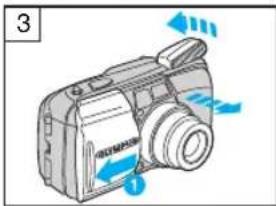
text_image
3 OCCUPATIONtext_image
Diagram of a device with labeled parts, showing cable routing and component positioningnatural_image
Close-up of a camera lens and screen (no text or symbols visible)IT
FUNZIONI STANDARD
natural_image
Diagram of a device with internal components and a blue dotted line indicating a measurement or adjustment (no text or symbols present)
natural_image
Diagram of a device interior showing a component with a blue arrow indicating rotation or movement (no text or symbols present)natural_image
Illustration of two figures standing outdoors with trees in the background (no text or symbols)text_image
Diagram showing a container with liquid and two labeled ports, marked with numbers ① and ②.text_image
2 Riferimento Autofocus
natural_image
Illustration of a handheld digital camera with a hand holding it, emitting sound waves (no text or symbols)natural_image
Diagram of a device with a blue arrow pointing to a control panel (no text or symbols visible)natural_image
Illustration of a digital camera with blue directional arrows indicating motion (no text or symbols)text_image
Diagram of a device with labeled parts, showing cable routing and component positioningnatural_image
Close-up of a car front panel with a blue circular icon on the top (no text or symbols visible)RU
СТАНДАРТНЫЕ ФУНКЦИИ
ЗАРЯДКА ФОТОПЛЕНКИ

natural_image
Diagram of a device with internal components and a blue dotted line indicating a specific area (no text or symbols present)
natural_image
Diagram of a device interior showing internal components and a blue directional arrow (no text or symbols)natural_image
Two people standing outdoors in front of trees, no visible text or symbolstext_image
Diagram showing two labeled components (① and ②) with arrows pointing to a container containing liquid, likely illustrating a filtration or separation process.natural_image
Illustration of a handheld electronic device with a blue arrow pointing to its top panel (no text or symbols visible)natural_image
Illustration of a digital camera with blue directional arrows indicating motion (no text or symbols)text_image
Diagram of a device with labeled parts, showing cable routing and component positioningДІОПТРІЙНА КОРЕКЦІЯ
natural_image
Diagram of a device's front panel with a blue circular arrow pointing to the screen (no text or symbols)UA
СТАНДАРТНІ ФУНКЦІЇ
ЗАРЯДКА ФОТОПЛІВКИ

natural_image
Diagram of a device with internal components and a blue dotted line indicating a measurement or adjustment (no text or symbols present)
natural_image
Diagram of a device interior showing a component with a blue arrow indicating rotation or movement (no text or symbols present)natural_image
Two people standing outdoors in a natural setting with trees and foliage (no text or symbols visible)
text_image
3 A Btext_image
Diagram showing a container with liquid and two labeled ports, marked with numbers ① and ②.natural_image
Diagram of a device with a blue arrow pointing to a component, no visible text or symbolsnatural_image
Mechanical component diagram showing a curved assembly with blue arrows indicating motion (no text or symbols)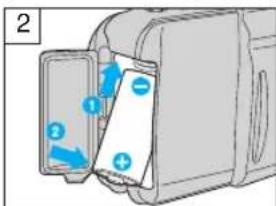
text_image
2 ① ② +
text_image
3 1text_image
Diagram of a device with labeled parts, showing a cable and a bag with blue arrows indicating connection points.INDSTILLING AF DIOPTRI
natural_image
Top-down view of a door handle with a blue circular indicator on the top (no text or symbols)DK
STANDARD FUNKTIONER
ISÆTNING AF FILM

natural_image
Diagram of a device casing with internal components and a blue indicator arrow (no text or symbols)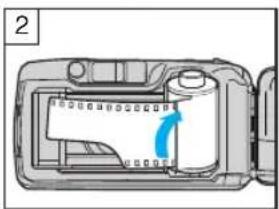
natural_image
Diagram of a device interior showing a component with a blue arrow indicating rotation or movement (no text or symbols present)natural_image
Illustration of two people standing outdoors in a natural setting (no text or symbols visible)text_image
Diagram showing a container with liquid and two labeled ports, marked as ① and ②.MANUEL TILBAGESPOLING AF FILMEN

natural_image
Illustration of a handheld electronic device with a blue arrow pointing to its screen (no text or symbols visible)text_image
Diagram of a device with labeled parts, showing cable routing and component positioningnatural_image
Diagram of a device's front panel with a circular button and a blue arrow pointing to the left side (no text or symbols)SE
STANDARD FUNKTIONER
FILMLADDNING

natural_image
Diagram of a device with internal components and a blue dotted line indicating a motion or movement (no text or symbols present)
natural_image
Diagram of a device interior showing a component with a blue arrow indicating rotation or movement (no text or symbols present)natural_image
Illustration of two figures standing in a forested area (no text or symbols)text_image
Diagram showing a container with liquid and two labeled ports, marked with numbers ① and ②.ÅTERSPOLNING AV FILM INNAN FILMSLUT
natural_image
Illustration of a device with a blue arrow pointing to its top panel (no text or symbols visible)natural_image
Illustration of a digital camera with blue directional arrows indicating motion (no text or symbols)text_image
Diagram of a device with labeled parts showing connection to a device with blue arrows indicating motion or force.INSTELLEN VAN DE OOGCORRECTIE
natural_image
Close-up of a computer monitor with a blue scroll wheel (no text or symbols visible)NL
STANDAARDFUNCTIES
natural_image
Diagram of a device with internal components and a blue dotted arrow indicating a motion or force (no text or symbols present)
natural_image
Diagram of a device interior showing internal components and a blue arrow indicating rotation (no text or symbols present)natural_image
Two people standing in a natural setting with trees and foliage in the background (no text or symbols visible)text_image
Diagram showing a container with liquid and two labeled ports, marked with numbers ① and ②.natural_image
Illustration of a handheld digital camera with a hand holding it, emitting sound waves (no text or symbols)natural_image
Illustration of a device with a blue arrow pointing to its screen (no text or symbols visible)Eén 3 V lithiumbatterij (DL123A of CR123A).
Afmetingen:
text_image
Diagram of a device with labeled parts, showing cable routing and component positioningDIOPTERIN SÄÄTÖ
natural_image
Diagram of a device's front panel with a circular dial indicator (no text or symbols)FI
PERUSTOIMINNOT
FILMIN LATAAMINEN

natural_image
Diagram of a device with internal components and a blue dotted line indicating a measurement or adjustment (no text or symbols present)
natural_image
Diagram of a device interior showing a component with a blue arrow indicating rotation or movement (no text or symbols present)natural_image
Illustration of two figures standing outdoors with trees in the background (no text or symbols)text_image
Diagram showing a container with liquid and two labeled ports, marked with numbers ① and ②.natural_image
Illustration of a handheld electronic device with a digital display and control panel, emitting sound waves (no text or symbols)natural_image
Illustration of a device with a blue arrow pointing to its internal components (no text or symbols visible)natural_image
Mechanical component diagram showing a curved assembly with blue arrows indicating motion (no text or symbols)natural_image
Illustration of a digital camera with blue airflow arrows indicating motion (no text or symbols)text_image
Diagram of a device with labeled parts, showing cable routing and component positioningDIOPTRICKÁ KOREKCE
natural_image
Diagram of a device's front panel with a blue arrow pointing to the screen (no text or symbols present)CZ
STANDARDNÍ FUNKCE
ZALOŽENÍ FILMU

natural_image
Diagram of a device casing with internal components and a blue dotted line indicating a measurement or adjustment (no text or symbols present)
natural_image
Diagram of a device interior showing a component with a blue arrow indicating rotation or movement (no text or symbols present)natural_image
Two people standing outdoors in a wooded area, viewed from behind (no text or symbols visible)text_image
Diagram showing two labeled components (① and ②) with a container filled with liquid and arrows indicating flow or direction.natural_image
Illustration of a hand holding a digital camera with sound waves and control panel (no text or symbols)natural_image
Diagram of a device with a blue arrow pointing to a component, no text or symbols present(Pouze u modelu Quartzdate)