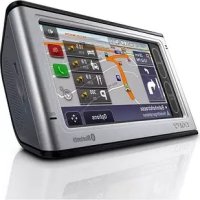
NVU80 - Gps SONY - Free user manual and instructions
Find the device manual for free NVU80 SONY in PDF.



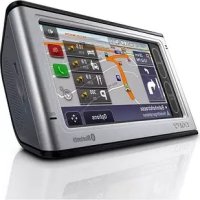
| Product type | Portable navigation system (GPS) |
| Brand and model | Sony NVU80 |
| Dimensions (L × H × D) | Approx. 134.4 × 79.1 × 44.0 mm (excluding protruding parts) |
| Weight | Approx. 380 g |
| Display | 4.3 inch (16:9) TFT LCD, 480 × 272 pixels, touch screen |
| Power and battery | 5 V DC via AC adapter or car battery adapter; built-in rechargeable lithium-ion battery: charge ~2.5 h (standby) or ~4.5 h (powered on), battery life up to 3.5 h |
| GPS reception | Built-in GPS; optional external antenna (VCA-41) |
| Connectivity | USB (for PC connection), DC IN 5V jack, external GPS antenna jack |
| Main functions | Voice guidance, route calculation, gesture control, points of interest (POI), 2D/3D mode, TMC (depending on model) |
| Included software | CD-ROM with PC connection software, language assistant, PDF manual |
| External storage | Slot for Memory Stick Duo (read-only, compatible up to 4 GB) |
| Operating temperature | 5 to 45 °C |
| Maintenance and cleaning | Clean the suction cup with water; do not use detergent; dry completely before reinstallation |
| Safety | Do not install in front of an airbag; do not look at the screen while driving; stop the vehicle before entering a destination |
| Spare parts and repairability | Replaceable fuse (do not exceed the indicated amperage); removable battery for disposal; optional external GPS antenna |
| General information | Manual available in multiple languages (FR, DE, EN, ES, IT, NL, PT, SV); disposal according to WEEE directive |
Frequently Asked Questions - NVU80 SONY
User questions about NVU80 SONY
0 question about this device. Answer the ones you know or ask your own.
Ask a new question about this device
Download the instructions for your Gps in PDF format for free! Find your manual NVU80 - SONY and take your electronic device back in hand. On this page are published all the documents necessary for the use of your device. NVU80 by SONY.
USER MANUAL NVU80 SONY
How to use this manual
When reading this manual, keep the control layout illustration (on the rear of this page) open for quick reference from any page.
Hinweis zu dieser
Bedienungsanleitung
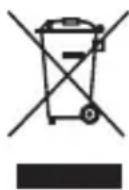
Disposal of Old Electrical & Electronic Equipment (Applicable in the European Union and other European countries with separate collection systems)
This symbol on the product or on its packaging indicates that this product shall not be treated as household waste. Instead it shall be handed over to the applicable collection point for the recycling of electrical and electronic equipment. By ensuring this product is disposed of correctly, you will help prevent potential negative consequences for the environment and human health, which could otherwise be caused by inappropriate waste handling of this product. The recycling of materials will help to conserve natural resources. For more detailed information about recycling of this product, please contact your local Civic Office, your household waste disposal service or the shop where you purchased the product.
Applicable accessories: Car battery adapter/AC power adapter
Caution
IN NO EVENT SHALL, SONY BE LIABLE FOR ANY INCIDENTAL, INDIRECT OR CONSEQUENTIAL DAMAGES OR OTHER DAMAGES INCLUDING WITHOUT LIMITATION LOSS OF PROFITS, LOSS OF REVENUE, LOSS OF DATA, LOSS OF USE OF THE PRODUCT OR ANY ASSOCIATED EQUIPMENT, DOWNTIME, AND PURCHASER'S TIME RELATED TO OR ARISING OUT OF THE USE OF THIS PRODUCT, ITS HARDWARE AND/OR ITS SOFTWARE.
Table of Contents
Warning. 5
Location of controls. 8
Turning the unit on 9
Performing initial setup 9
Receiving GPS signals 10
Basic Operations 10
Menu operations 10
Gesture Command operation. 11
Keyboard operations 12
Route Searching 13
Setting the destination and starting guidance 13
Setting the destination in other ways. 15
Guidance displays. 16
System Settings 18
Using the Supplied Software 19
Contents. 19
Connecting to your computer . . . 20
Additional Information 21
Precautions. 21
About the "Memory Stick" 21
What is "Memory Stick"? 21
Types of "Memory Stick Duo" that the system can use 21
Note on LCD panel 23
Maintenance. 23
Cleaning the suction cup 23
Fuse replacement. 24
Notes on unit disposal 24
Specifications. 26
Troubleshooting 27
Resetting the unit. 29
About this manual
- This Quick Start Guide contains instructions for basic operations. For more information, see the PDF manual on the supplied Application Disc. For details on installation and connections, see the supplied "Read This First" (installation manual).
- Contents of this manual are written for users with knowledge of using the Microsoft® Windows® operating system. For details about computer operation, see the manual for your computer.
- Illustrations in this manual may differ from the actual device.
- Before operating this system, read this manual and "Read This First" thoroughly.
- Retain this manual and the supplied "Read This First" in a place where you can refer to at any future time.
Warning
PLEASE READ THIS MANUAL AND THE SUPPLIED "READ THIS FIRST" (INSTALLATION MANUAL) COMPLETELY BEFORE INSTALLING OR OPERATING YOUR PERSONAL NAVIGATION SYSTEM. IMPROPER INSTALLATION OF THIS DEVICE MAY CAUSE ACCIDENT, INJURY OR DEATH.
On safety
- Besureto:
- install the navigation system in a safe place where it does not obstruct the driver's view.
not install the unit above an airbag. - place the cables and cradle where they do not obstruct driving.
- attach the unit to the cradle properly, otherwise the unit may fall.
- clean the surface of the suction cup and attachment surface before attaching. Also, confirm that the suction cup is securely attached after installation. Otherwise, the unit or cradle may fall.
- clean the surface on the dashboard before using the supplied sheet. Failure to do so may result in unsafe driving conditions.
-
Do not apply excessive force to the unit or cradle as it may fall.
-
Comply with local traffic rules, laws and regulations.
- Do not continuously watch the unit while driving. It is dangerous and may cause a traffic accident.
- If you need to operate the navigation system while driving, be sure to stop the car in a safe place before operating.
- Do not modify the unit.
- Do not disassemble the unit except when disposing of it.
- Do not use the navigation system with the system covered or blocked.
When using the unit indoors
Use this product near a wall outlet. This is to ensure that the power plug can be immediately unplugged from the wall outlet to power off if some abnormality occurs during use. Do not use the AC Adaptor placed in a narrow space, such as between a wall and furniture.
On handling
- Do not let foreign objects get inside the cradle connector (9) of the unit, as it may cause a malfunction.
continue to next page
- Turn the unit off by pressing I / (4), take it out of the cradle, then disconnect the car battery adapter, otherwise it may drain the car battery.
Note the following.
If your car's cigarette lighter socket is not connected to the ACC on your ignition switch, power will continue to be supplied to the unit's built-in power supply even when the ignition is off or the unit is not in use.
- Do not connect any accessory (car battery adapter, AC power adapter, etc.) other than those supplied or optional.
- Do not expose the unit to fire or water, as it may cause a malfunction.
- Be sure to remove the unit out of the car when leaving your car to prevent theft or high temperature damage inside the car.
Note that the built-in battery cannot be charged outside the temperature range 5 - 45^ (41 - 113 F). - Do not leave the unit in high ambient temperature as the built-in battery capacity will deteriorate, or it will become unchargeable.
On GPS
GPS (Global Positioning System) satellites continuously emit signals for positioning anywhere on the earth. As a GPS aerial receives these signals, users can be informed of their location (latitude, longitude and altitude). Information must be received from 3 satellites in order to obtain two-dimensional fixes (latitude and longitude), and 4 satellites are required for three-dimensional positioning (latitude, longitude and altitude). As GPS satellites are controlled by the U.S. Department of Defense, a deliberate margin of error between a few meters (a few feet) and 10 meters (32.8 feet) exists. As a result, the GPS navigation system may include an error of between 10 meters (32.8 feet) and about 200 meters (656.2 feet), depending on the circumstances.
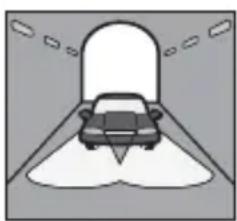
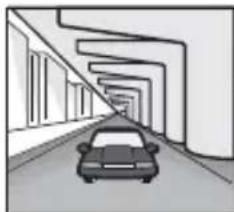
As GPS information is obtained using signal from satellites, it may be impossible or difficult to obtain the information in the following locations:
- Tunnel or underground
Under a highway
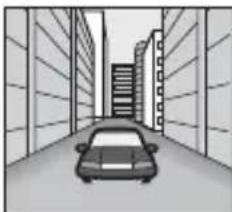
- Between high buildings
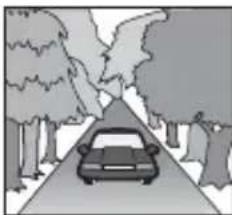
- Between tall trees with dense foliage
After the initial installation, park your car in a safe, open place (no high buildings, etc.) for up to 20 minutes to allow for GPS signals to be received before using the navigation system.
Note
It takes time to receive a GPS signal when switching the unit ON after switching OFF the main power, after the built-in battery is fully discharged, or after resetting the unit.
On this positioning system
The system has a function that allows the car's current position to be correctly displayed even at locations where the GPS signal is temporarily interrupted or poorly received, as when going under an overpass. To activate this function, do the following.
- Attach the unit to the cradle.
- Drive for a while in an area where the GPS signal is clearly received.
The positioning system will become ready for operation after you have driven a little with the unit on.
Notes
- The accuracy of this function may deteriorate if the unit is installed near a heated or heat-reflecting windscreen. In this case, use the optional External GPS Antenna.
Depending on the conditions, the car's current position or the movement may not be accurately displayed. This, however, will be corrected as soon as the GPS signal reception resumes. - This function is available only during route guidance.
On the software
Read the "END-USER LICENSE AGREEMENT" carefully before use.
Location of controls
Read the explanations below while referring to the illustrations on the flap. Refer to the pages listed for details.
1 Screen buttons 16
2 Display window/touch screen
CHG (battery charge) indicator
Lights up in red while charging.
4 I/O (on/standby) button 9
To turn the unit on/off.
RESET button 29
6 Speaker
Outputs guidance and warnings.
7Memory Stick Duo slot
For "Memory Stick Duo" insertion for functional expansion.
External GPS antenna (aerial) jack
To connect the optional External GPS Antenna VCA-41 to the cradle.
9 Cradle connector
10 POWER switch 9, 29
To turn the main power on/off.
11 Auto dimmer sensor
This sensor automatically adjusts the brightness of the display in response to the brightness of the surroundings.
12Jack cover
Note
If you pull off the jack cover by accident, use a pointed object to push it back in.
13USB jack 20
To connect to a computer with the USB cable.
14 DC IN 5V jack
To connect to the AC power adapter.
Microphone (only for models with built-in BLUETOOTH wireless technology) To talk on the telephone using the BLUETOOTH function. For details, see the supplied "BLUETOOTH Hands-free Manual."
Turning the unit on
Check that the POWER switch on the bottom left of the unit is in the ON position beforehand (page 8).
Press I/(4).
The display appears as follows.
During route guidance, the map display appears.
In other cases, the top menu appears.
To turn the unit off
Press I/O (4).
The unit enters standby mode for minimum power consumption.
Notes
- Do not turn the main power off except when the unit will not be used for more than 3 months.
- If you switch off the main power, it may take time to receive GPS signals when switching on again.
- Be sure to take the unit out of the cradle and disconnect the car battery adapter when the unit is not in use to prevent car battery drain.
Performing initial setup
The following contents can be set up by the Startup Configuration Wizard.
- Language
- Distance format
-Brightness
Time format - Address input method
Home address - Home phone number (BLUETOOTH models only, such as the NV-U80)
Follow the on-screen instructions to perform the setup.
These settings can then be further configured in the setting menu at any time (page 18).
Note
The current time setting (including time zone of current region and daylight saving time/standard time) is automatically set after GPS signals are received correctly.
Receiving GPS signals
After the initial installation, park your car in a safe, open place (no high buildings, etc.) for up to 20 minutes to allow for GPS signals to be received before using the navigation system. The system requires signals from a minimum of 3 GPS satellites to calculate the current car position properly.
GPS status indicator
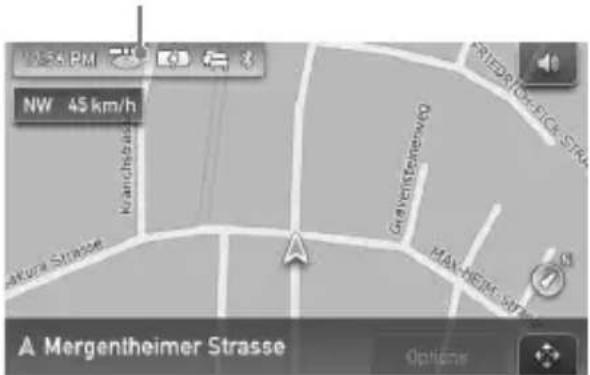
The icon shows the GPS signal reception condition. The indicator lights up in red when the signal cannot be received.
Basic Operations
Common procedures to operate the system are explained.
General operations can be performed on the touch screen. Touch the displayed icons with your finger gently.
Note
Do not press the display with excessive force, or use any sharp article, such as a pen, etc., to tap on the display.
Menu operations
The top menu appears when turning on the unit by pressing / (except during route guidance, in which case the map appears).
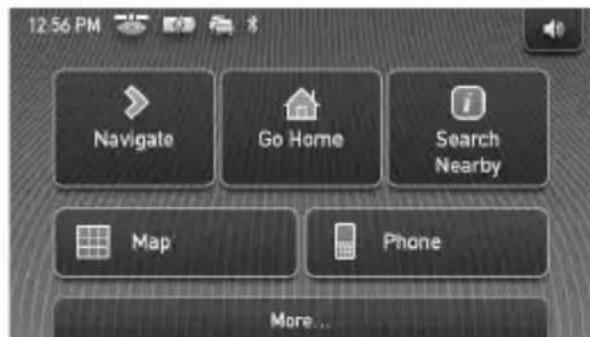
To show the top menu from the map display, touch the map.
To return to the top menu from any menu display, touch "VOICE/POS," then touch the map.
You can set items in the menu by the following procedures.
1 Show the top menu.
2 Touch "More...."
3 Touch "Settings."
The list of setting categories appears.
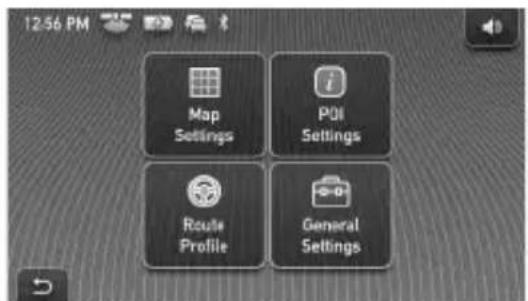
4 Touch a desired setting category.
The list of setting items in the selected category appears.
E.g.: when selecting the default map view
Touch "General Settings"
"Navigation View" "2D" or "3D."
During menu operation:
To return to the previous display, touch or X
To cancel the menu selection, touch "VOICE/POS" (the current car position display appears).
Note
The items on the menu and setting operations differ depending on the selected menu item.
Gesture Command operation
In map displays (except in map scrolling mode), by assigning a screen finger stroke such as line, etc., frequently-used operations can be performed easily. This is called Gesture Command operation.
continue to next page
To Draw
start navigation to your home

a circumflex.
start navigation to the nearest POI stored on Quick Links*
Quick Link 1

horizontal line (left to right).
Quick Link 2

vertical line (downwards).
Quick Link 3

horizontal line (right to left).
Make a call to your home (BLUETOOTH models only, such as the NV-U80)

draw a "V."
Keyboard operations
The keyboard display appears when you need to enter text.
You need only enter characters in upper case, as the system automatically converts them to appropriate characters.
You can enter special characters when necessary.
Keyboard display
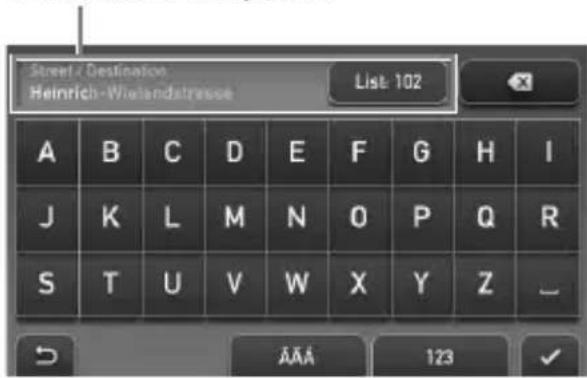
Candidates/entry field
| To Touch | |
| enter an alphabetical character | the desired character key. |
| enter a special character | “ÂÄÁ” to switch to the special character keyboard, then the desired character; and “ABC” to switch back. |
| enter a number “123” to switch to the numeric keyboard, then the desired number key; and “ABC” to switch back. | |
| enter a space | |
| delete a character | |
| show the candidate list* | “List” |
- The candidate list automatically appears when candidates are narrowed down as you continue inputting characters.
Route Searching
The system searches for routes automatically after setting the destination.
Before starting, check that GPS signals are sufficient for navigation (page 10).
Setting the destination and starting guidance
The procedure for searching for the route and starting route guidance is explained.
The following is an example of how to set the destination by its address in the given conditions below (configured at the Startup Configuration Wizard or in the setting menu).
- Selected address input method: "Step-by-Step Input"
For details on setting the destination in other ways, see "Setting the destination in other ways" on page 15.
continue to next page
For your safety, park your car in a safe place, then enter the destination information before starting a journey.
1 Show the top menu.
In the map display, touch the map. In the menu display, touch "VOICE/POS," then touch the map.
2 Select "Navigate."
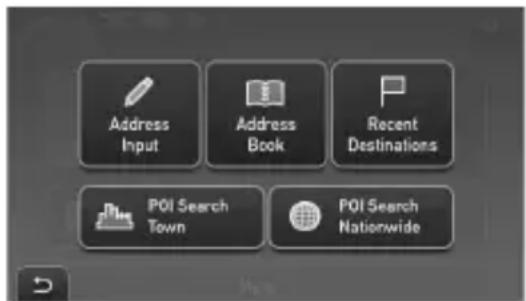
3 Select "Address Input," then input the address details.
Input the items in the order below, and touch or the candidate in the list to proceed.
For details on how to input characters, see "Keyboard operations" on page 12.
1 "Country"
"Town / Postal Code" If it is possible to pinpoint the destination by the selected postal code*, the address confirmation display appears. Select "Calculate Route."
"Street / Destination"
4 "No." or "Intersection"*2 The address confirmation display appears.
1 Available only in the UK and Netherlands.
2 Selectable only if existent in the selected street.
4 Select "Calculate Route."
The map display appears, the route is calculated, and route guidance starts.
To fine adjust the destination point
You can jump from the address confirmation display to the map scrolling mode, and fine adjust the destination point.
1 Touch switch to the map scrolling mode.
2 Drag the screen to adjust the destination point.
3 Touch to display the map scrolling mode menu.
4 Select "Navigate to Here" to start the route guidance.
For details on operations in the map scrolling mode, see "Map scrolling mode" on page 18.
Setting the destination in other ways
You can also set the destination and search for routes by the following methods.
From the top menu, select the items in the following order, then "Calculate Route" (if necessary).
For details, see the supplied PDF manual.
Search Nearby
Searches for routes to a POI, such as restaurant, hotel, etc., near the current car position.
Select "Search Nearby," then any of the following options.
"Quick Link 1 - 3"
Searches for routes to the nearest POI of the category stored on Quick Links.
Categories on Quick Links can be customized in the setting menu (page 18).
"Search by Name"
Enter the name of the POI directly. "Search by Category"
Select the desired POI category from the list.
Go Home
Searches for routes to your home when it is registered.
Navigate
The destination can be set by the following methods.
"Address Book"
Searches for routes to a saved destination point.
"Navigate" "Address Book"
"Recent Destinations"
Searches for routes to recently searched destinations.
"Navigate" "Recent Destinations"
"POI Search Nationwide"
Searches for routes to a POI, such as airport, etc., within the specified country.
"Navigate" "POI Search Nationwide"
"POI Search Town"
Searches for routes to POI, such as restaurant, hotel, etc., within the specified town.
"Navigate" "POI Search Town"
Guidance displays
Once a route has been calculated, visual guidance navigates you to the destination along with audio guidance.
Information on map tool menu
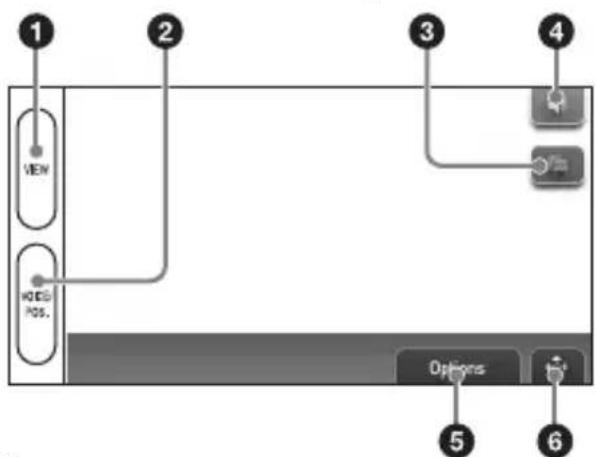
To select a map display (Map, DR, or Map+DR). For details on DR, see "Dynamic Route Information display (DR)" or page 17.
2 During route guidance: To hear the next voice guidance. In map scrolling mode: To switch to the current car position display.
To view detailed TMC information.*
To adjust the voice guidance volume.
To show option menu.
To switch to map scrolling mode.
- When the supplied (or optional) TMC cradle is used, this appears only when the route that has been found is congested.
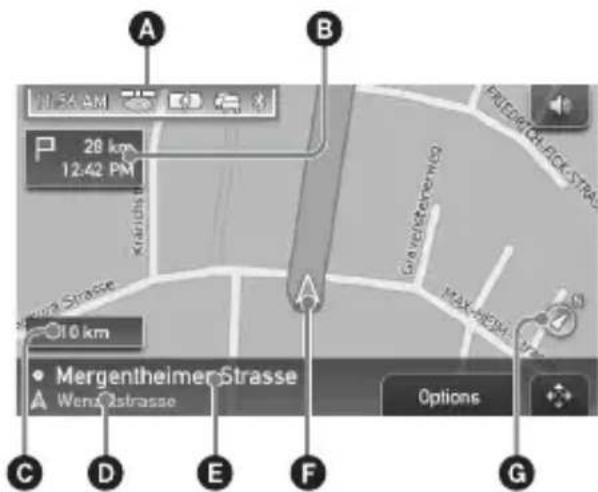
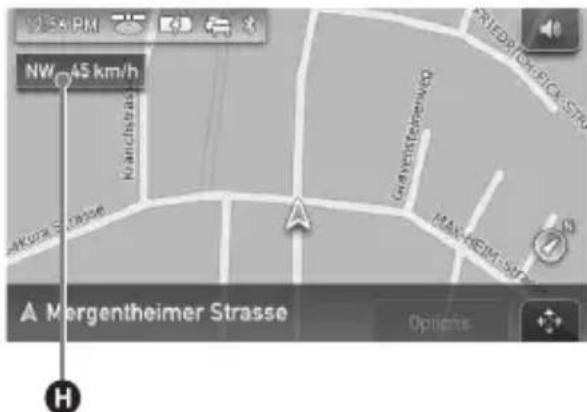
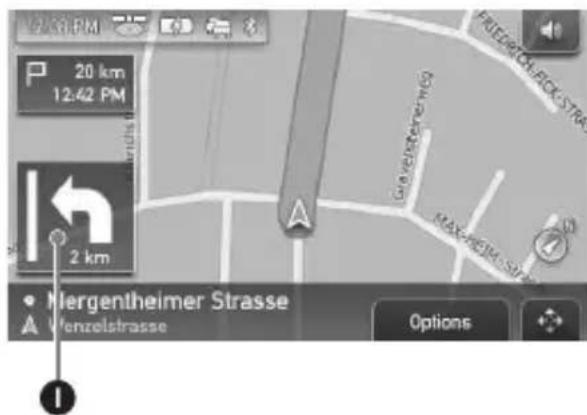
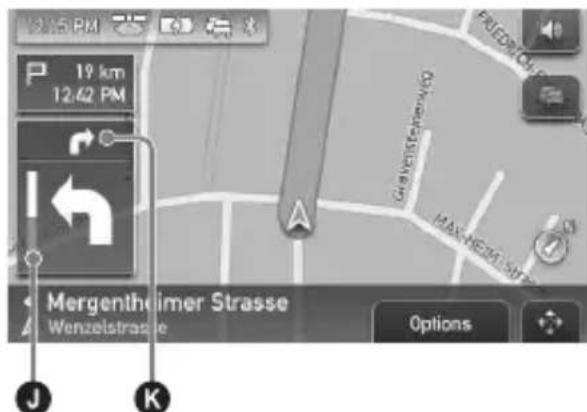
2D Map display
Straight-ahead driving (during route guidance)
Straight-ahead driving (in other cases)
Approaching an intersection
Approaching an intersection (closer)
AIndicators
Current time/GPS status/Battery condition/TMC status/ BLUETOOTH status For details, see the supplied PDF manual.
Distance to/ETA (Estimated Time of Arrival) at destination
Distance to next turn
Current street name
ENext street name
FCurrent position
To indicate where north is.
Current direction/current speed
Next turn instruction
Bar indication of distance to next turn
Instruction after next
3D Map display
You can set the 3D map display in the setting menu (page 18).
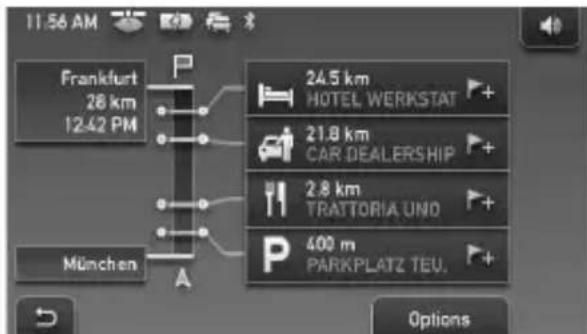
Dynamic Route Information display (DR)
This display shows the distance to the destination, POI information, etc. For details, see the supplied PDF manual.
continue to next page
Route display
You can view the entire route to the destination.
To display, select "Options" "Show Route."
Map scrolling mode
You can switch to map scrolling mode from map display by touching 喜 whether during route guidance or not. In map scrolling mode, the cross-hair is displayed on the map, and you can drag the screen to scroll the map.
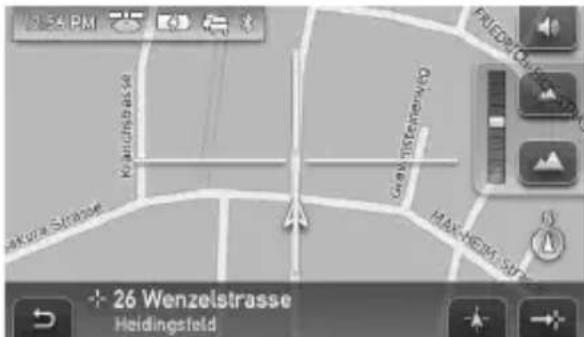
Touch to adjust map scale.
Place the intersection of the cross-hair on a desired point, then touch to show the map scrolling mode menu, where you can set the point as a destination, etc.
Touch -to switch from map scrolling mode to the current car position display.
System Settings
Various settings related to the system and memory are configurable.
From the top menu, select "More..." "Settings" the desired category the desired item below to make each setting.
Several representative setting items in each category are introduced here as examples.
For details, see the supplied PDF manual.
General Settings
Navigation View (to select the default map view (2D or 3D)), Show Distance/ ETA to Destination (to show/hide the distance to and ETA (Estimated Time of Arrival) at the destination), etc.
Map Settings
Current Map (to select a map stored in the unit).
POI Settings
Show POIs (to show/hide each POI), Quick Link 1 - 3 (to store 3 frequently-used POI categories, which can be used as shortcuts when setting the destination).
Route Profile
Type of Route (to select the route search preference), Motorways (to allow/avoid/forbid motorways/highways), etc.
Note
Warnings given according to map information may not always be correct due to road works, etc. Traffic situations and road regulations take absolute precedence over information given by the navigation system.
Using the Supplied Software
The major functions of the software on the supplied CD-ROM are introduced below.
If you insert the CD-ROM into your computer, the screen appears automatically. Follow the on screen instructions.
System requirements
- OS: Windows 2000/XP
- CD-ROM/DVD-ROM drive
- US B port
- 150MHz CPU speed minimum
Contents
Install PC Connection Software
PC connection software (ActiveSync) can be installed.
Language Manager
Language data for on-screen display and voice guidance can be added to the unit, and unnecessary language data can be deleted from the unit.
Read the Manual
You can read the PDF manual which contains further information on operations available.
Support Link
Easy access to the Sony navigation support site is available.
Visit this site for technical support, such as software updates, FAQs, etc.
Connecting to your computer
Before connecting to your computer, install the PC connection software (ActiveSync) to your computer.
1 Connect the unit to an outlet using the AC power adapter and the AC power cable.
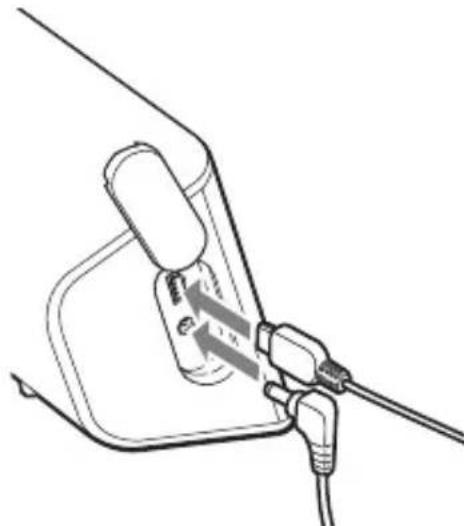
2 Connect the unit to your computer with the USB cable.
Connect the small connector of the USB cable to the USB jack on the unit, then the large connector to a USB port on your computer.
Notes when transferring data
- When connecting the unit to your computer, connect it directly to the computer. The unit may not work properly if it is connected through a USB hub.
- During transfer, do not
- disconnect the USB cable or the AC power adapter.
- turn off the main power of the unit, enter unit standby mode, or reset the unit.
- shut down the computer, enter computer standby mode, or restart the computer.
If you want to cancel transferring mid-way, click the cancel button on the computer screen.
Additional Information
Precautions
If your car has been parked in direct sunlight, allow the unit to cool off before operating it.
Moisture condensation
On a rainy day or in a very damp area, moisture condensation may occur inside the display of the unit. Should this occur, the unit will not operate properly. In such a case, slide the POWER switch on the bottom left of the unit to OFF position, then wait for about an hour until the moisture has evaporated.
About the "Memory Stick"
What is "Memory Stick"?
"Memory Stick" is a compact-size IC recording medium with a large capacity. It has been designed not only for exchanging/sharing digital data among "Memory Stick" compatible products, but also for serving as an insertable/removable external storage medium that can save data.
Types of "Memory Stick Duo" that the system can use
With the system, you can use the following types of "Memory Stick Duo."
- Memory Stick Duo (Not compatible with MagicGate)
MagicGate Memory Stick Duo -
Memory Stick PRO Duo
-
The system has been demonstrated as operable with a "Memory Stick Duo" with a capacity of 4 GB or smaller. However, we do not guarantee the operations of all the "Memory Stick Duo" media.
continue to next page
Notes
- This system supports only the reading of data on a "Memory Stick Duo." "Memory Stick Duo" formatting and writing cannot be performed.
- This system does not support parallel high-speed data transfer.
- When you format a "Memory Stick Duo," all the data will be erased. To avoid erasing important data by accident, make sure to check the content before formatting.
- To format a "Memory Stick Duo," use a formatting application that is compatible with the "Memory Stick Duo." When formatting the "Memory Stick Duo," do not use the format function on the Windows Explorer.
- Standard-size "Memory Stick" cannot be used in this system.
- When using a "Memory Stick Duo," make sure to check correct insertion direction. Wrong usage may cause trouble with the system.
- Do not place the "Memory Stick Duo" within the reach of a small child to prevent him from swallowing it by accident.
- Avoid removing the "Memory Stick Duo" from the system while the system is reading data.
- Data may be damaged in such occasions: - "Memory Stick Duo" is removed or the system is turned off during a read operation.
-
"Memory Stick Duo" is used in a location subject to static electricity or electrical noises.
-
We recommend that you save backup of the important data.
- Do not bend, drop or apply strong shock to the "Memory Stick Duo."
- Do not disassemble or modify the "Memory Stick Duo."
- Do not allow the "Memory Stick Duo" to get wet.
-
Do not use or store the "Memory Stick Duo" in a location that is subject to:
-
Extremely high temperature, such as in a car parked in the sun
- Direct sunlight
High humidity or places with corrosive substances
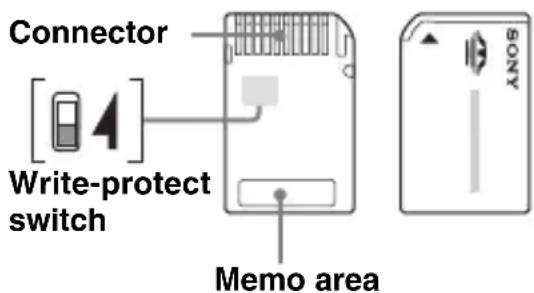
- Do not touch the "Memory Stick Duo" connector with your finger or metallic objects.
- You cannot record, edit or delete data if you slide the write-protect switch to LOCK.
- When you slide the write-protect switch of the "Memory Stick Duo," use a thinn-pointed device.
- When you use a "Memory Stick Duo" without the write-protect switch, be careful not to edit or delete the data by accident.
-
When you write on the memo area of the attached label, do not write forcefully.
-
When you carry or store the "Memory Stick Duo," put it in the case supplied with it.
Note on LCD panel
Some stationary blue, red or green dots may appear on the monitor. These are called "bright spots," and can happen with any LCD. The LCD panel is precision-manufactured with more than 99.99% of its segments functional. However, it is possible that a small percentage (typically 0.01% ) of the segments may not light up properly. This will not, however, interfere with your viewing.
Maintenance
Cleaning the suction cup
If the surface of the suction cup gets dirty and the attachment strength weakens, wash and clean the surface of the suction cup.
Before washing, be sure to detach the suction cup part from the cradle following the steps below.
1 Detach the suction cup from the cradle.
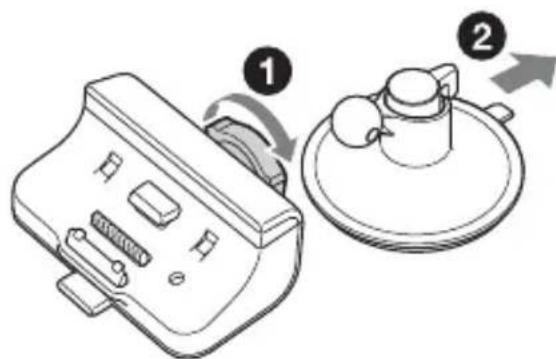
2 Wash the surface of the suction cup with water.
3 Allow the suction cup to air dry completely.
Warning
- Never wash the suction cup without detaching it from the cradle. Otherwise, it may damage the cradle.
- Do not use cleanser. Wash only with water.
- Be sure to dry the suction cup before reattaching.
Notes
- If the suction cup leaves a trace on the windscreen, wipe with water.
- The dashboard may leave an impression on the surface of the suction cup, however, it does not affect the attachment strength.
Fuse replacement
When replacing the fuse in the car battery adapter, be sure to use one matching the amperage rating stated on the original fuse. If the fuse blows, check the power connection and replace the fuse. If the fuse blows again after replacement, there may be an internal malfunction. In such a case, consult your nearest Sony dealer.
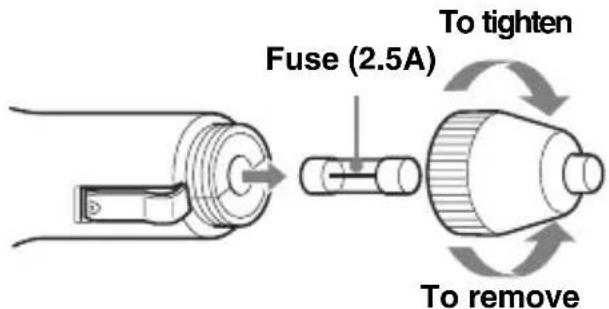
Warning
Never use a fuse with an amperage rating exceeding the one supplied with the unit as this could damage the unit.
Notes on unit disposal
Remove the built-in lithium-ion battery when disposing of the unit, and return the battery to a recycling location.
The procedure for removing the battery is explained below.
Note
Never disassemble the unit except when disposing of it.
1 Switch off the main power by sliding the POWER switch to the OFF position.
2 Remove the jack cover (page 8).
3 Remove the 2 screws on the underside of the unit using a screwdriver.
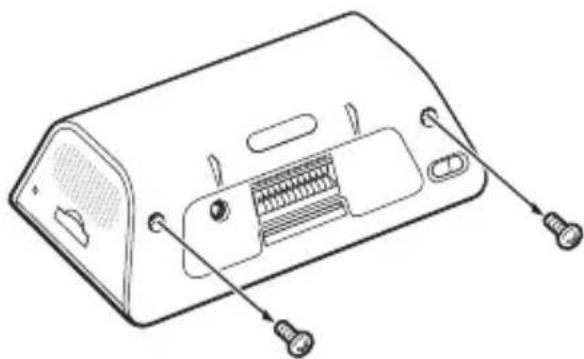
4 Remove the rear cover.
① Remove the top of the unit as shown below.
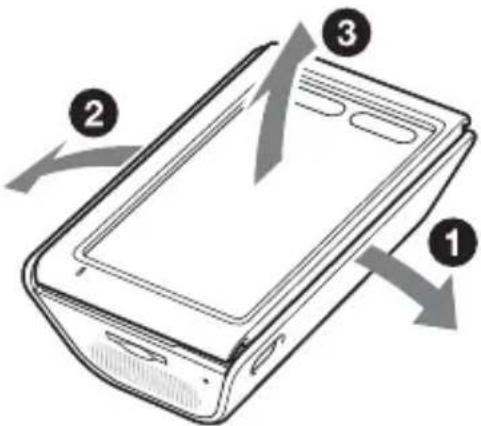
② Remove the bottom of the unit in the same way.
5 Disconnect the battery connector.
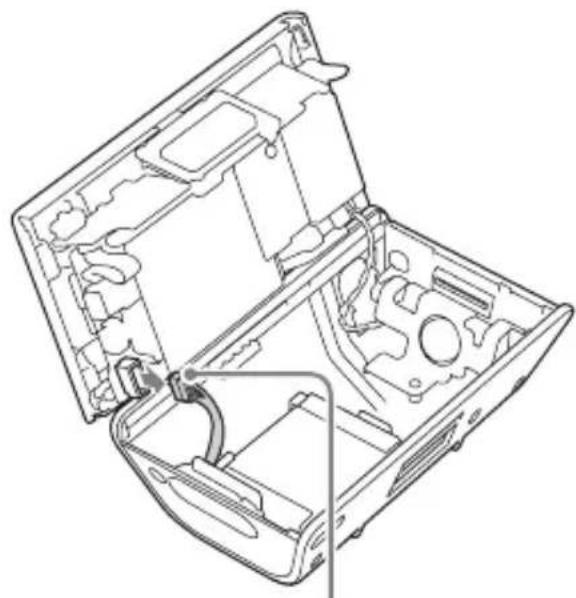
Battery connector
6 Remove the battery.
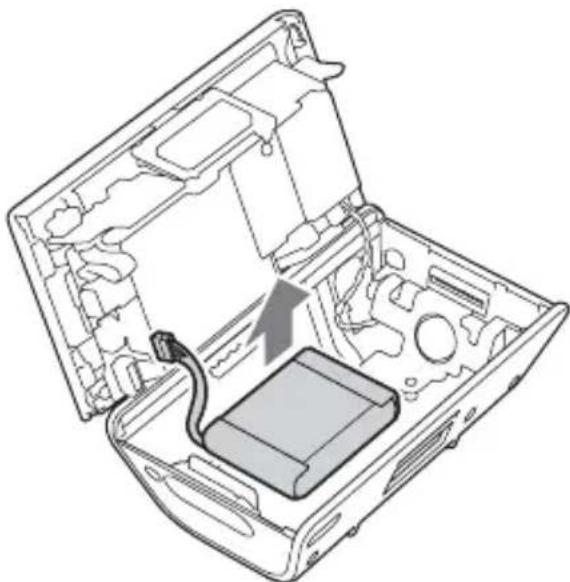
7 Insulate the connector terminal by wrapping with a tape.
Notes on the lithium-ion battery
- Keep the battery out of the reach of children.
- Do not hold the battery with metallic tweezers, otherwise a short-circuit may occur.
WARNING
Battery may explode if mistreated.
Do not recharge, disassemble, or dispose of in fire.
Specifications
Main unit
Operating temperature: 5 - 45^ (41 - 113^)
Power requirements: DC 5 V (from supplied AC power adapter)
Connection terminals:
Cradle connector
DC IN 5V jack
USB jack
External GPS antenna (aerial) jack
Memory card slot:
Memory Stick Duo slot
Speaker: 20 × 40 ~mm (0.8 × 1.6 in) oval speaker
Consumption current: Max. 1.5 A
Dimensions:
Approx. 134.4× 79.1× 44.0mm
(5.3× 3.1× 1.8 in) (w× h× d)
protruding parts excluded)
Mass: Approx. 380g (13.4 oz)
Monitor
System: Transmissive liquid crystal display
Drive system: a-Si TFT active matrix system
Dimensions: 4.3 in (16:9)
95.0× 53.9 109.2mm (3.8× 2.1 4.4
in) (h× v,d)
Segment: 391,680 dots (480× 272 pixel)
Cradle
Operating temperature: 5 - 45^ (41 - 113^)
Power requirements: DC 5.2 V (from supplied 12V car battery adapter (negative earth))
Connection terminals:
Unit connector
DC IN 5.2V jack
TMC aerial jack (TMC models only, such as the NV-U81T)
Reception frequency: 87.5 - 108.0MHz (TMC models only, such as the NV-U81T)
Built-in battery charging time/usage time
Charging time
With the supplied car battery adapter/AC power adapter: Approx. 4.5 hours (with unit turned on), or 2.5 hours (in standby mode)
Usage time
Up to 3.5 hours (depending on usage)
Optional accessories
External GPS Antenna: VCA-41
TMC Car Cradle Kit: NVA-CP3T
Car Install Kit:XA-49FM
Design and specifications are subject to change without notice.

- Halogenated flame retardants are not used in the certain printed wiring boards.
- Use of rechargeable lithium ion batteries.
Corrugated cardboard is used for the packaging cushions.
VOC (Volatile Organic Compound)-free vegetable oil based ink is used for printing the carton.
Troubleshooting
The following checklist will help you remedy problems you may encounter with your unit.
Before going through the checklist below, check the connection and operating procedures.
The operation icons on the display do not function.
An operation may take time while a map is displayed.
The unit does not turn on.
-
Check that the POWER switch on the bottom left of the unit is in the ON position.
Charge the built-in battery. -
Install the unit properly according to the supplied installation manual.
- Connect the unit to an outlet using the AC power adapter and the AC power cable.
The built-in battery cannot be charged.
Check that the POWER switch on the bottom left of the unit is in the ON position.
If the AC power adapter is being used, disconnect it from the outlet, then reconnect.
The built-in lithium-ion battery can be charged at temperatures between 5 - 45 ^ C (41 - 113 F). The battery may not be charged if the temperature inside the unit increases because of direct sunlight exposure, etc. This is not a malfunction.
GPS signal cannot be received.
- Read the GPS overview (page 6).
- The system cannot receive GPS signals due to an obstruction.
Move your car to a place where signals can be received clearly.
- GPS signal reception is low.
- Check the GPS status by selecting "More..." in the top menu "GPS Status."
- There is an obstacle in front of the GPS aerial.
Install the unit where the signal is not interrupted by the body of the car, etc. - GPS signal reception may be prevented by a heated or heat reflective windscreen.
Use the optional External GPS Antenna VCA-41.
The car position on the map does not match the current road.
The error margin of the signal from the GPS satellites is too large. A maximum error margin of a few hundred metres can exist.
Voice guidance cannot be heard.
The volume is set too low.
Raise the volume by touching top menu or the map display.
When the unit is powered by the built-in battery, volume may slightly decrease.
The LCD is not displayed normally.
- In high temperatures, the LCD may darken and not display clearly. In low temperatures, afterimage may occur on the LCD. These are not malfunctions, and the LCD will return to normal when the temperature returns to within the specified operating range.
The LCD is dark.
The auto dimmer function may be activated because its sensor (page 8) is covered by a hand, etc.
The cradle comes off from the attachment surface.
Attachment strength weakens if the surface of the suction cup or attachment surface become dirty.
Wash and clean the suction cup and the attachment surface (page 23).
The demonstration mode starts automatically even if no operation is performed.
Turn off the auto demonstration mode by selecting "More..." in the top menu "Settings" "General Settings" "Demo Mode." Then, confirm that "Demo Mode" is set to off.
Resetting the unit
If the navigation software freezes, try resetting the unit.
Press the RESET button with a pointed object, such as a ballpoint pens (page 8).
If the problem persists, switch off the main power by sliding the POWER switch to the OFF position, then switch on again after approximately 10 seconds (page 8).
Note
After you switch off the main power, it may take time to receive GPS signals when switching on again.
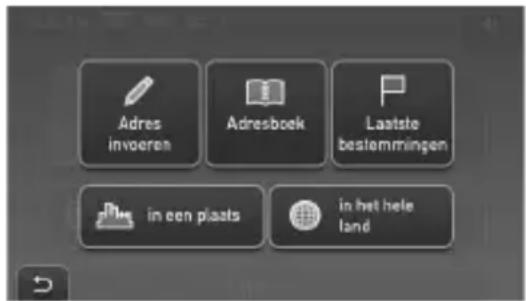
2 Selecteer "Navigeren".
"Snelkoppeling 1 - 3"
Wat is "Memory Stick"?
"Navigera" "I hela landet"
"På annan ort"
Soker after rutter till en IP, t.ex. en restaurang, ett hotell, i hela den valda orten.
"Navigera" "På annan ort"
Anvisningsskarmar
Dukommen latt at Sonys supportsida for navigating.
(Transmissive liquid crystal display)



- How to use this manual
- Hinweis zu dieser
- Bedienungsanleitung
- Disposal of Old Electrical & Electronic Equipment (Applicable in the European Union and other European countries with separate collection systems)
- Caution
- Table of Contents
- Basic Operations 10
- Route Searching 13
- System Settings 18
- Using the Supplied Software 19
- Additional Information 21
- About this manual
- Warning
- On safety
- When using the unit indoors
- On handling
- On GPS
- Note
- On this positioning system
- Notes
- On the software
- Location of controls
- Turning the unit on
- Check that the POWER switch on the bottom left of the unit is in the ON position beforehand (page 8).
- To turn the unit off
- Performing initial setup
- Receiving GPS signals
- Basic Operations
- Menu operations
- Gesture Command operation
- To Draw
- Keyboard operations
- Route Searching
- Setting the destination and starting guidance
- Show the top menu.
- Select "Navigate."
- Select "Address Input," then input the address details.
- Select "Calculate Route."
- To fine adjust the destination point
- Setting the destination in other ways
- Search Nearby
- "Quick Link 1 - 3"
- "Search by Name"
- Go Home
- Navigate
- "Address Book"
- "Recent Destinations"
- "POI Search Nationwide"
- "POI Search Town"
- Guidance displays
- Information on map tool menu
- 2D Map display
- Straight-ahead driving (in other cases)
- Approaching an intersection
- Approaching an intersection (closer)
- AIndicators
- 3D Map display
- Dynamic Route Information display (DR)
- Route display
- Map scrolling mode
- System Settings
- General Settings
- Map Settings
- POI Settings
- Route Profile
- Using the Supplied Software
- System requirements
- Contents
- Install PC Connection Software
- Language Manager
- Read the Manual
- Support Link
- Connecting to your computer
- Connect the unit to an outlet using the AC power adapter and the AC power cable.
- Connect the unit to your computer with the USB cable.
- Notes when transferring data
- Additional Information
- Precautions
- Moisture condensation
- About the "Memory Stick"
- What is "Memory Stick"?
- Types of "Memory Stick Duo" that the system can use
- Note on LCD panel
- Maintenance
- Cleaning the suction cup
- Fuse replacement
- Notes on unit disposal
- Disconnect the battery connector.
- Remove the battery.
- Insulate the connector terminal by wrapping with a tape.
- Notes on the lithium-ion battery
- Specifications
- Main unit
- Monitor
- Cradle
- Built-in battery charging time/usage time
- Charging time
- Usage time
- Optional accessories
- Troubleshooting
- The operation icons on the display do not function.
- The unit does not turn on.
- The built-in battery cannot be charged.
- GPS signal cannot be received.
- The car position on the map does not match the current road.
- Voice guidance cannot be heard.
- The LCD is not displayed normally.
- The cradle comes off from the attachment surface.
- The demonstration mode starts automatically even if no operation is performed.
- Resetting the unit
- Selecteer "Navigeren".
- "Snelkoppeling 1 - 3"
- Wat is "Memory Stick"?
- "På annan ort"
- Anvisningsskarmar
Brand : SONY
Model : NVU80
Category : Gps