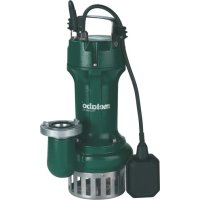
PS 24000 SG - Pump METABO - Free user manual and instructions
Find the device manual for free PS 24000 SG METABO in PDF.

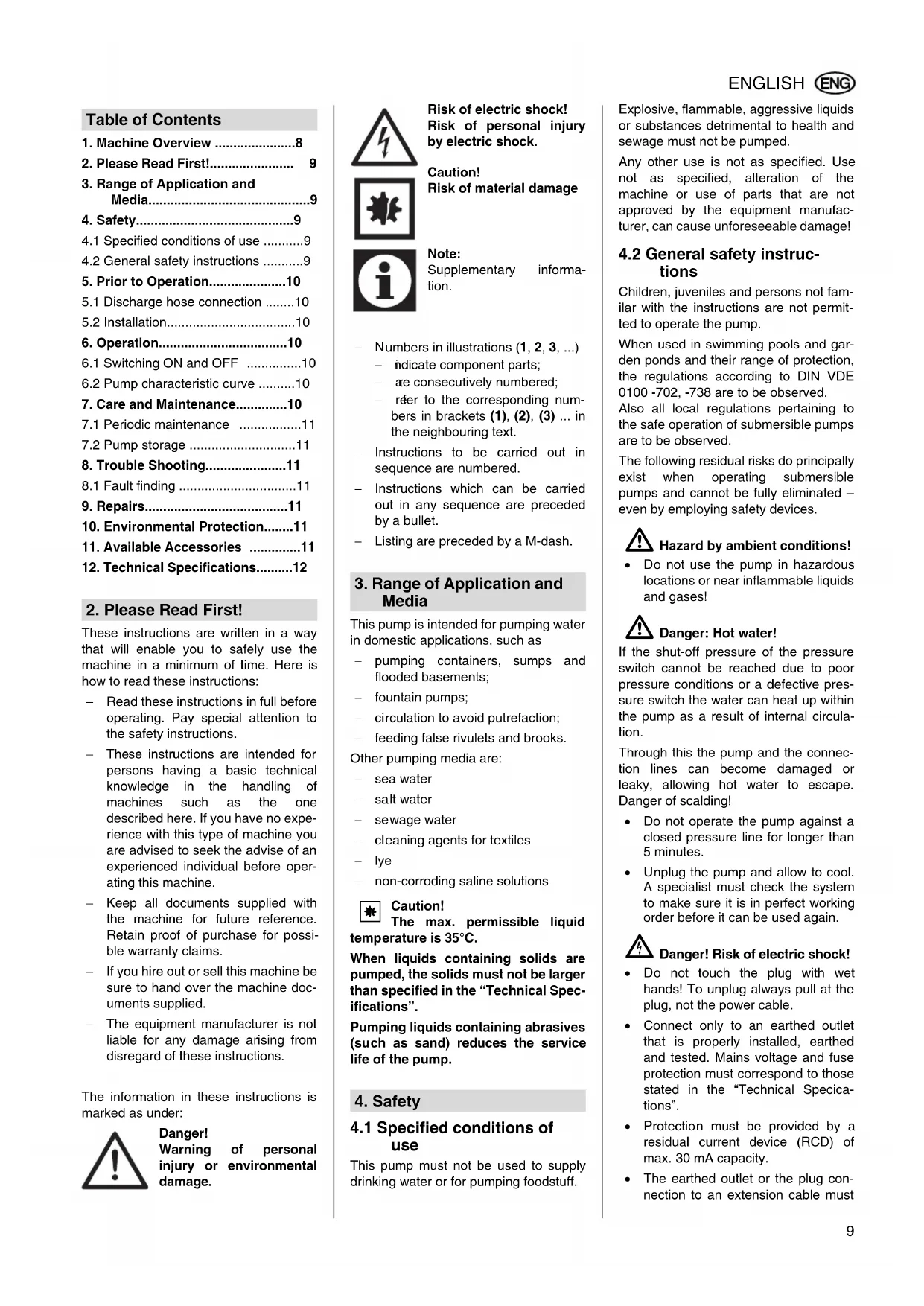


| Product type | Submersible drainage pump |
| Brand | Metabo |
| Model | PS 24000 SG |
| Dimensions (H x L x Ø) | 425 x 220.5 x 140 mm |
| Weight | 16.8 kg |
| Power supply | 230 V ~ 50 Hz, 1100 W |
| Rated current | 4.7 A |
| Min. fuse protection | 10 A (time-delay) |
| Max. flow rate | 24000 l/h |
| Max. delivery head | 11 m |
| Max. discharge pressure | 1.1 bar |
| Max. immersion depth | 10 m |
| Residual water level | 40 mm |
| Max. particle size | 10 mm |
| Max. liquid temperature | 35 °C |
| Protection rating | IP 68 |
| Protection class | I |
| Materials | Housing and impeller in grey cast iron, shaft in steel |
| Pressure connection | 1 1/2" IG (female) |
| Mains cable | 10 m, H07 RN-F |
| Float switch | Yes, adjustable (cable) |
| Functions | Pumping clean/dirty water, seawater, drainage, wells |
| Maintenance | Annual rinsing, cleaning of impeller |
| Safety | Residual-current circuit breaker 30 mA, thermal protection |
| Supplied accessories | Connection adapter and socket |
Frequently Asked Questions - PS 24000 SG METABO
User questions about PS 24000 SG METABO
0 question about this device. Answer the ones you know or ask your own.
Ask a new question about this device
Download the instructions for your Pump in PDF format for free! Find your manual PS 24000 SG - METABO and take your electronic device back in hand. On this page are published all the documents necessary for the use of your device. PS 24000 SG by METABO.
USER MANUAL PS 24000 SG METABO
KONFORMITÄTSERKLÄRUNGVDDECLARATION OF CONFORMITY
We herewith declare in our sole responsibility that this product complies with the following standards in accordance with the regulations of the undermentioned Directives*
2006/95/EG, 2004/108/EG
Volker Siegle
Director Innovation, Research and Development
Dokumentationsbevollmachtigter/ responsible person for documentation/ Chargé de la documentation
Metabowerke GmbH
Metabo-Allee 1
D-72622Nurtingen

- Machine Overview 8
- Please Read First! 9
-
Range of Application and Media. 9
-
Safety.. 9
4.1 Specified conditions of use .9
4.2 General safety instructions 9 -
Prior to Operation.. 10
5.1 Discharge hose connection 10
5.2 Installation 10 -
Operation 10
6.1 Switching ON and OFF 10
6.2 Pump characteristic curve 10 -
Care and Maintenance.. 10
7.1 Periodic maintenance 11
7.2 Pump storage 11
- Trouble Shooting.. 11
8.1 Fault finding 11 - Repairs.. 11
- Environmental Protection.....11
- Available Accessories 11
- Technical Specifications... 12
2. Please Read First!
These instructions are written in a way that will enable you to safely use the machine in a minimum of time. Here is how to read these instructions:
- Read these instructions in full before operating. Pay special attention to the safety instructions.
These instructions are intended for persons having a basic technical knowledge in the handling of machines such as the one described here. If you have no experience with this type of machine you are advised to seek the advise of an experienced individual before operating this machine. - Keep all documents supplied with the machine for future reference. Retain proof of purchase for possible warranty claims.
- If you hire out or sell this machine be sure to hand over the machine documents supplied.
The equipment manufacturer is not liable for any damage arising from disregard of these instructions.
The information in these instructions is marked as under:

Danger!
Warning of personal injury or environmental damage.

Risk of electric shock! Risk of personal injury by electric shock.
Caution!
Risk of material damage

Note:
Supplementary information.

Numbers in illustrations (1, 2, 3, ...)
indicate component parts;
- are consecutively numbered;
- refer to the corresponding numbers in brackets (1), (2), (3) ... in the neighbouring text.
- Instructions to be carried out in sequence are numbered.
- Instructions which can be carried out in any sequence are preceded by a bullet.
Listing are preceded by a M-dash.
3. Range of Application and Media
This pump is intended for pumping water in domestic applications, such as
- pumping containers, sumps and flooded basements;
- fountain pumps;
circulation to avoid putrefaction; - feeding false rivulets and brooks.
Other pumping media are:
sea water
salt water
sewage water
- cleaning agents for textiles
- lye
non-corroding saline solutions

Caution!
The max. permissible liquid temperature is 35^
When liquids containing solids are pumped, the solids must not be larger than specified in the "Technical Specifications".
Pumping liquids containing abrasives (such as sand) reduces the service life of the pump.
4. Safety
4.1 Specified conditions of use
This pump must not be used to supply drinking water or for pumping foodstuff.
Explosive, flammable, aggressive liquids or substances detrimental to health and sewage must not be pumped.
Any other use is not as specified. Use not as specified, alteration of the machine or use of parts that are not approved by the equipment manufacturer, can cause unforeseeable damage!
4.2 General safety instructions
Children, juveniles and persons not familiar with the instructions are not permitted to operate the pump.
When used in swimming pools and garden ponds and their range of protection, the regulations according to DIN VDE 0100-702, -738 are to be observed.
Also all local regulations pertaining to the safe operation of submersible pumps are to be observed.
The following residual risks do principally exist when operating submersible pumps and cannot be fully eliminated - even by employing safety devices.

Hazard by ambient conditions!
- Do not use the pump in hazardous locations or near inflammable liquids and gases!

Danger: Hot water!
If the shut-off pressure of the pressure switch cannot be reached due to poor pressure conditions or a defective pressure switch the water can heat up within the pump as a result of internal circulation.
Through this the pump and the connection lines can become damaged or leaky, allowing hot water to escape. Danger of scalding!
- Do not operate the pump against a closed pressure line for longer than 5 minutes.
- Unplug the pump and allow to cool. A specialist must check the system to make sure it is in perfect working order before it can be used again.

Danger! Risk of electric shock!
- Do not touch the plug with wet hands! To unplug always pull at the plug, not the power cable.
- Connect only to an earthed outlet that is properly installed, earthed and tested. Mains voltage and fuse protection must correspond to those stated in the "Technical Specifications".
Protection must be provided by a residual current device (RCD) of max. 30mA capacity. - The earthed outlet or the plug connection to an extension cable must
be located in an area safe against flooding.
- Use only extension cables of sufficient lead cross section (see "Technical Specifications"). Unroll cable reels fully.
- Do not buckle, squeeze, drag or drive over power cable and extension cables; protect from sharp edges.
-
Place extension cable so that it cannot get into the liquid to be pumped.
Unplug: -
Pror to all servicing;
- when persons are in the swimming pool or garden pond.

Danger by pump failings!
If you notice transport damage while unpacking, notify your supplier immediately. Do not operate the machine!
- Before each use check the pump, especially power cable and plug for possible damage. Risk of fatal electric shock!
- A damaged pump must be workmanlike repaired before it can be used again.
- Do not attempt to repair the pump yourself! When repaired inexpertly there is a hazard of liquid entering the electrical parts of the pump.

Caution!
To avoid water damage, e.g. flooded rooms, caused by pump malfunctions or defects:
provide for suitable safety measures such as the following:
alarm or
collection tank with monitoring.
The manufacturer is not liable for any damage caused by:
improper use of the pump;
- overloading of the pump through continuous operation;
- failure to operate and store the pump in a frost-free environment;
- unauthorised modification of the pump (repairs to electrical equipment may only be carried out by qualified electricians!);
- use of spare parts which have not been tested and approved by the manufacturer; or
use of unsuitable installation materials (fittings, connection lines etc.).
Suitable installation materials:
- pressure-resistant (min. 10 bar)
- heat-resistant (min. 100^ ).
5. Prior to Operation
5.1 Discharge hose connection
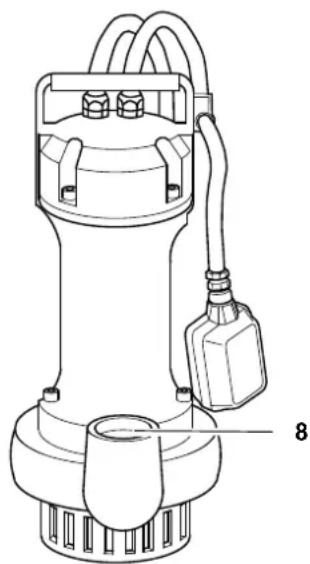
- Connect discharge hose with hose barb or connector supplied to the discharge port (8).
5.2 Installation
- Required space is approx. 50cm× 50~cm (for the float switch to operate properly it must be able to move freely).
- Pump must not be submerged deeper into water then stated in the "Technical Specifications".
- Place pump fully submerged.
- Place pump so that the suction inlet will not be blocked by foreign objects (stand on a base, if necessary).
- Ensure sufficient upright stability.

Caution!
Do not lift pump at cable or discharge hose; both are not designed for the tensile load by the weight of the pump.
-
Submerge pump at an angle to avoid an air cushion at the underside, which would prevent priming. Once the pump is submerged, it can be set into an upright position.
-
Lower pump to the bottom of the liquid container. Use a strong rope, fastened to the cable eye, to lower the pump.
The pump can also be operated when suspended by a rope.
- To start the submersible pump plug power cable in.
Unplug to stop the pump.
6. Operation
6.1 Switching ON and OFF
After connection to the mains, the submersible pump is automatically switched ON and OFF by the float switch:
It starts pumping when the liquid has lifted the float switch fully (9).
- The pump switches OFF when the float switch has fallen down (10).
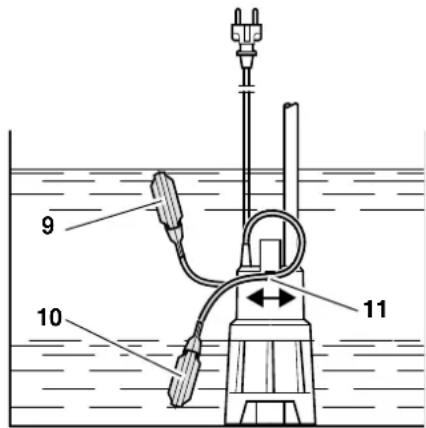
The cable for the float switch can be moved in the cable holder (11) to adjust the distance between the switching ON and OFF positions:
- "Short" float switch cable: ON and OFF positions are close together.
- "Long" float switch cable: ON and OFF positions are quite apart.

Caution!
The float switch must be able to move in such way that the pump cannot run dry.
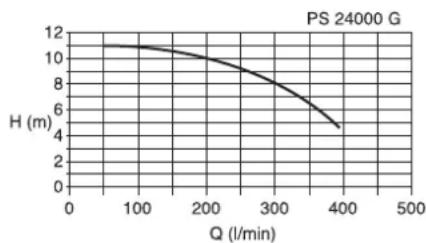
6.2 Pump characteristic curve
The pump characteristic curve shows which pump capacity is possible in dependence on the delivery head.
7. Care and Maintenance

Danger!
Prior to all servicing:
Switch Off.
Unplug.
Service and repair work other than described here must be left to qualified specialists.
7.1 Periodic maintenance
For the pump to function perfectly at any time periodic maintenance is required. This also applies if the pump is used under heavy conditions, but does not run for extended periods of time (e.g. when used in well drains):
Yearly service
- Check pump casing, cables and float switch for damage.
- Rinse pump with clear water. Remove persistent soiling, e.g. algae desposits, with brush and dishwashing liquid.
- To flush the inside of the pump, place it into a container filled with clear water and switch ON briefly.
Impeller cleaning
- Remove submersible pump's base as illustrated.
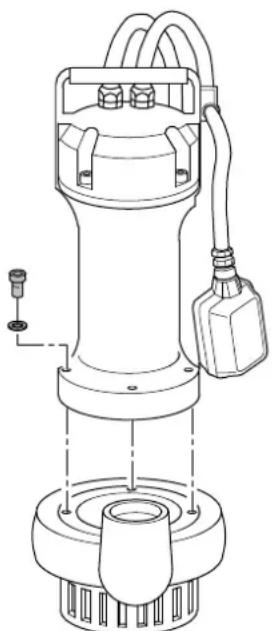
- Clean impeller and all accessible inside surfaces of the casing. Remove any fibres which may have wound around the impeller shaft. Remove persistent soiling with brush and dishwashing liquid.
- Reassemble pump.
7.2 Pump storage

Caution!
Frost damages the pump and accessories, as both always contain water!
- When there is danger of freezing remove pump and accessories and store at a frost-proof location.
8. Trouble Shooting

Danger!
Prior to all servicing:
- Switch Off.
Unplug.
8.1 Fault finding
Pump does not run:
No mains voltage.
-
Check cables, plug, outlet and mains fuse.
-
Mains voltage too low.
-
Use only extension cables with sufficient lead cross section (see "Technical Specifications").
-
Motor overheated, motor protection relay tripped.
-
Remove cause for overheating (liquid pumped too hot? Pump blocked by foreign objects?)
After cooling off the pump will switch ON again. -
Float switch does not switch the pump ON.
-
Ensure there is a sufficient water supply.
- Make sure the float switch can move unrestricted.
Motor hums but does not start:
- Pump blocked by foreign object.
- Clean pump.
Pump does not pump properly:
Delivery head too high.
- Observe max. delivery head (see "Technical Specifications").
- Discharge hose kinked.
- Straighten discharge hose.
Discharge hose leaky. - Seal discharge hose, tighten screw fittings.
Pump runs very noisy:
Pump primes air.
- Ensure there is a sufficient water supply.
- Adjust float switch correctly.
- Hold pump at an angle when submerging.
Pump runs continuously:
- Float switch does not reach lower position.
- Make sure the float switch can move unrestricted.
- Set to Manual mode, unplug.
9. Repairs

Danger!
Repairs to electric tools must only be carried out by a qualified electrician!
Electric tools in need of repair can be sent to an authorised service center in your country. See spare parts list for address.
Please attach a description of the fault to the electric tool.
10. Environmental Protection
The packaging of the pump can be 100% recycled.
Worn out power tools and accessories contain considerable amounts of valuable raw and plastic materials, which can be recycled.
These instructions are printed on paper produced with elemental chlorine free bleaching process.
11. Available Accessories
For this equipment the following accessories are available at specialist dealers.

Note:
Illustrations and stock numbers can be found at the end of these instructions.
A Adaptor C-connector
1 1/2" female,
pipe nipple 1 1 / 2'' x 300 mm
- Technical Specifications
| Mains voltage V 230 | ||
| Frequency Hz 50 | ||
| Rated output W 1100 | ||
| Rated current A 4.7 | ||
| Min. fuse protection (time-lag or L-type circuit breaker) A 10 | ||
| Running capacitor μF 20 | ||
| Rated speed min | -1 2800 | |
| Max. pump capacity l/h 24000 | ||
| Max. delivery head m 11 | ||
| Max. delivery pressure max. | bar | 1.1 |
| Immersion depth max. | m | 10 |
| Max. standing water | mm | 40 |
| Max. solids size | mm | 10 |
| Max. temperature liquid pumped | °C | 35 |
| Degree of protection | IP 68 | |
| Protection class | I | |
| Insulation class | F | |
| Materials | ||
| Pump casing | Gray cast iron | |
| Pump shaft | Steel | |
| Impeller | Gray cast iron | |
| Power cable (HO 7 RN-F) | m | 10 |
| Discharge port (AG=male, IG=female) | 1 1/2" IG | |
| Dimensions (pump casing) | ||
| Height | mm | 425.0 |
| Width | mm | 220.5 |
| Diameter | mm | 140.0 |
| Weight | kg 16.8 | |
| Max. length of extension cable | ||
| at 3 x 1.0 mm² lead cross-section | m | 30 |
| at 3 x 1.5 mm² lead cross-section | m | 50 |


- Volker Siegle
- Please Read First!
- Range of Application and Media
- Safety
- Specified conditions of use
- General safety instructions
- Danger by pump failings!
- Caution!
- To avoid water damage, e.g. flooded rooms, caused by pump malfunctions or defects:
- Prior to Operation
- Discharge hose connection
- Installation
- Do not lift pump at cable or discharge hose; both are not designed for the tensile load by the weight of the pump.
- Operation
- Switching ON and OFF
- The float switch must be able to move in such way that the pump cannot run dry.
- Pump characteristic curve
- Care and Maintenance
- Danger!
- Prior to all servicing:
- Periodic maintenance
- Yearly service
- Impeller cleaning
- Pump storage
- Trouble Shooting
- Fault finding
- Pump does not run:
- Motor hums but does not start:
- Pump does not pump properly:
- Pump runs very noisy:
- Pump runs continuously:
- Repairs
- Environmental Protection
- Available Accessories
- Note:
Brand : METABO
Model : PS 24000 SG
Category : Pump