HWW 300020 G - Pump METABO - Free user manual and instructions
Find the device manual for free HWW 300020 G METABO in PDF.



| Product type | Surface pump |
| Brand | Metabo |
| Model | HWW 300020 G |
| Dimensions (L x W x H) | 505 x 270 x 560 mm |
| Weight (empty) | 19 kg |
| Power supply | 230 V ~ 50 Hz, 900 W |
| Max flow rate | 3000 l/h |
| Max delivery head | 43 m |
| Max pressure | 4.3 bar |
| Max suction height | 8.5 m |
| Max water temperature | 35 °C |
| Pressure tank volume | 24 L |
| Tank pre-charge pressure | 1.5 bar |
| Suction connection | 1" female |
| Pressure connection | 1" male |
| Protection rating | IP X4 |
| Protection class | I |
| Housing material | Gray cast iron, steel, Noryl |
| Main functions | Pumping clean water for watering, irrigation, draining pools, ponds |
| Maintenance and cleaning | Drain water in case of frost, clean the strainer and valve |
| Safety | Dry-run protection, adjustable pressure switch, thermal circuit breaker |
| Spare parts and repairability | Parts available through customer service, repair by electrician |
Frequently Asked Questions - HWW 300020 G METABO
User questions about HWW 300020 G METABO
0 question about this device. Answer the ones you know or ask your own.
Ask a new question about this device
Download the instructions for your Pump in PDF format for free! Find your manual HWW 300020 G - METABO and take your electronic device back in hand. On this page are published all the documents necessary for the use of your device. HWW 300020 G by METABO.
USER MANUAL HWW 300020 G METABO
EG-KONFORMITÄTSERKLÄRUNGVEC-DECLARATION OF CONFORMITY
We herewith declare in our sole responsibility that this product complies with the following standards in accordance with the regulations of the undermentioned Directives issuing test office *** measured/ guaranteed noise sound power level***
NL
Director Innovation, Research and Development
Dokumentationsbevollmächtigter/ responsible person for documentation/ Chargé de la documentation
Metabowerke GmbH
Metabo-Allee 1
D-72622 Nurtingen
DEEN
We herewith declare in our sole responsibility that this product complies with the following standards in accordance with the regulations of the undermentioned Directives issuing test office *** measured/ guaranteed noise sound power level***
NL
Director Innovation, Research and Development
Dokumentationsbevollmächtigter/ responsible person for documentation/ Chargé de la documentation
Metabowerke GmbH
Metabo-Allee 1
D-72622 Nurtingen
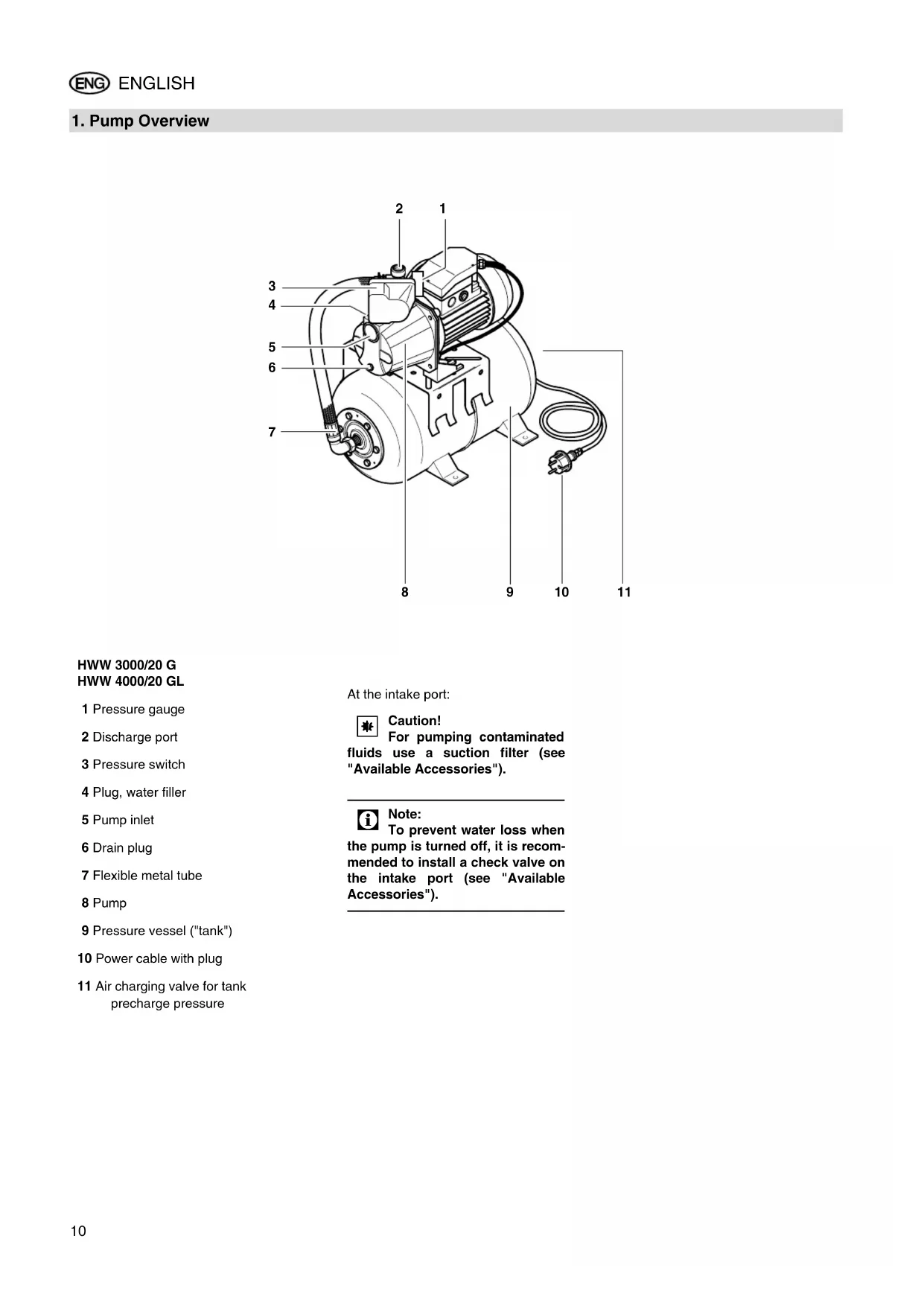
1 Pressure gauge
2 Discharge port
3 Pressure switch
4 Plug, water filler
5 Pump inlet
6 Drain plug
7 Flexible metal tube
8 Pump
9 Pressure vessel ("tank")
10 Power cable with plug
11 Air charging valve for tank precharge pressure
At the intake port:
Caution! For pumping contaminated fluids use a suction filter (see "Available Accessories").
Note: To prevent water loss when the pump is turned off, it is recommended to install a check valve on the intake port (see "Available Accessories").
Table of Contents
- Pump Overview 10
- Please Read First! 11
-
Range of Application and Pumping Media 11
-
Safety 11
4.1 Specified Conditions of Use.... 11
4.2 General Safety Instructions 11
- Prior to Operation.. 12
5.1 Installation. 12
5.2 Connecting the Suction Line.... 12
5.3 Discharge Port. 12
5.4 Connection to a Pipe System ....12
5.5 Connection to AC Power 12
5.6 Filling the pump and priming.... 12
- Operation 13
6.1 Commissioning 13
7. Care and Maintenance. 13
7.1 Danger of Ffreezing. 13
7.2 Pump Dismounting and Storing .13
8. Trouble Shooting.... 13
8.1 Locating the Fault 13
8.2 Adjusting the Pressure Switch ....14
8.3 Increasing the Precharge Pressure 14
- Repairs. 14
- Environmental Protection....14
- Available Accessories.....14/61
- Technical Specifications... 15
2. Please Read First!
These operating instructions have been written to make it easier for you, the operator, to learn how to operate this pump and to do so safely. These instructions should be used as follows:
- Read these instructions before use. When reading these instructions, pay special attention to all safety instructions.
- These operating instructions are intended for people with basic technical knowledge regarding the operation of a pump like this or similar pumps. Inexperienced persons are advised to seek competent advise from an experienced person before operating this pump.
- Keep all documents supplied with the pump for future reference. Retain proof of purchase for possible warranty claims.
- This pump must not be sold or lent to someone else without being accompanied by these operating instructions and all other machine documents supplied with the pump.
The manufacturer assumes no liability for any damage resulting from the
non-observance of any operating or safety instructions given in this manual.
The information in these instructions is denoted as under:

Danger! Risk of personal injury or damage to the environment.
Risk of electric shock! Risk of personal injury by electric shock.

Caution! Risk of material damage

Note: Additional information.
Numbers in illustrations (1, 2, 3, ...)
indicate component parts;
are consecutively numbered;
- refer to the corresponding numbers in brackets (1), (2), (3) ... in the neighbouring text.
- Instructions to be carried out in sequence are numbered.
- Instructions which can be carried out in any sequence are preceded by a bullet () .
Listing are preceded by a dash (-).
3. Range of Application and Pumping Media
This pump is intended for pumping clear water in domestic applications, such as
- irrigation,
- well, rain and service water pumping,
draining of pools, garden ponds and water tanks.
The max. permissible temperature of the pumped medium is 35^
4. Safety
4.1 Specified Conditions of Use
This pump must not be used to supply drinking water or for pumping foodstuff.
Explosive, flammable, aggressive fluids or substances detrimental to health as well as salt water must not be pumped.
This pump is not suitable for commercial or industrial use.
Modification of the pump or use of parts not approved by the manufacturer is not permitted.
Any use other than the use specified above may cause unforeseeable danger!
4.2 General Safety Instructions
Children, juveniles and persons not familiar with the instructions are not permitted to operate the pump.
When used in swimming pools and garden ponds and within their range of protection, the regulations of DIN VDE 0100 -702, -738 or applicable local regulation must be observed.
When used as domestic water supply any applicable local regulations pertaining to water supply and waste water disposal, plus DIN 1988 (where applicable) have to be observed.
The following residual risks do principally exist when operating pumps and pressure vessels and can not be fully eliminated - even by employing safety devices.

Hazard generated by ambient conditions!
- Do not expose to rain. Do not operate in damp or wet environment.
- Do not use the pump in hazardous locations or near inflammable liquids and gases!

Danger: Hot water!
If the shut-off pressure of the pressure switch cannot be reached due to poor pressure conditions or a defective pressure switch the water can heat up within the pump as a result of internal circulation.
Through this the pump and the connection lines can become damaged or leaky, allowing hot water to escape. Danger of scalding!
- Do not operate the pump against a closed pressure line for longer than 5 minutes.
- Unplug the pump and allow to cool. A specialist must check the system to make sure it is in perfect working order before it can be used again.

Danger! Risk of electric shock!
- Do not direct water jet directly against the pump or other electrical parts! Risk of fatal electric shock!
- Do not touch the plug with wet hands! To unplug always pull on the plug, not the power cable.
- The earthed outlet or the plug connection to an extension cable must be located in an area safe against flooding.
- Use only extension cables of sufficient lead cross section (see
"Technical Specifications"). Completely unroll cable reels.
- Do not buckle, squeeze, drag or drive over power cable and extension cables; protect from sharp edges.
-
Place extension cable so that it cannot get into the fluid to be pumped.
Unplug: -
prior to all servicing;
- when persons are in the swimming pool or garden pond.

Danger by pump failures!
If you notice transport damage while unpacking, notify your supplier immediately. Do not operate the pump!
- Before each use check the pump, especially the power cable and plug for possible damage. Risk of fatal electric shock!
- A damaged pump must be workmanlike repaired before it can be used again.
- Do not attempt to repair the pump yourself! Only trained specialists are permitted to service or repair pumps or pressure vessels.

Caution!
To avoid water damage, e.g. flooded rooms, caused by pump malfunctions or defects:
provide for suitable safety measures such as the following:
alarm or
collection tank with monitoring.
The manufacturer is not liable for any damage caused by:
improper use of the pump;
- overloading of the pump through continuous operation;
- failure to operate and store the pump in a frost-free environment;
- unauthorised modification of the pump (repairs to electrical equipment may only be carried out by qualified electricians!);
- use of spare parts which have not been tested and approved by the manufacturer; or
use of unsuitable installation materials (fittings, connection lines etc.).
Suitable installation materials:
- pressure-resistant (min. 10 bar)
- heat-resistant (min. 100^ ).
5. Prior to Operation
The pump is easily assembled and connected.
If in doubt, contact your specialist supplier or a qualified electrician.
5.1 Installation
- The pump must be placed on a plane and level surface, suitable of bearing the weight of the pump fully filled with water.
- To avoid vibrations the pump should be placed on an elastic base.
- The installation location should be well vented and protected from atmospheric exposure.
- When operated at garden ponds and pools the pump must be set up safe against flooding and safeguarded against falling into the water. Any additional legal requirements are to be observed.
5.2 Connecting the Suction Line
i Note:
Possibly further accessories may be required for connection (see "Available Accessories").
Caution!
The suction line needs to be installed in such manner that it does not exert mechanical force or distortion to the pump.
Caution! When a
When pumping contaminated fluids install a suction strainer to protect the pump from sand and dirt.
i Note:
A check valve is recommended to prevent water backflow when the pump is turned off.
- All screw fittings must be sealed with thread sealing tape; leaks cause the priming of air, which reduces or completely prevents the priming of water.
The suction line should have an inner diameter of 1^ (25 mm) minimum and must be kink and vacuum resistant. - Keep suction line as short as practical, as with increasing length the pump capacity is reduced.
- The suction line should ascend towards the pump to prevent air locks.
- A sufficient water supply must be ensured, the foot valve at the end of the suction line must be submerged in water at all times.
5.3 Discharge Port
i Note:
Possibly further accessories may be required for connection (see "Available Accessories").

Caution!
The discharge (or pressure) line needs to be installed in such manner that it does not exert mechanical force or distortion to the pump.
- All screw fittings should be sealed with thread sealing tape to prevent leakage.
- All parts of the pressure line must be resistant to internal pressure.
All parts of the pressure line must be installed in a workmanlike manner.
Danger! Improper installation and use of parts not resistant to internal pressure can cause the pressure line to break during operation. Risk of personal injury by liquid spurting from the line under high pressure!
5.4 Connection to a Pipe System
A stationary installation (e.g. in an indoor domestic water system) is also possible.
- To reduce vibrations and noises the pump should be connected to the pipe system with flexible tubing.
5.5 Connection to AC Power
Danger! Risk of electric shock! Do not operate the pump in wet environment and only under the following conditions:
- Connect only to an earthed outlet that is properly installed, earthed and tested.
- Mains voltage and fuse protection must correspond with the requirement stated in the "Technical Specifications".
- When operated at pools, garden ponds and similar locations, the pump must be protected by a residual current operated device (RCD, 30 mA) (DIN VDE 0100-702, -738 or equivalent applicable local regulations). We recommend the use of RCD's as a general precaution for personal protection.
- When operating the pump outdoors the electrical connections must be splash-proof; the connections must not be placed into water.
Use only extension cables of sufficient lead cross section (see "Technical Specifications"). Completely unroll cable reels.
5.6 Filling the pump and priming

Caution!
After installation, loss of water or priming of air the pump needs to be filled with water. Starting the pump without water causes damage!
i
Note:
The suction line does not need to be filled, the pump is self-priming. However, depending on length and diameter of the suction line it may take some time until pressure has built up.
-
Remove the water filler plug, complete with gasket.
-
Slowly pour in clear water, until the pump is filled.
-
To reduce the time needed for priming you can also fill the suction line.
-
Replace the water filler plug, complete with gasket.
-
Open pressure line (open tap or spray nozzle) for any air to escape during priming.
-
Start pump (see "Operation").
-
Turn pump OFF when water runs out steadily.
6. Operation
Pump and suction line must be connected and filled (see "Prior to Operation").
#
Caution!
The pump must not run dry. Ensure there is always sufficient pumping medium (water) available.
- If the motor does not start, no pressure is built up or similar effects are evident, switch the pump OFF - and try to resolve the fault (see "Trouble Shooting").
Pump characteristic curve
The pump characteristic curve shows which pump capacity is possible in dependence on the delivery head.

(Pump characteristic curve for 0.5m suction head and 1" suction hose.)
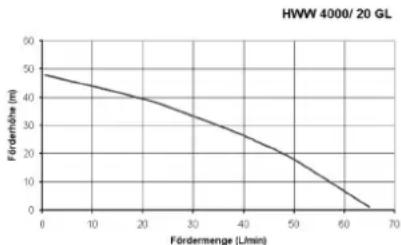
(Pump characteristic curve for 0.5m suction head and 1" suction hose.)
6.1 Commissioning
i
Note:
The pressure switch
- starts the pump when, by drawing water, the water pressure in the tank falls below the cut-in pressure;
- stops the pump when the cut-out pressure is reached.
1
Note:
In the tank is a rubber bag, factory-charged with air ("precharge pressure"); this permits the drawing of small amounts of water without the pump starting up.
- Plug power cable in.
- Open pressure line (open tap or spray nozzle).
- Check to see that the water comes out!
7. Care and Maintenance
A
Danger!
Prior to all servicing:
- Turn OFF.
- Unplug.
- Ensure that pressure is relieved from the pump and connected accessories.
Service and repair work other than described here must be left to qualified specialists.
7.1 Danger of Ffreezing
#
Caution!
Frost damages the pump and accessories, as both always contain water!
- When there is danger of freezing, dismount the pump and accessories and store at a frost-free location (see below).
7.2 Pump Dismounting and Storing
- Turn pump OFF and unplug.
- Open pressure line (open tap or spray nozzle) and drain water completely.
- Completely drain pump and tank; to do so remove the drain plug from the underside of the pump.
- Disconnect suction and pressure lines from the pump.
- Store pump in a frost-free location (at least 5^ ).
8. Trouble Shooting
A
Danger!
Prior to all servicing:
-
Turn OFF.
-
Unplug.
-
Ensure that pressure is relieved from the pump and connected accessories.
8.1 Locating the Fault
Pump does not run:
No mains voltage.
-
Check cables, plug, outlet and mains fuse.
-
Mains voltage too low.
-
Use only extension cables with sufficient lead cross section (see "Technical Specifications").
-
Motor overheated, motor protection relay tripped.
After cooling off the pump will start again.
- Ensure sufficient ventilation, keep vent slots clear.
- Observe max. temperature of the pumped medium.
Motor hums but does not start.
- With the motor turned OFF, put screwdriver or similar through the fan cover's ventilation slots and turn the fan.
Pump blocked or out of order.
- Disassemble pump and clean.
- Clean diffusor, replace if necessary.
- Clean impeller, replace if necessary.
Pump does not prime correctly or runs very noisily:
Lack of water.
- Ensure there is a sufficient water supply.
Suction line leaky.
- Seal suction line, tighten screw fittings.
Suction head too high.
- Observe max. suction head.
- Install check valve, fill suction line with water.
- Suction strainer (optional accessory) blocked.
- Clean, replace if necessary.
- Check valve (optional accessory) blocked.
- Clean, replace if necessary.
Water leaks between motor and pump, Ducone seal worn.
- Replace Ducone seal.
Pump blocked or out of order.
see above.
Pressure too low:
Suction line leaky or too much suction head.
see above.
Pump blocked or out of order.
see above.
Pressure switch incorrectly adjusted.
- Check cut-in pressure and cut-out pressure, adjust if necessary.
- Pump starts even when drawing only a small amount of water (approx. 0.5 l).
- Too little precharge pressure in the tank; increase.
Water dripping from air charging valve.
Rubber bag in tank leaky; replace.
8.2 Adjusting the Pressure Switch
If - in time - the factory-set cut-in pressure or cut-out pressure has changed considerably, the original setting can be restored (see "Technical Specifications").

Danger!
Risk of electric shock by the
terminals inside the pressure switch. Only qualified personnel is allowed to open and adjust the pressure switch.
- Remove the pressure switch cover.
- Open pressure line (open tap or spray nozzle) and let run water.
When the pump starts, read the cut-in pressure on the pressure gauge.
- Close the pressure line again.
Read the cut-out pressure on the pressure gauge when the pump stops.

Caution!
The factory-set cut-out presnust not be exceeded.
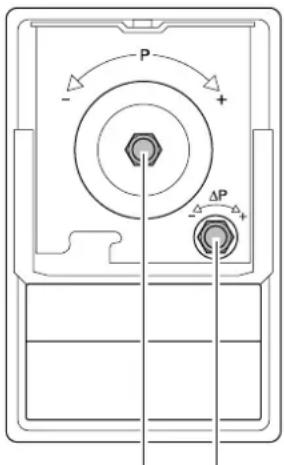
1213
-
To change the cut-out pressure, turn nut (12) as follows:
-
turn clockwise to increase the cut-out pressure;
-
turn counter-clockwise to reduce the cut-out pressure.
-
To change the cut-in pressure, turn nut (13) as follows:
-
turn clockwise to increase the cut-in pressure;
-
turn counter-clockwise to reduce the cut-in pressure.
-
If necessary, repeat steps 2. through 5. until the desired values are set.
- Replace the pressure switch cover.
8.3 Increasing the Precharge Pressure
When - in time - the pumps starts after only small amounts of water are drawn (approx. 0.5 l), the precharge pressure in the tank must be restored to the original level.

Note:
The precharge pressure can not be read on the pump's pressure gauge.
- Unplug.
- Open pressure line (open tap or spray nozzle) and drain water completely.
- Unscrew the plastic cover on the front side of the tank; the charging valve is located behind itl.
- Connect air pump or compressor hose with a "car tyre" type connector and pressure gauge to the charging valve.
- Inflate to the intended precharge pressure (see "Technical Specifications").
- Plug pump in again and check function.
9. Repairs

Danger!
Repairs to electric tools must only be carried out by a qualified electrician!
Electric tools in need of repair can be sent to an authorized service center in your country. See spare parts list for address.
Please attach a description of the fault to the electric tool.
10. Environmental Protection
The packaging material of the pump is 100% recyclable.
Worn out power tools and accessories contain considerable amounts of valuable raw and plastic materials, which can be recycled.
11. Available Accessories
For this pump the following accessories are available from your dealer.

Note:
Illustrations and stock numbers own at the end of this manual.
A Pump Installation Package, (MSS 310-HWA/P), complete with double nipple, check valve, filter short, washable filter cartridge, spiral hose assembly 1m thread sealing tape.
B Pump Installation Package, (MSS 380-HWW),complete with double nipple, check valve, filter short, washable filter cartridge, spiral hose assembly 1 thread sealing tape.
C Pump Installation Package, (MSS 200 - HWW/P), complete with double nipple, check valve, filter short, washable filter cartridge, spiral hose assembly 1m thread sealing tape.
D Pump Installation Package, (MSS 1000-HWA),complete with double nipple, check valve, filter short, washable filter cartridge, spiral hose assembly 1 thread sealing tape.
E Filter (for garden pumps), 1" connection, short, c/w washable synthetic material filter cartridge.
F Filter (for domestic water systems), 1" connection, short, c/w washable synthetic material filter cartridge.
G Spiral Suction Hose 1" (standard) 1) 4m , c/w quick release screw fitting and strainer with foot valve; 2) 7m , c/w quick release screw fitting and strainer with foot valve;
H Spiral Suction Hose 1" (professiona) 1) 1.5m both ends with quick release screw fitting; 2) 4m c/w quick release screw fitting and strainer with foot valve; 3) 7m c/w quick release screw fitting and strainer with foot valve;
I Reinforced Hose 500 mm
J Multi-adapter 1" ideal for connecting to pumps with 1" AG connector (AG=male thread, IG=female thread)
K Hydrostop, 230 V for automatic stopping when there is a lack of water, prevents the pump from running dry.
L Dry-running Stop Switch, 230 V with 10m cable, keeps the pump from running dry when pumping from tank, pool, etc.
M Thread Sealing Tape, 12 m roll.
N Washable Filter Cartridge, short, for mechanical pre-filtering of sand, reusable.
O Washable Filter Cartridge, long, for mechanical pre-filtering of sand, reusable.
- Technical Specifications
| HWW 3000/ 20G | HWW 4000/ 20GL HW | W 3000/ 20G | ||
| Mains voltage | V | 230 ~ 1 | 230 ~ 1 | 110 ~ 1 |
| Frequency | Hz | 50 | ||
| Rated output W 900 1300 950 | ||||
| Rated current A 3.3 4.5 | 9.7 | |||
| Fuse protection min. (time-lag or L-type circuit breaker) | A | 10 | 10 | 15 |
| Running capacitor | μF | 16 | 16 | 35 |
| Rated speed | min-1 | 2780 | 2800 | 3400 |
| Pump capacity max. | l/h | 3000 | 4000 | 3000 |
| Delivery head max. | m | 43 | 48 | 43 |
| Delivery pressure max. | bar | 4.3 | 4.8 | 4.3 |
| Max. suction head | m | 8.5 | 9.0 | 8.5 |
| Temperature of the primed medium max. | °C | 35 | 35 | 35 |
| Ambient temperature | °C | 5 ... 40 | 5 ... 40 | 5 ... 40 |
| Degree of protection | IP X4 | IP X4 | IP x4 | |
| Protection class | I | I | I | |
| Insulation class | B | B | B | |
| Materials | ||||
| Pump casing | Grey cast iron | Grey cast iron | Grey cast iron | |
| Pump shaft | Stainless steel | Stainless steel | Stainless steel | |
| Impeller | Noryl | Noryl | Noryl | |
| Connections | ||||
| Intake port (female thread) | 1" | 1" | 1" | |
| Discharge port (male thread) | 1" | 1" | 1" | |
| Pressure switch | ||||
| Cut-in pressure approx. | bar | 1.4 | 1.8 | 1.4 |
| Cut-out pressure approx. | bar | 2.8 | 3.8 | 2.8 |
| Tankl | ||||
| Tank capacity approx. | l | 24 | 24 | 24 |
| Tank pressure maximum | bar | 10.0 | 10.0 | 10.0 |
| Precharge pressure | bar | 1.5 | 1.5 | 1.5 |
| Dimensions (without connections) | ||||
| Length | mm | 505 | 505 | 505 |
| Width | mm | 270 | 270 | 270 |
| Height | mm | 560 | 560 | 560 |
| Weights | ||||
| Dry weight | kg | 19 | 22.5 | 19.8 |
| Weight filled with water | kg | 40.5 | 44.0 | 41.3 |
| Noise emission values (at max. pressure) | ||||
| Sound power level LwAm | dB (A) | 74 | 77 | 74 |
| Sound power level LwAd | dB (A) | 78 | 83 | 78 |
| Max. length of extension cable | ||||
| at 3 x 1.0 mm² lead cross-section | m | 30 | 30 | 10 |
| at 3 x 1.5 mm² lead cross-section | m | 50 | 50 | 20 |
Pomp verstopt of defect.
- zie hoger.
E Filter (havepumper),
Adapter 1", kort,
komplet med vaskelig plast-filter-indsats.
F Filter (vandpumper til hus),
Adapter 1", lang,
komplet med vaskelig plast-filter-indsats.
G Spiralslange 1" (standard)
1) 4m , komplet med snaplase og sugekurv med bundventil;
2) 7m , komplet med snaplase og sugekurv med bundventil;
H Spiralslange 1" (profi)
1) 1,5 m, komplet, med snaplase
pà begge sider;
2) 4m , komplet med snaplase og sugekurv med bundventil;
3) 7m , komplet med snaplase og sugekurv med bundventil;
I Armeret slange 500 mm
J Universaladapter 1"
ideel til tilslutning til pumpe med 1" IG-adapter (UG=udv. gevind, IG=indv. gevind)
K Hydrostop, 230 V
stopper pumpen automatisk nar der er vandmangel, forbindrer at pumpen korer tcr.
L Tørlobs-stopkontakt, 230 V