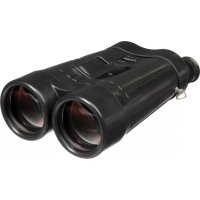
Classic S - Binoculars ZEISS - Free user manual and instructions
Find the device manual for free Classic S ZEISS in PDF.



| Product type | Binoculars |
| Brand | ZEISS |
| Model | Classic S (20x60 S) |
| Magnification | 20x |
| Objective lens diameter | 60 mm |
| Field of view at 1000 m | 52 m |
| Exit pupil | 3 mm |
| Minimum focusing distance | 14 m |
| Diopter adjustment range | ≥ ± 7 dpt |
| Interpupillary distance | 57 – 73 mm |
| Height (eyecups folded down) | 265 mm |
| Maximum width | 161 mm |
| Weight | 1,66 kg |
| Water resistance | Water splash |
| Image stabilization | Yes, via button (4) |
| Focus adjustment | Central wheel + diopter correction ring |
| Use with glasses | Retractable rubber eyecups |
| Lens care | Soft brush, optical cloth, air blower |
| Precautions | Do not look at the sun or lasers |
| Included accessories | Carrying case |
| Warranty | Refer to manual |
Frequently Asked Questions - Classic S ZEISS
User questions about Classic S ZEISS
0 question about this device. Answer the ones you know or ask your own.
Ask a new question about this device
Download the instructions for your Binoculars in PDF format for free! Find your manual Classic S - ZEISS and take your electronic device back in hand. On this page are published all the documents necessary for the use of your device. Classic S by ZEISS.
USER MANUAL Classic S ZEISS
Carl Zeiss Sports Optics
20 × 60 ~S
Gebrauchshinweise
Instructions for use
Mode d'emploi
Congratulations on your outstanding new binoculars. Enjoy the impressive experience of undistorted image reproduction which is distinguished by perfect brilliance and excellent colour accuracy.
Carl Zeiss brand products are characterised by outstanding optical performance, accurate processing and long durability. Please observe the following instructions for use, so that you enjoy optimum use of your product and it can be a faithful companion to you for many years.
Setting the pupillary distance
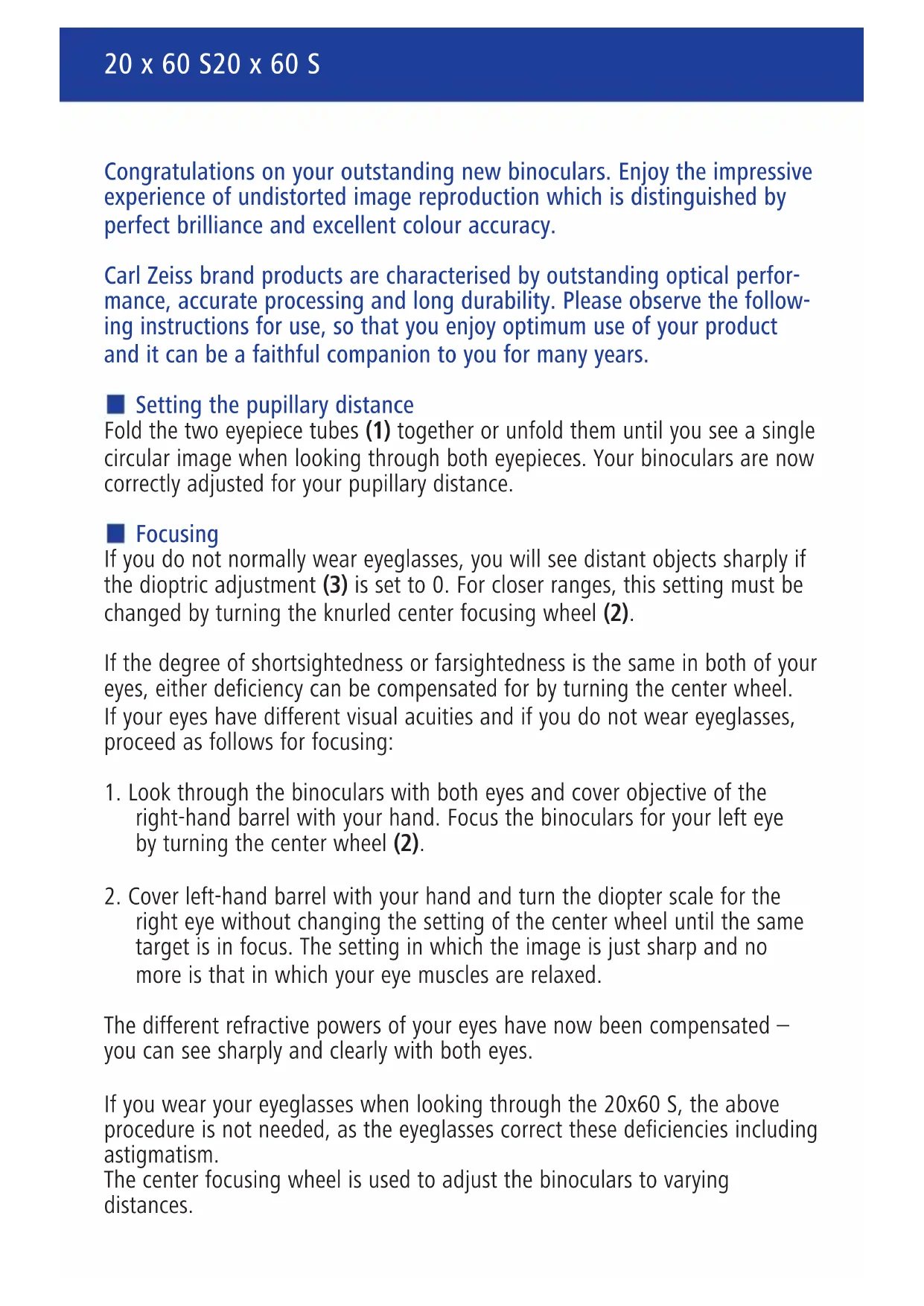
Fold the two eyepiece tubes (1) together or unfold them until you see a single circular image when looking through both eyepieces. Your binoculars are now correctly adjusted for your pupillary distance.
Focusing
If you do not normally wear eyeglasses, you will see distant objects sharply if the dioptic adjustment (3) is set to 0. For closer ranges, this setting must be changed by turning the knurled center focusing wheel (2).
If the degree of shortsightedness or farsightedness is the same in both of your eyes, either deficiency can be compensated for by turning the center wheel. If your eyes have different visual acuities and if you do not wear eyeglasses, proceed as follows for focusing:
- Look through the binoculars with both eyes and cover objective of the right-hand barrel with your hand. Focus the binoculars for your left eye by turning the center wheel (2).
- Cover left-hand barrel with your hand and turn the diopter scale for the right eye without changing the setting of the center wheel until the same target is in focus. The setting in which the image is just sharp and no more is that in which your eye muscles are relaxed.
The different refractive powers of your eyes have now been compensated -- you can see sharply and clearly with both eyes.
If you wear your eyeglasses when looking through the 20 × 60 ~S , the above procedure is not needed, as the eyeglasses correct these deficiencies including astigmatism.
The center focusing wheel is used to adjust the binoculars to varying distances.
Eyeglass-wearers should fold down the rims of the soft rubber eyecups over the top eyepiece mounts, see B. Users without eyeglasses should use the binoculars with extended eyecups, see A. Only two adjustments are required for this conversion.
Correct viewing using the stabilization system
When you press key (4), the optical system of your 20x60 S is stabilized — shaking of the hands is largely compensated. For prolonged observation from one location, it is advisable to use a camera tripod. Position the eyecups firmly against your eyebrows or the distance portions of your glasses and focus the target using the center wheel.
Care and maintenance
Carl Zeiss binoculars need no special care or maintenance. Do not wipe off coarse dirt particles (e.g. sand) from the lenses, but blow them off or remove them with a soft brush.
Fingerprints on the lens surfaces may affect them in the course of time. The easiest way to keep the lenses clean is by breathing on them and wiping with a soft optical cleaning cloth or optical cleaning paper.
To avoid a possible fungal coating which is common in the tropics, store the optics in a dry place and always ensure good aeration of the lens surface.
Please note in particular:
If possible, please only transport your 20x60 S Binocular in the case provided or in the bag which is available as an accessory - this is the best protection for your instrument. When transporting the instrument, please make sure that the stabilization key is not accidentally pressed by any objects lying on the binoculars.
Please keep the original packing in a safe place. It is advisable to use the original packing when transporting the instrument over long distances.
Caution
- Rapid turning of the instrument about its optical axis may slightly impair its functioning.
Pronounced shocks or jolting movements should be avoided, in particular when key (4) is pressed. Otherwise, this may result in damage to the stabilization system which is not covered by the guarantee. - Do not under any circumstances look through the binoculars at the sun or laser light sources - serious eye injury may otherwise result.
| Technical data | 20x60 S |
| Magnification | 20x |
| Objective lens diameter (mm) 60 | |
| Field of view at 1000 m (m) Ww 52 | |
| Exit pupil (mm) 3 | |
| Shortest focusing distance (m) 14 | |
| Dioptre adjustment range ≥ +/- 7 dpt | |
| PD from/to (mm) 57 – 73 | |
| Height with folded eyecup (mm) 265 | |
| Width (mm) 161 | |
| Weight (g) 1,660 | |
| Splash-proof • |
Subject to changes in design and scope of delivery as a result of ongoing technical development.

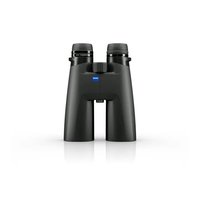
Brand : ZEISS
Model : Classic S
Category : Binoculars