Every Stage FX Signature - High chair Joie - Free user manual and instructions
Find the device manual for free Every Stage FX Signature Joie in PDF.



User questions about Every Stage FX Signature Joie
0 question about this device. Answer the ones you know or ask your own.
Ask a new question about this device
Download the instructions for your High chair in PDF format for free! Find your manual Every Stage FX Signature - Joie and take your electronic device back in hand. On this page are published all the documents necessary for the use of your device. Every Stage FX Signature by Joie.
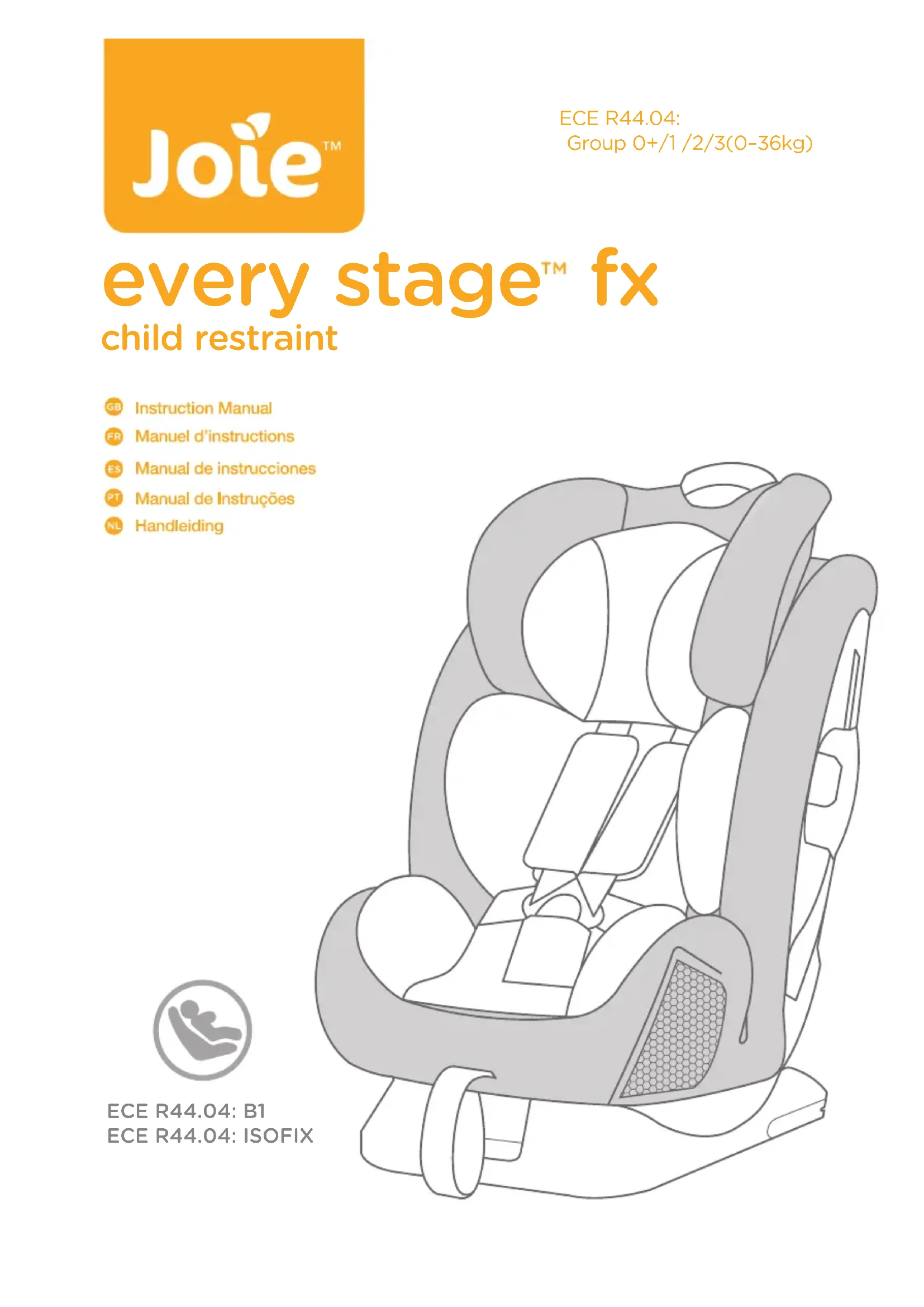
USER MANUAL Every Stage FX Signature Joie
natural_image
Line drawing of a car comfort seat with visible seats and seatbelt (no text or symbols)GB
Congratulations
You have purchased a high quality, fully certified child safety child restraint. This product is suitable for the use of children weighing UNDER 36kg (approximately 12 years old or under).
Carefully read this Instruction Manual and follow the installing steps because this is the ONLY way to protect your child from serious injury or death in case of an accident, and to provide comfort to your child while using this product.
Keep this instruction manual for future reference.
Please Confirm
Make sure that your vehicle is equipped with 3-point retractor safety-belt.
Seat belts may be different in design and length according to maker, manufacturing date, and type of the vehicle. This child restraint is only suitable for use in the listed vehicles fitted with 3-point retractor safety-belts, approved to UN ECE regulation NO.16 or other equivalent standards.
This child restraint is approved to UN ECE Regulation No. 44, 04 series of amendments.
For warranty information, please visit our website at joiebabv.com
! Please keep the instruction manual in the storage compartment of the rear cover for future reference.
Parts List
Make sure all parts are available before assembly. If any part is missing, please contact local retailer. No tools are required for assembly.
1 Head Support
2 Seat Pad
3 Buckle
4 Webbing Adjuster
5 ISOFIX Attachments Releasing Button
6 Recline Adjustment Handle
7 Crotch Strap
8 Shoulder Harness
9 Infant Insert
10 Lock-off
11 Lock-off Device
12 Head Support
Adjustment Lever
13 Tether Strap Adjuster
14 Tether Hook
15 Top Tether Strap
16 Instruction Manual
Storage Compartm
17 Base
18 ISOFIX Attachments Connector
19 Seat Belt Back Slot
20 Lap Belt Guiding
21 ISOFIX Attachments Guides
Soft goods include Seat Pad, Crotch Pad, Head Support and Infant Insert. Please make sure there are no missing parts. Please contact the retailer if anything is missing.

text_image
Diagram of car seat with numbered labels pointing to different seat positions
text_image
Technical diagram of a car head with numbered parts and an inset view of the front wheel.WARNING
NO child restraint can guarantee full protection from injury in an accident. However, proper use of this child restraint will reduce the risk of serious injury or death to your child.
This child restraint is designed ONLY for child weighing under 36kg (approximately 12 years old or under).
! DO NOT use forward facing mode before the child's weight exceeds 9kg.
! Any straps holding the restraint to the vehicle should be tight, that any straps restraining the child should be adjusted to the child's body, and that straps should not be twisted.
! DO NOT use or install this child restraint until you read and understand the instructions in this manual and in your vehicle owner's manual.
! Concern the danger of making any alterations or additions to the device without the approval of the Type Approval Authority, and a danger of not following closely the installation instructions provided by the child restraint manufacturer.
! DO NOT make any modification to this child restraint or use it along with component parts from other manufacturers.
! DO NOT use this child restraint if it has damaged or missing parts.
! DO NOT have your child in unfitted clothes when use this child restraint in baby or toddler mode, because this may prevent your child from being properly and securely fastened by the shoulder harnesses and the harnesses between thighs.
When use this child restraint in baby or toddler mode, the safety belt must be used correctly, and ensure that any lap strap is worn low down, so that the pelvis is firmly engaged.
! DO NOT leave this child restraint unbelted or unsecured in your vehicle because unsecured child restraint can be thrown around and may injure occupants in a sharp turn, sudden stop, or collision. Remove it if not in regular use.
Child is not left in the child restraint system unattended.
Do not place the child restraint in seating positions where an active frontal airbag is installed if your child is still in rear facing mode.
WARNING
! NEVER use a second-hand child restraint or a child restraint whose history you do not know because they may have structural damage that endangers your child's safety.
! Please keep this child restraint away from sunlight, otherwise it may be too hot for the child's skin.
! NEVER use ropes or any other substitutes in place of seat belts in case of injuries from restraint.
! DO NOT use this child restraint as a regular chair as it tends to fall down and injure the child.
! The child restraint shall not be used without the soft goods.
! The soft goods should not be replaced with any other than the one recommended by the manufacturer, because the soft goods constitutes an integral part of the restraint performance.
! DO NOT put anything other than the recommended inner cushions in this child restraint.
! DO NOT carry this child restraint with a child in it.
! Any luggage or other objects liable to cause injuries in the event of a collision shall be properly secured.
! Do not allow the child restraint harness or buckles to become trapped or caught in the vehicle seat or door.
The device should be changed when it has been subject to violent stresses in an accident.
Remove this child restraint from the vehicle seat when it is not in use for a long period of time.
! To avoid suffocation, remove plastic bag and packaging materials before using this product. The plastic bag and packaging materials should then be kept away from babies and children.
! Consult the distributor for issues concerning maintenance, repair and part replacement.
! DO NOT use any load bearing contact points other than those described in the instructions and marked in the child restraint.
! Frequently check the ISOFIX attachments guides for dirt and clean them if necessary. Reliability can be effected by ingress of dirt, dust, food particles etc.
WARNING
! DO NOT install this child restraint under the following conditions:
- Vehicle seats with 2-point safety belts.
- Vehicle seats facing sideward or rearward with respect to the running direction of the vehicle.
- Vehicle seats unstable during installation.
Emergency
In case of emergency or accidents, it is most important to have your child taken care of with first aid and medical treatment immediately.
Product Information
For Installation with 3-point-belt or with ISOFIX (ISOFIX attachments and top tether)
- This is a 'Universal' child restraint. It is approved to UN ECE Regulation No. 44, 04 series of amendments, for general use in vehicles and it will fit most, but not all, car seats.
- A correct fit is likely if the vehicle manufacturer has declared in the vehicle handbook that the vehicle is capable of accepting a 'Universal' child restraint for this age group.
- This child restraint has been classified as 'Universal' under more stringent conditions than those which applied to earlier designs which do not carry this notice.
- If in doubt, please consult the child restraint manufacturer or the retailer.
For Installation with ISOFIX (ISOFIX attachments and top tether)
- This is an ISOFIX CHILD RESTRAINT SYSTEM. It is approved to Regulation No. 44, 04 series of amendments for general use in vehicles fitted with ISOFIX anchorages systems. It is suitable for fixing into the seat positions of most cars.
- It will fit vehicles with positions approved as ISOFIX positions (as detailed in the vehicle handbook), depending on the category of the child restraint and of the fixture.
- Seat positions in other cars may also be suitable to accept the child restraint. If in doubt, consult either the child restraint manufacturer or vehicle manufacturer.
- The ISOFIX size class for which this device is intended is B1.
For Installation with ISOFIX attachments and 3-point-belt
- The child restraint is classified for "Semi-Universal" use.
- Seat positions in other cars may also be suitable to accept the child restraint. If in doubt, consult either the child restraint manufacturer or vehicle manufacturer.
Product Child Restraint
Model C1602
Suitable for Child weighing 0 - 36kg (approximately 0 - 12 years)
Mass Group 0+/1/2/3
Materials Plastics, metal, fabrics
Patent No. Patents pending
Choose the Installation Mode
| Child's Weigh ht | Installation Mode | Figure for Installation | Reference Age | Seat Infant Insert Position Instructions | |
| <18kg | Baby mode |  | <4 years | Position 5-6.56 | Infant insert must be used from 0-9 months to help restrain the child tightly |
| 9 - 18 kg | Toddler mode |  | 1 year to 4 years | Position 1-41234 | When installing the child restraint In the toddler mode, do not use the infant insert. |
 | |||||
| 15 - 36 kg | Junior mode |  | 3 years to 12 years | Position 1-41234 | When installing the child restraint In the junior mode, do not use the infant insert. |
 | |||||
Important
- DO NOT use forward facing mode before the child's weight exceeds 9kg.
- When the child is suitable for both toddler and baby modes, it is recommended to install this child restraint in the baby mode as it is relatively safer.
Use Side Impact Shield
see images

! Must open the side impact shield to protect the child more safely. The side impact shield opposite to the vehicle door can be closed to allow more seating space.

text_image
1 CLICK
text_image
2 CLICK 1 2Recline Adjustment
see images

Press the recline adjustment handle, and adjust the child restraint to the proper position. ③
The recline angles are shown as

There are two recline angles 5-6 for baby mode, they are marked as blue triangles.
There are four recline angles 1-4 for toddler mode and junior mode, they are marked as red triangles.
Angle indication: with top and bottom triangles aligned.
1 Make sure that vehicle seat belt will be retightend when adjusted in reclining position and vice versa if seat was already buckled up properly previously.

text_image
3
text_image
4 6 5 4 3 2 1Height Adjustment
for Head Support and Shoulder Harnesses
see images 5 - 6
Please adjust the head support and shoulder harnesses to proper height according to the child's height.
! When used in baby mode, the shoulder harness height must be even with child's shoulders. 5 -1
When used in toddler mode, the shoulder harness height must be even with child's shoulders. 5 -2
When used in junior mode, the shoulder belt guides must be even with child's shoulders. 5-3
If the shoulder harnesses are not at proper height, the child may be thrown from the child restraint when there is an accident.
5


Squeeze the head support adjustment lever, meanwhile pull up or push down the head support until it snaps into one of the 10 positions.
The head support positions are shown as
! Side wings are able to open while the head support is adjusted to the 6^th position.
6


Concerns on Installation
see images 7 - 10

natural_image
Interior view of a car showing seatbelt and door, with no visible text or symbols
natural_image
Interior view of a car seatbelt with a black strap and orange checkmark (no text or symbols)
natural_image
Interior view of a car showing seat, backrest, and window (no text or symbols)


text_image
Diagram showing two car seats with numbered positions and directional symbols indicating positions or directions.
natural_image
Line drawing of a car interior showing seatbelt and passenger seat (no text or symbols)Baby Mode
(Rearward Facing Mode/for Child under 18kg / Newborn-4 years old)
see images ⑪ - ⑳
Please install the child restraint on the rear vehicle seat, and then put the child in the child restraint.
i. Installation for Baby Mode
Please adjust the child restraint to proper angle (2 positions for baby mode). Angle indication: With top triangle and blue triangle aligned.
! Make sure the shoulder harness is adjusted to proper height before installing this child restraint.
When installing and adjusting the safety belts, make sure that both the shoulder belt and the waist belt are not twisted and will not stop the safety belts from functioning properly.
1. Pass the waist belt over lap belt guidings, and then engage the vehicle buckle tongue into the buckle. ① ②

natural_image
Diagram of a car seatbelt with color-coded arrows indicating movement or force (no text or symbols)
text_image
12 CLICK- Fasten the shoulder belt in the two shoulder-belt slots at the back of the child restraint. 13
! Shoulder belt must pass through the Lock-off 14.
! Ensure the belt lock off cover is completely closed when not in use to prevent injury, or damage to vehicle upholstery.

text_image
13- While pressing the child restraint, pull the belts to fasten the child restraint tightly and securely.
! The child restraint can not be used if the vehicle safety belt buckle (female buckle end) is too long to anchor the child restraint securely.
Please check by moving the child restraint back and forth.

natural_image
Diagram of a mechanical device with an orange arrow indicating direction, no text or symbols present
text_image
15 12 × +Correctly assembled vehicle belt is shown as
! Waist belt passes through the lap belt guidings, as 15 -1
Shoulder belt must passes through the shoulder-belt slots, as 16-2
! The vehicle buckle tongue is engaged with the buckle correctly, as 15 -3

text_image
16 1 2 3ii. Securing your Child in the Child Restraint Use Infant Insert
| Detach the snaps on the head support to remove the head portion of the insert. | Remove the head support portion of the infant insert when the child's head no longer fits comfortably. | |
| Remove the body portion of the infant insert when the infant's shoulders no longer fit comfortably. | ||
| We recommend using the full infant insert while the baby is 0-9 months or until they outgrow the insert. The infant insert increases side impact protection. | Remove the infant insert cushion by detaching the snaps to allow more space when the infant does not fit comfortably. The cushion can be used separately without being attached to the insert to bolster the infant's back for more comfort. |
- While pressing the harness adjustment button, pull completely the two shoulder harnesses of the child restraint.
- Press the red button to disengage the buckle. 18
- Place the child in the child restraint and pass both arms through the harnesses.
- Engage the buckle.

natural_image
Illustration of a person adjusting a seatbelt inside a car seat, with no text or symbols present.
text_image
18
text_image
19 CLICK- Pull down the adjustment webbing and adjust it to the proper length to make sure your child is snugly secured.
! After the child is seated, recheck whether the shoulder harnesses are at the proper height.
! Make sure the space between the child and the shoulder harness is about the thickness of one hand.

text_image
20Toddler Mode
(Forward Facing Mode/ for Child between 9-18kg / 1-4 years old)
see images 21 - 40
! Please install the child restraint on the vehicle seat, and then put the child in the child restraint.
i. Installation for Toddler Mode
! Please adjust the child restraint to proper angle (4 positions for toddler mode). Angle indication: With top triangle and red triangle aligned.
! Please adjust the shoulder harnesses to proper height before installing the child restraint.
When installing and adjusting the safety belts, make sure that both the shoulder belt and the waist belt are not twisted and will not keep the safety belts from being properly positioned.
a. For installation with 3-point-belt
- Thread the safety belt through two seat belt back slots at the back of the child restraint.
- Buckle the safety belt. 22
- Open the lock-off device and insert the safety belt through it.

natural_image
Line drawing of a car seat assembly with a red belt and orange arrow indicating a specific seat (no text or symbols present)
text_image
22 CLICK
natural_image
Illustration of a hand holding a red tool over a curved object, with no visible text or symbols- While pressing the child restraint, pull the belts to fasten the child restraint tightly and securely. ^24
! The child restraint can not be used if the vehicle safety belt buckle (female buckle end) is too long to anchor the child restraint securely. 24-1
! Please check by moving the child restraint back and forth.

text_image
24 ×The assembled safety belt is shown as
! Shoulder belt passes through Lock-off Device, as 25 -1
! Waist belt passes through the seat belt back slots, as 25 -2
! The vehicle buckle tongue is engaged with the buckle correctly, as 😊 -3

text_image
25 1 2 3b. For installation with ISOFIX (ISOFIX attachments and top tether)
-
Fit the ISOFIX attachments guides with the ISOFIX attachments anchor points. The ISOFIX attachments guides can protect the surface of the vehicle seat from being torn. They can also guide the ISOFIX attachments connectors.
-
Extend the ISOFIX attachments connectors by depressing on the release button ^27 whilst pulling on the connector ^28

text_image
26
text_image
27
text_image
28Make sure that both ISOFIX attachments connectors are securely attached to their ISOFIX attachments anchor points. The colors of the indicators on both ISOFIX attachments connectors should be completely green.
The ISOFIX attachments connectors must be attached and locked onto the ISOFIX attachments anchor points.
Check to make sure the child restraint is securely installed by pulling on the both ISOFIX attachments connectors.
! Select the desired recline position before moving back against the vehicle seat, as once the top tether is attached and tensioned, the recline angle will not be able to change without adjustment to the top tether.
3. Press the ISOFIX attachments release button and push the child restraint back against the vehicle seat until tight.
4. To extend Top Tether for use, press button on Tether Adjuster and pull to lengthen. 31

text_image
29 1 × ✓ 1 1 CLICK
natural_image
Illustration of a hand adjusting a seatbelt on a car (no text or symbols)
text_image
31 2 1- Connect the tether hook securely to the anchorage fitting.
! USE Top Tether for toddler mode installation if vehicle is equipped with a Tether anchorage fitting and vehicle requirements are met (see vehicle owner's manual).
- Correctly assembled ISOFIX (ISOFIX attachments and top tether) is shown as 33
! Make sure that tether hook are securely attached to the anchorage fitting. The colors of the indicators on tether strap adjuster should be completely green. ⚢-1
If recline angle is adjusted, check the tension on the top tether, or loosen to adjust angle then re-tension.
Removing the base
- To remove from the vehicle press the ISOFIX attachments release button 34 -1 and pull the base back from the seat. 34 -2

text_image
32
text_image
33 1 ✓ ✗
text_image
34 2 1- Then press and release the connectors from the vehicle's ISOFIX.
! The ISOFIX attachments is folded completely. ^36
When not in use, Top Tether MUST be properly stored. To make sure the top tether is properly stored away, remove any slack in strap to avoid the top tether swinging around when the vehicle is in progress.
! When the pocket is not used, please store it properly.

text_image
35 2 1
text_image
36 2 2 1
natural_image
Line drawing of a car seatbelt with a hand holding a spray bottle (no text or symbols)ii. Securing your Child in the Child Restraint
When installing the child restraint in the toddler mode, do not use the infant insert.
1. While pressing the harness adjustment button, pull completely the two shoulder harnesses of the child restraint. 38
2. Press the red button to disengage the buckle.
3. Place the child in the child restraint and engage the buckle.

text_image
38
text_image
39- Pull down the adjustment webbing and adjust it to the proper length so that your child is snugly secured.
! After the child is seated, recheck whether the shoulder harnesses are at proper height.
! Make sure the space between the child and the shoulder harness is about the thickness of one hand.

text_image
40Junior Mode
(Forward Facing Mode/for Child 15-36kg / 3-12 years old)
see images 41 - 45
i. Installation for Junior Mode
! Just use the vehicle seat belt when installing the child restraint in the junior mode, do not use the infant insert or 5 point harness, please store the shoulder harnesses, buckle and buckle tongues in respective storage compartments.
! Please adjust the shoulder harnesses to proper length before store the shoulder harnesses and buckle in their storage compartments.
! Please adjust the child restraint to proper angle (4 positions for junior mode). Angle indication: With top triangle and red triangle aligned.
When installing and adjusting the safety belts, make sure that both the shoulder belt and the waist belt are not twisted and will not keep the safety belts from being properly positioned.
- Press the red button to disengage the buckle.
- Remove the infant insert and crotch pad.
When installing the child restraint in the Junior mode, do not use the infant insert.

text_image
41
text_image
42 1 2 3 4- Detach the snaps. -1
- Lift the upper flap upward and pull the lower flap forward, and then store the shoulder harnesses and buckle in their storage compartments. -2 & -3
- Pull the buckle to the back of the seat pad, and then store the buckle and buckle tongues in respective storage compartments. -4
- Do reattach the snaps to recover the seat pad. The reassembled seat pad is shown as 🌿

natural_image
Line drawing of a car comfort seat with seat number 43 (no text or symbols on the diagram itself)ii. Securing your Child in the Child Restraint
a. For installation with 3-point-belt
- Place the child in the child restraint and check whether the shoulder belt guides are at proper height.
- Position shoulder belt through shoulder belt guide, pass waist belt through lap belt guidings. Fasten buckle and pull the vehicle belt to tighten. 44
! Shoulder belt must pass through shoulder belt guide. 45 -1
! Waist belt must pass through lap belt guidings.
! The child restraint can not be used if the vehicle safety belt buckle (female buckle end) is too long to anchor the child restraint securely.

! Never use a vehicle waist-only belt across front of child.
! Do not use shoulder belt loose or positioned under arm.
! Do not use shoulder belt behind child's back.
! Do not allow child to slide down in the child restraint in case of strangulation.

text_image
44 1 ×
text_image
45 1 2b. For installation with 3-point-belt and ISOFIX attachments

text_image
46 1 X ✓ 2 X 3- Installation with ISOFIX attachments is show as 26 - 30
- Place the child in the child restraint and check whether the shoulder belt guides are at proper height.
- Installation with 3-point-belt is show as 40 - 45
- Correctly assembled 3-point-belt and ISOFIX attachments is shown as
Make sure that both ISOFIX attachments connectors are securely attached to their ISOFIX attachments anchor points. The colors of the indicators on both ISOFIX attachments connectors should be completely green. ^18 -1
Check to make sure the child restraint is securely installed by pulling on the both ISOFIX attachments connectors.
! Shoulder belt must pass through shoulder belt guide. 46 -3
! Waist belt must pass through lap belt guidings.
! The child restraint can not be used if the vehicle safety belt buckle (female buckle end) is too long to anchor the child restraint securely. 46-2
Never use a vehicle waist-only belt across front of child.
Do not use shoulder belt loose or positioned under arm.
! Do not use shoulder belt behind child's back.
Do not allow child to slide down in the child restraint in case of strangulation.
Detach Soft Goods
see images 47
- Press the red button to disengage the buckle.
- Remove the infant insert and crotch strap.
- Detach the elastic on the head support, and then remove the head support.
- Detach the snaps on the seat pad, pull the buckle to the back of seat pad, and then remove the seat pad.
! To assemble soft goods, reverse the steps above.

natural_image
Illustration of a car comfort seat with orange arrows indicating rotation or movement (no text or symbols)Maintenance
! After removing the foam of infant insert, please store it somewhere that the child can not access it.
! Please wash the soft goods with cold water under 30°C.
! Do not iron the soft goods.
! Do not bleach or dry clean the soft goods.
! Do not use undiluted neutral detergent, gasoline or other organic solvent to wash the child restraint. It may cause damage to the child restraint.
! Do not twist the soft goods to dry with great force. It may leave the soft goods with wrinkles.
! Please hang dry the soft goods in the shade.
Please remove the child restraint from the vehicle seat if not in use for a long period of time. Put the child restraint in the shade and somewhere your child can not access it.

Note

Félicitations
text_image
Diagram of a car seat with numbered labels pointing to different seat positions
text_image
Technical diagram of a mechanical component with numbered parts for identificationAVERTISSEMENT
natural_image
Interior view of a car showing seatbelt and door panel, with no visible text or symbols
natural_image
Illustration of a car seatbelt with a black strap and orange checkmark (no text or symbols)
natural_image
Interior view of a car seat with a checkmark indicating selection (no text or symbols on the seats)


text_image
① ② ③ ④ ⑤ ⑥ ⑦ ① ② ③ ④ ⑤ ⑥ ⑦
natural_image
Side view line drawing of a car showing the seat, seatbelt, and dashboard (no text or symbols)Mode bébé
natural_image
Diagram of a car seatbelt with arrows indicating movement, no text or symbols present
text_image
12 CLICKnatural_image
Illustration of a hand holding a blue object with an orange arrow pointing to a gray diagonal line, no text or symbols present.
text_image
15 2natural_image
Illustration of a child's seatbelt being adjusted for a person's seatbelt, no text or symbols present
text_image
18
text_image
19 CLICKnatural_image
Line drawing of a car seat assembly with a red belt and orange arrow indicating a specific seat (no text or symbols present)
text_image
22 CLICK
natural_image
Illustration of a hand holding a red tool over a curved object, with no visible text or symbolstext_image
29 1 × ✓ 1 0 CLICK
natural_image
Illustration of a hand adjusting a seatbelt on a garment (no text or symbols)
text_image
31 2 1natural_image
Line drawing of a car seatbelt with a hand holding a tool, no text or symbols presentnatural_image
Illustration of a car seatbelt being adjusted for a person's seatbelt (no text or symbols present)
text_image
39natural_image
Line drawing of a car seat with orange badge showing number 43 (no text or symbols on the diagram itself)text_image
46 1 X ✓ 2 X 3text_image
Diagram of car seat with numbered labels pointing to different seat positions
text_image
Labeled diagram of a car interior with numbered parts, likely for medical or automotive diagnostic reference.ADVERTENCIA
natural_image
Interior view of a car seatbelt and backrest area with no visible text or symbols
natural_image
Interior view of a car seatbelt with a black belt buckle, no text or symbols visible
natural_image
Interior view of a car showing a seat with red buttons and a checkmark (no text or symbols)


text_image
Diagram showing two car seats with numbered positions and symbols indicating positions or indicators
natural_image
Line drawing of a car interior showing seatbelt and passenger silhouette (no text or symbols)Modo para bebés
natural_image
Illustration of a hand using a lever to lift a car, with an orange arrow indicating force direction (no text or symbols)natural_image
Illustration of a child's seatbelt being lifted by hands, no text or symbols present
text_image
18
text_image
19 CLICKnatural_image
Line drawing of a car seat with a red belt and orange arrow indicating a seatbelt (no text or symbols)
text_image
22 CLICK
natural_image
Illustration of a hand holding a red tool over a curved object, with no visible text or symbolstext_image
29 1 X ✓ 1 1 CLICK
natural_image
Illustration of a hand adjusting a seatbelt on a garment (no text or symbols)
text_image
31 2 1natural_image
Line drawing of a car seatbelt with hand holding a spray bottle (no text or symbols)natural_image
Illustration of a car seat being adjusted for a hand, showing the seatbelt and seatbelt switch (no text or symbols present)
text_image
39natural_image
Line drawing of a car seat with orange badge showing number 43 (no text or symbols on the diagram itself)text_image
46 1 X ✓ 2 X 3text_image
Technical diagram of a car seat with numbered labels pointing to different compartments or features.ALERTA
natural_image
Interior view of a car seat with a visible door and seatbelt, marked with an orange 'X' (no text or symbols on the seat or background)
natural_image
Interior view of a car seatbelt with a black strap and orange checkmark (no text or symbols)
natural_image
Interior view of a car seat with a checkmark indicating selection (no text or symbols on the seats)


text_image
Diagram showing two car seats with numbered positions and symbols indicating positions or indicators
natural_image
Line drawing of a car interior showing seatbelt and passenger silhouette (no text or symbols)Modo Bebê
(Modo de Costas/para Criança entre 18 kg / Recém-nascido - 4 anos)
ver imagens 11 - 20
natural_image
Illustration of a hand holding a blue object with an orange arrow indicating direction (no text or symbols)
text_image
15 2natural_image
Illustration of a person adjusting a seatbelt inside a car cab, with no text or symbols present.
text_image
18
text_image
19 CLICKnatural_image
Illustration of a car seat with a red belt and orange accent, no text or symbols present
text_image
22 CLICK
natural_image
Illustration of a hand holding a red tool over a curved object, with no visible text or symbolstext_image
29 1 × ✓ CLICK
natural_image
Illustration of a hand adjusting a seatbelt on a car interior (no text or symbols)
text_image
31 2 1natural_image
Line drawing of a car seatbelt with a hand holding a tool, no text or symbols presentnatural_image
Illustration of a car seat being adjusted for a person's seatbelt, showing no text or symbols
text_image
39natural_image
Line drawing of a car seat with top and front seats, no text or symbols presenttext_image
46 1 X ✓ 2 X 3Separar as partes macias
ver imagens 47
text_image
Labeled diagram of a car comfort seat with numbered parts for identification
text_image
Technical diagram of a car interior with numbered components for identificationWAARSCHUWING
natural_image
Interior view of a car seat with a visible door and seatbelt, marked with an orange X (no text or symbols)
natural_image
Illustration of a car seatbelt with a black strap and orange checkmark (no text or symbols)
natural_image
Interior view of a vehicle seat with a highlighted checkmark (no text or symbols)


text_image
Diagram showing two car seats with numbered positions and symbols indicating positions or indicators
natural_image
Side view line drawing of a car showing the seat, seatbelt, and dashboard (no text or symbols)Babystand
natural_image
Illustration of a hand holding a blue object with an orange arrow pointing to a gray diagonal line, no text or symbols present.
text_image
15 2natural_image
Illustration of a person adjusting a seatbelt inside a car (no text or symbols)
text_image
18
text_image
19 CLICKnatural_image
Illustration of a car seat with a red belt and orange accent, no text or symbols present
text_image
22 CLICK
natural_image
Illustration of a hand holding a red tool over a curved object, with no visible text or symbolstext_image
29 1 X ✓ I I CLICK
text_image
30