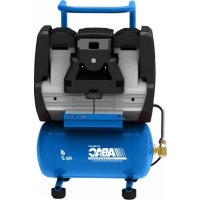
Start Silent OS20P - Compressor Abac - Free user manual and instructions
Find the device manual for free Start Silent OS20P Abac in PDF.



| Product type | Piston air compressor |
| Brand | Abac |
| Model | Start Silent OS20P |
| Power supply | Single-phase 230 V ~ 50 Hz |
| Maximum working pressure | 8 bars (116 psi) |
| Pressure adjustment | Automatic pressure switch (cut-off at 8 bars, restart at 6 bars) |
| Motor protection | Automatic or manual thermal protection depending on version |
| Pressure regulator | Yes, adjustable with pressure gauge |
| Safety valve | Yes, on the tank |
| Suction filter | Clean every 50 operating hours |
| Condensate drain | Drain valve under the tank, to be performed at least once a week |
| Recommended use | Intermittent (max 30% service per hour at full load) |
| Electrical connection | Two-pole + earth cable, grounded socket and residual current circuit breaker |
| Ambient operating temperature | 0 °C to +35 °C |
| Sound level | Silent (value not specified) |
Frequently Asked Questions - Start Silent OS20P Abac
User questions about Start Silent OS20P Abac
0 question about this device. Answer the ones you know or ask your own.
Ask a new question about this device
Download the instructions for your Compressor in PDF format for free! Find your manual Start Silent OS20P - Abac and take your electronic device back in hand. On this page are published all the documents necessary for the use of your device. Start Silent OS20P by Abac.
USER MANUAL Start Silent OS20P Abac
EN INSTRUCTION MANUAL AND SAFETY INSTRUCTION
FR MANUEL D'UTILISATION ET CONSIGNES DE SÉCURITÉ
Read and understand all of the operating instructions, safety precautions and warnings in the Instruction Manual before operating or maintaining this compressor. Most accidents that result from compressor operation and maintenance are caused by the failure to observe basic safety rules or precautions. An accident can often be avoided by recognizing a potentially hazardous situation before it occurs, and by observing appropriate safety procedures.
Basic safety precautions are outlined in the "SAFETY" section of this Instruction Manual and in the sections which contain the operation and maintenance instructions. Hazards that must be avoided to prevent bodily injury or machine damage are identified by WARNINGS on the compressor and in this Instruction Manual. Never use this compressor in a manner that has not been specifically recommended by manufacturer, unless you are absolutely sure that the planned use will be safe for you and others.
WARNING: indicates a potentially hazardous situation which, if ignored, could result in serious personal injury.
CAUTION: indicates a hazardous situation which, if ignored, could result in moderate personal injury, or could cause machine damage.
NOTE: emphasizes essential information.
1.2 SAFETY
WARNING: DEATH OR SERIOUS BODILY INJURY COULD RESULT FROM IMPROPER OR UNSAFE USE OF THE COMPRESSOR. TO AVOID THESE RISKS, FOLLOW THESE BASIC SAFETY INSTRUCTIONS.
Never place your hands, fingers or other body parts near the compressor's moving parts.
2. NEVER OPERATE WITHOUT ALL GUARDS IN PLACE
Never operate this compressor without all guards or safety features in place and in proper working order. If maintenance or servicing requires the removal of a guard or safety features, be sure to replace the guards or safety features before resuming operation of the compressor.
3. ALWAYS WEAR EYE PROTECTION
Always wear safety goggles or equivalent eye protection. Compressed air must never be aimed at anyone or any part of the body.
4. PROTECT YOURSELF AGAINST ELECTRIC SHOCK
Prevent body contact with grounded surfaces such as pipes, radiators, ranges and refrigeration enclosures. Never operate the compressor in damp or wet locations.
5. DISCONNECT THE COMPRESSOR
Always disconnect the compressor from the power source and remove the compressed air from the air tank before servicing, in specting, maintaining, cleaning, replacing or checking any parts.
6. VOID UNINTENTIONAL STARTING
Do not carry the compressor while it is connected to its power source or when the air tank is filled with compressed air. Ensure the knob of the pressure switch is in the "OFF" position before connecting the compressor to the power source.
7. STORE COMPRESSOR PROPERLY
When not in use, the compressor should be stored in a dry place. Keep out of reach of children. Store in a lockable area when not in use.
8. KEEP WORK AREA CLEAN
Cluttered work areas can cause injuries. Clear all work areas of unnecessary tools, debris, furniture etc. Risk of electric shock – do not expose the compressor to rain and don't use it in damp or wet locations. Keep work area well lit and well ventilated. Risk of fire or explosion. Do not carry and operate the compressor or any other electrical device near the spray area. Don't use the compressor in the presence of flammable liquids or gases as the compressor can produce sparks during operation. Never use compressor in sites containing lacquer, paint, benzene, thinner, gasoline, gases, adhe-
sive agents and other materials which are combustible or explosive.
- KEEP CHILDREN AND OTHER PEOPLE AWAY FROM COMPRESSOR DURING USE
Do not let children or other people interfere with the compressor or extension cord. All visitors should be kept safely away from work area.
10. DRESS PROPERLY
Do not wear loose clothing or jewellery. They can be caught in moving parts. Wear protective hair covering to contain long hair.
11. DO NOT ABUSE POWER CORD
Never yank or pull the power cord to disconnect it from the plug socket. Keep the cord away from heat, oil and sharp edges.
12. MAINTAIN COMPRESSOR WITH CARE
Follow instructions for lubricating. Inspect power cords periodically and if damaged, have them repaired by an authorized service facility. Inspect extension cords periodically and replace if damaged.
13. OUTDOOR USE OF EXTENSION CORDS
When compressor is in use outdoors, use only extension cords suitable for outdoor use.
14. STAY ALERT
Take care. Use common sense. Do not operate compressor when you are tired. Compressor should never be used by you if you are under the influence of alcohol, drugs or medication that makes you drowsy.
15. CHECK FOR DAMAGED PARTS AND AIR LEAKS
If a guard or other part is damaged it should be carefully checked to determine that it will operate properly and perform its intended function. Before further use of the compressor check for alignment of moving parts, binding of moving parts, breakage of parts, mountings, air leak and any other conditions that may affect its operation. A guard or other part that is damaged should be properly repaired or replaced by an authorized service center unless otherwise indicated elsewhere in this Instruction Manual. Defective pressure switches should be replaced by authorized service center. Do not use compressor if power switch does not turn it on and off.
- OPERATE THE COMPRESSOR ACCORDING TO THE INSTRUCTIONS PROVIDED HEREIN
This compressor has been designed and manufactured exclusively to produce compressed air. Operate the compressor according to the instructions provided herein.
17. HANDLE COMPRESSOR CORRECTLY
Operate the compressor according to the instructions provided herein. Never allow the compressor to be operated by children, individuals unfamiliar with its operation or unauthorized personnel.
- KEEP ALL SCREWS, BOLTS AND COVERS TIGHTLY IN PLACE
Keep all screws, bolts, and plates tightly mounted. Check their conditions periodically.
19. KEEP MOTOR AIR VENT CLEAN
The motor air vent must be kept clean so that air can flow freely at all times. Frequently check for dust build-up.
20. OPERATE COMPRESSOR AT THE RATED VOLTAGE
Operate the compressor at voltages specified on their nameplates. If using the compressor at a higher voltage than the rated voltage, it will result in abnormally fast motor revolution and may damage the unit and burn out the motor.
- NEVER USE A COMPRESSOR WHICH IS DEFECTIVE OR OPERATING ABNORMALLY
If the compressor appears to be operating unusually, making strange noises, or otherwise appears defective, stop using it immediately and arrange for repairs by an authorized service center.
22. DO NOT WIPE PLASTIC PARTS WITH SOLVENT
Solvents such as gasoline, thinner, benzene, carbon tetrachloride, and alcohol may damage and crack plastic parts. Do not wipe them with such solvents. Wipe plastic parts with a soft cloth lightly dampe-ned with soapy water and dry thoroughly.
23. USE ONLY GENUINE REPLACEMENT PARTS
Replacement parts which are not original may void your warranty and can lead to malfunction and resulting injuries. Genuine parts are available from your dealer.
24. DO NOT MODIFY THE COMPRESSOR
Do not modify the compressor. Always contact the authorized service center for any repairs. Unauthorized modification may not only impair the compressor performance but may also result in
accident or injury to repair personnel who do not have the required knowledge and technical expertise to perform the repair operations correctly.
- TURN OFF THE PRESSURE SWITCH WHEN THE COMPRESSOR IS NOT IN USE
When the compressor is not used, turn the knob of the pressure switch OFF, disconnect it from the power source and open the drain cock to discharge the compressed air from the air tank.
To reduce the risk of burns, do not touch tubes, heads, motors and cylinder.
27. DO NOT DIRECT AIR STREAM AT BODY
Risk of injury, do not direct air stream at persons or animals.
28. DRAIN TANK
Drain tank daily or after 4 hours of use. Open drain fitting and tilt compressor to empty accumulated water.
- DO NOT STOP COMPRESSOR BY PULLING OUT THE PLUG
Use the "AUTO/OFF" knob of pressure switch.
- USE ONLY RECOMMENDED AIR HANDLING PARTS ACCEPTABLE FOR PRESSURE NOT LESS THAN 125 PSI (8.6 BAR)
Risk of bursting. Use only recommended air handling parts acceptable for pressures not less than 125 psi (8.6 bar).
1.3 INTENDED USE
This compressor has been designed for use with intermittent (not continuous) operation, with a max. duty factor of 30% (i.e. 3 minutes run and 7 minutes stop), considering ideal environmental condition (max temp 25°C).
Respect of these tips and regular maintenance will ensure good functioning.
Compressors on wheels with power greater or equal than 3Hp/2,2 kW, are intended to be use indoor
1.4 ELECTRICAL CONNECTION
The compressor should be grounded while in use to protect the operator from electric shock.
Single-phase compressor is equipped with a three-core cable and three-pin grounding type plug to fit the proper grounding type socket.
Three-phase compressor is supplied with electrical cable without plug. Connection should be conducted only by qualified electrician
The green (or green and yellow) conductor in the cord is the grounding wire. Never connect it to a live terminal.
Never disassemble the compressor or carry out other connections to the pressure switch.
1.5 USE OF EXTENSION CABLE
Use only three-way extension cables that have three-pin connecting plugs and three-pole sockets that accept the compressor plug.
Do not use extension cables that are damaged or squashed. An under-rated cable will cause a drop in line voltage resulting in loss of power and overheating.
Check table A (pag.5) in order to choose cable correct size.
WARNING
Avoid electrical shock hazard.
Never use this compressor with a damaged or frayed electrical cord or extension cord. Inspect all electrical cords regularly.
Never use in or near water or in any environment where electric shocks are possible.
2. INSTALLATION AND USE
NOTE: The information contained in this Instruction Manual is designed to assist you in the safe operation and maintenance of the compressor. Some illustrations may show details or attachments that differ from those on your own compressor.
Specifications are subject to change without any prior warning where necessary.
2.1 INSTALLATION
- Remove the compressor from its packing (fig.1), makes sure it is in perfect condition, checking if it was damaged during transport, and carry out the following operations:
- Fit the wheels and rubber tab on the tanks on which they are not already fitted, observing the instructions in fig.2/3. In case of inflatable wheels, the maximum inflation pressure must be of 1,6 bar (24 psi).
- Position the compressor on a flat surface in a well ventilated area, away from the weather and in non-explosive atmosphere.
- TAKE CARE TO TRANSPORT THE COMPRESSOR CORRECT LY, DO NOT OVERTURN IT OR LIFT IT WITH HOOKS OR ROPES (FIG. 4/5)
- If the surface is inclined and smooth, check if the compressor moves while in operation – if it does, secure the wheels with two wedges. If the surface is a bracket or a shelf top, make sure it cannot fall, securing it in a suitable way.
- To ensure good ventilation and efficient cooling, the compressor's belt guard must be at least 50 cm from any wall (fig.6).
2.2 ELECTRICAL CONNECTION
Single-phase compressors are supplied with an electrical cable and a two-pole + earth plug. The compressor must be connected to a grounded power socket (fig.7) protected by a suitable differential switch (magneto-thermal).
2.3 START-UP
Check that the mains power matches that indicated on the electrical data-plate (fig.7), the permissible tolerance range is +/-5% .
Fit the plug in the power socket and start the compressor, turning the pressure switch knob into position "I/ON" (fig.8).
The compressor is fully automatic, and is controlled by the pressure switch which stops it when tank pressure reaches maximum value and restarts it when it falls to minimum value. The pressure difference between maximum and minimum values is usually about 2 bar (29 psi).
E.g.: the compressor stops when it reaches 8 bar (116 psi – maximum operating pressure) and restarts automatically when the pressure drops to 6 bar (87 psi).
After connecting the compressor to the power line, load it to maximum pressure and check correct functioning.
NOTE Some models are equipped with a discharge valve, useful to facilitate next start. In this case it is normal a puff of air when compressor stops
2.4 MOTOR PROTECTION DEVICES
Compressors must be always connected to a power socket protected by a suitable differential switch (magneto-thermal).
Compressor are equipped with an automatic thermal breaker located inside the winding. It stops the compressor when motor temperature reaches excessively high values. If the breaker is tripped, the compressors restarts automatically after 10 to 15 minutes.
Compressors of this range are fitted with a manual re-arm amperometric thermal breaker, located outside the terminal board cover. When the breaker is tripped, wait for a few minutes and then reset the breaker manually (fig.9).
Note: If the protection device trips again, it's highly recommended stop the compressor, disconnect electric plug and call the nearest service centre.
2.5 ADJUSTING THE WORKING PRESSURE
Pneumatic tools being used often requires lower pressure than the maximum operating pressure. Always check correct pressure on to - ol's manual.
On compressors supplied with a pressure reducer, operating pressure must be correctly adjusted (see fig.10).
Release the pressure reducer knob by pulling it up, adjust pressure to the required value by turning the knob clockwise to increase pressure and anti-clockwise to reduce it.
When you have obtained optimum pressure, lock the knob by pressing it downward.
Pressure can be seen on the pressure gauge.
For pressure reducers equipped without a pressure gauge, the set pressure can be seen on the graduated scale located on the reducer body.
WARNING: Some pressure regulators do not have "push to lock", therefore simply turn the knob to adjust the pressure.
For those models without pressure reducer, a suitable pressure reducer must be fitted on the distribution line by the user.
2.6 CAUTIONS WHILE USING
Do not unscrew any connection while the tank is pressurised, always check if the tank is pressure free.
Do not drill holes, weld or purposely deform the air tank.
Do not do any jobs on the compressor unless you have disconnected the power plug.
Temperature in operating ambient: 0°C +35°C.
Do not aim jets of water or inflammable liquids on the compressor.
Do not place inflammable objects near the compressor.
During down-times, turn the pressure switch to position "0" (OFF).
Never aim the air jet at people or animals
Do not transport the compressor while the tank is pressurised
Be careful with regard to some parts of the compressor such as the head and delivery tubes, as they can reach high temperatures. Do not touch these parts to avoid burns.(fig. 11)
Transport the compressor, lifting or pulling it with the appropriate grips or handles.
Keep children and animals well away from the machine operating area.
If using the compressor for painting:
a) Do not work in closed environments or near to naked flames
b) Make sure there is adequate exchange of air
c) Protect your nose and mouth with an appropriate mask.
If the electrical cable or plug are damaged, do not use the compressor and contact an authorised service centre to replace the faulty element with an original spare part.
Do not insert hands and/or any object inside protection grilles.
3. MAINTENANCE
Before attempting any maintenance jobs on the compressor, make sure of the following:
Master power switch in position "0/Off".
Pressure switch off, in position "0/Off"
No pressure in the air tank
3.1 CLEAN/REPLACE SUCTION FILTER
Every 50 hours of duty: dismantle the suction filter and clean the filtering element by blowing with compressed air (fig.12).
Replace the filter element at least once a year if the compressor operates in a clean environment, but more frequently if in a dusty environment.
In some models, the suction filter is located internally under the cover. Unscrew the securing screws, remove the cover carefully, remove the filter from its seat and clean it. Reassemble all parts before restart the compressor.
3.2 CONDENSATE DRAIN
The compressor generates condensate water which accumulates in the tank.
The condensate in the tank must be drained at least once a week, by opening the drain tap (fig.13) under the tank.
Take care if there is compressed air inside the cylinder, and water could flow out with considerable force. Recommended pressure: 1-2 bar max.
CONDENSATE MUST NOT BE DRAINED INTO THE SEWER OR DISPERSED IN THE ENVIRONMENT.
3.3 RECOMMENDED MAINTENANCE
In units with 2 poles, replace the whole connecting rod - piston unit every 700-800 hours of operation.
In units with 4 poles, replace the connecting rod - piston unit every 1800-2000 hours of operation.
4. TROUBLESHOOTING
Loss of air in valve under pressure switch
It could depend on poor tightness of the check valve. Take the following action (fig. 14):
Discharge all pressure from the tank
Unscrew the hexagon-head of the valve (A)
Carefully clean both the rubber disk (B) and its seat.
Refit all parts accurately.
Air losses
These can be caused by poor tightness of a union, check all unions, wetting them with soapy water.
Compressor turns but does not load
It may be due to failure of the valves or a seal: please contact the nearest service centre.
Compressor no starting
If the compressor has trouble starting, check the following :
Does mains power match that of the data-plate?
Are power cable extensions of adequate diameter or length (see 1.5)?
Is the work environment too cold? (under 0°C)
Was the thermal-breaker tripped? (see 2.4)
Is power supplied to the electrical line? (sockets well connected, thermal-breaker, fuses in good condition)
Compressor not stopping
If the compressor does not stop when maximum pressure is reached, and the tank safety valve comes into operation. In this evenience please contact the nearest service centre.
5 NOTE
5.1 TECHNICAL DATA
- Refer to the label affixed to the compressor.
- Compressors for the European market are manufactured in compliance with the EC directives (see declaration of conformity)
• Maximum operating pressure (see label on the compressor) - The sound level is measured in compliance with EC directives (see declaration of conformity)
5.2 STORING THE PACKED AND UNPACKED COMPRESSOR
For the whole time that the compressor is not used before un packing it, store it in a dry place at a temperature between +5°C and +45°C and sheltered away from weather.
For the whole time that the compressor is not used after unpacking it, while waiting to start it up or due to production stoppages, place sheets over it to protect it from dust e dirty.
5.3 PNEUMATIC CONNECTIONS
Make sure that pneumatic tubes for compressed air with maximum pressure characteristics that are adequate for the compressor are used. Do not attempt to repair faulty tubes.
1. PRÉMISSE
1.1 INFORMATIONS IMPORTANTES
- FAIRE ATTENTION AU CORDON
- AFBRYD KOMPRESSOREN FRA ELNETTET
OBS: understryker viktig information.
1.2 SÄKERHET
WARNING:
EN FELAKTIG ANVÄNDNING OCH ETT DÅLIGT UNDERHÅLL AV DENNA KOMPRESSOR KAN FÖRORSAKA FYSISKA KROPPS SKADOR PÅ ANVÄNDAREN. FÖR ATT UNDVIKA DESSA RISKER, BER VI DIG ATT LÄSA FÖLJANDE INSTRUKTIONER NOGA.
LÄS ALLA INSTRUKTIONER
- RÖR INTE DE RÖRLIGA DELARNA
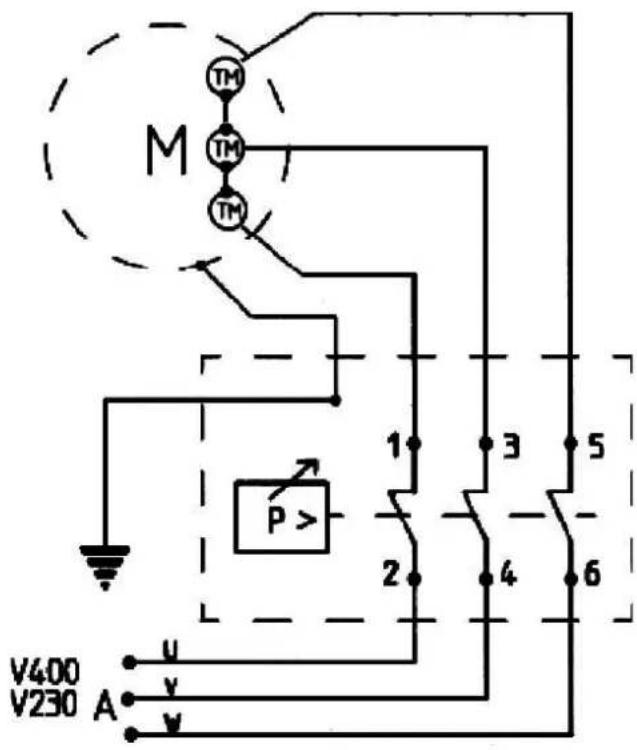
V115-120/60/1 V230/50/1 -

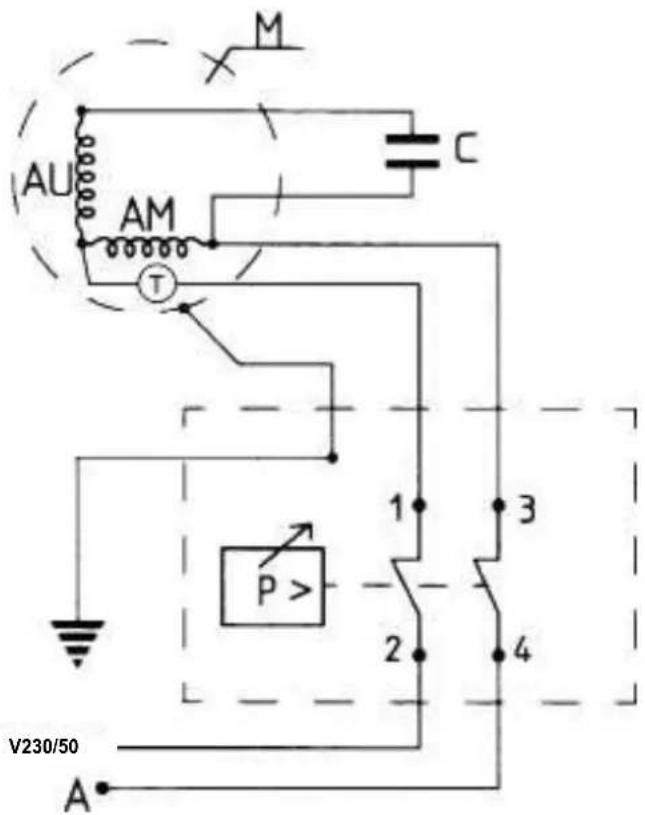
V220-230/50-60/3 - V380-400/50-60/3


| ITL'apparecchio non può essere smaltito nei normali rifiuti domestici.Questo apparecchio dispone di contrassegno ai sensi della direttiva europea 2012/19/UE in materia di apparecchi elettrici ed elettronici (waste electrical and electronic equipment - WEEE).Questa direttiva definisce le norme per la raccolta e il riciclaggio degli apparecchi dismessi valide su tutto il territorio dell'Unione Europea. Per la restituzione di un dispositivo dismesso, si prega di servirsi dei sistemi di restituzione e di raccolta messi a disposizione nei singoli paesi di utilizzo. | ENThe device may not be disposed of with household rubbish.This appliance is labelled in accordance with European Directive 2012/19/UE concerning used electrical and electronic appliances (waste electrical and electronic equipment - WEEE).The guideline determines the framework for the return and recycling of used appliances as applicable throughout the EU. To return your used device, please use the return and collection systems available to you. | FRII est interdit d'éliminer l'appareil avec les déchets urbains (déchets ménagers).Cet appareil est marqué selon la directive européenne 2012/19/UE relative aux appareils électriques et électroniques usagés (waste electrical and electronic equipment - WEEE).La directive définit le cadre pour une reprise et une récupération des appareils usagés applicables dans les pays de la CE. Pour renvoyer votre ancien appareil, utilisez les systèmes de renvoi et de collecte qui vous sont proposés. |
| DEDas Gerät darf nicht mit dem Siedlungsabfall (Hausmüll) entsorgt werden.Dieses Gerät ist entsprechend der europäischen Richtlinie 2012/19/UE über Elektro- und Elektronik-Altgeräte (waste electrical and electronic equipment - WEEE) gekennzeichnet.Die Richtlinie gibt den Rahmen für eine EU-weit gültige Rücknahme und Verwertung der Altgeräte vor. Für die Rückgabe Ihres Altgeräts nutzen Sie bitte die Ihnen zur Verfügung stehenden Rückgabe- und Sammelsysteme. | NLDit apparaat mag niet als ongesorteerde stedelijke afval verwijderd worden.Dit apparaat is gemarkeerd zoals voorgeschreven door de Europese richtlijn 2012/19/EU inzake elektrische en elektronische apparatuur (waste electrical and electronic equipment - WEEE).Deze richtlijn bepaalt de normen voor de inzameling en terugwinning van afgedankte apparatuur, geldig op het grondgebied van de Europese Unie. Voor het retourmeren van een afgedankl apparaat, gelieve de retour- en inzamelingssystemen te gebruiken, ter beschikking gesteld in het land van gebruik. | DKEnheden må ikke bortskaffes sammen med husholdningsaffald.Dette apparat er mærket i overensstemmelse med det europæiske direktiv 2012/19/EU angående brugt elektrisk og elektronisk udstyr (waste electrical and electronic equipment – WEEE).Retningslinjen bestemmer rammerne for returnering og genbrug af brugte apparater, som de gælder i hele EU. Vød retumering af din brugte enhed skal du bruge de tilgængelige returnerings- og indsamlingssystemer. |
| ESEl equipo no debe eliminarse junto con la basura urbana (basura doméstica).Este aparato está marcado con la Directiva europea 2012/19/UE relativa al uso de aparatos eléctricos y electrónicos (waste electrical and electronic equipment - WEEE).La directiva proporciona el marco general válido en todo el ámbito de la Unión Europea para la retirada y la reutilización de los residuos de los aparatos eléctricos y electrónicos. Para la devolución de su antiguo dispositivo utilice los sistemas de recogida y devolución disponibles y específicos. | PTO aparelho não pode ser eliminado junto com os residuos domésticos normais.Esse aparelho dispõe de marca nos termos da diretiva europeia 2012/19/UE em matéria de aparelhos elétricos e eletrónicos (waste electrical and electronic equipment - WEEE).Essa diretiva define as normas para a recolha e reciclagem dos aparelhos desativados válidos em todo o território da União Europeia. Para a restituição de um dispositivo desativado, solicitamos utilizar os sistemas de restituição e recolha colocados a disposição no país de utilização. | FILaltetta ei saa hävlttää kotltalousjätteen mukana.Tässä laitteessa on sähkö- ja elektroniikkalaiteromua koskevan EU-direktilivin 2012/19/EY mukainen merkintä (Waste Electrical and Electronic Equipment - WEEE).Kyseinen direktivi määrittää käytöstä poistettujen laitteiden keräykseen ja klerrätykseen liittyvät määräykset kalkissa EU-maissa. Käytöstä poistetun laitteen palauttamista varten, känny käyttömaissa käytössä olevien palautus- ja keräysjärjestelmien puoleen. |
| SEApparaten får inte bortskaffas tillsammans med normalt hushållsavfall.Denna apparat är försedd med märkning enligt det europeiska direktivet 2012/19/EU beträffande elektriska och elektroniska apparater (waste electrical and electronic equipment - WEEE),Detta direktiv fastställer de regler, som gäller för insamling och återvinning av kasserade apparater i hela den Europeiska Unionen.För återlämnande av en kasserad anordning, använd de återvinnings- och insamlingssystem, som stälits till förfogande i de enskilda användarländerna. |


- SAFETY
- NEVER OPERATE WITHOUT ALL GUARDS IN PLACE
- ALWAYS WEAR EYE PROTECTION
- PROTECT YOURSELF AGAINST ELECTRIC SHOCK
- DISCONNECT THE COMPRESSOR
- VOID UNINTENTIONAL STARTING
- STORE COMPRESSOR PROPERLY
- KEEP WORK AREA CLEAN
- DRESS PROPERLY
- DO NOT ABUSE POWER CORD
- MAINTAIN COMPRESSOR WITH CARE
- OUTDOOR USE OF EXTENSION CORDS
- STAY ALERT
- CHECK FOR DAMAGED PARTS AND AIR LEAKS
- HANDLE COMPRESSOR CORRECTLY
- KEEP MOTOR AIR VENT CLEAN
- OPERATE COMPRESSOR AT THE RATED VOLTAGE
- DO NOT WIPE PLASTIC PARTS WITH SOLVENT
- USE ONLY GENUINE REPLACEMENT PARTS
- DO NOT MODIFY THE COMPRESSOR
- DO NOT DIRECT AIR STREAM AT BODY
- DRAIN TANK
- INTENDED USE
- ELECTRICAL CONNECTION
- USE OF EXTENSION CABLE
- WARNING
- INSTALLATION AND USE
- INSTALLATION
- ELECTRICAL CONNECTION
- START-UP
- MOTOR PROTECTION DEVICES
- ADJUSTING THE WORKING PRESSURE
- CAUTIONS WHILE USING
- MAINTENANCE
- CLEAN/REPLACE SUCTION FILTER
- CONDENSATE DRAIN
- RECOMMENDED MAINTENANCE
- TROUBLESHOOTING
- NOTE
- TECHNICAL DATA
- STORING THE PACKED AND UNPACKED COMPRESSOR
- PNEUMATIC CONNECTIONS
- PRÉMISSE
- INFORMATIONS IMPORTANTES
- SÄKERHET
Brand : Abac
Model : Start Silent OS20P
Category : Compressor