M17R - Flashlight Ledlenser - Free user manual and instructions
Find the device manual for free M17R Ledlenser in PDF.



| Product type | Flashlight |
| Brand | Ledlenser |
| Model | M17R |
| Power supply | Integrated Li-ion rechargeable battery « Safety Ytrion Cell » (PowerModul) |
| Charger input voltage | 100-240 V AC, 50/60 Hz |
| Charging system | Magnetic via Floating Charge System Pro |
| Operating temperature | -20 °C to +50 °C |
| Focusing | Speed Focus with Fast Lock |
| Switch | Rotary Fast Action Switch, 5 positions (Lock, Low, Action, Signal, Defence) |
| Lighting functions | Low Power, Power, Dim, SOS, Blink, Signal Blink, Strobe |
| Energy management modes | Energy Saving and Constant Current |
| Charge indicator | LED ring (red/green) and 360° Power Indicator (10 blue LEDs) |
| Emergency function | Emergency Mode (automatic activation in case of power failure) |
| Housing material | Not specified (probably aluminum) |
| Included accessories | Charger, magnetic plug, wall mount, belt clip, manual |
| Maintenance | Clean with a dry, lint-free cloth; disassembly possible for cleaning lens and switch |
| Safety | Do not look directly into the beam; keep out of reach of children; avoid extreme temperatures and humidity |
| Spare parts | Replaceable PowerModul; other optional accessories (Roll Protection, Filter Set, Signal Cone, etc.) |
| Warranty | Manufacturer's warranty (void if modified or used improperly) |
| Additional specifications | Smart Light Technology (SLT) with microcontroller; protection against accidental activation (Lock) |
Frequently Asked Questions - M17R Ledlenser
User questions about M17R Ledlenser
0 question about this device. Answer the ones you know or ask your own.
Ask a new question about this device
Download the instructions for your Flashlight in PDF format for free! Find your manual M17R - Ledlenser and take your electronic device back in hand. On this page are published all the documents necessary for the use of your device. M17R by Ledlenser.
USER MANUAL M17R Ledlenser
(1) Head Module
(2) Power Module
(3) Charge indicator
(4) 360^ Power Indicator
⑤ Fast Action Switch
⑥ Floating Charge System Pro a. mains plug
b. charger with extension cable
c. magnetic charging socket
d. charger bracket
(7) Intelligent Clip
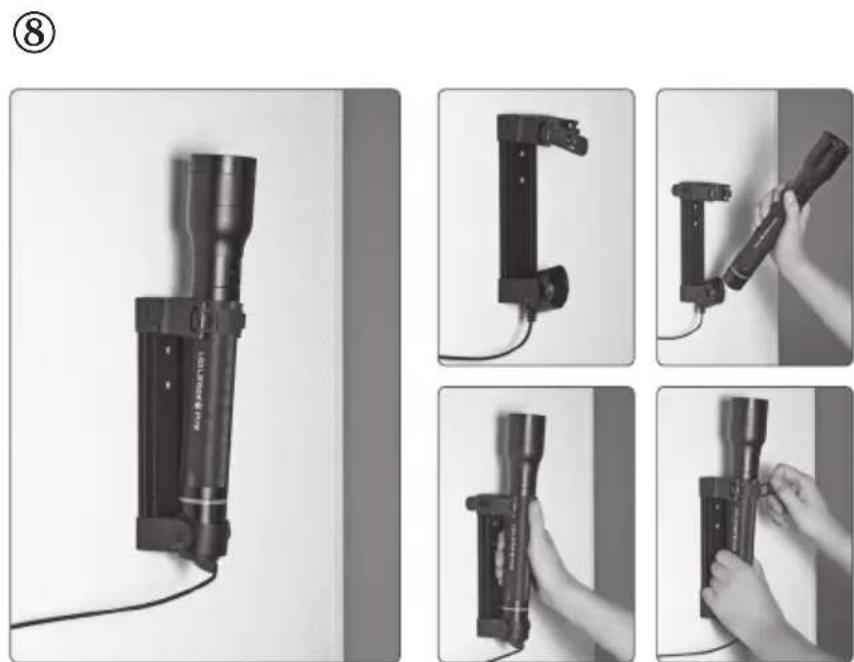
⑧ Connect M17R to the Floating Charge System
C E
We are delighted that you have purchased one of our products.
These are usage instructions to help you familiarise yourself with your new purchase. All the documents accompanying the product must be read attentively before using the product, preserved carefully and if the product is transferred to a third party, the documents must be handed over as well. This ensures that maximum benefit is drawn from the product and questions from users are anticipated before they arise.
Above all, comply with the warnings and safety instructions and dispose of the packaging material properly.
Under point 13 and 14 it is explained how the lamp head is separated from the Power Module and how the rear part of the shaft of the lamp is unscrewed. Both actions described under point 13 and 14 must be carried out before initial use of the lamp; they are necessary in order to remove and dispose of the two insulating films (one on each side). These two films serve as protection during transport of the "Safety Ytrion Cell" battery pack.
After taking off the insulating films, you must screw the rear part to the middle part first before pushing the switch button; otherwise the lamp might not work properly. Now, you can screw the Power Module (rear part plus middle part) to the lamp head.
Product
LED LENSER
8317-R Led Lenser M17R
Version of the operating manual: 1.1
1. Battery set:
1 × Power Module (shaft including "Safety Ytrion Cell" battery pack); no other batteries or accumulators are permitted.
2. Switching on and off
In the front section of the M17R, directly behind the wide head, is the selection ring of the "Fast Action Switch", in the groove of which the switch button is located. The name "Fast Action Switch" describes the facility provided by this switch system to quickly select and use various Light Programs and Light Functions (see Point 7). Turning the selection ring of the "Fast Action Switch" changes the position of the switch button in the groove. Its position can be adjusted so that it clicks into place in 5 different settings. These positions represent the various Light Programs (see point 7).
In the extreme left position of the switch button, which is marked on the selection ring by a lock symbol ( - Lock Function), the M17R is protected against accidentally getting switched on. In all the other positions, it can be switched on and the various Light Functions can be used.
What is important here is that there are three ways of actuating the switch button:
a) Switching
The switch button is pressed beyond the pressure point, i.e. so deep that the switch clicks into place. A small sound, a click, can be heard.
b) Brief tapping
The switch button is only tapped briefly and not as deeply as in a) above. As a result, the switch does not click into place, there is no click audible and the switch remains in the starting position when it is released.
c) Prolonged tapping
The switch button is pressed as under b), only slightly but for a longer time.
Here too, the button is not pressed so hard as under a. As a result, the switch does not click into place, there is no click audible and the switch remains in the starting position when it is released.
This prolonged tapping is required, e.g. to be able to make various settings (see Point 7 and 8).
The descriptions above apply to the switch button of the "Fast Action Switch" in the front section of the M17R. Please do not confuse it with the switch button (see Point 10), which is formed by the two concentric charging contacts at the end of the torch.
3. Focus
The focus of the M17R can be quickly adjusted with the help of the so-called Speed Focus. For this purpose, hold the torch on the serrated middle section firmly with one hand and with the other hand, push the wider lamp head in which the reflector lens is located, to the front or to the back. By doing this, you can adjust the light beam continuously variably to suit your needs.
4. Fast Lock
If required, a desired focus setting can be locked by means of the so-called Fast Lock. What this does is to prevent the focus setting from getting accidentally changed. To do so, the lamp head must be turned left with respect to the shaft, i.e. in the direction of the legend "Lock" on the lamp head. To release this fixed setting and to once again allow the continuously variable setting of the focus (see Point 3), the lamp head has to be turned in the other direction, i.e. the direction of the legend "Unlock".
5. Smart Light Technology (SLT)
The M17R is equipped with our Smart Light Technology (SLT). Thanks to the use of a microcontroller, the light output of the LED can be controlled and the user can use various Light Programs and Light Functions. By using a single switch in conjunction with the selection ring in the "Fast Action Switch", it was possible to design the interface to be simple and user-friendly. The pocket torch can give the user light in various intensities and in various different ways. There are thus two Energy Modes, four Light Programs and a number of Light Functions available. To switch the pocket torch on and off and to select the various Light Functions, the switch in its front section has to be used. Here, the switch is used in the three ways described above in Point 2.
What basically applies is that the brightness of the M17R is monitored by the in-built temperature control unit.
6. Energy Modes
By selecting one of the two Energy Modes (Energy Saving or Constant Current), you take a decision on how the energy contained in the accumulator is used.
-
Energy Saving: The light output is controlled by the integrated Smart Light Technology (SLT). The brightness is matched to the real conditions that occur during normal use of the lamp, thus providing a longer burn time.
-
Constant Current: This Energy Mode allows the continuous use of all the Light Functions with a more or less constant light output. This Energy Mode is to be preferred when a high brightness level is more important than a long burn time.
Changing of the Energy Modes
For changing the Energy Mode, the lamp has to be off and the switch button must be in the second position (O) of the "Fast Action Switch". If you now tap the switch button on the lamp head lightly 8 times, followed by a switching operation, and then the brightness increases jerkily, to later reduce gradually to zero, the M17R is in the Energy Mode 'Energy Saving'. But if the brightness of the M17R remains constant for approx. 2 seconds after the sudden increase, to then suddenly drop to zero, the M17R is thereafter in the Energy Mode 'Constant Current'. With this procedure, you can switch between the two Energy Modes. It is not possible to determine in which Energy Mode the M17R is. To find this out, you must carry out the procedure. If the M17R is thereafter not in the desired Energy Mode any more, you must repeat the procedure again.
7. Light Programs and Light Functions
As has already been described in Point 2, by turning the black selection ring (with its 5 marks) below the narrowing point of the lamp head, you can select from between 5 different positions and activate them with the switch button. The 5 positions represent the various Light Programs or the Lock Function. Thanks to the permanent magnets that are embedded in the selection ring of the "Fast Action Switch", the ring slides over the lamp housing when it is turned, and thus ensures contact-less transmission of the selection to the microcontroller in the lamp housing.
7.1 Lock function
In the first position from the left (the selection ring has been turned to the right till it comes to a stop), the M17R cannot be switched on, either intentionally or unintentionally. Thus, the lock function is handy for when the M17R is transported. Also, there could be situations in which the M17R may/should not be switched on, even unintentionally.
7.2 Light Program Low
If the switch button of the "Fast Action Switch" is in the second position of the selection ring, you can use the Light Function Low Power with its reduced brightness. By briefly tapping and letting go, you can switch to the Light Function Power with full brightness. When you tap it again, you can switch between the Light Programs Low Power and Power. One more switching operation, and the lamp is off. When the M17R is off, tapping can be employed, e.g. to send signals of various length in Morse code with reduced brightness.
7.3 Light Program Action
In the third position of the selection ring, by switching or tapping, the Light Function Power (full brightness) is immediately usable. As with Light Program Low, here too, it is possible to use tapping for sending Morse signals, but with full brightness in this case. Upon switching, the Light Function Power is firmly set and by brief tapping, it is possible to switch between the Light Functions Power and Dim. Upon switching to 'Dim' by tapping, if the switch button remains tapped for a longer time (prolonged tapping), the M17R starts to slowly change the brightness between low brightness and full brightness. The lamp will extinguish for one short moment if the brightest or lowest luminosity is reached. Upon releasing the switch, the M17R continues to glow with the current brightness level. This brightness level remains saved, i.e. remains set for the light function Dim, when the M17R is switched off. This brightness of the light function Dim is only lost, or changes, when the Power Module (shaft with "Safety Ytrion Cell" battery pack) is unscrewed at the head (also see the Reset function under Point 9). Of course, it also changes if specifically changed by the user as described above. One more switching operation, and the lamp is off.
7.4 Light Program Signal
In the fourth position, by switching or tapping, the Light Function SOS (3 short, followed by 3 long, followed again by 3 short flashes) can be invoked immediately. If, after a switching operation, the switch is tapped, the Light Function Blink (slow, continuous blinking) is activated. Tapping once again results in the Light Function Signal Blink (2x blinking at short intervals) One more switching operation, and the lamp is off.
7.5 Light Program Defence
The Light Mode Defence is the one on the extreme right on the selection ring; it can be selected by turning the selection ring completely to the left till it comes to a stop. Upon switching, the Light Function Strobe is set and by tapping briefly, it is possible to toggle between Strobe and Power. One more switching operation, and the lamp is off.
Here, too, the Light Functions are revolving, like with the Light Modes 2, 3 and 4. This means, for example, with Light Program 5, that after the Light Function Power, one more tap leads to the Light Function Defence. Thus, tapping does not take you into a dead end; there is a continuous circular series of selected light functions.
When the M17R is glowing in one of the Light Functions (2, 3 4 or 5), it also glows after a changeover (by turning the selection ring of the "Fast Action Switch") between these 4 Light Functions. With such a changeover, the M17R has the light function that it also had when switched on directly (e.g. with the Light Program Signal, the Light Function SOS).
8. Emergency Mode / Emergency Light Function
When the Emergency Mode is activated, the M17R has an emergency light function. For this purpose, the mode has to be activated and the M17R has to be connected to the charger (position light at the charger glows blue, see Point 10). In this case, the pocket torch automatically goes on when the electric supply that is providing energy to the charger fails. If positioned meaningfully, the M17R, when it is glowing, can facilitate quickly finding an escape route in an emergency, or the lamp can be quickly found and picked up, already on. If this function is active, the M17R glows automatically even if the charging process is interrupted by removing the M17R. Therefore, the function can also be used when the M17R has to be ready for immediate use.
To set the Emergency Mode, set the "Fast Action Switch" to Light Program action and tap prolonged for about 10 seconds. The M17R glows for these 10 seconds and then blinks. After blinking, the light turns off. When it flashes 4 times, Emergency Mode is activated; if it flashes twice, Emergency Mode is disabled. If this procedure is carried out again, the setting toggles between activated and disabled and signals this by a corresponding blinking.
9. Reset function
If the Power Module (shaft with "Safety Ytrion Cell" battery pack) is unscrewed completely at the head and the two parts are screwed together again only after a little while, you have "reset" the M17R. You have thus reset a few functions:
- As Energy Mode, Energy Saving is active (see Point 6).
The Emergency Mode (see Point 8) is active. - This lamp function Dim (see Point 7.3) is set to the lowermost brightness
10. Charging
The Power Module (shaft without lamp head) contains the "Safety Ytrion Cell" battery pack, the accumulator.
Charge your M17R only in a dry place.
For charging, connect the mains plug on one side to the accompanying charger (Input: 100 V to 240 V / 50 Hz to 60 Hz) and on the other side, to a power socket. Then connect the extension cable of the charger to the cable of the magnetic charging socket, whose blue position light then starts to glow. You can now connect the concentric charging contacts at the end of the M17R to the magnetic charging socket. When the lamp has been correctly connected, the charging display glows red (see Point 11) and the charging starts. The Power Module (shaft with the "Safety Ytrion Cell" battery pack) with the unscrewed lamp head can also be charged.
See the following section on the subject of the charging indicators (see Point 11) for more information.
Note - Please ensure that there is no short-circuit at the charging contacts. The charging contacts may not be touched with moist or metallic objects.
The magnetic charging socket can also be inserted in the cylindrical part of the charger bracket, which is a part of the supplied kit, and then locked in place by turning a couple of times in the counter-clockwise direction like a bayonet catch. The lock is released by rotating in the other direction. The bracket can be fastened on the wall with dowels (not scope of delivery) in such a way that the blue position lamp of the magnetic charging socket, for example, glows downwards. Please use a sufficient number (min. 4 pieces) and suitable dowels, depending on the material of the wall. The orientation described suggests itself when you wish to use the Emergency Module / Emergency Light function (see point 8) since the M17R glows upwards in case of a power failure. On the other side of the bracket, the M17R can be joined to the bracket with 2 rubber rollers and fixed permanently by using the rubber gusset that is located at the level of the two rubber rollers. The latter suggests itself if there are acceleration forces acting on the M17R. In this manner, the M17R can be fixed in the bracket inside the vehicle if the charger bracket is fixed permanently to a vehicle.
Using an optionally available car charger connection, the M17R can also be charged at the cigarette lighter and sockets in the vehicle. These accessory units match themselves automatically to the respective input voltage (12 V to 24 V).
11. Charge indication
Approx. 2 cm before the end of the shaft of the M17R, there is a narrow ring, which, during the charging process, indicates the charge status of the battery through lamps of different colours.
Red (glowing continuously) - charging ongoing.
Green (glowing continuously) - Charging completed, the M17R is ready for use with the full capacity of the battery. It generally takes 2 to 3 hours for an empty M17R to get fully charged.
No light- The cause of this can be that the Floating Charge System Pro is not getting adequate electric power. But it can also be that there is a loose contact. Therefore, check whether (magnetic) objects or dirt are hindering a good contact between the charging contacts at the end of the M17R and the magnetic charging socket. If required, remove them. If required, also correct the position or the angle of the M17R in the charging socket. If given an adequate electric power supply, the charge indicators still do not glow, immediately isolate the transformer or the optional car charger of the M17R from the present power supply system and get in touch with your dealer.
12. 360^ Power Indicator
The 360^ Power Indicator consists of 10 blue-glowing elements, which are arranged in a circle around the two concentric charging contacts at the end of the shaft of the M17R.
During use, the number of blue-glowing elements reduces further and just before the Power Module is empty, the last element glows in red. Depending on when the charging contacts are pressed, the following can be determined from the number of elements glowing.
1.) Battery status indication
If the charging contacts are pressed while the M17R is off, the elements serve as a battery charging status indication. If, for example, all the 10 elements briefly glow blue, the M17R is fully charged.
2.) Operating time indication
If the charging contacts of the M17R are pressed while the M17R is being operated with a Light Function, the number of glowing elements provides an indication of the remaining relative lighting duration of the current Light Function.
The M17R also shows this information for a brief moment when a light function has been selected by tapping or switching at the "Fast Action Switch", i.e. even without the 360^ Power Indicator having been actuated.
13. Changing the Power Module
Please charge the rechargeable battery in time. If the Power Module exhibits any atypical behaviour, please change it. For changing this accumulator, please first switch off the pocket torch without fail, and unscrew the part behind the "Fast Action Switch". You have thus separated the lamp head from the Power Module (shaft including "Safety Ytrion Cell" battery pack). For the disposal of the used Power Module, please read Point 14.
Screw on a new Power Module onto the lamp head till it cannot be turned any more. Thanks to the innovative new contact system and the fixed connection between the lamp shaft and the "Safety Ytrion Cell" battery pack (Power Module), transposition of the polarity is not possible.
14. Rechargeable batteries / Accumulators
Only the correspondingly approved LED LENSER Power Module, consisting of the "Safety Ytrion Cell" battery pack and shaft, may be used in this pocket torch. The Power Module was developed to ensure the highest level of safety and benefit.
If you have separated the used Power Module from the lamp head as described in Point 13, please unscrew the rear part of the shaft at the level of the charging display. You will then see a PCB of the "Safety Ytrion Cell" battery pack on this side as well, upon looking into the tube. The PCB is held in place on this side in the shaft by a narrow plastic ring with thread. For removing the "Safety Ytrion Cell" battery pack from the shaft, unscrew this plastic ring from the shaft. For doing so, use the two grooves in the plastic ring that are displaced 180^ from one another but make sure that you do not short circuit the contacts of the "Safety Ytrion Cell" battery pack. The "Safety Ytrion Cell" battery pack can now be easily removed and disposed of in keeping with the national laws. The shaft can be disposed of in the domestic trash.
In contrast to the Power Module (shaft with "Safety Ytrion Cell"), a replacement of a "Safety Ytrion Cell" battery pack in a Power Module may not be carried out. Neither is it permitted, after removal of the "Safety Ytrion Cell" battery pack, to charge it in any other manner or instead, to use accumulators or batteries in the Power Module. The Power Module may only be opened once, for separate disposal of the Ytrion Cell battery pack and the shaft; otherwise, the manufacturer's warranty will be rendered null and void.
In general, for the disposal of batteries as well as particularly for Lithium batteries, accumulators and accumulator packs, the applicable rule is that they may only be disposed of in discharged state and in a technically correct manner. If they are not discharged, then before disposal, by sticking non-conducting adhesive tape over the contacts, it has to be ensured that short-circuits are not possible.
Basically, the possibility of short-circuits of accumulators and batteries must be eliminated and they may neither be opened, nor enter the human body in any way, nor may they be thrown into a fire.
15. Cleaning
For cleaning, please use a dry, lint-free clean cloth.
If salt water is spilled on the lamp, it must be immediately entirely removed with such a cloth.
If it is not possible to rotate the selection ring of the "FastAction Switch" smoothly any more, it must be separated from the M17R, and the underside and the lamp tubes cleaned of dirt. To do so, with the screws, separate the lamp head from the Power Module. Carefully remove the black O-ring of rubber that is located above the lamp head thread. When the switch button is now pressed deep, the selection ring can be removed over the switch button in the direction of the thread. Please ensure here that the small spring-loaded ball including its casing above the switch button is not lost. Both surfaces can now be cleaned and the parts can be assembled again in the opposite sequence.
If the reflector lens has got loose in the lamp head or, e.g. dirt has got deposited on its inner side, you can apply the following remedial measures. The foremost one centimetre of the M17R, with the 12 indicated holes along the periphery, can be unscrewed. There is a plastic ring that fixes the reflector lens in it, and it can be tightened or removed for cleaning. You can clean the reflector lens if required, with a dry, lint-free clean cloth. Thereafter, please assemble everything in the opposite sequence.
16. Scope of delivery
The M17R is supplied in a hard case with the following accessories:
1 x Floating Charge System Pro
- mains plug
- charger with extension cable (Input: 100 V to 240 V / 50 Hz to 60 Hz)
- magnetic charging socket (magnetic charger) with cable and blue position light as connection between the charger and the M17R
- charger bracket - for fastening the charger components, e.g. to a wall
1 x operating manual
1 x Smart Instruction Card as an addition to the operating manual
1 x Intelligent Clip for fastening the M17R e.g. to belts up to max. 60 mm width
Additional accessories for the M17R are being designed (e.g. anti-roll protection, colour filter, signalling cones, spare accumulators, Floating Charge System Pro, car chargers etc.).
You can get information on these additional accessories over and above the supplied kit on our Internet page.
17. Caution:
Do not swallow any small parts or batteries that are present. The products or parts thereof (including batteries) must be stored outside the reach of children.
For reasons of safety and approval (CE), the product must not be modified and/or changed. The product is to be used exclusively as a pocket torch.
If the M17R is used for any other purpose, or used incorrectly, it can get damaged and hazard-free use is not guaranteed any more (danger from fire, short-circuit, electric shock etc.). There is then no liability for harm to persons or damage to property, and the warranty of the manufacturer is also rendered null and void.
The temperature range in which the M17R can be operated is -20^ to +50^ . Ensure that the M17R is not subjected to extreme temperatures, intense vibrations, explosive atmosphere, solvents and/or vapours. Also continuously exposed to direct sunlight, high humidity and/or moisture have to be avoided.
Changes, repairs and maintenance over and above those described in the documents accompanying the product may only be carried out by authorised technical personnel.
Once it is found that the product is charged and correctly screwed/closed, but nonetheless, normal, safe operation is not possible or the product shows damage, it must be rendered inoperative and not used any further. In this case, for warranty matters, contact your dealer.
18. Safety instructions
- This product is not a children's toy.
- Since it has small parts that can be swallowed, it is not suitable for persons below 5 years.
The article may not be used for examinations of the eyes (e.g. for the so-called pupil test). - When using it, the accumulation of heat, e.g. by covering, must be avoided.
If the product does not work correctly, the first thing that must be checked is whether this is due to a discharged battery or because the shaft and the lamp head are not screwed tight enough together. - If using in traffic, please follow the respective legal regulations.
- Owing to the permanent magnets in the selection ring of the "Fast Action Switch" and in the magnetic charging socket of the
Floating Charge System Pro, both the parts must be at a safe distance to, for example, heart pacemakers or magnetic storage media.
The hazard that poses the main threat in this product through optical radiation is the Blue-Light-Hazard (400 nm to 780 nm). Thermal hazard threshold values are clearly not reached.
The risk for the viewer depends on the use or on how the product is installed. However, there is no optical hazard as long as the aversion responses limit the time of exposure and as long as the information contained in this instruction manual is observed. The aversion reactions are triggered by the exposure and they are to mean all natural reactions that protect the eye from hazards through optical radiation. This includes in particular conscious aversion reactions such as eye or head movement (e.g. turning away).
When using the product it is of particular importance to bear in mind that the aversion reactions of persons at whom the light is directed at may be weakened or completely suspended as a result of medication, drugs or illness.
Because of the blinding effect of the product, improper use may lead to reversible, i.e. temporary impairment of sight (physiological blinding) or afterimages, or it may trigger feeling unwell in the sense of feeling queasy and tired (physiological blinding). The intensity of the temporary feeling of being unwell or the time until it subsides depend primarily on the difference in brightness between the blinding-light source and the surrounding area. Photosensitive persons in particular ought to consult a medical consultant prior to using this product.
As a matter of principle the rule is that high-intensity light sources carry a high secondary hazard potential due to their blinding effect. Just like looking into other bright light sources (e.g. headlights of a car), the temporary limited impairment of vision and afterimages may lead to irritation, inconveniences, impairments and even accidents, depending on the situation.
The information applies to the use of a single product. If more light-emitting products of the same type or of a different type are used together, the intensity of the optical radiation may increase.
Every longer viewing/eye-contact with the source of radiation of this product by the user or other persons, with and without other light-bundling instruments, is to be avoided as a matter of principle! Instead, the eyes are to be closed deliberately in such cases and the head ought to be turned away from the light beam.
In case of a commercial use or the product's use by public bodies, the user must be instructed as to all applicable laws and regulations that correspond to the individual case of usage.
Important rules of conduct:
- Do not aim the light beam directly into the eyes of a person.
The user or any other person should not look directly into the light beam. - In the event of optical radiation hitting the eye, the eyes must deliberately shut and the head is to be turned away from the beam.
The instruction manual and this information must be stored safely and must be passed on together with the product. - It is prohibited to look straight into the light that is being emitted by this product.
1 x Floating Charge System
-Netzstecker
14. Piles rechargeables / accumulates
1 x Floating Charge System
1x Floating Charge System
- primaire stekker
- lader met verlengsnoer (Input 100-240V / 50-60Hz)
- magnetische laadbus (magnetische lader) met kabel
- laad houder - om de laad componenten by. gegen de muur te bevestigen
1 - Floating Charge System
Cavo di ricarica
I x Floating Charge System Pro
7.53aunTHbI CBeTOBOpexNM
3aunTHbI CBETOBH pexHM HaxoHTcR C KpaHne IpaBOI CTOpHO bKolba BbIbopa N AKTNBnpyETc PnN NOMOu erno nobopoTa BNeBO do noHOB OCTaHOBKn.
PnB KJIIOHEnn AKTINBpyETcpeKIM CTPOBOCKOHa. KopOTKIM NOIyHaxaTHeM MOXHO IepeKJIIOUaTBcR MEXdy CTPOBOCKONOM IN peXHMOM NIOHOM MOUHOCTN.Eue ONDHO HAKATNE BbIKIOuaet foHApB.
Kak CBETOBbix nporpamMax 2,3 n 4 CBETOBbIe yHKmN 3dec TaKke NOBTopoHcTc. 3To O3HaAeT, HAnpMep, YTO BbIbpa 3aunTHbI CBETOBOpeKIM, Bbl NOLyHaxKaTnM MoKeTe BeCKOHeUHO nepeKInouaTbc So CToPobocKOna Ha peKIM nonHoi rPkOcTn, No Kpyr.
ΦOHaBp npn 3Tom He BbIKIOHaeTcR.
Ecnn M17R yke pa6oTaet B nio6om u3 cBeToBbix pexMnOB (2,3,4 nn 5), To OH npOdoNkT pa6oTa b np Cme He pexMnOB (ecnn Bbl TOBOPAHBAeTe KOJIto). Pn TOM pexMbIb 6yUT MeHbTa TAK Xe, KaK N PpN PpMOM IX BKIOUeHN. HanpImep, PpN Bbl6ope CINHaNbHorO CBETOBOR pexMma foHapb NaHET CBETNb B pexMne SOS.
8. AbapnHbI peKm/ФyHKunna abapnHoro ocBeueHn
Pn aKTHBaunabapuHoro pexima, BKNIOaETcYHKUNaBAPuHoro OCBeueHnA.
Iπa 3TOrO Heo6xOIMo AKTHBnpoBaTb abapnHbI pexKIM m CoedHnHTb foHAp5 M17R C 3apAaHbIM yctPoCtBOM (NHdNkaTOp 3apAHO rCTpOcTBa Ropnt rOy6bIM CBETOM, CM.nyHKT 10).B 3TOM cnyae foHAp8 BKJIOUaETCA BTOMAITHECKN, daKe eCNi nEET c60I 3HePROCha6KeHnR B cTeN, K KOtopoI noDkNoueHo 3apAHOe yCTpOcTBQ. Boone toro, foHAp8 npOdoNkNT paOToTaB n Nocne nonHoro OTKJIooHnR O T aPdHORO yCTpOcTBa.
Takm 6pa3om, y Bac ectb BO3MOXHOCTb NCIOBt b foHaPb KaK CnHbHOe ycToCTBO npaHbAkyaun, ero moxho 6bictpo HauTN noO6paTb Yke BKIOUeHHbIM.
IaBnHnepmBaBbepTeCBTOyIO pOgPamMy NnHO MoNHOCTn () nDaJIte NOnyHaKaTn B TeeHne 10 cekn.
3000 0000 0000 0000 0000 0000 0000 0000 0000 0000 0000 0000 0000 0000 0000 0000 0000 0000 0000 0000 0000 134256789999999999999999999999999999999999999999999999999999999999999999999999999999999
9.C6poc Hactpoek fOpahpa
EcHn 6aTapeHbI OTeK (c KOMIIeKToM 6aTapeek «Safety Ytrion Cell") OTkpyeH OT IIOBbl fOHaPn IKaOe-TO BpEm HAxoNTcR OTJeNbHO, TO ABTomATueckn C6paCbBaIOTc Bce HAcTPOKn M17R.
K 3aBODCKIM HAcTPOINKAM BO3BpaUaOTc CNeDyUOUIne CBeTOBbIe peKIMbl:
-3Heproc6beperaoupi npexm (cm.nyht 6)
- AbapnHbpekm (cm.nyHKT 8)
- CBeTOBAR yHKUINI pNIRJyUeHHORO CBETA (CM.NyHKT 7.3) nepeiDeT Ha camYIO Hn3Kyo IpKOCTb.
10.3apdka
BataeHbO TcE Knt B KOMNKeTc AKKMyJrTopaMn ,Safety Ytrion Cell
3apKaTb foHApB M14R MoXHO ToIbKO B cyXOM MeCTe.
CoéHnHTe ceTeBOM wTeKep c 3apnHbIM yCtpoNCTBOM (BXQHaJ MOnHocTb: ot 100 BOnT do 240 BOnT/ 50 Tdo 60 Tc) c OndH CTopoHbI BOtKHnHTeBnHbI Ka6enb 3apnHOrO yCtpoNCTBa C Ka6enm MaHnTHOro 3apnHOrO yCtpoNCTBA, KOTOpBn HnHTeCBtntB Toy6Bm UBeTOM. C MaHnTHBm 3apnHbIM yCtpoNCTBOM Bm MoKete coeHNrT BoTko foHApB M17R. Ecnn FoHApB NOkKnUoyeh nPabuNlBO HnIKaTOp 3apKnD 3aGopaeTcKpAChbIM LcBTOM (CM.NyHKT 11) n NaHnHaTeC npOeCC 3apKnD.
BaTapeHbIO TcE KMOXHO 3aPJAaTB OTDeJIbHO OTOCBETHeIbHOIIOBObl.
PnmeaHne: Toxaynta, npOBepTe KOthaktb foHapn 3apAnHO yCTpOcTBA BO n36eKaHne KopoTko 3aMbikn. OHn He dOnKbCOpnkacatbcra BnaXhIM Nm MeTaNNueCKIMN PpeDMtAMN.
MaHHTHO 3aApIHOE yCTPOIECTBO MOXHO IqDcoEINHbT K CnEuaJIbHOMy KPOHITeHy - DepKaTeHIO fOpHAp (NETB KOMIIKeTKe).IomeCTHe ERO B UINHINpueckyio cAte b depKaTeIg NIOBepHIne Dba pa3a IpoTINb YacOBOn CTpeIKN. IpyOTcOeHNHeHn IOBepHIne 3apAIDoe yCTPOIcTB O B dpyUo CTOpOHy.
KpOHHTM MoHIO 3aKePENb Ha CTHe IPNOMOUIIIOBEn (He BxOaT B KOMPiKeT) TaKIM Oba3OM, YTObI CNHIN CBET NaJaBI BH3, HAnpImep. POKaIyIcTa, yuTbBaIte Oco6eHNocTn KpeNEXHO NOBepXHOCTn CTe H He NCIOJIb3yIte MeHbIe 4-x IOBEnI DIA pIKCaUN M KOHHTeHa.
PpeJIOKeHHa BbIe opHeHTnpOBKa fOHaAp RAoKet 6bITb None3Ha,ecnPi PpeJIONaRaETcNcONb30BaTb FyHKUIN ABapHOrO OCBueHnA, TAK KAcB yka3AHOM NOIOKeHHn fOHaAp b dyTe CBETNB BBepx.
TakoKoHOApb MoXHO 3aKpeHbTc NOMOUsbIO DByx peHOBbIX KpyIbIX HAcNaDOK. Tako cNooc KpeNneHn NOMOXET XpaHtB foHapb B MaUNHe I NOBJIeTcBO3MOXHOCTb COeINHbTc 3apdHoe YcTpOcTB0 C pInkypnbTaTeNem (NCONb3yEmar MOUHOCTb12 V/24V).
11.Инданаши заядки
Ha yueke fohapr npnoi3ntbHO B 2-x CM do KOHua OCHOBaHna HxOoNTc y3Koe KOnbIo, KOtOpoe Noka3bBaet CtaTyc 3apdKn pni nOMoU
CBETOBbIX INHdkaTopoB.
KpaHb (pOdoNkTeNbHbCBt)- nDeT pOcecc 3apJkn.3eJeHb (pOdoNkTeNbHbCBt)- fOpahb 3apJxehn ITOB K kCnpyaTaum.
3ap4dkxBaTaetHa2-3aca
OcTbne CBTOBO CnHana 3apKMOKET 6bITb Bb3BaHO TEM, YTO 3eKTPoNTaHne IIN CnCTeMbI HenpepbBHO 3apK (Floating Charge System) HeIOCTaTOHoe INN KOHTAKT MEJy 3apJHbIM yCTPOCTBOM IN OOHApEM CNMUKOM cna6.
PpOepbTe, ectb IIN NOCTOPOHHe NpeDMeTb INI 3aRpa3HeHnHa KOHcE pOapr M17R n MaHHTHO rApdHOrO yCTPOyCTBa, KOTOpB MeMaOT PIIIOTHOMY pNpERAHmIO KOHTaKToB. YdaIIne Tc, ECNI OH INMIEOTCr. Pnp Heo6xOIMOCnI INMehne TpyanM3eHNe pOapr M17R bAepdHOM YcTOHCTBe. EcnI Daekpe NpI DcTAToHOM AnEKeTPOCHa6XeHN HINdKATOpBr 3aprAOTcN HeaIeHNO tCOeIHNHe NCONb3yEmoe 3apdHoe yCTPOJCTBO (CTaUNHOAPHe INI OT ABTomO6bIbHOrO pNkypnbTaTeN (12 BoNb/T/24 BoNbT)) n CBXNTecb C BaWIM dInepom.
12. 360^ INHdNKaTOP MOUHOCTN
360VHnKATOPMOUHOCTN COCTOHT 10 3JemeHOTB,CBETAUXIgYbIM CBETOM,BΦOpMe Kpyra,KOTOpbIe paCnIOXKeHb BOKpyr 3apRnHbIX KOHTaKTOB B TOUeBOu Yactn Kopnyca foHApra.
IIO MEpe IcNtB3OBAHnIa FOHApra KON-BO CBeTAAxxC3IeMeHTOB COKpaAaETcN I nepei pa3pRkO 6aTapeN 3aropaetc KpaChbI cBET. IocpeCTBOM CBETAAxxC3IeMeHTOB MOXHO ONPeDeJIITb CNeDyUoee:
1)CTeHb3apyaakymyITopa
Ecni npBbIKIOHcHOM pOHape M17R haxaTb Ha 3apIaNbIe KOHTaKtbl, To MOxHO OIpEJIeITb CTeneHb 3apIa aKKyMyJrTopa. HanpImep, ecnn Bce 10 3JeMeHToB 6bICTpo 3aropAOTcra Tny6bIM CBeTom, To pOHAp bNOJIHOCTbIO 3apXKeH.
2)OctabueecBpeMa pa60TbI
EcnHaxkTaHa 3apnHbIe KOHTaKtB1 BO BpeMpaObTbOJHORIO N3 CBeTOBbIX pEXMMOB, TO KONIMHECTBO CBETRUXxC3NeMeHTOB NOKAKET OCTBauee BpeM paObTbDAHHO rCbeTOBoro peXUMA. PIn BBiope CBeTOBOrpexKIMAs HNdkaTOpHbIe 3NeMeHTb TaKke 3aropaOTcHa KopoTKe BpeM, Dae6e3 Haxatna.
13.3aMeHa aKKymyIraTopa
IoxaJyHCTa, CBOeBpeMeHHO 3apKaJte aKKMyJrTOp. 3aMeHnTe aKKMyJrTOp, ecN 3aMeTnTe YTO-TO HeTNuHoe B erO paBoTe. Ira 3aMeHbI aKKMyJrTopa CHaHaJIa BBKJIouHTe foHAp b N OTKpyTnTe aKKMyJrTOpHbN 6JIOK. IVcHtpyKUIno no 3aMeHe 6Jnoka CM. B nyHKe 14.
AkkypaTHO npnKpyTne AKKMyJrTOpHbI 6JOK KOCBeTtNeBHOI rONObe foHapra.
Blaqapn HHOBAUHHO CNTeMe KOHTKOB IN KIKCUPOBAHOMy CoeINHeHIO Mekdy Kopnycom FoHApn KOMPNeKTOM BaTapeek «Safety Ytrion Cell» nepenytaTb NOJpHOCt HeBO3MOXHO.
14.3apraaemble 6atapeKn /akkymyTOpbl
IIN 3TOFOOHAPOHMOKHO NcONb3OBaBToBko COOTBeCTBEHNO Oo6peHHbI LED LENSER aKKyMnIaTOpHbI 6NOK, cOeTOnuN 3aKymIaTPOA TFAgYTrion Cell I KOPnyca foHAp. ToBko B 3tOM cNyuae KomnaHra LED LENSER rapaHTnpyET HAdEJXHO e 0fFekTNBHOe nCIOBOAHne fOHaP.
EcIn Bb otdeHnnn nCnoB3oBaHHn akKymyIaTOpHbI b6nok, kak oncaHo B nyHKte 13, ot roNoBbl foHaapr, to daJe e OtkpyTne 3aHIOu cactb Kopnyca foHaapr Ha yPoBHe CneuaHbHOI OTMeTkn. NocmTopeB Ha aKKymyIaTOpHbI b6nok, Bbl yBuIeNt Ha odHoi CTopohe nnaty akKymyIaTopa, KOTOPA pnpKpyeHa npn nOmoOn y3KOro PnaCTMaCCOBoro KObla c pe3b6oJ. Dny ydaNeHH KOMNKeTka akKymyIaTOpob «Safety Ytrion Cell" n3 Kopnyca foHaapr OTKpyTne PnaCTIKOBoe KOJIbO, nCNoB3yra Dba na3a, HaxoJaXnxCra Ha nPactIKOBom KOJIbE, noBepHyTbe Ha 180 rpaJ. Pn3OTM y6BeNTceB, yTO Het KOpOTko 3aMbKaHnB B KOHTaKTax 6aTaapeek «Safety Ytriton Cell". DaJeee n3BNeKeITe akKymyIaTOpB I yTuINn3uPyIe B COOTBETCBN C 3aKHOdaTeJIbCTBOM.
AkkMyJrTopbMOryT 6bItb yTnHn3uPoBaHbI KaK DOMaHHe OTXoDbI.
He pa3peaTaTc nocne ydaIeHn KOMnEkeTa 6bataeek «Safely Ytrion Cell» 3apraKATb IN B dpyrom MceTe INN BCTABnTb B aKKyMynTophBn 6nOK dpyrte 6bataeKn HkAkyMynTopHb6nK MoKHO TONbKO qINn p4 nlaH eK 6bataeek Ytrion Cell, bpoTbHOM cnYae 0rMeHTcR rapaHTn npo3BOJNTen.
YtNn3npoBaTb 6aTaapeiKn (Oc0BeHNO JNTneBbIe 6aTaapeKNI aKKMyJrTopbl) MOKHO ToJIbKO pa3pJKeHHbIe N B COOTBeCTBUN C TeXNHueCKMN INpeDnCahmry. Bo I36ekaHne KopoTkoTO 3aMbKaHn, B cIyae, ecnn OHI He pa3pJKeHbI, nepey TynlnaeNe H3ONMPOBaTb KOHTaTbI HnepoBOaJeI JeHToN.
Ytobn36ekatb KopoTko 3aMbikaHn AkkymyIaTOPOB n 6aTaapeek peKOMeHdyETcH He OTKpbBaTb Nx, 6paTb B pyKn nn 6pOcaTb B orHO.
15. Ynctka fohapra
IaHCTnKINcNoJIb3yIe cyxyo caIpeTky 6e3 BOpca.
Pn nonaHnnc coJeHOB BoBb Ha oHApb, HeMeIeHNO npoTpne erHO hAcyxo.
EcnBbIcNbITbIAeTe TpydHocTH npn BpaueHmK OJIbaa BbIbOpa peXIMOB,TOero HeoobxOJIMo CHaTb N OHCTMTh 3aRp3HeHMA KAK ERO 3aHIOU cTak,Tk NO KnpC foHAp. IaToro OTkpytneOCBeTnteHyto fOnoby foHAp. OctopoxHO BbTaunte YepHoe pe3HOBoe npOKnadoHoe KOJIbO, KOtOpoe HaxoINTC CbePxype86bl.
Ecnn CnIbHO Hauabntb Ha KhoNk BYKIOUeHn, To KOJIbO BbIbOpa peKIMOB MOXHO CHaTb HAnpaBHeHHpe3b6bl. Y6eNTecb, YTO Bbl He notepaHn He6oJbwo NoDpyKHeHHbI WapNK, HaxOJaMmCraHd BbIKIOuTeMeM.
Pocne ouncTKn NOBepxHocTe co6epnte nx, cJeDy INHcTpyKuIN.
Ecn 3aepnnaacb nH3a peekto, Hnnpmeop noanlncb hla ero BHTpehneuactn TO moxno npnnahtb HkXeykaaHHhe MepbI. OTKpyTHe NaOH CTtMEpO cBETNIEy uactc b 12 OTBepCTmnn POeepnKTOF PepeKTOF TOKCIPyeTc PnactIKOBbIM KOJIbOM KOTOPOE MOxHO OTHPYIN IOHCTNTB. NmH3y MOxHO OCHUaTb TOnjko CxOY KAHbOBe3 BOPCA.
16. Komnlektaun
M17R nocTaBnIeTcB TBepDoYnakOBKe cCneDyUOUMn akceccyapamn:
1xMarHHTHoe3apdHoeyCTPOCTBO
Cetebon wTeencenb
- 3apdHoe yctpoCtBO C yDnHHTeIeM (BxoHna MoHocTb: 100 V do 240 V / 50 Tz to 60 T)
- MaHHTHOe rHe3do 3apJHOrO yCTpoiCTBa C rOly6bIM N03uioHHbIM CBeToIOoOM I Ka6eIeM DIIa COeINHeHnA 3apJHOrO yCTpoiCTBa M17R
KpOHTeH 3apJdHOrO yCTpoIcTbA dIa KCaUN KOMNKeKTyOuNX, HApPIMep, K CTHe
1xHnctpykunno 3Kcnnyatau
1x KapToyKa c npoueHHbIM onncaHem paOToBf oHaP B DOnoJIHeHne K INHCTpyKUIN NO 3KcnIyatauN.
1xHHHOaONHnKaIyΦKCaunM17R,HanpImep,Ha pemHe.MakcmaNbHaa shpuHa pemHa 60 MM.
Pa3pa8aBbAOTcI DOnONHtEnbHbe Akceccyapbl IIN M17R (Haepmep, 3auHTbIe CTOpbp, CBeTHIe FInbtpbl, KOHy cI INaHn ABAPnHBIX CnHaNoB, DOnONHtEnbHbe AKKMyTApbl, MarHtHOe 3apdHoe yctpoCTBO Bepcn PRO, pNkypBaTeNb dN abTomobun).
HOpMaIIO no akceccyapam-CM. Ha Hauem caTe B INHTepHeTe.
17. Mepbl npedocTopoxHoctn:
XpaHnTe npOdyKuIIO uN KOMnNeKtTyUoNne (BkTIOyA 6aTapeiKn) BdaNt OT dTeN.
InpaBnHbONKcNJIyataunu coXpaHEHnraPHTnHe pa3peaaetcayactuHO ININ NOHOCbIO N3MeHrTb KOHCTpyKUIO. IcNOJB3OBaTB FOHaPb MOxHO NCKJIOUHTeNbHO KAK KapMaHHbl.
Bpe3yIbTaTe HeHaDJIeKaUero IcNoIb3oBaHnry INIcNoIb3oBaHnry NO He Ha3HaueHnIO, M17R MoXeT BbIITN 3CTPOI H630NaChoe MCNoIb3oBaHnE BoIbIe He MoXeT 6bITb rapaHTnpOBAHO (K TAKIM ycNoBnM OTHOCrTcNOxap, KOPOTKe 3aMbKaHne, YdAP 3NeKTpHecKIM TOKOM n.T.I). PpOn3BOuNTeH He HecET OTBeTCTBeHHocTn 3a BpeI, HaHeceHHb IOnb3oBaTeIIIO, TaKke 3a NOBpeJdeHne IMUjcTeBA n rapaHTnI pOn3BOuNTeIg OTMeHaeTc.
Tempehny M17R ot -20 C*do +50 C, erp komehnyetc co6ndaTb n He 3knpaTpoBaTb foHapb npn 3KCTpeMaJIbHbIX Tempehpyax, cnIbHbIX Bn6paunx n BO B3pbBOOanachOn atmocpepe. N3eRaTe nonaHaNpa cactBopnteien n/nnn BODHO npapa, npMoro COJIHeHORo CBeta B TeueHne dInTEJbHO BpeMeHN, BBICOKO BnAxAHOCTn n CbyPOCTn.
I3meHn, peMOHT n TexHnueckoe 06cJyXnBaHne, He BXoJxuE B nepeHnCJIeHHbI CnICOK, BblONTHOTc TOJbKO KOMnTeHThBIM TEXHNueCKHM nepcoHaIOM.
EcHn pHaB He BkIIOUaETcA, HecMOTpHa cIeIOBaHHe IHCTpyKcNn No 3KcIIyatauN, INI NOBpeXJDeH, BbIKIOHTe erO n ObaTNTecB K CBOEmy dInepy B pAMkax rapaHTmHOro 0cbnyKBaHH.
18.Инстукци no texHMke 6e3onachoctn
- PpOdyKT He RaBnErcn rpykOn dJaTeT
He daBaTb DeTm MnaDwe 5 nT, NockoIbky B KOMnIeKtauHIO foHApR BXOaT MEJIKe Yactu, KOtOpBle pe6eHK MoKet npOrnToTb - HeNb3a HcNoB3OBaTb B KaueCTBe INHCTpyMeHTa IJIpyOBepKn 3peHnra (TaK Ha3bBaembl KOKOBhbl TeCT)
- ɪəsərəiTe neperpeBa Bo Bpemə ṢKcπnyaTaún
- Ecπn φoHapb He pa6oTaεT, npoBepbTe 3apRd δaTapeek n pnoTHO Jn npNKpyeHa rnoBa φoHapr n aKKymJrTOpHbI OTcK
- Ppi 3eknlyataun B dopore co6IouaTe npabOBbIe npedncaHna
- 13-3a MaHHTA B KOJIbCe BbIbOpa CBeTOBbIX peKIMOB IN MaHHTHOJ po3eTKN, FOHaPb DOJKeH HxOINbCra Ha 6e3OnaCHOM paccToHHN OT KApDIOCTMmYJrTOPa INI MaHHTHBIX HOCHTeJe INHΦOpMaUHN.
Onachocb CnHrO CBeta: BO3MOXHO NOyUHTb fTOOXMmueckoe NOBpeKdHeNe CeTuAtKN, KOtOpoe BbI3bBAeTcR 3KcNo3uNne N3nyehnHa DInHHax BonH MExdy 480 n 780 Hm. KpaHne 3NaueHn TepMaJbHoon OAnchocn He DoCTnHyTbI.
Otnuueckag onachoctb nIg cmotprrero 3aBnCt OT nCIOJIb3OBaHnN I NOJoxeHnФoHAp. Tem He MeHee, taKa yrpo3a He BO3HnKaet, ecnn CpaabaIBaIOT eCTeTBHe Hbte 3auHTbIe peakun N coBIOJaTcN IHCTpyKmN IO kcnnyatau.
3aunthbte peakn n akTBNpyoTcB 3aBNCIMOCn OT BpeMeHn I npKoCTBO3JeCTBnI, N eCTeCTBeHHbIM o6pa3OM 3aunuHaOT cTeaTKy rna3 OT ONTHeCKOrO n3nyehn (Hanpimep, yeIOBEk 3axMypNBaETcN INN OTbopaUNBaET roNoBy).
PnncnoB3OBAHnn Pohapr Cneyet yuHTbBaT, YTO 3aunthIbe peakm IIOeH, Ha KoTopbIX HAnpaBHeh CBET, Mory T bT bcna6neHHbIMN NIN 3aTOPMOKeHHbIMN N3-3a MeNKaMeHToB, PnEema JekapCTB NIN 60Je3HN.
BcneCTBnOcennnoIooero 3o0fkeTa HeHaNKeAaee IcNoIb3ObaHHe MoKet npBeCTn K Heo6paTmblM NocJeCTBnM: BpeMeHHoN oTePn 3epHna (fniueckoe ocennnHne) nIOCTaTOHOMy 3pIeJIbHOMy OUHTUeHHe, HeDOMoHAnHO, YCBCTBY YCTANOCt (NCXHOITHECKOE 0cnnnne HbOboHctb 3o0fkeTob 3aBcNT OaHnCb b IApKoCTM MeJdy ObEKTOM MecTHOCTbIO. CBeToYbCTBnTebHbIM IIOdpeKoMeHdyTeC npOKOHcyNbTIPOBaTcBco Co cneuaanMCtom nepei EKnIpyaTuaneoi Ohoar.
HHTECHBbIe CBTOBIE NCTOHNIKN 33a OcENPJIIOUero 3ΦΦKTA COaDAOT ONACHOCTB TTOPHOT OCNENIIHIN. HanpIMep, B3rJnA Hpyro IApkN CBTOBOH NtOCHNIK (aphAp ABTOMOJIuM) MoKet TaKke pNBecCTN K BPemEHNO NoTEpe 3PENH, oCtAOHOMY 3PITeNbHO MyUyUeHNO, BO3b2kDEHNIH, HEPNRTHOYM OUYUeHNO IN DaKe J HecuaTbHM CNYaRM, B 3aBMCIOCTN OT CNTUaCIIN.
3TNHCTpykun DeIcTBnTeBbTOJbKO dIaHHoro fOpAra.HTeHCNBHOCTb ONTueckoro 3NJyueHna YBeJIuNBAeTCr npn OJHOBpeMeHHOM NCIOB3OBAHNI NOO6hIX INI pa3NIuHbIX npnbopOB, IMNTpyUxix CBET.
CneNyET n36eRaTb npoDOnXnTeNbHoro KOHTaTa C nCTOuHNKOM n3JyueHn8 6e3 cneuaJIbHbIX nHcTpymeHToB. 3akpbIb rna3a nnOTBepHyTbcra.
Pn nCnoJIb3OBAHnB KOMMepuecko 6JIaCTn HnI rocctpykTpyax Heo6xOIMo Co6IIOaTb INcHTpyKUHO 3aKOHbIe ppeINcaHnB 3abncmocTNOT CUYHAR NcNoJIb3OBAHnA.
BaxhblnYHKTbI:
He HanpaBnTe CBeTOBOn Lyu nprMo B rna3a
- Nolb30BaTeB nnn OkpykaHoune He doJnxHb nprMo CMOTpeTb Ha CBeTOBOn Lyu
- EcnnCBet nonadaet B rna3a, 3akpoTe rna3a n OTBepHnTEcb
CobIIOaIte HNCTpyKUHO NO 3KcNpyaTauu INpepaBaIe ee BmecTe CTOBapOM BCnyae daepnna IIN npOdaJN
3anpeaaetcmaTpebHa npaMOHcxOaIuN3foHapcCBET
当 且 将立即可逆,即 a_1 = a_2 = a_3 = = a_n - 1 = a_n ,则
Version of the operating manual: 1.1