ManualGo.com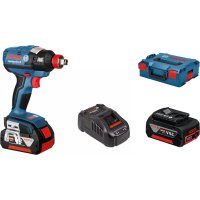
GDX 18 VEC Professional - Screwdriver BOSCH - Free user manual and instructions
Find the device manual for free GDX 18 VEC Professional BOSCH in PDF.



Download the instructions for your Screwdriver in PDF format for free! Find your manual GDX 18 VEC Professional - BOSCH and take your electronic device back in hand. On this page are published all the documents necessary for the use of your device. GDX 18 VEC Professional by BOSCH.
USER MANUAL GDX 18 VEC Professional BOSCH
(5) Battery release button
(6) Button for electronic speed preselection (7) Speed indicator (8) Button for "PowerLight" lamp (9) Rotational direction switch (10) On/off switch (11) "PowerLight" (12) Handle (insulated gripping surface) (13) Carrying strap (14) Double bit (15) Universal bit holder
(16) Screwdriver bit
- Accessories shown or described are not included with the product as standard. You can find the complete selection of accessories in our accessories range. Technical Data Cordless impact screwdriver GDR 14.4 V-EC GDR 18 V-EC Article number 3 601 JB9 2 p. 3
- 601 JB9 2 p. 3
- 601 JB9 3 601 JB9 3 p. 3
- with rechargeable battery "premium" "compact" "premium" "compact" Rated voltage V = 14.4 14.4 18 18 No-load speed – Setting 1 rpm 0–1300 0–1300 0–1300 0–1300 – Setting 2 rpm 0–2000 0–2000 0–2000 0–2000 – Setting 3 rpm 0–2800 0–2800 0–2800 0–2800 Impact rateCordless impact screwdriver GDR 14.4 V-EC GDR 18 V-EC – Setting 1 rpm 0–1100 0–1100 0–1100 0–1100 – Setting 2 rpm 0–2600 0–2600 0–2600 0–2600 – Setting 3 rpm 0–3200 0–3200 0–3200 0–3200 Maximum torque, hard screw- driving application according to ISO5393 Nm 160 160 170 170 Machine screw diameter mm M6–M14 M6–M14 M6–M14 M6–M14 Tool holder ¼" internal hexagon ¼" internal hexagon ¼" internal hexagon ¼" internal hexagon Weight according to EPTA- Procedure 01:2014 kg 1.4–1.7 1.2–1.4 1.5–2.0 1.3–1.7 Cordless impact screwdriver GDS 14.4 V-EC GDS 18 V-EC Article number 3 601 JB9 5 p. 3
- 601 JB9 5 p. 3
- 601 JB9 5 601 JB9 5 p. 3
- with rechargeable battery "premium" "compact" "premium" "compact" Rated voltage V = 14.4 14.4 18 18 No-load speed – Setting 1 rpm 0–1300 0–1300 0–1300 0–1300 – Setting 2 rpm 0–2000 0–2000 0–2000 0–2000 – Setting 3 rpm 0–2800 0–2800 0–2800 0–2800 Impact rate – Setting 1 rpm 0–1100 0–1100 0–1100 0–1100 – Setting 2 rpm 0–2600 0–2600 0–2600 0–2600 – Setting 3 rpm 0–3200 0–3200 0–3200 0–3200 Maximum torque, hard screw- driving application according to ISO5393 Nm 175 175 185 185 Machine screw diameter mm M6–M16 M6–M16 M6–M16 M6–M16 Tool holder ■ ½" ■ ½" ■ ½" ■ ½" Weight according to EPTA- Procedure 01:2014 kg 1.4–1.7 1.2–1.4 1.5–2.0 1.3–1.7 Cordless impact screwdriver GDX 14.4 V-EC GDX 18 V-EC Article number 3 601 JB9 0 p. 3
- 601 JB9 0 p. 3
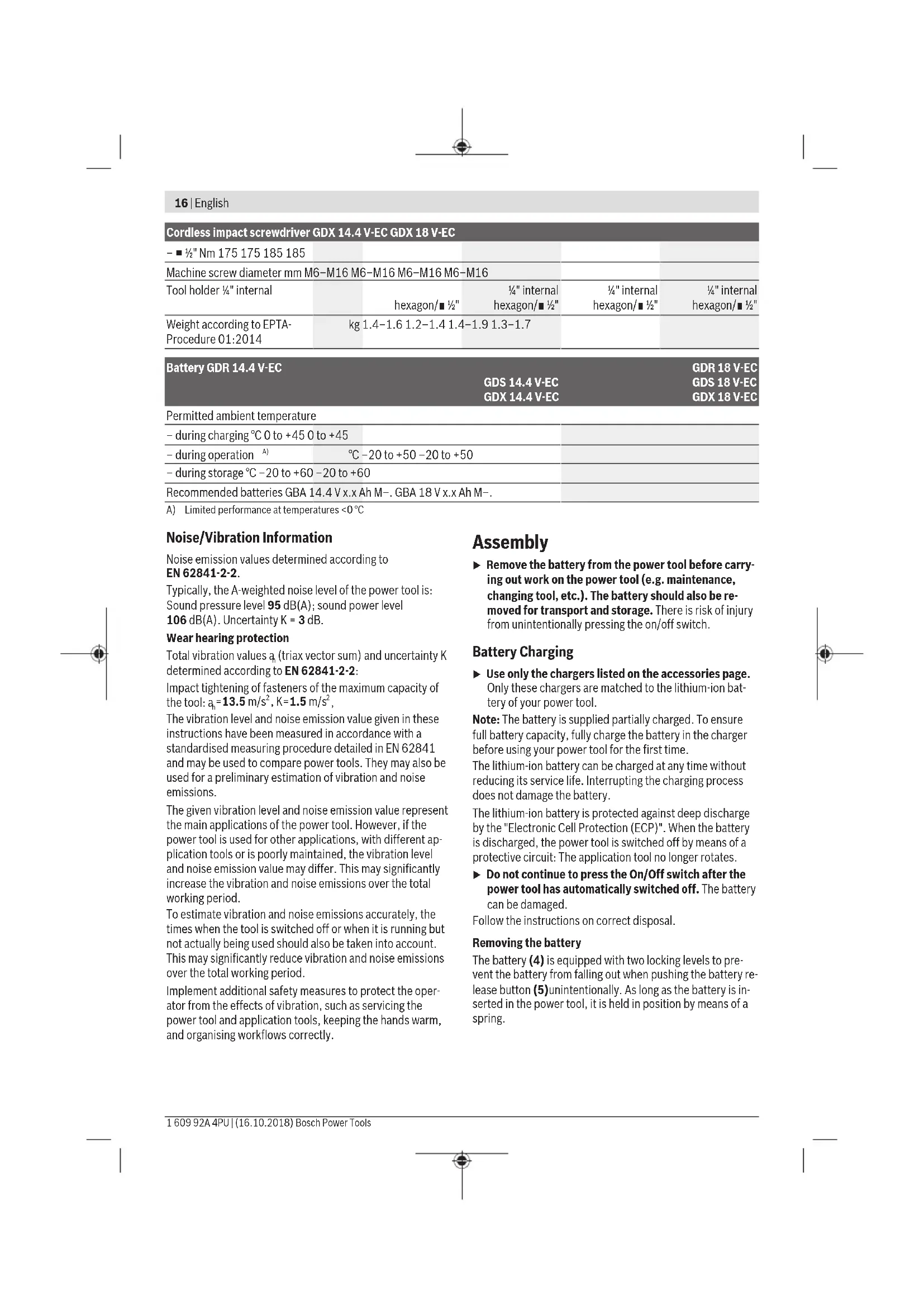
- 601 JB9 1 601 JB9 1 with rechargeable battery "premium" "compact" "premium" "compact" Rated voltage V = 14.4 14.4 18 18 No-load speed – Setting 1 rpm 0–1300 0–1300 0–1300 0–1300 – Setting 2 rpm 0–2000 0–2000 0–2000 0–2000 – Setting 3 rpm 0–2800 0–2800 0–2800 0–2800 Impact rate – Setting 1 rpm 0–1100 0–1100 0–1100 0–1100 – Setting 2 rpm 0–2600 0–2600 0–2600 0–2600 – Setting 3 rpm 0–3200 0–3200 0–3200 0–3200 Maximum torque, hard screw- driving application according to ISO5393 – ¼" internal hexagon Nm 160 160 170 170 English | 15 Bosch Power Tools 1 609 92A 4PU | (16.10.2018)16 | English 1 609 92A 4PU | (16.10.2018) Bosch Power Tools Cordless impact screwdriver GDX 14.4 V-EC GDX 18 V-EC – ■ ½" Nm 175 175 185 185 Machine screw diameter mm M6–M16 M6–M16 M6–M16 M6–M16 Tool holder ¼"internal hexagon/∎ ½" ¼"internal hexagon/∎ ½" ¼"internal hexagon/∎ ½" ¼"internal hexagon/∎ ½" Weight according to EPTA- Procedure 01:2014 kg 1.4–1.6 1.2–1.4 1.4–1.9 1.3–1.7 Battery GDR 14.4 V-EC GDS 14.4 V-EC GDX 14.4 V-EC GDR 18 V-EC GDS 18 V-EC GDX 18 V-EC Permitted ambient temperature – during charging °C 0 to +45 0 to +45 – during operation p. 3
°C –20 to +50 –20 to +50 – during storage °C –20 to +60 –20 to +60 Recommended batteries GBA 14.4 V x.x AhM–. GBA 18 V x.x AhM–. A) Limited performance at temperatures <0°C Noise/Vibration Information Noise emission values determined according to EN62841-2-2. Typically, the A-weighted noise level of the power tool is: Sound pressure level 95dB(A); sound power level 106dB(A). Uncertainty K=3dB. Wear hearing protection Total vibration values a
(triax vector sum) and uncertainty K determined according to EN62841-2-2: Impact tightening of fasteners of the maximum capacity of the tool: a
The vibration level and noise emission value given in these instructions have been measured in accordance with a standardised measuring procedure detailed in EN 62841 and may be used to compare power tools. They may also be used for a preliminary estimation of vibration and noise emissions. The given vibration level and noise emission value represent the main applications of the power tool. However, if the power tool is used for other applications, with different ap- plication tools or is poorly maintained, the vibration level and noise emission value may differ. This may significantly increase the vibration and noise emissions over the total working period. To estimate vibration and noise emissions accurately, the times when the tool is switched off or when it is running but not actually being used should also be taken into account. This may significantly reduce vibration and noise emissions over the total working period. Implement additional safety measures to protect the oper- ator from the effects of vibration, such as servicing the power tool and application tools, keeping the hands warm, and organising workflows correctly. Assembly u Remove the battery from the power tool before carry- ing out work on the power tool (e.g. maintenance, changing tool, etc.). The battery should also be re- moved for transport and storage. There is risk of injury from unintentionally pressing the on/off switch. Battery Charging u Use only the chargers listed on the accessories page. Only these chargers are matched to the lithium-ion bat- tery of your power tool. Note: The battery is supplied partially charged. To ensure full battery capacity, fully charge the battery in the charger before using your power tool for the first time. The lithium-ion battery can be charged at any time without reducing its service life. Interrupting the charging process does not damage the battery. The lithium-ion battery is protected against deep discharge by the "Electronic Cell Protection (ECP)". When the battery is discharged, the power tool is switched off by means of a protective circuit: The application tool no longer rotates. u Do not continue to press the On/Off switch after the power tool has automatically switched off. The battery can be damaged. Follow the instructions on correct disposal. Removing the battery The battery (4) is equipped with two locking levels to pre- vent the battery from falling out when pushing the battery re- lease button (5)unintentionally. As long as the battery is in- serted in the power tool, it is held in position by means of a spring.To remove the battery (4), press the release button (5) and pull the battery forward and out of the power tool. Do not use force to do this. Changing the Tool u Remove the battery from the power tool before carry- ing out work on the power tool (e.g. maintenance, changing tool, etc.). The battery should also be re- moved for transport and storage. There is risk of injury from unintentionally pressing the on/off switch. u Regularly clean the power tool’s air vents. The motor’s fan can draw the dust inside the housing and excessive accumulation of powdered metal may cause electrical hazards. GDR14.4V-EC/GDR18V-EC/GDX14.4V-EC/GDX18V- EC: Inserting Pull the locking sleeve (2) forward, guide the application tool (1) into the tool holder up to the stop and release the locking sleeve (2) to lock the application tool. Screwdriver bits (16) can be inserted using a universal bit holder with ball catch (15). Removing Pull the locking sleeve (2) forward and remove the applica- tion tool. GDS14.4V-EC/GDS18V-EC/GDX14.4V-EC/GDX18V- EC: u When working with an application tool, pay attention that the application tool is connected securely to the tool holder. When the application tool is not securely connected with the tool holder, it can come off during ap- plication. Slide the application tool (17) onto the square drive of the tool holder (1). Due to the way the system operates, the application tool (17) will move around slightly in the tool holder (1); this has no influence on the function/safety. GDX14.4V-EC/GDX18V-EC: Some application tools (e.g. double bits) cannot be safely secured in the tool holder. Operation Method of Operation The tool holder (1) (with the application tool) is driven by an electric motor via a gear and impact mechanism. The working procedure is divided into two phases: Screwing in and tightening (impact mechanism in action). The impact mechanism is activated as soon as the screwed connection runs tight and load is therefore put on the motor. The impact mechanism then converts the power of the mo- tor to steady rotary impacts. When loosening screws or nuts, the process is reversed. Starting Operation Inserting the battery u Use only original Bosch lithium-ion batteries with the voltage stated on the type plate of your power tool. Using other batteries can lead to injuries and pose a fire hazard. Set the rotational direction switch (9) to the centre position to protect the power tool from being switched on accident- ally. Push the charged battery (4) into the base of the power tool from the front until the battery is securely locked. Set the rotational direction (see figureD) The rotational direction switch (9) is used to change the ro- tational direction of the power tool. However, this is not pos- sible while the on/off switch (10) is being pressed. Right rotation: To drive in screws and tighten nuts, press the rotational direction switch (9) through to the left stop. Left Rotation: To loosen and unscrew screws and nuts, press the rotational direction switch (9) through to the right stop. Switching on/off To start the power tool, press and hold the on/off switch (10). To switch off the power tool, release the on/off switch (10). Adjusting the Speed You can adjust the speed of the power tool when it is on by pressing in the on/off switch (10) to varying extents. A light pressure on the on/off switch (10) results in a low ro- tational speed. Increased pressure on the switch causes an increase in speed. Preselecting the speed/impact rate With the button (6), you can preselect the required speed/ impact rate in three stages. Press the button (6) repeatedly until the desired setting appears in the speed indicator (7). The selected setting will be saved. The required speed/impact rate is dependent on the mater- ial and the work conditions and can be determined by prac- tical trials. English | 17 Bosch Power Tools 1 609 92A 4PU | (16.10.2018)18 | English 1 609 92A 4PU | (16.10.2018) Bosch Power Tools Switching the "PowerLight" lamp on/off Press the button (8) to activate the lamp (11). To switch off the lamp (11), press the button (8) again. Practical advice u Only apply the power tool to the screw/nut when the tool is switched off. Rotating tool inserts can slip off. The torque depends on the impact duration. The maximum achieved torque results from the sum of all individual torques achieved through impact. Maximum torque is achieved after an impact duration of 6–10 seconds. After this duration, the tightening torque is increased only minim- ally. The impact duration is to be determined for each required tightening torque. The actually achieved tightening torque is always to be checked with a torque wrench. Screw applications with hard, spring-loaded or soft seats When the achieved torques in an impact series are measured during a test and transferred into a diagram, the result is the curve of a torque characteristic. The height of the curve cor- responds with the maximum reachable torque, and the steepness indicates the duration in which this is achieved. A torque gradient depends on the following factors: – Strength properties of the screws/nuts – Type of backing (washer, disc spring, seal) – Strength properties of the material being screwed/bolted together – Lubrication conditions at the screw/bolt connection The following application cases result accordingly: – A hard seat is a metal-to-metal screw application which uses washers. After a relatively short impact duration, the maximum torque is reached (steep characteristic curve). Unnecessary long impact duration only causes damage to the machine. – A spring-loaded seat is also a metal-to-metal screw ap- plication but uses spring washers, disc springs, studs or screws/nuts with conical seats. It is also called a spring- loaded seat when extensions are used. – A soft seat is a screw application of e.g. metal on wood or a screw application that uses lead washers or fibre wash- ers as backing. For a spring-loaded seat as well as for a soft seat, the max- imum tightening torque is lower than for a hard seat. Also, a clearly longer impact duration is required. Guide values for maximum screw tightening torques Figures given in Nm; calculated from the tensional cross-section; utilization of the yield point: 90% (with friction coefficient
total =0.12). As a control measure, always check the tightening torque with a torque wrench. Property Classes according to DIN267 Standard Screws/Bolts High-strength Bolts
0–2600 0–2600 0–2600 0–2600 – Seade3 min
0–2600 0–2600 0–2600 0–2600 – Seade3 min
0–2600 0–2600 0–2600 0–2600 – Seade3 min
0–26000–26000–26000–2600
0–26000–26000–26000–2600
0–26000–26000–26000–2600
EPTA-Procedure 01:2014 1,4–1,61,2–1,41,4–1,91,3–1,7
°–20+ ...60–20+ ...60
0–26000–26000–26000–2600
"¼ "¼ "¼ "¼ EPTA- Procedure 01:2014 kg1,4–1,71,2–1,41,5–2,01,3–1,7
0–26000–26000–26000–2600
0–26000–26000–26000–2600
°C–20+ ...60–20+ ...60
EU Declaration of Conformity We declare under our sole responsibility that the stated products comply with all applicable provisions of the directives and regulations listed below and are in conformity with the following standards. Technical file at: * Cordless impact screwdriver Article number