C 4002 - Heating Trumatic - Free user manual and instructions
Find the device manual for free C 4002 Trumatic in PDF.



Frequently Asked Questions - C 4002 Trumatic
User questions about C 4002 Trumatic
0 question about this device. Answer the ones you know or ask your own.
Ask a new question about this device
Download the instructions for your Heating in PDF format for free! Find your manual C 4002 - Trumatic and take your electronic device back in hand. On this page are published all the documents necessary for the use of your device. C 4002 by Trumatic.
USER MANUAL C 4002 Trumatic
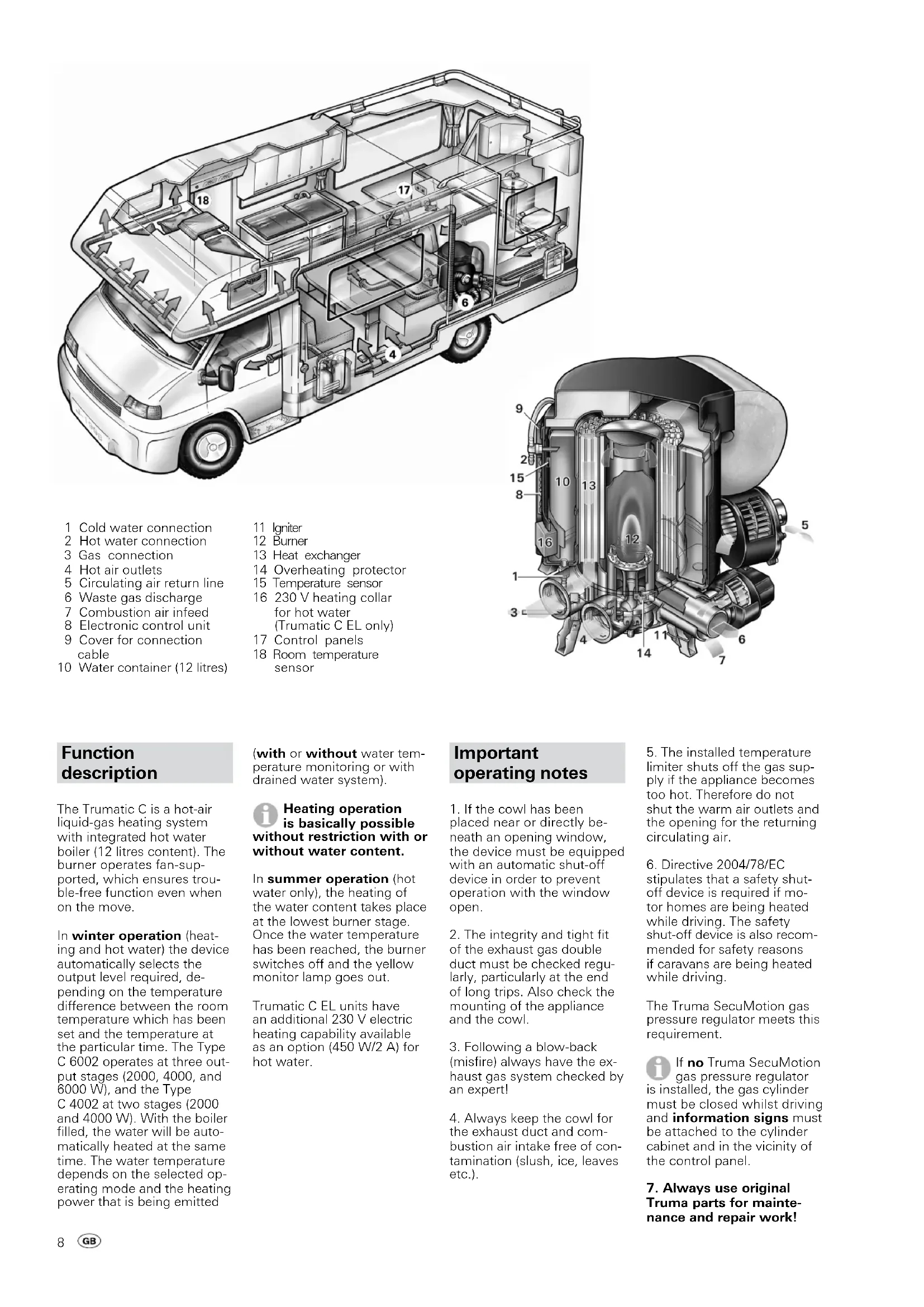
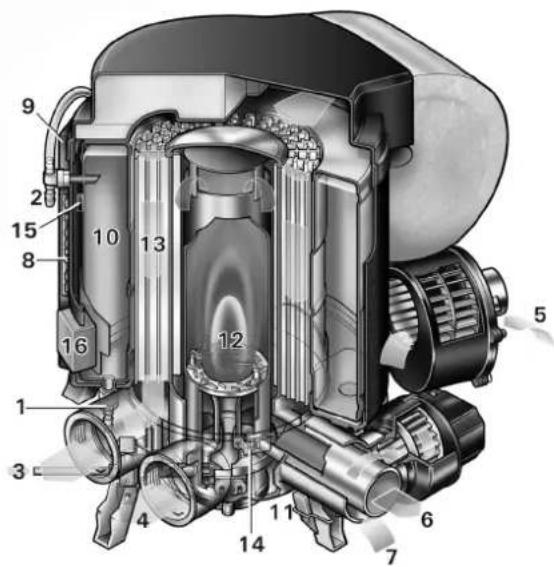
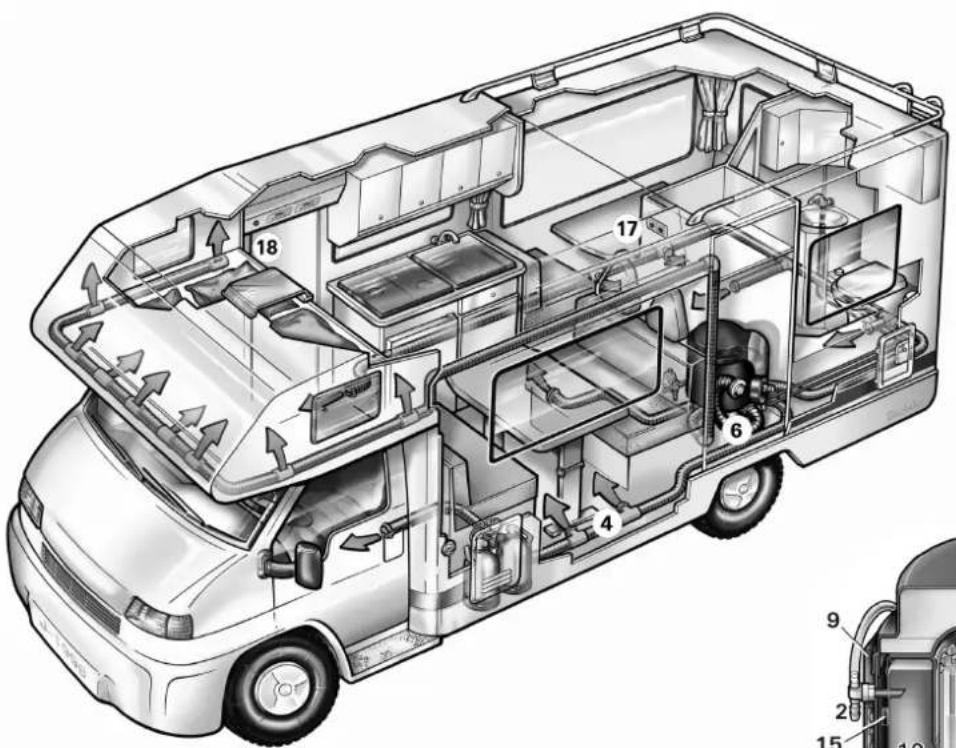
1 Cold water connection
2 Hot water connection
3 Gas connection
4 Hot air outlets
5 Circulating air return line
6 Waste gas discharge
7 Combustion air infeed
8 Electronic control unit
9 Cover for connection cable
0 Water container (12 litres)
11 Igniter
12 Bumer
13 Heat exchanger
14 Overheating protector
15 Temperature sensor
16 230 V heating collar for hot water (Trumatic C EL only)
17 Control panels
18 Room temperature sensor
Function description
The Trumatic C is a hot-air liquid-gas heating system with integrated hot water boiler (12 litres content). The burner operates fan-supported, which ensures trouble-free function even when on the move.
In winter operation (heating and hot water) the device automatically selects the output level required, depending on the temperature difference between the room temperature which has been set and the temperature at the particular time. The Type C 6002 operates at three output stages (2000, 4000, and 6000 W), and the Type C 4002 at two stages (2000 and 4000 W). With the boiler filled, the water will be automatically heated at the same time. The water temperature depends on the selected operating mode and the heating power that is being emitted
(with or without water temperature monitoring or with drained water system).
Heating operation is basically possible without restriction with or without water content.
In summer operation (hot water only), the heating of the water content takes place at the lowest burner stage. Once the water temperature has been reached, the burner switches off and the yellow monitor lamp goes out.
Trumatic C EL units have an additional 230 V electric heating capability available as an option (450 W/2 A) for hot water.
Important operating notes
- If the cowl has been placed near or directly beneath an opening window, the device must be equipped with an automatic shut-off device in order to prevent operation with the window open.
- The integrity and tight fit of the exhaust gas double duct must be checked regularly, particularly at the end of long trips. Also check the mounting of the appliance and the cowl.
- Following a blow-back (misfire) always have the exhaust gas system checked by an expert!
-
Always keep the cowl for the exhaust duct and combustion air intake free of contamination (slush, ice, leaves etc.).
-
The installed temperature limiter shuts off the gas supply if the appliance becomes too hot. Therefore do not shut the warm air outlets and the opening for the returning circulating air.
- Directive 2004/78/EC stipulates that a safety shut-off device is required if motor homes are being heated while driving. The safety shut-off device is also recommended for safety reasons if caravans are being heated while driving.
The Truma SecuMotion gas pressure regulator meets this requirement.
If no Truma SecuMotion gas pressure regulator is installed, the gas cylinder must be closed whilst driving and information signs must be attached to the cylinder cabinet and in the vicinity of the control panel.
7. Always use original Truma parts for maintenance and repair work!
Operating instructions
Always observe the operating instructions and "Important operating notes" prior to starting!
The vehicle owner is responsible for the correct operation of the appliance.
The installer or vehicle owner must apply the yellow sticker with the warning information, which is enclosed with the appliance, to a place in the vehicle where it is clearly visible to all users (e.g. on the wardrobe door)! Ask Truma to send you stickers, if necessary.
Before using for the first time, it is essential to flush the entire water supply through with clean warm water. If the heater is not being used, always drain the water contents if there is a risk of frost. There shall be no claims under guarantee for damage caused by frost! Also drain the water prior to repair or maintenance work on the vehicle (in the workshop!) as the electrical safety/drain valve opens when the appliance is switched dead.
Electrical safety/drain valve
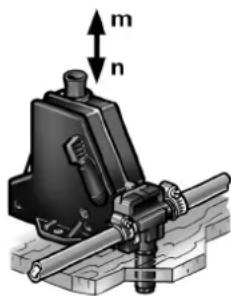
m = Control knob „closed"
n = Control knob „drain"
The safety/drain valve is held closed by a electrical coil. To save battery power, we recommend to open the valve if the vehicle is not in use for a prolonged period!
If the temperature at the safety/drain valve is less than 4^ , the water contents may discharge on its own accord if the appliance is not in operation (also if there is a failure)! To avoid water loss, switch the device on (summer or winter operation) and close the safety/drain valve at the actuating button by raising it up (position m).
Without heater operation, the safety/drain valve can only be closed again at temperatures above 8^
The draining socket of the electrical safety/drain valve must always be kept clear (free from slush, ice, leaves etc.)! There shall be no claims under guarantee for damage caused by frost!
Filling the water heater
- Close electrical safety/drain valve at the control knob by lifting up (position m).
At temperatures of around 8^ and less, switch on the heater or water heater first, to make sure the valve does not open again! - Switch on power for water pump (main switch or pump switch).
- Open hot water taps in kitchen and bathroom, (set preselecting mixing taps or single-lever fittings to "hot"). Leave taps open until the water heater has forced out air and filled up with water and water is flowing out of the taps.
If just the cold water system is being operated, without using the water heater, the heater tank also fills up with water. In order to avoid damage by frost, the water contents must be drained by operating the safety/drain valve, also when the water heater has not been used. As an alternative, two shutoff valves, resistant to hot water, can be fitted in front of the cold and hot water connection.
When connecting to a central water supply (rural or city mains), a pressure reduction valve must always be installed to prevent pressures above 2.8 bar from developing in the water heater.
Draining the water heater
- Interrupt power for water pump (main switch or pump switch).
-
Open hot water taps in kitchen and bathroom.
-
Open electrical safety/ drain valve at control knob by pressing in (position n).
The water heater content is now emptied to the outside through the safety/drain valve. Place a bucket beneath the outlet to check whether the water content has completely drained away (12 litres). There shall be no claims under guarantee for damage caused by frost!
Gas operation (heating and hot water)
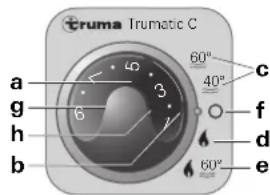
a = Rotary switch for room temperature (1 - 9)
b = Green „Operation“ monitor lamp
c = Summer operation (water temperature 40^ or 60^)
d = Winter operation (heating without water temperature monitoring or with drained water system)
e = Winter operation (heating with water temperature monitoring)
f = Rotary „Off“ switch
g = Yellow „Boiler heating phase" monitor lamp
h = Red „Fault“ monitor lamp
When using vehicle-specific switches: refer to operating instructions of vehicle manufacturer.
Room thermostat
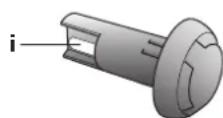
i = Room temperature
s e n s o r
To measure the room temperature, an external room temperature sensor (i) is located in the vehicle. The location of the sensor is determined individually by the vehicle manufacturer, depending on the vehicle type; consult the operating instructions for your vehicle for further details.
The thermostat setting on the control panel (1-9) must be determined individually depending on the heating requirement and the type of vehicle. For an average room temperature of about 23^ , we recommend a thermostat setting of about 6-8.
Taking into operation
- Check that the cowl is not obstructed. Always remove any covers, open deck cowl on boats.
In winter, if a roof cowl is fitted, it is recommended that a cowl extension be fitted (see Accessories). This must be removed when the vehicle is on the move. To run the cowl through the roof on a caravan, a cowl extension piece is likewise used, which must be fixed to the roof with clamp rings (see Accessories). - Turn on gas cylinder and open quick-acting valve in the gas supply line.
Heating operation is basically possible without restriction with or without water content.
Summer operation (hot water only)
Set the rotary switch to Summer operation (c), 40^ or 60^ .
Once the water temperature which has been set (40^ or 60^) has been reached, the burner will switch off and the yellow monitor lamp (g) will go out.
Winter operation
(Heating with water temperature monitoring)
- Set the rotary switch to the operational setting e^ .
- Set the rotary switch (a) to the desired thermostat setting (1 - 9). The green indicator lamp (b) illuminates and indicates the room temperature setting.
The device automatically selects the setting that is required in accordance with the difference between the temperature setting and the current room temperature.
Once the room temperature set on the control panel has been reached, the burner switches back to the lowest stage, and heats the water content to 60^ . The yellow monitor lamp (g) indicates the heating-up phase is in progress, and goes out once the appropriate water temperature has been reached.
Heating without water temperature monitoring
-
Set the rotary switch to the operational setting ^ d^ .
-
Turn the rotary switch (a) to the desired thermostat setting (1-9). The green indicator lamp (b) illuminates and indicates the room temperature setting.
The device automatically selects the setting that is required in accordance with the difference between the temperature setting and the current room temperature. Once the room temperature set on the control panel has been reached, the heating will switch off.
If the boiler is filled, the water will automatically be heated at the same time. The water temperature is then dependent on the heating output being given off, and the duration of heating required to reach the desired room temperature.
In this operational mode, the yellow monitor lamp (g - boiler heat-up phase) only lights up if the water temperature is below 5^
Heating operation is basically possible without restriction with or without water content.
Heating with drained water system
-
Set the rotary switch to the operational setting ^ d^ .
-
Turn the rotary switch (a) to the desired thermostat setting (1-9). The green indicator lamp (b) illuminates and indicates the room temperature setting.
The device automatically selects the setting that is required in accordance with the difference between the temperature setting and the current room temperature.
Once the room temperature set on the control panel has been reached, the heating will switch off.
In this operating mode the yellow indicator lamp (g - boiler heat-up phase) only illuminates at room temperatures of less than 5^
Switching off "Gas operation"
Switch heating system off at the rotary switch (f).
Always drain water contents if there is a risk of frost!
If the appliance is not to be used for a prolonged period, close the quick-acting valve in the gas supply line and turn off the gas cylinder.
Red indicator lamp „Failure"
In the event of a fault, the red monitor lamp (h) will light up.
Please consult the Troubleshooting list for possible causes.
Release is effected by switching the system off and then on again.
Opening the window switch and closing it again is the equivalent to switching off/on at the control panel (e.g. performing a fault reset)!
230 V electrical operation (450 W/2 A) - Trumatic C EL only - (hot water only)
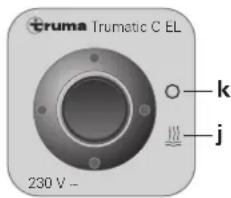
$$ \begin{array}{l} \text {j = R o c k e r s w i t c h , O n "} \ \text {k = R o c k e r s w i t c h , O f f "} \end{array} $$
Switch boiler on at the operating point (j). The indicator lamp indicates that the device is in operation.
When using vehicle-specific switches: refer to operating instructions of vehicle manufacturer.
The water temperature cannot be selected, automatic temperature limitation at approx. 60^ For a faster heating up period the appliance can be simultaneously operated with gas and electrical power.
Maintenance
The water container used is made of stainless steel, which is foodstuff-compatible.
Use wine vinegar for descal ing the water heater, this being introduced into the appliance via the water supply. Allow the product to react and then thoroughly flush out the appliance with plenty of fresh water. To sterilise the water we recommend "Certsil-Argento". Other products, particularly those containing chlorine are unsuitable.
To avoid infestation by microorganisms, the boiler must be heated to 70^ at regular intervals (only possible in winter operation).
The water can be heated to up to 70^ depending on the heating power that is required to achieve the room temperature.
Do not use the water as drinking water!
Fuses
The device and control panel fuses are on the electronic control unit on the device.
Device fuse: 6.3 AT - slow - Control panel fuse (F3): 1.6 AT - slow -
The fine-wire fuse must only be replaced by a fuse of the same design.
General safety notes
If the gas system is leaking or if there is a smell of gas:
extinguish all naked flames
- do not smoke
- switch off the appliances
- shut off the gas cylinder
open windows and door
- do not actuate any electrical switches
have the entire system checked by an expert!
Repairs may only be carried out by an expert!
A new O-ring must always be installed after dismantling the exhaust duct!
- Any modifications to the unit (including the exhaust duct and the cowl) or the use of spare parts and accessories that are important to the operation of the system (e.g. the time switch) that are not original Truma parts and failure to follow the installation and operating instructions will cancel the warranty and indemnify Truma from any liability claims. It also becomes illegal to use the appliance, and in some countries this even makes it illegal to use the vehicle.
- The operating pressure of the 30 mbar gas supply must correspond with the operating pressure of the device (see data plate).
- Liquid gas systems must comply with the technical and administrative regulations of the respective country of use (e.g. EN 1949 for vehicles or EN ISO 10239 for boats in Europe). National directives and regulations (e.g. DVGW worksheet G 607 for vehicles and G 608 for boats in Germany) must be complied with.
The testing of the gas system must be repeated every two years by a qualified specialist and, if appropriate, confirmed on the inspection certificate (in Germany, f. ex. DVGW Worksheet G 607 for motor vehicles or G 608 for boats).
The vehicle owner is always responsible for arranging the inspection.
Pressure regulating devices and hoses must be replaced with new ones no more than 10 years after their date of manufacture (every 8 years
if used commercially). This is the responsibility of the operator.
-
Liquid gas equipment must not be used when refuelling, in multi-storey car parks, in garages or on ferries.
-
During the initial operation of a brand new appliance (or after it has not been used for some time), a slight amount of fumes and smell may be noticed for a short while. It is a good idea to heat the device up several times in summer operation (60^) and to make sure that the area is well ventilated.
-
If the burner makes an unusual noise or if the flame lifts off, it is likely that the regulator is faulty and it is essential to have it checked.
-
Items sensitive to heat (e.g. spray cans) must not be stored in the installation area, since excess temperatures may under certain circumstances be incurred there.
-
Only pressure control equipment that complies with EN 12864 (in vehicles) and EN ISO 10239 (for boats) with a fixed delivery pressure of 30 mbar must be used for the gas system. The flow rate of the pressure control device must correspond to at least the maximum consumption of all devices installed by the system manufacturer.
For vehicles we recommend the Truma SecuMotion gas pressure regulator and the Truma DuoComfort automatic changeover valve for the two-cylinder system.
At temperatures of around 0^ or less the gas pressure regulator and the changeover valve must be operated using the EisEx de-icing system.
Controller connecting hoses that meet national regulations must always be used in the respective country for which the equipment is destined. These hoses must be checked regularly for brittleness. Winter-proof special hoses must always be used if the equipment is operated during the winter.
Technical data
determined in accordance with EN 624 or Truma test conditions
Type of gas:
Liquid gas (propane/butane)
Operating pressure:
30 mbar (refer to data plate)
Water contents:
12 litres
Heating up time from approx. 15^ to approx.
60^ C
Boiler approx. 30 minutes
(measured according to
EN 15033)
Heater + water heater
approx. 80 min.
Water pressure:
max. 2.8 bar
Rated thermal output
C 4002: 2000/4000 W
C 6002: 2000/4000/6000 W
Gas consumption
C 4002:170-320 g/h
C 6002:170-480 g/h
Air delivery volume (free
blowing without hot-air pipe)
C 4002: with 3 hot-air
outlets
max. 249m^3 /h
with 4 hot-air
outlets
max. 287m^3 /h
C 6002: with 4 hot-air
outlets
max. 287m^3 /h
Current input at 12V
Heater + water heater
C 4002: 0.2 - 5.6 A
(average power
consumption 1.3 A)
C 6002:0.2-5.6 A
(average power
consumption 1.4 A)
Heating up of water heater:
0.4A
Stand-by:
0.001 A
Current input of electrical
safety/drain valve at 12 V:
0.035 A
Weight:
17.6 kg
(without water contents)
Declaration of conformity:
The Trumatic C has been
tested by the DVGW and
complies with the gas equip
ment directive (90/396/EEC)
and the other applicable EC
directives. The following
CE Product Ident. No. is
available for EU countries
C 4002: CE-0085AS0121
C 6002: CE-0085AS0122.
The heater complies with
heater directive 2001/56/EC
and supplements 2004/78/EC
and 2006/119/EC and bears
the type approval number
C 4002:e1000147
C 6002:e1 00 0146.
The heater complies with
vehicle engine interference
suppression directive
72/245/EEC with supple
ments 2004/104/EC and
2005/83/EC, and bears
type approval number:
e1032499.
The heater complies with
EMC directive 89/336/EEC
and low voltage directive
73/23/EEC.

The right to effect technical
Trouble-shooting list
| Fault | Cause | Rectification |
| Gas operation | ||
| · No control lamp lights up when the system is switched on (winter and summer operation). | - Device fuse or vehicle fuse defective. | - Charge battery voltage (12 V). - Check all electrical plug connections/fuses. |
| - Open window above cowl (window switch). | - Close window. | |
| · The green indicator lamp comes on when the equipment is switched on (using the ZUC timer), but the heater is not operating. | - Open window above cowl (window switch). | - Close window. |
| · The red monitor lamp flashes after the heating system has been switched on. | - Warning! Battery voltage is too low (< 10.5 V). | - Charge battery! |
| · About 30 seconds after the heating has been switched on, the red monitor lamp lights up and remains steady. | - Gas cylinder or quick-closure valve in the gas line is closed. | - Check gas feed. |
| - Air feed interrupted. | - Check cowl for possible coverage. - If being used on boats, open the deck cowl. | |
| · Heating switches to Fault mode after an extended period of operation. | - Hot-air outlets blocked. | - Check individual outlet apertures. |
| - Gas pressure regulator iced up. | - Use de-icing system controller (EisEx). | |
| - Butane content in the gas cylinder too high. | - Use propane (at temperatures below 10°C in particular, butane is unsuitable for heating purposes). | |
| 230 V electrical operation | ||
| · No control lamp lights up when the system is switched on. | - No supply voltage. - Check 230 V supply voltage and fuses. | |
| Water supply | ||
| · When the heating system is switched off, the electrical safety/drain valve opens. | - Outside temperature below 4°C. | - Switch the heating on. At temperatures of about 4°C and below the drain valve will open automatically! |
| - No 12 V power supply at the drain valve. | - Check 12 V supply voltage and fuses. | |
| · The electrical safety/drain valve will no longer close. | - Outside temperature below 8°C. | - Switch the heating on. Without heating operation, the drain valve will not close again until temperatures above 8°C have been reached! |
| - No 12 V power supply at the drain valve. | - Check 12 V supply voltage and fuses. | |
| · Water dripping from the electrical safety/drain valve. | - Water pressure too high. | - Check pump pressure (max. 2.8 bar). If connected to a central water supply (rural or urban connection), a pressure reducer must be used, which will prevent pressures higher than 2.8 bar entering the boiler. |
If these measures do not lead to the rectification of the fault, in principle we would ask you to contact the Truma Service Centre.
Accessories
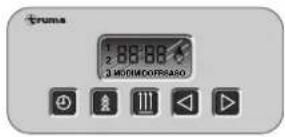
Truma Timer ZUC 2 complete with 3m connecting cable (part no. 34042-01).
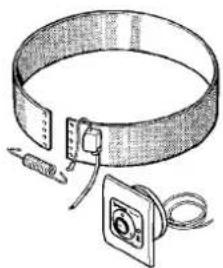
230 V, 450 W electrical heating collar for hot water, complete with 3m connecting cable (part no. 34141-01).
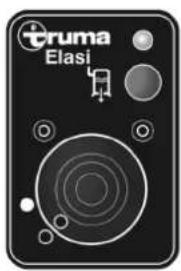
Remote control for electrical safety/drain valve, complete with 3m connecting cable (part no. 34170-01).
The electrical accessories are fitted with a plug and can be connected individually.
Extension cables for the control panel, the ZUC 2 timer and remote control panel for the drain valve are available if required.
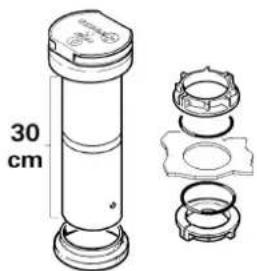
Cowl extension KVC for winter camping (part no. 34070-01).
Double-skin leadthrough for caravan-double-skin roofs (part no. 34080-01).
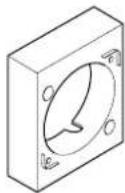
Surface-mounting frame for Truma control panel (part no. 40000-52600). Combination with the side pieces is not possible.
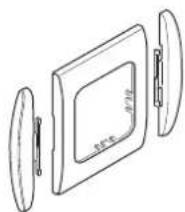
As standard, Truma supplies a suitable cover frame, in agate grey colour, for every control panel/every time switch. In addition, cover frames are also available as special accessories in the colours black, beige, platinum or gold.
Suitable for control panels or time switches, the side pieces available in eight different colours create a visually attractive finish.
Please contact your specialist dealer in this connection.
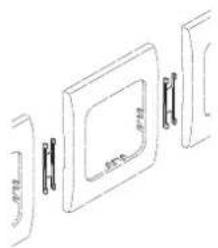
Clip row (part no.34000-65900). For installing several Truma control panels next to one another.
Manufacturer's terms of warranty
1. Case of warranty
The manufacturer grants a warranty for malfunctions in the appliance which are based on material or production faults. In addition to this, the statutory warranty claims against the seller remain valid.
A claim under warranty shall not pertain:
for parts subject to wear and in cases of natural wear and tear,
- as a result of using components in the units that are not original Truma parts and using unsuitable gas pressure regulators,
- as a consequence of failure to respect Truma instructions for installation and use,
- as a consequence of improper handling,
- as a consequence of improper transport packing, not arranged by Truma.
2. Scope of warranty
The warranty is valid for malfunctions as stated under item 1, which occur within 24 months after conclusion of the purchase agreement between the seller and the final consumer. The manufacturers will make good such defects by subsequent fulfilment, i.e. at their discretion either by repair or replacement. In the event of manufacturers providing service under warranty, the term of the warranty shall not recommence anew with regard to the repaired or replaced parts; rather, the old warranty period shall continue to run. More extensive claims, in particular claims for compensatory damages by purchasers or third parties, shall be excluded. This does not affect the rules of the product liability law.
The manufacturer shall bear the cost of employing the Truma customer service for the removal of a malfunction under warranty - in particular transportation costs, travelling expenses, job and material costs, as long as the service is carried out in Germany. The warranty does not cover customer service work in other countries.
Additional costs based on complicated removal and installation conditions of the appliance (e.g. removal of furniture or parts of the vehicle body) do not come under warranty.
3. Raising the case of warranty
The manufacturer's address is:
In Germany, always notify the Truma Service Centre if problems are encountered; in other countries the relevant service partners should be contacted (see Truma Service Booklet or www.truma.com). Any complaints are to be described in detail. In addition, the properly completed guarantee certificate is to be presented, or the factory number of the unit and the date of purchase given.
In order for the manufacturers to be able to determine whether an incident subject to guarantee has occurred, the end user must, at his own risk, bring the device to the manufacturers or send it to them. If there is damage to heaters (heat exchangers), the gas pressure regulator must also be sent back to the factory.
In instances of the device being sent to the works, dispatch is to be effected by freight transport. In cases under guarantee, the works shall bear the transport costs or the costs of delivery and return. If the damage is deemed not to be a warranty case, the manufacturer shall notify the customer and shall specify repair costs which shall not be borne by the manufacturer; in this case, the customer shall also bear the shipping costs.
Sous reserve de modifications techniques!
To be filled in by the dealer. Udfyldes af forhandleren.
Applicable for Germany only!