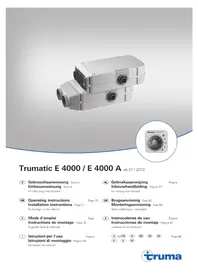
E 2800 A - Heating Trumatic - Free user manual and instructions
Find the device manual for free E 2800 A Trumatic in PDF.



Frequently Asked Questions - E 2800 A Trumatic
User questions about E 2800 A Trumatic
0 question about this device. Answer the ones you know or ask your own.
Ask a new question about this device
Download the instructions for your Heating in PDF format for free! Find your manual E 2800 A - Trumatic and take your electronic device back in hand. On this page are published all the documents necessary for the use of your device. E 2800 A by Trumatic.
USER MANUAL E 2800 A Trumatic
1 Control panel (of your choice)
2 Time switch
(special accessory)
3 Combustion air
4 Flue gas
5 Electronic control unit
6 Power supply
7 Gas connection
W Warm air
U Return air
F
text_image
Technical diagram of an electrical device with labeled components and directional arrows indicating flow or movement.
1
text_image
0 - 5 cm max. 30 cm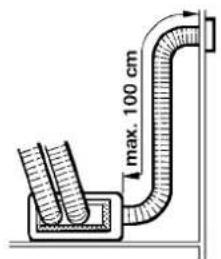
text_image
max. 100 cm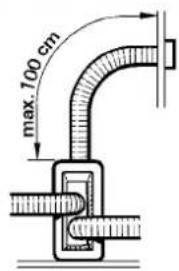
text_image
max. 100 cm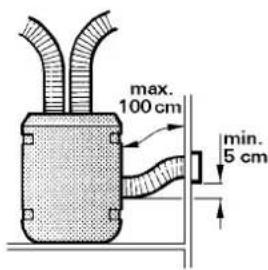
text_image
max. 100 cm min. 5 cmEinbauvarianten Installation options
Variantes
d'installation
Varianti
d'installazione
Inbowvarianten
natural_image
Mechanical setup diagram showing a lever and base with no visible text or symbolsC
text_image
d 32 35 30 33D
natural_image
Technical line drawings of mechanical components and connectors (no text or symbols)E
text_image
36 39 37 40 d 38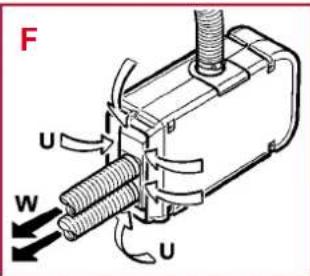
text_image
F U W U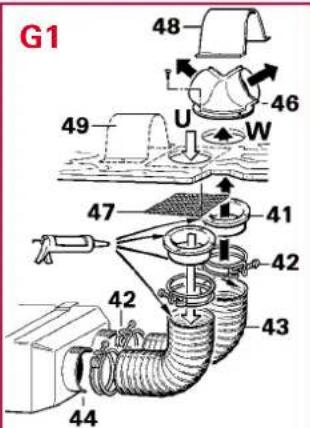
text_image
G1 48 46 49 U W 47 41 42 42 43 44G2
text_image
W 45 W UG3
text_image
Technical diagram of a mechanical assembly with labeled parts, showing exploded view and component detailsJ1
J2
H1
text_image
Ø 55 mm 1 2 3 4 5 6 7 7 8H2
text_image
2 9 11 10 8H3
H4
text_image
4 F1 1 2H5
H6
flowchart
graph TD
    A["1"] --> B["2"]
    B --> C["3"]
    C --> D["4"]
    D --> E["5"]
    E --> F["6"]
    F --> G["7"]
    G --> H["Output"]
    style A fill:#f9f,stroke:#333
    style B fill:#f9f,stroke:#333
    style C fill:#f9f,stroke:#333
    style D fill:#f9f,stroke:#333
    style E fill:#f9f,stroke:#333
    style F fill:#f9f,stroke:#333
    style G fill:#f9f,stroke:#333
    style H fill:#f9f,stroke:#333
Trumatic E 2800, E 2800 A E 4000, E 4000 A
L.P.G. Heater with electronic control, built-in air distribution and thermostat
Operating instructions
Always observe the operating instructions and "Important operating notes"
prior to starting! The vehicle owner is responsible for the correct operation of the appliance.
The installer or vehicle owner must apply the yellow sticker with the warning information, which is enclosed with the appliance, to a place in the vehicle where it is clearly visible to all users (e.g. on the wardrobe door)! Ask Truma to send you stickers, if necessary.
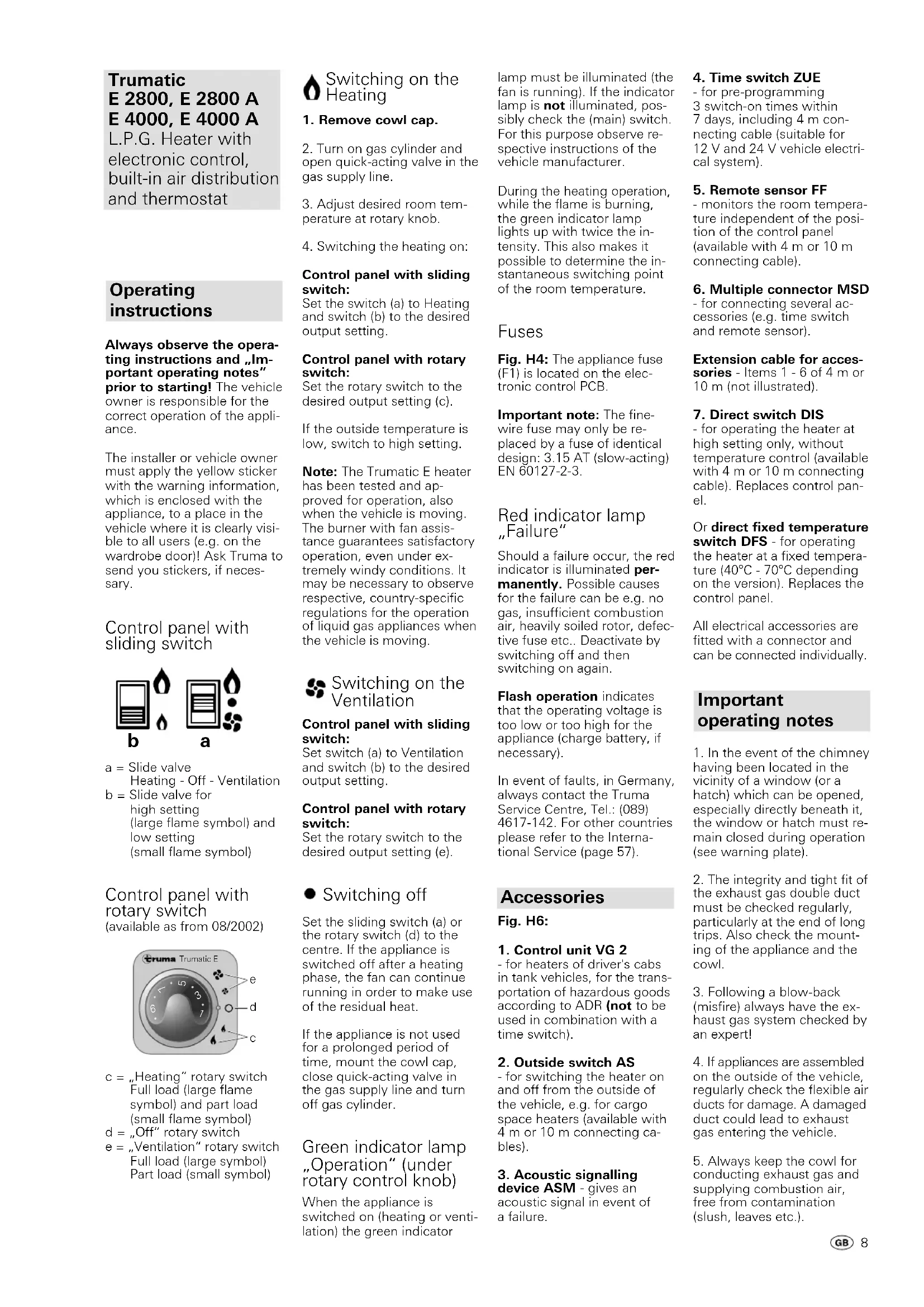
Control panel with sliding switch
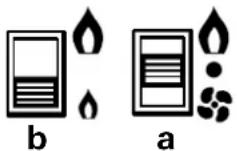
a = Slide valve Heating - Off - Ventilation
b = Slide valve for high setting (large flame symbol) and low setting (small flame symbol)
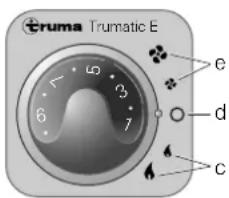
Control panel with rotary switch
(available as from 08/2002)
text_image
Truma Trumatic E 5 3 6 7 e d cc = "Heating" rotary switch Full load (large flame symbol) and part load (small flame symbol)
d = „Off" rotary switch
e = „Ventilation“ rotary switch Full load (large symbol) Part load (small symbol)
Switching on the Heating
1. Remove cowl cap.
-
Turn on gas cylinder and open quick-acting valve in the gas supply line.
-
Adjust desired room temperature at rotary knob.
-
Switching the heating on:
Control panel with sliding switch:
Set the switch (a) to Heating and switch (b) to the desired output setting.
Control panel with rotary switch:
Set the rotary switch to the desired output setting (c).
If the outside temperature is low, switch to high setting.
Note: The Trumatic E heater has been tested and approved for operation, also when the vehicle is moving. The burner with fan assistance guarantees satisfactory operation, even under extremely windy conditions. It may be necessary to observe respective, country-specific regulations for the operation of liquid gas appliances when the vehicle is moving.
Switching on the Ventilation
Control panel with sliding switch:
Set switch (a) to Ventilation and switch (b) to the desired output setting.
Control panel with rotary switch:
Set the rotary switch to the desired output setting (e).
- Switching off
Set the sliding switch (a) or the rotary switch (d) to the centre. If the appliance is switched off after a heating phase, the fan can continue running in order to make use of the residual heat.
If the appliance is not used for a prolonged period of time, mount the cowl cap, close quick-acting valve in the gas supply line and turn off gas cylinder.
Green indicator lamp „Operation“ (under rotary control knob)
When the appliance is switched on (heating or ventilation) the green indicator
lamp must be illuminated (the fan is running). If the indicator lamp is not illuminated, possibly check the (main) switch. For this purpose observe respective instructions of the vehicle manufacturer.
During the heating operation, while the flame is burning, the green indicator lamp lights up with twice the intensity. This also makes it possible to determine the instantaneous switching point of the room temperature.
Fuses
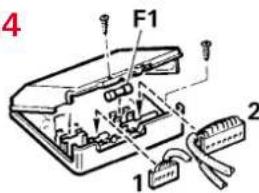
Fig. H4: The appliance fuse (F1) is located on the electronic control PCB.
Important note: The fine-wire fuse may only be replaced by a fuse of identical design: 3.15 AT (slow-acting) EN 60127-2-3.
Red indicator lamp „Failure“
Should a failure occur, the red indicator is illuminated permanently. Possible causes for the failure can be e.g. no gas, insufficient combustion air, heavily soiled rotor, defective fuse etc.. Deactivate by switching off and then switching on again.
Flash operation indicates that the operating voltage is too low or too high for the appliance (charge battery, if necessary).
In event of faults, in Germany, always contact the Truma Service Centre, Tel.: (089) 4617-142. For other countries please refer to the International Service (page 57).
Accessories
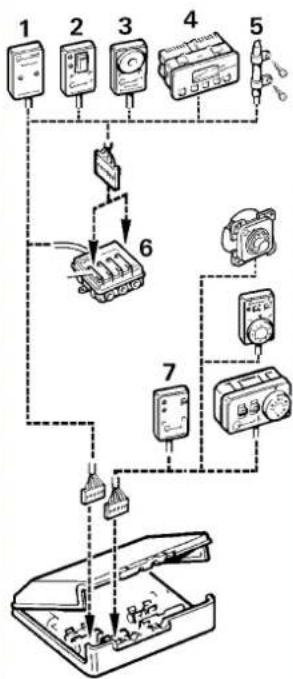
Fig. H6:
1. Control unit VG 2
- for heaters of driver's cabs in tank vehicles, for the transportation of hazardous goods according to ADR (not to be used in combination with a time switch).
2. Outside switch AS
- for switching the heater on and off from the outside of the vehicle, e.g. for cargo space heaters (available with 4 m or 10 m connecting cables).
3. Acoustic signalling
device ASM - gives an acoustic signal in event of a failure.
4. Time switch ZUE
- for pre-programming 3 switch-on times within 7 days, including 4 m connecting cable (suitable for 12 V and 24 V vehicle electrical system).
5. Remote sensor FF
- monitors the room temperature independent of the position of the control panel (available with 4 m or 10 m connecting cable).
6. Multiple connector MSD
- for connecting several accessories (e.g. time switch and remote sensor).
Extension cable for accessories - Items 1 - 6 of 4 m or 10 m (not illustrated).
7. Direct switch DIS
- for operating the heater at high setting only, without temperature control (available with 4 m or 10 m connecting cable). Replaces control panel.
Or direct fixed temperature switch DFS - for operating the heater at a fixed temperature (40°C - 70°C depending on the version). Replaces the control panel.
All electrical accessories are fitted with a connector and can be connected individually.
Important operating notes
-
In the event of the chimney having been located in the vicinity of a window (or a hatch) which can be opened, especially directly beneath it, the window or hatch must remain closed during operation (see warning plate).
-
The integrity and tight fit of the exhaust gas double duct must be checked regularly, particularly at the end of long trips. Also check the mounting of the appliance and the cowl.
-
Following a blow-back (misfire) always have the exhaust gas system checked by an expert!
-
If appliances are assembled on the outside of the vehicle, regularly check the flexible air ducts for damage. A damaged duct could lead to exhaust gas entering the vehicle.
-
Always keep the cowl for conducting exhaust gas and supplying combustion air, free from contamination (slush, leaves etc.).
-
The installed temperature limiter shuts off the gas supply if the appliance becomes too hot. Therefore do not shut the warm air outlets and the opening for the returning circulating air.
-
If the electronic control p.c.b. is defective, return it well packed. If you fail to do so, guarantee claims shall no longer be valid. Only use original p.c.b. as a spare part!
-
In Germany, according to Section 22a of StVZO, the heat exchanger of heaters built into motor vehicles must be replaced with an original part by the manufacturer or authorised workshops, ten years after the year of first registration (this date must be scribed on the name plate). The heater is then to be fitted with a plate indicating the selling date of the heat exchanger and the word „original spare part” (if exhaust ducts are conducted through rooms frequented by people, these must also be replaced by original spare parts after 10 years). The vehicle owner is the person responsible for arranging the inspection and the replacing of the parts.
-
For conducting the exhaust gas under the floor, the vehicle floor must be sealed tight. There must also be three open sides beneath the vehicle floor to ensure unhindered escape of the exhaust gas (snow, aprons etc.).
-
Always mount the cover cap for the wall cowl when the appliance is not being used. This applies in particular when washing the vehicle and for boats.
Instructions for mobile heating appliances
Truma mobile cargo-hold heating units have been approved by the professional associations. They are complete heating appliances which are simply placed in the cargo hold with the cargo as the need arises. The heaters are completely independent and require no external connections of any kind.
Approval covers only original mobile cargo-hold heaters manufactured by Truma. Reproductions by third parties have not been approved! Truma refuses to give any guarantee of safety and correct functioning in respect of a reproduction mobile cargo-hold heater.
The use of the appliance in vehicles used for the transport of hazardous goods is not permitted.
General safety notes
If the gas system is leaking or if there is a smell of gas:
- extinguish all naked flames!
- do not smoke!
- switch off the appliances!
- shut off the gas cylinder!
- open the windows!
- do not actuate any electrical switches!
- have the entire system checked by an expert!

Repairs may only be carried out by an expert!
Attention: A new O-ring must always be installed after dismantling the exhaust duct!
- Any alteration to the appliance (including exhaust duct and cowl) or the use of spare parts and accessories which are important to the function of the heater and which are not original Truma parts, as well as the non-observance of the installation and operating instructions, will lead to the cancelling of the guarantee and exclusion of liability claims. It also becomes illegal to use the appliance, and in some countries this even makes it illegal to use the vehicle.
2. The operating pressure for the gas supply is 30 mbar (or 28 mbar butane/37 mbar propane) or 50 mbar and must correspond to the operating pressure of the appliance (see name plate).
- For Germany only: Liquid gas systems for leisure vehicles must accord with the DVGW datasheet G 607 or G 608 for water sports vehicles.
For vehicles for commercial use, the relevant accident prevention regulations issued by the professional associations are to be respected (BGV D 34).
The inspection of the gas system is to be repeated every two years by am approved liquid gas specialist (DVFG, TUV, DEKRA). This is to be confirmed on the corresponding inspection certificate (G 607, G 608, or BGG 935). The keeper of the vehicle is responsible for arranging the inspection.
- In other countries: The technical and administrative regulations applicable in the particular country for the approval and tightness test of liquid gas systems are to be respected. For your own safety, it is essential that the entire gas installation, the device itself and the exhaust gas duct, must be inspected regularly by an authorised specialist (at the most every two years).
For further details on the rules and regulations in the respective country of designation, please contact our agencies abroad (refer to the International Service, page 57).
5. Do not operate the appliance when refuelling the vehicle and when in the garage.
-
During the initial operation of a brand new appliance (or after it has not been used for some time), a slight amount of fumes and smell may be noticed for a short while. This can be remedied by running the heater at maximum output and ensuring adequate room ventilation.
-
If the burner makes an unusual noise or if the flame lifts off, it is likely that the regulator is faulty and it is essential to have it checked.
-
Items sensitive to heat (e.g. spray cans) must not be stored in the installation area, since excess temperatures may under certain circumstances be incurred there.
For the gas system, only gas pressure regulators with an over-pressure security device may be used. These are, for example, gas pressure regulators for leisure vehicles in accordance with DIN 4811 or VP 306 with safety valves, and for commercial vehicles in accordance with BGV D 34, Art. 11, Para. 4 with protection against impermissibly high pressure increases. We recommend the Truma vehicle regulator, or, for the two-cylinder gas system in cylinder boxes which are only accessible from the outside, the Truma-Triomatic with automatic reserve switchover. The Truma regulators have been specially designed for heavy duty use in caravans, boats and vehicles. In addition to a safety valve they also have a pressure gauge with which you can check that the installation is gas-tight.
Always connect the pressure regulators to the gas cylinders by hand, taking great care! For temperatures around 0^ C and below, the regulators should be operated with a defroster system (Eis-Ex). Inspect regulator connection hoses regularly for signs of weakness. For winter operation only use special frost-resistant hoses. Gas cylinders must always be upright!
If the pressure regulator is exposed to weather conditions - especially on trucks - always make sure to protect the regulator using the Truma protective cover (standard accessory in truck attachment kit).
Technical data
Type of gas: Liquid gas (propane/butane)
Operating pressure: 30 or 50 mbar (refer to nameplate)
Rated thermal output E 2800 (A): 2800 W E 4000 (A): 3700 W
Gas consumption E 2800 (A): 110 / 225 g/h E 4000 (A): 150 / 310 g/h
Air flow rate E 2800 (A): 70 / 140 m³/h E 4000 (A): 120 / 190 m³/h
Current input at 12 V E 2800 (A): 0,5 / 0,8 A E 4000 (A): 1,0 / 2,3 A
Current input at 24 V E 2800 (A): 0,4 / 0,6 A E 4000 (A): 0,6 / 1,06 A
Standby: 0.01 A
Weight: approx. 10 kg
Declaration of conformity: The Trumatic E has been DVGW-tested and complies with the EC gas appliance guideline (90/396/EEC) as well as with the associated EC guidelines. The following CE Product Ident. Number is available for EU countries;
E 2800 (A): CE-0085AP0231 E 4000 (A): CE-0085AP0232
General design approval of the federal office for motor vehicles:
E 2800 (A): S/140 E 4000 (A): S/139
Installation instructions

Please fold out page with diagrams!
The installation and repair of the appliance is only to be carried out by an expert. Read the installation instructions carefully prior to starting work and observe the instructions!
Intended use
This appliance has been designed for installation in vehicles (mobile homes, caravans, boats, trucks). Other applications are also possible following consultation with Truma.
Approval
Declaration of conformity: The Trumatic E heater has been tested and approved by the DVGW and complies with the EC guideline for gas appliances (90/396/EEC) as well as the associated EC guidelines. The following CE Product Ident. No. is available for EU countries:
E 2800 (A): CE-0085AP0231 E 4000 (A): CE-0085AP0232
The heater is approved for installation in rooms frequented by people (in motor vehicles) and for operation while the vehicle is moving.
The appliance is not approved for installation inside busses.
In Germany, for inspection or testing of the vehicle according to Sections 19, 20 and 21 of StVZO, the installation is also to be inspected. For subsequent installation proceed as specified in Section 19 of StVZO.
General Design Approval of the German Federal Office for Motor Vehicles: E 2800 (A): \140 E 4000 (A): \139
Regulations
Any alteration to the appliance (including exhaust duct and cowl) or the use of spare parts and accessories which are important for the functioning of the heater and which are not original Truma parts, as well as the non-observance of the installation and operating instructions, shall lead to the cancelling of the guarantee and exclusion of liability claims. It also becomes illegal to use the appliance, and in some countries this even makes it illegal to use the vehicle.
The operating pressure for the gas supply is 30 mbar (or 28 mbar butane/37 mbar propane) or 50 mbar and must correspond to the operating pressure of the appliance (see name plate).
Take the nameplate from the operating instructions and installation instructions and adhere to the appliance at a place where it is clearly visible and protected against damage. The year of initial operation must be marked on the nameplate.
When installing the appliance always observe the technical and administrative rules and regulations of the country in which the vehicle is to be registered for the first time.
In Germany, for example, gas appliances, cylinder mounts, the laying of lines, and acceptance and tightness tests, must all accord with the DVGW datasheet G 607 for liquid gas systems in leisure vehicles, and G 608 for liquid gas systems in water sports vehicles respectively.
For vehicles used for commercial purposes, the relevant accident prevention regulations issued by the professional associations are to be respected (BGV D 34).
For further details on the rules and regulations in the respective country of designation, please contact our agencies abroad (refer to the International Service).
Exhaust gas lines and chimneys must be laid in such a way that exhaust gases cannot penetrate into the interior of the vehicle. Operationally important parts of the vehicle must not be impaired in their function. The outlet of the exhaust gas tube is to be positioned upwards, to the side, or, in the event of the exhaust gas being laid beneath the vehicle floor, to a point in the vicinity of the side or rear delimitation of the vehicle cab or of the vehicle itself.
Hot air distribution: Hot air suction apertures must be arranged in such a way that no exhaust gases from the engine or the heating device can be drawn in. It must be ensured by means of construction design that the heating air introduced into the vehicle is not polluted (e.g. by oil vapour). This is achieved, for example, with air heaters with circulating air operation, both for interior installations and for external installations. (In heaters with fresh air operation the fresh air is not to come from the engine compartment or from the vicinity of the exhaust or the exhaust outlet of the heater).
Notes on the installation in commercial vehicles
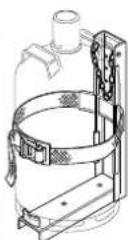
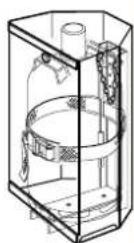
The officially tested (TÜV) cylinder bracket (Art. no. 39741-00) - refer to Fig. J1 - is part of the General Design Approval of the German Federal Office for Motor Vehicles, for the Trumatic E heaters, in compliance with Section 22a. of StVZO (Road Traffic Act). Here it is stated that 2 gas cylinders with a contents of max. 15 kg can be connected and used for operating the heaters while the vehicle is moving. For the protection of the cylinder valve and the gas pressure regulator, just the protective cover provided with the cylinder bracket is required.
For protection against theft or for reasons of appearance, the gas cylinder can also be concealed using the lockable cylinder cabinet (Art. no. 39010-21100) - refer to Fig. J2. The cabinet is bolted with the cylinder bracket to the vehicle frame.
When installing the heater in special vehicles (e.g. vehicles for transporting hazardous goods), the respective regulations for such vehicles must be observed.
Notes on installation in driver's cab
-
For appliances with exhaust ducts under the vehicle floor, the exhaust cowl must extend into the area of the side or rear wall of the cab or vehicle, in order to make sure exhaust gas does not enter the inside of the vehicle.
-
Model-related assembly instructions can be obtained from Truma.
-
In Germany, for tank vehicles carrying hazardous goods in the field of application covered by the ADR, the appliance is only approved with the Truma control unit.
Installation instructions for permanent heating appliances in cargo holds
-
It is preferable for heating appliances to be installed inside the location concerned. If there is a risk of water entering the heating appliance due to cleaning operations, install the heater types that are specially designed to be externally mounted (E 2800 A, E 4000 A).
-
If there is not enough room in the cargo hold, a heating appliance with floor cowl should be installed on the front face. If underfloor heating with wall cowl has been installed, a suitable means must be used to ensure that neither dirt nor dampness can enter the heater through the circuits for combustion products or recirculating air.
-
Installation in vehicles used for the transport of hazardous goods is not permitted.
Notes on installation in boats
For installation in boats, apply the installation instructions analogously. In this connection, also observe the following:
-
In Germany, the „Technical specifications“ of the DVGW form G 608 must be observed for sports boats, and for commercial inland shipping the „guidelines for construction, fitting, testing and operation of liquid gas systems for domestic purposes on boats, within the scope of inland shipping“ (BGR 146) must be observed. According to these guidelines the liquid gas system is only to be installed by fitters recognised by the inland shipping liability insurance association (Berufsgenossenschaft) and is only to be checked and tested by experts of this association. In other countries always observe the respectively valid regulations.
-
It is not possible to install heaters with floor cowl.
-
For further notes on installation, refer to the assembly instructions for the Trumatic E boat heater.
1 Choice of location
Always install the appliance and its exhaust duct in such a way that it is always easily accessible for service work and can be removed and installed easily.
For evenly distributed heating, the installation of the appliance should be as much in the centre of the vehicle as possible (or under the vehicle), and in such a way that the air distribution ducts can be routed with approximately the same length.
The cowl must be placed in such a way that exhaust gas cannot find its way into the vehicle interior. For this reason, choose a location where there are no opening windows, skylights or ventilation openings directly above the cowl or for 30 cm on either side. If this is not possible, a warning plate must be placed on the inside of the window (or skylight) stating that it must be kept closed while the heater is operating. In this case refrigerator ventilation ducts must be tight-sealed from the interior of vehicle.
2 Exhaust duct
Trumatic E 2800 (A) and E 4000 (A) heaters with wall or roof cowl must be installed only with Truma exhaust duct AA 3 (Art. no. 39320-00) - or Truma high-quality steel exhaust duct AEM 3 (Art. no. 39360-00) for boats - and air intake duct ZR (Art. no. 39580-00), because the appliances have only been tested and approved with these ducts.
Attention: New O-rings must installed each time the appliance has been dismantled.
Permitted duct lengths
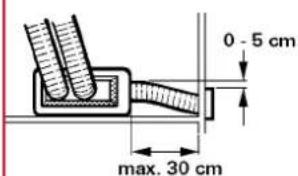
- Inside installation with wall cowl (see installation variant 1, page US 2):
- Duct lengths up to max. 30 cm can be laid horizontally or with a downward slope up to 5 cm.
- Duct lengths of up to max. 100 cm must be laid with an upward slope of at east 5 cm to the wall cowl.
- Inside installation with roof cowl (see installation variant 2, page US 2):
- Duct lengths up to max. 200 cm must be routed upwards at an angle of at least 45 degrees.
- Under floor installation with wall cowl (see installation variant 3, page US 2):
- Duct lengths of up to 30 cm can be laid horizontally or with a downward slope of up to 5 cm. Ducts must also be protected against damage from flying stones.
3 Inside installation with wall cowl set
See installation variant 1 (page US 2)
Installation of wall cowl
Fig. A2: Install the wall cowl on a surface which is as flat as possible with a wind flow from all sides. Drill hole (8) with diameter 83 mm (any hollow compartments in the vicinity of the cowl hole should be lined with wood). Seal with rubber seal supplied (10). Coat textured surfaces with a plastic coachwork sealing agent (not silicon).
Slide the clamp (4) onto the inner cowl section (11). First compress the exhaust duct (1) so that the coil windings are pressed against each other, then slide over the O-ring onto the connection fitting (2). Engage the clamp (4) and screw tight. Slide the air intake duct (5) onto the serrated connection fitting and secure with the black screw (12).
Slide the seal (10) over the air intake duct (5) onto the connection fitting (2). The wide edge must face up, and the narrow edge with the drainage opening must face down.
Insert the assembled cowl into the opening in the vehicle wall.
Place the finned insert (13) in the inner cowl section (11). Secure the cowl grating (14), cowl section (11) and seal (10) with 4 screws (15) (Check correct installation position - the word „Top" printed on the cowl section must be uppermost, and the drainage opening in the seal must be facing down). The upwardly projecting part seals the cap (16) and can be glued to the vehicle wall. Application of the adhesive is easier with the cap on.
Double cowl duct connection to the heating appliance
Fig. A1: First compress the exhaust duct (1) so that the coil windings are pressed against each other. Slide the clamp (4) over the exhaust duct (1). Slide the exhaust duct onto the connection fitting (2) over the O-ring. Engage the clamp (4) and screw tight. Secure the air intake duct (5) on the connection fitting (6) with clamp (7).
4 Inside installation with roof cowl set See installation variant 2 (page US 2).
Install roof cowl on a surface which is as straight as possible, with wind flow from all sides. From the appliance to the cowl it must be possible to have a direct duct route rising over the entire duct length (max. 2 m)!
Assembling the condensate trap
A condensate trap has to be installed between the heater and the double duct to allow condensation water and rain water to drain away.
Attention: The exhaust gas double duct must not sag - the condensate trap must be the lowest point!
Fig. A3: Fully open the clamp (4) and slide over the O-ring onto the exhaust gas connection fitting (2). Slide the exhaust coupling (17) over the O-ring onto the exhaust gas connection fitting (2) (if the condensate trap is installed on a level with the heater, the drain (18) must be facing down). Engage the clamp (4) and screw tight. Tighten the drain (18).
Assembling the roof cowl
Fig. A3: Drill a hole with diameter 83 mm (any hollow compartments in the vicinity of the cowl hole should be lined with wood). Seal with rubber seal supplied (22). Coat textured surfaces with a plastic coachwork sealing agent (not silicon).
If the roof cowl is relatively thick, first connect the exhaust gas double duct from the outside onto the cowl.
Slide the rubber seal (22) and clamp (4) onto the inner cowl section (23). First compress the exhaust duct (1) so that the coil windings are pressed against each other, then slide over the O-ring onto the connection fitting (24). Engage the clamp (4) and screw tight. Slide the air intake duct (5) onto the serrated connection fitting and secure with the black screw (25).
Fasten the cowl section (23) with 6 bolts (26). Mount cowl roof (27) and secure using 2 bolts (28).
Attention: The exhaust vents in the cowl roof must face at right-angles to the direction of travel.
Always keep the cap (29) on when the heater is not operating.
Double duct connection to the heating appliance
Fig. A3: Press end of exhaust duct (1) together so that winding touches winding. Slide clamp (4) over exhaust duct (1). Pass the exhaust duct (1) via the O-ring and fit it to the exhaust coupling (17). Engage the exhaust duct tightener (4) onto the exhaust coupling (17) and secure. Take the connection fitting (19) with the wide side over the exhaust duct and slide it firmly onto the air connection fitting (6) on the heating unit. Line up the opening in the connection fitting (19) with the drain (18). Screw in and tighten connection fitting (20).
Slide the air intake duct (5) firmly onto the connection fitting (19) and fasten with duct clamp (7).
Drill a 10 mm diameter opening in the vehicle floor for the condensate hose (21). Fasten the condensate hose onto the connection fitting (20) and pass it through the opening.
Attention: Due to the risk of frost in winter, the hose should not project more than 2 cm below the vehicle floor!
5
Under-floor assembly with wall cowl kit
Refer to installation variant Fig. 5 (Page US 2).
Install wall cowl on as flat a surface as possible on an outside wall (vehicle apron) (refer to item 3 of interior installation with wall cowl kit).
Attention: If the wall cowl is installed using mounting brackets, or such, under the floor, the vehicle floor must be sealed tight (refer to item 6 of interior installation with floor cowl).
6
Interior installation with floor cowl
Refer to installation variant Fig. 2 (Page US 2).
When using the floor cowl always observe any restrictions given in the country-specific regulations.
The appliance is only to be assembled in upright position. In vehicles designed for residential purposes or in vehicles with areas frequented by persons on a short-term basis, the vehicle floor must be sealed tight and is to have no openings to the interior, e.g. vent openings for refrigerators, unsealed pedal openings, ventilation valves, hollow double floors. The ventilation opening for the gas cylinder box is not to be in the floor, it must be routed to the side, directly above the floor, through the outer wall.
The floor cowl is not to lie within the splash range of the wheels (apply splash guard, if necessary) and it must be free-standing so as to prevent supports, axles, cross arms and such from impairing the correct operation. In addition, at least three sides beneath the vehicle floor must be open in order to ensure unhindered escape of the exhaust gas.
Assembly of the floor cowl
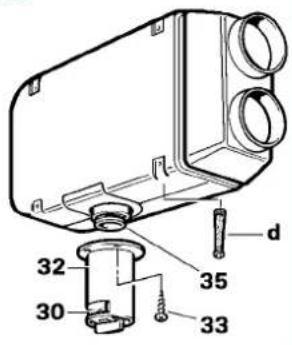
Fig. B1: The rectangular opening for the exhaust gas outlet (30) must be right-angles to the direction of travel.
Attention: No modifications must be carried out to the floor cowl!
Drill an 83 diameter opening in the vehicle floor. Coat the space between the cowl and the vehicle floor with plastic coachwork sealing agent (31) - do not use silicone! - Secure the floor cowl (32) with 4 screws (33).
7
Outside installation with floor cowl
Refer to installation variant Fig. 4 (Page US 2).
The appliance is only to be assembled with cowl connection fitting pointing vertically down. The appliance can be installed on the outside of the vehicle, on a perpendicular wall (e.g. on the cab rear wall or on the body fire wall of a truck). In articulated vehicles always pay attention to sufficient spacing between the cab rear wall and the semi-trailer (observe rotary and articulation movements).
Assembly of the floor cowl
Fig. C: Slide the cowl (32) over the O-ring onto the exhaust gas connection fitting (35) on the heating unit. The side-facing rectangular openings (30) must be at right-angles to the direction of travel. Apply four flange borings to the heater casing, drill through them with a short drill 2.5 mm in diameter and fasten the cowl with 4 screws (33)
8
Fastening the heating appliance
Inside installation with wall cowl or roof cowl
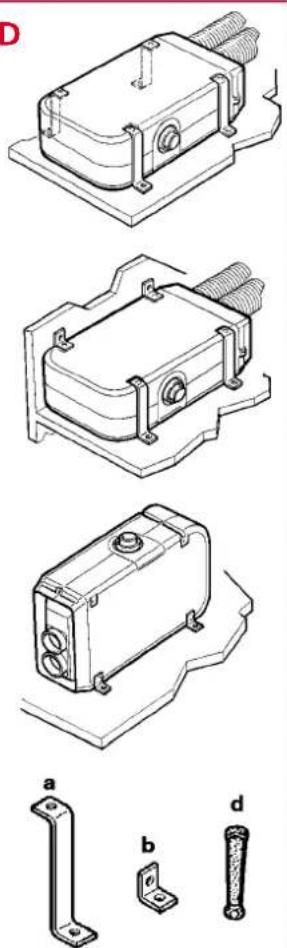
Fig. D: Depending on the installation site, bolt the heating appliance securely with the fastening straps (a) or angle pieces (b) supplied.
Inside installation with floor cowl
Where a floor cowl is used, place the appliance on the cowl opening and screw tight with 4 angle pieces (see Fig.B2).
Outside installation
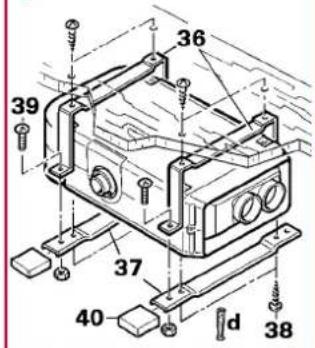
Fig. E: Assemble with the aid of the assembly mount. Fasten both mounts (36) securely and firmly to the vehicle with through bolts not less than M 5 in size. Fasten the U-beam (37) to the outside of the heater with the bolts supplied (38). Fasten the heater with 4 M 6 x 10 bolts (39) and self-locking nuts. Fasten two protective caps (40) to the outside of the vehicle.
In order to drain condensation water, drill a hole 8 mm in diameter at the lowest point in the heater casing some 20 mm from the edge. Ensure that the drill does not penetrate more than 10 mm in order to prevent damage to any internal components. Fit the rubber connection fitting supplied (it projects about 4 cm downward). (Fig. C + E:d)
9
Warm air distribution and circulating air return with interior installation
Warm air distribution
Fig. F: The hot air (W) is expelled from 2 vents, either directly or via a hot air duct VR (diameter 72 mm).
From the appliance to the first air outlet install only VR duct (72 mm diameter) with a maximum length of approx. 1.5 m. To prevent overheating, the first air outlet must be non-sealable (swivelling vent SCW 2, end support ENE). ÜR duct (65 mm diameter) can also be laid after the first air outlet. Hot air ducts whose surface temperature exceeds 80 degrees C (especially as far as the first air outlet in the case of the E 4000) must be protected from contact by cladding with a duct insulator (such as Truma I 80). Secure all duct connections with self-tapping screws. Fasten ducts with clamps.
The warm air system is designed for each type of vehicle individually, on a modular basis. There is an extensive accessories program available (refer to brochure). You can obtain sketch diagrams free of charge from the Truma Service Centre, showing optimal installation suggestions for warm air systems in all current-type caravans and mobile homes.
Circulating air return
Fig. F: The circulating air (U) is sucked directly back into the appliance.
If the heating appliance is installed in a stowage compartment or similar, make an appropriately sized opening (approx, 200 mm ^4 ) for circulating air feedback.
Attention: Do not block air ducts to heating appliance.
10
Warm air supply and circulating air return with outside assembly
Refer to installation variants 4 + 5 (Page US 2).
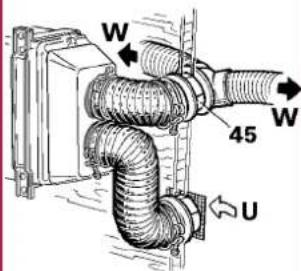
The warm air duct and recirculating air duct between the heater and the vehicle - especially in the area prone to stone damage - must be made from flexible LF air ducting or, in the protection zone, from LI air ducting (106 mm in diameter)
A protective casing over the entire heater system protects it against damage and weather conditions and simultaneously serves as insulation.
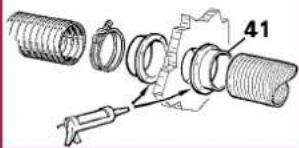
Fig. G1: Drill two openings with a diameter of 100 mm. Apply sealing agent to flange of both connector fittings (41) and bolt to the openings on the outside. Place the grid (47) in the recirculating air duct between the suction connection fitting and the vehicle wall. Thread LFS wire clamps (42) onto the air ducts (43). Slide the air ducts over the heater connection fittings (44) and the connector fittings (41) and fasten them with the LFS wire clamps (42). Seal the joints with silicon paste.
Fig. G2: Seal hollow double walls around the air duct by putting two rolled sheet metal strips (45) or lengths of pipe between 97 an 100 mm in diameter into the openings.
Fig. G3: The warm air can be extended inside the vehicle using LI air duct (diameter 106 mm). To connect the air duct, fasten another convection fitting (81) into the opening. The two connector fittings can be bolted together through the wall.
Fig.G1: If you wish the warm air to be diffused inside the vehicle, an air diffuser (82) can be fitted over the warm air duct with 4 bolts.
Attention: Do not close off or restrict the opening for the recirculating air duct!
The air diffuser (46) has 2 connections for VR duct (72 mm diameter), neither of which must be closed off. The protective metal sheet supplied (48) acts as a heat shield and must be securely fastened over the air diffuser (46). Stowage protection can be provided in the form of anoth-
er protective metal sheet (49) fastened over the opening for the recirculating air duct (Accessory: Art. no. 39010-11500).
The warm air system is designed for each type of vehicle individually, on a modular basis. There is an extensive accessories program available (refer to brochure). You can obtain sketch diagrams free of charge from the Truma Service Centre, showing optimal installation suggestions for warm air systems in all current-type caravans and mobile homes.
11 Fitting the Control panel
Attention: When using Control panels which are specific to the vehicle or manufacturer, the electrical connection must be effected in accordance with Truma interface specifications. Any modification made to the Truma components pertaining to this will lead to the cancellation of the guarantee and to the exclusion of any claims for liability. The installer (manufacturer) is responsible for providing operating instructions for the user as well as for the labelling of the Control panels.
When selecting the location, take note that the Control panels must not be subjected to any direct radiant heat. Length of the connection cable 4 m or 10 m.
If installation is only possible behind curtains or in similar locations with temperature fluctuations, a remote sensor for the ambient temperature must be used (special accessory).
Installing the flush-fitted Control panel (available from 08/2002)
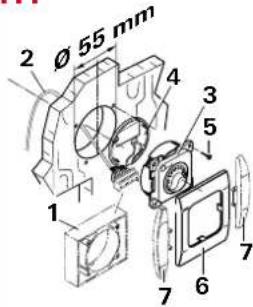
Note: If it is not possible to install the Control panel in a location flush with the surface, Truma can provide, on request, a surface-mounting frame (1) (Art. no. 40000-52600) as a special accessory.
-
Fig. H1: Drill a hole ∅ 55 mm in diameter.
-
Plug the Control panel cable (2) into the Control panel (3) and then fit the rear cover cap (4) as a stress-relieving device.
-
Push the cable through to the rear and lay it to the elec-
tronic control unit.
- Secure the Control panel with four screws (5) and fit the cover frame (6) in place.
Note: For the connection to the cover frame, Truma can provide a set of side elements (7) as a special accessory, Art. no. 34000-61200.
Installing the surface-mounted Control panel
-
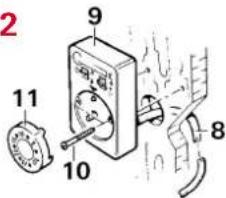
Fig. H2: Drill a hole ∅ 22 mm in diameter for feeding the cable.
-
Push the Control panel cable (8) through and lay it to the electronic control unit.
-
Secure the Control panel (9) with two screws (10) and fit the rotary button (11) in place.
Note: For installing the Control panel flush with the surface, Truma can provide a BR Control panel frame as a special accessory (Art. no. 39980-01).
Installing the special Control panel
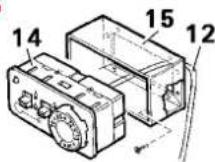
Fig. H3: For existing installation sections
-
Remove the cover screen from the installation section.
-
Plug the Control panel cable (12) into the Control panel (14), feed it to the rear through the installation section, and lay it to the Control panel.
-
Push the Control panel (14) in until the front face is flush with the surface.
Note: If there is no installation section present, the Control panel can be fitted with the flush-fitting installation frame provided.
If installation flush with the surface is not possible, Truma can provide a surface mounting frame (15) (Art. no. 39050-11600) as a special accessory.
12 Fitting the electronic control unit
- Fig. H4: Unscrew the cover of the control unit.
Attention: The plug on the electronic control unit should only be withdrawn or plugged in if the supply voltage had been disconnected beforehand. Pull the plug out straight.
- Insert the plug on the Control panel cable (1) as shown in the diagram onto the red terminal strip of the control unit.
Note: If a timer switch or a fine sensor is fitted, its plug is to be inserted on the red terminal strip. If several accessory components are being used at the same time, connection is effected via the multiple socket (Fig. H6: 6).
-
Secure the lower part with two screws at an easily accessible location, protected against moisture (must not be heated to above 65^ C).
-
Screw the cover of the control unit into place.
If the appliance is assembled on the outside of the vehicle, the electronic control unit must be installed inside the vehicle, where it is protected against moisture and damage. Drill an opening of 25 mm diameter in the floor or wall, disconnect connector (Fig. H4: 2) of 20-pin cable form the control unit and pass through the opening. Seal with cable grommet. Re-insert connector.
In special cases, the electronic control unit can be assembled on the outside of the vehicle, in a protective box, for the electronics on the outside (special equipment Art. no. 39950-00).
13 Electrical connection 12 V/24 V
Electric cables, switching units and control units for heaters must be arranged in the vehicle in such a way that their satisfactory operation cannot be adversely affected under normal operating conditions. All cables leading to the outside must be splash proof at the leadthrough opening.
Prior to working on electric components the appliance must be disconnected from the power supply. Switching off at the control panel is not sufficient!
When carrying out electric welding work on the body the appliance connection must be disconnected from the vehicle electrical system.
Attention: If the connections are transposed there is a risk of cable burning. This also rules out any guarantee or liability claims!
The red cable is positive, the blue cable is negative!
Connect the appliance to the fused vehicle electrical system (central electrical system 5 - 10 A) using the 2 x 1.5 mm ^2 cable, for lengths over 6 m use 2 x 2.5 mm ^2 cable. Negative cable to central ground. For direct connection to the battery the positive and negative cable must be fused. Connections in Faston terminals, fully insulated (motor vehicle flat connector system, 6.3 mm).
Do not connect any other consumers to the supply line!
When using power packs, please observe that the appliance is only to be operated with safety extra-low voltage in accordance with EN 60742!
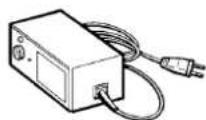
Note: When connecting several appliances we recommend using the electronically controlled Truma Power Pack NT (230/12 V, 6 A, Art. no. 39900-01, or 230/24 V, 3 A, Art. no. 39900-02 Fig. H5). The Truma power pack is also suitable for trickle charging of lead-acid batteries (not for gel batteries!) Other chargers are only to be used with a car battery acting as buffer. When calculating the power requirement always consider the starting currents. The peak performance of power packs can differ. A ripple content U_BR ≤ 1 V with load is still possible.
Tip: For saving the battery we recommend using solar collectors. Please ask for information from your dealer.
14 Gas connection
The gas supply line, diameter 8 mm, is connected to the connection fitting with olive couplings. Carefully hold in place with a second wrench when tightening!
Attention: The gas connection fitting on the appliance is not to be shortened or bent.
Prior to connecting the appliance make sure that the gas lines are free from dirt, chips and such!
Route the pipes in such a way that the appliance can be removed again for servicing.
Keep the number of parting connections in the gas supply line in rooms frequented by people to a technically feasible minimum. The gas system
must comply with the technical and administrative rules and regulations of the respective country of destination.
15
Function check
After installation, check the gas supply line for leaks according to the pressure drop method. Then check all functions of the appliance, as specified in the operating instructions. The operating instructions are to be handed to the user, together with the completed warranty card.
Take the nameplate of the operating instructions and installation instructions and adhere to a place on the appliance which is clearly visible and protected against damage. The year of initial operation must be marked on the nameplate.
16
Warning information
The installer or vehicle owner must apply the yellow sticker with the warning information, which is enclosed with the appliance, to a place in the vehicle where it is clearly visible to all users (e.g. on the wardrobe door)! Ask Truma to send you stickers, if necessary.
Trumatic E 2800, E 2800 A E 4000, E 4000 A
Manufacturer's terms of warranty
1. Case of warranty
The manufacturer grants a warranty for malfunctions in the appliance which are based on material or production faults. In addition to this, the statutory warranty claims against the seller remain valid.
A claim under warranty shall not pertain:
- for parts subject to wear and in cases of natural wear and tear,
- as a result of not original Truma parts being used in the appliance and as a result of unsuitable gas pressure regulators being used,
- as a consequence of failure to respect Truma instruc-
tions for installation and use,
- as a consequence of improper handling,
- as a consequence of improper transport packing, not arranged by Truma.
2. Scope of warranty
The warranty is valid for malfunctions as stated under item 1, which occur within 24 months after conclusion of the purchase agreement between the seller and the final consumer. The manufacturers will make good such defects by subsequent fulfilment, i.e. at their discretion either by repair or replacement. In the event of manufacturers providing service under warranty, the term of the warranty shall not recommence anew with regard to the repaired or replaced parts; rather, the old warranty period shall continue to run. More extensive claims, in particular claims for compensatory damages by purchasers or third parties, shall be excluded. This does not affect the rules of the product liability law.
The manufacturer shall bear the cost of employing the Truma customer service for the removal of a malfunction under warranty - in particular transportation costs, travelling expenses, job and material costs, as long as the service is carried out in Germany. Customer service carried out abroad is not covered by the warranty.
Additional costs based on complicated removal and installation conditions of the appliance (e.g. removal of furniture or parts of the vehicle body) do not come under warranty.
3. Raising the case of warranty
The address of the manufacturers is: Truma Gerätetechnik GmbH & Co. KG, Wernhervon-Braun Strasse 12, D-85640 Putzbrunn. In Germany, in the event of faults, in principle the Truma Service Centre at the manufacturers' address is to be notified; abroad, respective service partners are available (refer to address list). Complaints must be specified. In addition, the correctly completed warranty certificate must be presented or the Serial number of the appliance and the date of purchase specified.
In order for the manufacturers to be able to determine whether an incident subject to guarantee has occurred,
the end user must, at his own risk, bring the device to the manufacturers or send it to them. If there is damage to heaters (heat exchangers), the gas pressure regulator must also be sent back to the factory.
In instances of the device being sent to the works, dispatch is to be effected by freight transport. In cases under guarantee, the works shall bear the transport costs or the costs of delivery and return. If the damage is deemed not to be a warranty case, the manufacturer shall notify the customer and shall specify repair costs which shall not be borne by the manufacturer; in this case, the customer shall also bear the shipping costs.
F
natural_image
Exterior view of a modern glass building with 'Truma' signage, surrounded by trees and water features (no readable text beyond logo)Truma was founded in 1949. This middle-sized family concern is today Europe's leading manufacturer of gas heating systems for motor vehicles.
Truma develops, manufactures, and markets comfort equipment for caravans, mobile homes, and boats.
• Liquid gas heating systems
- Hot-air systems
• Air-conditioning systems
• Hot-water production systems
- Gas lights
- Convenience accessories for gas systems
• Manoeuvring aid for caravans
and supplementary heating systems for commercial vehicles.
The Truma Group also includes the company of ALDE, a Swedish manufacturer of hot water heating systems, and MPV-TRUMA, a firm which supplies technical medical products.
natural_image
Abstract logo design with a stylized flame and checkmark inside a circle (no text or symbols)To be filled in by the dealer. Udfyldes af forhandleren.
A remplir par le commerçant. A ser rellendada por el commerciente.
Applicable for Germany only!