ManualGo.com
PSSA 20Li A1 - Saw PARKSIDE - Free user manual and instructions
Find the device manual for free PSSA 20Li A1 PARKSIDE in PDF.



Frequently Asked Questions - PSSA 20Li A1 PARKSIDE
Download the instructions for your Saw in PDF format for free! Find your manual PSSA 20Li A1 - PARKSIDE and take your electronic device back in hand. On this page are published all the documents necessary for the use of your device. PSSA 20Li A1 by PARKSIDE.
USER MANUAL PSSA 20Li A1 PARKSIDE
Translation of the original instructions
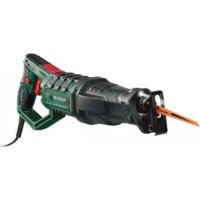
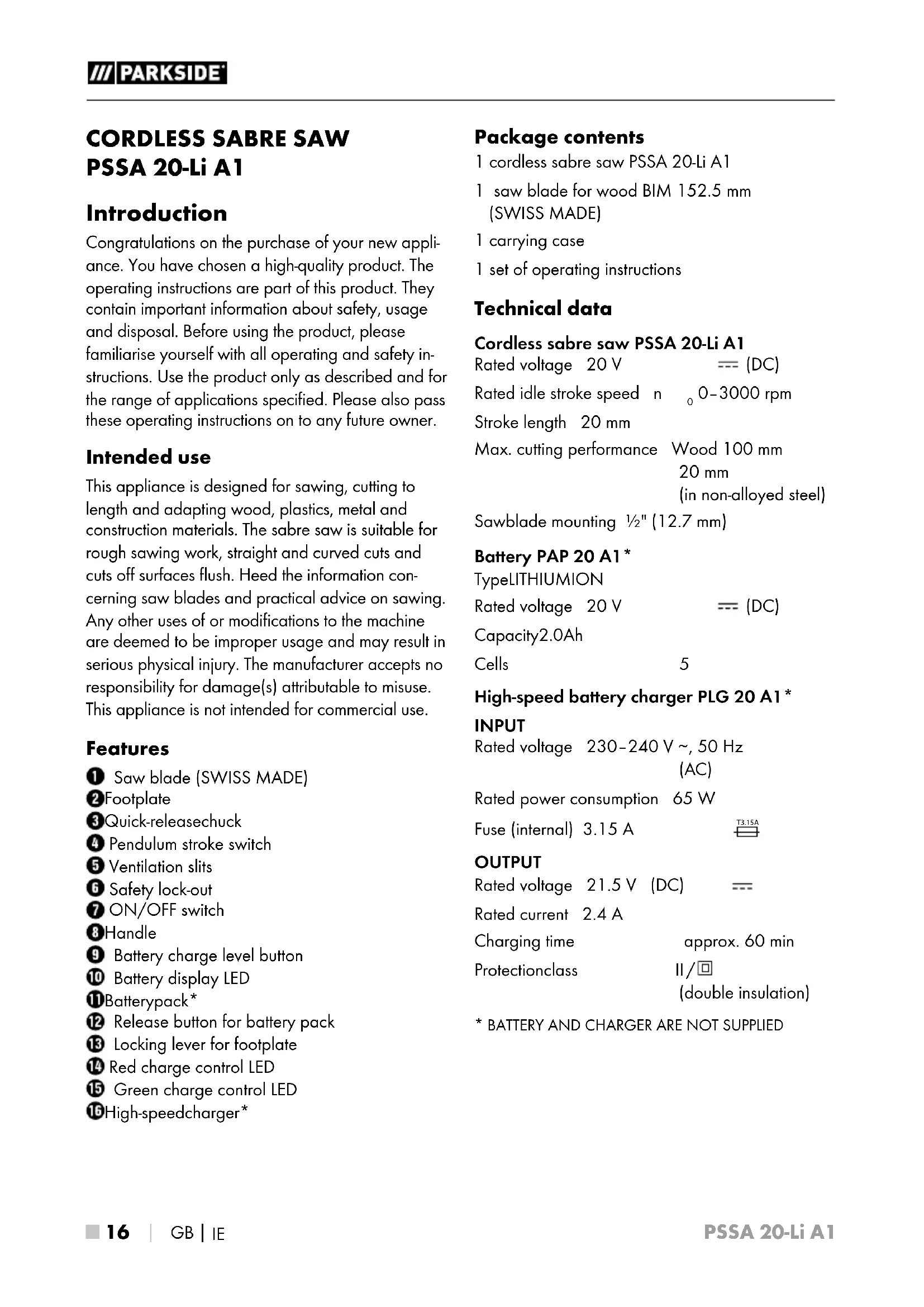
PSSA 20-Li A1 Introduction Congratulations on the purchase of your new appli- ance. You have chosen a high-quality product. The operating instructions are part of this product. They contain important information about safety, usage and disposal. Before using the product, please familiarise yourself with all operating and safety in- structions. Use the product only as described and for the range of applications specified. Please also pass these operating instructions on to any future owner. Intended use This appliance is designed for sawing, cutting to length and adapting wood, plastics, metal and construction materials. The sabre saw is suitable for rough sawing work, straight and curved cuts and cuts off surfaces flush. Heed the information con- cerning saw blades and practical advice on sawing. Any other uses of or modifications to the machine are deemed to be improper usage and may result in serious physical injury. The manufacturer accepts no responsibility for damage(s) attributable to misuse. This appliance is not intended for commercial use. Features Saw blade (SWISS MADE) Footplate Quick-release chuck Pendulum stroke switch Ventilation slits Safety lock-out ON/OFF switch Handle Battery charge level button Battery display LED Battery pack* Release button for battery pack Locking lever for footplate Red charge control LED Green charge control LED High-speed charger* Package contents 1 cordless sabre saw PSSA 20-Li A1 1 saw blade for wood BIM 152.5 mm (SWISS MADE) 1 carrying case 1 set of operating instructions Technical data Cordless sabre saw PSSA 20-Li A1 Rated voltage 20 V (DC) Rated idle stroke speed n
0–3000 rpm Stroke length 20 mm Max. cutting performance Wood 100 mm 20 mm (in non-alloyed steel) Sawblade mounting ½" (12.7 mm) Battery PAP 20 A1* Type LITHIUM ION Rated voltage 20 V (DC) Capacity 2.0 Ah Cells 5 High-speed battery charger PLG 20 A1* INPUT Rated voltage 230–240 V ∼, 50 Hz (AC) Rated power consumption 65 W Fuse (internal) 3.15 A T3.15A OUTPUT Rated voltage 21.5 V (DC) Rated current 2.4 A Charging time approx. 60 min Protection class II / (double insulation)
17 ■ Noise emission value Noise measurement value determined in accor- dance with EN 62841. The A-rated noise level of the tool is typically Sound pressure level L
= 88 dB(A) Uncertainty K = 3 dB Sound power level L
= 99 dB(A) Uncertainty K = 3 dB Wear hearing protection! Vibration values (vector total of three directions) determined in accordance with EN 62841: Total vibration value Sawing chipboard a h,B = 11.4 m/s
Sawing of timber beams a h,WB = 9.6 m/s
NOTE ► The vibration emission values and the noise emission values given in these instructions have been measured in accordance with a standardised test procedure and can be used for comparison of the power tool with another tool. ► The specified total vibration values and the noise emission values can also be used to make a provisional load estimate. WARNING! ► Depending on the manner in which the power tool is being used, and in particular the kind of workpiece that is being worked, the vibration and noise emission values can deviate from the values given in these instruc- tions during actual use of the power tool. ► Try to keep the load as low as possible. Measures to reduce the vibration load are, e.g. wearing gloves and limiting the working time. Wherein all states of operation must be included (e.g. times when the power tool is switched off and times where the power tool is switched on but running without load). General power tool safety warnings WARNING! ► Read all safety warnings, instructions, illust- rations and specifications provided with this power tool. Failure to follow all instructions listed below may result in electric shock, fire and/or serious injury. Save all warnings and instructions for future reference. The term „power tool“ in the warnings refers to your mains-operated (corded) power tool or bat- tery-operated (cordless) power tool.
a) Keep work area clean and well lit. Cluttered or dark areas invite accidents. b) Do not operate power tools in explosive atmospheres, such as in the presence of flammable liquids, gases or dust. Power tools create sparks which may ignite the dust or fumes. c) Keep children and bystanders away while operating a power tool. Distractions can cause you to lose control.
2. Electrical safety
a) Power tool plugs must match the outlet. Never modify the plug in any way. Do not use any adapter plugs with earthed (grounded) power tools. Unmodified plugs and matching outlets will reduce risk of electric shock. b) Avoid body contact with earthed or ground- ed surfaces, such as pipes, radiators, ranges and refrigerators. There is an increased risk of electric shock if your body is earthed or grounded. c) Do not expose power tools to rain or wet conditions. Water entering a power tool will increase the risk of electric shock. d) Do not abuse the cord. Never use the cord for carrying, pulling or unplugging the power tool. Keep cord away from heat, oil, sharp edges or moving parts. Damaged or entangled cords increase the risk of electric shock.PSSA 20-Li A1 ■ 18
e) When operating a power tool outdoors, use an extension cord suitable for outdoor use. Use of a cord suitable for outdoor use reduces the risk of electric shock. f) If operating a power tool in a damp location is unavoidable, use a residual current device (RCD) protected supply. Use of an RCD reduc- es the risk of electric shock.
a) Stay alert, watch what you are doing and use common sense when operating a power tool. Do not use a power tool while you are tired or under the influence of drugs, alcohol or medication. A moment of inattention while operating power tools may result in serious personal injury. b) Use personal protective equipment. Always wear eye protection. Protective equipment such as a dust mask, non-skid safety shoes, hard hat or hearing protection used for appropriate conditions will reduce personal injuries. c) Prevent unintentional starting. Ensure the switch is in the off-position before connecting to power source and/or battery pack, picking up or carrying the tool. Carrying power tools with your finger on the switch or energising power tools that have the switch on invites accidents. d) Remove any adjusting key or wrench before turning the power tool on. A wrench or a key left attached to a rotating part of the power tool may result in personal injury. e) Do not overreach. Keep proper footing and balance at all times. This enables better control of the power tool in unexpected situations. f) Dress properly. Do not wear loose clothing or jewellery. Keep your hair and clothing away from moving parts. Loose clothes, jewellery or long hair can be caught in moving parts. g) If devices are provided for the connection of dust extraction and collection facilities, ensure these are connected and properly used. Use of dust collection can reduce dust-related hazards. h) Do not let familiarity gained from frequent use of tools allow you to become complacent and ignore tool safety principles. A careless action can cause severe injury within a fraction of a second.
4. Power tool use and care
a) Do not force the power tool. Use the correct power tool for your application. The correct power tool will do the job better and safer at the rate for which it was designed. b) Do not use the power tool if the switch does not turn it on and off. Any power tool that can- not be controlled with the switch is dangerous and must be repaired. c) Disconnect the plug from the power source and/or remove the battery pack, if detacha- ble, from the power tool before making any adjustments, changing accessories, or storing power tools. Such preventive safety measures reduce the risk of starting the power tool acci- dentally. d) Store idle power tools out of the reach of children and do not allow persons unfamiliar with the power tool or these instructions to operate the power tool. Power tools are dangerous in the hands of untrained users. e) Maintain power tools and accessories. Check for misalignment or binding of moving parts, breakage of parts and any other condition that may affect the power tool’s operation. If damaged, have the power tool repaired be- fore use. Many accidents are caused by poorly maintained power tools. f) Keep cutting tools sharp and clean. Properly maintained cutting tools with sharp cutting edges are less likely to bind and are easier to control. g) Use the power tool, accessories and tool bits etc. in accordance with these instructions, tak- ing into account the working conditions and the work to be performed. Use of the power tool for operations different from those intended could result in a hazardous situation.PSSA 20-Li A1
19 ■ h) Keep handles and grasping surfaces dry, clean and free from oil and grease. Slippery handles and grasping surfaces do not allow for safe handling and control of the tool in unex- pected situations.
5. Battery tool use and care
a) Recharge only with the charger specified by the manufacturer. A charger that is suitable for one type of battery pack may create a risk of fire when used with another battery pack. b) Use power tools only with specifically desig- nated battery packs. Use of any other battery packs may create a risk of injury and fire. c) When battery pack is not in use, keep it away from other metal objects, like paper clips, coins, keys, nails, screws or other small metal objects, that can make a connection from one terminal to another. Shorting the battery terminals together may cause burns or a fire. d) Under abusive conditions, liquid may be ejec- ted from the battery; avoid contact. If contact accidentally occurs, flush with water. If liquid contacts eyes, additionally seek medical help. Liquid ejected from the battery may cause irritation or burns. e) Do not use a battery pack or tool that is damaged or modified. Damaged or modified batteries may exhibit unpredictable behaviour resulting in fire, explosion or risk of injury. f) Do not expose a battery pack or tool to fire or excessive temperature. Exposure to fire or temperature above 130 °C (265°F) may cause explosion. g) Follow all charging instructions and do not charge the battery pack or tool outside the temperature range specified in the instruc- tions. Charging improperly or at temperatures outside the specified range may damage the battery and increase the risk of fire. CAUTION! RISK OF EXPLOSION! Never charge non-rechargeable batteries! Protect the rechargeable battery from heat, for example from continuous exposure to sunlight, fire, water and moisture. There is a risk of explosion.
a) Have your power tool serviced by a qualified repair person using only identical replace- ment parts. This will ensure that the safety of the power tool is maintained. b) Never service damaged battery packs. Service of battery packs should only be performed by the manufacturer or authorized service providers. Appliance-specific safety instructions for sabre saws To avoid the risk of injury or fire as well as health risks: ■ Hold the power tool by the insulated gripping surfaces when performing work where the power tool may hit hidden pow- er lines or its own power cord. Contact with a live wire may electrify exposed metal parts of the power tool and could give the operator an electric shock. ■ Secure and secure the workpiece to a stable surface by means of clamps or otherwise. Holding the workpiece by hand or against your body will cause it to remain unsta- ble, resulting in loss of control. ■ Wear a dust mask!PSSA 20-Li A1 ■ 20
Safety guidelines for battery chargers ■ This appliance may be used by children aged 8 years and above and by persons with limited physical, sensory or mental capabilities or lack of experience and knowledge, provided that they are under super- vision or have been told how to use the appliance safely and are aware of the potential risks. Do not allow children to use the appliance as a toy. Cleaning and user maintenance tasks may not be carried out by children unless they are supervised. ■ To avoid potential risks, damaged mains cables should be replaced by the manufacturer, their customer service department or a similarly qualified person. The charger is suitable for indoor use only. WARNING! ■ If the power cord requires replacement, this should be carried out by the manufacturer or an approved representative to avoid safety hazards. CAUTION! ♦ This charger can only charge the following batteries: PAP 20 A1/PAP 20 A2/ PAP 20 A3. ♦ A current list of battery compatibility can be found at www.lidl.de/Akku. Original accessories/auxiliary equipment ■ Use only the accessories and additional equipment that are specified in the oper- ating instructions and are compatible with the appliance. Using attachments or accessory tools other than those recommended in the oper- ating instructions can lead to a risk of injury. Information on saw blades You can use any saw blade provided it is fitted with a suitable mount – ½" (12.7 mm) universal shaft. Saw blades optimised for your sabre saw are available from retail stores in different lengths for various purposes. NOTE ► TPI = teeth per inch = the number of teeth per 2.54 cm Wood saw blade: Dimensions: 152.5 x 0.9 mm, 6 - 12 TPI Ideal for: sawing construction wood, chipboard, panels and plywood, and also plunge cuts.PSSA 20-Li A1
21 ■ Before use Charging the battery pack (see fig. A) CAUTION! ► Always unplug the appliance before you remove the battery pack from or connect the battery pack to the charger. NOTE ► Never charge the battery pack if the ambient temperature is below 10°C or above 40°C. If a lithium-ion battery is to be stored for an extended period, the charge level should be checked regularly. The optimum charge level is between 50% and 80%. The storage climate should be cool and dry and the ambient tem- perature should be between 0°C and 50°C. ♦ Connect the battery pack to the high-speed battery charger (see fig. A). ♦ Insert the power plug into the socket. The control LED lights up red. ♦ The green LED indicates that the charging process is complete and the battery pack
ready. CAUTION! ♦ If the red control LED flashes, this means that the battery pack has overheated and cannot be charged. ♦ If the red and green control LEDs both flash, this means that the battery pack is defective. ♦ Push the battery pack into the appliance. ♦ Switch off the charger for at least 15 minutes between successive charging sessions. Also disconnect the power plug from the mains power socket. Attaching/disconnecting the battery pack to/from the appliance Inserting the battery pack: ♦ Allow the battery pack to click into place in the appliance. Removing the battery pack: ♦ Press the release button and remove the battery pack . Checking the battery charge level ♦ Press the battery charge level button to check the status of the battery (see also main diagram). The status will be shown on the battery display LED as follows: RED/ORANGE/GREEN = maximum charge RED/ORANGE = medium charge RED = low charge – charge the battery Fitting/changing the saw blade WARNING! ► Remove the battery before carrying out any work on the power tool (e.g. mainte- nance, changing tools, etc.) as well as during the transport and storage of the power tool. Unintentional activation of the ON/OFF switch can result in injury. ♦ Turn the quick-release chuck as far as the stop and hold it in this position. ♦ Push the required saw blade into the quick-release chuck as far as the stop. CAUTION! ► The teeth of the saw blade must point downwards!PSSA 20-Li A1 ■ 22
♦ Let go of the quick-release chuck so that it returns to its initial position. The saw blade is now locked. Adjusting the footplate RISK OF INJURY! ► Always switch the appliance off and remove the battery before carrying out any work on the appliance. ♦ Adjust the footplate according to the cutting depth. ♦ To do so, undo the locking lever and move the footplate to the corresponding position. ♦ Lock this position by closing the locking lever
Adjusting the pendulum stroke ♦ You can use the pendulum stroke switch to adjust the pendular movement of the saw blade . You can achieve fine, clean-cut edges without pendulum movement (setting "0"). Deactivate pendulum movement when working on thin workpieces. You can achieve an increas- ingly fast work rate if the pendulum stroke is activated (setting "I"). Use Switching on and off Switching on: ♦ First press the safety lock-out and then the ON/OFF switch . Afterwards, release the safety lock-out . Switching off: ♦ Release the ON/OFF switch
Adjusting the rotational speed Press the ON/OFF switch lightly for a low speed. Increasing the pressure increases the speed. NOTE ► The integrated motor brake ensures rapid stoppage. Guiding the sabre blade safely To adapt to the workpiece and for safe placement, the footplate can be swivelled. It must always be in contact with the workpiece when the appliance is running. Practical advice on sawing ♦ Check the material to be worked to make sure that all foreign objects have been removed, e.g. nails, screws, etc. ♦ Ensure that the ventilation slits are not covered. ♦ Switch the appliance on before moving it towards the material to be worked. ♦ Switch the appliance off immediately if the saw blade jams. Open up the sawn gap using a suitable tool and pull out the sabre saw. ■ Use the appropriate saw blade and stroke rate for the material to be worked. ■ Saw blades optimised for your sabre saw are available from retail stores in different lengths for various purposes. ■ Saw the material at a constant speed.PSSA 20-Li A1
23 ■ Sawing flush to edges: Using flexible saw blades with a suitable cor- responding length, you can saw off protruding workpieces such as pipes flush to the wall. Proceed as follows:
1. Place the saw blade
directly against the wall.
2. Bend it by applying lateral pressure to the sabre
saw so that the footplate makes contact with the wall.
3. Switch the appliance on as described and
saw off the work piece by applying constant pressure. Plunge sawing: CAUTION! RISK OF KICKBACK! ■ Plunge cuts may only be made in soft materials (wood or similar). Proceed as follows:
1. Place the sabre saw with the lower edge of the
footplate onto the workpiece. Switch the appliance on.
2. Tilt the sabre saw forwards and plunge the saw
blade into the workpiece.
3. Position the sabre saw vertically and continue
sawing along the cutting line. Maintenance and cleaning WARNING! RISK OF INJURY! Always switch the appliance off and remove the battery before carrying out any work on the appliance. ■ The appliance must always be kept clean, dry and free from oil or grease. ■ Use a soft, dry cloth to clean the housing. ■ Replace the saw blade as soon as its teeth are blunt and proper sawing is therefore no longer possible. ■ Keep the appliance and ventilation slits clean at all times. If the ventilation slits are blocked, there is a risk of overheating and/or the appliance being damaged. ■ Always clean the appliance after completion of work. ■ Never permit liquids to enter inside the appli- ance. Use a cloth to clean the housing. Never use petrol, solvents or cleansers which can damage plastic. ■ If necessary, clean the saw blade mount with a brush or compressed air. ■ If a lithium-ion battery is to be stored for an extended period, the charge level should be checked regularly. The optimum charge level is between 50% and 80%. The optimum storage environment is cool and dry. WARNING! ► Do not use any accessories not recommend- ed by PARKSIDE. This can lead to electric shock and fire.PSSA 20-Li A1 ■ 24
Kompernass Handels GmbH warranty Dear Customer, This appliance has a 3-year warranty valid from the date of purchase. If this product has any faults, you, the buyer, have certain statutory rights. Your statutory rights are not restricted in any way by the warranty described below. Warranty conditions The warranty period starts on the date of purchase. Please keep your receipt in a safe place. This will be required as proof of purchase. If any material or manufacturing fault occurs within three years of the date of purchase of the product, we will either repair or replace the product for you or refund the purchase price (at our discretion). This warranty service requires that you present the defective appliance and the proof of purchase (re- ceipt) within the three-year warranty period, along with a brief written description of the fault and of when it occurred. If the defect is covered by the warranty, your prod- uct will either be repaired or replaced by us. The repair or replacement of a product does not signify the beginning of a new warranty period. Warranty period and statutory claims for defects The warranty period is not prolonged by repairs effected under the warranty. This also applies to replaced and repaired components. Any damage and defects present at the time of purchase must be reported immediately after unpacking. Repairs carried out after expiry of the warranty period shall be subject to a fee. Scope of the warranty This appliance has been manufactured in accord- ance with strict quality guidelines and inspected meticulously prior to delivery. The warranty covers material faults or production faults. The warranty does not extend to product parts subject to normal wear and tear or to fragile parts which could be considered as consumable parts such as switches, batteries or parts made of glass. The warranty does not apply if the product has been damaged, improperly used or improper- ly maintained. The directions in the operating instructions for the product regarding proper use of the product are to be strictly followed. Uses and actions that are discouraged in the operating instructions or which are warned against must be avoided. This product is intended solely for private use and not for commercial purposes. The warranty shall be deemed void in cases of misuse or improper handling, use of force and modifications / repairs which have not been carried out by one of our authorised Service centres. The warranty period does not apply to ■ Normal reduction of the battery capacity overtime ■ Commercial use of the product ■ Damage to or alteration of the product by the customer ■ Non-compliance with safety and maintenance instructions, operating errors ■ Damage caused by natural hazardsPSSA 20-Li A1
25 ■ Warranty claim procedure To ensure quick processing of your case, please observe the following instructions: ■ Please have the till receipt and the item number (e.g.IAN12345) available as proof of purchase. ■ You will find the item number on the type plate on the product, an engraving on the product, on the front page of the operating instructions (below left) or on the sticker on the rear or bottom of the product. ■ If functional or other defects occur, please contact the service department listed either by telephone or by e-mail. ■ You can return a defective product to us free of charge to the service address that will be pro- vided to you. Ensure that you enclose the proof of purchase (till receipt) and information about what the defect is and when it occurred. You can download these instructions along with many other manuals, product videos and installation software at www.lidl-service.com. This QR code will take you directly to the Lidl service page (www.lidl-service.com) where you can open your operating instructions by entering the item number (IAN) 123456. Service WARNING! ► Have the power tool repaired by the service centre or a qualified electrician and only using genuine replacement parts. This will ensure that the safety of the appliance is maintained. ► If the mains cable is damaged, it must be replaced with a special cable that is avail- able from the manufacturer or its customer service. NOTE ► Replacement parts not listed (such as carbon brushes, switch) can be ordered via our service hotline. Service Great Britain Tel.: 0800 404 7657 E-Mail: kompernass@lidl.co.uk Service Ireland Tel.: 1890 930 034 (0,08 EUR/Min., (peak)) (0,06 EUR/Min., (off peak)) E-Mail: kompernass@lidl.ie IAN 331791_1907 Importer Please note that the following address is not the service address. Please use the service address provided in the operating instructions.
Disposal The packaging is made from environmentally-friendly material and can be disposed of at your local recycling plant. Do not dispose of power tools in your normal domestic waste! European Directive 2012/19/EU requires that worn-out power tools be collected separately and recycled in an environmentally compatible manner. Do not dispose of batteries in your normal household waste! Defective or worn-out rechargeable batteries must be recycled according to Directive 2006/66/EC. Take the battery pack and/or appliance to a nearby collec- tion facility. Please consult your local authorities regarding suitable disposal of worn out power tools/battery packs. Note the labelling on the packaging and separate the packaging material components for disposal if necessary. The packaging material is labelled with abbreviations (a) and numbers (b) with the following meanings: 1–7: Plastics, 20–22: Paper and cardboard, 80–98: Composites. Your local community or municipal authorities can provide information on how to dispose of the worn-out product. The product is recyclable, subject to extended producer responsibility and is collected separately.PSSA 20-Li A1
27 ■ Translation of the original Conformity Declaration We, KOMPERNASS HANDELS GMBH, document officer: Mr. Semi Uguzlu, BURGSTR. 21, 44867 BOCHUM, GERMANY, hereby declare that this product complies with the following standards, normative documents and EC directives: Machinery Directive (2006/42/EC) EC Low Voltage Directive (2014/35 / EU, charger only) EMC (Electromagnetic Compatibility) (2014/30/EU) RoHS Directive (2011/65/EU)*
- The manufacturer bears the full responsibility for compliance with this conformity declaration. The object of the dec- laration described above complies with the requirements of the Directive 2011/65/EU of the European Parliament and Council of 8 June 2011 on the limitations of use of certain dangerous substances in electrical and electronic appliances. Applied harmonised standards: EN 62841-1:2015 EN 62841-2-11:2016 EN 62233:2008 EN 60335-1:2012/A13:2017 EN 60335-2-29:2004/A2:2010 EN 55014-1:2017 EN 55014-2:2015 EN 61000-3-2:2014 EN 61000-3-3:2013 EN 50581:2012 Type designation of machine: Cordless sabre saw PSSA 20-Li A1 Year of manufacture: 11 - 2019 Serial number: IAN 331791_1907 Bochum, 20/11/2019 Semi Uguzlu - Quality Manager - We reserve the right to make technical changes in the context of further product development.PSSA 20-Li A1 ■ 28
Ordering a replacement battery If you want to order a replacement battery for your appliance, you can do so easily via the Internet on www.kompernass.com or by telephone. NOTE ► Online ordering of replacement parts might not be possible in some countries. In this is the case, please contact the Service hotline. Telephone ordering Service Great Britain Tel.: 0800 404 7657 E-Mail: kompernass@lidl.co.uk Service Ireland Tel.: 1890 930 034 (0,08 EUR/Min., (peak)) (0,06 EUR/Min., (off peak)) E-Mail: kompernass@lidl.ie To ensure fast processing of your order, have the article number of your appliance to hand (e.g. IAN 331791) in case of questions. The article number can be found on the type plate or the title page of these instructions.PSSA 20-Li A1