ManualGo.com
GCPC 1335 I TC - Saw EINHELL - Free user manual and instructions
Find the device manual for free GCPC 1335 I TC EINHELL in PDF.



Download the instructions for your Saw in PDF format for free! Find your manual GCPC 1335 I TC - EINHELL and take your electronic device back in hand. On this page are published all the documents necessary for the use of your device. GCPC 1335 I TC by EINHELL.
USER MANUAL GCPC 1335 I TC EINHELL
1. Safety regulations
2. Layout and items supplied
5. Before starting the equipment
7. Cleaning, maintenance, storage and ordering of spare parts
8. Disposal and recycling
Danger! When using the equipment, a few safety pre- cautions must be observed to avoid injuries and damage. Please read the complete operating instructions and safety regulations with due care. Keep this manual in a safe place, so that the in- formation is available at all times. If you give the equipment to any other person, hand over these operating instructions and safety regulations as well. We cannot accept any liability for damage or accidents which arise due to a failure to follow these instructions and the safety instructions.
1. Safety regulations
The corresponding safety information can be found in the enclosed booklet. Danger! Read all safety regulations and instructions. Any errors made in following the safety regula- tions and instructions may result in an electric shock, fi re and/or serious injury. Keep all safety regulations and instructions in a safe place for future use.
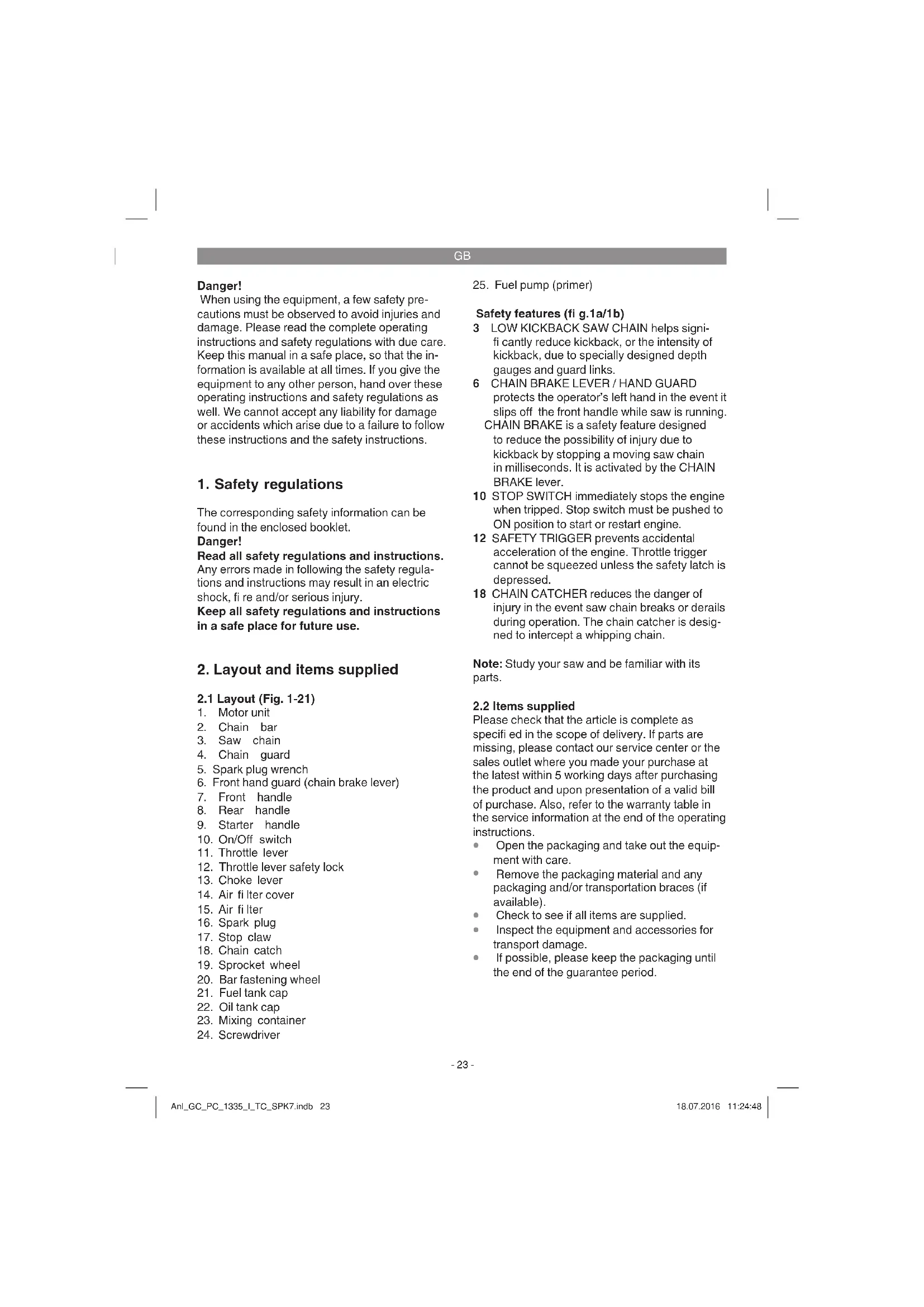
2. Layout and items supplied
5. Spark plug wrench
12. Throttle lever safety lock
14. Air fi lter cover
Safety features (fi g.1a/1b) 3 LOW KICKBACK SAW CHAIN helps signi- fi cantly reduce kickback, or the intensity of kickback, due to specially designed depth gauges and guard links.
6 CHAIN BRAKE LEVER / HAND GUARD
protects the operator’s left hand in the event it slips off the front handle while saw is running. CHAIN BRAKE is a safety feature designed to reduce the possibility of injury due to kickback by stopping a moving saw chain in milliseconds. It is activated by the CHAIN BRAKE lever. 10 STOP SWITCH immediately stops the engine when tripped. Stop switch must be pushed to ON position to start or restart engine. 12 SAFETY TRIGGER prevents accidental acceleration of the engine. Throttle trigger cannot be squeezed unless the safety latch is depressed. 18 CHAIN CATCHER reduces the danger of injury in the event saw chain breaks or derails during operation. The chain catcher is desig- ned to intercept a whipping chain. Note: Study your saw and be familiar with its parts.
Please check that the article is complete as specifi ed in the scope of delivery. If parts are missing, please contact our service center or the sales outlet where you made your purchase at the latest within 5 working days after purchasing the product and upon presentation of a valid bill of purchase. Also, refer to the warranty table in the service information at the end of the operating instructions.
Open the packaging and take out the equip- ment with care.
Remove the packaging material and any packaging and/or transportation braces (if available).
Check to see if all items are supplied.
Inspect the equipment and accessories for transport damage.
Danger! The equipment and packaging material are not toys. Do not let children play with plastic bags, foils or small parts. There is a danger of swallowing or suff ocating!
Original operating instructions
The chain is designed exclusively for sawing wood. You may only fell trees if you have received the appropriate training. The manufacturer cannot be held liable for damage caused by improper or incorrect usage. The equipment is to be used only for its prescri- bed purpose. Any other use is deemed to be a case of misuse. The user / operator and not the manufacturer will be liable for any damage or inju- ries of any kind caused as a result of this. Please note that our equipment has not been de- signed for use in commercial, trade or industrial applications. Our warranty will be voided if the machine is used in commercial, trade or industrial businesses or for equivalent purposes. Caution! Residual risks Even if you use the equipment in accordance with the instructions, certain residual risks cannot be eliminated. The following hazards may arise in connection with the equipment‘s construction and layout:
1. Injuries through cutting in case of contact with
the unguarded or rotating saw chain.
2. Injuries through cutting in case of kickback or
other accidental movements of the guide rail.
3. Injuries due to parts of the saw chain being
4. Injuries due to parts of the cut material being
5. Damage to hearing if the compulsory hearing
protection is not used.
6. Breathing problems due to the inhaling of
harmful fumes and skin injuries due to con- tact with pertol.
Maximum speed with cutting equipment ............................11,000 min
Only use appliances which are in perfect wor- king order.
Service and clean the appliance regularly.
Adapt your working style to suit the appliance.
Do not overload the appliance.
Have the appliance serviced whenever ne- cessary.
Switch the appliance off when it is not in use.
5. Before starting the equipment
Danger: Do not start the engine until the saw is
fully assembled. Caution: Wear protective gloves at all times when handling the chain.
5.1 Fit the chain bar
To ensure that the bar and the chain are supplied with oil, USE ONLY THE ORIGINAL BAR. The oi- ling hole (Fig. 2/Item A) must be kept clear of dirt and any build-up of residue.
1. Make sure the Chain brake lever is pulled
back into the DISENGAGED position (Fig. 3A)
3. Turn the chain tensioning wheel (19) IN
COUNTER-CLOCKWISE DIRECTION until the HINGE (E) (projecting tip) is at the end of its sliding path in the direction of the coupling roller and gear wheel (Fig. 3B/3C).
4. Fit the open end of the chain bar over the bar
pins (F). Align the bar such that the HINGE fi ts into the hole (G) in the chain bar (Fig. 3C/3D).
5.2 To install saw chain
1. Spread chain out in a loop with cutting edges
(A) pointing CLOCKWISE around loop (Fig. 4A).
2. Slip the chain around the sprocket (B) behind
the clutch (C). Make sure the links fi t between the sprocket teeth (Fig. 4B).
3. Guide the drive links into the groove (D) and
around the end of the bar (Fig. 4B). NOTE: The saw chain may droop slightly on the lower part of bar. This is normal.
4. Pull the chain bar forward until the chain is
closely seated. Make sure that all the drive links are in the groove of the bar.
5. Attach the coupling cover (Fig. 5) and turn
the bar fastening wheel (20) clockwise to secure it. The chain is not allowed to slip off the guide bar when you do this. Tighten the bar fastening wheel by hand and then follow the instructions for adjusting the chain tension as described in the section ADJUSTING THE CHAIN TENSION. 5.3. Adjusting the chain tension The correct tension of the saw chain is extremely important and must be checked before starting and during all sawing work. If you take time to adjust the saw chain correctly, you will be able to make better cuts and the life of the chain will be prolonged. Caution: Wear high-strength gloves at all times when handling or adjusting the saw chain.
1. Hold the tip of the chain bar upwards and turn
the chain tensioning wheel (19) IN CLOCK- WISE DIRECTION in order to increase the chain tension (Fig. 5). If you turn the chain tensioning wheel IN COUNTER-CLOCKWI- SE DIRECTION, the chain tension will be re- duced. Check that the chain is seated around the entire chain bar (Fig. 6).
2. After making the adjustment and with the tip
of the bar still upwards, tighten the bar faste- ning wheel (20). The chain is correctly tension when it is closely seated and can be pulled right around by hand. Note: If the chain is hard to turn around the chain bar or blocked, it is too tightly tensioned. Make the following small adjustments:
1. Undo the bar fastening wheel (20) by 1/2 re-
volution. Slacken the chain tension by slowly turning the chain tensioning wheel (19) IN COUNTER-CLOCKWISE DIRECTION. Pull the chain back and forth on the bar. Do this until the chain can be moved smoothly but is still closely seated. Increase the tension by turning the chain tensioning wheel IN CLOCKWISE DIRECTION.
2. When the saw chain is correctly tensioned,
hold the tip of the bar upwards and tighten the bar fastening wheel (20). Note: A new saw chain stretches, requiring ad- justment after as few as 5 cuts. This is normal with a new chain, and the interval between future adjustments will lengthen quickly. Note: If the saw chain is TOO LOOSE or TOO TAUT, the drive wheel, chain bar, chain and crank shaft bearing will suff er premature wear. Fig. 6 shows the correct tension A (when cold) and ten- sion B (when warm). Fig. C shows a chain that is too loose. Anl_GC_PC_1335_I_TC_SPK7.indb 25Anl_GC_PC_1335_I_TC_SPK7.indb 25 18.07.2016 11:24:4818.07.2016 11:24:48GB
5.4 Fuel and lubrication
Fuel Use regular grade unleaded gasoline mixed with 1:40 custom 2-cycle engine oil for best results. Mixing fuel Mix fuel with 2 cycle oil in an approved container. Shake container to ensure thorough mix. Note: Never use straight gasoline in your unit. This will cause permanent engine damage and void the manufacturer’s warranty for that product. Never use a fuel mixture that has been stored for over 90 days. Note: If 2-cycle lubricant is to be used, it must be a premium grade oil for 2-cycle air cooled engi- nes mixed at a 1:40 ratio. Do not use any 2-cycle oil product with a recommended mixing ratio of 1:100. If insuffi cient lubrication is the cause of en- gine damage, it voids the manufacturer’s engine warranty for that occurrence. Recommended fuels Some conventional gasolines are being blended with oxygenates such as alcohol or an ether com- pound to meet clean air standards. Your engine is designed to operate satisfactorily on any gasoline intended for automotive use including oxygenated gasolines. It is recommended to use unleaded petrol as fuel. Lubrication of chain and chain bar Whenever you refi ll the fuel tank with petrol you must also top up the level of chain oil in the chain oil tank. It is recommended to use standard chain oil. Engine oil and gasoline I Saw chain Mixture 1:40 I Oil Only Engine pre-start checks
Danger: Never start or operate the saw unless
the bar and chain are properly installed.
1. Fill the fuel tank (21) with correct fuel mixture
2. Fill the oil tank (22) with chain oil (Fig. 4).
Once you have fi lled the chain and oil tank, tigh- ten the tank cover securely by hand. Do not use any tools to do so.
Before you use the saw, check it for damage. If you discover any damage, do not use it. The chainsaw may be started only when the chain brake is engaged. The chain brake is engaged when the brake lever (6) is pushed forward. Explanation of how it works: refer to Che- cking the chain brake - Static check.
The chainsaw is fi tted with a chain brake which reduces the risk of injury caused by the danger of kickback. The brake is engaged when pressure is applied to the hand guard (6), e.g. when the hand of the person operating the chainsaw strikes the hand guard (6) if kickback occurs. When the bra- ke is engaged, the chain (3) stops abruptly.
Warning: The chain brake is intended to reduce
the risk of injury due to kickback; however, it is un- able to provide adequate protection if the saw is used carelessly. You must check the operation of the chain brake on a regular basis. Test the chain brake before the fi rst cut, after several cuts, after maintenance is done on the chainsaw and if the chainsaw has been subjected to strong impact or if it has been dropped.
6.1.1 Checking the chain brake (Fig. 5A/5B/6)
Static check (engine switched off ) Chain brake disengaged (chain (3) is free to move)
1. Pull the front hand guard (6) towards the front
handle (7). The front hand guard (6) must make an audible click when it snaps into place. (Fig. 5A)
2. It must be possible to move the chain (3) on
the guide rail (2). Chain brake engaged (chain (3) is blocked)
1. Push the front hand guard (6) towards the
2. It must not be possible to move the chain (3)
on the guide rail (2). Note: The front hand guard (6) must snap into place in both positions. If you feel strong resis- tance or if the front hand guard (6) does not snap into place, do not use the chainsaw. Take your chainsaw to an authorized service center for repair. Dynamic check (engine is started)
1. Place the saw on a fi rm and level surface.
2. Hold the front handle (7) with your left hand.
3. Start the chain saw by following the starting
instructions. (refer to 6.2 and 6.3)
4. Disengage the chain brake (pull the front
hand guard (6) towards the front handle (7)). (Fig. 5A)
5. Grasp the rear handle (8) with your right
6. After a brief warmup period, run the engine
at full speed. With the back of your left hand, push the front hand guard (6) towards the gui- de rail (2). This will engage the chain brake. (Fig. 6)
Danger: Engage the chain brake slowly and ca-
refully. Hold the saw fi rmly with both hands, and make sure you have a good grip. The saw must not touch any objects.
7. The chain (3) must stop abruptly. Immediately
release the throttle lever (11) when the chain (3) has come to a stop.
Danger: If the chain (3) does not stop, shut off
the engine and take the saw to an authorized ser- vice center for repair.
6.1.2 Checking the clutch
Carry out a functional check on the clutch on a re- gular basis. Test the clutch before the fi rst cut, af- ter several cuts, after maintenance is done on the chainsaw and if the chainsaw has been subjected to strong impact or if it has been dropped.
1. Start the chain saw by following the starting
instructions. (refer to 6.2 and 6.3)
2. Briefl y actuate the throttle lever (11) and re-
lease it to ensure that the throttle valve has been released and the engine is idling.
3. The chain (3) must stop when the engine is
idling. The clutch has been designed so that when the idling speed is increased by a factor of 1.25 no chain movement can be detected.
Danger: If the chain (3) does not stop, shut off
the engine and take the saw to an authorized ser- vice center for repair.
Danger: Always engage the chain brake (6) befo-
re you start the engine.
6.2 Starting a cold engine (Fig. 7A-7D)
Fill the tank with an adequate amount of gasoline/ oil mix. (refer to Paragraph 5.3)
1. Set the equipment down on a hard, level sur-
Note: Pulling out the choke lever I I (13) opens the throttle valve slightly and locks it in that posi- tion. This increases the idle speed, and the saw starts faster.
5. Hold the saw fi rmly and pull out the starter
handle (9) until you feel it start to resist. Then sharply pull the starter handle (9) 3 times. (Fig. 7C/7D)
6. Push in the choke lever (13).
7. Hold the saw fi rmly and pull out the starter
handle (9) until you feel it start to resist. Then quickly pull the starter handle (9) several times until the engine starts. (Fig. 7D) Note: Do not allow the starter handle (9) to snap back. This may result in damage. Once the engi- ne has started, allow the saw to warm up for 10 seconds.
Warning: Since the throttle lever is slightly open,
the cutter starts to operate when the engine is started. Briefl y actuate the throttle lever (11). This releases the throttle valve and the engine returns to idle mode. (Fig. 7C)
8. If the engine does not start up after the starter
handle is pulled 8 times, repeat steps 1-7. Please note: If the engine does not start up even after several attempts, read the Engine trouble- shooting section. Please note: Always pull the starter handle out straight. If it is pulled out at an angle, friction will occur on the eyelet. As a result of this friction, the cable will become frayed and will wear faster. Al- ways hold onto the starter handle when the cable Anl_GC_PC_1335_I_TC_SPK7.indb 27Anl_GC_PC_1335_I_TC_SPK7.indb 27 18.07.2016 11:24:4818.07.2016 11:24:48GB
retracts. Never allow the starter handle to snap back when it has been pulled out.
6.3 Starting a warm engine (Fig. 7A-7D)
(The chainsaw has been idle for less than 15-20 min.)
1. Set the equipment down on a hard, level sur-
3. Hold the saw fi rmly and pull out the starter
handle (9) until you feel it start to resist. Then quickly pull the starter handle (9) several times until the engine starts. The equipment should start after 1-2 tugs. If the saw does not start after 6 pulls, repeat steps 1 - 7 of Para- graph 6.2. (Fig. 7D)
1. Release trigger and allow engine to return to
2. Move STOP switch down to stop engine.
Note: To stop the engine in an emergency, activa- te the chain brake and switch the ON/OFF switch to “Stop (0)”.
6.5 General cutting instructions
Danger: Felling trees is prohibited without the
necessary training! Felling
Felling is the term for cutting down a tree. Small trees up to 6-7 inches (15-18cm) in diameter are usually cut in a single cut. Larger trees require notch cuts. Notch cuts determi- ne the direction the tree will fall.
A retreat path (A) should be planned and cleared as necessary before cuts are started. The retreat path should extend back and dia- gonally to the rear of the expected line of fall, as illustrated in Fig. 8.
If felling a tree on sloping ground, the chain saw operator should keep on the uphill side of the terrain, as the tree is likely to roll or slide downhill after it is felled.
Direction of fall (B) is controlled by the not- ching cut. Before any cuts are made, consider the location of larger branches and natural lean of the tree to determine the way the tree will fall (Fig. 8).
Do not cut down a tree during high or chan- ging winds or if there is a danger to property. Consult a tree professional. Do not cut down a tree if there is a danger of striking utility wi- res; notify the utility company before making any cuts. General guidelines for felling trees (Fig. 9) Normally felling consists of 2 main cutting opera- tions, notching (C) and making the felling cut (D).
Start making the upper notch cut (C) on the side of the tree facing the felling direction (E). Be sure you don t make the lower cut too deep into the trunk. The notch (C) should be deep enough to create a hinge (F) of suffici- ent width and strength. The notch should be wide enough to direct the fall of the tree for as long as possible.
Never walk in front of a tree that has been notched. Make the felling cut (D) from the other side of the tree and 1.5 - 2.0 inches (3-5 cm) above the edge of the notch (C). Never saw completely through the trunk. Always leave a hinge. The hinge guides (F) the tree. If the trunk is completely cut through, control over the felling direction is lost. In- sert a wedge or felling lever in the cut well before the tree becomes unstable and starts to move. This will prevent the guidebar from binding in the felling cut if you have misjudged the falling direction. Make sure no bystanders have entered the range of the falling tree be- fore you push it over.
Before making the final cut, always recheck the area for bystanders, animals or obstac- les. Felling cut
Use wooden or plastic wedges (A) to pre- vent binding the bar or chain (B) in the cut. Wedges also control felling (Fig. 10).
When diameter of wood being cut is greater than the bar length, make 2 cuts as shown (Fig. 11).
As the felling cut gets close to the hinge, the tree should begin to fall. When tree begins to fall, remove saw from cut, stop engine, put chain saw down, and leave area along retreat path (Fig. 8). Limbing
Limbing a tree is the process of removing the branches from a fallen tree. Do not remove supporting limbs (A) until after the log is bucked (cut) into lengths (Fig. 12). Branches under tension should be cut from the bottom up to avoid binding the chain saw.
Bucking is cutting a fallen log into lengths. Make sure you have a good footing and stand uphill of the log when cutting on sloping ground. If possible, the log should be suppor- ted so that the end to be cut off is not resting on the ground. If the log is supported at both ends and you must cut in the middle, make a downward cut halfway through the log and then make the undercut. This will prevent the log from pinching the bar and chain. Be care- ful that the chain does not cut into the ground when bucking as this causes rapid dulling of the chain. When bucking on a slope, always stand on the uphill side.
1. Log supported along entire length: Cut from
top (overbuck), being careful to avoid cutting into the ground (Fig. 13A).
2. Log supported on 1 end: First, cut from
bottom (underbuck) 1/3 diameter of log to avoid splintering. Second, cut from above (overbuck) to meet fi rst cut and avoid pinching (Fig. 13B).
3. Log supported on both ends: First, overbuck
1/3 diameter of log to avoid splintering. Second, underbuck to meet fi rst cut and avoid pinching (Fig. 13C).
The best way to hold a log while bucking is to use a sawhorse. When this is not possible, the log should be raised and supported by the limb stumps or by using supporting logs. Be sure the log being cut is securely supported. Bucking using a sawhorse (Fig. 14) For personal safety and ease of cutting, the cor- rect position for vertical bucking is essential. A. Hold the saw fi rmly with both hands and keep the saw to the right of your body while cutting. B. Keep the left arm as straight as possible. C. Keep weight on both feet. Caution: When working with the saw, always make sure that the saw chain and chain bar are suffi ciently lubricated.
7. Cleaning, maintenance, storage
and ordering of spare parts Disconnect the spark plug boot before doing any cleaning and maintenance work!
Keep all safety devices, air vents and the motor housing free of dirt and dust as far as possible. Wipe the equipment with a clean cloth or blow it with compressed air at low pressure.
We recommend that you clean the device immediately each time you have finished using it.
Clean the equipment regularly with a moist cloth and some soft soap. Do not use cleaning agents or solvents; these could attack the plastic parts of the equipment. En- sure that no water can seep into the device.
Warning: All maintenance work on the chainsaw
apart from the work described in this manual may only be carried out by authorized after-sales ser- vice personnel.
Note: Never operate saw without the air fi lter. Dust and dirt will be drawn into engine and dama- ge it. Keep the air fi lter clean! The air fi lter must be cleaned or replaced after every 20 hours of service. Cleaning the air fi lter (Fig. 15A/15B)
1. Remove the top cover (14) by undoing the co-
ver fastening screw (A) on the cover. You can then remove the cover (Fig. 15A).
2. Lift out the air fi lter (15) (Fig. 15B).
3. Clean air fi lter. Wash fi lter in clean, warm,
soapy water. Rinse in clear, cool water. Air dry completely. Note: It is advisable to have a supply of spare fi lters.
4. Insert the air fi lter. Install the air fi lter cover
Note:Never use the saw without a fuel fi lter. After 100 hours in operation the fuel fi lter should be cleaned or, in case of damage, replaced. Be sure to empty the fuel tank before changing the fi lter.
1. Remove the fuel tank cap.
2. Bend a piece of soft wire.
3. Reach into fuel tank opening and hook fuel
line. Carefully pull the fuel line toward the ope- ning until you can reach it with your fi ngers. Note: Do not pull hose completely out of tank.
4. Lift fi lter out of tank .
5. Pull off the fi lter with a twist and clean it; if the
fi lter is damaged, dispose of it.
6. Insert a new fi lter. Place one end of the fi lter
into the tank opening. Make sure that the fi lter is seated in the lower corner of the tank. If ne- cessary, use a long screwdriver to move the fi lter to its correct position, taking care not to damage in the process.
7. Fill tank with fresh fuel / oil mixture. See Sec-
Note: To ensure that the saw’s engine retains its power, the spark plug must be clean and have the correct electrode gap. The spark plug must be cleaned or replaced after every 20 hours of service.
1. Set the On/Off switch to Stop (0)”.
2. Remove the top cover (14) by undoing the co-
ver fastening screw (A) on the cover. You can then remove the cover (Fig. 15A).
3. Lift out the air fi lter (15) (Fig. 15B).
4. Disconnect the ignition cable (C) from the
spark plug by pulling and twisting it simulta- neously (Fig. 15B).
6. Clean the spark plug with a copper wire brush
The carburetor has been set to its perfect adjust- ment at the factory. If it requires adjusting, take the saw to your nearest authorized after-sales service outlet.
Grease the guide rail starwheel after every 10 hours of operation. This is necessary to get the best performance from your chainsaw. (Fig. 16) Clean the lube hole, then place the lube gun (not included) at the hole and pump grease into the bearing until grease is forced out.
Clean the groove which the chain runs in as well as the oil entry hole on a regular basis using a commercially available cleaning tool. (Fig. 17A) This is important to ensure optimal lubrication of the guide rail and chain during operation.
Remove burrs and sharp edges on the guide rail (2) by carefully filing them down with a flat file. (Fig. 17B)
Turn the guide rail (2) around after every 8 hours of operation so that it wears evenly on the top and bottom. Oil passages Oil passages on the bar should be cleaned to en- sure proper lubrication of the bar and chain during operation. Note: The condition of the oil passages can be easily checked. If the passages are clear, the chain will automatically give off a spray of oil within seconds of starting the saw. Your saw is equipped with an automatic oiler system. Automatic chain lubrication. The chain saw is equipped with an automatic oil lubrication system with a toothed wheel drive. It automatically supplies the bar and the chain with the right quantity of oil. The moment the engine is accelerated, the oil also starts to fl ow through the bar plate more quickly as well. The chain lubrication system has been set to its perfect adjustment at the factory. If it requires adjusting, take the saw to your nearest authorized after-sales service outlet. On the underside of the chainsaw you will fi nd the setting screw (A) for the chain lubrication system (Fig. 21). Turning the screw counter-clockwise in- creases the chain lubrication, turning it clockwise decreases the chain lubrication. To check the chain lubrication, hold the chain saw, with the chain, over a piece of paper and run it at full speed for a few seconds. You will be able to judge the set amount of oil from the paper. Anl_GC_PC_1335_I_TC_SPK7.indb 30Anl_GC_PC_1335_I_TC_SPK7.indb 30 18.07.2016 11:24:4918.07.2016 11:24:49GB
On a regular basis, check that the chain lubrica- tion is working correctly. Test chain lubrication before the fi rst cut, after several cuts and always after any maintenance. Chain lubrication Always make sure the automatic oiler system is working properly. Keep the oil tank fi lled with Chain, Bar and Sprocket Oil. Adequate lubrication of the bar and chain during cutting operations is essential to minimize friction with the guide bar. Never starve the bar and chain of lubricating oil. Running the saw dry or with too little oil will de- crease cutting effi ciency, shorten saw chain life, cause rapid dulling of chain, and lead to exces- sive wear of bar from overheating. Too little oil is evidenced by smoke or bar discoloration.
7.2.6 Chain maintenance
Chain sharpening Note: A sharp chain produces well-defi ned chips. When your chain starts to produce sawdust, it is time to sharpen. Chain sharpening requires special tools to ensure that cutters are sharpened at the correct angle and depth. For the inexperienced chain saw user, we recommend that the saw chain be professio- nally sharpened by the nearest professional Ser- vice Center. If you feel comfortable sharpening your own saw chain, special tools are available from the professional Service Center. Chain sharpening (Fig. 18) Sharpen the chain using protective gloves and a round fi le of. Always sharpen the cutters only with outward strokes (Fig. 19) observing the values given in Fig. 18. After sharpening, the cutting links must all have the same width and length. After the blades have been sharpened 3-4 times, check the height of the depth limiter and if neces- sary lower it with a fl at fi le and then round off the front corner (Fig. 20). Round off the front edges with a fi le.
7.3 Storage and transportation
Install the chain guard (4) before transporting or storing the chainsaw. Note: Never put a chain saw into storage for longer than 30 days without carrying out the fol- lowing steps. Storing a chain saw Storing a chain saw for longer than 30 days re- quires storage maintenance. Unless the storage instructions are followed, fuel remaining in the carburetor will evaporate, leaving gum-like depo- sits. This could lead to diffi cult starting and result in costly repairs.
1. Remove the fuel tank cap slowly to release
any pressure in tank. Carefully drain the fuel tank.
2. Start the engine and let it run until the unit
stops to remove fuel from carburetor.
3. Allow the engine to cool (approx. 5 minutes).
4. Thoroughly clean the saw.
Note: Store the unit in a dry place and away from possible sources of ignition such as a furnace, gas hot water heater, gas dryer, etc. After the saw has been in storage, perform the steps listed in Paragraph 5 before starting the chainsaw. Transportation
Engage the chain brake.
Make sure the chainsaw cannot shift position in order to prevent fuel loss, damage or injury.
7.4 Ordering replacement parts:
Please quote the following data when ordering replacement parts:
Article number of the machine
Identification number of the machine
8. Disposal and recycling
The equipment is supplied in packaging to pre- vent it from being damaged in transit. The raw materials in this packaging can be reused or recycled. The equipment and its accessories are made of various types of material, such as metal and plastic. Never place defective equipment in your household refuse. The equipment should be taken to a suitable collection center for proper disposal. If you do not know the whereabouts of such a collection point, you should ask in your local council offi ces. Anl_GC_PC_1335_I_TC_SPK7.indb 32Anl_GC_PC_1335_I_TC_SPK7.indb 32 18.07.2016 11:24:4918.07.2016 11:24:49GB
Problem Probable cause Corrective Action Unit won’t start or starts but will not run. - Incorrect starting procedures. - Too much fuel in the combustion chamber following failed attempts to start the saw. - Incorrect carburetor mixture adjust- ment setting. - Fouled spark plug. - Fuel fi lter plugged. - Follow instructions in the User Ma- nual. - Wait about 30 minutes until the fuel in the combustion chamber has evaporated before trying again to start the chainsaw. - Have carburetor adjusted by an Au- thorized Service Center. - Clean / gap or replace plug. - Replace fuel fi lter. Unit starts, but engi- ne has low power. - Incorrect lever position on choke. - Dirty air fi lter. - Incorrect carburetor mixture adjust- ment setting. - Move the lever to the correct positi- on. - Remove, clean and reinstall fi lter. - Have carburetor adjusted by an Au- thorized Service Center. Engine hesitates. - Incorrect carburetor mixture adjust- ment setting. - Have carburetor adjusted by an Au- thorized Service Center. No power under load. - Incorrectly gapped spark plug. - Clean / gap or replace plug. Runs erratically. - Incorrect carburetor mixture adjust- ment setting. - Have carburetor adjusted by an Au- thorized Service Center. Smokes excessi- vely. - Incorrect fuel mixture. - Use properly mixed fuel (40:1 mix- ture). Poor performance when operated - Blunt chain - Loose chain - Sharpen or replace the chain - Tension the chain Engine dies - Empty petrol tank - Fuel fi lter in the wrong position in the tank - Fill up the petrol tank - Completely fi ll the petrol tank or or re-position the fuel fi lter in the petrol tank Insuffi cient chain lubrication (the cutter rail and chain get hot) - Empty oil tank for the chain - Oil lubrication openings moved - Top up the oil tank for the chain - Clean the oil entry hole/groove on the guide rail. The reprinting or reproduction by any other means, in whole or in part, of documentation and papers accompanying products is permitted only with the express consent of the iSC GmbH. Subject to technical changes Anl_GC_PC_1335_I_TC_SPK7.indb 33Anl_GC_PC_1335_I_TC_SPK7.indb 33 18.07.2016 11:24:4918.07.2016 11:24:49GB
Service information We have competent service partners in all countries named on the guarantee certifi cate whose contact details can also be found on the guarantee certifi cate. These partners will help you with all service re- quests such as repairs, spare and wearing part orders or the purchase of consumables. Please note that the following parts of this product are subject to normal or natural wear and that the following parts are therefore also required for use as consumables. Category Example Wear parts* Cutter bar, spark plug, air fi lter, petrol fi lter Consumables* Saw chain Missing parts
- Not necessarily included in the scope of delivery! In the eff ect of defects or faults, please register the problem on the internet at www.isc-gmbh.info. Ple- ase ensure that you provide a precise description of the problem and answer the following questions in all cases:
Did the equipment work at all or was it defective from the beginning?
Did you notice anything (symptom or defect) prior to the failure?
Warranty certifi cate Dear Customer, All of our products undergo strict quality checks to ensure that they reach you in perfect condition. In the unlikely event that your device develops a fault, please contact our service department at the address shown on this guarantee card. You can also contact us by telephone using the service number shown. Please note the following terms under which guarantee claims can be made:
1. These guarantee terms apply to consumers only, i.e. natural persons intending to use this product
neither for their commercial activities nor for any other self-employed activities. These warranty terms regulate additional warranty services, which the manufacturer mentioned below promises to buyers of its new products in addition to their statutory rights of guarantee. Your statutory guarantee claims are not aff ected by this guarantee. Our guarantee is free of charge to you.
2. The warranty services cover only defects due to material or manufacturing faults on a product which
you have bought from the manufacturer mentioned below and are limited to either the rectifi cation of said defects on the product or the replacement of the product, whichever we prefer. Please note that our devices are not designed for use in commercial, trade or professional applica- tions. A guarantee contract will not be created if the device has been used by commercial, trade or industrial business or has been exposed to similar stresses during the guarantee period.
3. The following are not covered by our guarantee:
- Damage to the device caused by a failure to follow the assembly instructions or due to incorrect installation, a failure to follow the operating instructions (for example connecting it to an incorrect mains voltage or current type) or a failure to follow the maintenance and safety instructions or by ex- posing the device to abnormal environmental conditions or by lack of care and maintenance. - Damage to the device caused by abuse or incorrect use (for example overloading the device or the use or unapproved tools or accessories), ingress of foreign bodies into the device (such as sand, stones or dust, transport damage), the use of force or damage caused by external forces (for ex- ample by dropping it). - Damage to the device or parts of the device caused by normal or natural wear or tear or by normal use of the device.
4. The guarantee is valid for a period of 24 months starting from the purchase date of the device. Gu-
arantee claims should be submitted before the end of the guarantee period within two weeks of the defect being noticed. No guarantee claims will be accepted after the end of the guarantee period. The original guarantee period remains applicable to the device even if repairs are carried out or parts are replaced. In such cases, the work performed or parts fi tted will not result in an extension of the guarantee period, and no new guarantee will become active for the work performed or parts fi tted. This also applies if an on-site service is used.
5. To make a claim under the guarantee, please register the defective device at: www.isc-gmbh.info.
Please keep your bill of purchase or other proof of purchase for the new device. Devices that are returned without proof of purchase or without a rating plate shall not be covered by the guarantee, because appropriate identifi cation will not be possible. If the defect is covered by our guarantee, then the item in question will either be repaired immediately and returned to you or we will send you a new replacement. Of course, we are also happy off er a chargeable repair service for any defects which are not covered by the scope of this guarantee or for units which are no longer covered. To take advantage of this service, please send the device to our service address. Also refer to the restrictions of this warranty concerning wear parts, consumables and missing parts as set out in the service information in these operating instructions. Anl_GC_PC_1335_I_TC_SPK7.indb 35Anl_GC_PC_1335_I_TC_SPK7.indb 35 18.07.2016 11:24:4918.07.2016 11:24:49F
SIGURNOSNE FUNKCIJE (sl. 1a/1b)
Annex V Annex VI Noise: measured L