62001 - Automatic letter opener MartinYale - Free user manual and instructions
Find the device manual for free 62001 MartinYale in PDF.


| Product Type | Automatic Envelope Opener |
| Brand | MartinYale |
| Model | 62001 |
| Processing Speed | Up to 17,500 envelopes/hour |
| Maximum Envelope Thickness | 6.3 mm |
| Cutting Depth | Adjustable (wide/narrow) |
| Maximum Envelope Length Capacity | 152.4 mm |
| Loading Stack Height | 7.5 cm maximum |
| Dimensions (H x W x D) | 311 mm x 540 mm x 375 mm |
| Weight | 15.4 kg |
| Power Supply | 230 V, 50/60 Hz, 1.5 A |
| Loading Mechanism | Double spiral belts + retaining roller |
| Blade Type | Self-sharpening steel |
| Safety | Safety lock with automatic shutdown |
| Thermal Protection | Automatic motor reset |
| Waste Bin | Removable for confetti |
| Access Tray | Slotted, front half removable for cleaning |
| Belt Maintenance | Cleaning every 20 hours of operation |
| Blade Lubrication | Every 40,000 envelopes |
| Origin | Made in the United States |
Frequently Asked Questions - 62001 MartinYale
User questions about 62001 MartinYale
0 question about this device. Answer the ones you know or ask your own.
Ask a new question about this device
Download the instructions for your Automatic letter opener in PDF format for free! Find your manual 62001 - MartinYale and take your electronic device back in hand. On this page are published all the documents necessary for the use of your device. 62001 by MartinYale.
USER MANUAL 62001 MartinYale
Slitting Depth .Adjustable
Load Capacity 6
Physical
Dimensions . . . . . . . . . . . . . . . . . . . . . . . . . . . . . . . . . . . . . . . . . . . . . . . . . . . . . . . . . . . . . . . . . . . . . . . . . . . . . 12-1/4" H x 21-1/4" W x 14 3/4" D (machine only)
Machine Weight 34 lbs. (machine only)
Electrical
Power...Model 62001 115 VAC, 1.3 Amp
Model 62002 230 VAC
Introduction
Thank you for selecting the Martin Yale Model 62001 High Speed Letter Opener. The Model 62001 is an automatic letter opener capable of processing up to 17,500 mixed envelopes per hour and makes it possible to handle large volumes of different sized envelopes without presorting. Please review this manual in its entirety before attempting to operate your Model 62001. Thorough understanding of this information will help eliminate most operator-associated errors and ensure years of trouble-free performance.
WARNING: Keep hands clear of moving belts.
WARNING: Never connect power to the opener until you are ready to set up and operate your Model 62001. This machine contains moving parts. During setup, operation, and maintenance keep hands, hair, loose clothing, and jewelry away from all moving parts. Serious bodily injury could result. Service, or disassembly of covers should only be attempted with the power disconnected and locked out.
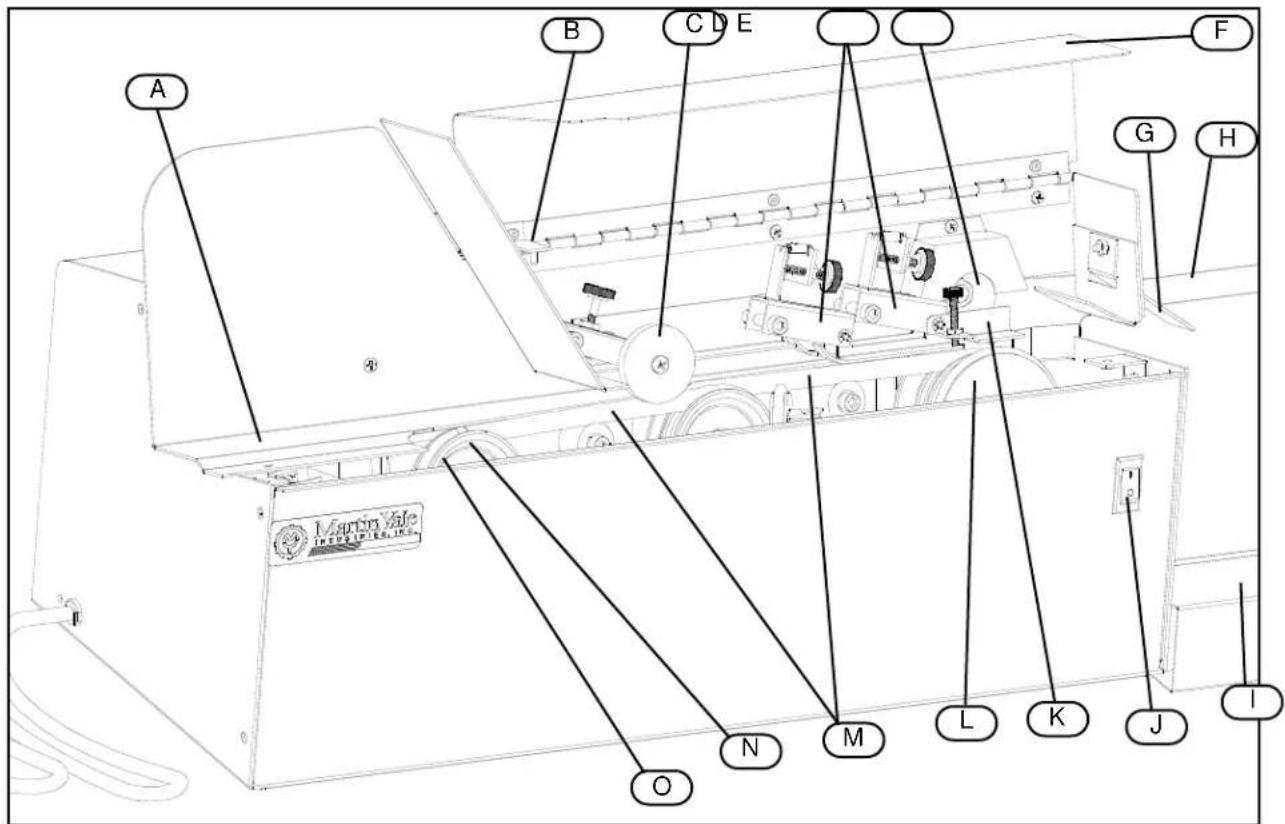
Figure 1
1.0 Parts
A. Feed Deck
B. Safety Interlock
C. Holdback Wheel
D. Ski Assembly
E. Blade Assembly
F. Front Cover Assembly
G. Plate Deflector
H. Scrap Bin
I. Catcher Base
J. Power Switch
K. Pressure Plate
L. Ejector Wheel
M. Feed Belt
N. Eccentric Pulley Assembly
O. Pulley Flange
2.0 Unpacking
Carefully unpack the letter opener. Place all packing materials back in the shipping box and store the box for any future shipment of the letter opener. Inspect the letter opener and all accessories for shipping damage. If any damage is found, contact the carrier immediately.
ATTENTION: For equipment that plugs in, the socket/outlet shall be installed near the equipment and shall be readily accessible.
3.0 Features
The Martin Yale Model 62001 High Speed Letter Opener is a precision-engineered mail handling machine embodying unique design features that make it possible to handle large volumes of different sized envelopes without pre-sorting.
Before operating the Model 62001, please look over the machine to familiarize yourself with these design features and how they function.
3.1 Feed Mechanism
An exclusive feed design mechanism feeds many different size envelopes without pre-sorting and is virtually jam proof.
- Note the twin spiral feed belts (M, see Fig. 1). Their spiral counterclockwise action shunts envelopes against the back plate for precision slitting. Note that the belt at left is angled more sharply. This "pre-feeds" envelopes to the belt at right.
- The transporter wheel (not shown), another Model 62001 feature, acts as a further assurance that out-size pieces will be shuttled inward on the front deck (Fig. 2).
- The holdback wheel (C) prevents jamming at the loading end. Since it is spring loaded, the bulkier the envelope, the greater the pressure exerted by the holdback wheel. This effectively prevents entry of more than one piece of mail at a time.
The combined action of these interrelated parts eliminates many of the problems associated with conventional mail opening machines and explains why the Model 62001 can deliver a high speed capacity of 17,500 mixed envelopes per hour.
3.2 Ski Assembly
The ski assembly (D) guides envelopes straight into the blade assembly (E). Front and back adjustments are factory set to apply correct pressure to letters of varying size. (NOTE: Should adjustment become necessary, loosen the locking nut and adjust the black thumbscrew accordingly. Retighten the locking nut).
3.3 Blade Assembly
Self-sharpening blades made of precision steel (E) cut a measured strip from each envelope, whether fed face-up or face-down. The control knob at right (see Fig. 2) adjusts the blade and permits the operator to vary the width of cut from wide to fine.
3.4 Ejection Assembly
The ejector wheel (L) pulls the envelopes out into the catcher base (I). The pressure plate directly above it (K) keeps the envelope in position for accurate ejection. The plate deflector (G) angles pieces downward into the catcher base.
3.5 Catcher Base
The catcher base (I) receives all opened envelopes as they leave the blade and ejection assemblies. A separate light-weight scrap bin (H) keeps scrap separate from opened envelopes for easier disposal.
3.6 Split Deck
Interiors of most mail opening machines are inaccessible without the removal of the entire operating assembly. The Model 62001 has a unique split deck feature which solves that problem. The deck is split lengthwise into two halves, front (see Fig. 2) and rear. The front half is removable, making cleaning, inspection and repair of the interior of the letter opener easier.
3.7 Eccentric Pulley Assembly
The eccentric pulley assembly has the effect of separating the individual envelopes so that only one envelope is fed at a time. You will note the pulley (N) bounces up and down when the unit is in operation. This is normal.
3.8 Safety Interlock
The tab of the safety interlock (B) is released whenever the front cover assembly (F) is lifted. Power is automatically cut which shuts off the machine so that the operator never comes in contact with moving parts.
3.9 Automatic Resetting Thermal Motor Protection
In the unlikely event of a jam or other machine malfunction, the motor may automatically shut down due to overheating. The thermal breaker will then self reset after the motor cools to normal operating temperature. Caution: The machine may start running unexpectedly when an overheated motor cools to normal operating temperature.
3.10 Self-sharpening Blades
The blades are precision ground of high carbon steel. As noted, they adjust for width of cut and are self-sharpening. Note: Self-sharpening action is continuous whenever mail is not going through the opener and will cause a whirring noise. This is normal.
4.0 Installation and Set-up
4.1 Installation
Place the Model 62001 on a flat, level surface where it will be used. Make sure ample space is provided for the catcher base. The cooling slots on the machine back should be unobstructed. The socket-outlet shall be installed near the equipment and shall be easily accessible.
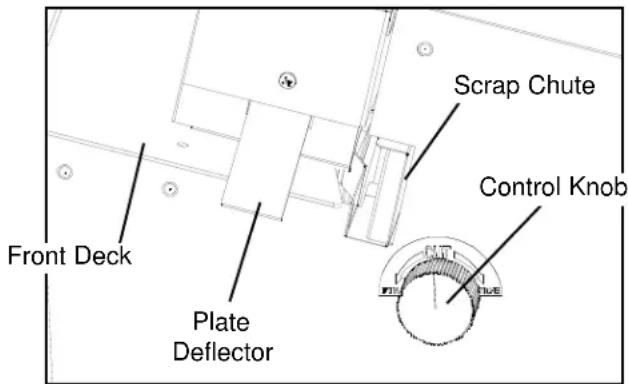
Figure 2
4.2 Attach the plate deflector
This is a one-time only installation. Look for the plastic packet inside the shipping carton. It contains the nickel-plated plate deflector and screw. Simply attach outside at point as shown. (See Fig. 2)
4.3 Align the Catcher Base
The catcher base simply sits on the exit side of the folder in a posi
tion to catch processed envelopes as they are ejected from the machine (See Fig. 1 for placement). The scrap bin lies in the narrow recess of the catcher base. The entire assembly then is aligned so that the inside front wall of the scrap bin butts against the front edge of the protruding lip of the scrap chute (See Fig. 2).
5.0 Operation
5.1 Machine Preparation
Check the control knob (Fig.2) for width of cut desired, from wide to fine. The cut should be deep enough to open envelopes cleanly but fine enough to insure that the blade does not come into contact with contents such as checks and money orders, etc., nor coins, staples and paper clips. Make sure the Model 62001 is 'OFF' as indicated by the 'O' on the power switch. Plug the machine into an appropriate power outlet.
5.2 Mail Preparation
Using a table or other flat surface, hand jog (tamp while holding the mail loosely) a handful of mail (not more than a 3" high stack) so contents move to the bottom of the envelopes. Lightly fan stack to insure that envelopes are separated. NOTE: Some types of envelopes may open easier on the bottom edge rather than the top. In that case, jog the envelopes so that the contents move to the top. Smooth all curled edges or torn flaps so the edge entering the Model 62001 is free of protruding surfaces that could snag on machine parts. Remove and hand process any severely damaged letters.
5.3 Mail Processing
1) Load prepared envelopes on the feed deck (A) at the left side of the machine with the edge to be cut inward.
2) Turn the machine 'ON' by depressing the power switch at right (J). The Model 62001 will now feed and slit the loaded envelopes.
3) The opened envelopes should now start processing and stacking in the catcher base. Do not let the envelopes accumulate higher than 4 inches, as this may cause a back jam.
4) Remove chads regularly by lifting out the scrap bin (H) and emptying.
6.0 Routine Maintenance
6.1 Housekeeping
Keep the Model 62001 clean. Smooth functioning of the Model 62001 requires daily removal of accumulated scrap with a soft bristled brush. If scraps are stuck between blades, remove these also. Be sure to check machine before each use for signs of such accumulation. Periodically remove the front deck for inspection of interior.
6.1.1 Front Deck Removal
Before attempting to remove the front deck, make sure the letter opener is turned 'OFF' and the machine is unplugged. Unscrew the two Phillips head screws, one on the left and one on the right, and lift out the front deck. Caution: Do NOT remove the screw in the center (near transporter wheel). To reinstall, angle the front deck in and downward. Then, while lifting the ski assembly (D), slide the front deck into position. Reinsert screws and tighten.
6.2 Feed belts
Approximately once for every twenty hours of machine operation, clean the feed belts of the unit with soap and water. Turn the machine off and on repeatedly to make sure that the entire lengths of the belts are cleaned.
6.3 Holdback wheel maintenance
The holdback wheel does not rotate; hence it will wear a flat spot over time. If this occurs, simply loosen the center screw of the holdback wheel and rotate it to expose a fresh surface.
6.4 Blade Maintenance
For each 40,000 pieces of mail processed, coat both the upper and lower blades with a blade emollient such as Premier Brand Trim Ease Lubricant (Martin Yale #MRS037046, available through your Martin Yale Dealer).
7.0 Troubleshooting
Several of the most commonly encountered problems are listed below along with the most common causes and remedies.
| Problem | Possible Cause | Remedy |
| 7.1 Envelopes Jam | Scrap build-up in ski assembl- bly and blade assembly area | Clean as outlined in section 6.1 |
| Scrap bin filled beyond capacity | Clear scrap out of letter opener and make sure the scrap bin is cleared regu- larly during machine use | |
| 7.2 Feeding Problems | Feed belts dirty | Clean as described in section 6.2 |
| Holdback wheel worn | Turn holdback wheel as described in section 6.3 | |
| Envelope too thick | Make sure letter thickness is no more than 1/4" | |
| 7.3 Envelopes Only Partially Cut | Transport Wheel not rotating | Verify that transport wheel spins as the opener runs |
| Ski Assembly misadjusted | Make sure ski assembly moves freely, and the springs are still attached to both ends of it. | |
| 7.4 Envelope Contents Cut | Cut adjusted to wide | Set the cut width adjustment to a nar- rower setting |
| Envelopes not tamped | Prepare mail as outlined in section 5.2 | |
| 7.5 Not Cutting or Abnormal Noise | Blades worn or lubrication needed | Lubricate blades or replace |
| 7.6 Will Not Run | Paper jam | Unplug opener and clear jam |
| Lid not closed | Make sure front cover assembly is closed | |
| Power disconnected | Try the opener in a known good outlet | |
| Thermal breaker tripped | Let the Model 62001 cool for at least 1/2 hour, then try again | |
| Fuse blown (non-resettable) | Replace fuse | |
| Electrical malfunction | Call Martin Yale customer service | |
| 7.7 Motor Runs, Belt Not Rotating | Timing belt disconnected from motor or belt broken | Connect or replace belt |
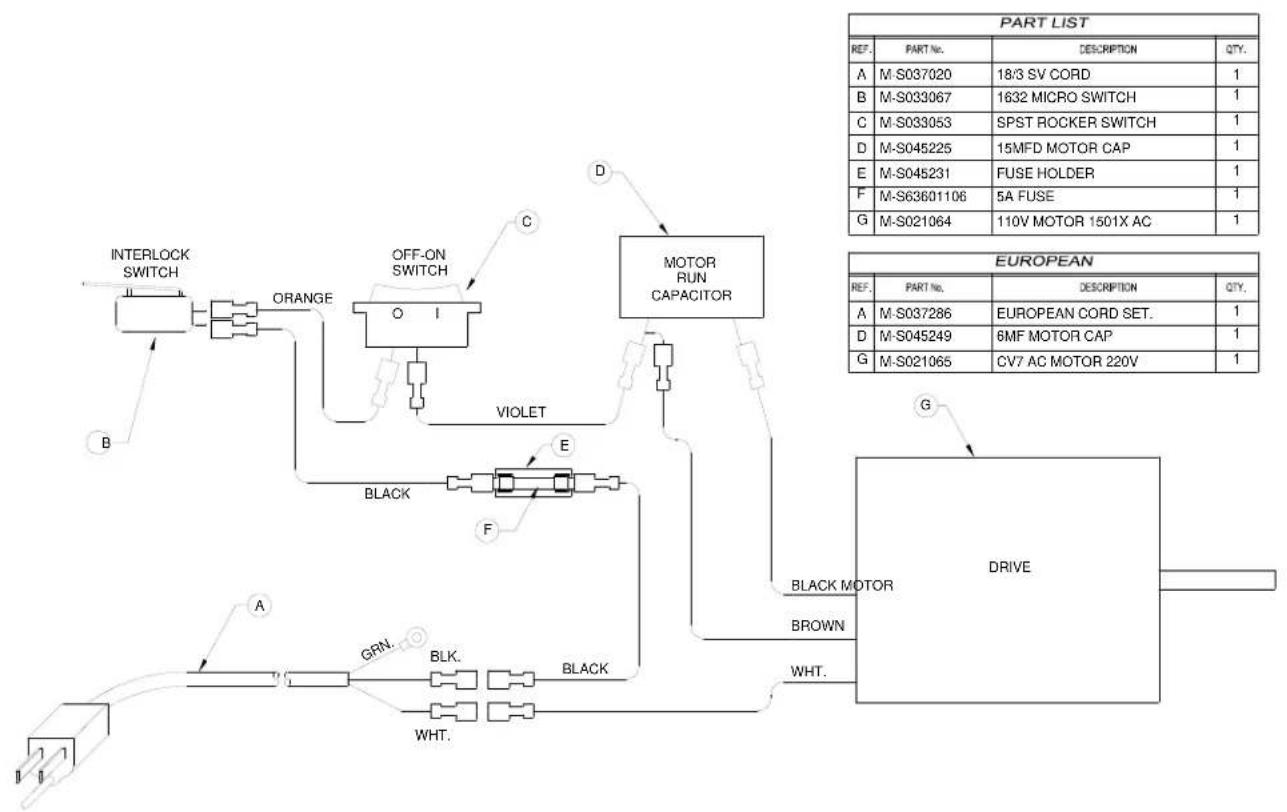
Wiring Diagram Model 62001 (115 VAC) / 62002 (230 VAC) Letter Opener

MARTIN YALE
Industries
251 Wedcor Avenue · Wabash, IN 46992
Phone: 260/563-0641 · FAX: 260/563-4575
website: www.martinyale.com · email: info@martinyale.com
MADE IN U.S.A.

MARTIN YALE
Model 62002
(230V)
Vysokorychlostní
Otvírac Dopisù
Specifikace
Funkčni Vlastnosti
3.1 3arpy3oHbI MExaHn3M
NckHouHTeJIbHaKoHCTpykUma MEXaHn3Ma 3aRpy3Kn O6ecneuBaET NDAUY MHOKeCTBa HMeHOuX pa3JIuHbI pa3Mepbl KOHBepTOB 6e3 npedBapntelbHoCOPTIPOBKn IpaKTNUeCKN NCKHooAET BO3MOxHOCTb 3aeDaHNI 3aUeMJeHH.
* O6paTne BHMaHHe Ha cnPpAlbHbe KOHeBepHbe JeHTbI (M, CMOTpn pnc. 1). Nx HnPaBHeHoe No cnPpAin npotnb YacOBn CTeJIKn DeCTBHe OTBOuNT KOHeBPTbI NO ONOPHO nnTE DnTOUHO rnoIOBHoro pa3peaHHa. ObpaTne BHMaHHe Ha To, UToJeHTa CneBa IMeET n3rN6 noD 60Jee OCTpbIM yrrm. 3To o6ecneuBAe T'peDbapntelHyIO naay? KOHeBtOB Ha neHTy cnpaba.
TpaHcnpertpe KOleco (He nok3aHO), eue OHa ocOeHHocb Moedn 62002, BicTynaet B KaeeCTBe eue OHoro cpeCTBa, rapaHTnpuyooero To, TTO mHeoune PpeBbIahoUe pa3Mepeb KoHeptb ByuT nepeMeuaTcB H anpabInem BOHytpb Ha nepeHIO pIATfOpMy (PNC. 2).
* 3aepxnbauoee koene (C) npedotbpaaaet 3aueemneHne Ha 3arpy3ouHcTcOpe. No npnHHe TOr, OTO OHO RAJIeTcN oDnpyxHHeHHbIM, HEM MaccNBHee OKa3bIaebcra KOHBeP, TEM 60bnuee daBneHne OKa3bIaebcra 3aepxnbauoHm KOlecom. TaKIM o6pa3om o6ecneuBaetc 3ffekTNBHOe npedotbpaaeHne OHOBpeMeHHoro nonadHn 6one OOnHO ROHOBepTa.
CoBMeCTHoe DeIcTBnE 3nX B3aMmOCB3aHHbIX YacTeY yCtpaHReT MHorne n3 Tex npo6JIeM, KOtOpBle CB3aHbI C pa6OToI obHybIX KOHBePTOBCKpbBaHOuNX MaunH, N o6bChReT, NOeMy MoJeB 62002 OKa3bIbAETcR B COCTOHN BBiDaBaTb TaKyIO BblCOkyIO npOn3BOInTeNbHOCTb, Ka17500 CmeaAHbIX KOHBePTOB B ac.
3.2 HanpaBnaIoun y3en
HanpaBnIOuIy3eI (D) HapBaBnEe KOHBeptb npMo B y3eH HoKa (E). NpeaHne n 3aHne peryNpOBKn yCTaHOBHeHa 3aBODeHnroBHTeNe I o6ecneNuBAOT npINOKeHne npAunbHorO daBHeHH B OTHoWeHH Ncem pa3NHybIX pa3MePoB. (PIMMEAHNE: B cnUyae ecn BO3HnKAeT HeoXoDMOCtB B perynPiOBKe, Heo6xOdmo cnaBbTB KOHTprayK u COOTBeTcByOuM o6pa3OM OTperynPiOBaTB cepHbIN BuHT C hakataHHo rONOBKO. 3aTeM CHOba 3aTaNHE KeOHPrayKy).
3.3 Y3en HOXa
N3ROBHeHbIe N3 PpeUNHOHcTaN CAMo3aTuNbAIOUncE Hoxn (E) OTe3aOT NOIOCKy yCTaHOBHeHOrO pa3Mepa OT KaJDO KOHBepTa, He3ABNCIMO OT TORO, NOaIOTc ONH JInCeBOB CTOpOH BBePx ININ BHN3. PyKoRTka YnpaBJeHHc npaba (CMOTPN 2) ObecneuHbAet perynpOBky HOxN I daET BO3MOXHoCTb OepaTOpy BapbIOBaBt bIpNHy OTe3aEMOn NoIOCKN OT WIPOKo DO y3Koi.
3.4 Y3eJ BbItaKnBaHna
BbTANKBAHOOe KONEO (L) BbITrMaBaET KOHBeptb HApyKb B HINKHn noDcH (I). HaxmHa nactHa HEnocpeCTBeHNO HaHMM (K) ydepKmbaet KOHBept B NOJIOKeHM drr ToHOro BbITANKBaHIM. IpaTInHAtb OtpaKaTeB (G) HappABnEe KOHBeptb NoYtOM BHNKHn noDDOH.
3.5 HxHn noDOn
IopdoB OCHOBAHN (I) npHnMaet B ce6B BCE OTKpbItbE KOHeptb NocTe TORO, Ka OH npoWn y3eH HOKa n y3eN BtAnKnBaHn. OtJeNbHn, n3rTOBnEHn H3 IerKOrO MaTePnAa 6yHKeP dnn o6pe3KOB (H) coepXHT B ce6e o6pe3Kn OTdJIbHO OT OKpbItbIX KOHBepTOB, dnn o6JeYtnn3aun.
3.6 Pa3bemHnnaTfOpMa
BHytpHHne 30hbl60bIbHnCTBa Maun H AINOTc HeIOCTyHbIMn 6e3 ChTBA BCero pa6oery y3na. Moenb 62002 OTnuaetc TaKo OocbeHHocTBko, Ka Hauuhe He NMeIOUe anAIONOB pa3bemHO nIaTOpMb, npn NOMOu KOTopo PA3pe7aetc DaHnHa np6bema. DAnHaa PnATOpMa pa3dJeTcB nPdoJIbHom HApabNeHm Ha DBe NoOBnHb, nepeHIO (CMOTpu pnc. 2) n3aHIO. PepeHra noOBnHa ABJETcCBEMHO, YTO o6JIeYaeT UCTky, OCMTp IN pEmOH BHytpHHx 30H KOHeptOBCKpbiaOue MauHbI.
3.7 Y3en 3KcCHTpNKOBORO 5KNBa
Y3eKcUHTpIKOBORo 1kNBA npEHa3HaeH dToro, YTObI pa3DeJIbTb OTdeHbIe KOHeptbI C TEM, YTObI ODHOMOEMTHO ObecneHbIaIbIO TaHO TOnbKO OdHOrO KOHepta. Bby 3amETInTe, YTO LKB (N) (PbIgAeT) BBepx INBnB BO BPempa50bI MaunHbI. 3To RAJIeTcHOPMaJIbHIM.
3.8 3aunTHa 6JIOKnpOBka
Kohtakthb BblkHouateJIb 3aunTHOH 6IOKpOBKn (B) BblknHuaetcKaKdb pa3 npn noDbem y3na nepeHero orpaKdHn (F).PponCxOHT ABTOMATueckoe OTKIOUeHne 3JeKtpO3Heprm, YTO npINBOuNT K OTKIOUeHNO MaUNHbIC TeM, YTO6bl NCKIOUHTb BO3MOXHOCTb KOHTAKTA OepaTopa C DBNKyUIMNCaCTAMN.
3.9 TennoBo 3aunTHbI ABTomAT DBraTeTn
B cnuyaX MaIOBepoTHoro 3aueMJIeHn HIN Pn DpyTN HeNCnPbAHOCTx MaunHb, MoKET IPOCNXOHTb ABTOMaTHUeCKOE BblKNIOHeHne DBIraTeJIa-3a erO neperpeBa. TEnnoBo BBykNIOuATEb 3aTeM 6yET Bo3BpaTaBCaBc B NxCDOHoe COCTORHHe NOCNE TOR, KAK DBNrAteJIb OXlaNTcdo HopMaJIbHO paOoh TeMnpaTpyb. BHUMHue: MaUNHa MOXem Haampbapommb HeoKudHNO, KoDa nepepebui duaameNB ocMbHem do HopMaIbHO paOoey mempepamypbl.
3.10 Camo3aTaUBaHouueCe Hoxu
Hoxn n3rotobnebln BbICOKyrrpeoNCTOcTaN NocpeDCTBOM pueznsnoHoro shnpoBaHn. Kac bIIO OTmeHo, OH nperynpuyotc no mPInHe pe3aHn I RbIyOTc cAm03aTuNAbKOUMNC. Ppumeyahue: onepauu caMo3amoyku reIemc nocmohho mo epm, Ko2da uee3 MaunHy nuCbMa He nodaomcr, conpoeoKdaemc kyykkaum wymom. TaKo Wym ReJreMc HopMaNbHbIM.
4.0 YctaHOBka n Hanaika
4.1 YctaHOBka
PomeCTeMaHMy MoEJ62002 Ha IIOCKO, ROpI3OTaJIbHO NOBepXHOCTN, rTe OHa 6yET NcONb3OBaTcR. Po3a6oTbTecb TOM, YTObIb oBeCneHeo DoCTaTOH MecTa dIra HnKHeRo NODOna. UeJIN DnIg OxnaXDeHnB 3aDHeu YAcTH MaunHbI He DOJNXbI bItb HnYem 3aropoxKeHHIM. Po3ETKa dIra NoKIIIOueHn DaJnxHbHa B6n3n O6OpyDOBaHn I DoJnxHb6bIT JERKOocTyHNO.
4.2 YctahOBNTb nactnHcyatbI OTpaxaTeB
3To RAJIETcT OINbKO OINHOPa3OBY yCTAHOBKO.HaINITe INACTIKOBy nAKET BHYTPn TPAHCNPTHOI KAPTOHHO KoP6Kn. B HEM HAXODITcR HNKENIPoBaHHB NIACTINHATbO TpAkaTeNb BNHT. Heo6xOIMO npocTo npKpeNTb ChapyKn B ToKe, KaN oKa3aHo Ha pCcyHke. (CMOTPMnC.2)
4.3 BbICTaBNTb HNXHn NOdOH
HnKnn noDnO npocTo nomeaTcRa H BixoHoi CTopoHe MaunHbI B NOIOXeHne DNr IpNema o6pa6oTaHHbIX KOHBeptOB No Mepe TOr, KaOH NBytaIKBaIOTcN3 MaunHbI (DNr pa3MeueHn CMOTPN pnc.1). ByHKep Dnro obpe3KOB HaxoNTcR B y3KoH HnHe HnKHERo NDHOa. 3aTeM BeCb y3en BbCTabJIeTcRA TakIM o6pa3OM, YTO6b BYHTpeHHra nepeHHra cTeHa 6yHKepa DNr obpe3KOB ynpapacB B nepeDHIO KpOMky BbICTyaIooero 6yPTNa NotKa DNr obpe3KOB (CMOTPN pnc.2).
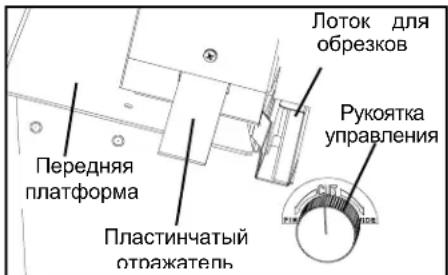
PncyHOK 2
5.0 Pa60Ta
5.1. Nodrotobka MaHHbI
PpOeBpTe pyKoTky ynpabHeHn (pnc. 2) dIy onpeJeHn Tpe6yEmo IuInHb OTpe3aEmo NIOCKn,OT uipoko do y3KOe. Pe3AHne DOnKHO 6blTO DOCTaTOUHO rYbOKM mIra TOR, YTObI oEbcNueHBaTB uNCTOE OTKpbBaHne KOHBePTOB, HO DCtAToHO TOHKIM, YTObI rapaHTnpoBaTb, YTO Hx He 6yET KOHTaTIPoBaTb C Takm BHyTpEHNM COepKmbim, KAK YeKN IINaTeXhBle NOpuyehn n T. n., a TAke MoHetAMn, CKoBaMn n Ckpenkam nIg Myar. YdoCTOBepbTeCB B TOM, YTO MaUNHa HaxoNTcB B BbIKNoeHHom CoCTOHN (OFF), HA YTO yka3bBaet CmBON «O» Ha BbIKIOHateJe 3eKTPoNTaHn. BKnIOHTe BnKy MaINHb B COOTBetCTByOuIPO3ETKY PINTAHn.
5.2 NodrotOBKa nouTbI
IcnoB3y cTOn nnn dpyryn noockyo nobepxhoctb, ytpam6ynte pykami (obctynte, hennnotho ydepknbaa nncbma) naKy nncem (naKy He tonue 3 duimOB (75 MM) C TEM, yTO6bl nx codepxumoe nepemectnocb bHm3 KOHeptOB. Cnerka cdenai Te naKy Beepom, yTO6bl y6eHtbcra, TO KOHBePTb He CKneeHb Meckdy CO60. PNIME4AHNE: Hekomopbte munbl KOHeepmoosym omKpbmbacr Ha Huxhem Kpae Jneve, hem ha eepxhem. B 3omom cyayae ympam6yime KOHeepbta makum o6pa3om, mO6b1 codepXUMoe nepemecmunoCb eepxHIOU qacmb. BbipOBHnTe BCE 3aRhyBnceK pOMKn nn OtpbBhle klanahb TaKMM o6pa3om, YTO6bl KpaB, BXODaun B MaunHy, He IMeBblCTynaouX NoepxHOCTe, KOToBpeMn6bl CeNnTBc3a ChnMaunbMoDen 62002. UdaHnTe N o6pa6otaTe BpyHyoo NIOBble NcBMa, IMeouune cepbe3hble NOpeXdHnA.
5.3 06pa6oTka noYtbI
1) NomeCTIte NOIROTOBJIeHHbIe KOHBeptbI Ha 3aRpy3OHyIO PnA TΦOpMy (A) Ha JEBoN CTopoHe MaunHbI, YTO6bI KpOMKa, NoJNeXaIIaY OTe3aHIIO, BbIJa ObaaueHa BOHyTpB.
2) BkIIOHHTe MaunHy (ON) nocpeDCTBOM haxaTn BbIKIOHaTeTg 3JIeKTPoNTaHnC npaBoi CTopoHbJ (J).MaunHa 6ydt ocUeCTBnTb Iodayy 3arpyKeHHbIX KOHBePTOB IN IX OTpe3aHne.
3) Nocne 3T0rO OTKpbItbke KOHBeptbI dONKbHaHmHaTb npoxoMTb o6pa6Otky u KlnaKy B HnKnn noDoH. He donyckaTe TOrO, YTO6bI KOHBeptbI HAKANIIBaINcB c npeBbUeHHem 4IOHMOB (100 MM)NO BBcOTe, NOCKOBkY 3TO MOXET pNBECTN K o6pATOMY 3aUeMJIeHHIO.
4) PerynpHo ydaIaIte o6pe3Kn, BbIHMa n onopoxHg 6yHKep dIg o6pe3KOB (H).
6.0 Perynphoe TexHueckoe 06cnykBaHne
6.1 O6uH nopdok u HcToTa
Copeknte Maunhy B nctote. BecepeboHoe yHKnOHNPOBaHne Maunhbl Tpe6yet ekeJHeBHO ydaenHaKoONBUNXcra 6pe3koB C nnoIb3OBaHnem MrgkOn KcTn. Ecn 06pe3kn 3aIINm Mekdy HoxkAm, ydaIIne nx taKke. O63aTeNbHO npOBepaTe MaunHy nepeKaKdbIM nCIOb3OBaHnem Ha HauHnne np3NaKob TaKOro HAKOpNeHn. PepNoDnueckn ChImaIte npedHIO pNAtfOpMy dner npOBepKn BHTpeHHx 3OH.
6.1.1 ChTne nepeDHe nlaTphiOpMbI
Peped mem, kak npucmumb K cHmui npedhe nnamfopmbi, ydocmoepbmeb e mom, mno KOHeepmoecpblaoua Maunuha bkyknoyea (OFF) u bnuka bHyma u3 po3emku 3neKmpocemu. OTBnHTME DBA BnHToNcJyCpeHcckO RONOBK C KpctOBbIM WnueM, Ondn CneBa n Ondn Cnpaba, n OndnMMte npedHIO nIatfOpMy. BHumane: HE omeopauuaime uhm e cempe (e03ne mpaCnppehzo koneca). IJRA o6paTHoYCTaHOBNK, HAKJOHNTe npedHIO nIATfOpMy BOHYTpB n BH3. 3aTeM, BO BpEmrNoHrttna Hapabnlozero y3na (D), 3aDbHbTe npedHIO nIATfOpMy h CBOE MeCTo. BCTabBe BNtBt o6paTHo 3aTaNHTe.
6.2KoHBeHepHbIe NeHTbl
Pn6H3NTeBHO uepe3 KaKdIe DaaIaTb YeIbpe Yaca pa6oTb MaunHbI, POn3BODtE OHTKY KOHeepbIX JeHT MaunHbIC NcOJIb3OBAHmEBMjnaNBODJI. NOBTOPOBkIOUaTe N BbIKIOUaTe MaUNHy DnToro, TTOb6y6eINTCB R TOM, TTO KOHeepbIEJeHTbOuINHe IIO BCENiHe.
6.3 TexHnueckoe 06cIyXnBaHne 3aIepXnBaIoero Koneca
3aepxmbioee Koneco He Bpaaaetcnockonky co Bpemeh Ha HEM BbipabatbbaeTc nIOCKn yAcTOK. Ecn 3TO cnYcaTe, Heo6xoJIMO npocTo ocnaBntbcHTpanhbln BnHT 3aepxmbioooKoneca TaK, TTO6bl 3aJeCTBOBaHbIM OKa3anC HoBb yAcTOK.
6.4 TexHnueckoe 06cnyKnBaHne HOXa
Pocne Kaqdbix 40 000 uTyK o6pa6oTaHbix nIcem, CmaXbTe BepxHn HIXHn HOxN CmraHouM CpeCTBOM DnHOKe - TaKM, KAc Cma3ka DnObnueHn npaBn Premier Brand Trim Ease Lubricant (Martin Yale #MRS037046, KOtopoe moxHo npno6pctyn y BaWero dInepa Martin Yale).
7.0 YcTpaHeHne HEnCnpaBHOcteI
Hnke npedctabneHb Heckonbko n3 Han6oee yacto BCTpeauuxcxra npoblem, Bmecte c Han6oee paocpoctpaehnblm npuHaMn nCnocobamnx yctpaHeHna.