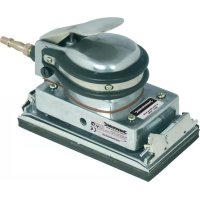
763565 - Sander SILVERLINE - Free user manual and instructions
Find the device manual for free 763565 SILVERLINE in PDF.



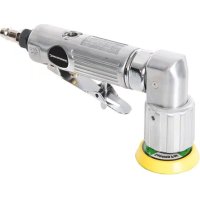
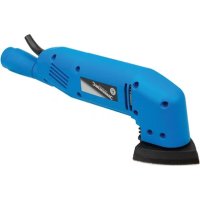
| Product Type | Pneumatic Orbital Sander |
| Brand | Silverline |
| Model | 763565 |
| Power Source | Compressed Air |
| Maximum Operating Pressure | 6.3 bar (90 psi) |
| Air Consumption | 135 L/min (4.75 cfm) |
| Air Inlet Connection | 1/4" BSP |
| No Load Speed | 8000 rpm |
| Sanding Pad Dimensions (L x W x H) | 170 x 90 x 12 mm |
| Weight | 2 kg |
| Sound Pressure Level (LpA) | 93 dB(A), uncertainty K=3 dB |
| Abrasive Attachment Type | Front and rear clamps |
| Intended Use | Light to medium duty sanding on wood, metal, etc. |
| Speed Adjustment | Variable speed trigger and air restrictor |
| Lubrication | Daily pneumatic oil via air inlet |
| Maintenance | Clean with soft brush or dry cloth |
| Required Protective Equipment | Safety glasses, FFP2 mask, hearing protection, gloves |
| Warranty | 3 years subject to registration within 30 days |
| Spare Parts and Repairability | Available from Silverline or at toolsparesonline.com |
| Conformity | Machinery Directive 2006/42/EC, EN11148-8:2011 |
Frequently Asked Questions - 763565 SILVERLINE
User questions about 763565 SILVERLINE
0 question about this device. Answer the ones you know or ask your own.
Ask a new question about this device
Download the instructions for your Sander in PDF format for free! Find your manual 763565 - SILVERLINE and take your electronic device back in hand. On this page are published all the documents necessary for the use of your device. 763565 by SILVERLINE.
USER MANUAL 763565 SILVERLINE
Thank you for purchasing this Silverline tool. This manual contains information necessary for safe and effective operation of this product. This product has unique features and, even if you are familiar with similar products, it is necessary to read this manual carefully to ensure you fully understand the instructions. Ensure all users of the tool read and fully understand this manual.
Description of Symbols
The rating plate on your tool may show symbols. These represent important information about the product or instructions on its use.

Wear hearing protection.
Wear eye protection.
Wear breathing protection.
Wear head protection.

Wear hand protection.

Read instruction manual.

Conforms to relevant legislation and safety standards

Environmental Protection
Air tools should not be disposed of with household waste. They contain traces of oil and other lubricants. Please recycle where facilities exist. Check with your local authority or retailer for recycling advice
Technical Abbreviations Key
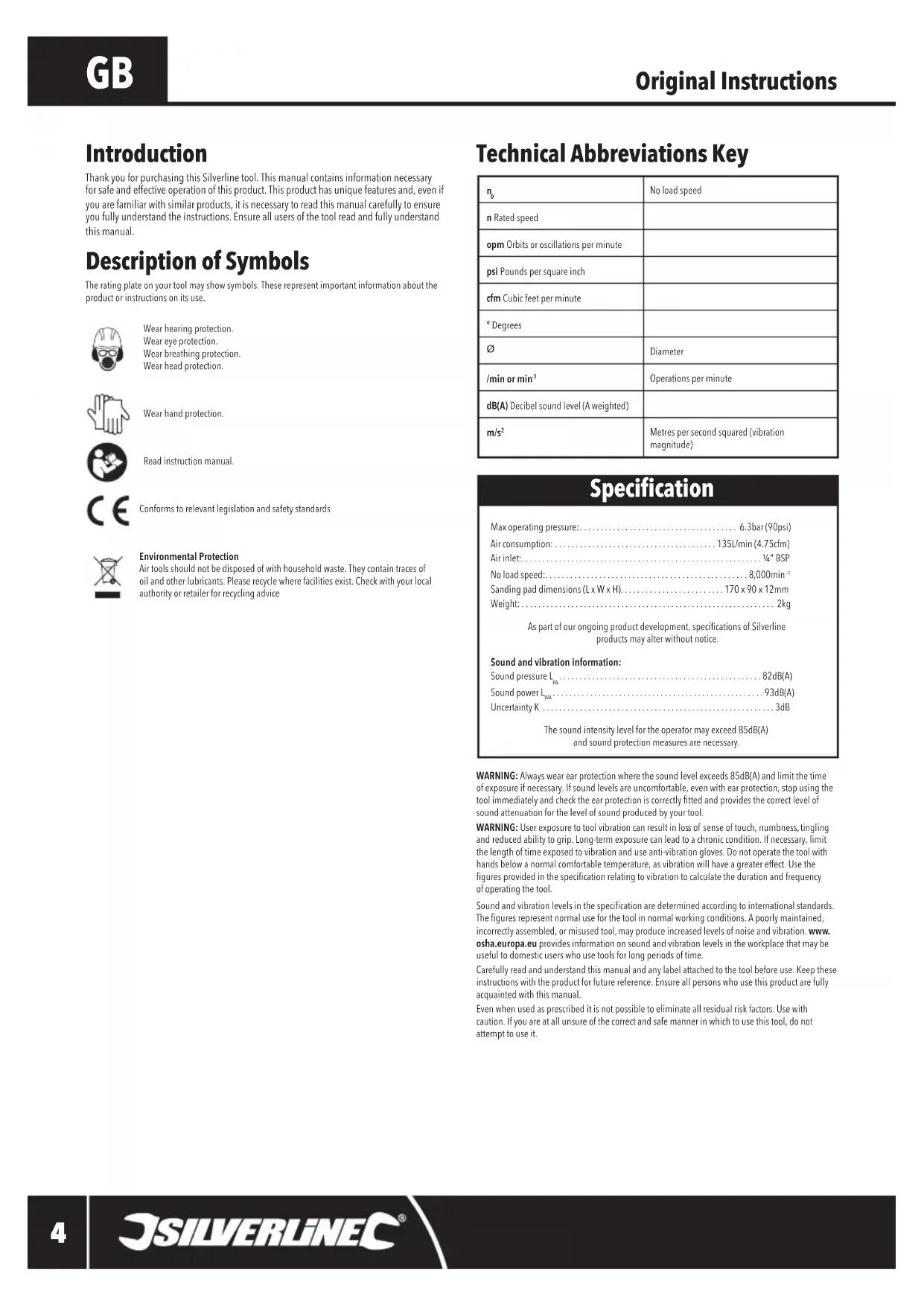
| \( {\mathrm{n}}_{0} \) | No load speed |
| n Rated speed | |
| opm Orbits or oscillations per minute | |
| psi Pounds per square inch | |
| cfm Cubic feet per minute | |
| ° Degrees | |
| 0 | Diameter |
| /min or min \( {}^{-1} \) | Operations per minute |
| dB(A) Decibel sound level (A weighted) | |
| \( \mathrm{m}/{\mathrm{s}}^{2} \) | Metres per second squared (vibration magnitude) |
Specification
Max operating pressure: 6.3bar (90psi)
Air consumption: 135l/min (4.75cm)
Air inlet: 14* BSP
No load speed: 8,000min
Sanding pad dimensions (L × W × H) 170 x 90 x 12mm
Weight: 2kg
As part of our ongoing product development, specifications of Silverline products may alter without notice.
Sound and vibration information:
Sound pressure L. 82dB(A)
Sound power L_w 93dB(A)
Uncertainty K 3dB
The sound intensity level for the operator may exceed 85dB(A) and sound protection measures are necessary.
WARNING: Always wear ear protection where the sound level exceeds 85dB(A) and limit the time of exposure if necessary. If sound levels are uncomfortable, even with ear protection, stop using the tool immediately and check the ear protection is correctly fitted and provides the correct level of sound attenuation for the level of sound produced by your tool.
WARNING: User exposure to tool vibration can result in loss of sense of touch, numbness, tingling and reduced ability to grip. Long-term exposure can lead to a chronic condition. If necessary, limit the length of time exposed to vibration and use anti-vibration gloves. Do not operate the tool with hands below a normal comfortable temperature, as vibration will have a greater effect. Use the figures provided in the specification relating to vibration to calculate the duration and frequency of operating the tool.
Sound and vibration levels in the specification are determined according to international standards. The figures represent normal use for the tool in normal working conditions. A poorly maintained, incorrectly assembled, or misused tool, may produce increased levels of noise and vibration. www. osha.europa.eu provides information on sound and vibration levels in the workplace that may be useful to domestic users who use tools for long periods of time.
Carefully read and understand this manual and any label attached to the tool before use. Keep these instructions with the product for future reference. Ensure all persons who use this product are fully acquainted with this manual.
Even when used as prescribed it is not possible to eliminate all residual risk factors. Use with caution. If you are at all unsure of the correct and safe manner in which to use this tool, do not attempt to use it.
General Safety
WARNING: Read all safety warnings and all instructions. Failure to follow the warnings and instructions may result in electric shock, fire and/or serious injury.
Save all warnings and instructions for future reference.
The term "air tool" in the warnings refers to your air operated tool.
Work Area Safety
a) Keep work area clean and well lit. Cluttered or dark areas invite accidents.
b) Do not operate air tools in explosive atmospheres, such as in the presence of flammable liquids, gases or dust. Air tools create sparks which may ignite the dust or fumes.
c) Keep children and bystanders away while operating an air tool. Distractions can cause you to lose control.
Personal Safety
a) Stay alert, watch what you are doing and use common sense when operating an air tool. Do not use an air tool while you are tired or under the influence of drugs, alcohol or medication. A moment of inattention while operating air tools may result in serious personal injury.
b) Use personal protective equipment. Always wear eye protection. Protective equipment such as dust mask, non-skid safety shoes, hard hat, or hearing protection used for appropriate conditions will reduce personal injuries.
c) Prevent unintentional starting. Ensure the switch is in the OFF-position before connecting to air supply, picking up or carrying the tool. Carrying air tools with your finger on the switch invites accidents.
d) Remove any adjusting key or wrench before turning the air tool ON. A wrench or a key left attached to a rotating part of the air tool may result in personal injury.
e) Do not overreach. Keep proper footing and balance at all times. This enable better control of the air tool in unexpected situations.
1) Dress appropriately. Do not wear loose clothing or jewellery. Keep your hair, clothing and gloves away from moving parts. Loose clothes, jewellery or long hair can be caught in moving parts.
g) If devices are provided for the connection of dust extraction and collection facilities, ensure these are connected and properly used. Use of dust collection can reduce dust-related hazards.
Air Tool Use & Care
a) Do not force the air tool. Use the correct air tool for your application. The correct air tool will do the job better and safer at the rate for which it was designed.
b) Do not use the air tool if the switch does not turn it ON and OFF. Any air tool that cannot be controlled with the switch is dangerous and must be repaired.
c) Disconnect the plug from the air source before making any adjustments, changing accessories, or storing air tools. Such preventive safety measures reduce the risk of starting the air tool accidentally.
d) Store idle air tools out of the reach of children and do not allow persons unfamiliar with the air tool or these instructions to operate the air tool. Air tools are dangerous in the hands of untrained users.
e) Maintain air tools. Check for misalignment or binding of moving parts, breakage of parts and any other condition that may affect the air tool's operation. If damaged, have the air tool repaired before use. Many accidents are caused by poorly maintained air tools.
f) Keep cutting tools sharp and clean. Properly maintained cutting tools with sharp cutting edges are less likely to bind and are easier to control.
g) Use the air tool, accessories and tool bits, etc. in accordance with these instructions, taking into account the working conditions and the work to be performed. Use of the air tool for operations different from those intended could result in a hazardous situation.
Service
a) Have your air tool serviced by a qualified repair person using only identical replacement parts. This will ensure that the safety of the air tool is maintained.
Air Tool Safety
Dangerous environment
- Always ensure there is adequate clear space around the work area. Only use spraying tools in a well ventilated area or a specialist spray booth. Be aware that air hoses can present a trip hazard; always lay hoses in a way that minimises hazards
Protect your eyes
Always wear safety goggles or safety glasses
Protect your hearing
Always wear ear protection
Protection from vibration
- Hand-held air tools may produce vibration and should not be used for long periods without a break. Vibration can cause disease. Gloves may help to maintain good blood circulation in the fingers.
Protective clothing
- Always wear appropriate protective equipment including but not limited to overalls, gloves, facemask, etc.
It is the user's responsibility to ensure that other persons in the vicinity of the work area are also
equipped with the appropriate protective equipment
Use the correct air hose
- Use lightweight hose to connect the tool to the air compressor
- Most air tools should be fitted with a coil hose; only use a straight hose with spray guns
- When spraying, ensure the gun is connected to a clean, filtered air supply
Always disconnect
Always ensure that your air tool has fully stopped functioning before putting it down
- Disconnect an air tool from the air supply before performing any servicing, or changing any blades, discs, or other attachments
- Ensure blades, discs or attachments are correctly fitted before reconnecting to air supply
- Ensure the air tool is switched OFF before connecting to air supply. Be aware that air tools may hold residual pressure after use. Always bleed air pressure from the tool after shutting off air supply
Do not abuse the tool
- Do not overload the machine. Allowing the tool to work at its optimum speed is more efficient and prolongs its service life
- Do not increase air pressure above the recommended level; excessive pressure leads to wear of moving parts, possible failure and may cause the tool casing to split
Do not attempt to modify air tools. Any attempt to modify this air tool could result in serious injury to you or others, and will invalidate its warranty
Air Tool Safety
Dangerous environment
- Always ensure there is adequate clear space around the work area. Only use spraying tools in a well ventilated area or a specialist spray booth. Be aware that air hoses can present a trip hazard; always lay hoses in a way that minimises hazards
Protect your eyes
Always wear safety goggles or safety glasses
Protect your hearing
Always wear ear protection
Protection from vibration
- Hand-held air tools may produce vibration and should not be used for long periods without a break. Vibration can cause disease. Gloves may help to maintain good blood circulation in the fingers.
Protective clothing
- Always wear appropriate protective equipment including but not limited to overalls, gloves, facemask, etc.
- It is the user's responsibility to ensure that other persons in the vicinity of the work area are also equipped with the appropriate protective equipment
Use the correct air hose
- Use lightweight hose to connect the tool to the air compressor
- Most air tools should be fitted with a coil hose; only use a straight hose with spray guns
- When spraying, ensure the gun is connected to a clean, filtered air supply
Always disconnect
- Always ensure that your air tool has fully stopped functioning before putting it down
- Disconnect an air tool from the air supply before performing any servicing, or changing any blades, discs, or other attachments
- Ensure blades, discs or attachments are correctly fitted before reconnecting to air supply
- Ensure the air tool is switched OFF before connecting to air supply. Be aware that air tools may hold residual pressure after use. Always bleed air pressure from the tool after shutting off air supply
Do not abuse the tool
- Do not overload the machine. Allowing the tool to work at its optimum speed is more efficient and prolongs its service life
- Do not increase air pressure above the recommended level; excessive pressure leads to wear of moving parts, possible failure and may cause the tool casing to split
Do not attempt to modify air tools. Any attempt to modify this air tool could result in serious injury to you or others, and will invalidate its warranty
Sanding Tool Safety

WARNING!
- Use clamps or another practical way to secure the workpiece to a stable platform. Holding the workpiece by hand or against the body makes it unstable and may lead to loss of control.
a. ALWAYS wear appropriate protective equipment, including a dust mask with a minimum FFP2 rating, eye protection and ear defenders
b. Ensure all people in the vicinity of the work area are also equipped with suitable personal protective equipment
c. Take special care when sanding some woods (such as beech, oak, mahogany and teak), as the dust produced is toxic and can cause extreme reactions
d. NEVER use to process any materials containing asbestos. Consult a qualified professional, if you are uncertain whether an object contains asbestos
e. DO NOT sand magnesium or alloys containing a high percentage of magnesium
f. Be aware of paint finishes or treatments that may have been applied to the material that is being sanded. Many treatments can create dust that is toxic, or otherwise harmful. If working on a building constructed prior to 1960, there is an increased chance of encountering lead-based paints
g. The dust produced when sanding lead-based paints is particularly hazardous to children, pregnant women, and people with high blood pressure. DO NOT allow these people near to the work area, even if wearing appropriate personal protective equipment
h. Whenever possible, use a vacuum dust extraction system to control dust and waste
i. Be especially careful when using a machine for both wood and metal sanding. Sparks from metal can easily ignite wood dust. ALWAYS clean your machine thoroughly to reduce the risk of fire
j. Empty the dust bag or container (where applicable) frequently during use, before taking breaks and after completion of sanding. Dust may be an explosion hazard. DO NOT throw sanding dust into an open fire. Spontaneous combustion may occur when oil or water particles come into contact with dust particles. Disposse of waste materials carefully and in accordance with local laws and regulations.
k. Work surfaces and sandpaper can become very hot during use. If there is evidence of burning (smoke or ash), from the work surface, stop and allow the material to cool. DO NOT touch work surface or sandpaper until they have had time to cool - DO NOT touch the moving sandpaper
m. ALWAYS switch off before you put the sander down
n. Even when this tool is used as prescribed it is not possible to eliminate all residual risk factors. If you are in any doubt as to safe use of this tool, do not use it
Additional Safety Instructions for Pneumatic Sanding Tools
- Inspect the backing pad before use. Do not use if cracked or broken or if it has been dropped
- Never run the tool unless abrasive is applied to the workpiece
Grinding wheels and cutting-off tools shall not be used - Check that the maximum operating speed of the inserted tool (flap wheels, abrasive belts, fibre discs, backing pads, etc.), is higher than the rated speed of the sander or polisher
- Self-fixing sander discs shall be placed concentrically on the supporting pad
- Ensure that there are no electrical cables, gas pipes, etc., which can cause a hazard if damaged by use of the tool
Product Familiarisation
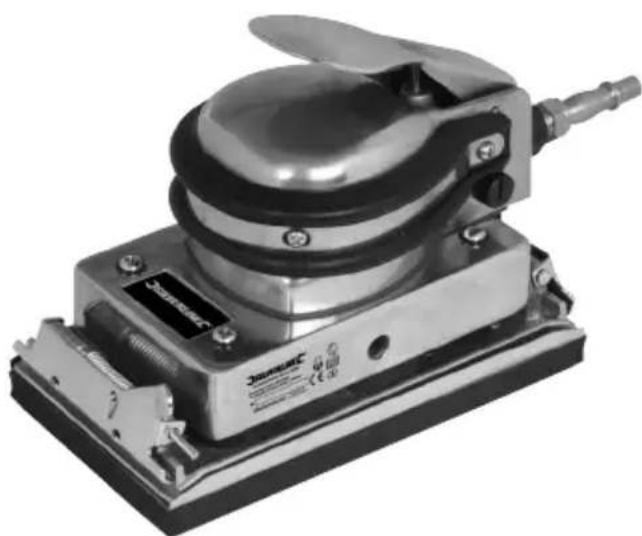
- Handle
- Speed Control Trigger
- Air Restrictor
- Quick Connector
- Fear Clamp
- Sanding Pad
- Front Clamp
Intended Use
Air sander, powered by compressed air from a compressor, for light to medium sanding tasks using conventional clamp-fitted sanding sheets.
Unpacking Your Tool
Carefully unpack and inspect your tool. Fully familiarise yourself with all its features and functions
- Ensure that all parts of the tool are present and in good condition. If any parts are missing or damaged, have such parts replaced before attempting to use this tool
Before Use
Fitting the quick connector
Note: This tool is supplied with two different male airline quick connectors:
EO-4 commonly used in Europe
EN-6 - mainly used in the UK
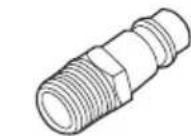
EQ-4 Europe
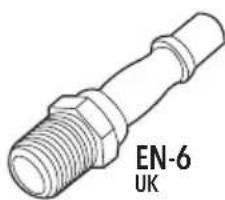
- Please choose the connector that is compatible with the airline system you are using, and install as outlined below:
- Apply some PTFE tape (not included) to the screw threads of the Quick Connector (4). This will help to maintain an air tight seal
Note: Apply PTFE tape tightly and in a clockwise direction, so it does not come off when the thread is screwed into the tool.
- Remove the protective plug from the air inlet
- Using a spanner (not included) screw the quick connector into the air inlet located at the base of the handle
- Connect to airline, pressurise carefully and carry out a leak check (e.g. by spraying small amounts of soapy water on to the outside of the connectors)
Air lines fitted with matching female quick connectors will now be a push fit to the tool
Air supply connection
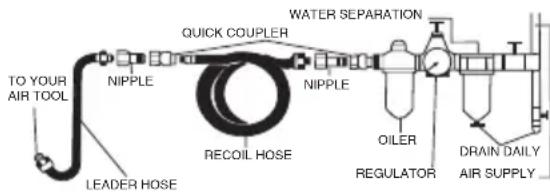
- This tool should be connected to a clean, dry air supply with inline oiler and water separator
- Do not allow supply pressure to exceed the maximum stated (see "Specifications")
- Ensure that water is drained from air system daily
- Ensure that all parts of the system (hoses, couplers, etc.) are correctly rated for the air pressure to be used
Setting tool power
- The tool speed/power can be adjusted by reducing/increasing the air supply pressure within the range specified in 'Specifications'. Further speed adjustments are made by turning the Air Restrictor (3)
- Whilst working with the tool, speed adjustments can be made via the Speed Control Trigger (2)
Fitting a sanding sheet
- Select sanding sheet of the correct grit for the task
- Clamp each end of the sheet under the Front and Rear Clamps (7 & 5)
- Ensure the abrasive paper is pulled tight against the Sanding Pad (6) and aligned so that the pad is completely covered
Operation
- We recommend that you test the machine on scrap material prior to starting work on the workpiece
- Grip the main handle firmly with one hand, so that you can easily operate the Speed Control Trigger (2)
- Squeeze the speed control gently to get used to the way the tool operates
- You can adjust the speed of the tool by adjusting the pressure you apply to the Speed Control Trigger
- Begin by bringing the abrasive paper gently into contact with the workpiece, and slowly build up speed and pressure
Note: The friction between abrasive paper and material will cause heat. Check the workpiece frequently to ensure it does not burn.
Note: DO NOT allow the tool to run in 'idle rotation' for an extended period of time. This will shorten its life.
WARNING: Be aware that air tools may hold residual pressure after use. Always bleed air pressure from the tool after shutting off air supply.
Accessories
- Accessories for this tool are available from your Silverline stockist
- Spare parts can be obtained from your Silverline dealer or toolsparesonline.com
Maintenance
WARNING: Always disconnect from the air supply and depressurise before cleaning or carrying out any maintenance.
Cleaning
- Keep your tool clean at all times. Dirt and dust will cause internal parts to wear quickly, and shorten the machine's service life. Clean the body of your machine with a soft brush, or dry cloth
IMPORTANT: There is very little that can go wrong with your air tool and it should be noted that when an air tool fails to work it is generally because the internal workings have corroded due to dirty, wet air and failure to follow the instructions given below.
Daily maintenance procedure: Disconnect from the air supply, pour the equivalent of a tablespoon of oil into the air intake. Operate the machine at low speed to thoroughly lubricate all internal workings.
If the machine is in constant use or used for long periods at a time, a combined filter/ubricator must be fitted. There must be an air filter fitted at all times
- Use air tool oil. DO NOT UNDER ANY CIRCUMSTANCES USE NORMAL ENGINE OIL
- Failure to comply with the operating and maintenance instructions may invalidate the guarantee
Contact
For technical or repair service advice, please contact the helpline on (+44) 1935 382 222
Web: silverlinetools.com/en-GB/Support
Address:
Powerbox
Boundary Way
Lufton Trading Estate
Yeovil, Somerset
BA22 8HZ, United Kingdom
Storage
- When you store the machine use, always ensure there is oil in the inline oiler. If necessary, top up the oil before packing the machine away neatly in its case
- Failure to comply with the operating and maintenance instructions may invalidate the guarantee
Always store the machine neatly in the case provided - Store this tool carefully in a secure, dry place out of the reach of children
Disposal
Air tools should not be disposed of with household waste
Air tools may contain traces of tool oil and other lubricants and so must be recycle accordingly
- Contact your local waste disposal authority for information on the correct way to dispose of air tools
Troubleshooting
| Problem Possible cause Solution | ||
| Tool operating slowly | Pressure incorrect Set the correct air pressure according to the specification | |
| Dirt within the mechanism Pour oil into air inet as per maintenance instructions | ||
| Air blockage Operate tool in short bursts to clear blockage | ||
| Air leak | Check all fittings and hose for air leaks and correct issue by re-tightening, using PTFE tape or replacing | |
| Blockage in gauze mesh filter Remove Quick Connector (3) and clean mesh filter | ||
| Tool seized | Dirt or rust in mechanism Try 'Tool operating slowly' solutions | |
| Dirt or rust in mechanism Tap tool gently with a soft mallet | ||
| Dirt or rust in mechanism Free mechanism by rotating drive manually when disconnected from air line | ||
| Tool will not stop after trigger is fully released | Throttle valve O-ring or valve seat damaged Have the tool repaired at an authorised Silverline service centre | |
| If the above troubleshooting solutions fail, contact your dealer or an authorised Silverline service centre. | ||
Silverline Tools Guarantee
This Silverline product comes with a 3 year guarantee
Register this product at www.silverinetools.com within 30 days of purchase in order to qualify for the 3 year guarantee. Guarantee period begins according to the date of purchase on your sales receipt.
Registering your purchase
Registration is made at silverlinetools.com by selecting the Guarantee Registration button. You will need to enter:
- Your personal details
Details of the product and purchase information
Once this information is entered your guarantee certificate will be created in PDF format for you to print out and keep with your purchase.
Terms & Conditions
Guarantee period becomes effective from the date of retail purchase as detailed on your sales receipt.
PLEASE KEEP YOUR SALES RECEIPT
If this product develops a fault within 30 days of purchase, return it to the stockist where it was purchased, with your receipt, stating details of the fault. You will receive a replacement or refund.
If this product develops a fault after the 30 day period, return it to:
Silverline Tools Service Centre
PO Box 2988
Yeovil
BA21 1WU,UK
The guarantee claim must be submitted during the guarantee period.
You must provide the original sales receipt indicating the purchase date, your name, address and place of purchase before any work can be carried out.
You must provide precise details of the fault requiring correction.
Claims made within the guarantee period will be verified by Silverline Tools to establish if the deficiencies are related to material or manufacturing of the product.
Carriage will not be refunded. Items for return must be in a suitably clean and safe state for repair, and should be packaged carefully to prevent damage or injury during transportation. We may reject unsuitable or unsafe deliveries.
All work will be carried out by Silverline Tools or its authorized repair agents.
The repair or replacement of the product will not extend the period of guarantee
Defects recognised by us as being covered by the guarantee shall be corrected by means of repair of the tool, free of charge (excluding carriage charges) or by replacement with a tool in perfect working order.
Retained tools, or parts, for which a replacement has been issued, will become the property of Silverline Tools.
The repair or replacement of your product under guarantee provides benefits which are additional to and do not affect your statutory rights as a consumer.
What is covered:
The repair of the product, if it can be verified to the satisfaction of Silverline Tools that the deficiencies were due to faulty materials or workmanship within the guarantee period.
If any part is no longer available or out of manufacture, Silverline Tools will replace it with a functional replacement part.
Use of this product in the EU.
What is not covered:
Silverline Tools does not guarantee repairs required as a result of:
Normal wear and tear caused by use in accordance with the operating instructions eg blades, brushes, belts, bulbs, batteries etc.
The replacement of any provided accessories drill bits, blades, sanding sheets, cutting discs and other related items.
Accidental damage, faults caused by negligent use or care, misuse, neglect, careless operation or handling of the product.
Use of the product for anything other than normal domestic purposes.
Change or modification of the product in any way.
Use of parts and accessories which are not genuine Silverline Tools components.
Faulty installation (except installed by Silverline Tools).
Repairs or alterations carried out by parties other than Silverline Tools or its authorized repair agents.
Claims other than the right to correction of faults on the tool named in these guarantee conditions are not covered by the guarantee.
CE Declaration of Conformity
The undersigned: Mr Darrell Morris
as authorised by: Silverline Tools
Declarethat
This declaration has been issued under the sole responsibility of the manufacturer.
The object of the declaration is in conformity with the relevant Union harmonisation Legislation.
Identification code: 763565
Description: Air Orbital Jitterbug Sander
Conforms to the following directives and standards:
- Machinery Directive 2006/42/EC
EN11148-8:2011
The technical documentation is kept by: Silverline Tools
Date: 27/06/13
Signed:
Mr Darrell Morris
Managing Director
Name and address of the manufacturer:
Powerbox International Limited, Company No. 06897059. Registered address:
Powerbox, Boundary Way, Lufton Trading Estate, Yeovil, Somerset BA22 8HZ, United Kingdom.
Introduction
Lifton Trading Estate
Yeovil, Somerset
Silverline Tools Service Centre
PO Box 2988
Yeovil
BA21 1WU, GroBbritannien
Silverline Tools Service Centre
PO Box 2988
Yeovil
BA21 1WU,GB
Silverline Tools Service Centre
PO Box 2988
Yeovil
BA21 1WU,GB
Alle claims要去en binnen de garantiperiode worden ingediend.
Silverline Tools Service Centre
PO Box 2988
Yeovil
BA21 1WU, UK
Powerbox International Limited, Company No. 06897059. Registered address: Powerbox, Boundary
Way, Lufton Trading Estate, Yeovil, Somerset BA22 8HZ, United Kingdom.
GB 3 Year Guarantee. Register online within 30 days. Terms and Conditions apply.


- Description of Symbols
- Specification
- General Safety
- Work Area Safety
- Personal Safety
- Air Tool Use & Care
- Service
- Air Tool Safety
- Dangerous environment
- Protect your eyes
- Protect your hearing
- Protection from vibration
- Protective clothing
- Use the correct air hose
- Always disconnect
- Do not abuse the tool
- Sanding Tool Safety
- Additional Safety Instructions for Pneumatic Sanding Tools
- Product Familiarisation
- Intended Use
- Unpacking Your Tool
- Before Use
- Fitting the quick connector
- Air supply connection
- Setting tool power
- Fitting a sanding sheet
- Operation
- Accessories
- Maintenance
- Cleaning
- Contact
- Storage
- Disposal
- Troubleshooting
- Silverline Tools Guarantee
- This Silverline product comes with a 3 year guarantee
- Registering your purchase
- Terms & Conditions
- PLEASE KEEP YOUR SALES RECEIPT
- Silverline Tools Service Centre
- PO Box 2988
- Yeovil
- BA21 1WU,UK
- What is covered:
- What is not covered:
- CE Declaration of Conformity
- Introduction
- BA21 1WU,GB
- BA21 1WU, UK
Brand : SILVERLINE
Model : 763565
Category : Sander