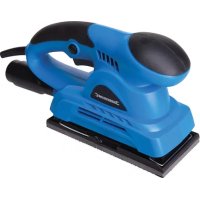
264125 - Sander SILVERLINE - Free user manual and instructions
Find the device manual for free 264125 SILVERLINE in PDF.


| Product type | Orbital 1/3 sheet palm sander |
| Brand | Silverline |
| Model | 264125 |
| Power | 150 W |
| No-load speed | 12,000 rpm |
| Base plate dimensions | 90 x 187 mm |
| Sanding sheet type | Hook-and-loop or conventional |
| Hook-and-loop sheet dimensions | 90 x 190 mm |
| Weight | 1.6 kg |
| Power cable length | 2.5 m |
| Protection class | II (double insulation) |
| IP rating | IP20 |
| Sound pressure (LPA) | 72 dB(A) |
| Sound power (LW) | 83 dB(A) |
| Typical weighted vibrations | 4.45 m/s² |
| Power supply | Mains 230 V ~ 50 Hz |
| Main functions | Light to medium sanding on wood, plastic, painted surfaces |
| Maintenance and cleaning | Disconnect before cleaning; use a soft brush or dry cloth |
| Safety | Double insulation, wear PPE (goggles, FFP2 mask, ear defenders) |
| Spare parts and repairability | Replacement base plate available; repair by authorized professional |
| Warranty | 3 years (online registration within 30 days) |
Frequently Asked Questions - 264125 SILVERLINE
User questions about 264125 SILVERLINE
0 question about this device. Answer the ones you know or ask your own.
Ask a new question about this device
Download the instructions for your Sander in PDF format for free! Find your manual 264125 - SILVERLINE and take your electronic device back in hand. On this page are published all the documents necessary for the use of your device. 264125 by SILVERLINE.
USER MANUAL 264125 SILVERLINE
Description of Symbols
The rating plate on your tool may show symbols. These represent important information about the product or instructions on its use.

Wear hearing protection Wear eye protection
Wear breathing protection Wear head protection

Wear hand protection

Read instruction manual

Double insulated for additional protection

Conforms to relevant legislation and safety standards

Environmental Protection
Waste electrical products should not be disposed of with household waste. Please recycle where facilities exist. Check with your local authority or retailer for recycling advice
| V | Volts |
| ~ | Alternating current |
| A, mA | Ampere, milli-Amp |
| n0 | No load speed |
| n | Rated speed |
| Hz | Hertz |
| W, kW | Watt, kilowatt |
| /min or min-1 | Operations per minute |
| rpm | Revolutions per minute |
| dB(A) | Decibel sound level (A weighted) |
| m/s2 | Metres per second squared (vibration magnitude) |
Specification
Voltage: 230V~50Hz
Power: 150W
No load speed: 12,000min-1
Base measurements: 90 x 187mm
Sanding sheet type: . hook and loop and conventional sanding sheets
Hook & loop sanding sheet dimensions: 90 x 190mm
Protection class:
Ingress protection: IP20
Power cord length: 2.5m
Weight: 1.6kg
Noise and vibration information:
Sound pressure L 72dB(A)
Sound power L .83dB(A)
Uncertainty K: 3dB
Typical weighted vibration a 4.45m/s2
Uncertainty K: 1.5m/s²
As part of our ongoing product development, specifications of Silverline products may alter without notice.
The sound intensity level for the operator may exceed 85dB(A) and sound protection measures are necessary.
WARNING: Always wear ear protection where the sound level exceeds 85dB(A) and limit the time of exposure if necessary. If sound levels are uncomfortable, even with ear protection, stop using the tool immediately and check the ear protection is correctly fitted and provides the correct level of sound attenuation for the level of sound produced by your tool.
WARNING: User exposure to tool vibration can result in loss of sense of touch, numbness, tingling and reduced ability to grip. Long term exposure can lead to a chronic condition. If necessary, limit the length of time exposed to vibration and use anti-vibration gloves. DO NOT operate the tool with hands below a normal comfortable temperature, as vibration will have a greater effect. Use the figures provided in the specification relating to vibration to calculate the duration and frequency of operating the tool.
Sound and vibration levels in the specification are determined according to EN60745 or similar international standards. The figures represent normal use for the tool in normal working conditions. A poorly maintained, incorrectly assembled, or misused tool, may produce increased levels of noise and vibration.
www.osha.europa.eu provides information on sound and vibration levels in the workplace that may be useful to domestic users who use tools for long periods of time.
General Safety
WARNING Read all safety warnings and all instructions. Failure to follow the warnings and instructions may result in electric shock, fire and/or serious injury.
WARNING: This appliance is not intended for use by persons (including children) with reduced, physical or mental capabilities or lack of experience or knowledge unless they have been given supervision or instruction concerning use of the appliance by a person responsible for their safety. Children must be supervised to ensure that they do not play with the appliance.
Save all warnings and instructions for future reference.
The term "power tool" in the warnings refers to your mains-operated (corded) power tool or battery-operated (cordless) power tool.
1) Work area safety
a) Keep work area clean and well lit. Cluttered or dark areas invite accidents
b) Do not operate power tools in explosive atmospheres, such as in the presence of flammable liquids, gases or dust. Power tools create sparks which may ignite the dust or fumes.
c) Keep children and bystanders away while operating a power tool. Distractions can cause you to lose control.
2)Electrical safety
a) Power tool plugs must match the outlet. Never modify the plug in any way. Do not use any adapter plugs with earthed (grounded) power tools. Unmodified plugs and matching outlets will reduce risk of electric shock.
b) Avoid body contact with earthed or grounded surfaces, such as pipes, radiators, ranges and refrigerators. There is an increased risk of electric shock if your body is earthed or grounded.
c) Do not expose power tools to rain or wet conditions. Water entering a power tool will increase the risk of electric shock.
d) Do not abuse the cord. Never use the cord for carrying, pulling or unplugging the power tool. Keep cord away from heat, oil, sharp edges or moving parts. Damaged or entangled cords increase the risk of electric shock.
e) When operating a power tool outdoors, use an extension cord suitable for outdoor use. Use of a cord suitable for outdoor use reduces the risk of electric shock.
f) If operating a power tool in a damp location is unavoidable, use a residual current device (RCD) protected supply. Use of an RCD reduces the risk of electric shock.
9) When used in Australia or New Zealand, it is recommended that this tool is ALWAYS supplied via Residual Current Device (RCD) with a rated residual current of 30mA or less.
3)Personal safety
a) Stay alert, watch what you are doing and use common sense when operating a power tool. Do not use a power tool while you are tired or under the influence of drugs, alcohol or medication. A moment of inattention wh*"/=ile operating power tools may result in serious personal injury.
b) Use personal protective equipment. Always wear eye protection. Protective equipment such as dust mask, non-skid safety shoes, hard hat, or hearing protection used for appropriate conditions will reduce personal injuries.
c) Prevent unintentional starting. Ensure the switch is in the off-position before connecting to power source and/or battery pack, picking up or carrying the tool. Carrying power tools with your finger on the switch or energising power tools that have the switch on invites accidents.
d) Remove any adjusting key or wrench before turning the power tool on. A wrench or a key left attached to a rotating part of the power tool may result in personal injury.
e) Do not overreach. Keep proper footing and balance at all times. This enables better control of the power tool in unexpected situations.
f) Dress properly. Do not wear loose clothing or jewellery. Keep your hair, clothing and gloves away from moving parts. Loose clothes, jewellery or long hair can be caught in moving parts.
4) Power Tool Use & Care
a) Do not force the power tool. Use the correct power tool for your application. The correct power tool will do the job better and safer at the rate for which it was designed.
b) Do not use the power tool if the switch does not turn it on and off. Any power tool that cannot be controlled with the switch is dangerous and must be repaired.
c) Disconnect the plug from the power source and/or the battery pack from the power tool before making any adjustments, changing accessories, or storing power tools. Such preventive safety measures reduce the risk of starting the power tool accidentally.
d) Store idle power tools out of the reach of children and do not allow persons unfamiliar with the power tool or these instructions to operate the power tool. Power tools are dangerous in the hands of untrained users.
e) Maintain power tools. Check for misalignment or binding of moving parts, breakage of parts and any other condition that may affect the power tool's operation. If damaged, have the power tool repaired before use. Many accidents are caused by poorly maintained power tools.
f) Keep cutting tools sharp and clean. Properly maintained cutting tools with sharp cutting edges are less likely to bind and are easier to control.
g) Use the power tool, accessories and tool bits etc. in accordance with these instructions, taking into account the working conditions and the work to be performed. Use of the power tool for operations different from those intended could result in a hazardous situation.
5)Service
a) Have your power tool serviced by a qualified repair person using only identical replacement parts. This will ensure that the safety of the power tool is maintained.
Sanding Tool Safety
- Before connecting the tool to a power source, ensure that the voltage supply matches that specified on the rating plate of the tool
- Always wear appropriate protective equipment, including a dust mask with a minimum FFP2 rating, safety goggles and ear defenders
- Ensure all people in the vicinity of the work area are also equipped with suitable personal protective equipment
- Take special care when sanding some woods (such as beech, oak, mahogany and teak), as the dust produced is toxic and can cause extreme reactions
- Do not sand magnesium or alloys containing a high percentage of magnesium
- Be aware of paint finishes or treatments that may have been applied to the material that is being sanded. Many treatments can create dust that is toxic, or otherwise harmful. If working on a building constructed prior to 1960, there is an increased chance of encountering lead-based paints
- The dust produced when sanding lead-based paints is particularly hazardous to children, pregnant women, and people with high blood pressure. Do not allow these people near to the work area, even if wearing appropriate personal protective equipment
- Whenever possible, use a vacuum dust extraction system to control dust and waste
- Be especially careful when using a machine for both wood and metal sanding. Sparks from metal can easily ignite wood dust. Always clean your machine thoroughly to reduce the risk of fire
- Work surfaces and sandpaper can become very hot during use, if there is evidence of burning (smoke or ash) from the work surface, stop and allow the material to cool. Do not touch the work surface or sandpaper until they have had time to cool
- Do not touch the moving sanding paper
Always switch off before placing the sander down - Always unplug the sander from the mains power supply before changing or replacing sandpaper
- Even when this tool is used as prescribed it is not possible to eliminate all residual risk factors. If you are in any doubt as to safe use of this tool, do not use it
Product Familiarisation
1 On/Off Trigger Switch
2 Lock-On Button
3 Standing Base
4 Quick-Change Levers for Conventional Sanding Sheets
5 Dust Extraction Adapter
6 Main Handle
7 Front Handle
Included accessories:
1 hook and loop sanding sheet (100 grit),
1 conventional sanding sheet (100 grit)
Intended Use
Electric orbital sheet sander for light to medium duty sanding tasks on wood, plastic, painted surfaces and other surface coatings
WARNING: This sander is NOT suitable for wet sanding.
Unpacking Your Tool
- Carefully unpack and inspect your tool. Familiarise yourself with all its features and functions. Ensure that all parts of the tool are present and in good condition
- If any parts are missing or damaged, have such parts replaced before attempting to use this tool
Before Use
WARNING: Ensure the sander is disconnected from the power supply before attaching or changing any accessories.
- This sander is supplied fully assembled, but the Dust Extraction Adapter (5) needs to be connected to a dust extraction system before use
Connecting the dust extraction system
- The Dust Extraction Adapter (5) is a two-part device
- The rounded rectangular end of the adapter fits onto the sander
Note: Inserted into the round end of the adapter is a removable reducer, which may or may not be required to fit the sander to a standard vacuum cleaner or workshop dust extraction system, depending on the diameter and connector of the hose used
- Push the Dust Extraction Adapter (5) on to the dust extraction port on the machine
-
Push the hose of a vacuum cleaner or workshop dust extraction system onto the dust extraction adapter
-
To remove, pull the vacuum hose off the adapter
Notes:
- Ensure the sanding sheets used are hole-punched for use with sanders featuring dust extraction. Ensure the holes in the sanding sheet line up with the holes in the sanding base of the tool. If using a sanding sheet with no dust extraction holes, refer to section 'Changing the sanding sheet (conventional non-hook-and-loop sanding sheets)' of this manual
WARNING: When sanding metal, ensure your dust extraction system is suitable and free of any remaining wood dust. Hot metal particles and sparks could ignite residual wood dust, and cause the dust extraction system to catch fire. Always clean tools THOROUGHLY when switching from sanding wood to sanding metal, and vice versa.
WARNING: Always connect the sander to a suitable vacuum cleaner or workshop dust extraction system if the sanding dust contains harmful substances, such as particles from old paint, varnish, surface coatings etc. Always dispose of harmful dust according to laws and regulations.
WARNING: Take special care to guard against harmful and toxic dusts when sanding lead-based painted surfaces, woods and metals, particularly if you are unsure about the exact substances involved. All persons entering the work area must wear a mask specially designed for protection against the toxic dust and fumes involved. Children and pregnant women MUST NOT enter the work area. DO NOT eat, drink or smoke in the work area.
Selecting the right grade of sanding sheet
Note: Always use good quality sanding sheets to maximise the quality of the finished task. Always test the sander on a scrap piece of material to determine whether the sanding sheet is suitable for the intended task:
- Coarse (60 grit) for use on rough material
Medium (120 grit) for smoothing off
Fine (240 grit) for finishing
Note: DO NOT use sanding sheets designed for wet sanding.
Changing the sanding sheet (hook and loop)
WARNING: Always switch off and disconnect from the power supply before changing the sanding sheet.
- Remove the old hook and loop sanding sheet, if fitted, by peeling it away from the machine's hook and loop Sanding Base (3)
- Clean any dust or debris from the hook and loop sanding base
- Align the dust extraction holes in the new sanding sheet with those of the base and press the sheet firmly in place
Changing the sanding sheet (conventional non-hook-and-loop sanding sheets)
WARNING: Always switch off and disconnect from the power supply before changing the sanding sheet.
- Release the Quick-Change Levers for Conventional Sanding Sheets (4) from both sides of the Sanding Base (3). Remove any old sanding sheet
- Clean any dust or debris from the sanding base and lever mechanisms
- Align the dust extraction holes in the new sanding sheet with the holes of the sanding base
- Fit one side of the sheet under one of the quick-change levers and close the lever
- Push the other end of the sanding sheet under the quick-change lever on the opposite side of the sanding base. Push the sheet so it sits tightly in line with the base, and close the second lever
WARNING: If the sanding sheet is not tightly clamped over the Sanding Base (3), it will wear excessively. Always make sure the sanding base is completely covered by the sanding sheets, as you might otherwise cause damage to the surface of the base and the workpiece.
Note: If you are using conventional, non-hook-and-loop sanding sheets with no punched holes, the dust extraction system of this sander WILL NOT FUNCTION. Use a suitable tool to manually punch holes through the sanding sheet, exactly where the dust extraction holes in the base of the sander are located. Take care not to damage the hook and loop surface of the base.
Operation
Switching on and off
WARNING: Always wear safety goggles, an adequate dust mask, hearing protection and suitable gloves, when working with this tool.
WARNING: Never switch the sander on when the base is in contact with the workpiece or any other surface, as this might cause the operator to lose control over the machine, and lead to serious injury.
- Connect the sander to the mains power supply
- Squeeze the On/Off Trigger Switch (1) located below the main handle, to switch the sander on
- Release the trigger switch to switch the sander off
Note: If you wish the sender to remain on, squeeze the On/Off Trigger Switch (1), then push the Lock-On Button (2) and release the trigger. The machine will continue to operate until the trigger switch is squeezed again, whereby the lock-on button is released.
WARNING: Always wait until the machine has stopped vibrating completely before putting it down. Always disconnect from the power supply after use.
Sanding
WARNING: Always wear safety goggles, an adequate dust mask, hearing protection and suitable gloves, when working with this sander.
Note: DO NOT continue to use worn, torn, or heavily clogged sanding sheets. Ensure foreign objects, such as nails and screws, are removed from the workpiece before commencing sanding.
WARNING: DO NOT use a sanding sheet on wood that has previously been used on metal. This may cause scouring on the wooden surface. DO NOT use this sander for sanding magnesium, or for wet sanding.
WARNING: NEVER touch the moving sanding sheet.
Note: Always use clamps to secure your workpiece to the workbench wherever possible.
- Grip both, the Main Handle (6) and Front Handle (7) firmly, and switch the sander on
- Move the machine in a circular motion over the workpiece surface, applying an even, moderate pressure (Fig. D), until you reach the desired surface finish
Note: Apply moderate pressure only. Excess pressure will not lead to a faster removal of material, but will damage the sanding sheet and the machine.
-
If there are still scratches on your workpiece after sanding, try either of the following:
-
Return to a coarser grit sanding sheet and sand the marks out before recommencing with the original choice of sanding sheet or,
- Try using a new sanding sheet of the same grit to eliminate the unwanted marks before progressing to a finer grit and finishing the job
WARNING: Do not allow the sandpaper to completely wear down before replacing it. Failure to observe these precautionary measures can lead to damage to the hook and loop surfaces, resulting in sanding sheets failing to attach properly.
Accessories
- A full range of sanding sheets and accessories is available from your Silverline dealer
Maintenance
WARNING: Always disconnect from the power supply before carrying out any inspection, maintenance or cleaning.
General inspection
Regularly check that all the fixing screws are tight. They may vibrate loose over time
- Inspect the supply cord of the tool, prior to each use, for damage or wear. Repairs should be carried out by an authorised Silverline service centre. This advice also applies to extension cords used with this tool
Cleaning
WARNING: ALWAYS wear protective equipment including eye protection and gloves when cleaning this tool.
- Keep your tool clean at all times. Dirt and dust will cause internal parts to wear quickly, and shorten the device's service life
- Clean the body of your machine with a soft brush, or dry cloth
- Never use caustic agents to clean plastic parts. If dry cleaning is not sufficient, a mild detergent on a damp cloth is recommended
Water must never come into contact with the tool - Ensure the tool is thoroughly dry before using it
If available, use clean, dry, compressed air to blow through the ventilation holes (where applicable)
Hook and loop surfaces
- Hook and loop surfaces need to be clean, free of dirt and foreign matter, such as hair, fibres, sand etc.
- In order to provide adequate adhesion for securing accessories, hook and loop surfaces must be in good condition
- When used extensively, hooks and loops will become elongated or broken, and the mechanism will be unable to provide the required strength of adhesion
Note: This sander's hook and loop Sanding Base (3) is NOT a warranty item. Replacement plates can be fitted at an authorised Silverline service centre.
Storage
- Store this tool carefully in a secure, dry place, out of the reach of children
Disposal
Always adhere to national regulations when disposing of power tools that are no longer functional and are not viable for repair.
- Do not dispose of power tools, or other waste electrical and electronic equipment (WEEE), with household waste
- Contact your local waste disposal authority for information on the correct way to dispose of power tools
Silverline Tools Guarantee
This Silverline product comes with a 3 year guarantee
Register this product at www.silverfinetools.com within 30 days of purchase in order to qualify for the 3 year guarantee. Guarantee period begins according to the date of purchase on your sales receipt.
Registering your purchase
Registration is made at silverlinetools.com by selecting the Guarantee Registration button. You will need to enter:-
- Your personal details
- Details of the product and purchase information
Once this information is entered your guarantee certificate will be created in PDF format for you to print out and keep with your purchase.
Terms & Conditions
Guarantee period becomes effective from the date of retail purchase as detailed on your sales receipt.
PLEASE KEEP YOUR SALES RECEIPT
If this product develops a fault within 30 days of purchase, return it to the stockist where it was purchased, with your receipt, stating details of the fault. You will receive a replacement or refund.
If this product develops a fault after the 30 day period, return it to:
Silverline Tools Service Centre
PO Box 2988
Yeovil
BA21 1WU, UK
The guarantee claim must be submitted during the guarantee period.
You must provide the original sales receipt indicating the purchase date, your name, address and place of purchase before any work can be carried out.
You must provide precise details of the fault requiring correction.
Claims made within the guarantee period will be verified by Silverline Tools to establish if the deficiencies are related to material or manufacturing of the product.
Carriage will not be refunded. Items for return must be in a suitably clean and safe state for repair, and should be packaged carefully to prevent damage or injury during transportation. We may reject unsuitable or unsafe deliveries.
All work will be carried out by Silverline Tools or its authorized repair agents.
The repair or replacement of the product will not extend the period of guarantee
Defects recognised by us as being covered by the guarantee shall be corrected by means of repair of the tool, free of charge (excluding carriage charges) or by replacement with a tool in perfect working order.
Retained tools, or parts, for which a replacement has been issued, will become the property of Silverline Tools.
The repair or replacement of your product under guarantee provides benefits which are additional to and do not affect your statutory rights as a consumer.
What is covered:
The repair of the product, if it can be verified to the satisfaction of Silverline Tools that the deficiencies were due to faulty materials or workmanship within the guarantee period.
If any part is no longer available or out of manufacture, Silverline Tools will replace it with a functional replacement part.
Use of this product in the EU.
What is not covered:
Silverline Tools does not guarantee repairs required as a result of:
Normal wear and tear caused by use in accordance with the operating instructions eg blades, brushes, belts, bulbs, batteries etc.
The replacement of any provided accessories drill bits, blades, sanding sheets, cutting discs and other related items.
Accidental damage, faults caused by negligent use or care, misuse, neglect, careless operation or handling of the product.
Use of the product for anything other than normal domestic purposes.
Change or modification of the product in any way.
Use of parts and accessories which are not genuine Silverline Tools components.
Faulty installation (except installed by Silverline Tools).
Repairs or alterations carried out by parties other than Silverline Tools or its authorized repair agents.
Claims other than the right to correction of faults on the tool named in these guarantee conditions are not covered by the guarantee.
Battery Guarantee
Silverline batteries are guaranteed for 30 days. If a defect occurs on a registered battery during the term of the Battery Guarantee, due to material or manufacturing fault, then Silverline will replace it free of charge. This guarantee does not apply to commercial use nor does it extend to normal wear and tear or damage as a result of accident, abuse or misuse.
CE Declaration of Conformity
The undersigned: Mr Darrell Morris
as authorised by: Silverline Tools
Declaresthat
This declaration has been issued under the sole responsibility of the manufacturer.
The object of the declaration is in conformity with the relevant Union harmonisation Legislation.
Identification code: 264125
Description: 150W Orbital Sander 1/3 Sheet
Conforms to the following directives and standards:
- Machinery Directive 2006/42/EC
Low Voltage Directive 2014/35/EC
EMC Directive 2014/30/EC
RoHS Directive 2011/65/EU
EN60745-1:2009+A11
EN60745-2-4:2009+A11
EN55014-1:2006+A1+A2
EN55014-2:1997+A1+A2
EN61000-3-2:2014
EN61000-3-3:2013
Notified body: Intertek
The technical documentation is kept by: Silverline Tools
Date: 14/04/2016
Signed:

Mr Darrell Morris
Managing Director
Name and address of the manufacturer:
Powerbox International Limited, Company No. 06897059. Registered address:
Central House, Church Street, Yeovil, Somerset BA20 1HH, United Kingdom.
Tension: 230 V~, 50 Hz
Puissance : 150 W
Silverline Tools Service Centre
PO Box 2988
Yeovil
Silverline Tools Service Centre
PO Box 2988
Yeovil
Tension: 230 V~, 50 Hz
Potencia: 150 W
Signor Darrell Morris
Central House, Church Street, Yeovil, Somerset BA20 1HH, Regno Unito.
Silverline Tools Service Centre
PO Box 2988
Yeovil
BA21 1WU, GB
*Register online within 30 days. Terms & Conditions apply

Garantie de 3 ans


- Description of Symbols
- Environmental Protection
- Specification
- Noise and vibration information:
- General Safety
- 1) Work area safety
- 2)Electrical safety
- 3)Personal safety
- 4) Power Tool Use & Care
- 5)Service
- Sanding Tool Safety
- Product Familiarisation
- Included accessories:
- Intended Use
- Unpacking Your Tool
- Before Use
- Connecting the dust extraction system
- Notes:
- Selecting the right grade of sanding sheet
- Changing the sanding sheet (hook and loop)
- Changing the sanding sheet (conventional non-hook-and-loop sanding sheets)
- Operation
- Switching on and off
- Sanding
- Accessories
- Maintenance
- General inspection
- Cleaning
- Hook and loop surfaces
- Storage
- Disposal
- Silverline Tools Guarantee
- This Silverline product comes with a 3 year guarantee
- Registering your purchase
- Terms & Conditions
- PLEASE KEEP YOUR SALES RECEIPT
- Silverline Tools Service Centre
- BA21 1WU, UK
- What is covered:
- What is not covered:
- Battery Guarantee
- CE Declaration of Conformity
- Signed:
- PO Box 2988
- Yeovil
- BA21 1WU, GB
- Garantie de 3 ans
Brand : SILVERLINE
Model : 264125
Category : Sander