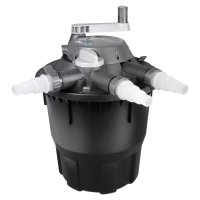
Bioforce Revolution 18000 - Water filter HOZELOCK - Free user manual and instructions
Find the device manual for free Bioforce Revolution 18000 HOZELOCK in PDF.



| Product type | Pressurized water filter for garden pond |
| Brand | Hozelock |
| Model | Bioforce Revolution 18000 |
| Power supply | 230 V ~ 50 Hz |
| UV-C lamp power | 18 W |
| Maximum flow rate (Qmax) | 18 000 l/h |
| Protection rating | IP57 |
| Maximum water temperature | 35 °C |
| Power cable length | 5 m |
| Cleaning system | Cleaning crank with rotating yellow blades |
| Filtration type | Mechanical (Cypricube foam), biological (media), UV-C |
| Maximum pond capacity (with fish) | Not specified in the manual |
| Maximum pond capacity (without fish) | Not specified in the manual |
| Pipe connection | Spouts for 25, 32 and 40 mm hoses |
| Main functions | Water clarification, debris removal, organic waste conversion |
| Routine maintenance | Cleaning with crank (a few minutes), rinsing the foams |
| UV lamp replacement | Every 12 months |
| Cypricube foam replacement | Annually, preferably in winter or early spring |
| Electrical safety | Residual current circuit breaker (RCCB) 30 mA mandatory, earthing |
| UV safety | Circuit breaker if housing opened, do not operate in open air |
| Installation | Vertical, above ground or partially buried, non-submersible |
| Winter protection | Store in a dry, cold place, lid removed for ventilation |
| Warranty | 2 years (excluding UV lamp), Clear Water Guarantee 12 months under conditions |
| Available spare parts | UV lamp, Cypricube foam, quartz tube, seals, crank |
| Customer service | www.hozelock.com, phone +44 121 313 1122 |
Frequently Asked Questions - Bioforce Revolution 18000 HOZELOCK
User questions about Bioforce Revolution 18000 HOZELOCK
0 question about this device. Answer the ones you know or ask your own.
Ask a new question about this device
Download the instructions for your Water filter in PDF format for free! Find your manual Bioforce Revolution 18000 - HOZELOCK and take your electronic device back in hand. On this page are published all the documents necessary for the use of your device. Bioforce Revolution 18000 by HOZELOCK.
USER MANUAL Bioforce Revolution 18000 HOZELOCK
BIOFORCE REVOLUTION 12/18/28000
natural_image
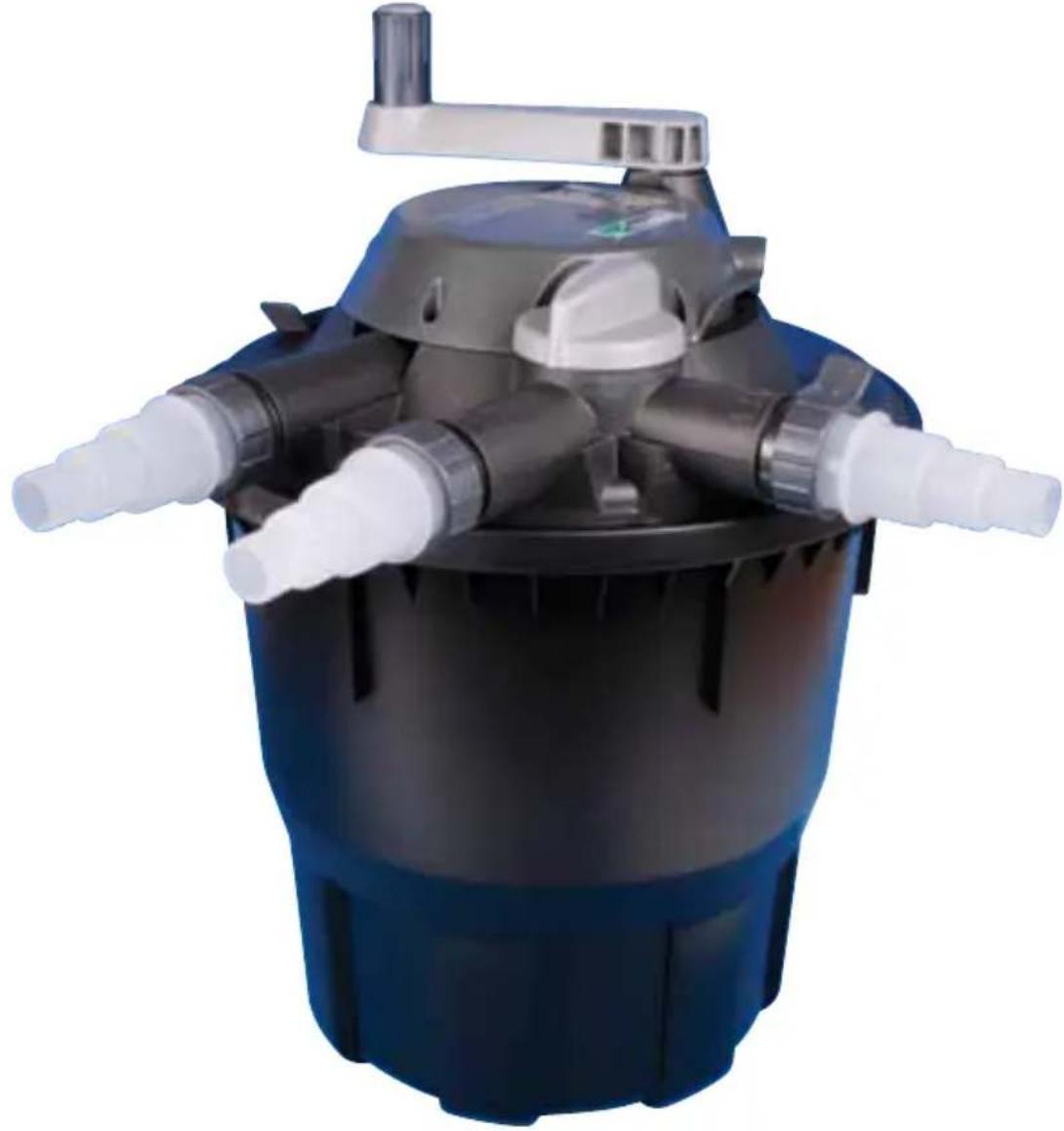
3D rendering of a mechanical device with blue and black casing, featuring white pipes and a metallic top (no text or symbols visible)
Year guarantee
Ans de garantie
Jahre garantie
Jaat garantie
Años de garantía
Χρόνια εγγύηση

text_image
www.hozelock.com HOZELOCK Hozelock Ltd. Midpoint Park, Birmingham, B76 1AB. England Tel: +44 (0) 121 313 1122 www.hozelock.com 33853-000Hazelock Ltd. Midpoint Park, Birmingham, B76 1AB. England Tel: +44 (0) 121 313 1122
www.hozelock.com
33853-000
Contents • Contenu • Inhalt • Inhoud • Contenidos • Innehåll • Innhold • Sisältö • Indhold • Indice • Conteúdo Zawartość • Періехóμενα • İçindekiler • Tartalom • Obsah • Содержание • Sisukord • Saturs • Turinys Cuprins • Зміст • Vsebina
natural_image
Technical line drawing of a mechanical device with cylindrical components and mounting holes (no text or symbols)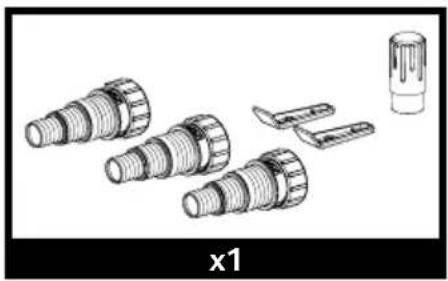
natural_image
Illustration of multiple mechanical connectors and a cylindrical component, labeled 'x1' (no text or symbols on components)
text_image
解决概念法 x1Assembly • Assemblage • Montage • Samenstelling • Montaje • Montering • Montering • Kokoaminen • Montering Montaggio • Montagem • Montaż • Συγκρότημα • Montaj • Összeszerelés • Sestava • Сборка • Koostamine Montāža • Surinkimas • Ansamblu • Монтаж • Sestav
text_image
2 a b g g h j i l n o m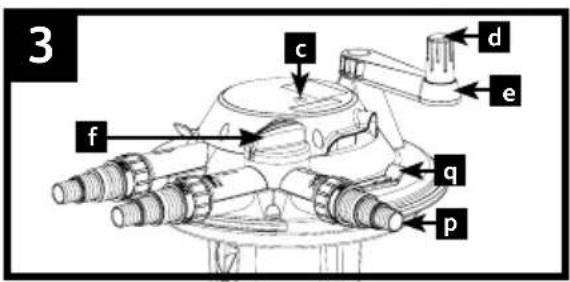
text_image
3 c d e f q p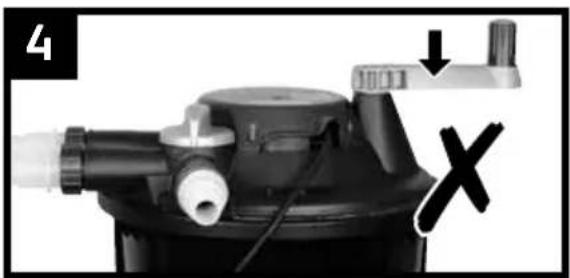
natural_image
Close-up of a mechanical device with labeled ports and an arrow pointing to a component (no readable text or symbols)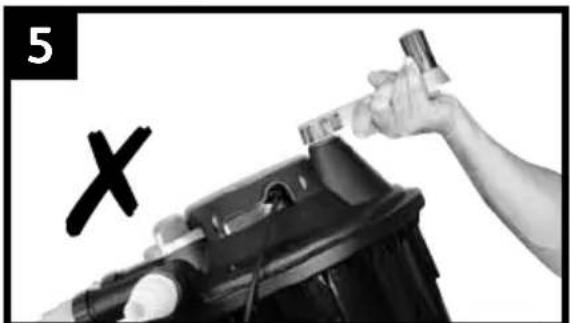
natural_image
Black-and-white photo of a hand using a tool to clean or install a battery, with a large 'X' symbol nearby (no text or symbols on the main subject)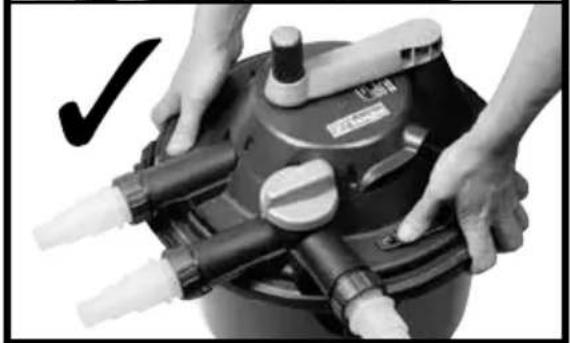
natural_image
Close-up of hands operating a mechanical pump device with valves and tubing (no visible text or symbols)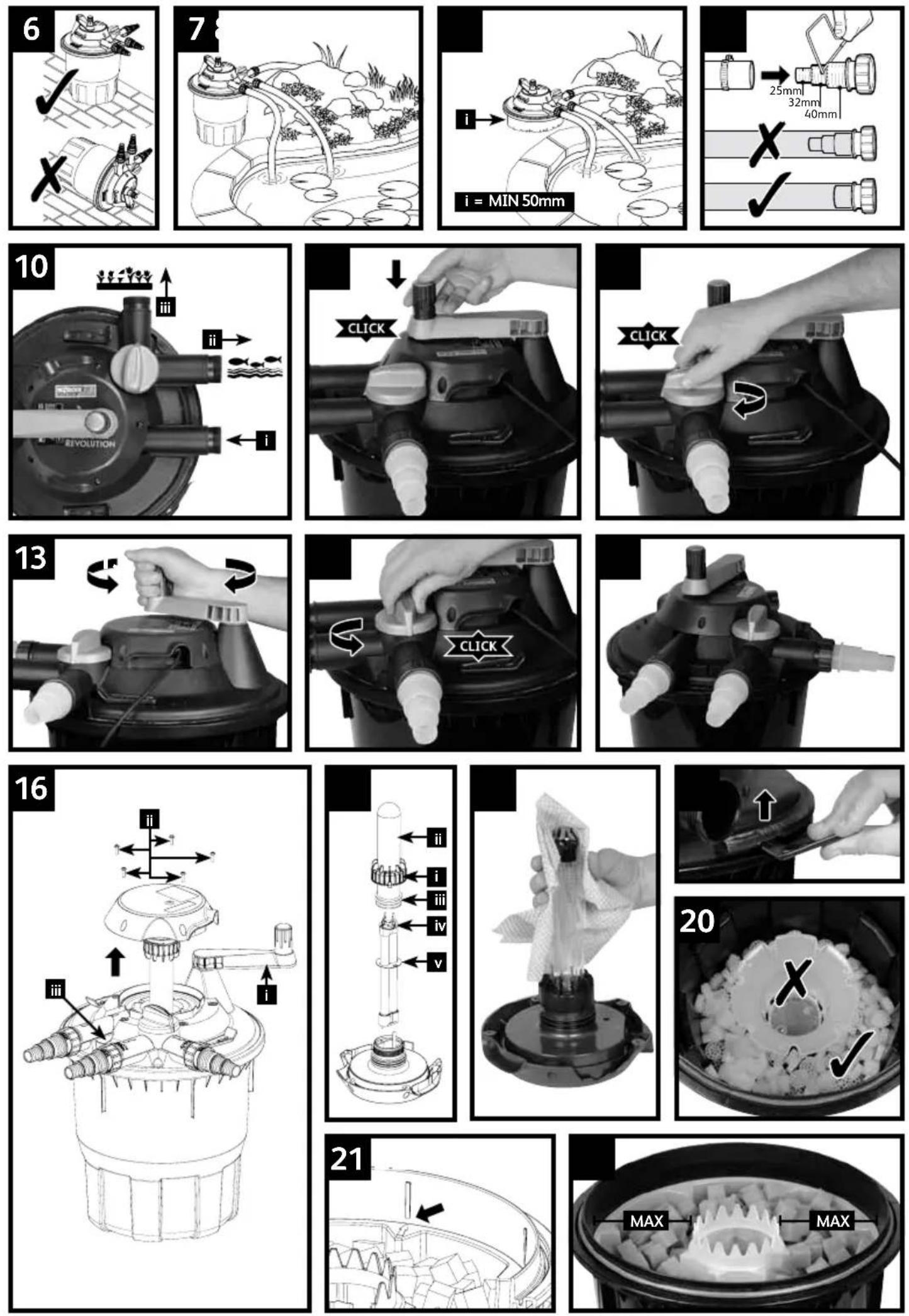
GB
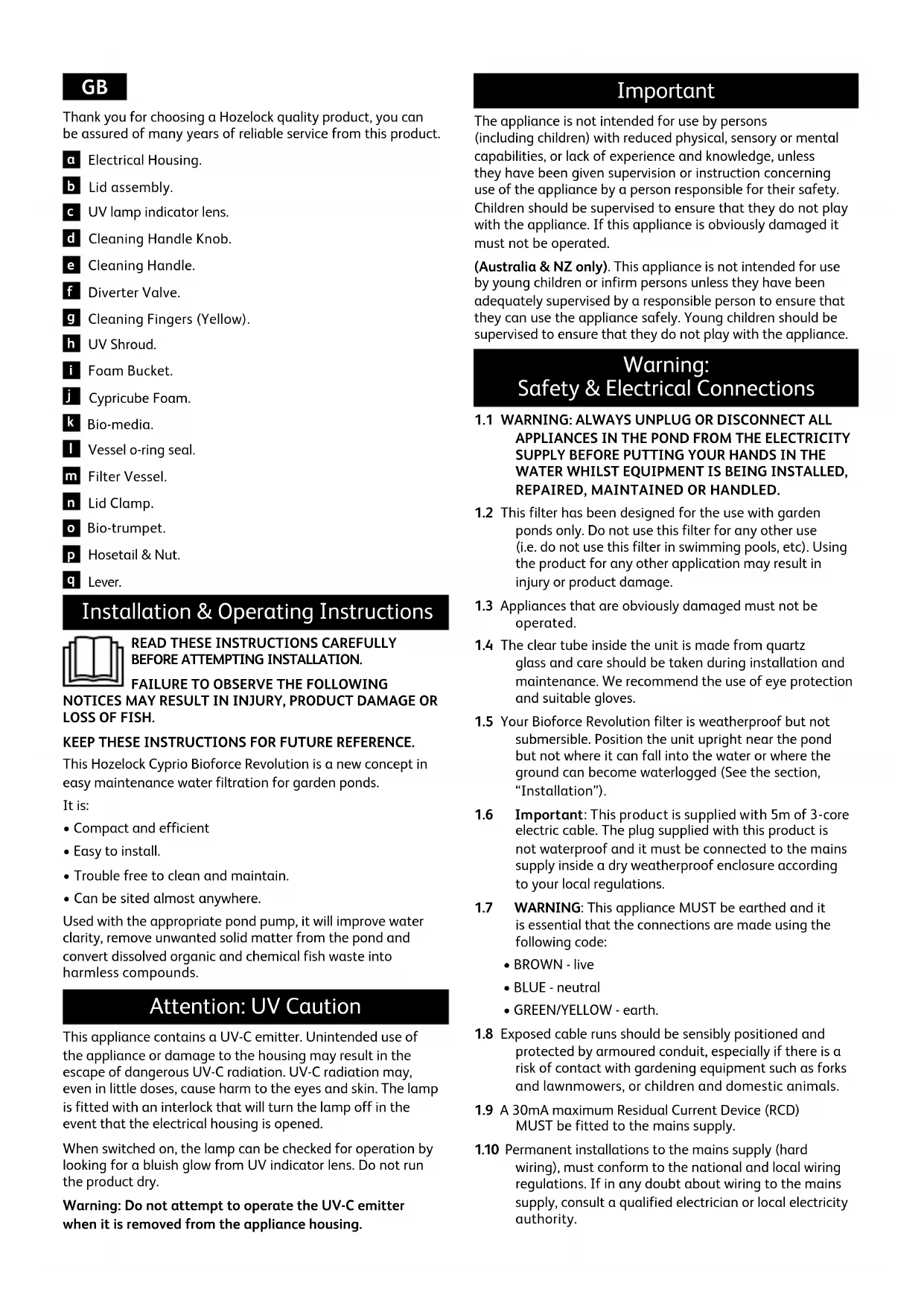
Thank you for choosing a Hozelock quality product, you can be assured of many years of reliable service from this product.
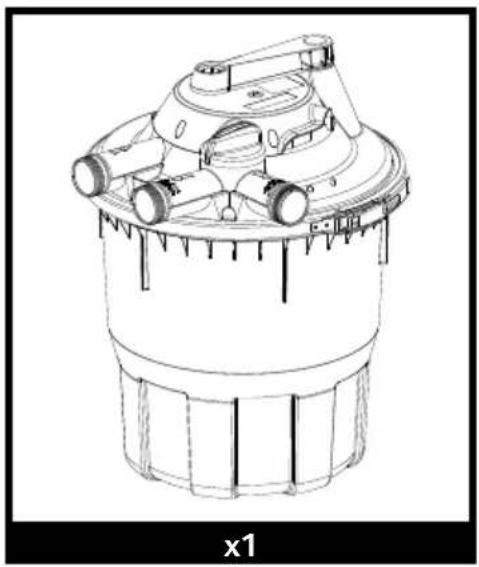
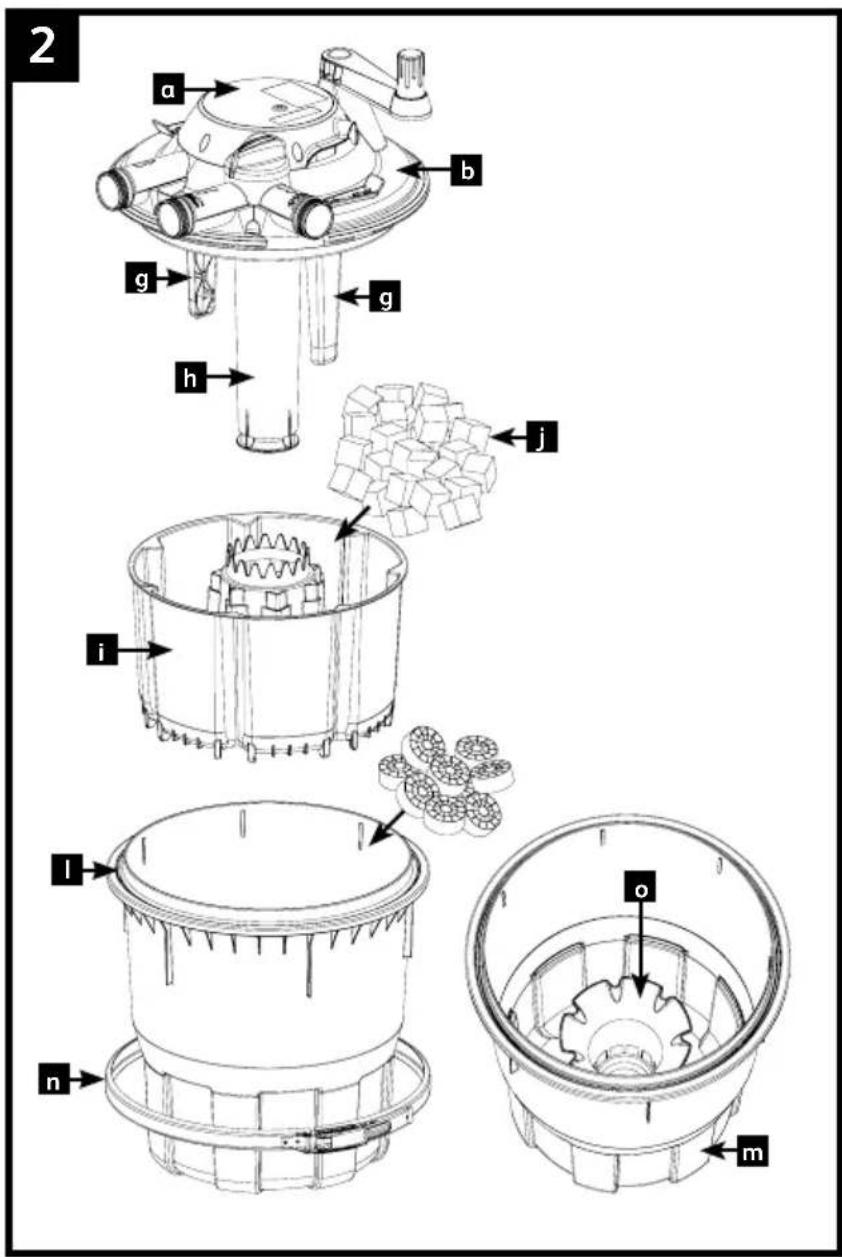
a Electrical Housing.
b Lid assembly.
c UV lamp indicator lens.
d Cleaning Handle Knob.
e Cleaning Handle.
f Divterter Valve.
9 Cleaning Fingers (Yellow).
h UV Shroud.
i Foam Bucket.
j Cypricube Foam.
k Bio-media.
Vessel o-ring seal.
m Filter Vessel.
n Lid Clamp.
o Bio-trumpet.
p Hosetail & Nut.
q Lever.
Installation & Operating Instructions

READ THESE INSTRUCTIONS CAREFULLY BEFORE ATTEMPTING INSTALLATION.
FAILURE TO OBSERVE THE FOLLOWING
NOTICES MAY RESULT IN INJURY, PRODUCT DAMAGE OR LOSS OF FISH.
KEEP THESE INSTRUCTIONS FOR FUTURE REFERENCE.
This Hozelock Cyprio Bioforce Revolution is a new concept in easy maintenance water filtration for garden ponds.
It is:
- Compact and efficient
- Easy to install.
- Trouble free to clean and maintain.
- Can be sited almost anywhere.
Used with the appropriate pond pump, it will improve water clarity, remove unwanted solid matter from the pond and convert dissolved organic and chemical fish waste into harmless compounds.
Attention: UV Caution
This appliance contains a UV-C emitter. Unintended use of the appliance or damage to the housing may result in the escape of dangerous UV-C radiation. UV-C radiation may, even in little doses, cause harm to the eyes and skin. The lamp is fitted with an interlock that will turn the lamp off in the event that the electrical housing is opened.
When switched on, the lamp can be checked for operation by looking for a bluish glow from UV indicator lens. Do not run the product dry.
Warning: Do not attempt to operate the UV-C emitter when it is removed from the appliance housing.
Important
The appliance is not intended for use by persons (including children) with reduced physical, sensory or mental capabilities, or lack of experience and knowledge, unless they have been given supervision or instruction concerning use of the appliance by a person responsible for their safety.
Children should be supervised to ensure that they do not play with the appliance. If this appliance is obviously damaged it must not be operated.
(Australia & NZ only). This appliance is not intended for use by young children or infirm persons unless they have been adequately supervised by a responsible person to ensure that they can use the appliance safely. Young children should be supervised to ensure that they do not play with the appliance.
Warning: Safety & Electrical Connections
1.1 WARNING: ALWAYS UNPLUG OR DISCONNECT ALL APPLIANCES IN THE POND FROM THE ELECTRICITY SUPPLY BEFORE PUTTING YOUR HANDS IN THE WATER WHILST EQUIPMENT IS BEING INSTALLED, REPAIRED, MAINTAINED OR HANDLED.
1.2 This filter has been designed for the use with garden ponds only. Do not use this filter for any other use (i.e. do not use this filter in swimming pools, etc). Using the product for any other application may result in injury or product damage.
1.3 Appliances that are obviously damaged must not be operated.
1.4 The clear tube inside the unit is made from quartz glass and care should be taken during installation and maintenance. We recommend the use of eye protection and suitable gloves.
1.5 Your Bioforce Revolution filter is weatherproof but not submersible. Position the unit upright near the pond but not where it can fall into the water or where the ground can become waterlogged (See the section, "Installation").
1.6 Important: This product is supplied with 5m of 3-core electric cable. The plug supplied with this product is not waterproof and it must be connected to the mains supply inside a dry weatherproof enclosure according to your local regulations.
1.7 WARNING: This appliance MUST be earthed and it is essential that the connections are made using the following code:
• BROWN - live
- BLUE - neutral
- GREEN/YELLOW - earth.
1.8 Exposed cable runs should be sensibly positioned and protected by armoured conduit, especially if there is a risk of contact with gardening equipment such as forks and lawnmowers, or children and domestic animals.
1.9 A 30mA maximum Residual Current Device (RCD) MUST be fitted to the mains supply.
1.10 Permanent installations to the mains supply (hard wiring), must conform to the national and local wiring regulations. If in any doubt about wiring to the mains supply, consult a qualified electrician or local electricity authority.
1.11 Never use the mains supply cable or cleaning handle to lift or move the filter, as this may cause damage. If the filter needs to be moved, the product should be switched off and drained of water first. Then lift the product by gripping the area where the lid is clamped to the main vessel.
1.12 Never sit or lean on the cleaning handle! (Fig. 4).
1.13 Never lift the filter using the cleaning handle. Always carry the unit using two hands by firmly gripping the rim of the lid (Fig. 5).
1.14 Do not operate your filter dry.
1.15 Do not block outlets whilst filter is in use.
1.16 Do not operate this product if the mains supply cable has become damaged in any way. The supply cable cannot be replaced. If the cable is damaged, the electrical housing should be disposed of according to local regulations.
1.17 Protect from frost if the unit is not to be run year-round. (See the section, "Winter Care").
1.18 Protect the filter from direct sunlight.
1.19 This product is not suitable for water temperatures above 35^ C or below 0^ C.
1.20 Only use accessories which have been designed for use with this product. The use of any other accessories or spares may invalidate your guarantee.
General Guidance
2.1 The Technical Information Chart overleaf gives general guidance on the specifications of the filter & recommended pump. However, for best results several other condition factors should be taken into consideration, as these reduce the capabilities of the filter.
- Pond depth: Hozelock Cyprio recommends a minimum depth of 1.2m (4') for Koi ponds. For a pond with an average depth of less than 0.75m (2' 6") the Condition Factor is + 25%. Shallow ponds are subject to full penetration of sunlight, and warm up quickly. This encourages algae growth.
- Location: Pond location determines the daily amount of sunlight or shade a pond receives. Ponds exposed to full sunshine throughout the day have a Condition Factor of +25% .
- Climate: Climate affects water temperatures and fish activity rate/feeding requirements. The more active the fish, the greater the demands on the filtration system. In hot climates (ie South Africa), the Condition Factor is +35% In temperate climates (ie Southern Europe), the Condition Factor is +15% In a Northern European climate (ie most areas of Great Britain), the Condition Factor is +0% .
- EXAMPLE: You have a 2200 litre goldfish pond 0.75m deep (Condition Factor +25%). You live in London - a Northern European climate (Condition Factor +0%). The pond is exposed to full sunlight (+25%). The effective volume of your pond is therefore increased by 50% (25% + 25%), and you would need to size your equipment as though your pond held 3300 litres.
2.2 Flow Rate: For best results the pond volume should pass through the Bioforce Revolution every 1½ - 2½ hours, the fastest flow rate being recommended for Koi ponds. Do not exceed the maximum flow rate, as stated in the Technical Information Chart overleaf. Correct flow rate is essential if you are to obtain clear water. If your installation does not suffer from high losses (ie long hose runs) it may be necessary to adjust the flow to achieve the 1½ - 2½ hours turnover rate using a flow control hose tap.
Small-diameter hose, unnecessarily long hose runs and a high pumping lift ('head') can all considerably reduce a pump's output. We recommend choosing a pump that will deliver the required flow against full static lift (= vertical distance between pond surface and filter inlet), plus 0.6m (2ft) to allow for friction losses in hoses.
The object of filtration is to transfer waste material from the pond into the filter, and so any pump used as part of the package should be capable of handling solids such as Hozelock Cyprio's range of Aquaforce pumps which have been specifically designed for ponds in the size range covered by Bioforce Revolution. The pump should be positioned in the deepest part of the pond to ensure the best circulation of water in the pond and maximise its solids handling capability. The pump should be installed on a flat level platform which is raised 300mm off the bottom of the pond. This will prevent the pump sucking dirt directly from the bottom of the pond and will also ensure that sufficient water remains in the pond in the event of accidental leakage of pond water.
How to check your flow rate: Take a container of a known volume and time how long it takes to fill (in seconds). Then divide 3600 by the number of seconds it takes to fill the container, and multiply by the volume (litres or gallons) of the container. The result will be the flow rate in litres or gallons per hour (lph or gph).
2.3 Fish Stocking Density: Under normal conditions and feeding regime, the Bioforce Revolution range will support up to 50cm per 1000 litres (10" of fish per 100 gallons) of pond capacity. Introduce fish slowly over the first few weeks, up to 20% of maximum recommended level, increasing this if you wish to 50% after six months. The balance will allow for fish growth.
2.4 Pond Treatments: Some medications/ treatments can degrade very quickly by UVC radiation. Consider switching off the filter during disease treatment. The mechanical and biological filtration will continue to work.
If treating your pond for blanketweed, turn off your pump and filter for the duration of treatment until the treated blanketweed has been removed from the pond
2.5 Extra care should be taken with any hose connections as leaks will result in loss of water from the pond.
Installation
3.1 Important: Do not use a pump with a flow rate greater than 8000lph or a maximum head greater than than 5m with the Bioforce Revolution range of filters.
3.2 Important: Bioforce Revolution filters must only be installed in an upright vertical position (Fig. 6).
3.3 Bioforce Revolution filters are pump-fed, pressurised external filter and UVC units, suited to either above ground (Fig. 7) or in-ground (Fig. 8) installation adjacent to your pond or concealed at the top of a waterfall.
If you choose to install your filter above ground, place the filter on flat level ground.
If you choose to part-bury your filter, the excavation should be firmly back-filled with compacted sand to support the unit. If you choose this type of installation, you should leave a minimum of a 50mm gap between the clamp and ground level ensuring it is easily removable for annual maintenance.
3.4 Using small bore hoses leads to excessive restriction of the water flow. The larger the diameter of hose that you use the better the performance of the filter will be, especially over long hose runs. The hosetails supplied with this unit will accommodate 25mm (1"), 32mm (1¼") and 40mm (1¾") Cypriflex hose. We would always recommend that on the Bioforce Revolution filters, that the 40mm diameter hose should be used to avoid water flow restriction.
Once you have selected the hose diameter you wish to use, cut the steps off the hosetail which are smaller than the hose diameter to eliminate restriction (Fig. 9).
The pump which supplies the filter and the outlet of the pond return hose should be as far apart as possible for optimal water circulation, so bear this in mind when purchasing, measuring and cutting the Cypriflex hose.
Attach a suitable length hose between the supply pump and the filter inlet (Fig. 10 (i)) securing the hose to the hosetails using Hozelock Cyprio hoseclips, available separately. Then connect a suitable length of hose to the filter outlet (Fig. 10 (ii)) in the same way. For details on the waste outlet (Fig. 10 (iii)), refer to the section “Cleaning”.
Place the pump in the pond in a suitable location and position the end of the outlet hose so that filtered water returns to the pond.
Avoid kinks and sharp bends when positioning the hoses. Keep the hose runs as short as possible to minimise the restriction of flow.
3.5 Ensure the winding handle is positioned over the electrical housing. Take the winding handle knob & cover supplied and connect it to the cleaning handle by locating it on the handle and clicking it in place (Fig. 11).
Your filter is now ready for use.
Operation
4.1 Ensure the Diverter Valve is turned to the pond outlet (Fig. 12).
4.2 Connect the filter's supply cord (See section 1 – Safety & Electrical Connections). This switches on the UVC lamp. You can check that the lamp is working by looking for the blue glow in the UV lamp indicator lens in the top housing (Fig. 1 (c)).
4.3 Switch on the pump.
4.4 Periods of Operation: Keep the filter working 24 hours a day. Ideally it should run all year round but at least throughout the feeding season (ie until water temperature falls below 10°C). In winter, operating the pump and filter will maintain a basic level of useful bacteria in the Bioforce and will help prevent the pond icing over. If you switch off the pump for winter, wash the filter thoroughly before resuming filtration in the spring (see "Winter Storage", 11.0). Never feed your fish when the filter is not in use.
Maturation
5.1 Biological maturation means that the filter has built up enough nitrifying bacteria to convert harmful fish and other organic waste (ie ammonia, nitrite) into relatively harmless nitrate. The process normally takes 6-8 weeks, but depends on many factors such as water temperature, feeding rate and stocking density. Speed up maturation by adding a maturing agent such as Hozelock Cyprio Filter Start.
Cleaning
When to clean your Bioforce Revolution.
Bioforce Revolution filters deliver maximum performance with minimum maintenance. If the pond is very dirty, the filter may need cleaning every few days at first, as it takes up waste matter very quickly. Once the pond becomes clearer, there will be less waste to remove, so the filter will need cleaning less often. Pressurised filters are at their most efficient when the foam becomes partly blocked. However, as blockage increases, the flow rate drops as less water can flow through the foam and cleaning becomes necessary.
6.1 Switch off the pump at the mains.
6.2 Connect a suitable length of hose to the waste outlet (Fig. 10(iii)) using the hosetail provided and a hoseclip. The end of the waste hose can positioned above a drain or over a flowerbed. The waste water makes excellent fertiliser.
6.3 Wind the handle several times. We recommend several revolutions in both clockwise and anticlockwise directions (Fig. 13). As the handle is rotated, the yellow cleaning blades (Fig. 2 (g)) will rotate breaking apart and squeezing each foam cube releasing debris which they have collected.
6.4 Turn the diverter valve to the waste position (Fig. 14). You will hear a "click".
6.5 Switch on the pump.
6.6 Continue winding the handle (complete revolutions in both directions). Initially the waste water will be an intense green or brown colour depending on your pond's set up.
After a short period of time the intensity of the colour of the waste water fades and the water will start to clear. At this point, stop winding and return the handle to the stowage position above the main housing (Fig. 15).
Wait 5 seconds for the last bits of waste to be flushed through and turn the diverter valve back to pond.
WARNING: Leaving the valve in the waste position will empty the pond. Make sure it is switched back to pond outlet.
6.7 The time required to clean your filter depends on several factors, but the more regularly you clean your filter, the shorter the cleaning time required. Typically the cleaning will take a few minutes.
From time to time, you will need to top up your pond to replace the waste water removed during cleaning. Partial water changes are an important aspect of maintaining a healthy pond water system.
Maintenance
Warning: Read these maintenance instructions before opening the appliance.
Warning: do not attempt to remove the lid or electrical housing when the pump and filter are in use. A slot for a padlock is provided in the lid clamp to prevent accidental opening and we recommend this is used where children are likely to be present.
7.1 Replacing the UV lamp:
Warning: The appliance must be disconnected from the power supply before disconnecting the UV-C emitter.
A UV lamp's effectiveness reduces significantly over time so you should replace your lamp every 12 months even if the lamp is still functioning.
7.1.1 Switch off the power to the supply pump and filter.
7.1.2 Turn the diverter valve to waste. This allows the internal pressure to equalise with atmospheric pressure and allows easy removal of the electrical housing without water being drawn up onto the top surface of the lid.
7.1.3 Wind the cleaning handle by half a turn so that it is out of the way of the electrical housing (Fig. 16 (i)).
7.1.4 Use a screwdriver to remove the 5 screws which secure the electrical housing to the lid. (Fig 16 (ii)). There is a pocket provided between the filter's inlet and outlet to store the screws while you change the lamp (Fig. 16 (iii)).
7.1.5 Grip the electrical housing and gently pull up to remove the electrical housing. Turn the housing upside down and place on a dry level surface.
7.1.6 (Fig. 17) Unscrew the quartz tube locking collar (i). Gently hold the quartz tube (ii), lift up and remove together with its o-rings (iii) and locking collar.
7.1.7 Remove the old lamp by gently pulling it from its holder and remove the black protection cap from the end of the lamp (Fig. 17 (iv)) and remove the reflector plate (Fig. 17 (v)). Dispose of the old lamp according to local regulations and fit the new lamp.
7.1.8 Refit the reflector plate and push the black cap on to the end of the lamp.
7.1.9 Slide the quartz tube down over the lamp. Ensure that the two o-rings at the base of the quartz tube are clean and free from debris.
7.1.10 Slide the locking collar down over the quartz tube and screw down. You should screw down until the stop of the locking collar hits the stop of the housing so that the collar cannot be screwed down any more.
7.1.11 Refit the electrical housing. The housing can only be fitted in one position so do not try to force it down. Once in position, replace the 5 screws. The screws must be fully screwed down to ensure that the interlock switch is activated.
7.1.12 Turn the diverter valve back to pond and position the cleaning handle in the stowage position.
7.1.13 Re-start the pump first checking for leaks, then switch on the UV lamp. Check for the bluish glow from UV indicator lens.
7.2 Care of UV quartz tube:
Especially in hard water areas the quartz tube sheathing the UVC lamp may become covered in limescale. This will reduce the efficiency of the unit if it is allowed to build up. To clean, switch off the pump and the power supply to the UV, remove the electrical housing, as described in 7.1, and wipe the quartz tube with a soft cloth moistened with a gentle cleaning agent such as vinegar (See fig 18). You should wear protective clothing when cleaning the quartz tube such as safety glasses and gloves.
7.3 Cypricube foam replacement:
Inspect your foam annually. The frequency of foam replacement will depend on your pond's set up. We recommend that foams are replaced during winter and before you start feeding the fish again at the start of the spring*. Changing the foam at other times of the year may cause the pond chemistry to alter and this may harm your fish.
*As pond water cools in the autumn, fish start slowing down in preparation for a period of semi-dormancy. Their digestive and immune systems slow down, and they are not capable of digesting the same types of foods that they can during the warmer months. If they are hungry they will feed off more simple foods which naturally occur in the pond environment. Therefore, once the pond water temperature falls below 10°C for a prolonged period of time, you should stop feeding your fish. Once the weather begins to warm at the start of the spring, as the fish start to become more active you can gradually start to feed your fish again.
7.3.1 Switch off the power to the supply pump and filter.
7.3.2 Turn the diverter valve to waste. This allows the internal pressure to equalise with atmospheric pressure and allows easy removal of the lid.
7.3.3 Unlatch the lid clamp (Fig. 2(n)). Gently release and remove the lid by using the 2 levers in opposite slots (Fig. 19). It may help if you remove the attached hoses.
7.3.4 Lift and remove the foam bucket (Fig. 2(i)) and discard the old foam. Empty the water from inside the filter vessel collecting the bio-media in a net. The bio-media does not require any maintenance.
7.3.5 If the bottom of the vessel is coated in a layer of sludge, rinse out the bottom of the vessel with some pond water.
7.3.6 Replace the bio-media ensuring it is located around the bio-trumpet (Fig. 2(o)) at the bottom of the vessel. There must be no bio-media inside the bio-trumpet (Fig. 20).
7.3.7 Place the foam bucket into the vessel. Rotate the foam bucket until the small triangles at the top of the foam bucket align with one of the vertical lines on the inside of the filter vessel (Fig. 21). The foam bucket will drop into place. Ensure that the foam bucket is correctly positioned to allow easy location of the lid.
7.3.8 Fill the foam bucket with the recommended amount of replacement Cypricube foam. Don't worry if the new dry foam cubes take up a little more space when they are new. Ensure no foam falls down the central hole into the bio-trumpet area.
Never squash down your foam to fit more in. The dry foam should be loosely added and should not fill higher than the filter vessel (Fig. 22). Adding too much foam will make it harder to clean the filter.
7.3.9 Ensure that the seal (Fig. 2(l)) at the top of the filter vessel is in position and free from dirt and debris. Add a light coating of silicone grease to the seal if required to help assembly. Refit the lid. Slide the central black tube which covers the UV lamp down through the central hole.
7.3.10 Re-fit the lid clamp. Ensure that there is no build up of water beneath the band clamp and keep the hinged lever lubricated using an oil based lubricant.
7.3.11 Turn the diverter valve back to pond and position the cleaning handle in the stowage position.
7.3.12 Re-start the pump first checking for leaks. Then switch on the UV lamp. Check for the bluish glow from UV indicator lens.
Winter Storage
8.1 In cold winter weather (when fish are inactive and algae growth ceases) the unit may be switched off. It should then be removed, thoroughly washed, cleaned and dried and stored in a dry frost protected area. Always store the unit with the lid off to ensure adequate ventilation and drying.
Troubleshooting/FAQs
| Problem Possible cause Remedy | ||
| No water flow through filter to pond. | Supply pump not switched on or not working. | Check that the pump is working and switched on. |
| Supply hose blocked. | Check supply hose and pond return hose for blockages. | |
| Diverter valve set to “Waste” | Turn diverter valve to “Pond”. | |
| Reduced flow through filter | Foams are blocked. | Clean filter (See “Cleaning”). |
| Supply hose blocked. | Check supply hose and pond return hose for blockages. | |
| Problem Possible cause Remedy | ||
| Water does not clear | New Filter has not matured yet. | The pond water clarity should start to improve within 2-3 weeks, but full biological maturation can take 6-8 weeks before the filter is fully effective. |
| Wrong sized filter for your pond. | Check you are using the appropriate filter for your pond set up. | |
| Wrong size supply pump. | Check your flow rate. See 2.2. | |
| Blown UV lamp. Check UV indicator lens. Replace UV lamp. | ||
| Old UV lamp. Replace UV lamp every 12 months. | ||
| Foams need cleaning. | Clean filter (See “Cleaning”). | |
| The outlet of the pond return hose is positioned above the supply pump | Move the pump or the outlet of the pond return hose so that they are as far apart as possible. | |
| Pond is overstocked with fish. | Reduce the quantity of fish in your pond. | |
| Overfeeding. Only feed your fish with as much food as can be consumed in a few minutes. Only feed once per day. | ||
| Cleaning handle does not rotate. | Pump is running at the start of cleaning. | Switch off pump. Wind the handle in both directions several times. Switch on your pump (See “Cleaning”). |
Hozelock Cyprio Clearwater Guarantee
WE GUARANTEE YOU CLEAR WATER OR YOUR MONEY BACK for a Hozelock Cyprio Bioforce Revolution when used with the appropriate pump. This guarantee runs for 12 months after purchase, provided that
- You have followed the installation and operating instructions.
- You are using equipment of the correct size, according to Hozelock Cyprio's sizing information.
- You consult our Helpline (0121 313 1122) early enough for any problems to be put right.
- The product has been returned undamaged.
A refund can only be authorised by Hozelock Cyprio and is made only at the place of purchase to the value of the purchase price of the filter only. Please note that the Clearwater Guarantee does not cover loss of water clarity when blanketweed, as opposed to greenwater algae, is the cause.
Hozelock Cyprio 2 Year Guarantee
If this Bioforce Revolution (excluding Lamp) becomes unserviceable within 2 years of the date of purchase it will be repaired or replaced at our option free of charge, unless in our opinion it has been damaged. Liability is not accepted for damage due to accident, improper installation or use. Liability is limited to replacement of the faulty unit. This guarantee is not transferable. It does not affect your statutory rights. To obtain the benefits of this guarantee, firstly contact Hozelock Cyprio Consumer Services (0121 313 1122) who may request that the unit is sent along with proof of purchase directly to the address below.
Contact/Spare Parts
For product advice and spares please contact Hozelock Cyprio Consumer Services on 0121 313 1122 or visit www.hozelock.com
Technical Information
| Part Number 1352 1353 1354 | |||
| Range Bioforce Revolution | |||
| Volts (V) 230V 50Hz | |||
| UVC Power (W) 18 24 36 | |||
| Maximum Pond size with Fish | 6000 ltr(1320 gal) | 9000 ltr(1980 gal) | 14000 ltr(3080 gal) |
| Maximum Pond size without Fish | 12000 ltr(2640 gal) | 18000 ltr(3960 gal) | 28000 ltr(6160 gal) |
| Max Hozelock Cyprio Aquaforce Pump Size (lph) | 4000 6000 8000 | ||
| Max Flow, QMAX, (LPH) | 3000 4500 7000 | ||
| IP Rating IP57 IP57 IP57 | |||
| Max Water Temperature TMAX,, (°C) | 35°C 35°C 35°C | ||
| Bioforce Revolution Cleaning System | √ √ | √ | |
| * Measured under controlled conditions | |||

Do not dispose of electrical appliances as unsorted municipal waste, use separate collection facilities. Contact your local government for information regarding the collection systems available. If electrical appliances are disposed of in landfills or dumps, hazardous substances can leak into the groundwater and get into the food chain, damaging your health and well-being. In the EU, when replacing old appliances with new ones, the retailer is legally obligated to take back your old appliance for disposal at least free of charge.
D
Midpoint Park, Birmingham,
B76 1AB. England
Tel: +44 (0) 121 313 1122
www.hozelock.com
33853-000