304339 - Alarm system Brandson - Free user manual and instructions
Find the device manual for free 304339 Brandson in PDF.


| Product Type | Carbon Monoxide (CO) Detector |
| Brand | Brandson |
| Model | 304339 |
| Power Supply | 2 AAA 1.5 V batteries |
| Sensor Type | Electrochemical |
| Sensor Lifespan | Approximately 7 to 10 years |
| Alarm Thresholds | 30 ppm (120 min), 50 ppm (60-90 min), 100 ppm (10-40 min), 300 ppm (0-180 s) |
| Sound Volume | 85 dB at 1 m |
| Operating Temperature Range | -10 °C to +40 °C |
| Humidity Range | 15 % to 90 % |
| Dimensions (approx.) | Approximately 10 x 10 x 3 cm |
| Weight (approx.) | Approximately 150 g (without batteries) |
| Display | Digital screen with CO value in ppm |
| LED Indicators | Green (normal operation), Red (alarm), Yellow (low battery/error) |
| Main Functions | Immediate alarm, memory function, long-term measurement, test/hush, self-test |
| Installation | Wall-mounted or placed on a flat surface |
| Recommended Mounting Height | At least 1.5 m above the floor and 1.85 m away from fuel-burning appliances |
| Maintenance and Cleaning | Monthly test, dust with a dry cloth, do not use cleaning products |
| Battery Replacement | When low battery signal (yellow LED) |
| Repairability | Not user-repairable; replace the device if faulty |
| Safety | Do not open, do not expose to moisture, keep out of reach of children |
| General Information | CE compliant, WEEE directive 2012/19/EU, registration number DE 67896761 |
Frequently Asked Questions - 304339 Brandson
User questions about 304339 Brandson
0 question about this device. Answer the ones you know or ask your own.
Ask a new question about this device
Download the instructions for your Alarm system in PDF format for free! Find your manual 304339 - Brandson and take your electronic device back in hand. On this page are published all the documents necessary for the use of your device. 304339 by Brandson.
USER MANUAL 304339 Brandson
ENG: Current drivers, user manuals and other relevant documents for this product can be found on our homepage: https://model.ganziinfach.de/304339.
Thank you for choosing a Brandon product. Please read the following user manual carefully so as to get the most from the product you have purchased.
1. Scope of delivery
- Carbon monoxide detector
Assembly material - User manual
2. Technical data
| Power supply Two 1.5V AAA batteries | |
| Operating temperature -10°C to 40°C | |
| Beep volume 85 dB (at a distance of 1m) | |
| Permitted humidity range | 15% to 90% |
| Alarm activation | • 30 ppm to 49 ppm(after 120 minutes) • 50 ppm to 99 ppm (60 to 90 minutes) • 100 ppm to 299 ppm (10 to 40 minutes) • more than 300 ppm (0 to 180 seconds) |
| Sensor life approx. 7 - 10 years | |
| Sensor category Electrochemical | |
| Features | • Status LEDs • Display • Immediate alarm • Memory function • Long term reading |
3. Functions
The carbon monoxide detector measures the CO value in the surrounding environment. If the CO content of the ambient air reaches a critical value and represents a danger to humans and animals, the detector emits a warning signal.
4. What is carbon monoxide?
Carbon monoxide is a colourless, odourless and tasteless gas which can barely be perceived by the human senses. It is generated during the incomplete oxidation of substances containing carbon, such as wood, charcoal, fuel oil, petrol or gas. Carbon monoxide kills or harms hundreds of people every year. It binds the haemoglobin in the blood and reduces the amount of oxygen in the body. In high concentrations, carbon monoxide can poison a person within minutes.
5. Trigger sensitivity
If the device detects increased CO levels, an alarm signal sounds and the red LED starts flashing. The display of the device shows the current CO value at the same time. When the CO concentration has dropped to about 30 ppm, the device switches off the alarm. The product is equipped with a function that detects a persistent low CO concentration and alerts the user that there is a low CO concentration. In this case, the device emits 5 beeps every 5 minutes and the red LED flashes 5 times.
| CO concentration No | alarm before Alarm sound | |
| 30 ppm 120 min - | ||
| 50 ppm 60 min 90 min | ||
| 100 ppm 10 min 40 min | ||
| 300 ppm - 3 min | ||
6. Symptoms of CO poisoning
The following symptoms may be related to CO poisoning:
35 ppm The maximum allowable concentration for continuous exposure of healthy adults in any 8 hour period.
200 ppm Slight headache, fatigue, dizziness, nausea after 2-3 hours
400 ppm Frontal headache within 1-2 hours, life-threatening after 3 hours
800 ppm Dizziness, nausea and convulsions within 45 minutes. Unconsciousness within 2 hours, Death within 3 hours.
1600 ppm Headache, dizziness and nausea within 20 minutes. Death within 1 hour
6400 ppm Headache, dizziness and nausea within 1-2 minutes.

WARNING: The device does not prevent the chronic effects of carbon monoxide exposure. The device does not fully protect people who are at particular risk. It may not completely protect individuals with specific medical problems. If in doubt, a doctor should be consulted.
7. Positioning the carbon monoxide detector
If you have a single-storey apartment, you should install a CO detector in the bedroom, in the corridor or near the sleeping area as the minimum protection required. In any case, ensure that the alarm is clearly audible in the sleeping area.
If your home has multiple storeys, ensure that at least one CO detector is located on each floor. For optimal protection, a detector should be installed in or near every room, where a fuel-burning appliance such as a fireplace or a stove is available.
Caution! This device only indicates the presence of carbon monoxide gas that is close to the sensor. This means that carbon dioxide could also be present in other areas!
Please note that the carbon dioxide detector does not serve as a substitute for a smoke or gas detector.
7.1 Installation
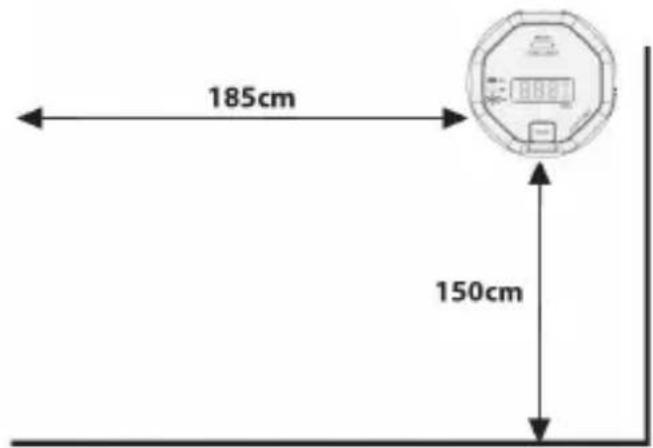

To use the detector efficiently, the device should be installed at least 1.5 meters above the ground and at least 1.85 meters away from the corresponding fuel-burning equipment.
The following areas should be avoided:
- Places where the temperature falls below -10 °C or rises above 40 °C
- Places with a damp environment
- Places with a lot of dust, dirt or grease deposits
Behind curtains or furniture - Positioning in / on air outlet of an oven
Near fans or air conditioners
Outside the building - Directly above a wash basin or a stove

Caution!
The carbon monoxide detector is designed only for interior use. Do not expose the device to any moisture or rain.
The product does not warn against carbon monoxide poisoning if the batteries are empty.
Do not open or manipulate the gas detector since this could result in malfunctions.
8. Installation
The carbon monoxide detector is operated with two 1.5V AAA batteries and does not require any extra wiring. You can install the device either on the wall or place it on a table, for example.
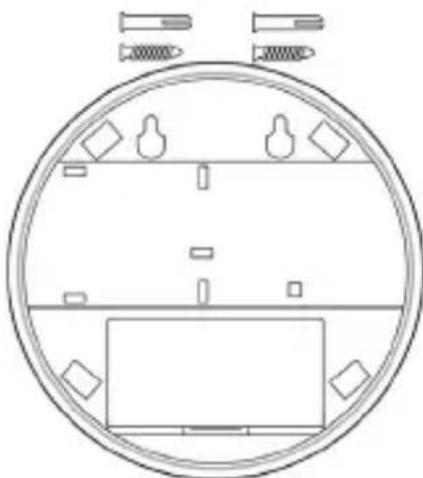
8.1 Wall assembly
After selecting the installation place and setting it up, ensure that no electrical wiring or pipelines are present in this area.
Finally, mark the mounting holes and do the drilling at the marked places.
Tighten a screw in each of the two holes and ensure that the screw head projects by approx. 4mm .
Subsequently, insert two 1.5V AAA batteries into the battery compartment of the device and then close the compartment.
Mount the carbon monoxide detector on the screws affixed previously.
Please pay attention to the chapters 7 and 7.1 about wall mounting in this user manual.
8.2 Pedestal assembly
Alternatively, you can put the CO detector at the place you desire. Select the location so that the display can be clearly seen. Please read chapters 7 and 7.1 in this user manual for wall-mounting.
9. Using the carbon monoxide detector for the first time
Remove the device from its packaging and remove any packaging material. Open the battery compartment on the back of the unit and insert 2x 1.5V AAA batteries. Otherwise the battery compartment cannot be closed. Make sure that the polarity of the batteries is correct.
9.1 Normal mode
When carbon monoxide is not present, the green LED flashes once every 50 seconds.
9.2 Testing the carbon monoxide detector
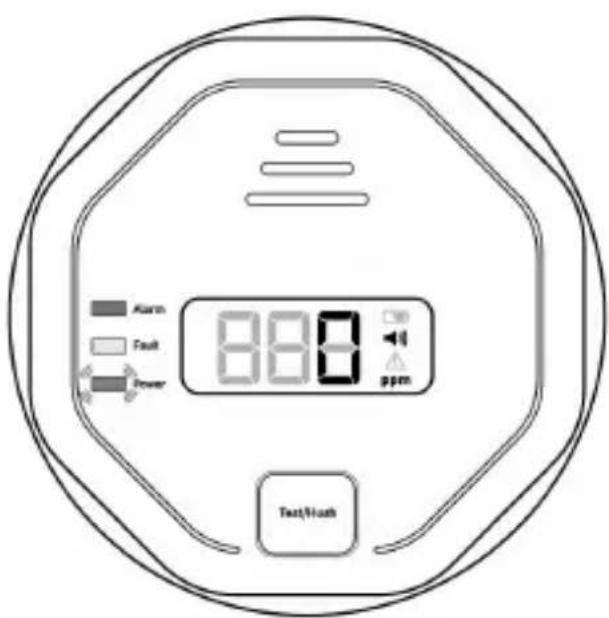
Press the key "test/hush" on the front side of the device. It simulates now a high CO concentration. The carbon monoxide detector detects the increased value and sounds an alarm. The green and yellow LEDs glow continuously. The red LED flashes. In the display, the current CO value and a speaker symbol appear.
Note: It is recommended to test the carbon monoxide detector once a month to ensure that the device is working properly.
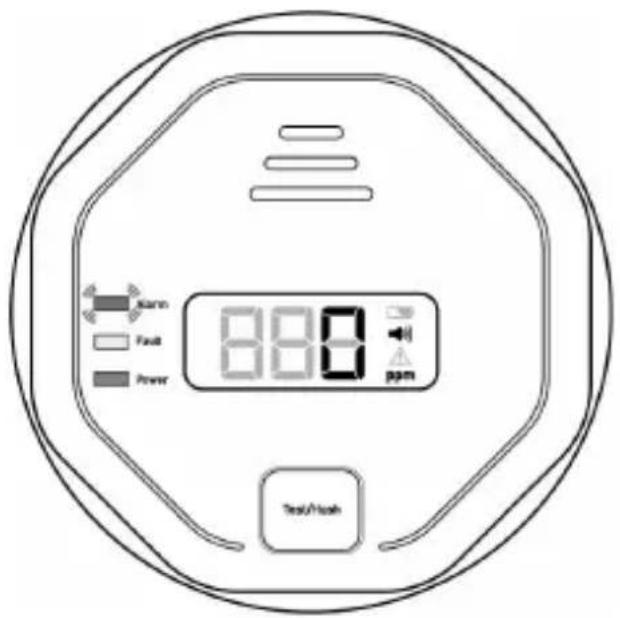
9.3 Snoozing the alarm
Heavy vapours or the like can also trigger an alarm. In the alarm mode, press the "TEST/Hush" button when the concentration is lower than 50 PPM. The alarm is muted and the red and green LED flash once every 10 seconds.
After enabling the mute, new alarm conditions must be first present (see table, Chapter 5 "Trigger sensitivity") so that the alarm is activated again.
If the carbon monoxide concentration continues to be 30 PPM, the mute mode is exited and the standby mode is activated.
If the concentration increases and the corresponding concentration and time is reached, then the alarm mode is activated.
9.4 Saving function
If the device detects an increased CO value and the alarm sounds, but nobody is at home, the device stops the alarm as soon as the value is back within the normal range. The highest measured CO concentration is displayed every 45 seconds, the device beeps four times and the red LED flashes for one second every 50 seconds. Press the "test/hush" key to delete the stored maximum value. The device subsequently returns to the normal operating mode.
9.5 Low battery
When the device detects that the battery voltage is low and the batteries need to be replaced, the yellow LED flashes once in about every 47 seconds and an alarm sounds. If the battery voltage reduces further, the cycle for displaying the low voltage is reduced to 12 seconds.
NOTE: The normal stand by time of the battery is at least 3 years. Please replace the battery on time after the low voltage alarm signal.
9.6 Manual reset
A manual reset of the display is possible only if the current value is under 10 PPM. To reset the display value to 0 PPM, press and hold the "test / hush" key for approx. 3 seconds until the PPM sign is no longer displayed on the screen. Then, release the key.
The manual reset can be carried out only under the following conditions:
- The CO concentration on the display is less than 10 PPM.
The first digital display shows "-"
9.7 Self test
This device carries out a self test every 10 seconds. If an error occurs during this test, the device beeps every 40 seconds. At the same time, the yellow LED light blinks. The display shows "ERR". In this case, reset the device. If the error persists, exchange the device immediately.
9.8 End of service life of the CO detector
If the product has reached the end of its service life (approx. 7 - 10 years), a beep sounds 3 times in succession every 60 seconds and at the same time the yellow LED blinks. The display shows "ERR".
10. When the CO alarm is triggered
Immediately seek fresh air or open all doors and windows to ventilate the area and allow the carbon monoxide to escape.
If possible, shut down all possible sources of carbon monoxide (e.g. fireplace or gas oven) and leave the building as soon as possible.

Enter the concerned area only after proper ventilation and after the CO concentration value has been reduced to a non-critical level and the alarm signal of the CO detector is no longer triggered.
Contact an expert and allow for a proper examination and possible repair of the concerned fuel-burning appliance before using it again.
In case of extremely high CO concentration and if the source cannot be determined or eliminated, you should immediately seek fresh air and alert other occupants. Call the fire brigade and rescue teams immediately and follow their instructions.

11. Maintenance
The carbon monoxide detector warns you of potentially dangerous CO concentrations in your house if you maintain it properly.
To maintain your CO detector in a sound condition, we recommend:
- Test the alarm at least once a month by pressing the "test / hush" key.
- Remove the dust regularly from the CO detector. Do not use any damp cloth for this purpose. Clean the device very carefully with a damp cloth only.
- Never use any cleaning solutions.
- Do not paint the alarm or paint over the alarm.

CAUTION!
12. Additional safety instructions
Make sure that your family know the causes and effects of carbon monoxide poisoning. Check the CO detector once a month.
Exchange empty batteries immediately. A qualified technician should check the installation. Regularly examine your fuel-burning appliances such as the fireplace or the gas oven.
Do not use any grill within your house or your garage.
Keep yourself informed and pay attention to any signs of carbon monoxide poisoning such as, for example, discomfort, headache, vertigo, nausea, shortness of breath and cramps.

CAUTION!
13. Safety instructions and disclaimer
Please do not try to open the device to carry out repairs or modifications by yourself. Avoid contact with the mains supply. The device does not carry current only when disconnected. Please do not short-circuit the product. Do not forget to disconnect the power cord when the device is not being used or during thunderstorms. The device is not approved for outdoor use. Therefore, please use it only in dry surroundings. Protect it from high humidity, water and snow.
Do not expose the device to high temperatures. Do not expose the device to sudden changes in temperature or strong vibrations, as this could damage the electronic components. Check the device for any damage before using it. The device should not be used if it has been subject to impact or has been damaged in any other way. Please follow the local regulations and restrictions. Do not use the device for purposes other than those described in this manual.
This product is not a toy. Keep it out of the reach of children or mentally disabled persons. Any repair or modifications to the device, which is not carried out by the original supplier will void any warranty and guarantee claims. The device should only be used by those who have read and understood this user manual. The specifications of the device may be changed without prior notice.

14. Disposal instructions
In line with the European WEEE directive, electrical and electronic devices should not be disposed of along with domestic waste. Their components have to be separately sent for recycling or disposal, because improper disposal of toxic and dangerous components may permanently damage the environment.
According to the electrical and electronic equipment act (ElektroG), you are obliged (as a consumer) to return (free of charge) all electrical and electronic devices to the manufacturer, the point of sale or public collection points at the end of their service life. The relevant local laws regulate the details in this regard. The symbol displayed on the product, in the user manual or/and on the packaging refers to these regulations. With this manner of sorting, recycling and disposal of used devices, you make an important contribution towards protecting our environment.
15. Instructions for battery disposal
In conjunction with the sale of batteries along with the supply of devices that include batteries, the supplier is obliged to point out the following to the customer: The customer is legally obliged to return used batteries. The customer can return used batteries which the supplier offers or has offered as new batteries in his assortment free of charge to the supplier's dispatch warehouse (shipping address). The symbols shown on the batteries indicate the following: Pb = battery contains more than 0.004 percent lead by weight, Cd = battery contains more than 0.002 percent cadmium by weight, Hg = battery contains more than 0.0005 percent mercury by weight.

The symbol of the crossed-out dustbin means that the battery may not be disposed of in household waste.



WEEE directive: 2012/19/EU
WEEE Register no.: DE 67896761
The company WD Plus GmbH hereby certifies that the device 304339 complies with the fundamental requirements and all other relevant stipulations. A complete conformity statement can be obtained from: WD Plus GmbH, Wohlenbergstraße 16, 30179 Hanover
(FR) +49511/13221730
(IT) +49511/13221740
(ES) +49511/13221750
MO-FR 9:30am - 18pm CET

brandson-equipment.de