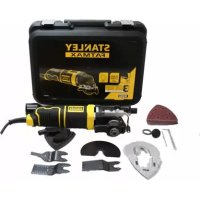
FME650 - Multitools STANLEY - Free user manual and instructions
Find the device manual for free FME650 STANLEY in PDF.



| Product Type | Multi-function oscillating saw/sander |
| Brand | Stanley Fat Max |
| Model | FME650 |
| Supply voltage | 230 V AC |
| Power | 300 W |
| No-load speed | 10,000 - 22,000 min⁻¹ (6 positions) |
| Oscillation angle | 1.4° - 2.8° |
| Weight | 1.53 kg |
| Sound pressure level | 90 dB(A), uncertainty 3 dB(A) |
| Sound power level | 101 dB(A), uncertainty 3 dB(A) |
| Vibration (wood cutting) | 4.5 m/s², uncertainty 1.5 m/s² |
| Vibration (metal cutting) | 10.3 m/s², uncertainty 1.5 m/s² |
| Vibration (sanding) | 11.4 m/s², uncertainty 1.5 m/s² |
| Intended use | DIY: sanding, cutting (wood, plastic, plaster, non-ferrous metals, tiles), scraping |
| Double insulation | Yes, no earth wire required |
| Accessory attachment type | Super-lok™ clamping lever (tool-free) |
| Included accessories | Cutting blades (wood, metal), scrapers, rasps, abrasive sheets, dust extraction adapter, cutting/depth guide |
| Maintenance | Clean ventilation slots with a soft brush or dry cloth; clean motor compartment with a damp cloth (no solvents) |
| Safety | Automatic stop of movement after releasing button; hold tool by insulated gripping surfaces |
| Warranty | 12 months against defects in material or workmanship (conforming use) |
Frequently Asked Questions - FME650 STANLEY
User questions about FME650 STANLEY
0 question about this device. Answer the ones you know or ask your own.
Ask a new question about this device
Download the instructions for your Multitools in PDF format for free! Find your manual FME650 - STANLEY and take your electronic device back in hand. On this page are published all the documents necessary for the use of your device. FME650 by STANLEY.
USER MANUAL FME650 STANLEY
(Original instructions)
Intended use
Your Stanley Fat Max FME650 oscillating tool has been designed for DIY applications such as sanding operations. It is also suitable for cutting wooden materials, plastic, gypsum, non-ferrous metals and fastening elements (e.g., unhardened nails, staples), working soft wall tiles and scraping of small surfaces. This tool is intended for professional and private, non-professional users.
Safety instructions
General power tool safety warnings

Warning! Read all safety warnings and all instructions. Failure to follow the warnings and instructions listed below may result in electric shock, fire and/or serious injury.
Save all warnings and instructions for future reference.
The term "power tool" in the warnings refers to your mains operated (corded) power tool or battery operated (cordless) power tool.
1. Work area safety
a. Keep work area clean and well lit. Cluttered or dark areas invite accidents.
b. Do not operate power tools in explosive atmospheres, such as in the presence of flammable liquids, gases or dust. Power tools create sparks which may ignite the dust or fumes.
c. Keep children and bystanders away while operating a power tool. Distractions can cause you to lose control.
2. Electrical safety
a. Power tool plugs must match the outlet. Never modify the plug in any way. Do not use any adapter plugs with earthed (grounded) power tools. Unmodified plugs and matching outlets will reduce risk of electric shock.
b. Avoid body contact with earthed or grounded surfaces such as pipes, radiators, ranges and refrigerators. There is an increased risk of electric shock if your body is earthed or grounded.
c. Do not expose power tools to rain or wet conditions. Water entering a power tool will increase the risk of electric shock.
d. Do not abuse the cord. Never use the cord for carrying, pulling or unplugging the power tool. Keep cord away from heat, oil, sharp edges or moving parts. Damaged or entangled cords increase the risk of electric shock.
e. When operating a power tool outdoors, use an extension cord suitable for outdoor use. Use of a cord suitable for outdoor use reduces the risk of electric shock.
f. If operating a power tool in a damp location is unavoidable, use a residual current device (RCD) protected supply. Use of an RCD reduces the risk of electric shock.
3. Personal safety
a. Stay alert, watch what you are doing and use common sense when operating a power tool. Do not use a power tool while you are tired or under the influence of drugs, alcohol or medication. A moment of inattention while operating power tools may result in serious personal injury.
b. Use personal protective equipment. Always wear eye protection. Protective equipment such as dust mask, non-skid safety shoes, hard hat, or hearing protection used for appropriate conditions will reduce personal injuries.
c. Prevent unintentional starting. Ensure the switch is in the off-position before connecting to power source and/or battery pack, picking up or carrying the tool. Carrying power tools with your finger on the switch or energising power tools that have the switch on invites accidents.
d. Remove any adjusting key or wrench before turning the power tool on. A wrench or a key left attached to a rotating part of the power tool may result in personal injury.
e. Do not overreach. Keep proper footing and balance at all times. This enables better control of the power tool in unexpected situations.
f. Dress properly. Do not wear loose clothing or jewellery. Keep your hair, clothing and gloves away from moving parts. Loose clothes, jewellery or long hair can be caught in moving parts.
g. If devices are provided for the connection of dust extraction and collection facilities, ensure these are connected and properly used. Use of dust collection can reduce dust-related hazards.
4. Power tool use and care
a. Do not force the power tool. Use the correct power tool for your application. The correct power tool will do the job better and safer at the rate for which it was designed.
b. Do not use the power tool if the switch does not turn it on and off. Any power tool that cannot be controlled with the switch is dangerous and must be repaired.
c. Disconnect the plug from the power source and/or the battery pack from the power tool before making any adjustments, changing accessories, or storing power tools. Such preventive safety measures reduce the risk of starting the power tool accidentally.
d. Store idle power tools out of the reach of children and do not allow persons unfamiliar with the power tool or these instructions to operate the power tool. Power tools are dangerous in the hands of untrained users.
e. Maintain power tools. Check for misalignment or binding of moving parts, breakage of parts and any other condition that may affect the power tools operation. If damaged, have the power tool repaired before use. Many accidents are caused by poorly maintained power tools.
f. Keep cutting tools sharp and clean. Properly maintained cutting tools with sharp cutting edges are less likely to bind and are easier to control.
g. Use the power tool, accessories and tool bits etc. in accordance with these instructions, taking into account the working conditions and the work to be performed. Use of the power tool for operations different from those intended could result in a hazardous situation.
5. Service
a. Have your power tool serviced by a qualified repair person using only identical replacement parts. This will ensure that the safety of the power tool is maintained.

Warning! Additional safety warnings for oscillating tools
Hold power tool by insulated gripping surfaces when performing an operation where the cutting accessory may contact hidden wiring or its own cord. Cutting accessory contacting a "live" wire may make exposed metal parts of the power tool "live" and could give the operator an electric shock
Use clamps or another practical way to secure and support the workpiece to a stable platform. Holding the work by hand or against your body leaves it unstable and may lead to loss of control.

Warning! Contact with or inhalation of dusts arising from sanding applications may endanger the health of the operator and possible bystanders. Wear a dust mask specifically designed for protection against dust and fumes and ensure that persons within or entering the work area are also protected.
Thoroughly remove all dust after sanding.
Take special care when sanding paint which is possibly lead based or when sanding some woods and metal which may produce toxic dust:
Do not let children or pregnant women enter the work area.
- Do not eat, drink or smoke in the work area.
Dispose of dust particles and any other debris safely.
The intended use is described in this instruction manual. The use of any accessory or attachment or performance of any operation with this tool other than those recommended in this instruction manual may present a risk of personal injury and/or damage to property.
- The accessory will continue to move after releasing the switch. Always switch the tool off and wait for the accessory to come to a complete standstill before putting the tool down.
- Keep hands away from cutting area. Never reach underneath the work piece for any reason. Do not insert fingers or thumb into the vicinity of the reciprocating blade and blade clamp. Do not stabilize the saw by gripping the shoe.
- Keep blades sharp. Dull or damaged blades may cause the saw to swerve or stall under pressure. Always use the appropriate type of saw blade for the workpiece material and type of cut.
When cutting pipe or conduit, make sure that they are free from water, electrical wiring, etc.
Do not touch the workpiece or the blade immediately after operating the tool. They can become very hot.
Be aware of hidden hazards, before cutting into walls, floors or ceilings, check for the location of wiring and pipes.
Safety of others
This appliance is not intended for use by persons (including children) with reduced physical, sensory or mental capabilities, or lack of experience and knowledge, unless they have been given supervision or instruction concerning use of the appliance by a person responsible for their safety.
Children should be supervised to ensure that they do not play with the appliance.
Residual risks.
Additional residual risks may arise when using the tool which may not be included in the enclosed safety warnings. These risks can arise from misuse, prolonged use etc.
Even with the application of the relevant safety regulations and the implementation of safety devices, certain residual risks can not be avoided. These include:
Injuries caused by touching any rotating/moving parts.
Injuries caused when changing any parts, blades or accessories.
Injuries caused by prolonged use of a tool. When using any tool for prolonged periods ensure you take regular breaks.
Impairment of hearing.
Health hazards caused by breathing dust developed when using your tool (example:- working with wood, especially oak, beech and MDF.)
ENGLISH
(Original instructions)
Vibration
The declared vibration emission values stated in the technical data and the declaration of conformity have been measured in accordance with a standard test method provided by EN 60745 and may be used for comparing one tool with another. The declared vibration emission value may also be used in a preliminary assessment of exposure.
Warning! The vibration emission value during actual use of the power tool can differ from the declared value depending on the ways in which the tool is used. The vibration level may increase above the level stated.
When assessing vibration exposure to determine safety measures required by 2002/44/EC to protect persons regularly using power tools in employment, an estimation of vibration exposure should consider, the actual conditions of use and the way the tool is used, including taking account of all parts of the operating cycle such as the times when the tool is switched off and when it is running idle in addition to the trigger time.
Labels on tool
The following pictograms are shown on the tool along with the date code:

Warning! To reduce the risk of injury, the user must read the instruction manual.

Warning! Always wear a dust mask when using this tool.
Electrical safety

This tool is double insulated; therefore no earth wire is required. Always check that the power supply corresponds to the voltage on the rating plate.
- If the supply cord is damaged, it must be replaced by the manufacturer or an authorised Stanley Fat Max Service Centre in order to avoid a hazard.
Features
This tool includes some or all of the following features.
- On/Off switch
- Variable speed dial
- Super-lok™ Tool free accessory clamping lever
- Sanding base
- Dust extraction adapter (fig. E Where supplied)
- Toolled accessory adapter (spacer)
- Toolled accessory adapter (Fixing bolt)
- Cut/Depth guide)
Accessories
This tool includes some or all of the following accessories. The performance of your tool depends on the accessory used. Stanley Fat Max accessories are engineered to high quality standards and designed to enhance the performance of your tool. By using these accessories you will get the very best from your tool.
| Precision plunge cut saw blade for wooden materials, soft plastics. (Part number - STA26105-XJ) Separating, plunge and flush cutting of wood and soft plastics. Ideal for working on doors, skirting boards, windowsills and flooring. | |
| Plunge cut saw blade for wood and metal. (Part number - STA26110-XJ) Separating, plunge and flush cutting of wood, plastics, thin-walled non-ferrous pipes and extrusions, nails and screws. | |
| Plunge cut saw blade for wood and metal. (Part number - STA26115-XJ) Separating, plunge and flush cutting of wood, plastics, thin-walled non-ferrous pipes and extrusions. | |
| Segmented saw blade. (Part number - STA26120-XJ) Long life blade which is ideal for cutting wood, plastics, thin walled ferrous and non-ferrous material. | |
| Rigid scraper. (Part number - STA26135-XJ) Ideal for removal of hard and soft material from flat surfaces such as the removal of vinyl flooring, bonded carpet adhesive, tile floor adhesive, grout, paint and varnish. | |
| Flexible scraper. (Part number - STA26140-XJ) Ideal for removal of elastomer materials from hard flat surfaces in difficult to reach areas such as silicon sealant and other caulking materials. | |
| Carbide grout removal blade. (Part number - STA26125-XJ) Carbide coated surface ideal for clearing grout and tile adhesive from flat surfaces and for fast stock removal of wood, chipboard and fiberglass. | |
| Carbide rasp. (Part number - STA26130-XJ) Carbide coated surface ideal for grout removal and for fast stock removal of plastics, chipboard and fiberglass. | |
| Sanding Sheets. (Part number - STA32348-XJ) Various grades for sanding of wood, painted and varnished surfaces. | |
Assembly
Fitting and removing the accessories (fig. A - G)
Warning! Before fitting an accessory, disconnect the tool from the mains supply.
Fitting a Stanley Fat Max accessory (fig. A-C)
Hold the tool and squeeze the accessory clamping lever (3).
Slide the accessory (9) between the shaft and the accessory holder making sure the accessory engages all eight pins on the holder and is flush with the shaft.
Release the accessory clamping lever.
Note: Some accessories, such as scrapers and blades can be mounted at an angle if required (fig. C).
Removing a Stanley Fat Max accessory accessory (fig. A)
Hold the tool and squeeze the accessory clamping lever (3).
Pull the accessory from the tool making sure the accessory dis-engages from all eight pins on the holder.
Release the accessory clamping lever.
Warning: Gloves must be worn when removing accessories as then may become hot during use.
Fitting a sanding sheet (fig. D)
Line up the sanding sheet (10) with the sanding base (4) as shown.
Press the sheet firmly and evenly onto the sanding base, making sure that the holes in the sheet coincide with the holes in the base.
Removing a sanding sheet
Pull the sanding sheet off the sanding base (4).
Warning! Never use the sanding base without a sanding sheet or accessory in place.
Fitting the dust extraction adaptor (fig. E)
Line up the dust extraction adaptor (5) with the sanding base (4) as shown.
Press the adaptor firmly and evenly in to the sanding base.
Secure the adaptor by turning the locking nut (11) clockwise.
Connect a vacuum cleaner to the dust extraction adaptor.
Removing the dust extraction adaptor
Turn the locking nut (11) anti-clockwise.
Pull the dust extraction adaptor (5) out of the sanding base (4).
Fitting the depth/cut guide (fig. F)
The depth/cut guide allows you to precisely cut material at a specified depth and more accurately track a marked cut line.
Attach the depth/cut block (8) by inserting the tabs on the guide into the slots on the main body.
Secure the block to the main body with the bolt (12) and tighten with the supplied hex wrench.
Insert the guide (13) into the required position and secure by turning the depth/cut adjustment knob (14) clockwise.
Fitting alternative accessories (fig. G)
Place the spacer (6) onto the collar (15).
Place the alternative accessory (16) onto the collar (15).
Firmly attach the fixing bolt (7) into place to ensure a tight fit for the alternative accessory (16).
Note: The spacer and fixing bolt are not used to attach Stanley Fat Max accessories. Stanley Fat Max accessories are attached using the Super-lok™ Tool free accessory clamping lever.
Use
Warning! Let the tool work at its own pace. Do not overload.
Warning! Before cutting into walls, floors or ceilings, check for the location of wiring and pipes.
Variable speed control (fig. H)
The variable speed control allows you to adapt the speed of the tool to the application.
- Set the variable speed dial (2) to the desired setting. At setting 1 the tool will operate at low speed, 10,000min - 1 . At setting 6 the tool will operate at the maximum speed, 22,000min - 1 .
Switching on and off (fig. 1)
To switch the tool on, slide the on/off switch (1) forward (position I).
To switch the tool off, slide the on/off switch (1) to the rear (position O).
Cut guide (fig. F & J)
This feature allows you to more accurately track a marked cut line.
To use the cut guide, insert the guide (13) as shown in figure J into the front slot on the depth/cut guide block (8).
Adjust the length of the guide by pulling out or pushing inward to achieve the desired cut depth.
Secure the guide in place by turning the depth/cut adjustment knob (12) clockwise. To release the guide turn the depth/cut adjustment knob anti-clockwise.
Depth guide (fig. F & K)
This feature allows you to precisely cut material at a specified depth.
To use the depth guide, insert the guide (13) as shown in figure K into the front slot on the depth/cut guide block (8).
Adjust the length of the guide by pulling out or pushing inward to achieve the desired cut depth.
Secure the guide in place by turning the depth/cut adjustment knob (12) clockwise. To release the guide turn the depth/cut adjustment knob anti-clockwise.
Hints for optimum use
Always hold the tool securely. For precision work, hold the tool near the front.
Clamp the workpiece whenever possible, especially when using cutting blades.
Do not exert too much pressure on the tool.
Always use the appropriate type of attachment for the workpiece material and type of cut.
Regularly check the condition of accessories. Replace when necessary.
Mark the desired starting point.
Switch the tool on and slowly feed attachments into the workpiece at the desired starting point.
- Clamp a piece of plywood or soft wood to the back of the workpiece and saw through the combination in order to obtain a clear cut.
Do not force the cutting blade into the workpiece. Note that cutting sheet metal will normally take more time than sawing thicker wooden workpieces.
When cutting metal spread a thin film of oil along the cutting line before cutting.
- When sanding new layers of paint before applying another layer, use extra fine grit.
- On very uneven surfaces, or when removing layers of paint, start with a coarse grit. On other surfaces, start with a medium grit. In both cases, gradually change to a fine grit for a smooth finish.
Consult your retailer for more information on available accessories.
Maintenance
Your Stanley Fat Max corded/cordless appliance/tool has been designed to operate over a long period of time with a minimum of maintenance. Continuous satisfactory operation depends upon proper tool care and regular cleaning.
Warning! Before performing any maintenance on corded/ cordless power tools:
Switch off and unplug the appliance/tool.
Or switch off and remove the battery from the appliance/ tool if the appliance/tool has a separate battery pack.
Or run the battery down completely if it is integral and then switch off.
Regularly clean the ventilation slots in your appliance/tool/ charger using a soft brush or dry cloth.
Regularly clean the motor housing using a damp cloth. Do not use any abrasive or solvent-based cleaner.
Mains plug replacement (U.K. & Ireland only)
If a new mains plug needs to be fitted:
Safely dispose of the old plug.
Connect the brown lead to the live terminal in the new plug.
Connect the blue lead to the neutral terminal.
Warning! No connection is to be made to the earth terminal.
Follow the fitting instructions supplied with good quality plugs.
Recommended fuse: 5 A.
Protecting the environment

Separate collection. This product must not be disposed of with normal household waste.
Should you find one day that your Stanley Fat Max product needs replacement, or if it is of no further use to you, do not dispose of it with household waste. Make this product available for separate collection.

Separate collection of used products and packaging allows materials to be recycled and used again. Re-use of recycled materials helps prevent environmental pollution and reduces the demand for raw materials.
Local regulations may provide for separate collection of electrical products from the household, at municipal waste sites or by the retailer when you purchase a new product.
Stanley Europe provides a facility for the collection and recycling of Stanley Fat Max products once they have reached the end of their working life. To take advantage of this service please return your product to any authorised repair agent who will collect them on our behalf.
You can check the location of your nearest authorised repair agent by contacting your local Stanley Europe office at the address indicated in this manual. Alternatively, a list of authorised Stanley Europe repair agents and full details of our after-sales service and contacts are available on the Internet at: www.2helpU.com
Technical data
| FME650 (Type 1) | ||
| Voltage V | AC | 230 |
| No-load speed min | -1 | 10,000-22,000 |
| Oscillating angle Degrees | 1.4 - 2.8 | |
| Power | W | 300 |
| Weight | kg 1.53 |
| Level of sound pressure according to EN 60745: |
| Sound pressure (LPA) 90 dB(A), uncertainty (K) 3 dB(A) |
| Sound power (LWA) 101 dB(A), uncertainty (K) 3 dB(A) |
| Vibration total values (triax vector sum) according to EN 60745: |
| Cutting wood (ah, cw) 4.5 m/s2, uncertainty (K) 1.5 m/s2 |
| Cutting metal (ah, cm) 10.3 m/s2, uncertainty (K) 1.5 m/s2 |
| Sanding (ah) 11.4 m/s2, uncertainty (K) 1.5 m/s2 |
EC declaration of conformity MACHINERY DIRECTIVE

FME650 Multifunction Oscillating Tool
Stanley Europe declares that these products described under "technical data" are in compliance with: 2006/42/EC, EN60745-1:2009+A11:2010,
EN60745-2-4:2009+A11:2011
These products also comply with Directive 2014/30/EU and 2011/65/EU. For more information, please contact Stanley Europe at the following address or refer to the
back of the manual.
The undersigned is responsible for compilation of the technical file and makes this declaration on behalf of Stanley
Stanley Europe, Egide Walschaertsstraat14-18, 2800 Mechelen, Belgium 06/12/2016
R. Laverick
Engineering Director
traat14-18,
2800 Mechelen, Belgium
06/12/2016
Guarantee
Stanley Europe is confident of the quality of its products and offers an outstanding guarantee for professional users of the product. This guarantee statement is in addition to and in no way prejudices your contractual rights as a private non-professional user. The guarantee is valid within the territories of the Member States of the European Union and the European Free Trade Area.
ONE-YEAR FULL WARRANTY
If your Stanley Fat Max product becomes defective due to faulty materials or workmanship within 12 months from the date of purchase, Stanley Europe guarantees to replace all defective parts free of charge or – at our discretion – replace the unit free of charge provided that:
The product has not been misused and has been used in accordance with the instruction manual.
The product has been subject to fair wear and tear;
Repairs have not been attempted by unauthorised persons;
Proof of purchase is produced.
The Stanley Fat Max product is returned complete with all original components
If you wish to make a claim, contact your seller or check the location of your nearest authorised Stanley Fat Max repair agent in the Stanley Fat Max catalogue or contact your local Stanley office at the address indicated in this manual. A list of authorised Stanley Fat Max repair agents and full details of our after sales service is available on the internet at: www.stanley.eu/3
Engineering Director
Stanley Europe, Egide Walschaertsstraat 14-18,
2800 Mechelen, Belgien
06/12/2016
Garantie
GARANTIE TOTALE UN AN
Engineering Director
Stanley Europe, Egide Walschaertsstraat14-18
2800 Mechelen, Belgio
06/12/2016
Garanzia
Engineering Director
Stanley Europe, Egide Walschaertsstraat14-18,
2800 Mechelen, Belgie
06/12/2016
Garantie
Engineering Director
Stanley Europe, Egide Walschaertsstraat 14-18,
Engineering Director
Stanley Europe, Egide Walschaertsstraat14-18,
Ta bort adaptern for dammsugning
Vrid Iasringen (11) moturs.
Dra bort adaptern for dammsugning (5) fran basplattan (4).
Montera sagsdjupsguiden (fig. F)
R.Laverick Engineering Director
Walschaertsstraat14-18, 2800 Mechelen, Belgien
06/12/2016
Garanti
ETT ARS FULL GARANTI
Engineering Director
Engineering Director
Walschaertsstraat14-18,
2800 Mechelen, Belgien
06/12/2016
Garanti
Engineering Director
Stanley Europe, Egide Walschaertsstraat 14-18,
2800 Mechelen, Belgium
06/12/2016
Takuu
1.AoΦaAεiαwpou εpyaσiαs
a. DiatnpieTe To xwpo EpyaiaC kaapo kai KaIa _0 . OI akataotatoi xwpo kai ta onueia xwpic KaIo Tpokaov atxnhata.
β. Mny xnpoiotoiite nEeKpia epyaia o E Tepiabaaov otou utapxei kivduvoC ekpnns, P.x. Tnapouoia eupkeTsw uypwv, aepiwv n okovnc. Ta nEeKpiKa epyaleia mTopei va dnoiuopynoou v OTIVnpiOo o oToioC mTpei va avaPeeTn Okovn n TIC avaUmuic
y. Otau xpoioTOIEto nEeKpIO epyaleio, kpatate ta naia kai ta unoloina atopa maekia aTTOx wOPOAic. 2E TEPITIWn Tou aa atoataoauv Tnv TPOOXn oac mTpei va xaote Tov Eeyxo Tou epyaleiou.
2.Aoaaianxphon nAektpikou pEuMaTOs
a.To 昌 Tou kaawoiou Tou nektpikou epyaleiou Tpentei va taipiae1 otnv avioToiyn piz. Dev EITIpeTETai e Kavevav TpoTIO n eTaOKEun Tou C. Mny xpanoiTOIEITE PPOAPUOTIKa iyeiwéva nektpikaepyaaleia.Ta tsou dev exouv utooTei TPOTTOINoeic kai oI kataaAnec npizc s eiwovuTv kivduvo nektpoTnIgac.
β. ATOPOUYETN V E TAOH TOU O WATOC OAC ME YEIWHEVES ETTIPAVIECS OTWCSOWANVEs, BEPHAVTIAO WUMATA (KALOPIPEP), KOUZIVECS KAI WUYEA. Otav TO OWA OAC Eivai YEWevo, auGavetai o KIVDUVOc NAEKTPOITNGiaC.
y. Mny ekTeTe Ta nAeKtpiKa epyaia 0tn Bpoxn n Tnu uypaia. H EIOXwPOnn Vepou OTO nAeKtpiKO epyaio auGavE1 Tov Kivduo NAEKtpTAnIaIac
8. Mny kaoketaeipzote To kawio. Mny Xpnoiopoieite note To kawio yia va metaepete To epyaleio,va TpaBnEte n va to aTouvOeTe aTo Tnv pia.Kpatate To kawio paikia ato 0epoTnta,laia,aixnpa akpa n Kivoumeva epn. Tuxov xaalaoeva n mtpoepeva kaawio auavouv tokivuo noekpotanlqac.
ε. Otav xρησιμοποίeTe to ηλεκτρικό εργαλείοσε Εξωτερικός χώρους, va xρησιμοποίeTe πάντοτε καλώδία προεκτασης καταλληλία γία xρήση σε Εξωτερικός χώρους. H xρήση καλωδίου προεκτασης καταλληλου γία εργασία σε Εξωτερικός χώρους μειώνει tov κύνουνο ηλεκτροπιληξίας.
OT. EAV n xpno n evoc nAekpikou epyaleiou e uynn TtoTbeia eivai avatnpoeuktn, xpoioptoiote ia Diataqn Pooataiac Peuapotc diappoic (RCD). H xpnoon diataqns RCD eiwvei tov kivduvo nAektpoTAnxiac.
3.AaAeia npoowv
a. Otav xnpoiottoie To nEeKpiK epyaaleio, va eioTe TPOoekTkoi, va dive Te PPOOxN OTNV Epyaia Tou Kavete KAI VA ETIOPTATEUETE TIV KOIVN LOYIK. Mny XpnoIooIEte To nEeKpiK epyaaleio OTAV eioTe Koupaopeoi n otav Bpikoote UTO NTV Etnpeia VapkwiKwv, oivOTVEmuatoC npapakwv. Mia OTiyuaia aTPOeixia kata TO xeipio tou nEeKpiKou Epyaieou mToei va odnynoe i 0oBapoucs Tpaumaiouc.
β. Na xnpoiopoioie EoTIAOIO ppoosIKnC npoostiaac. Na oopate navta npoosteutikya yuaia. O kivduvo tspaumatouw meiwetai otav xnpoiotoiite EoTIAOIO npoostiaic, ontw macka npoostaiac ato kovn, avioiaothiKa TATOUTA aospaleiac, kpavn n wtaotidec, avloya e TIC suvthkec epyaoiaC.
y. EmuoiTE Tnv akouia evpyoioiOn Tou epyaieiou. Beaiwte iTe oI O biakottnc aeitoupyaic pikoetai otn theon "OFF" TpiuovdeoeTo epyaieio otnv pica n/ka 0tnv matapia kai Tpiu To onkwote H metapop a nektpiwv epyaleiwv Me to daxlu oac etavw 0to biakotttn n ouveon otnv piCa nektpiwv epyaleiwv Me To biakottn otn theon evpyoioanC, Evexi Kivovouc Tpokanoc atuxmuatwv.
- PIV θεσετο ηλεκτρικό εργαλείο σε λειουργία, αφαπεστε Tuxov εργαλεία ἡκεδία μθμισης. Eav φησετέ ενα εργαλείο ἡκεδία πάνω σε καποι Περιστρεφόμεν Εξαρτημα ενός λεκτρικό εργαλείου μπορείν προληθουν τραμαισομί.
ε. Mny TeVTwveote. Povtiote navtoe va exete Tnv kataaannn otaoen kai va biatnpite Tnv iooppoia oac.Auto aoc etitipetieTov kaAUTEpo eleyxo tou nAektpikoEpyaaleiou e TEPITIWoeic atpoookntwv kataotaewv.
OT. Opaté katállnη evdupaia εpyaioac. Mny opate φapóia pouxa n kooμnmuata. Kpatate ta μaalia, ta evóμata kai ta yavtnia aoc μakpiä aTTO ta KIVOUεva εaptηmuata. Ta φapóia pouxa, ta kooμnmuata kai ta μakpiá μaaliá μTtpei va επλakouv oTa KIVOUεva εaptηmuata.
Z.Eav TApexovTai diataeic aTaywync kai oulloyns OKovnc, BbaIomegaite otivai ouvdevecs kai oti xpnoiopoiouvtai owoTA. H xponoiatadewv oulloync oKovnc meiwv touc kivduvouc tou oxetizovtai eTn oKovn. - Xpion kai φρovtiδa tou ηεκτριού εργαλείου
a. Mny utepopotwve To nAekptko epyaeeio. Xpnoiouoite yia Tnv ekaoTote epyaia oac to nAektpko epyaeeio Tou TpoopiZetai ia autiv. Me To katalnnlo nAekptko epyaeeio, epyaceote kalutepa kai aoopaotepa otnv ovuaotikn Tepioxn 1oxuoc tou.
β. Mny xpnoiopoioinoe TOTe eva nekpiok epyaaleio tou oloiou o diaokottns aeitoupyiac eivai xaouveoc.Eva nekpiok epyaaleio tou onoiou n leitoupyia dev mtopei va eeyxtheta i e to diaokottn eivai etikivduvo kai pntie va etiokuaotei.
y. ByaTe To aTo TnV Tpiz a Nkai TnV mTatapia aTo nEeKTPiKO epyaaleio, Tpv DIEgayayete Katoia epyaia puOmuGnS, Tpv aAlambdaeTE kATOIO aEsouap n otav PPOeITai va aTOnkEoTe TA nEeKTPiKa epyaia.AutTa TpoanTTiKa Mtpa aopaaiae μeiuvov Tov Kivuvo va TeBcI To epyaieio akouia o E Aetoupyia. - Na qualate Ta nEeKpia epaia Tou 6x npoiotioieite pakia ato taiaia.Mnv apnveTe aToa Tou dev iivai Egoikeiomegava Te to nEeKpiko epyaleio n Tou dev exouv diaabeiautec tic onyies xpns vto xnpoiotoinouv.Ta nEeKpia epyaia eivai Etikivoua otav npoiotioovtai ato atoqa xwpic kataaan EKTAAeUON.
ε. Na ouvtnpite Ta nλeKTPiKa εpyaia. EéyTe eav ta KIVoumeva εgaptnata εivai owoTa EUouypaumoiéva n mTTwC exouv MTLOkapei, mTiwC exouv OTAOI KOUMATIA, KaWc kai eav TAnpouVTai OAcO UNTOIOTE CPOUTOBcEIC Tous EvExoEvwC VA ETNpeaoovtn owotn λeIToupyia Tou epyaieiou. AωTE tuxov xalaaeva εgaptnata Tou nλeKTPiKOU εpyaieiou yia ETIOKEUn TPIV TO xPNOIpOTIOINOET EAI. H avTAPKnC ouvtnpon Tuv nλeKTPiKWv εpyaieiw aTOTEa iTIA TOnaw atuxnpatw.
OT. Diatnpie Ta KOTTIKA epyaia KoTepa kai Kaapa. Ta KOTIKA epyaiae aixnpa KOTTIKA akpa Tou ou uvtnpouvtai owtaeovuayotepes Tihavotntec va μλokapouv kai λevxovtai eukolotepa.
Z. Na xpnoiioiEite Ta nAektpia epyaia, ta aegouap, Tc mutec epyaieiw KkT. ouuwa tig npouoe osnyies, aubavovtac uToyn oac ts Ouvhke cpeyaoias kai tv epyoia Tou bela Te va ekteleote. Hxonn Tou nAekptikou epyaeiou yia epyaicis nepa atto Tc ppoBentouvecs mtopei va oynoe i ETTIKIVUVEKATAOTaeic.
- Texvikégutnpétnon
a. Epyaioe Texvikns Eou nEeKtko ouacg Epyaeiou npetvi a vaaalauavoumv ovo eptepoi Texvikoia m ovo xpooiotoiwtau ynoia avtaakia. Etoi Eaopaiietai n diatnpon tcaopaiaic tou nEeKtko Epyaieou.

Ppoeioiogn! upi npwpatikc Tpoeiotoioeic aqaaia yia TaaiKa epyaia
Kpatate To nAektpiko Epyaleio aTTO TIG MOVwvec ETTiAPVEIEC OUYKPATNOCS OTAV EKTEAEITE KAITOA Epyaia KATA TNY OTOIA TO EApntma KOTNC MTOpei VA EPOEIO ETAOPH ME KpumuEv a Kaawbia n Me To DIKO TOU KAWIO. EVA EApntma KOttnc TO OTIOIO Epxetai OE ETAOPH ME NkTPoPoPo KaWIO MTOpei VA KATAOTNEI KAI TA EKTDEIEVEA METAALIKA MEPN TOU NkTPKOU Epyaieou NkTPoPoPcA KAI VA TIPOKAeOI NkTPoTNIgia OTO XEPIOTn TOU
Xpnoiopoioite Opiyktnpes n aaaa TpaKTia mea yia va aopaaizete kai va otnpizete To npoc ETEEepyaia avtkeievo oia staepn bao. H ouykpatnon Tou KAtepyafoevou Teayiou e To xepi n Etavw oTo owma oac to kaotatao aotaec kai mtpei va onnyne i e anwaleia tou eleyxou.

PooiOtoin! H eTn n n EOTVOn Tns OKovns Tou oNmuOpuyoU oEapmoyEc Aiaavon mTopei va Evexouv Kivduvo yia Tnv Uyeia Tou xepiOtn kai twv Tapeuipokoevw. Fopeote maaka oKovns EIDka Oxediaoevn Yia PPOtaia evavTI nCkovns kai twv avaBumiaeewy kai BepaiWte OTI TA aToa Tnou pikovtai n EIOepxovtai OTO Xpo Epyaic civai Etion n PpOtaeueva.
MetaTnAevon,KaOapioTe KaAaTn OKovn.
Na pooexe 10iaepa kata n aeavon xpawatwv, ta otioia evextai va exouv wc bao n to olaubdo n kat a n aeavon opioevuv EIOWv EALou kai eTALou, ta otioia evexetai va npayovu TOsIKn OKovn:
MnV EITIPTETE O TAIIDI N EYKUOvC VA EIOEPXovTAt OTO Xwpo EpyaiaC.
Mny TpWTE, IVETE n KATViciE TE OTO Xwpo EpyaiaC.
k e v t p w o t e o n n k o v n k a i t a a a a u t t o e i a t a kai atoppipye ta tov kataaanlo tpotto.
H TPOBLeTouevn XpOn TEPiPyPawetai OTO TAPov EYXeipio 0bnyiw. H XpOn OTIOIOuONIOTe aEouap n EApntmuToC n EKTEeOg m Auto to EpyAeo OTIOAOBHTOTE aaNc EpyaiaC Tepav ato autc TOU Ouviotwai oT TAPov EYXeipio 0bnyiw EvExetai va EykUOpEi KIVduvo Tpaumatou n/kai UIKW Znuiw.
To aegouap ouvexie va kiveiai kai tny
aTeLeuBepwn Tou dakottn. Atevepytoite Tavta
TO epyaio kai TepiEvete va otajatnoe EVTEwC TO
aegouap, tpotou akouptneTcKATW to epyaio.
Mnv TAnoiaceTa xepia oac OTNV Tepioxn KOTNc. Note mny TAnoiaceTa xepia oac kATw aTO kATEpyafoevo Teayio yia otIOovdntote Ayo.o Mny TAnoiaceTa daxtua n tov avixepa oac Kovta OTNV TAAOevn Ama kai TO opiyknpa tnc Amuac.Mnv OTAepoTIOIEte To piovi kpatwtaoc aTO TEOIIO.
AiatnpieTisLaeKoPtepe.OIOTouwvec n KATEOtpaueves Lapei va Tpokaleouv TApekkion Tou Tpioviou hiaoktn tsAitoupyiac Tou UTO TIEON. Xpoaiotoiite TAVTA TOV KatalAANo TUTo TPIovolapac avaloya to uAIKO Tou KATEpyacoeou TEaxiou KAI TOV TUTo KOITNS.
Otav kobete oawhvec n aywyouc a i w e i t e o T i d e v Tepiexouv vepo, naektpikecs kaawoioeic, kTt.
MnyayizTeTOKATEpyaZoMeVO TEPAXIO nTnAma aepowc
muTn xPnOtnou epyaleiou. MTopei va eivai TOnu
Zeota.
PooexTe Touc Kpuouc Kivououskai, TpiV aTIO nV KOITn Toixwv, DantEowv n TaBavw, ExyeYy eY iA TUxov DIepxOeva KaWdi a oWhveC.
Aσφαλειατριων
Autn n ouakeun dev Tpoopicietai yia xpion ano atoata (ota oioia tepiaaubavovtai kai ta tiaia) e meiwueves qouikcs,avianttikcnsdiavontkeic iakovntnc n aotua xwpi cmuieipia kai yywoei,napa mvo eoosov etinnpouvtai n touc exouv dothei odnyiec oxetikaue tn xpion tou epyaaleiou ano atopo uteuhuv yia tnvaopaia touc.
Ta Taaia npetie va etitnpouvtai ia va diaaopaiaetai oTt deV taizouv me to epyaiaio.
Avtópeuktoi kivduvoi.
Mtopei va 0noupyoov EITIPOOeTOI AVATOKEKTOI Kivduovotav xnooiIOEITE TO epyaleio,OI OTIOI MTOpe i va unuTEPIaBavovTAt IC TPOEIOTOnieC aQaAeiac Toun eawkEIOvTA. Autoi o Kivduov mTOpei v TpokAnoV ano kakxphon, Tapatetauevn xphon kTλ.
Akopa kai TnV npnon Twv oxETIKW KAVOVIOuW aaoaaleia cai t n xphon meoov PPOOtaia, oipaevoi kivduoi dev evai duvaro va eaaeikpouv. Auroi Tepiaauabavouv:
Tpaumouc ano to ayiyia t wv Tepiortpepoeewv/ KIOUeVwEapntmuatW.
Tpaumouc aioaayn oiovwntote eapntmuatwv, AETIDWv n aEouap.
Tpaumatioouc ano napateaevn xponon tou epyaiaou. Otav xpooiotoe otoiodntote epyaia yia Tnapatetaevecs xovike cteipodouc, bbaowite otikavete taktika diaimuata.
PpOβλnμaTaakonc.
Kivovoi otny uyia Tou pokaovtai ano tv EIOVOn OkoVnc otav xpnaioToie To epyaio (TapadEvma: -otav EtEePyaeote Loo, iDikα dbu, oia kai MDF.)
Aovnon
H n T 日 EKTIouNTG doVnOg T OU aVapepetai OTA
TEXVIKA xapaKTNIOTIKA kAI T N DnWON OUMOpPwOng EEXI
MEtPOEi OuMPwVA ME IIA TUOTIOINeVN MEOO BOKIUNs
Tou TAPExeTAl AO TO TPOTuTO EN 60745 KAI MTopei va
XpnoIIOINeY iA T NOUYKPION Evoc EpyaEiou ME eva
ALLO.H DnLWUEvN TUIN EKITouNTG doVnOg MIOpei EITIONS VA
XpnoIIOINeI OE EVAV TPOKaTAPKTIO IOPOOIOPOTO TNS
EKoEoNG.
Ipoeioiogn! H tni EKIOUng dovnoq katv npayatikxpontou nAekptikou epyaleiou mTopei va diapeei ato tn dNawevn tiun, avaloya te TpOTo Tou xpnoipoiietai to epyaleio. H oTaOndovnnc mTopei v auNthei Tavw anto tn otAonn Tou exE NwEi.
Kata tov npooiopioo nC ekoeon o doVn yia tov Kaopioo twv anaitouveuv metpw aaoaieac ouuwova eTnv oyia 2002/44/EK yia tvnpoataia npooWtow Tous xpoiopoioov ouxva nAektpika epyaia otnv epyaia tou, ia npoeeyyiotkEktunTcEkoan cdoVn on PpTe i va aauapei utouyn Tc paymuikoc uovhkecxpnang Kai tov tpanto xpno tsou epyaieiou, ouupeiauabavouw v Kai olww twv etiepouc tmuatow Tou kuklou epyaia, OTWC, POEC qopec teonke To epyaieo EKTOS aeitoupyiac, TOTE evai oe aeitoupyia xwpic qoptio eTTTPOOeTA OTO xpovo tioc nC oavdaan.
ETIKETC OTO EpyaIeio
To epyaleio fepei ta napakatw npoeidoonitikα ouβoλa μaζ i e tov kwidiok nepoynviaç:

Ppoeiooipoi! ia va i o kivouoc Tpaumatioou, o xnoTns PpTei va diaaoei to Exyepidio odniw.

Ppoeiobtoinon! Otav xpnoiotoiite auto to epyaleio, va φopate πavtoe maoka Tpoataia c ano kovn.
Engineering Director
Stanley Europe, Egide Walschaertsstraat14-18, 2800 Mechelen, Belgium 06/12/2016
Eyyunon
H Stanley Europe eivai oiyoupn yia tnv nioiota twv
Tpoiovtwv Tng kai napexei mia egaipetikn eyyunon yia touc
eTTayveApaties xnoTeC Tou poiovtos. Autn n dnaowon
eyyunon civai eTTIppoOtheta n Ota kai dev eTnpaecei pe
kaveva TpOTo TA ouuBAtika diKaiwmuata oac wic idiwn
Un eTayveApatia xhoTn. H eyyunon IOxuei Evtoc tsns
ETIKPATEIA TOW KpatW Meawv Tng Eupwtaiknc Evwons kai
tns Eupwtaiknc ZwVNS EAeUeEepw Suvaalaywv.
IIAHPHE ERTYHENEO ETOY
Eav to npoiov oac Stanley Fat Max kataoTei eAattwpatiko loywoeAATTWmuATIKwv uikownepyaioac evtoc 12 mnvov anot nvynepeopnuia ayopac, n Stanley Eupwn avalaubetavi aavTKATAOTnoeI ola ta eAATTWmuTikα epn dopeav n - kat a Tnv Kpion pa - va avtikataoTnoeTn movada xwpic xpewon, UTO TOV opo ot:
To Tpoiov 6ev exi UTOOTe i KAKoetaxepion kai exi XpnoiopoTOnEi ouwva e To yxepidio onnyiw.
To pioov exi utoBnOe i e quoioloyikn othopa,
aT0eunC aT0 pN Eouoioodotnueva atoua.
Ynpx1 aTobEi en ayopac.
To Tpoiov Stanley Fat Max EITIOPTpeTai Pnpe, e 0a Ta auOeVTiKa Eaaptna
Eav EITUeIe va eipete aWcic, EIKoivwVnote 10v TOWAANT OAC n EAYTE Tnv TOTOeOia Tou ANoieTepou EGOIOBtneovou Kevtpo EIOKEuwv Stanley Fat Max OTOV KAIALOYO TNS Stanley Fat Max n ETIKOIVWvnoTe ME TO TOTIKO Oa ypaefio TNS Stanley oTn dieuuvon Tou avaypafetai OTO PApov EYxepidio. EaALAKTikA, iA iota Me ta EGOIOBtneva Kevtpa EIOKEuwv TNS Stanley Fat Max KAI PAHPEi AETTOpeIEC viA TIC UINPeoe C Tous TAPEXOVTai MTA tv NwAnon diATIeVTai OTo DiABIKTuO, Otn dIEuOuvon:www. stanley.eu/3
| België/Belgique Stanley Fat Max De. Tel. +32 70 220 065E. Walschaertstraat 14-16 Fr. Tel. +32 70 220 0662800 Mechelen Fax +32 15 473 799Belgium www.stanleytools.eu | ||
| Enduser.be@SBDinc.com | ||
| Denmark Stanley Fat Max Tel. 70 20 15 10Farveland 1B Fax 70 22 49 102600 Glostrup www.stanleyworks.dk | ||
| Deutschland Stanley Fat Max Tel. 06126 21-1Richard Klinger Str. 11, D - 65510 Idstein | ||
| ΕλλάδαStanley Fat Max.Σράβωνος 7 & Λεωφ. Bουλιαγμένης 159Γλύφάδα 166 74 - Αθήνα | Fax 06126 21-2770 | |
| EspanaStanley Fat Max.Parc de Negocis "Mas Blau"Edificio Muntadas, c/Bergadá, 1, Of. A608820 El Prat de Llobregat (Barcelona) | Tel. 934 797 400Fax 934 797 419respuestos.postventa@sbdinc.comwww.stanleyworks.es | |
| FranceStanley Fat Max Tel. 04 72 20 39 205 allée des HêtresB.P. 3008469579 Limonest Cédex | Fax 04 72 20 39 00www.stanleyoutillage.fr | |
| HelvetiaStanley Fat Max Tel. 01 730 67 47In der Luberzen 408902 Urdorf | Fax 01 730 70 67www.stanleyworks.de | |
| ItaliaStanley Fat Max Tel. 039-9590200Energypark-Building 03 sud, Via Monza 7/A20871 Vimercate (MB) | Fax 039-9590313www.stanley.it | |
| NederlandStanley Fat Max Tel. +31 164 283 065Joulehof 12,4600 RG Bergen op Zoom | Fax +31 164 283 200Enduser.NL@sBDinc.com | |
| NorgeStanley Fat Max Tif. 45 25 13 00Postboks 4613, Nydalen0405 Oslo | Fax 45 25 08 00 | |
| ÖsterreichStanley Fat Max Tel. 01 66116-0Oberlaaerstraße 248,A-1230 Wien | Fax 01 66116-614www.stanleyworks.de | |
| PortugalStanley Fat Max Tel. 214667500Centro de Escritórios de Sintra Avenida AlmiranteGago Coutinho, 132/134, Edificio 142710-418 Sintra2710-418 Lisboa | Fax 214667575resposta(posvenda@sbdinc.com | |
| SuomiStanley Fat Max Puh. 010 400 430Tekniikantie 12, 02150 Espoo | Faksi 0800 411 340www.stanleyworks.fi | |
| SverigeStanley Fat MaxBox 94, 431 22 Mölndal | Tel. 031-68 61 00Fax 031-68 60 08 | |
| TürkijeStanley Fat MaxKALE Hirdavat ve Makina A.S.Defterdar Mah. Savaklar Cad. No:15Edirnekapi / Eyüp / ISTANBUL 34050 | Puh. 0212 533 52 55Faks 0212 533 10 05www.stanleyworks.fi | |
| United KingdomStanley Fat Max Tel. +44 (0)1753 511234210 Bath RoadSlough, Berkshire SL1 3YD | Fax +44 (0)1753 551155www.stanleytools.co.uk | |
| Middle East & AfricaStanley Fat Max Tel. +971 4 8127400P.O.Box - 17164Jebel Ali (South Zone), Dubai,UAE | Fax +971 4 8127036www.stanleyworks.aee | |
N507186 REV-01
02/2017
- (Original instructions)
- Intended use
- Safety instructions
- General power tool safety warnings
- Save all warnings and instructions for future reference.
- Work area safety
- Electrical safety
- Personal safety
- Power tool use and care
- Service
- Safety of others
- Residual risks.
- ENGLISH
- Vibration
- Labels on tool
- Electrical safety
- Features
- Accessories
- Assembly
- Fitting and removing the accessories (fig. A - G)
- Fitting a Stanley Fat Max accessory (fig. A-C)
- Removing a Stanley Fat Max accessory accessory (fig. A)
- Fitting a sanding sheet (fig. D)
- Removing a sanding sheet
- Fitting the dust extraction adaptor (fig. E)
- Removing the dust extraction adaptor
- Fitting the depth/cut guide (fig. F)
- Fitting alternative accessories (fig. G)
- Use
- Variable speed control (fig. H)
- Switching on and off (fig. 1)
- Cut guide (fig. F & J)
- Depth guide (fig. F & K)
- Hints for optimum use
- Maintenance
- Mains plug replacement (U.K. & Ireland only)
- Protecting the environment
- EC declaration of conformity MACHINERY DIRECTIVE
- Guarantee
- ONE-YEAR FULL WARRANTY
- Garantie
- GARANTIE TOTALE UN AN
- Garanzia
- Ta bort adaptern for dammsugning
- Montera sagsdjupsguiden (fig. F)
- Garanti
- ETT ARS FULL GARANTI
- Takuu
- 1.AoΦaAεiαwpou εpyaσiαs
- 2.Aoaaianxphon nAektpikou pEuMaTOs
- 3.AaAeia npoowv
- Aσφαλειατριων
- Avtópeuktoi kivduvoi.
- Aovnon
- ETIKETC OTO EpyaIeio
- Eyyunon
- IIAHPHE ERTYHENEO ETOY
Brand : STANLEY
Model : FME650
Category : Multitools