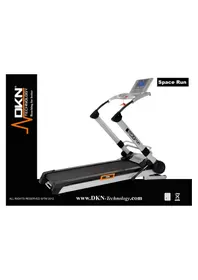
Space Run - Exercise bike DKN - Free user manual and instructions
Find the device manual for free Space Run DKN in PDF.



Frequently Asked Questions - Space Run DKN
User questions about Space Run DKN
0 question about this device. Answer the ones you know or ask your own.
Ask a new question about this device
Download the instructions for your Exercise bike in PDF format for free! Find your manual Space Run - DKN and take your electronic device back in hand. On this page are published all the documents necessary for the use of your device. Space Run by DKN.
USER MANUAL Space Run DKN
This DKN product is designed for residential use only.
Network to the original retail purchaser and authenticated by proof of purchase from a retailer a product sold by an authorized DKN dealer.
This Limited Warranty is not transferable and does not cover normal wear and tear (including, but not limited to, damage and wear to batteries, springs, bearings, running mats, hydraulic systems, ropes, belts, pulleys, power shocks, drive belts and other non-durable parts, etc...).
This Limited Warranty is void if the product is damaged by accident, unreasonable use, improper service, failure to follow instructions provided, modification from its original state, or other causes determined not arising out of defects in material, the consequences of improper treatment, bad installation, wrong assembly or tampering of the parts by incorrect assembly, improper use of the machine (eg. too heavy load in time, weight etc...), problems caused by lack of maintenance, deviations of the standard machine, such as light vibrations or noise, and in case of semi-professional, professional and commercial use (inter alia in sports schools, physio, companies, etc...).
Transport charges, travel charges for technicians, and possible trader and/ or workshop charges are excluded from this warranty, and will be at the sole cost of the owner.
The liability of the manufacturer under this Limited Warranty shall not include any liability for direct, indirect, or consequential damages resulting from any defect nor the use of this machine.
Before you start training on your DKN platform, please read the instructions carefully. Be sure to keep the Instructions for Information, in case of repair and for spare part delivery.
This exerciser has been tested up to a max. body weight of 120kg / 260 lbs.
Follow the carefully the different steps of the assembly instructions.
Use only original parts as delivered.
Before starting the assembly, be sure to check if delivery is complete by using the included parts-list.
For assembly use only suitable tools and ask for assistance with assembly if necessary.
Place the exerciser on an even, non-slippery surface. Because of possible corrosion, the usage of any exerciser in moist areas is not recommended.
Check before the first training and every 1-2 months that all connecting elements are tight fitting and are in the correct condition.
Replace defective components immediately and/or keep the equipment out of use until repair.
For repairs, use only original spare parts.
In case of repair please ask your dealer for advice
Avoid the use of aggressive detergents when cleaning.
Ensure that training starts only after correct assembly and inspection.
For all adjustable parts be aware of the maximum positions to which they can be adjusted/tightened to.
This exerciser is designed for adults. Please ensure that children use the exerciser only under the supervision of an adult.
Ensure that those present are aware of possible hazards, e. g. movable parts during training.
Warning: incorrect/excessive training can cause health injuries.
Please follow the advice for correct training as detailed in training instructions.
Consult your physician before starting with any exercise programme. He can advise on the kind of training and which impact is suitable.
The owner's manual is only for customers' reference.
The supplier can not guarantee for mistakes occurring due to translation or change in technical specification of the product.
All data displayed are approximate guidance and cannot be used in any medical application.
! Note : The treadmill should be placed on a level surface. If the treadmill is not level the belt will continuously track to the low side of the treadmill.
-
Belt adjustment bolts are located at the rear of the treadmill, as show below.
-
Belt moving (tracking) to the right :
Start the treadmill and set at 4 kph. Using an allen key wrench, turn the right adjustment bolt clockwise 1/4 of a turn. Continue adjustments at 1/4 of a turn until belt returns to the center. Continue to run the treadmill for a short period of time monitoring the belt movement to ensure you have not made an over adjustment.
- Belt moving (tracking) to the left :
Start the treadmill and set at 4 kph. Using an allen key wrench, turn the right adjustment bolt clockwise 1/4 of a turn. Continue adjustments at 1/4 of a turn until the belt returns to the center. Continue to run the treadmill for a short period of time monitoring the belt movement to ensure you have not made over adjustment.
Always hold onto the hand rails when getting on and off the treadmill. Place feet on foot rails (not on the tread) of the treadmill before starting. Turn on treadmill and set at slow position before stepping on. Adjust the speed slowly to avoid sudden surge in speed. Always unplug the power cord before performing the maintenance and adjustment procedures described in this manual. Never remove the shroud unless instructed to do so by an authorized service representative. Servicing other than the procedures in this manual should be performed authorized service representative only.
3000:160=18.75
3000:120 = 25.00
3000:100 = 30.00
[ \begin{aligned} & \text{Indice de resistencia} = 18.75 + 25.00 + 30.00 \ & = 73.75 \end{aligned} ]
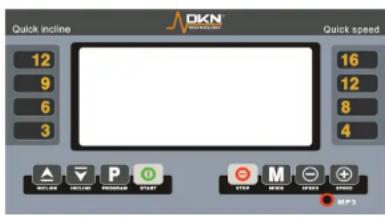
Operating Instructions Computer
Function keys
Start/stop: starting and stopping the belt.
Select: selecting program or data.
Speed / to adjust speed. Or set speed using the direct speed keys (1-18 km/h).
Incline / : to adjust inclination level. Or set inclination using the direct incline keys (1-15)
General operation:
Please read carefully before using
Safety tips:
To start, turn on the power and attach the safety key to the monitor. Note that the machine does not work and no data will be displayed without the safety key attached. Please clip the other end of the safety key to the user before exercising to ensure the machine will stop in case the user accidentally runs off the treadmill. Should that happen, the safety key will be cut off the monitor and the treadmill will stop at once to avoid further injury.
Program selection:
There are 19 programs including: 1 manual, 14 preset courses, 3 HRC runs and body fat calculation.
Pulse rate:
There are two ways to measure your heart rate. Hand-pulse sensors or chest belt. Hand-pulse sensor requires both hands to gently hold the hand-pulse sensors. There are 2 sensors and 2 pieces of metal part each sensor. Each hand must gently hold both metal pieces to trigger the HR measuring.
For HR training the use of a chest belt to measure pulse rate is compulsory.
Your computer is compatible with the optional DKN chest transmitter (ref 20073), for integrated wireless heart rate registration. Contact your dealer, or visit our website www.DKN-Technology.com or ask for more information: info@ds-design.be
Start-up
Position the safety key into the on position. Press the power button.
The monitor will turn on
Next select manual (press start) or select a program (using program button).
MANUAL training
Press start, use incline and speed buttons to adjust values.
Note: keep feet on the slide step, let the machine start, and step on the belt after the machine reaches initial speed (+/- 1km/h)
PROGRAM mode:
Press PROGRAM and/or incline / to select program (2-14), use speed / to adjust exercise time. Press start to begin exercising.
HRC programs (chest belt transmitter compulsory).
P15: HR1 - weight loss:
Set age ('A' show on the display) by using speed +/- buttons, press MODE to confirm. Set THR (Target Heart Rate) by pressing the / keys, confirm with MODE. Set TIME by pressing the / keys, confirm with MODE.
Press START: the treadmill will run at 1 kph for 1 minute as warm-up. After this timeframe the computer will adjust speed with 1 km every 30 seconds till THR (+/- 5 BPM) is reached. In case the THR is exceeded, the computer will automatically reduce speed till THR is reached again.
P16: HR2 - cardio:
Enter age by using speed / buttons, press MODE to confirm. EnterTHR (Target Heart Rate) by pressing the / keys, confirm with MODE. Enter TIME by pressing the / keys, confirm with MODE. Press START: the treadmill will run at 1 kph for 1 minute as warm-up: adjust speed manually. After this timeframe the computer will adjust inclination with 1% every 30 seconds till THR (+/-5 BPM) is reached. In case the THR is exceeded, the computer will automatically reduce inclination till THR is reached again.
P17: HR3 - interval fat burn:
Enter age by using speed buttons, press MODE to confirm. EnterTHR (Target Heart Rate) by pressing the keys, confirm with MODE. Enter TIME by pressing the keys, confirm with MODE. Press START: the treadmill will run at 1 kph for 1 minute as warm-up. After this timeframe the computer will adjust inclination with 1% and speed with 1 km every 30 seconds till THR (+/-5 BPM) is reached. In case the THR is exceeded, the computer will automatically reduce inclination and speed till THR is reached again.
P18:BODY FAT:
Press PROGRAM to select program 18 for body fat measuring. Enter personal data using MODE and use speed to adjust values (Gender, age, height, and weight). For gender: s = 01 , y = 02 . Position both hands gently on the handpulse sensors, the monitor will display body fat within 10 seconds
Heart rate displayed is an approximate read-out, and may not be used as guidance in any cardio-vascular related medical or paramedical program.
Training Instructions
If you have not been physically active for a long period of time and also to avoid health risks you should consult your general physician before starting to exercise.
Everyone, or almost everyone, is fascinated by the champions/athletes among us. We dream away when we have one look at a trained body, full of muscles, in movement, and hope that one day we also have an athletic body like that. It's then that we realize that exceptional performances need exceptional talents, but also daily training, well organized and planned within the smallest detail.
If we compare the genetic inheritance of great athletes to the genetic inheritance of the sporty amateur in general, we only can determine small deviations, which can't explain the difference in performances.
However if we compare the trainings, we do see great differences. In general, athletes on a higher level do not only had years of training, they also benefit from the help of a professional coach and have adapted their lives to their physical condition. Their training program is outlined and planned within the smallest detail and is being regularly evaluated in order to check if the preset goals are being achieved.
The sporty amateur who wants to improve his performances usually starts training without a plan. Sometimes he copies the training program of a well known athlete. This usually slows down his progress and often leads to strain the muscles and sometimes the cardiovascular system. A special, optimal training
program, suitable for everyone, would be wishful.
The incredible complexity and the different adapting processes which our body has to go through every training, don't allow us to use such a training program. Whether you train on muscle development, power, endurance, speed, flexibility or a better coordination of your movements, everyone starts with different initial conditions.
The goal of each training program is to improve your performances. You don't need to become a top athlete, you also can train to lose weight or just to feel better. The optimal performance can be for example, run 5 minutes longer than before at the same tempo and without interruption, or do more push-ups than the day before.
The research on the influence of a sporty training on our body has made lot of progress in the last several years. Even if some questions are still unanswered, the knowledge we achieved from the sporty science and related fields, have proven their use in practice and serve in the first place our top athletes. This doesn't mean we can't use the basics of a training for top athletes for every individual which practice a sport and who wants to improve his performances.
Evaluation of your physical condition
For each level of your training program (development of the muscles, endurance, flexibility, speed, coordination of your movements), we recommend you to find out through some tests on which level you find yourself. But first we recommend you to consult your physician in order to set up a health report:
Are you older than 35 years
- Have you not been exercising for a long time?
- Do you have overweight
- Are some movements not suitable for you?
Do you have to take medicines
- Are you suffering from a serious disease or are you having breathing difficulties
- Do you have a metabolic disorder (ex. Diabetes)
- Do you have any infections
- Do you have a fever as a result of any disease
- Do you have an infectious disease
- Are you having problems with your organs
- Do you suffer from hyperventilation
- Are you having any respiration diseases
- Do you have any pain while breathing
- Or do you have a poor physical condition
If your medical health is satisfactory, you can begin to set up your training program. But before you start, make sure you know your initial capacities - or a diagnose - so it is easier to determine your goals. Only then you can set up a training program which will match your goals.
Diagnosis
Determine your goals.
- Organization (long, mid-long, short term)
Evaluate
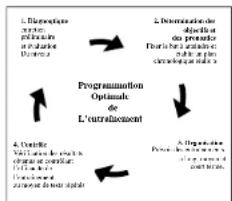
Regularly check your progress, so you can adapt your training program if necessary. The following survey shows the interaction between the 4 elements, which are important in an efficient training program.
Diagnostic - initial level
Before setting up a program, you have to take note of some parameters and take your sizes. These measurements will help you determine your present physical condition. It is the intention to collect all data concerning your personality, your health and your performances.
- Individual data: age, sex, figure, weight, fat percentage, measurements, pictures, etc.
- Data concerning your health : blood pressure, orthopedic data, research of the metabolism, serious diseases, injuries, etc.
Performance data: endurance tests, power tests, movement tests and speed control is often not necessary in fitness. Coordination of the movements however is crucial because it is very important when you execute the exercises.
"Clumsiness" usually means a lack of exercise. Therefore stick to the preset modules when you exercise, even if it is an endurance sport.
Every test, intellectually or physically, shows you your personal possibilities at a certain moment in time. Even though mathematic results become inadequate after a certain time, the results which you will achieve (after the same test one week later) will be better than the first one, because you have been able to locate your weak points and adapt your training in order to get rid of your shortcomings.
We work in the same way for the body. Let us assume you have taken an endurance test and the result of this test is 20% under the average level. This result must now help you to set up a program to achieve this average level. This shows that the test is the base to set up a training program in order to reach your goal. So it is very important you check your performances on a regular base to see if they measure up to the preset goals. If not, you have to adapt your training program.
The results of these check-ups give you the opportunity to compare your performances with the average performances, but also show if you are making progress. After 6 weeks we begin again with the same test to check if your performances have been improved and how much they have been improved.
Physical features
Weight
Are you happy with your body, often depends on the balance. But what is the ideal weight? Following formulas are known to determine the ideal weight:
Normal weight = girth waist in centimeter 100
- Ideal weight women = normal weight - 15%
- Ideal weight men = normal weight -10%
This formula designed by "Broca" has a limited value. As long as there is no new method to determine the ideal weight, the image we have of ourselves, tells us more than any other number. But a lot of people feel better when they can compare themselves with figures and numbers. Therefore it is sensible to take into account a few well known formulas as the body mass index (BMI) and with some reserve, the waist to hip rate (girth waist - hip).
Body Mass Index (BMI)
The BMI refers to the connection between weight and body shapes, which allows us to set up a better and exact standard than the "Broca" formula.
BMI = present weight (in kg): height in ^2 Ex.A man of 70 kg and 1.70 m high has a BMI of 70:1.7m^2 = 24.22
In the table beneath you can situate yourself. These values are a guidance and are not guaranteed, especially not for sick persons, children and elderly people.
Women Men
<19 <20 Underweight
19-24 19-25 Normal
24 >25Overweight
30 >30 Corpulent
40 >40 Obese
Fatpercentage
Body fat expressed in percentage tells us more than numbers about the relation weight/waist. To determine the fat percentage we have to take into account some parameters depending on age. You can determine your fat percentage in different ways. You even find many balances who also can measure your fat percentage. If you want to lose weight, then the fat percentage is more important than the weight itself, because it is the fat you want to disappear.
BMI Table
Standard according BMK index related to age.
Age Female Male
| 17-29 year 15 | % 25 % | |
| 30-39 year 17 | % 27,5 % | |
| Over 40 20 % | 30 % |
Connection waist - hip (waist to hip rate)
You have determined a higher fat percentage than normal in above chart. This fat can have a different impact on your health. With a simple test, which you can do at home, you can determine if you have a higher risk for cardiac disorders. To execute this test, you have to measure the girth of your waist just above your belly button, without holding in your stomach and in a relaxed position. Than measure the girth of your hips on his widest point. Divide the girth of the waist by the girth of the hips. If the result is lower than 0.9 (for men) and 0.8 (for women), you don't have a higher risk for cardiac disorders than normal.
Measurements
Do also take your other measurements, besides your waist and hips. If you want to improve your silhouette, these measurements can show you the changes your body made during training. This method is still the most precise, fastest and cheapest one. Please pay attention you take your measurements always on the same place. We advise you to take measurements of the following parts : girth of
the neck, shoulders, breast, arms, upper arms, waist, hips, thighs and calves.
Figure
Talents are often seen as interesting and attractive in daily life. This is also the case for our figure. If it doesn't measure up to certain criteria, we find a way to change this. Unfortunately we also have to say that the "Rubens" type will not become easily a "topmodel".
So before we begin fighting windmills, it is probably more sensible to take into account our figure. Do we all have to be "topmodels"? Our physical appearance depends strongly on the time we live in. Therefore it is rarely that the body types, you find next, exist. Most people among us are a combination of different types.
Leptosome/ectomorphe type
Features
Wider pelvis than shoul
- Very supple joints
- Weak muscle development
- Weak blood pressure
- Increased pulse in rest
- Weak circulation (less endurance)
Cold hands and feet, dizziness when you stand up
- Intense activity of the nervous system
- Weak metabolism (hard to gain weight)
Contradictory to other types, this type will not be suitable for performances which include power and endurance. An adapted training can improve these shortcomings even though the starting points are not always favorable. The figure of the ectomorphe types often creates envy by other types. This type has the privilege
to eat as many as he wants without gaining weight.
The atlete / mesomorphe type
Features:
Strong and muscular
- Wider shoulders than hips
- The muscular system and the blood circulation are suitable for excellent performances
- Weak blood pressure and pulse in rest by the active mesomorphe types
- Increased blood pressure and pulse by the non-active types
- Not susceptible to cold
- Correct general figure
Normal digestion
In case of inactivity or over feeding, the fat stays hanging on the body
Taking into account above features, a moderate training will be enough for the mesomorphe type to improve his performances. The risk on injuries is much higher for this type because the development of the muscles isn't always in proportion to the elasticity of the muscles. We therefore recommend you to invest a lot of time of your training in improving the elasticity of the muscles.
The figure of the athletic type and the active mesomorphe type stands very close to the ideal figure in the 80ties and 90ties. Therefore many of us would like to belong to this category, although they often belong to another category. Those who can't admit that not everybody can have the perfect body, often remain frustrated.
Endomorphe type
Features:
- Round shapes, holding fat
- Width shoulders, width pelvis (due to overweight)
- More equal distribution of the weight in comparison to the other 2 types
Average figure - Very suitable for performances aimed at power and endurance
- Easy food insertion and slow digestion make it easy to gain weight
Slow pulse in rest, normal blood pressure (for active types)
Power, endurance and mobility are the greatest trumps of the endomorph. Only the weight, often too high, can be an interference in some situations. Therefore he must pay attention to his food, healthy and adapted to his needs, emphasizing endurance to stabilize his weight.
Taking into account the beauty ideals of this moment, the figure of the endomorph type is not suitable. But above features also show that the active endomorph has the right talents for a good health and a sportive attitude. If the endomorph takes into account his genetic potential, a few extra pounds, can not harm him.
Endurance test
An endurance test may not be executed in following circumstances, except when it is done under medical supervision:
- Serious and chronic illnesses of the respiration
- Illnesses with fever attacks
- Infectious diseases
- Serious increased blood pressure
- Disorders (ex. of the heart or lungs)
Infections - Taking of medicines (betablockers)
- When you aren't feeling well
The most know endurance test which is used in sports is the "Cooper test". In this test you have to run as hard as you can for 12 minutes and run as much kilometers as you can on an flat underground.
Even it's aim is not to stop, you can slow down and walk. The covered distance is noted and compared with the numbers in the Cooper chart. This chart gives us more information about your performances.
The benefit of this test is that you can do the test whenever you want, you only need a chronometer and a course with a fixed distance.
The disadvantage of this test is that you need some running experience to become a good result. You may not take this test if you are not feeling well (pain, tiredness, feeling unwell, etc.)
| Cooper Test | Data in km, M = male, F = female | ||||||
| Age | 20-29 | 30-39 | 40-49 | 50 | 59 | ||
| Very well | M | 2.64-2.81 | 2.51-2.70 | 2.46-2.64 | 2.32-2.53 | ||
| F | 2.16-2.32 | 2.08-2.22 | 2.00-2.14 | 1.90-2.08 | |||
| Well | M | 2.40-2.63 | 2.34-2.50 | 2.24-2.45 | 2.10-2.31 | ||
| F | 1.97-2.15 | 1.90-2.07 | 1.79-1.99 | 1.70-1.89 | |||
| Average | M | 2.11-2.39 | 2.10-2.33 | 2.00-2.23 | 1.87-2.09 | ||
| F | 1.79-1.96 | 1.70-1.89 | 1.58-1.78 | 1.50-1.69 | |||
| Weak | M | 1.95-2.10 | 1.89-2.09 | 1.82-1.99 | 1.65-1.86 | ||
| F | 1.54-1.78 | 1.52-1.69 | 1.41-1.57 | 1.34-1.49 | |||
| Too weak | M | <1,95 | <1,89 | <1,82 | <1,65 | ||
| F | <1,54 | <1,52 | <1,41 | <1,34 | |||
You also can take another endurance test: the "Harvard-Step-Test. For this test you need a hear rate monitor, a chronometer, a stair or bench. The height of the stairs or bench depends on your length.
| Harvard-Step-Test Height in cm | Height of the step |
| <152 cm 30 cm < 160 cm 35 cm < 175 cm 40 cm < 180 cm 48 cm >180 cm 50 cm |
To execute this test, step down and up the bench or stairs every 2 seconds. This makes 30 times/minute up the bench, which gives a total of 120 up-and down steps. Whether you change leg or always use the same leg, this has no effect on the result. Measure your heart rate after 4 minutes. When you are done with the exercise, take your pulse after 60
seconds, and again after 1 minute. In this way you become 3 values which you have to use in the following formula :
A + 3000 divided by heart rate B + 3000 divided by heart rate C = endurance index. Example: when your heart rate is 160 after ending the exercise (heart rate A), 120 a minute later (heart rate B) and 100 after 2 minutes (heart rate C), then you have an endurance index of :
3000:160=18.75
3000:120 = 25.00
3000:100 = 30.00
Endurance index = 18.75 + 25.00 + 30.00 = 73.75
On the basis of the chart below you can adapt your training and divide your powers better according the result of this test. If you take the endurance index from our example (73.75), you can see in the chart below that this value is sufficiently for someone younger than 35 and good for someone older than 35.
| Endurance index | |
| Less than 35 Over 35 | |
| < 50 | not sufficient medium |
| 51 - 60 | medium medium |
| 61 - 70 | medium fair |
| 71 - 76 | fair well |
| 77 - 85 | good very well |
| 86 - 90 | very well exceptional |
| > 90 | excellent exceptional |
Training planning
Overload
Training means making an effort, using our energy reserve. This effort will show a lower performance afterwards. This effort can only be undone if we give our body time to recover and to rest. So both effort and rest are the ingredients of a perfect training. Effort and relaxation are one.
To determine how long we have to rest is not simple because it depends on a lot of elements such as the number of executed exercises, the used weights, the kind of exercise, how long we exercise...etc.
Furthermore, not every muscle needs the same time to recuperate. A small muscle can already be ready during practice, a big muscle can need extra time.
To set up an intelligent training, we recommend you to use some constant parameters during a limited training period. Based on these parameters it is much easier to see if our body has enough time to recuperate.
If you start training, you will feel "tired" after every effort. However the longer you train, the more easy it will become for your body to recuperate and after a while you want feel "tired" anymore and your performances will get better. However if you keep feeling "tired", your body needs more time to recuperate and we even recommend you to stop training for a few days and give your body the rest it deserves.
You will notice that when you resume training, your performances will get better much faster than when you keep training without resting (overload).
Descending or stagnating performances can be signs of overload. Also an increased heart rate can lead to overload, which also increases the risk for injuries.
Muscular trainingperiode
To prevent physical overload by overtraining, we recommend you to train no longer than 4 to 6 weeks on one territory. Divide your training up into different periods and change your program regularly.
- Training unity = one training session
- Micro cycle : all training sessions during 1 week
- Meso cycle : groups 3 to 5 micro cycles. In muscle training, the meso cycle is a training which emphasizes endurance, increase of size or power.
Macro cycle : groups different meso cycles and can take a few months (6 to 12 months).
Now you find some more information about the different features of each territory:
Endurance
A run of 400 meter requires endurance and power. The endurance training will include a preset series and the repetition of it. Attention! the recuperation period is also very important.
The lactic acid in the muscles will increase and will cause a inflamed feeling when the tiredness keeps increasing.
One of the greatest effects of a training with extended efforts is the increase of the tolerance of the acid in the muscles, which can be put into work as follows: there will appear different causes who will neutralize a part of the lactic acid; muscles will no longer be sour, this brings along an extended action for a few
seconds, or by repetition, by which they refuse to go on.
Increase of the muscular mass
he growth of our muscle cells is promoted by an extended stimulant. The use of energetic phosphates of the muscle cells is reduced to a minimum. The corn of the cell, which also contains a product of proteins, under the form of muscle fibres, also works in on the thickness of the muscles.
Maximal power/ effort
The maximum power of the muscle depends on the average thickness, and also on the number of muscle fibres due to movement. The interaction between the nerves and the muscles determine the capacity of a muscle during an effort.
Training period: endurance
Competition sports is one of the basics to set up a training schedule in function of endurance. The sporty amateur once again takes advantage of the benefits of a training set up for a competitive sportsman. As the weights and the repetition of the exercises play an important part in the measurement of our "tiredness" in the training of muscle development, the heart rate is the most important element in the endurance training.
Before we give you some recommendations for cardio training, it is important to know your maximum heart rate. We can determine this rate by a test which will ask a maximum effort of our cardio-vascular system. This test whoever is not suited for the sporty amateur. However we can determine our maximum heart rate by another formula : 220 minus our age.
Starting from this formula, our optimal heart rate in function of age, will be between 70 and 85% of our maximum heart rate obtained during a cardio-vascular training session, and between 60 and 70% during a metabolism training.
We have different ways of training in the endurance sports.
- Continuous training
- Training by interval
- Repetition training
- Competition training
Continuous training is most used in leisure sports, training by interval in a less way. Repetition and competition training mostly ask for exceptional and intense efforts and therefore they are not recommended for the sporty amateur.
A continuous training is characterized by a training over a longer period, without interruption of the effort. The most sporty amateurs automatically go for this kind of training.
They often become good results when the level of effort correspond to the optimal heart rate in a certain age category.
The training by interval usually contains a series of efforts and a series of relaxation. The series of relaxation contains moments of partial rest.
Continuous training is chosen by 80 to 90% of the sportsmen who wants to work on endurance. We therefore recommend continuous training to every sporty amateur.
| Age | HR MAX/ min | 60% MAX/ min | 65% MAX/ min | 70% MAX/ min | 75% MAX/ min | 80% MAX/ min | 85% MAX/ min |
| 20 | 200 | 120 | 130 | 140 | 150 | 160 | 170 |
| 25 | 195 | 117 | 127 | 137 | 146 | 156 | 166 |
| 30 | 190 | 114 | 124 | 133 | 143 | 152 | 162 |
| 35 | 185 | 111 | 120 | 130 | 139 | 148 | 157 |
| 40 | 180 | 108 | 117 | 126 | 135 | 144 | 153 |
| 45 | 175 | 105 | 114 | 123 | 131 | 140 | 149 |
| 50 | 170 | 102 | 111 | 119 | 128 | 136 | 145 |
| 55 | 165 | 99 | 107 | 116 | 124 | 132 | 140 |
| 60 | 160 | 96 | 104 | 112 | 120 | 128 | 136 |
| 65 | 155 | 93 | 101 | 109 | 116 | 124 | 132 |
| 70 | 150 | 90 | 98 | 105 | 113 | 120 | 128 |
Training evaluation
The preset program is only effective if you regularly control yourself. It is better to use the term "evaluation" because we evaluate the present data/results in function of the next training cycle.
Even though the preset goals were chosen carefully and realistic, it always is possible that the program of a meso cycle is realized partially.
This can have several causes such as illness, injuries, occupation activities, or other motifs to interrupt your training. If you already reached some goals, but not all of them, you have to adapt your training program for the next meso cycle.
Training diary
The keeping of a training diary can help you in finding the causes when you have not reached your goals. In this diary you can write down different information, which can help you to set up a training program, such as your eating habits, periods of rest and sleep, remarkable results etc. A visit to the dentist for example can influence your training results. If you can take into account certain circumstances, you can avoid a stagnation in your results.
Adaptations of your training are usually important for the intensity of your program, the succession and the repetitions of the exercises and the achieving of results.
Summary
- Make sure if a fitness training doesn't cause problems for your health.
Evaluate your level of power, endurance, flexibility, speed and coordination before you start training. - Set realistic goals based on your physical possibilities.
- Set up a training program for a longer period (6 to 12 months)
- Divide your long term planning up into different cycles (meso cycle) of 4 to 6 weeks.
- Make sure there is enough variation in your training. Train on endurance, power and muscle development.
If you choose for endurance training, vary between short, mid-long and long training periods.
During a meso cycle you have to increase the intensity of the training for endurance as well
as for muscle training. Limit the intensity of the training in the beginning of every new cycle. Evaluate regularly your training to make sure you are on the right track and if you can achieve your most important goals, if not:
- Adapt the next meso cycle
- Repeat the initial test
- Do interim tests at the end of every meso cycle
Success
Even after a short period of regular exercises you will realise that you constantly have to increase the pedalling resistance to reach your optimum pulse rate.
The units will be continuously easier and you will feel a lot fitter during your normal day. For this achievement you should motivate yourself to exercise regularly. Choose fixed hours for your work out and do not start training too aggressively.
An old saying amongst sportsmen says:
"The most difficult thing about training is to start it."
Wishing you lots of fun and success with your exerciser.
All data displayed are approximate guidance and cannot be used in any medical application.
Heart rate displayed is an approximate read-out, and may not be used as guidance in any cardio-vascular related medical or paramedical program.
P16: HR2 - endurance:
Surcompensation/Surentrainement
Oefenen in PROGRAMMA mode:
Body Mass Index (BMI)
Verband taille - heup (waist to hip rate)
- Continue training
- Training per interval
Herhalingstraining - Competitietraining
Less than 35 Over 35
| <50 | not sufficient medium |
| 51-60 | medium medium |
| 61-70 | medium fair |
| 71-76 | fair well |
| 77-85 | good very well |
| 86-90 | very well exceptional |
| >90 | excellent exceptional |
Piano d'Allenamento
Sovraccarico
Body Mass Index (BMI)
Haxmte KnaBnuy START (CTAPT),dny
3MeHeHHH 3HaueHHN nCnOJIb3yIeTe
KNaBnHnHaKnOHa NCKOpocTn.
PpmeaHHe: BCTaHbTe HoroHa 60KoByO
Ha npaBnIouyIO, DaITe TpeHaeKepy HaTaTb
Ie Hnne nne nne nne nne nne nne nne nne nne nne nne nne nne nne nne nne nne nne nne nne nne nne nne nne nne nne nne nne nne nne nne nne nne nne nne nne nne nne nne nne nne nne nne nne nne nne nne nne nne nne
TTO, KAK MaHHa Docn H
Pexm PROGRAM (NPOTPAMMA):
Hakmnte KnaBnpy PROGRAM
(ПОТРAMMA)ИИИ КпавиИн个HaknoHa
ДлгБыбога nporpaMMbI(2-14),Длг 3адань.
BpeMeHnChb3yute KnbAun+7- HwauWnt Start (Grr)
Hakimboe Star (CTap1)DnR Hana HtepnOBKn.
PporpaMmby 4CC (o6ra3aTeIbHo
HcnoIb3OBAHne HarpyduHO pEmnG c nepeadaTukOM).
P15: HR1 - noTepe Beca:
3aainTe L'cc (eJeBaa yactota cepdeHbix
cokpaueHn) npn nmooun knabuW /
noTBePKeHnHaXmnte KnaBnuy MODE
(PEKIM).
3aainTimeBPEMnnpnooKnaBnW
↑/,nnoTBeHnHaKmTeKnabWy
MODE (PEKIM).
Hakmite START (CTAPT): Ha npoTaeKhen 1 MHNHTy5bET BybIOnJIbTHcBpa3MnHKha
ckopocb6beroBOndoPoxKb6ydtcoCTABnTb
1Kw. Nocne OOKHuaHna DaHHoro BpeMeHN
KOMNBJOTep HauHT yBENHMBaT bCKOCTb 1
Kw4 qeskabde 50 CeknDIO DcivkneHINLLIGC(5vNv)R
LHCCKNTTCTOTATGTNTNNTNNNTNNT
CCKKMOBTOAOMMOWOYHMMN COKOPCTIOOCTHOHNHQUCC
P16:HR2-Kapdno:
BBeDHTeBO3pACT PnH NMOOJI KNABI +/-CKOPCTI, IIN NOITBEPXDEHN HAXMITE MODE (PEKMN)
3aaineLHC (ueenebaaactota cepdehbx
(cokpaeeHH) npH NMOOIN KnaBIM P
NIOBBePckDnHn PekMnTeKlAbuWy MODE (PEXMM).
3aaine TIME (BPEM) npn noomou knaibu
个,nnoTBePckDeHnHaXmTeKnabNwY
MODE (PEKIM).
HAnMMeT START (CTAPT): H noPtoJxekhen1 MInHTy bSyET bBnIoJIHTbCpA3MmHka,
CKOPOCTb 6EROBOn DOPOXKn 6yET COCTABNtB
1 KM/4: n3MeHnTe ckopocb BpyHyio. Nocne
OKOHaHnDaHHOrBpEmeHnKOMNbIOTep
HaehyeBnMBAHbHahHOH H %pe3
Kakb36ccknDIOoCkneHHCC(45yM)BcNaepeBHeHuaLHCC
KOMBIOTEDARTOMATWHECKYMHeHJUHT
CKOPoCTb DO DOCTnKeHnLIUCC
P17:HR3- mHTepBaIbHoe cXmraHne Xnpa:
BBeDHTeBO3pACT npn nomou nKnabu+
CKOPoCTN,ДЯ NOДТВeRРДeHnHaXmTe
MODE (PEKIM).
3aainTeUCC (ueeneBa yactota cepneHbIX
cokpaueHn) npn HMOuN KHBn 7, nD
(PEKIM).
3aainTe TIME (BPEM) npn noooun Knabu
个,nnoTBepeHnHaKmTe KnaBn
Haxmte START (CTAPT): Ha npotxkeHH 1
MNHyTb6yDenET BbINONHrTbcra pa3MmHKa,
ckopoctb 6eBOBdoPOKKn 6yETcoCTaBnTb
1Km/4.
Pocne OKOHHaHn DaHHOro BpeMeHH
KOMBIOTep HaHTeH3MeHrTaHaKNOH Ha 1%
nCKopoocTbHa1KMAUyepe3KaKdble 30
cekyHa do doctxkeHnL qCC(+/-5 yD/MNH).
B cnyuae npeBbIeHn HCC KOMnbIOTeP
abTomatueckn yMeHbWHT HAcNIO hCKopoCTb
do doCTnHexHn LqCC.
P18:BODY FAT (TELECHbI JXINP):
Haxmte KnaBny PROGRAM
M3MeHeHHaHcEHn (NoJ,Bo3paT,
Bec).ДнэnapaMeTpα non: =01, =02.
OctopoxHO Hboknpe pykn Ha
kapnoaTnki,ypoBeHbTelechoroXpa
Ooopa3nBcH Ma MoHTope BteeHMe TO
OTo6paXaemMaJyactota cepdeHbIX
COKpaueHHYBnEeTcH
npiu6n3nteHbHOH He MoXeT 6bITb
NCN0NJb3ObaHBAKaueCTBe
pyKOBoODCTBaDnMaDnCnHckNX
nporpamn no neueHNO 6one
cepeuHO-cocyndctOn cHCTeMbI
napaMeHnHcknx nporpaMM.
3KcnnyataunHnctpykunK TpeHnroBkam
Ecnn Bbl DnntteBhoe Bpemr He 3aHIMAAINcB H3NueckMn ynpaxhneHmM,TO BO N36EkaHne PnCKA nI3DopOBb peKOMeHyTeTc npokOHcybTInpoBaTbcpeepd NaHApON TpeHHPOBOK C BaAMB BpaOM.
Bce, INN NOCTIN BCE, OUAPOBaHb XINBYUHMN CpeDn HAC YEMNHOAMC/NCPCTMEHAMM. Iocne OJHORO B3rJaHa TpeHIpoBaHoe, NIOHHe Mblu TEOB B DVBXeHHMbl BnDAeM B MeTbI HaDeemcA, YoT B OINH ChACTINBBbl DeHb Takke CTaHEM ObNDaTeTEM TAKORO CnpTNIBHOrTO Ta. NToLbKO NOTOM Mbl HAHuHMe IONIMATb, YTO BEINKONENHbIe pe3yNbTaTbTIpe6yOT He ToNbKO NCKNUOHTENHOrO TanaHTA, HO IN EeKeHNBEhBXx, XOpWO OprAnH3OBaHbXn CnNAHPOBaHHbIX Do MNoeou TpeHIpOBOK.
EcnnMbIcpaBHM THeTneckyH
HacNECTBHeHOCTb BEINHX CNOpTcMeHOB C
HacNEcTBeHHocTbIO HbOEtNtEeCNoTpA,TO B
OaBHxCepTAbM HAJdEM MHNMMaHbIe
pa3nHMy, KOToBPIM Heh3ra O6bCHNTb
pa3nHmYe B DOCTNHByt xe3yNbTaTAX.
OHaKo ecNI MbI cpaBHM INx EkeDHeBHBle
TpeHnpOBKn, TO yBuDNM CUeCTBeHHyIO
pa3nHu. B o6nHex cepTx cNoPcTcMeHbI
BbICOKOro TpeHepa HE ToJIbKO pOBeIN MHOrVe
rDaBa B YcINeHbIK TpeHnpOBKa HO OH TaKeK
PnIBeRaIOT K NOMOni PNOeCEcHOnAblbX
TpeHepoB N aADTIpyOT CBOIO XU3Hb K
Φn3nueKOMy COctOHHIO. PpOrpAMMa IN
TpeHnpOBok BbBePeHa N cPiAnHPOBAHa Do
MeNooy, OHa NoCToRHHO OueHNBaETc Ha
PpeDMTe DcCTNXeHHa 3aDaHHbx paHee
cJeH.
ObHy cOpTcMeHb-IlIOBtEni,KeaIoUe neyUHTb CBOI pe3yIbTaIb,HaUHAIOT TpeHpyOBx 63E porpammMy. HnOrda OHONKINHOT porpammy TpeHpyOBk INBCThblxCnOPTcMeHOB. 3auchTyO 3TO BeTeK 3aMeJInHO pa3BtNtI, Ype3mepHoH nHarpy3Ke HAMbIuIb, aHOrDa IaKe npOBeNemAM cepDeHNO-CocYNDCTo CnCTeMbl.CneuaIbHa, ONTHMaIbHa nPorpAMMa TpeHpyOBK, IOXODJaA dIg BcEx, ABJIeTcR MeTou.
HebeporTHa cnoXhoCt b np3Hoobpa3ne
npoecccb aadantauim, npocxodarx n
haumOpraHn3MOM BvBpemKaKdoi
TpeHHOBKn He No3BOJIeT HAM
ncIObn3OBAIcB pnpopammy CnpTCMeHOB
bIbcOuaWero yOPOBH. Bce TpeHHOBKn,
npoBDmMbte BuJeNx pa3BNTM MbU, cnbl,
bByHOCNBOCTN, CKOPCTN, nIKoCTN NNI
koOpDnHaun, hauHnAOTc npn pa3NnHbIX
hauAInbHbIX ycNOBHX.
LcIbxo KaJDoN pnpopamMy TpeHHOBOK
BnRrTeCy yUyUWeHne BaWnx pe3YbTaTOB.
Bam He HyKHO CTAnOHBOITcB
npoPeCCNoHaNbHbIM CnpOTcMeHOM, Bbl
TpeHHpyTeB dI TorO YTOb6CbPocNTb Bec
HINn PnOCTo yUyUHbTcBOe CaMOyCTBNe.
OTImNaMbHbIMpe3YbTaTOM, HApNIMep,
MOket 6blb Bpem 6era Ha 5MNHT DOnbwe,
Yem O6bUHO npn AnAoHUMoH Temne 6e3
OctAHOBok, INn BblONHeHne 60JbWero
KoJIuHEBa OTKmHMnH, Yem BvEpa.
3a HeCKOJIbKO nocSeDiHX Net NCCLeDObAHnA,
CBRAAHbIE C nUyEHMe BmIAHn 3aHrttn
CnOPTOM HA NaOHpOHRM3, 3aHuTEbHO
npoDaHNyNC. HecMOrp Ta HTo Ha
HEKOTOpBE BonPOCb OTBeTb TAK He
HaNDehb, 3HaHn, KOToPbe Mbl NOnyUIn OT
CnpTIBHOH HayKn mCEkHOJdRETAeTBOCHTn,
DOKa3aIN CBOIO pPaKTHecky 3HaHmOCTb H
HaueEnel, B ne BYPO uepeB, Ha
CnpOTcMeHOB BbcOaHwero yPOBn. 3To He
03HauaET,TOMbIHEMOKEMCINOpB3oBaTbIX OCHOB DnI CNOpTCMeHOB-IOJIeTeNei, XEAIAHXYJUHHTB CBOIpe3yJITatbI.
OuEHa BaueroΦn3Nueckoro COCTOHHN
Mbpekomehyem Bam npoTn HeckOblko OueHouhix MCntaHnn Jnna KaKDo rPOBnH nporpAmMb TpeHNPOBKn (pa3BNTne MbUu, BbHIOCNBOCTb, NfKoCtB, CKOpCtB, KOOPHaHnBaWux DmKHeHH), KOTOpBle NO3BONJr ONPeDenHb BaW yPoBeHb NOIrotOBKn. HoChAnaMb peKomehyET NOUYHTb KOHCYNbTaunHO y BAWeRo BPaa dNc COCTAJIENH OYTeO CoCTOHN 3DOpOBBy.
Bam 60nee 35 net
3aHMMANbI NblBfNcUeCKHMn ynpaxkHeHHMn HnpoTaeKHeHN dInTeNbHO BpeMeH
- CtpadaeTe Nn Bbl NmHm BECOM
BceNn DnKHeHn NOxOaT nBaC
- PnHmMaTe JN Bbl JekapCTBeHHbIe cpeCDTBA
CtpadaeteJIH BblTRXKeBIM 3a0bEBAHMe IMI NpO6MeMaMn C DbbXAHMe
CtpadaeTeIINBbHapyuWeHMeO6MeHaBeueCTB(HanpImep,mabet)
- Ecnn n y Bac KaKne-Nnbo Hnfoekuun
NobuheHaYBaCTempePaB pe3yntate3a0neBaHn
Ctpaadea HbI INHcEkuHHbHM 3a6oBeaHmEe
CtpadaeTe Nn Bbl 3a6oBeBaHnA Mn BHyTpEHHx OprAHOB
- CtrpaedeTe Nn Bbl TnepBentnlaeue NtkeNk
CTpaAaeTe Nn Bbl KaKMM-NH60pecnnpaTophBM3a6oNEBaHmM
OuyyaeteNnBb60nnB npocce
dbixAHn
CBOCTBEHNO JIN BAMIPOXOEΦM3HECKOe COCTOHNE
Ecni coctoHne BaWero oprAHn3Ma yDObIeTBoPntBHe,TO BbMoKeTe HauaTb nHaHnpoBaT Co6tBeHHyN nporpaMMy TpeHNPOBok. Ho nepeT TEM KAKHauaTb yBeNTec, Yo Bbl 3HaTe BaWi BNyTpEHNcNoC6bOCTN- ININ DaNHO3-TAK PNOSe OnPeDenHb WAn CEIN. ToNko TOrDa Bbl MoKeTe HauaTb TpeHpOBky, COOTBeTCTByHOuYBOaWMM CJIaAM
- DnnaHos3
OueHka
- OnpepeleHne Baixns ueJeI
- OpraHn3aHn (doHrcOpuHna cpeHncOpuHna, kPktKocPnu
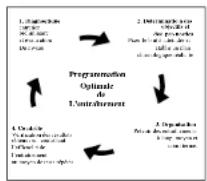
Peyrnapno npoBepreIte ypoBEB BaWero pa3BnTn - 3TO nO3BOHNT, pNp He06XoDMOCn, 3MmEHb TporppaMMy TpeHnpOBKn. Ha cneDyUeem PcCynHke NOKa3AHa CBBa MekJy 43neMeHTAMn, irpaHOuIMn BAXHyO pObl B aFfKeTNBHOn nporpamme TpeHnpOBKn.
HnarHocTNKa-HaayabHbIyypoBeHb
Ipeednactpokn nporpaMMbBam Heo6xOIMO 3anOMHInb HeckOJIbKO napameTPOB nBaun pAsMePb. TaKHe
N3MepeHnNo3BONr Bam OnpeDenHb TeKUyuee Fn3uHeCKoe COCTOHNHe. Heo6xmoI NoynHTb Ce DaHHBe, Kacauouneec Bac,Baewero 3OpOBBa n pe3yNbTaTOB.
-ПИИHbIe DAHHbIe Bo3pAcT, non,ФИrpya, BEc,nPpOeHT TENEChORo Xnpa, N3MepeHn. FOtOrPAfMn I.T.
- DaaHHbIe o coCToRHM BAaWero 3dOpOBbK KPOBHaHoe DaBaJIeHHe, optoneDInHeckne daHHbIe, aHaJIIN3 Meta6OJIuYeCKNX npOueCCOB, TaKeJIbe 3a6OBeBAHn, TpaBMUT.
Даньtiepe3yntaTax:TecbHa BbHOCINBOCTbN CnIY, TcBtBdNKeHH N KOHTPOJNAckOPOCTNo6bHIO He Tpe6yTOcIgФNTHeCA. KoOpDInaCua DnKBeHNrAIBReTcQOeH BaxHBm napaMeTPOB BnpoceCE TpeHIpOBok.
HeNoBOpOTnIOBCTb"ObbHNO RaBnErcTcpe3yNbTaTOM HeOCTaTOhBixTpHenPbOBK.03ToMY,BO BpEmrTeHNPOBKN PnpdeKBMaTecb3aDaHbMxMOyNe,IaKe B TOM Cnyae,ecNTHoYnpaXHeHNA BaBHOCnIOBCTb
KaXdbTecT,6yDbTOTeCT DnONpeDeneHIN HNTENKTEYaIbHbIX INHINHINCKHX CnOCOBHcTeN,OToBpaKaet BauIypOBeH B TeUkyMMeMTBpeMeHN DaKe,HeCMOTPA HA To, YTO MATemATuWeckNPE3yNbTaTBIC TEHEHM EBMENH TepRoT CBOIO 3HAUMOCbT, DOCTNRAeMBe BAIMpe3yNbTaTB (NOcNE AANOHURHO TECTA HeDEIO NO CYCT) yNyUWATCBsOTHOCHTeBHO NepBbIX TAK KAK Bbl CMOKeTe OPeDEnNTB CBOIN CAbble MeCTa N3MEHITb NpOPaMMY TpeHNPoBKN, DnToro YTObbl N36ABiTbc ON DAHbX HeDCOTATKOB
AHAIOHMObpaOtaemHCaHIMTeIOM DaBaItePnpoNOXMM,TOBbBbINHIN
TCT Ha BaBHOCINBOCTb HaaBpe3yNbTaT Ha 20% HNKe cpeHero ypoBHn.
POnyEnHHb pe3yBtTat DOnJKeH NOMOyBaM nOoTOBnTb npOrpAMMy dnoOctKHeHn 3TORo CpeHero ypoBH.NToO3Haayet,TO TECT ABBETcO OCHOBo DNRA3aHnA npOrpAMMb TpeHnpOBKn dNo DCtNKeHn BAeWu CEHN OTOMY OChEh BaxHo peYrnapHO npOpBepaTb Baun Pe3yNbTaTb dNn XCONOTABHnC 3daHbHMu CEINMM. EcN TaKoe COOTBeTCTBne He Ha6JIoDaTeC, To npOrpAMMy TpeHnpOBKn Heo6XoDnMo h3MeHnTB.
DaHHbIe KOHTpOraJaOT Bam BO3MOXHOcTb cpaBnBaTb BauIN pe3yJbTaTb CO cpeHIMM 3aHaehnMI, HO pNt OTM oBeceNBAOT BaAe TaBnTbe. YpeE3 6 HeJeB nocne Haana TpeHPOBkMb BiInOpHIM aHAnOMHhble TeCTb N npOBepIM, yNyUHmncBn BAuIN pe3yJbTaTb, n eCnn yNyUHmNCb, To HA KAKYIO BEMNHy.
ФиЗИЧЕСКЕ папмЕТпьI
Bec
YIOBNEbOpeHHOCt BaIIM TeOM ObUHO 3aBcNt OT balaHca. KaKo BEc RAJIeTcR NdeAIBHbM?
IIra ONpeIeHnI INeAInHo Beca
INCnONb3yIOCT CneIyoUHe FOpMyIbI.
HopMaJIbHbI Bec = 0xbaT rpyd n B Cm. - 100
IeanbHbBecnJxEHnH= HOpMaHbHbBc-15%
- IeaeJIbHbI BcDnI MyKyHIN = HOpMaJIbHbI Bc-10%
DaHnHaPpMyNa, H3bHaMaHpOpMNoI BpOkKa, ImeEOrpaHueHHoe 3aHuene. TaK KaK HeCyUeCTByET HoBOro CnOcoba
OnpeIeHnIeAanbHorOBeca,TOHaWe
OC6BTHEHoeBOcPnIHnTne CamnxCe6aCKaXET
HAM60JIbe,YemIOoEoCNo. Ho
60JIbUHNCTBy IIOeJyDooHHe cpaBHnBaTb
CBOEcoCTOHRe CnVAMnIOToMYCTOHT
YUYtBuBHe HecKoJIbKO 3MBCTeBHX fOpMnI JnI
BbUncHEnH,NHKeKaMacCbI Tena (UMT)N,C
HEKOTOPOr OROBOPKOr OTHOuHHeNe pAmepa
rpyKn K6ePaam (OXBaTa rpydKn OXBaty
6Beep).
HndekmcacbIrena (MMT)
3HaHHe IMTOnpeJenRb3aMmocB3b MeKdy BEcOM TeNa IeroΦopMoN INCnObl3yETcIINa3aHaHnIyUweroN6oJe TToHOHOr CTAnDAPrA, YemC NcNoJIb3oBaHMeΦopMyIbI BpOKKa.
VMT = φακτηνεκκην BEC (B Kr) : (POCT B M)².
Πριμερ. Ππλγκυχήνν BECOM 70 Kr n POCTOM 1,70 M VMT COCTABNERT 70 : (1,7M)² = 24,22.
BnpBedeHHHnHexe TaBnue Bbl MoKeTe HauN CBOE 3HAUHeMe. DaHbIe 3HAeHnRABnTcR opNEHTPOBQUHBMn H He rapaHTnpyo TOHoe 3HAUHeMe,OCobEHNO d60bnHbXIOJeD, dAteTne NnOxNloro BO3pacta .
XeHnHb MyKHHb
OTHoHHeNrpyb-6eepa (OTHOseHne OXBaTa rpyn K OXBaty 6eep)
IcnoJb3yprnBeDeHnyoBbIe Ta6nucy BbIOnpeDEnnn, YTO yOpeBHe JnPa BbIe HOpMaJIbHOr.3T0T XnP MoKTe OKa3bIBaTb pa3NJHoe BmNHHe h BAe 3dOpOBe.
BlaorOap npocToMy TecTy, KOTOpBn MOxHO BblONHtB Doma, ONpeDenite, OHOCHTcB NBI bRpyNne pncKa cepDeHybX3abObeBaHH. Jn3TOrO Bam Heo6XoIMMo N3MePraTb OXBat BaIeYr pyDu yybBbIe npkA He BTaRnBa. XIKBOT NHAXODAcB B paccNa6NeHHOM NOLOXEHNI. 3aTe mpon3BeNTe N3MepeHne OXBata 6Beep B cAMOn UmpOKo ToUcky. Pa3DeNtE OXBat rpyDn Ha OXBat6eep.
Ecnn nonyeHHoe 3haeHne Hnke 0,9 (Jnna MYKWHN) N 0,8 (Jnna JxEHUHN),TO BbHe OTHOCINTEcb Kpynnpe PnCKa cepJeHHbx 3a6oBaeHN.
N3MepeHn
POMMIMO n3mepeHHO xOBaTArpydn 6eep Heo6xOIOMO BbIPOHNHt CnEDyIOUcne n3mepeHH. Ecnn Bbl XeNaTe EynuWHTB cBOIO fNHyp,
To pe3yIbTaBn3MepeHn NmOryT BAM CneIbTb 3a pe3yIbTaTAMn B npOceCe TpeHHPOBk DaHhB MeTOB BCE eEe ABnIEcTc HAm6Oone ToCHbIM, B6CtPbIM n DeWeBbIM. Heo6XoHMo NOMHbTb, YTO N3MepeHn BblONHHTocB OOnHXn TEX Xe Tockax.Mb peKoMeHydEm N3Meptb CneJyHoune qactn TEa OKyRKnHcTb Weu, rpyDi, npDeNpNeuHnn, nNeu, TaNN, bep, roHee n Kp.
Фигра
B NOBceHBeBHOn Xn3HN Mbl BNIMM akTepeb KAcOHeH INTEpechBIX N pINBNEKATEbHbIX IIOJei. 3To OTHOCITN K HAKeH eI HHTeHfpye E CEni ne napameTpbl He COOTBCTBYOT ONPeDeneHHOMy KpInTEpHO, TO Mbl CTpeMHMCr YTO-TO I3MeHNTb.KCOKaJIeHIO,HAM npXoONtCn pN3Atb, YTO fPhIrpa QPeDa AcTepe H BcERda CTaHOBtCBsC hFpyo APohOBla WBepeHcETepa.3To OTHOCITSC n K HAWeMy Tey, Py6EHC He TaKnpocTcSTb TOn MOdenbIo. PO3OTomy NepeD TEM, KAK Haatb 60pOTBC S BoBOB DopOxKo, HABepHOe, 6yEt npAIBnlBHee npINHrTB BO BHMAHne HAUfPHpyu.HyKHO NIMAM BCem cTAHOBtCBsTOn MOdenm?Haue fM3Hcckoe CoCTOHNBE B3HAHITeBHOH Mepe ONpeDJeTcB PBeMeHem, B KOtOpom Mbl XKNBEm. PO3OTomy NPUBeDEHbIe HNKe TNIb MyrPBCtePAOTc peKD. BoJbUnHCTBO
JIIOe CpeHn HAc-3To IIOHpa3HOrTO Tnna.
ActHueeckn/3KtOMOpHbI TIN
Oc06eHHocn:
Ta3 wnpenneu
OueHb n6Kne ccyTabbl
Cna6oe pa3BHTneMbI山
Hn3Koe KpOBAHOe DaBHeHne
- YBENHHHI IVNbc B NOKOE
Cna6aBzPkyJnA (Hn3Ka BbHOcJIbBOcTb)
XoIOOnHbIe pyKn nCTyTNH, roNoBOKpyKeHne npN BCTaBAHN
IHTeHcMBHae DaTeTbHOCTb HEPBHO CNTEmbl
Cna6bmyMeta60n3M(T8KeIHOh6upaetcBec)
B OTNIWNEOTDPYRINDAHHNTHINHOJNDXOHNIT
DnAERTEENTHOBCTN,PNPDNARAOUeYcUNHne
NbHBNCIOMBCT.AADANTPOBAHNAH
TpeHINPOBKA NO3BOONETYCPTAHNTb DAHHbIE
HEoCTATKIN,DAKEBTOMCNyAE,ecNI
HaAHJIbHBeYcNOBHeYABNIOCT
6bnAFOPNTHBMIM,FNYrpaAKTOMOPFOHORTNH
0bIbHO Bb3bBaet 3aBNCTb y npdeCTaBnTeNe
DPYRINTHIOB.PnpdCTaBnTeN DAHHORTOH
MOrY eCTb CKONbKO XOTRT N PnH 3TOM He
Na6upatb BEc.
CnoptcmeH/Me3omopfHbI TIN
OcobehoCTn:
CnBna npa3Bnta MyckynaTpa
- Pnneu upe 6eep
MbIeHnA CHTeMa HpKpyLna KPOB BENKoNEHNO NOxOuNT DnI 3HaHTeBbHbX Harpy30K
H3K0e KpOBAHOBdAaBHeNIE Npybc B NOK0e DnA kTtBbIx npEcdTaBnTeNe M3oMOpFOHOrO Tnla
- YBENHHeHoe KpoaHoe DaIbIeHne IyIbcIgNe He AKTINBbIX npEcdTBeNEme Me3OMOpOcPHOro TnTa
Hn3KaBBOCPnMmMBOCTbKXoNoDy - PpabunbHaHnhypa
HopmaJIbHoe nIeBapeHne
B Cnyae HeaKTHINBOCTH NnN36bIOTOHORI nTAHJXn HAYHnAe TCBNAbTC Ta
yUHTbBA Bce BblIeCKa3AHoeДЯ
yUHtBHeNpe3YbTaTob ME3OMOpPFOHO
TINa DOCTaTOH OMepeHHbIX TpeHHoBOK.
Jn DaHHORO TINa PNC TpABM
3HaHTeNTbHO BIIue, TAK KAc pa3BNTHE
MbIu He BcERda COOTBETCTByET IN
3AnactHNOCTn. PO3OTMy MBI peKomeHdyEM
3aTpaHbATb 3HaHTeNTbHOE BpEmr DJIa
TpEHPOBOK C UeJIb YBEInuHeyH
3NaCTHNOCTN MbIHU.
Φnypbl CnpTINBHORIO N OeHb AKTINBHORO Me3oMOpHOrTO TNOB OOHb 6bn3K K nDeaIbHOH Fonpyo80-90x roOB. PO3tOMy MHOrne H3c HcT XOTR pNHaJNeKAtb K daHHoKateropnX,OTR 3aAcTyO 3To He TaK. IOnDn KOTOpBe HEmOYr PnIHsHTb TO fpaKT, YTO nDeaIbHOte TEIO He MoKet 6bItb y KaKaDOrO, O6bHuOeHp pacCTPnBaIOTcR.
3HDoMOpΦhBmTn
Oc06eHHoCTM
Okpyrblbe fOpMbI, XkpOBbIe ckOnnneHn
- WnpoKne npeu, Wnpokn Ta3 (nonpnuHne H36bItoUHO Beca)
Bonee paBHomeHoe paccpeJeHHeBe Ceca no cpaBHeHIO C DByM npyTmTNnAMN
CpeHnA qHpya
XopoOo noDxOaT dIaTeTbHocTn,
HaueeHHO HA CNNy N BbIHOCINBOCTb
- PnocToI npnem nHn MeMnEHHoe nHnueBapene nPnBODnK bCtpoMy habOpy Beca
HnKnnPbC BNOKoe, HOpMaIbHoe KPOBHOE DaJIeNEe (DnA kTNBbIX npectabnteJIe)
TnBIMKo3bIePMN 3HDMOPOBABRNETCa CnNA, BbHOCINBOCTn NODBVHXOCTB, B HEKOTOpbix CNTyauXn IperpaDOn MOKeT CTab Tb0bcE.BpeCTABmTeB daHHORo Tnna DoJIkeH 6bpaatb BHIMAHne Ha Niuuy, OHa DOnkHA 6bIt 3dopoBoi n aadTInpOBaHnA K eO notpE6HOCTM, oBeCNEHBATb BbHOCINBOCTb dra CTaBNIH3aUcNBEca. YuTBBA cyueCTbyOuune Ha daHHBI MOMENT uaeblk PAcotbl, fHyprpa 3HDMOPFO HOrnHe NoDxOHT K TakOMy onpeJeHnIO.Ho ykaahnble Bbiwe OOC6EHNOCTn TAKKe CBNDetelCBYHT, YTO AKTNBBH 3HDMOpΦ 6bndaet Heo6XoIMMbIM TaanHtAMn DnXoPoeo 3DOPOBBy IN cNOPUBHO TcNla KJNOrpAMM EMy YeNoBPeNT.
TecHa BbHOCINBOCTb
TeCT Ha BbHocINBocTb He MoKcET
BbIIOHNrTaCBy CnEduyoUnx YcNOBnIX,3a
NCKIIOUeHH npObeHnnpoHaJIIOJeHnEM
Bpcaa:
TaeKeIbe I xpoHueckne peCnnpaTophie 3a6oJIeBAHH
3a6oJIeBaHnIg,coPbOxKaIOuIueCe BbICOKo TEMpepaTPOI
- INHfekUHOHHbIe 3a6oJIeBAHnI
3HaHTeBbHoe yBelleHHeNKe KPOBaHOrO DabNeHnA
HapyeHne yHKun (Haepmep, cepua nnnn
HΦekun
Pnem MeikametOB (6eTa-6nokatopbl)
- Noxoe camouyBCTBne
BbHINCTBO IN3BecTHbIX TcTeOB Ha
BbHOCNIOBCTO, HCNIOB3YeMbIX B CnOpTe,
BRAJIOCTC TcEmo Kynepa. PnI BbIOnJIeHNH
DaHHOrTO TcTeA Bam Heo6XoIMMo 6KeJaTb C
MAKcIMAbHbON CKOpocTbO B TeUHeHne 12
MHyT Ha MaKcIMAbHoe pacCToHHe Ha
PiNCKoN NoBepxHOCTn.
HECMOTPAHTOYTOZENBOYABNRETCB DNNKHe 63OCTaHOBNB, BYMOKETe 3aEMDNTbEer NPOITNI NKOM.
PpeoDoneHHe paccTcHHe fKcnpyeTcN cpaBnBaEeTcO chAchEnHmM 3n TaBnIcbl Kyepa.DaHHa oBtua daet 3hAnHTbHyOn HfOpMaMuH O BauXp eeybTaTx.
OCHOBHbIM IpeMMyIeCTBOM DaHHOro TecTa
ABJRETCTO, YTO BbMoKTe BblNOHnTb eRo
BJIIOoe BpemN 63NoCTOpOHne
nomoiu. Bam NotpeSyeTc ToIbKO
cekyIDomep HANpaNBHeNc
fIKCNPOBaHHbIM pacCToHnEM.
HeoctaKom daHHoro Tecta RaBnEeTcTo, YoTo
IINI POUYHnX XPOUHX pe3yIbTaTOB
Heo6xOIMO NMeTb HeKOTOpBn Oblt B 6ere.
Bb MoKeTe He BbIOnHrTa DaHHb TeC Tnp
PiONOM CamOvByCTBN (60nb,yCTaNOCTb,
He3DopOBoe COCTOARHE n T.D.)
Tect Kynepa
| Test kynepa Жендана Возрac | Даннbleв KM, M = мужунna,Ж = | |||
| 20-29 | 30-39 | 40-49 | 50-59 | |
| Очныхорош M Ж Хорош Ж Средни Ж Слаб Ж Очны слаб M Ж | 2.64-2.81 2.16-2.32 2.40-2.63 1.97-2.15 2.11-2.39 1.79-1.96 1.95-2.10 1.54-1.78 <1.95 <1.54 | 2.51-2.70 2.08-2.22 2.34-2.50 1.90-2.07 2.10-2.33 1.70-1.89 1.89-2.09 1.52-1.69 <1.89 <1.52 | 2.46-2.64 2.00-2.14 2.24-2.45 1.79-1.99 2.00-2.23 1.58-1.78 1.82-1.99 1.41-1.57 <1.82 <1.41 | 2.32-2.53 1.90-2.08 2.10-2.31 1.70-1.89 1.87-2.09 1.50-1.69 1.65-1.86 1.34-1.49 <1.65 <1.34 |
BbTAKKE MOXTEE BbINOHNHTb DpyrO Tect Ha
BbHOCINBOCTb:「FapBaPdCKm CTynEHaTbI
Tect」.BbIbONJIHeHn DaHNO Tecta
HEoBXODIM MOHITOP cepDeuHOro pHTMa,
cekyHOMep, CTynehKa INN cKamEka.
BbCota CTyneHn INN CKameKn 3abVCNT OT
BaWero poCTa.
TapBapdckn CtyneHuaTbI Tect
| Poct, cm | BbICota |
| ctypehi | |
| <152 cm | 30 cm |
| <160 cm | 35 cm |
| <175 cm | 40 cm |
| <180 cm | 48 cm |
| >180 cm | 50 cm |
Дя Bылонненядан Horo TecTa BCTaBaTte Hа CkamKyHnCtynEhky nCxOJTe C Hee KaKdIbe 2 cekHyBb MmHytBy BblonHnReTe 30 DbKHeHn, YTO B6Uem Daet 120 WarOB BBePx HnH. CmeHa Hor
HINHCNOb3OBaHHe TOnbKO OHOH HOrn He BBNIEHT Ha pe3ynbTaT. N3MepeTe YaCTOTy cepDeYhBc cokpaAeHH Yepe3 4 MNHyI. Pocne OKOHAAHN YnpaxKHeHH N3MepeTe nnbcYepe3 60 CekyHd N else pa3 hep3 takoe Xe BpMa. Taikm Obp3Am, Bbl nonyTuTE 33aHeHH, KOTOpBe Heo6XOJMo NOCTABuTB B CneDyoUy foPMyNy:
A+3000 DeenHbHe Ha CC B +3000 DeENHbHe HA CC = INDeKc BbIOHCINBOCTI.
PpMep: ecnnn oocne okohanyu npaxHeHHBac nynbc coctabnet 160 (CC A), 120 cnCTMaHHTy (CC B) n 100 uepe3 2 MHNytb (CCH C), to Baun Hndekc BblHOINBOCTN COCTABNT:
3000:160 = 18.75
3000:120 = 25.00
3000:100=30.00
INDEKC BbHOcNBOCTN=18,75+25,00+30,00=73,75
HaOCHOBAHINnpBBeHNOHNKHe TaBnIbbl BMOKETe INMENHT npORpAMMY CBOEITpeHPOBKNi pa3dennbYcNIMBA COOTBeCTBmC pESyBtTATAmTeTcA.13 npBBeHNOHNKHeTaBnIbMb,INHNeKcBAHOCNBOCTn INPIMepa (73,75),BblNTe, YTO DAHHOE 3NAUYEHNE RBNRETCDOCTaTOHO XoPOUHM DIA YenOBekaMnAaue 35net OChEBXoPOUHM DIA YenOBeka CTapwe 35 net.
Ecnn BbOCTaHOBnINCb Ha nporpamme
BbHOCNBOCTH, INMeHReIe ee B npeJeIax
KpaTkoCPOVHbX, CpeDHeoPHybIX
DOIOrOcPOVHbX nepNOOB.
B MeoKne Bam HeoXoDmO yBeINuMbTa
INTHEMCBHOCT bpEHNPOBKn DnMblIeUHbIX
nporpamm n nporpamm BblHOCINBOCTN.
OrpaHNVBaIte INTEHCUNBOCT bpEHNPOBKn BnaJae KaXdoT OBOrO LkNJa.
PeyLNRPO OueHNBaIte Baau TpeHNPOBKn, DnTO rTO qTo6bl NoHrT, HaxoMDTeCb Nn Bbl Ha BEHPOM pTN I cNoCObHbI Nn DoCTuB 60nbWHCTBa Baxhblx ueJe,ecnn Het:
- 13MeHHTe CneDyIOUm MeOuKn
- IOBTopHeHauaHbHbI Tect
BbINOHnIte npomExyToHbIe TcTebl B KOHc KAXDOrO Me3OuKJIa.
ycnex
JaKeYepe3 HnnpoDIOKInTeNbHOe BpEmr
peyIaHbIX TpeHPOBOK Bbl yBUNITte, YTO
DOJKNbI NOCTOHNHO yBENUINBaTb
CONOTMBHeHne Ha NepdAnx DnI DOCTXKeHH
ONTMaNbHorO npbca.
NoCTeNEHNO ynpaxHeHHa 6dyt DaBaTbcR
PnoSe, N Bbl BydTe UYCbTBOBaTb Ce6B
HEMHoro NpyWe B TeYcHne DnR.
3To DoNkHO CTaTB BaWey MoTbBaUnei DnR
peyIaHbIX TpeHPOBok.Bb6epnte
OnpeDeneHHbIe Yacbl dnn ZaHTm I He
HaunHaiTe TpeHApOBky OChb arpeccmbHO.
Ctapar NoCnOBuCa cpei cnOpTcMeHoB
rIacnT:
"CaMbIM CIOXHbIM B TpeHIpOBKe RaBnEe Hauano
KeJaem Bam MOpy yDObOBoNCTBnI yCnEXOB Pn INCNOlb30BaHH TpeHaKeepa.
Bce npBbeHbIe daHbIe IaBIOCTcR
npBn3HTeNbHbIM yKoBODCTBOM n
He MOryT 6bITb HcNoBtOBAHbIB
MeDnIHNCHX cTeNIX
OtobpaKaemar Yactota cepDehbx
coKpAueHn IaBnETcR
npBn3HTeNbHO n He MoXeTb6bITb
ncONoBtOBAHa B KaueCTBe
pyKOBoCDtBa dJa MeDnIHNCHX
nporpAMn NoJeueHn BoJe3Nei
cepDeHo-cocSydntCnCTeMbI n
napameDiunHCNX nporpAMM
PykoBoCTBO Nolb3ObaTeNa npedHa3nueHo TOnbKO nI IN cnpBaoCHbIX ceNei NOKynTeNA. NocTabuNK He rapaHTpyet oTCyTCTBNE OoH6K nepeBOda HmN hMMeHenH texHyecknx xapakTepcntk HsDeJIa.
The owner's manual is only for customers' reference. The supplier can not guarantee for mistakes occurring due to translation or changes in technical specifications of the product.
| S/N | Name | Qty | |
| 1 | Inline bracket 1 | ||
| 2 | Main frame 1 | ||
| 3 | upright tube 1 | ||
| 4 | Left handle bar 1 | ||
| 5 | Right handle bar 1 | ||
| 6 | Console bracket 1 | ||
| 7 | console tube 1 | ||
| 8 | foldable bar 1 | ||
| 9 | Left grounding tube 1 | ||
| 10 | Right grounding tube 1 | ||
| 11 | Cross tube 1 | ||
| 12 | U grip ring | 2 | |
| 13 | Lock | 2 | |
| 14 | Wire line hitch | 2 | |
| 15 | Wire connector 2 | ||
| 16 | Spindle ring 2 | ||
| 17 | Cylinder connector | 2 | |
| 18 | Motor base 1 | ||
| 19 | Cylinder switch 2 | ||
| 20 | V belt | 1 | |
| 21 | Running belt 1 | ||
| 22 | Running board 1 | ||
| 23 | Front roller 1 | ||
| 24 | Rear roller 1 | ||
| 25 | Motor | 1 | |
| 26 | Incline motor 1 | ||
| 27 | Upper console cover | 1 | |
| 28 | Under console cover | 1 | |
| 29 | Left cross tube 1 | ||
| 30 | Middle cross tube | 1 | |
| 31 | Right cross tube 1 | ||
| 32 | Cross bar board | 1 | |
| 33 | Left console spindle cover | 1 | |
| 34 | Right console spindle cover | 1 | |
| 35 | Handle pulse 2 | ||
| 36 | Handle cover 2 | ||
| 37 | Left foldable bar cover 2 | ||
| 38 | Right foldable bar cover | 2 | |
| 39 | Left upright tube cover 2 | ||
| 40 | Right upright tube cover | 2 | |
| 41 | Left motor cover 1 | ||
| 42 | Middle motor cover | 1 | |
| 43 | Right motor cover | 1 | |
| 44 | Upper cylinder cover | 2 | |
| 45 | Under cylinder cover | 2 | |
| S/N | Name Qty | |
| 46 | Left rear cover 1 | |
| 47 | Right rear cover | 1 |
| 48 | Side rail | 2 |
| 49 | Insertion strip | 2 |
| 50 | Left decoration part 1 | |
| 51 | Right decoration part 1 | |
| 52 | Plastic cover 2 | |
| 53 | Cylinder | 2 |
| 54 | Below Wire 2 | |
| 55 | Upper Wire 2 | |
| 56 | Controller | 1 |
| 57 | Transformer 1 | |
| 58 | switch | 1 |
| 59 | Restoration switch | 1 |
| 60 | Power cable 1 | |
| 61 | Plug | 1 |
| 62 | Switch button | 1 |
| 63 | Wheel | 2 |
| 64 | Wheel base 2 | |
| 65 | Small cushion pad | 2 |
| 66 | Cushion pad 4 | |
| 67 | Covar | 4 |
| 68 | Foam | 2 |
| 69 | Sator for Side rail | 6 |
| 70 | Lock spring 2 | |
| 71 | Screw | 2 |
| 72 | Flat washer Φ35*Φ8.5*2.5 | 2 |
| 73 | Lubrication cover | 2 |
| 74 | Hex screw M10*65 | 1 |
| 75 | Hex screw M10*55 | 2 |
| 76 | Hex screw M10*45 | 1 |
| 77 | Hex screw M8*50 | 2 |
| 78 | Hex screw M8*15 | 2 |
| 79 | Hex screw M8*65 | 2 |
| 80 | Hex screw M8*45 | 1 |
| 81 | Hex screw M8*35 | 2 |
| 82 | Hex screw M8*25 | 4 |
| 83 | Hex screw M8*20 | 8 |
| 84 | Hex screw M8*15 | 2 |
| 85 | Hex screw M6*15 | 4 |
| 86 | Hexagonal screw M8*50 | 2 |
| 87 | Cross screw M6*20 2 | |
| 88 | Cross screw M6*15 | 8 |
| 89 | Cross screw M5*15 | 4 |
| 90 | Cross screw M5*10 | 8 |
| S/N | Name | Qty | |
| 91 | Cross screw M4*15 | 6 | |
| 92 | Cross screw M4*8 | 19 | |
| 93 | Cross screw M4*12 | 2 | |
| 94 | Cross screw M6*25 | 8 | |
| 95 | Cross screw ST4*15 | 44 | |
| 96 | cross screw ST4*10 | 9 | |
| 97 | cross screw ST4*10 | 4 | |
| 98 | cross screw ST3*10 | 2 | |
| 99 | Cross screw ST2.9*6.5 | 2 | |
| 100 | lock nut M10 | 4 | |
| 101 | Lock nut M8 | 2 | |
| 102 | Lock nut M6 | 2 | |
| 103 | Flat washer Φ10 8 | ||
| 104 | Flat washer Φ8 12 | ||
| 105 | Flat washer Φ6 | 6 | |
| 106 | Flat washer Φ4 | 6 | |
| 107 | Lock washers Φ4 | 1 | |
| 108 | Plastic sheet for wire fix | 2 | |
| 109 | Line nip | 1 | |
| 110 | Filter | 1 | |
| 111 | Inductor | 1 | |
| 112 | Magnet ring 2 | ||
| 113 | Cross screw ST4*20 | 2 | |
| 114 | Console wire 1 1 | ||
| 115 | Console wire 2 1 | ||
| 116 | Optical sensor 1 | ||
| 117 | Optical sensor bracket | 1 | |
| 118 | Square cushion | 4 | |
| 119 | Running board cushion | 8 | |
| 120 | Cross screw M5*8 | 2 | |
| 121 | Safety key | 1 | |
| 122 | Cylinder spring | 2 | |
| 123 | Cross screw ST4*12 | 8 | |
| 124 | Cross screw M5*15 | 4 | |
| 125 | Rubber pad 50*25*2 | 2 | |
| 126 | Rubber pad 55*20*5 | 1 | |
| 127 | Small cushion pad | 2 |



DKN-Benelux
Zwaarveld 58
9220 Hamme
Belgium
DKN-Espana
Avenida Camino Cebolla no, 7 (Polig. Ind.)
46138 Rafelbunyol
Valencia
Spain
DKN-France
Centre Auvergne Enterprise
1000 South Fremont Avenue 38
Alhanbra Los Angeles
California CA 91803
USA
DKN-Suisse
Hauptstrasse 37
9553 BETTWIESEN
Switzerland