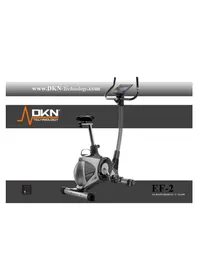
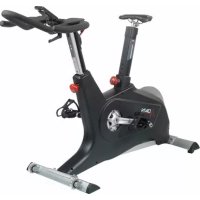
EF2 - Exercise bike DKN - Free user manual and instructions
Find the device manual for free EF2 DKN in PDF.


| Product type | Exercise bike |
| Brand | DKN |
| Model | EF2 |
| Power supply | Mains 220-240V |
| Maximum user weight | 140 kg |
| Resistance levels | 16 levels |
| Training programs | Manual, Program (12 profiles), User (customizable curve), Target HR, Body Fat, Watt |
| Display | Time, Distance, Calories, Speed, RPM, Watt, Pulse |
| Heart rate sensor | Metal handlebars (sensors) + compatible telemetric chest strap (optional) |
| Body Fat function | Calculation of BMI and body fat percentage |
| Warranty | 2 years against manufacturing defects (excluding wear parts) |
| Usage | Domestic use only |
| Maintenance | Check assembly every 1 to 2 months; clean without harsh products |
| Safety precautions | On a flat, non-slip surface; avoid moisture; supervise children |
| Spare parts | Use only genuine DKN parts |
| Manufacturer contact (France) | DKN France, Centre Auvergne Entreprise, 15-17 Rue du Pré La Reine, 63100 Clermont-Ferrand |
Frequently Asked Questions - EF2 DKN
User questions about EF2 DKN
0 question about this device. Answer the ones you know or ask your own.
Ask a new question about this device
Download the instructions for your Exercise bike in PDF format for free! Find your manual EF2 - DKN and take your electronic device back in hand. On this page are published all the documents necessary for the use of your device. EF2 by DKN.
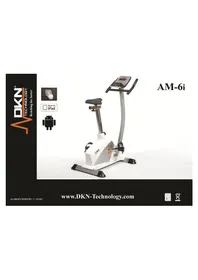
USER MANUAL EF2 DKN
This guarantee covers all manufacturing and material flaws on DKN-Technology. products purchased from an authorized DKN-Technology dealer for a period of two years from purchase.
If you wish to make a claim under the guarantee, DKN-Technology shall be entitled to repair or replace the defective unit or part at its discretion. The owner of the unit must pay for the transport costs and any dealer's workshop costs.
To make a claim under the guarantee, take your guarantee card to your dealer. The dealer will then take the necessary action. If this is not possible, contact your national DKN-Technology importer.
The following are not covered by the guarantee: normal wear and tear and the consequences of improper treatment or damage caused by the purchaser or third persons and faults which are due to other circumstances. Claims may not be made under the guarantee if modifications have been made to the original construction or equipment or if DKN-Technology original parts were not used to repair the unit. In no event the manufacturer shall be liable for incidental or consequential losses, damages or expenses in connection with exercise products.
This exerciser has been designed for home use only. Professional use, commercial or use in gym centers, will automatically cancel the manufacturers' and/or importers' product liability.
Before you start training on your DKN platform, please read the instructions carefully. Be sure to keep the Instructions for Information, in case of repair and for spare part delivery.
This exerciser has been tested up to a max. body weight of 140kg / 310 lbs.
Follow the carefully the different steps of the assembly instructions.
Use only original parts as delivered.
Before starting the assembly, be sure to check if delivery is complete by using the included parts-list.
For assembly use only suitable tools and ask for assistance with assembly if necessary.
Place the exerciser on an even, non-slippery surface. Because of possible corrosion, the usage of any exerciser in moist areas is not recommended.
Check before the first training and every 1-2 months that all connecting elements are tight fitting and are in the correct condition.
Replace defective components immediately and/or keep the equipment out of use until repair.
For repairs, use only original spare parts.
In case of repair please ask your dealer for advice
Avoid the use of aggressive detergents when cleaning.
Ensure that training starts only after correct assembly and inspection.
For all adjustable parts be aware of the maximum positions to which they can be adjusted/tightened to.
This exerciser is designed for adults. Please ensure that children use the exerciser only under the supervision of an adult.
Ensure that those present are aware of possible hazards, e. g. movable parts during training.
Warning: incorrect/excessive training can cause health injuries.
Please follow the advice for correct training as detailed in training instructions.
Consult your physician before starting with any exercise programme. He can advise on the kind of training and which impact is suitable.
The owner's manual is only for customers' reference.
The supplier can not guarantee for mistakes occurring due to translation or change in technical specification of the product.
All data displayed are approximate guidance and cannot be used in any medical application.
Operating Instructions Computer
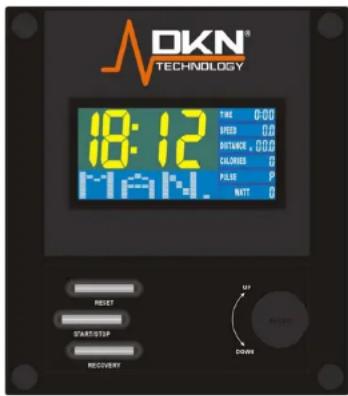
Switch on
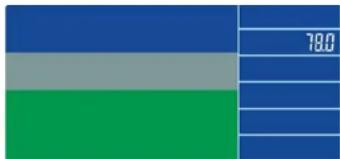
After applying power and/or after pressing any button the display will be blinking for some seconds showing the figure 78, while running selftest ENTER as shown below.
Next enter the calendar setting. Use twist-dial to enter the year, confirm pushing ENTER. Follow same procedure to enter month, day and clock.
Function buttons
ENTER Press to select any function to be displayed on the main screen.
ST/STOP To start or stop the exercise program.
RECOVERY Press this button for recovery function: After exercising, while the LCD is still active, press recovery button, and hold both sensors (or wear the chest transmitter) The computer will run a time down for 60 seconds, after which your recovery rate will be displayed, grades 1 up to 6. Level 1 featuring fast recovery, level 6 slow recovery.
RESET To clear the display and reset all data.
TOTAL RESET Repowering the display
UP To select upward function.
DOWN To select downward function
Function description
Time:
Displays time function by pressing the ENTER button
(marking - flashes in "TIME" (cd window). For countdown enter rate in minutes by turning the twist-dial.
Distance:
Displays distance function by pressing the ENTER button (marking - flashes in "DISTANCE" Icd window). For countdown enter rate in km by turning the twist-dial.
Calories:
Displays calorieburn function by pressing the ENTER button (marking - flashes in "CALORIE" Icd window). For countdown enter rate by turning the twist-dial.
Speed:
Displays speed function by turning the ENTER button (marking - flashes in "SPEED" Icd window).
Watt:
Displays power value function by pressing the ENTER button (marking - flashes in "WATT" Icd window.)
Pulse:
Hold firmly both sensors on the handgrip (please wipe sensors and hands before starting measuring your pulse) or apply optional chest strap (moisten slightly the contacts of the strap). Your current heart rate will be displayed within 30 seconds up to one minute. A stable figure requires to hold both sensors firmly.
Your computer is compatible with the optional chest transmitter (ref 20073), for integrated wireless heart rate registration. For any questions please do contact your DKN dealer, or visit our website www.DKN-Technology.com, or ask for more information: info@ds-design.be
Training in MANUAL MODE
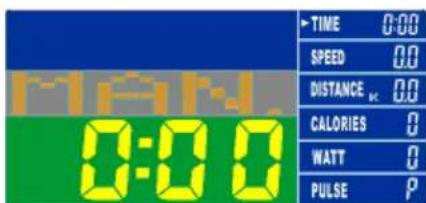
- Select "MANUAL", use twist-dial to adjust the load level (this ergometer offers 16 levels), confirm selection by pressing "ENTER".
- "TIME" flashes: use twist-dial to set exercise time, confirm selection by pressing "ENTER". If you don't intend setting exercise time, simply press "ENTER".
"DISTANCE" flashes: use twist-dial to set distance, confirm selection by pressing "ENTER". If you donot intend setting exercise distance, simply press "ENTER". - "CALORIES" flashes: use twist-dial to set calorie consumption, confirm selection by pressing "ENTER". If you donot intend setting calorie consumption, simply press "ENTER".
PULSE" flashes: use twist-dial to set maximum heart rate, confirm selection by pressing "ENTER". If you donot intend setting a heart rate level, simply press "ENTER", the monitor will display current heart rate value. - Start exercising by pressing the "ST/STOP" button.
Training in PROGRAM MODE
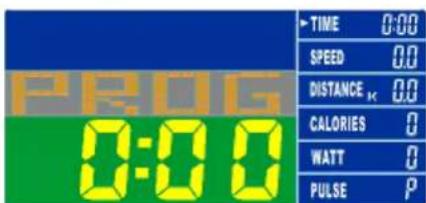
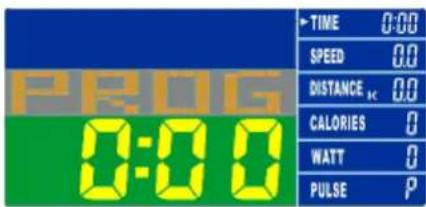
- Select "PROGRAM", use to select profile 1 to 12, confirm selection by pressing "ENTER".
Press "ENTER" again, and set target value for 'TIME, DISTANCE, CALORIES AND PULSE'. Follow the procedure as described above in manual ENTER. In program ENTER "WATT" cannot be preset. - If you don't intend setting any target value, start exercising by pressing the "ST/STOP" button.
Training in USER MODE
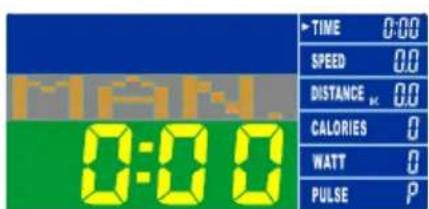
- Select "USER" use twist-dial to set up your own profile (this ergometer offers 16 load levels and 20 load segments).
- In each segment confirm your loadsettings by pressing "ENTER".
- Start exercising by pressing the "ST/STOP" button.
Training in TARGET H.R. MODE
-
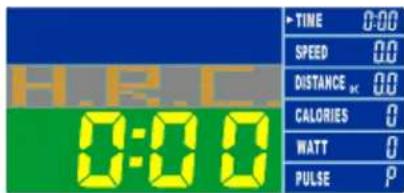
Select "TARGET H.R.", use twist-dial to enter your age.
Press "ENTER", "55%" is flashing. Use twist-dial to select 55, 75, 90 or THR. Confirm your selection by pressing "ENTER".
If you selected 55, 75 or 90% , "TIME" is flashing: follow the procedure as described above in manual ENTER for presetting target values. -
If you selected THR, "100" is flashing: use twist-dial to set target heart rate.
- Confirm your selection by pressing "ENTER".
- Start exercising by pressing the "ST/STOP" button.
Upon entering rate in BPM (Beats per minute) the load tension will be controlled by current heart rate. The resistance will be auto-adjusted according to current heart rate figure. If your heart rate figure is under the target pulse, the tension will be up-adjusted one level every 30 seconds, up to the maximum level 16. As soon as your heart rate figure has achieved the target pulse, tension will be down adjusted one level immediately. In case of overspec the level will be down adjusted one level immediately, and keep down-adjusting each 15 seconds until your heart rate figure has achieved the target pulse.
every 30 seconds, up to the maximum level 16. As soon as you achieved the set value, tension difficulty will be down adjusted one level immediately. In case of overspec the level will be down adjusted one level immediately, and keep down-adjusting each 15 seconds until you reach the preset value.
- If you donot intend setting Watts, simply press "ENTER".
BODY FAT display
- Select "BODYFAT" and press "START".
- Hold both sensors for approximately 10 seconds.
- LCD will show your BMI.
Training in WATT MODE
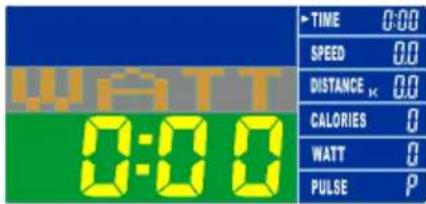
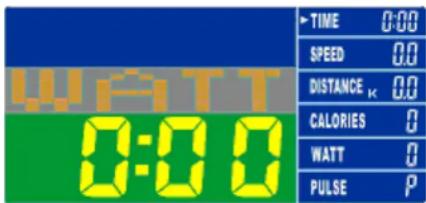
- Select "WATT", use twist-dial to set target watts (programmable between 10 up to 350 Watt), confirm selection by pressing "ENTER".
- The tension difficulty will be auto-adjusted according to the Watt figure. If the figure is under the target value, the tension difficulty will be up-adjusted one level
Training Instructions
If you have not been physically active for a long period of time and also to avoid health risks you should consult your general physician before starting to exercise.
Everyone, or almost everyone, is fascinated by the champions/athletes among us. We dream away when we have one look at a trained body, full of muscles, in movement, and hope that one day we also have an athletic body like that. It's then that we realize that exceptional performances need exceptional talents, but also daily training, well organized and planned within the smallest detail.
If we compare the genetic inheritance of great athletes to the genetic inheritance of the sporty amateur in general, we only can determine small deviations, which can't explain the difference in performances.
However if we compare the trainings, we do see great differences. In general, athletes on a higher level do not only had years of training, they also benefit from the help of a professional coach and have adapted their lives to their physical condition. Their training program is outlined and planned within the smallest detail and is being regularly evaluated in order to check if the preset goals are being achieved.
The sporty amateur who wants to improve his performances usually starts training without a plan. Sometimes he copies the training program of a well known athlete. This usually slows down his progress and often leads to strain the muscles and sometimes the cardiovascular system. A special, optimal training
program, suitable for everyone, would be wishful.
The incredible complexity and the different adapting processes which our body has to go through every training, don't allow us to use such a training program. Whether you train on muscle development, power, endurance, speed, flexibility or a better coordination of your movements, everyone starts with different initial conditions.
The goal of each training program is to improve your performances. You don't need to become a top athlete, you also can train to lose weight or just to feel better. The optimal performance can be for example, run 5 minutes longer than before at the same tempo and without interruption, or do more push-ups than the day before.
The research on the influence of a sporty training on our body has made lot of progress in the last several years. Even if some questions are still unanswered, the knowledge we achieved from the sporty science and related fields, have proven their use in practice and serve in the first place our top athletes. This doesn't mean we can't use the basics of a training for top athletes for every individual which practice a sport and who wants to improve his performances.
Evaluation of your physical condition
For each level of your training program (development of the muscles, endurance, flexibility, speed, coordination of your movements), we recommend you to find out through some tests on which level you find yourself. But first we recommend you to consult your physician in order to set up a health report:
Are you older than 35 years
- Have you not been exercising for a long time?
- Do you have overweight?
- Are some movements not suitable for you?
- Do you have to take medicines
- Are you suffering from a serious disease or are you having breathing difficulties
- Do you have a metabolic disorder (ex. Diabetes)
- Do you have any infections
- Do you have a fever as a result of any disease
- Do you have an infectious disease
- Are you having problems with your organs
- Do you suffer from hyperventilation
Are you having any respiration diseases
- Do you have any pain while breathing?
- Or do you have a poor physical condition
If your medical health is satisfactory, you can begin to set up your training program. But before you start, make sure you know your initial capacities - or a diagnose - so it is easier to determine your goals. Only then you can set up a training program which will match your goals.
- Diagnosis
- Determine your goals.
- Organization (long, mid-long, short term)
- Evaluate
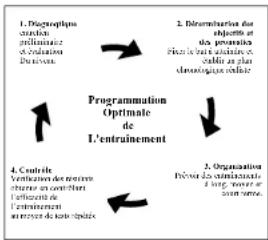
Regularly check your progress, so you can adapt your training program if necessary. The following survey shows the interaction between the 4 elements, which are important in an efficient training program.
Diagnostic - initial level
Before setting up a program, you have to take note of some parameters and take your sizes. These measurements will help you determine your present physical condition. It is the intention to collect all data concerning your personality, your health and your performances.
- Individual data: age, sex, figure, weight, fat percentage, measurements, pictures, etc.
- Data concerning your health : blood pressure, orthopedic data, research of the metabolism, serious diseases, injuries, etc.
- Performance data: endurance tests, power tests, movement tests and speed control is often not necessary in fitness. Coordination of the movements however is crucial because it is very important when you execute the exercises.
"Clumsiness" usually means a lack of exercise. Therefore stick to the preset modules when you exercise, even if it is an endurance sport.
Every test, intellectually or physically, shows you your personal possibilities at a certain moment in time. Even though mathematic results become inadequate after a certain time, the results which you will achieve (after the same test one week later) will be better than the first one, because you have been able to locate your weak points and adapt your training in order to get rid of your shortcomings.
We work in the same way for the body. Let us assume you have taken an endurance test and the result of this test is 20% under the average level. This result must now help you to set up a program to achieve this average level. This shows that the test is the base to set up a training program in order to reach your goal. So it is very important you check your performances on a regular base to see if they measure up to the preset goals. If not, you have to adapt your training program.
The results of these check-ups give you the opportunity to compare your performances with the average performances, but also show if you are making progress. After 6 weeks we begin again with the same test to check if your performances have been improved and how much they have been improved.
Physical features
Weight
Are you happy with your body, often depends on the balance. But what is the ideal weight? Following formulas are known to determine the ideal weight:
Normal weight = girth waist in centimeter-100
- Ideal weight women = normal weight - 15%
- Ideal weight men = normal weight -10% This formula designed by "Broca" has a limited value. As long as there is no new method to determine the ideal weight, the image we have of ourselves, tells us more than any other number. But a lot of people feel better when they can compare themselves with figures and numbers. Therefore it is sensible to take into account a few well known formulas as the body mass index (BMI) and with some reserve, the waist to hip rate (girth waist - hip).
Body Mass Index (BMI)
The BMI refers to the connection between weight and body shapes, which allows us to set up a better and exact standard than the "Broca" formula.
BMI = present weight (in kg): height in 2 Ex.A man of 70 kg and 1.70 m high has a BMI of 70:1.7m2= 24.22.
In the table beneath you can situate yourself. These values are a guidance and are not guaranteed, especially not for sick persons, children and elderly people.
Women Men
| < 19 | <20 | Underweight | ||
| 19-24 | 19-25 Normal | |||
| > | 24 | > | 25 | Overweight |
| > | 30 | > | 30 | Corpus |
| > | 40 | > | 40 | Obese |
Fatpercentage
Body fat expressed in percentage tells us more than numbers about the relation weight/waist. To determine the fat percentage we have to take into account some parameters depending on age. You can determine your fat percentage in different ways. You even find many balances who also can measure your fat percentage. If you want to lose weight, then the fat percentage is more important than the weight itself, because it is the fat you want to disappear.
BMI Table
Standard according BMK index related to age.
Age
Female
Male
| 17-29 year 15 % | 25 % | |
| 30-39 year 17 % | 27,5 % | |
| Over 40 20 % | 30 % |
Connection waist - hip (waist to hip rate) You have determined a higher fat percentage than normal in above chart. This fat can have a different impact on your health. With a simple test, which you can do at home, you can determine if you have a higher risk for cardiac disorders. To execute this test, you have to measure the girth of your waist just above your belly button, without holding in your stomach and in a relaxed position. Than measure the girth of your hips on his widest point. Divide the girth of the waist by the girth of the hips. If the result is lower than 0.9 (for men) and 0.8 (for women), you don't have a higher risk for cardiac disorders than normal.
Measurements
Do also take your other measurements, besides your waist and hips. If you want to improve your silhouette, these measurements can show you the changes your body made during training. This method is still the most precise, fastest and cheapest one. Please pay attention you take your measurements always on the same place. We advise you to take measurements of the following parts: girth of the neck, shoulders, breast, arms, upper arms, waist, hips, thighs and calves.
Figure
Talents are often seen as interesting and attractive in daily life. This is also the case for our figure. If it doesn't measure up to certain criteria, we find a way to change this. Unfortunately we also have to say that the "Fred Astaire" type not often becomes the "Arnold Schwarzenegger" type. This is also true for our body, the "Rubens" type will not become easily a "topmodel". So before we begin fighting windmills, it is probably more sensible to take into account our figure. Do we all have to be "topmodels"? Our physical appearance depends strongly on the time we live in. Therefore it is rarely that the body types, you find next, exist. Most people among us are a combination of different types.
Leptosome/ectomorphe type
Features
- Wider pelvis than shoulders
- Very supple joints
- Weak muscle development
- Weak blood pressure
- Increased pulse in rest
- Weak circulation (less endurance)
Cold hands and feet, dizziness when you stand up - Intense activity of the nervous system
- Weak metabolism (hard to gain weight)
Contradictory to other types, this type will not be suitable for performances which include power and endurance. An adapted training can improve these shortcomings even though the starting points are not always favorable. The figure of the ectomorphe types often creates envy by other types. This type has the privilege to eat as many as he wants without gaining weight.
The athlete / mesomorphe type
Features:
Strong and muscular
- Wider shoulders than hips
- The muscular system and the blood circulation are suitable for excellent performances
- Weak blood pressure and pulse in rest by the active mesomorphe types
- Increased blood pressure and pulse by the non-active types
Not susceptible to cold
- Correct general figure
Normal digestion
- In case of inactivity or over feeding, the fat stays hanging on the body
Taking into account above features, a moderate training will be enough for the mesomorphe type to improve his performances. The risk on injuries is much higher for this type because the development of the muscles isn't always in proportion to the elasticity of the muscles. We therefore recommend you to invest a lot of time of your training in improving the elasticity of the muscles.
The figure of the athletic type and the active mesomorphe type stands very close to the ideal figure in the 80ties and 90ties. Therefore many of us would like to belong to this category, although they often belong to another category. Those who can't admit that not everybody can have the perfect body, often remains frustrated.
Endomorphe type
Features:
- Round shapes, holding fat
-
Width shoulders, width pelvis (due to overweight)
-
More equal distribution of the weight in comparison to the other 2 types
Average figure - Very suitable for performances aimed at power and endurance
- Easy food insertion and slow digestion make it easy to gain weight
Slow pulse in rest, normal blood pressure (for active types)
Power, endurance and mobility are the greatest trumps of the endomorph. Only the weight, often too high, can be an interference in some situations. Therefore he must pay attention to his food, healthy and adapted to his needs, emphasizing endurance to stabilize his weight.
Taking into account the beauty ideals of this moment, the figure of the endomorph type is not suitable. But above features also show that the active endomorph has the right talents for a good health and a sportive attitude. If the endomorph takes into account his genetic potential, a few extra pounds, can not harm him.
Endurance test
An endurance test may not be executed in following circumstances, except when it is done under medical supervision:
- Serious and chronic illnesses of the respiration
- Illnesses with fever attacks
- Infectious diseases
- Serious increased blood pressure
- Disorders (ex. of the heart or longs)
Infections - Taking of medicines (betablockers)
- When you aren't feeling well
The most know endurance test which is used in sports is the "Cooper test". In this test you have to run as hard as you can for 12 minutes and run as much kilometers as you can on an flat underground. Even it's aim is not to stop, you can slow down and walk. The covered distance is noted and compared with the numbers in the Cooper chart. This chart gives us more information about your performances.
The benefit of this test is that you can do the test whenever you want and without assistance. You only need a chronometer and a course with a fixed distance.
The disadvantage of this test is that you need some running experience to become a good result. You may not take this test if you are not feeling well (pain, tiredness, feeling unwell, etc.)
Cooper test
| Cooper Test | Data in km, M = male, F = female | |||
| Age | 20-29 | 30-39 | 40-49 | 50-59 |
| Very well M | 2,64-2,81 | 2,51-2,70 2 | 46-2,64 2,3 | 2-2,53 |
| F | 2,16-2,32 | 2,08-2,22 2 | 00-2,14 1,90 | 2-2,08 |
| Well M | 2,40-2,63 | 2,34-2,50 2 | 24-2,45 2,10 | 2-2,31 |
| F | 1,97-2,15 | 1,90-2,07 1 | 79-1,99 1,70 | 1-89 |
| Average M | 2,11-2,39 | 2,10-2,33 2 | 00-2,23 1,87 | 2-2,09 |
| F | 1,79-1,96 | 1,70-1,89 1 | 58-1,78 1,50 | 1-69 |
| Weak M | 1,95-2,10 | 1,89-2,09 1 | 82-1,99 1,65 | 1-86 |
| F | 1,54-1,78 | 1,52-1,69 1 | 41-1,57 1,34 | 1-49 |
| Too weak M | <1,95 | <1,89 | <1,82 | <1,65 |
| F | <1,54 | <1,52 | <1,41 | <1,34 |
You also can take another endurance test: the 'Harvard-Step-Test'. For this test you need a hear rate monitor, a chronometer, a stair or bench. The height of the stairs or bench depends on your length.
| Harvard-Step-Test | |
| Height in cm | Height of the step |
| <152 cm | 30 cm |
| <160 cm | 35 cm |
| <175 cm | 40 cm |
| <180 cm | 48 cm |
| >180 cm | 50 cm |
To execute this test, step down and up the bench or stairs every 2 seconds. This makes 30 times/minute up the bench, which gives a total of 120 up-and down steps. Whether you change leg or always use the same leg, this has no effect on the result. Measure your heart rate after 4 minutes. When you are done with the exercise, take your pulse after 60 seconds, and again after 1 minute. In this way you become 3 values which you have to use in the following formula:
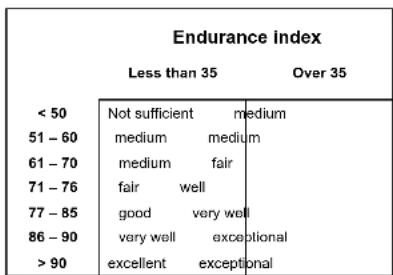
A + 3000 divided by heart rate B + 3000 divided by heart rate C = endurance index. Example: when your heart rate is 160 after ending the exercise (heart rate A), 120 a minute later (heart rate B) and 100 after 2 minutes (heart rate C), then you have an endurance index of :
3000:160=18.75
3000:120=25.00
3000:100=30.00
Endurance index = 18.75 + 25.00 + 30.00 = 73.75
On the basis of the chart below you can adapt your training and divide your powers better according the result of this test. If you take the endurance index from our example (73.75), you can see in the chart below that this value is sufficiently for someone younger than 35 and good for someone older than 35.
Training planning
Overload
Training means making an effort, using our energy reserve. This effort will show a lower performance afterwards. This effort can only be undone if we give our body time to recover and to rest. So both effort and rest are the ingredients of a perfect training. Effort and relaxation are one.
To determine how long we have to rest is not simple because it depends on a lot of elements such as the number of executed exercises, the used weights, the kind of exercise, how long we exercise...etc.
Furthermore, not every muscle needs the same time to recuperate. A small muscle can already be ready during practice, a big muscle can need extra time.
To set up an intelligent training, we recommend you to use some constant parameters during a limited training period. Based on these parameters it is much easier to see if our body has enough time to recuperate.
If you start training, you will feel "tired" after every effort. However the longer you train, the more easy it will become for your body to recuperate and after a while you want feel "tired" anymore and your performances will get better. However if you keep feeling "tired", your body needs more time to recuperate and we even recommend you to stop training for a few days and give your body the rest it deserves.
You will notice that when you resume training, your performances will get better much faster than when you keep training without resting (overload).
Descending or stagnating performances can be signs of overload. Also an increased heart rate can lead to overload, which also increases the risk for injuries.
Muscular trainingperiode
To prevent physical overload by overtraining, we recommend you to train no longer than 4 to 6 weeks on one territory. Divide your training up into different periods and change your program regularly.
- Training unity = one training session
- Micro cycle : all training sessions during 1 week
- Meso cycle : groups 3 to 5 micro cycles. In muscle training, the meso cycle is a training which emphasizes endurance, increase of size or power.
Macro cycle : groups different meso cycles and can take a few months (6 to 12 months).
Now you find some more information about the different features of each territory:
Endurance
A run of 400 meter requires endurance and power. The endurance training will include a preset series and the repetition of it. Attention! the recuperation period is also very important. The lactic acid in the muscles will increase and will cause a inflamed feeling when the tiredness keeps increasing.
One of the greatest effects of a training with extended efforts is the increase of the tolerance of the acid in the muscles, which can be put into work as follows: there will appear different causes who will neutralize a part of the lactic acid; muscles will no longer be sour, this brings along a extended action for a few seconds, or by repetition, by which they refuse to go on.
Increase of the muscular mass
he growth of our muscle cells is promoted by an extended stimulant. The use of energetic phosphates of the muscle cells is reduced to a minimum. The corn of the cell, which also contains a product of proteins, under the form of muscle fibres, also works in on the thickness of the muscles.
Maximal power/ effort
The maximum power of the muscle depends on the average thickness, and also on the number of muscle fibres due to movement. The interaction between the nerves and the muscles determine the capacity of a muscle during an effort.
Training period: endurance
Competition sports is one of the basics to set up a training schedule in function of endurance. The sporty amateur once again takes advantage of the benefits of a training set up for a competitive sportsman. As the weights and the repetition of the exercises play an important part in the measurement of our "tiredness" in the training of muscle development, the heart rate is the most important element in the endurance training.
Before we give you some recommendations for cardio training, it is important to know your maximum heart rate. We can determine this rate by a test which will ask a maximum effort of our cardio-vascular system. This test whoever is not suited for the sporty amateur. However we can determine our maximum heart rate by another formula: 220 minus our age.
Starting from this formula, our optimal heart rate in function of age, will be between 70 and 85% of our maximum heart rate obtained during a cardio-vascular training session, and between 60 and 70% during a metabolism training. We have different ways of training in the endurance sports.
- Continuous training
- Training by interval
- Repetition training
- Competition training Continuous training is most used in leisure sports, training by interval in a less way. Repetition and competition training mostly ask for exceptional and intense efforts and therefore they are not recommended for the sporty amateur.
A continuous training is characterized by a training over a longer period, without interruption of the effort. The most sporty amateurs automatically go for this kind of training.
They often become good results when the level of effort correspond to the optimal heart rate in a certain age category.
The training by interval usually contains a series of efforts and a series of relaxation. The series of relaxation contains moments of partial rest.
Continuous training is chosen by 80 to 90% of the sportsmen who wants to work on endurance. We therefore recommend continuous training to every sporty amateur.
| Age | Hr MAX /min | 60% MAX /min. | 65% MAX /min. | 70% MAX /min. | 75% MAX /min. | 80% MAX /min. | 85% MAX /min. |
| 20 | 200 | 120 | 130 | 140 | 150 | 160 | 170 |
| 25 | 195 | 117 | 127 | 137 | 146 | 156 | 166 |
| 30 | 190 | 114 | 124 | 133 | 143 | 152 | 162 |
| 35 | 185 | 111 | 120 | 130 | 139 | 148 | 157 |
| 40 | 180 | 108 | 117 | 126 | 135 | 144 | 153 |
| 45 | 175 | 105 | 114 | 123 | 131 | 140 | 149 |
| 50 | 170 | 102 | 111 | 119 | 128 | 136 | 145 |
| 55 | 165 | 99 | 107 | 116 | 124 | 132 | 140 |
| 60 | 160 | 96 | 104 | 112 | 120 | 128 | 136 |
| 65 | 155 | 93 | 101 | 109 | 116 | 124 | 132 |
| 70 | 150 | 90 | 98 | 105 | 113 | 120 | 128 |
Training evaluation
The preset program is only effective if you regularly control yourself. It is better to use the term "evaluation" because we evaluate the present data/results in function of the next training cycle.
Even though the preset goals were chosen carefully and realistic, it always is possible that the program of a meso cycle is realized partially. This can have several causes such as illness, injuries, occupation activities, or other motifs to interrupt your training. If you already reached some goals, but not all of them, you have to adapt your training program for the next meso cycle.
Training diary
The keeping of a training diary can help you in finding the causes when you have not reached your goals. In this diary you can write down different information, which can help you to set up a training program, such as your eating habits, periods of rest and sleep, remarkable results etc. A visit to the dentist for example can influence your training results. If you can take into account certain circumstances, you can avoid a stagnation in your results. Adaptations of your training are usually important for the intensity of your program, the succession and the repetitions of the exercises and the achieving of results.
Summary
- Make sure if a fitness training doesn't cause problems for your health.
- Evaluate your level of power, endurance, flexibility, speed and coordination before you start training.
- Set realistic goals based on your physical possibilities.
- Set up a training program for a longer period (6 to 12 months)
- Divide your long term planning up into different cycles (meso cycle) of 4 to 6 weeks.
- Make sure there is enough variation in your training. Train on endurance, power and muscle development.
If you choose for endurance training, vary between short, mid-long and long training periods.
- In de loop van een mesocyclus dient u de intensiteit van de training te verhogen, zowel voor ulthouding als voor spiertraining. Beperk de intensiteit van de training steeds in de beginfase van elke neue cyclus.
- Evaluateer regelmatig uw training om te zien of u op het goede spoor zit en of u de belangrijkste doeleinden kan bereiken, indien nicht :
During a meso cycle you have to increase the intensity of the training for endurance as well as for muscle training. Limit the intensity of the training in the beginning of every new cycle. -
Evaluate regularly your training to make sure you are on the right track and if you can achieve your most important goals, if not:
-
Adapt the next meso cycle
- Repeat the initial test
- Do interim tests at the end of every meso cycle
Success
Even after a short period of regular exercises you will realise that you constantly have to increase the pedalling resistance to reach your optimum pulse rate.
The units will be continuously easier and you will feel a lot fitter during your normal day. For this achievement you should motivate yourself to exercise regularly. Choose fixed hours for your work out and do not start training too aggressively.
An old saying amongst sportsmen says:
"The most difficult thing about training is to start it."
Wishing you lots of fun and success with your exerciser.
All data displayed are approximate guidance and cannot be used in any medical application.
Heart rate displayed is an approximate read-out, and may not be used as guidance in any cardio-vascular related medical or paramedical program.
m = 311 ;
bon
Ires
moven
1
atisfalsant
bon
excellent
Surcompensation/Suretrainement
Body Mass Index (BMI)
Verbandaille-heup (waist to hip rate)
- Continue training
- Training per interval
- Herhalingstraining
- Competitietraining
Allenamento in MODO PROGRAMMA
Allenamento in MODO WATT
| Endurance index | ||
| Less than 35 | Over 35 | |
| < 50 | Not sufficient | medium |
| 51 - 60 | medium | medium |
| 61 - 70 | medium | fair |
| 71 - 76 | fair well | |
| 77 - 85 | good | very well |
| 86 - 90 | very well | exceptional |
| > 90 | excellent | exceptional |
Piano d'Allenamento
Sovraccarico
Body Mass Index (BMI)
The owner's manual is only for customers' reference. The supplier can not guarantee for mistakes occurring due to translation or changes in technical specifications of the product.
1000 South Fremont Avenue
Building A10 Suite 38
Alhanbra Los Angeles
California CA 91803
Belgium
France
Italy
Switzerland
USA
ALL RIGHTS RESERVED©TM 2009
www.DKN-Technology.com


- Operating Instructions Computer
- Function buttons
- Function description
- Time:
- Distance:
- Calories:
- Speed:
- Watt:
- Pulse:
- Training in MANUAL MODE
- Training in PROGRAM MODE
- Training in USER MODE
- Training in TARGET H.R. MODE
- BODY FAT display
- Training in WATT MODE
- Training Instructions
- Evaluation of your physical condition
- Diagnostic - initial level
- Physical features
- Weight
- Body Mass Index (BMI)
- Fatpercentage
- BMI Table
- Measurements
- Figure
- Leptosome/ectomorphe type
- The athlete / mesomorphe type
- Endomorphe type
- Endurance test
- Overload
- Muscular trainingperiode
- Endurance
- Increase of the muscular mass
- Maximal power/ effort
- Training period: endurance
- Training evaluation
- Training diary
- Summary
- Success
- Surcompensation/Suretrainement
- Verbandaille-heup (waist to hip rate)
- Allenamento in MODO PROGRAMMA
- Allenamento in MODO WATT
- Piano d'Allenamento
- Sovraccarico
Brand : DKN
Model : EF2
Category : Exercise bike