GEOVID 42 HD - Binoculars LEICA - Free user manual and instructions
Find the device manual for free GEOVID 42 HD LEICA in PDF.


| Product type | Binoculars with laser rangefinder |
| Brand | Leica |
| Model | GEOVID 42 HD |
| Magnification | 8x or 10x depending on version |
| Objective lens diameter | 42 mm |
| Exit pupil | 5.25 mm (8x) / 4.2 mm (10x) |
| Field of view at 1000 m | 125 m (8x) / 110 m (10x) |
| Measuring range | 10 m to 1300 m approx. |
| Measurement accuracy | ±1 m at 350 m, ±2 m at 700 m, ±0.5 % beyond |
| Power supply | 1 lithium battery 3V type CR2 |
| Battery life | ≥ 2000 measurements at 20 °C |
| Dimensions (L × H × D) | approx. 124 × 174 × 65 mm |
| Weight (with battery) | approx. 900 g |
| Water resistance | Waterproof to 5 m depth (0.5 bar) |
| Operating temperature | −25 °C to +55 °C |
| Housing material | Die-cast aluminum |
| Lens coating | HDC™ and Aqua-Dura hydrophobic, P40 phase correction |
| Diopter compensation | ±3.5 diopters approx. |
| Interpupillary distance | 56–74 mm |
| Main functions | Distance measurement, continuous scanning, aiming reticle, diopter compensation |
| Maintenance and cleaning | Brush, soft cloth, rinsing with running water |
| Safety | Do not look directly at light sources; class 1 laser, eye-safe |
| Available spare parts | Eyecups, caps, strap, tripod adapter |
| Serviceability | Leica customer service or national representations |
Frequently Asked Questions - GEOVID 42 HD LEICA
User questions about GEOVID 42 HD LEICA
0 question about this device. Answer the ones you know or ask your own.
Ask a new question about this device
Download the instructions for your Binoculars in PDF format for free! Find your manual GEOVID 42 HD - LEICA and take your electronic device back in hand. On this page are published all the documents necessary for the use of your device. GEOVID 42 HD by LEICA.
USER MANUAL GEOVID 42 HD LEICA
Important notice for USA
The attachment has been made and is to comply with the law for a child who does not, as it is said above, is to put that in the CCLO. These laws are intended to make reasonable statements against unfair待遇 and to ensure that children are treated with respect. The attachment has been made and is to comply with the law for a child who does not, as it is said above, is to put that in the CCLO. However, there is no guarantee that this law will not cause a significant contradiction. If the attachment does not cause unfair待遇 or loss of freedom of movement, after it can be demonstrated that the attachment has been made and is to put that in the CCLO, it cannot be considered to violate its existence because of the following measures:
e e
n
a
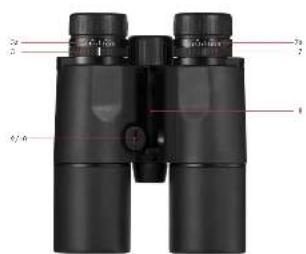
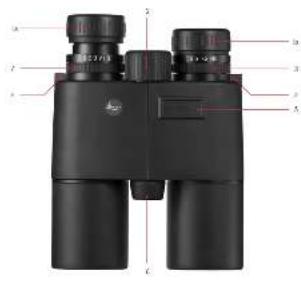
- Eyepiece cups
Position a: Unscrewed for viewing without glasses
Position b: Screwed in for viewing with glasses - Central focusing dial
- Diopter compensation dial with a. Scale
- Eyelets for carrying strap
- Release button for distance metering
- Laser transmission optics
- Diopter compensation for target mark with a. Scale
- Hinged axis for adjustment of eye spacing
- Battery compartment
- Battery compartment cap
FOREWORD
Dear customer
Throughout the world, the Leica name stands for premium quality, precision mechanics, excellent reliability and long service life.
We wish you a great deal of enjoyment and success with your new Leica Geovid HD binoculars.
To ensure that you can use them correctly, we recommend that you read this manual first.
SCOPE OF DELIVERY
- Binoculars
- 1 3V lithium battery, type CR2
- Carrying strap
Ever ready case - Eyepiece cap
- 2 lens caps
Warranty Card
CONTENTS
Designation of parts 15
Foreword 15
Scope of delivery 15
Disposal of electric and electronic equipment 17
Possible applications 17
Attaching the carrying strap and the eyepiece cover 17
Attaching the lens caps. 17
Inserting and changing the battery 18
Battery charge level 19
Adjusting the eyepiece cups/Using with and without glasses 20
Adjusting theeyebase 20
Setting the focus/Diopter compensation 21
Distance metering. 22
Scan mode 23
Metering range and accuracy 23
Maintenance/cleaning. 24
Accessories 24
Spare parts 24
Troubleshooting 25
Technical data 26
Leica Academy 28
Leica on the Internet 28
Leica Information Service 28
Leica Customer Care 28
Warning notice: As with all binoculars, to prevent damaging the eyes avoid using your Leica Geovid BRF to look directly at bright sources of light.
DISPOSAL OF ELECTRIC AND ELECTRONIC EQUIPMENT
(Applies within the EC, and for other European countries with segregated waste collection systems)
This device contains electrical and/or electronic components and should therefore not be disposed of in general household waste! Instead it should be disposed of at a recycling collection point provided by the local authority. This costs you nothing.
If the device itself contains exchangeable (re charge-able) batteries, these must be removed first and, if necessary, also be disposed of ac cording to the relevant regulations.
Further information on this point is available at your local administration, your local waste collection company, or in the store where you purchased this device.
POSSIBLE APPLICATIONS
The Leica Geovid HD binoculars have a robust aluminium housing, allowing them to be used even under adverse conditions. This means that you do not have to worry about them getting wet - they are absolutely waterproof to a depth of 5m and there is no fogging in the internal optical system thanks to a nitrogen filling.
ATTACHING THE CARRYING STRAP AND THE EYEPIECE COVER
If you want to attach the eyepiece cap to the carrying strap, you must thread the strap through the eyelet on the eyepiece cover before you attach the carrying strap to the left-hand side of the binoculars.
ATTACHING THE LENS CAPS
To fit the two lens caps, place the rubber rings of the caps over the binocular tubes from the lens side such that the caps open downwards.
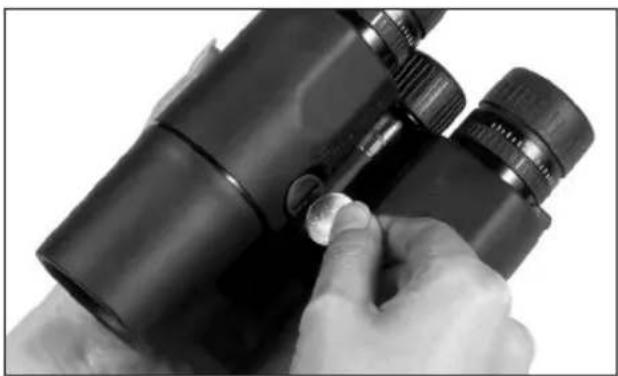
INSERTING AND CHANGING THE BATTERY
The Leica Geovid HD binoculars are supplied with power by one 3 Volt lithium battery (e.g. Duracell DL CR2, Ucar CR2, Varta CR2, or other CR2 types).
- Open the battery compartment (9) cap (10) by turning it anticlockwise, with a coin for example.
- Insert the battery with its positive contact facing forwards (as marked in the battery compartment).
- Close the cap again by turning it clockwise.
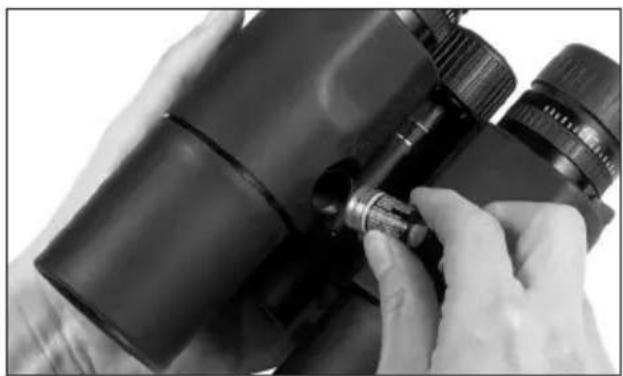
Notes:
- Batteries should be stored in a cool dry place.
- If the binoculars are not going to be used for a long time, the battery should be removed.
Attention:
- Batteries should never be put in a fire, heated, recharged, taken to pieces or broken apart.
- Used batteries may not be disposed of as normal, household waste as they contain hazardous materials that are harmful to the environment. To ensure that they are properly recycled, they should be returned to the dealer or disposed of as special waste (at a collection point).
BATTERY CHARGE LEVEL
A new battery is sufficient for more than 2000 measurements at 20^ .
Depending on the conditions of use, the battery life can be significantly shorter or longer than this. Low temperatures and frequent use of scan mode (see p. 23) shorten the battery life.
A flat battery is indicated by a flashing measured value and target display. Once this flashing starts, around 50 more measurements are possible, but with a continuously reduced range.
Attention: Cold conditions impair the battery performance. At low temperatures, the Leica Geovid HD should therefore be carried close to the body and used with a fresh battery.
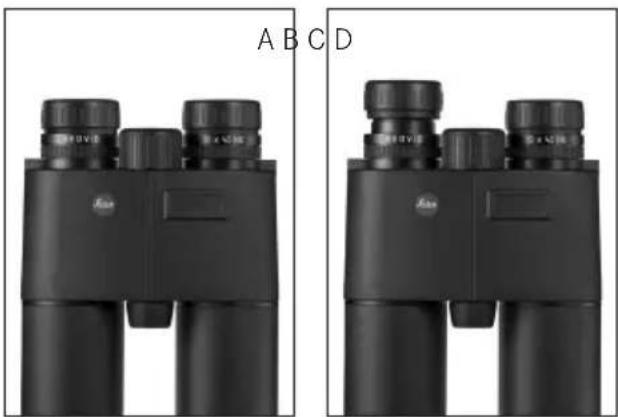
adjusTing The eyepiece cups/ using wiTh and wiThouT glasses
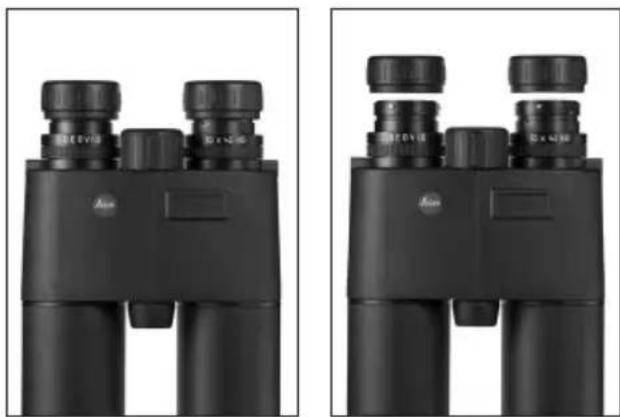
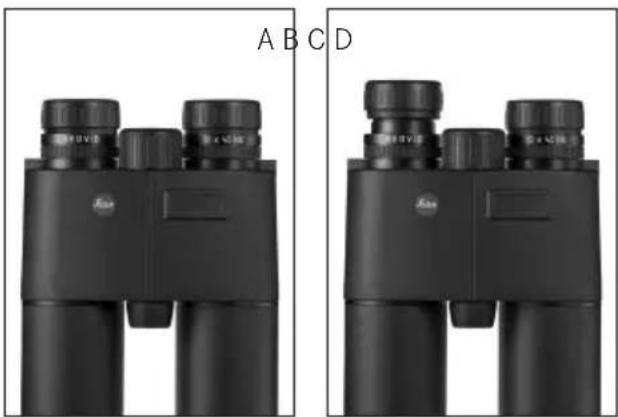
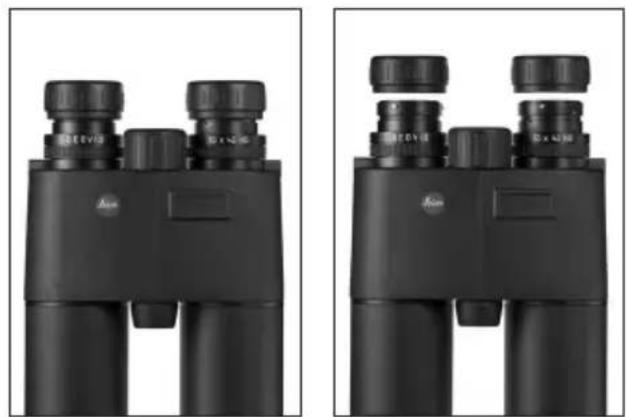
The eyepiece cups (1) can easily be adjusted by turning them and lock securely into the selected position. They can also be completely removed for thorough cleaning.
For viewing with glasses (Figure A), they remain in their fully screwed in position.
For viewing without glasses, they are unscrewed by turning them anticlockwise. Two positions are available for optimum adjustment (Figures B, C). If the eyepieces are very dirty, it is recommended that the eyepiece cups are removed for cleaning (Figure D). To do this, they are removed by pulling them slightly when in their fully unscrewed position.
adjusTing The eyeBase
The individual eyebase is adjusted by bending the binoculars around the hinged axis (8). The right and left fields of view must merge into a circular field.
SETTING THE FOCUS/ DIOPTER COMPENSATION
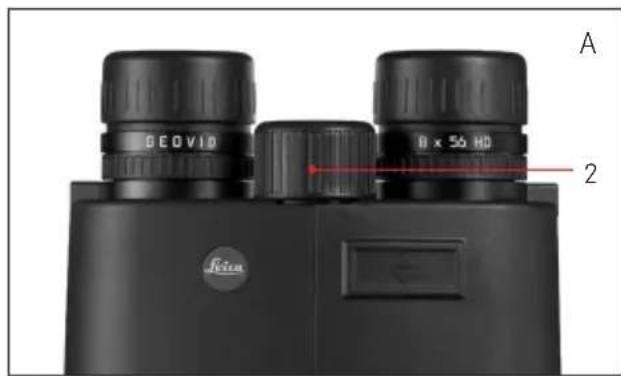
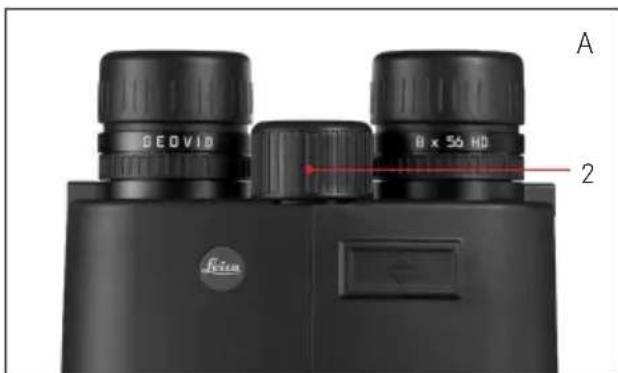
On the Leica Geovid HD binoculars, the focus is set for objects different distances away using the central focusing dial (2).
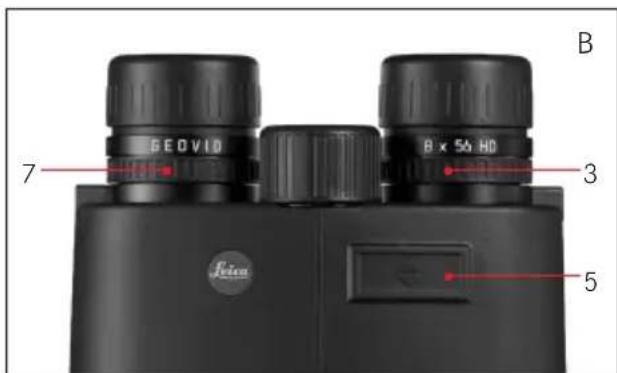
The two diopter compensation dials (3/7) are used to compensate for individual vision defects for viewing without glasses and for focusing on the target.
Run carefully through the steps described be low. You will then be able to fully utilise the op -tical capabilities of the binoculars.
- Turn both diopter compensation dials to their zero positions.
- While viewing with both eyes, focus on a distant object using the central focusing dial.
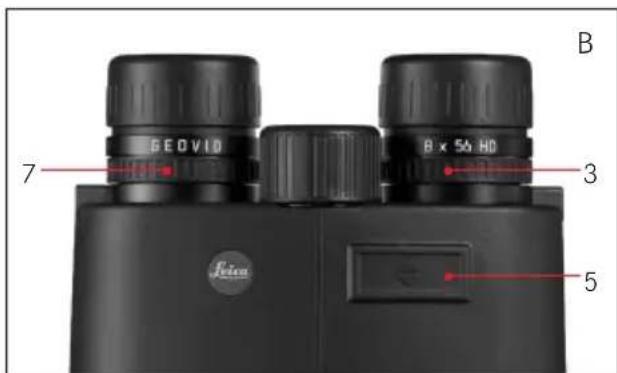
- Now press the release button (5) to activate the target.
- Once the target appears, while continuing to view with both eyes adjust the right-hand diopter compensation dial (7, red index) so that the target is in focus in the right-hand optical field.
- Then, with the target still activated but now viewing with the right eye only, use the central focusing dial for fine focusing of the image in the right-hand tube.
- Then adjust the image in the left-hand tube to optimum focus using the left-hand diopter dial (3).
You can read off the set values by way of the "+" or "-" values on the diopter scales (3a/7a).
Note: When looking through the binoculars with the right or left eye only, the other eye should be kept tightly shut, or simply place your hand in front of the lens on the other side of the binoculars.
DISTANCE METERING
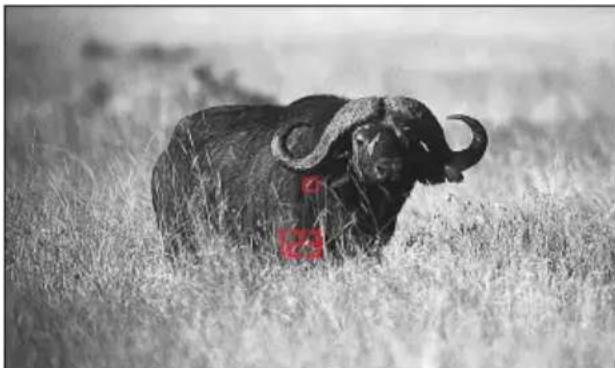
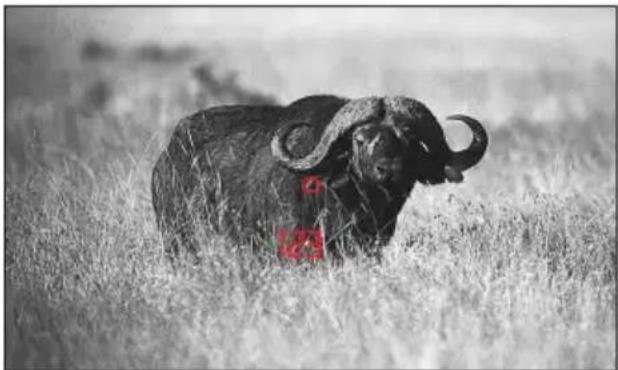
To measure the distance to an object, you must lock onto it precisely. To do this, activate the target marker by pressing the release button (5) once. Once the button is released, the target marker remains illuminated for around another 4s. If the button is held down, the target marker is illuminated continuously. While it is illuminated, lock onto the object and carry out the dis tance metering by pressing the release button again. The measured value is then displayed. The target marker disappears briefly during metering.
You can start a new measurement at any time by pressing the release button again, as long as the target marker is illuminated.
If the object distance is less than 10 meters/ yards or if the range is exceeded or the object does not reflect sufficient light, the display shows
When the display goes out, the distance meter is automatically deactivated.
Notes:
- Depending on the angle of the optical systems to each other, i.e. the set interpupillary distance, the displays may appear slightly slanted.
- The Leica Geovid HD binoculars are available in different versions displaying the distance in meters or yards. Externally, the different versions can be recognised by the information on the cover of the central focusing dial.
SCAN MODE
The Leica Geovid HD binoculars can also be used for continuous metering. If you hold down the release button (5) after the second press, after approx. 0.5s the binoculars switch to this scan mode and then perform constant metering. This can be identified by the changing display: A new measured value is output approx. every 1.5s. Scan mode is particularly practical when metering small targets.
Notes:
- Scan mode consumes more power than individual metering due to the constant metering.
- Scan mode automatically shuts down after 10s, to preserve the battery in case the button is pressed accidentally.
METERING RANGE AND ACCURACY
The measuring system on the Leica Geovid HD binoculars is configured in such a way that distance information displayed can be assigned to the desired target with the maximum possible reliability. However, if the electronic system re ceives several signals, particularly if they are weak, e.g. if different objects within the measurement field are detected, "—" appears to indi cate
that clear distance information cannot be pro - vided in this case.
The measuring accuracy is up to ± 1 meter/yard. The maximum range is achieved with well reflecting target objects and a visual range of 10km . The measuring range is influenced by the following factors:
| Range | Higher | Lower |
| Colour of object | White | Black |
| Angle to object | Vertical | Acute |
| Object size | Large | Small |
| General brightness (cloudy) | Low | High |
| Atmospheric conditions | Clear | Hazy |
| Object structure | Homogeneous (building wall) | Inhomogeneous (bush, tree) |
With sunshine and good visibility, the ranges and accuracies are as follows:
| Range | 10 m/yds up to approx. 1300 m/1400yds |
| Accuracy | ±1 m/yd up to 350 m/380yds |
| ±2 m/yds up to 700 m/763yds | |
| ±0.5 % above 700 m/763yds |
MAINTENANCE/CLEANING
Your Leica Geovid HD binoculars do not require any special maintenance. Coarse dirt particles, such as sand, should be removed with a fine hair brush or blown away. Fingerprints etc. on lenses or eyepieces can be wiped off with a soft, clean leather or dust-free cloth. For heavy soiling, e.g. to the rotating eyepiece cups, the binoculars can be cleaned by simply rinsing them under running water. Saltwater can be rinsed off in the same way.
Attention: Do not exert excessive pressure when wiping heavily soiled lens surfaces. Although the coating is highly resistant to abrasion, sand or salt crystals can still damage it.
As well as its type designation, each set of Leica Geovid HD binoculars have their „personal“ serial number. Make a note of this number in your documents for security.
Accessories Order no.
Tripod adapter with 1 / 4 " thread. 42 220
Swimming carrying strap, orange 42 163
SPARE PARTS
If you should require any spare parts for your binoculars, e.g. eyepiece cups, covers or carrying strap, please contact our Customer Care de partment (for address, see p. 27) or the Leica office in your country (see Warranty Card for addresses).
TROUBLESHOOTING
| Fault | Cause | Remedy |
| Circular field is not achieved a) The binoculars are not a) Simply correct the during viewing correctly adjusted to eyebase of the two personal eye spacing. binocular tubes by bending the hinged axis inwards or outwards. | ||
| b) The viewer's pupil is not in b) Correct head, eye and the binoculars' exit pupil. binocular position. | ||
| c) The position of the c) Correct adjustment: eyepiece cups does If wearing glasses, screw not match the correct in eyepiece cups; for use with and without viewing without glasses: glasses. unscrew eyepiece cups. | ||
| Image out of focus is not accurate Dioptré compensation repeat dioptré compensation (see p. 21) | ||
| During distance metering, the a) Object too close or Note information on display shows “- - - ” metering rangeeterced metering range (see p. 23) | ||
| b) The object is insufficiently reflective | ||
| Display is flashing or metering Battery flat Replace battery (see p. 18) not possible | ||
TECHNICAL DATA
| LEICA GEOVID 8x42 HD LEICA GEOVID 10x42 HD | ||
| Magnification 8x | 10x | |
| Lens diameter | 42 mm | |
| Exit pupil | 5.25mm | 4.2mm |
| Twilight number | 18.33 | |
| Geometric luminous intensity | 27.56 | 17.64 |
| Field of view (at 1000m/yds) | 125m/yds / 7.1° | 110m/yds / 6.3° (wide angle) |
| Close range limit (at 0 dioptres) approx. | 5.6m/18'4" approx. 5.6m/18'4" | |
| Exit pupil longitudinal distance | 18.5mm | 15.6mm |
| Pupil distance | 56-74mm | |
| Prism type | Roof | |
| Coating on lenses on prisms Phase correction coating P40 | High Durable Coating (HDC™) and hydrophobic AquaDura coating on outer lens surfaces | |
| Dioptré compensation approx. ±3.5 dioptrés | ||
| Suitable for wearers of glasses | Yes | |
| Operating temperature -25°C/-13°F to +55°C/+131°F | ||
| Storage temperature -40°C/-40°F to +85°C/+185°F | ||
| Watertightness | 0.5 bar (approx. 5m water depth) | |
| Housing material | Die cast aluminium | |
| Maximum range | approx. 1300m/1400yds | |
| Minimum distance | 10m/yds | |
| Metering accuracy | ±1m/yd up to 350m/380yds ±2 m/yds up to 700m/763yds ±0.5% above 700m/763yds | |
| Display | 4-digit LED | |
| Battery | 1 3V lithium battery type CR2 | |
| \( Battery life^1 \) | ≥ 2000 measurements | |
| Laser | Safe for eyes according to EN and FDA Class 1 | |
| Laser beam divergence | 2.5 x 0.5mrad | |
| Maximum metering duration | approx. 1.4s | |
| Dimensions (\( W^2 \times H^3 \times D^2 \)) | approx. 124 x174 x 65mm | |
| Weight (including battery) | approx. 900g | |
At 20^ and average usage profile
2With eye spacing 65mm
3 With eyepiece cups screwed in
TECHNICAL DATA
| LEICA GEOVID 8x56 HD LEICA GEOVID 15x56 HD | ||
| Magnification 8x | 15x | |
| Lens diameter | 56mm | |
| Exit pupil 7mm | 3.7mm | |
| Twilight number | 21.17 | |
| Geometric luminous intensity | 49 | 13.94 |
| Field of view (at 1000m/yds) | 118m/yds / 6.8° 72m/yds / 4.1° | |
| Close range limit (at 0 dioptres) approx. | 5.5m/18'4" approx. 5.5m/18'4" | |
| Exit pupil longitudinal distance | 18.5mm | 15.6mm |
| Pupil distance | 58-74mm | |
| Prism type | Roof | |
| Coating on lenses on prisms Phase correction coating P40 | High Durable Coating (HDC™) and hydrophobic AquaDura coating on outer lens surfaces | |
| Dioptre compensation approx. ±3.5 dioptres | ||
| Suitable for wearers of glasses | Yes | |
| Operating temperature -25°C/-13°F to +55°C/+131°F | ||
| Storage temperature -40°C/-40°F to +85°C/+185°F | ||
| Watertightness | 0.5bar (approx. 5 m water depth) | |
| Housing material | Die cast aluminium | |
| Maximum range | approx. 1300m/1400yds | |
| Minimum distance | 10m/yds | |
| Metering accuracy ±1m/yd up to 350m | /380yds | |
| ±2m/yds up to 700m/763yds | ||
| ±0.5% above 700m/763yds | ||
| Display | 4-digit LED | |
| Battery | 1 3V lithium battery Type CR 2 | |
| Battery life1 | ≥2000 measurements | |
| Laser | Safe for eyes according to EN and FDA Class 1 | |
| Laser beam divergence | 2.5 x 0.5mrad | |
| Maximum metering duration | approx. 1.4s | |
| Dimensions (W2xH3xD2) | approx. 135 x182 x 68mm | approx. 135 x 208 x 68mm |
| Weight (including battery) | approx. 1100g | approx. 1245g |
At 20^ and average usage profile 2With eye spacing 65mm 3 With eyepiece cups screwed in
leica academy
Our seminars offer participants practical information on the Leica world of values and the fascination of skilled use of Leica products. Course programs are application-oriented and informative. They offer a wealth of practical susses, help, and advice.
More details, along with the current programme of seminars, are available from:
Leica Camera AG
Leica Akademie
Oskar-Barnack Str. 11
D-35606 Solms
Tel.: +49 (0) 6442-208-421
Fax: +49 (0) 6442-208-425
la@leica-camera.com
leica information serVice
Should you have any technical questions regarding the use of Leica products, the Leica information service will be happy to answer in writing or by phone, fax, or e-mail:
Leica Camera AG
For service of your Leica equipment and in case of necessary repairs please contact the Customer Care department of Leica Camera AG or of any national Leica agency (see Warranty Card for address list). Ask your authorized dealer and Leica specialist for advice.
Leica Camera AG
Customer Care
Chere cliente, cher client,
Hoboi 6aTapeKn XBaHT dIy BbIIOJIHeHn npIMepHO 2000 n3MepeHn npn 20^
B 3aBnCmOCTN OT yCNoBn npImeHnra CpOK cnyK6bl 6batapeKn MoKet 6blb 3HaunTeJbHO KOpOe NIN DOJIb- W. Ha cokpaueHne cpoKa cnyK6bl 6batapeKn BInraET Hn3kAa TemnepaTpya n aactoe HcnoJb3OBaHne pexnMa cKaHnpoBaHnra (cm. cTp. 93).
Mngaun HnNkatop n3mpeHHoB eHUnHbI BN3np-Ho MapKn co6uaet o Tom, yTo 6atapeKa n3pacxo-DoBaIa cBoi pecypc. Nocne nepBoro mnaHnMoXHO BbINOHNtB eue OKOLO 50 n3MepeHn, npabda, coCTpeMnteHbHO yMeHb7aIOUeCra daIbHOCTbIO DeIcTBnI.
BHHMaHHe:OTXoIOna yMeHbShaetc MoUHOCTb 6atapeKn. PoTOMy BO BpEmr HcPONb3OBaHNr Pn Hn3KoTemNepaType Heo6xOIMo HOcHTb Leica Geovid HD KaMooH0 6JIuKe K TeNy n UcTaHOBnTB HOByIO 6atapeKy.
PerynpoBka OkyIpaOB / nCnoIb3ObaHne c H 6e3 OukOB
OkyjarpbI (1) IerKo perynpuOTc npTeM BpaueHn
HaedekHO fNkCnpUOTc B BblpaHHOM NIOXKeHN.
TOb6bl BblONHHTb TtateJIbHyIO ONUCTKy, IN MOxHO
NOHOCTBIO CHrTb.
DnI o6O3peHnB Ouykax (pncyHOK A) OHn OCTaOTcB
NIOHOCTBIO BKpyeHHOM NIOXKeHN. DnI o6O3peHn
6e3 OOKOB OHN BblkpyHBAOTc NpTeM BpaueHn pO-
TINB YacOBOn CTpeIKN. DnI ONTMaNbHO aAANTauHN
DOCTYINb DBa NIOXKeHN (pncyHKn B,C).
EcIn OKyJrpbl CnIbHO 3aPra3HeHb, peKomeHnyETc
CHrTb IN dNl NocJeDuOSei ONUCTKN (pncyHOK D).
TOb6bl 3TO cIeNaTb, Heo6xoJIMo PnI NIOHOCTBIO
BblkpyeHHOM NIOXKeHN OkyJapOB CJIeKa NOTHYb
IX.
Perynpobka pacctoHmMeKdy Tla-3amn
Iytem cH6aHn 6HOKn no 7apHnpOc (8) yCTaHaBnBaetc HnDnBnDyalbHoe pacctoHne MeKdy rna3am. IpaBn nLeBbN CekTOp o630pa npn Eton DOnJXhbl CInTBcB EeHnHOE OKpyTIOe N3o6paKeHne.
Pereynipobka pe3Koctn / perynipobka dnoontpn
PeynpobKa pe3KocTn Ha pa3nHbIe ydaJIeHHbIe
ObBeKtbl DoCTnraetcHa 6nHokJx Leica Geovid HD c
nomoBIO ueTpalbHO KOBaФokycuPOBKn (2).
IIa KOMpeHCauIN ININIBNduyALbHO AmETpONn IJIa
O6O3peHn8 Be3 OOK N IJIa FOkycuPOBaHnRA Bn3InpHO
MapKn CnyKAT DBA KObua peYnpOBKn DINOITPNi
(3/7).
BHIMATElbHO BbIOnHInTe ONncAHHbIe HnKe DeIcTBn.
ToIbKO nocJe 3TOrO Bb CMOXeTe NCNoIb3ObaTb BCIO
MOUHOCTb OINTKN.
- Поворачивая оба кolyца рergyларовки дноюпунустановке в В hyneBoe поожене.
- C nOMOuHIO ueHTpaHbHO KOIbua FOKycnPOBKn, CMOTpra 06oHMn rna3amH, cFOKcHpyntecb Ha ydaJIeHHOM o6beKeTe.
- C NOMOJIIO KHOJIKI (5) aKTHINpyTe TenepeB Bn3HHyIO Mapky.
- Посл появелень ВИЗнров Марки, СЕТAK КЕ смOTРЯ обουим Газами, OTperулируне павое кольцорулировки Дюприй (Красьи уkaЗател) ТAKIMOBpa3OM, YTO6ыВправом объektibe Бы моглу чETКOBIDTe BИЗнру Марку.
- 3aTeM Otperynpyu Te C NOMOuBIO UeHTpaIbHOro KOJIbuaФokycnpOBKn pe3KocTb H3O6paKeHne B npABO Tpy6Ke npN BKIIoueHHo BN3uHPOH MapKe, HO CMOTp TaTepb ToJIbKO pPaBBIM rla3OM.
- B 3aknoueHne oTpereynpyTe onTmAbHyo pe3KoCTb n3o6paXeHnB JIeBOI Tpy6Ke C NOMOuJIeBOr KOJIbua DIOONTPn (3).
YCTAHOBJIeHHBIE BENUHbI BblMOKTe IPOCMOTpeB “+” ININ“-”3HaueHnX IIkaJIbI DIOITpn (3a/7a).
Yka3aHHe: npn npocmTope uepe3 neByu nIn npabvTo Tpy6ky Heo6xOIMO npuUpytB npyroI rna3 nIn npocTo ydepKnBaT COOTBETCTBYUOIO NOOBHy 6HOKJI Npei ObkeKTHOBOM.
H3mepenhe paCToHHN
YTo6bI n3Mepntb paCCToHHe Io o6bekTa, eTo HxKHO TOUHO 3aBn3npoBaTb. IInr 3TOrO cNeNyEt aKTUBnPOBaTb BN3nPHyO Mapky, Haxab KOnKy (5) OOnn pa3. Pocne
OTnyckAHKHOKNB3nHApMapKa 6yET npOJXkAtb CBETNbC8eue B TeueHne 4c.Ecn HaxKaTb N ydepKHBt KHOKNy,TO BN3nHAp MapKa 6yET CBETNbC8 HepepbIBHO.1oKa OHa CBeNTCT,ObEKT 6yET 3aBN3nPOBaH,aPn NOBtOpHOM HaxKaTHN KHOKN 6yET BblNOJIHeHO I3MepeHne pacctOraHHN I NOKa3aHO I3MepeHHoe 3NaueHne.Bo Bpem I3MepeHn B3nHAp MapKa 6bICTpo rachet.
При NOВTOPHOM HAXKATN KHOKN BCErda MOXHO bIIOHNb HOBOE N3MpeHne, NOKA BUNHPaH aMapKa eue CBETTCr. Ecni pacCToHn Edo obekTa coCTabJrEt MeHee 10 MetpoB, ecni npebblweHa daJIbHoCTb DeiCTBn IIN o6bekt HeIOCTaTOUHO OTPxaETcR, To NORBNTcR INDkaZuY "--".
Iocne toro ka INHnKaunnorachET,daNbHomep 6yJeT abTomatueckn BbIKIOHeH.
Yka3aHHa:
B 3aBnCmOCTN OT yIa ONTneCKHX CNTcEM NO OTHoWeHIO Dpyr K Dpyr, T.e. B 3aBnCmOCTN OT yCTaHOBJIeHHOro paCtOraHn MekJy rna3amn, INdNKaHIO MOxHO TaKke IpocMaTpPbAtb NOD He60JIbHIM yIOM.
- IMeIOCTcpa3HnUHbIeBepCn6HOKJIeLeicaGeoVidHD:cHnDnKauuePacCToHnBMeTpaxnnIpydax.BHeWHe pa3HnHbIeBepCn pacNo3HaOTcnoDaHHbIM,yKa3aHHbIMHaKpbIWeZeHTpaJIbHOKoJIbuaΦokycnpOBKn.
Pekm cKaHnpOBaHHa
C nOmoUb6HOKLei Leica Geovid HD bblonHnTb
H3MepeHne BO3MOxHO TaKKe B HnpepbBHom pexmpepaobtI. Ecn npn BTOPM HaxaTHN KhoKN (5) npo-
doJkaTbe ee yepXHBaT, To no HCteueHNn npm. 0,5c
np6op nepeKIOuHTcB peKIM cKaHIpOBaHN, n 6ydet
HepepbBHO BblONHb Tn3MepeHNA. 3To BnHO nO MeHnIOeienCnHnKaun. IooCTeueHNn npm. 1,5c 6ydet
PokaHaHO HOBOE n3MepeHHoe 3NaueHne.
Pekm cKaHnpOBaHN oO6eHNO yO6eH npn H3MepeHNn
Ha He6OJIbux X obkTx.
Yka3aHHa:
BpeKIMe cKaHnpOBaHN npn BbIOnHeHN HEnpepeBbIX n3MepeHN IOTpe6JIeHne 3JIeKtpOaHeprN 60JbWe, Yem npn BbIOnHeHN eDHHuHbIX n3MepeHN.
- ПО ИСТЕЧEN 10c ржим сkaнровань 6удет abTOMATUWECKN BbIKIQUeH,чTOБы He paCXOДOBaTB 3apJd 6batapeN n3-3a HeyMbIJIeHHOro HaKaTIN KHOПOK.
TouHocTb HdaJIbHoCTb H3MepeHnA
I3MepntbHa cHcTeMa 6nHokLei Ca Geovid HD
HaCTpoeHa TAKIM O6pa3OM, yTO OTo6paXaEMbIe DaHHbIe
pacCTOHN MOryT 6blTb IpiCBOeHbI Bn3npOBaHHOMy
O6bekTy C MaKcImaJIbHO ToUHOCTbIO. EcNl 3JeKtPOHnKa NOLyAet HeCKoJIbKO CnIHAnOB, B OOC6eHHocTH
Cna6bIe CnHaJIbI, HApnIMep PpI yCNoBn, yTO B o6laCTn
I3MepENHs 6blIbN O6hApYKeHbI pa3nUHbIe npEJaMeTbI, TO
IIOBHTCn HINKauN“-”,CBnTeJIbCTByIOuaO TOM,TO DaHHbIe paCCToHn B 3TOM Cnyae He MOryT 6bITb ONpeJeHbI ToHNo.TouHOCTb N3MepeHn COCTaBnIeT ±1 MeTp.MakcImaJIbHaJdAaJIbHOCTb DeIcTBn MOKeT 6bITb DOCTnHyTa Pn HaINuHn XOpOio OTPaXaEMbIX 06BeKToB INB3YaJIbHOJ DaJIbHOCTn BNDIMOCt n PaBHOn 10KM.DaJIbHOCTb N3MepeHn 3aBNCHT OT CNeDyIOUHX fakTopoB:
JaIbHOCTb 60JIbUe MEHbUe DeIcTBn

- FOREWORD
- SCOPE OF DELIVERY
- CONTENTS
- DISPOSAL OF ELECTRIC AND ELECTRONIC EQUIPMENT
- POSSIBLE APPLICATIONS
- ATTACHING THE CARRYING STRAP AND THE EYEPIECE COVER
- ATTACHING THE LENS CAPS
- INSERTING AND CHANGING THE BATTERY
- Notes:
- Attention:
- BATTERY CHARGE LEVEL
- adjusTing The eyepiece cups/ using wiTh and wiThouT glasses
- adjusTing The eyeBase
- SETTING THE FOCUS/ DIOPTER COMPENSATION
- DISTANCE METERING
- SCAN MODE
- METERING RANGE AND ACCURACY
- MAINTENANCE/CLEANING
- Accessories Order no.
- SPARE PARTS
- leica academy
- leica information serVice
- PerynpoBka OkyIpaOB / nCnoIb3ObaHne c H 6e3 OukOB
- Perynpobka pacctoHmMeKdy Tla-3amn
- Pereynipobka pe3Koctn / perynipobka dnoontpn
- H3mepenhe paCToHHN
- Yka3aHHa:
- Pekm cKaHnpOBaHHa
- TouHocTb HdaJIbHoCTb H3MepeHnA
Brand : LEICA
Model : GEOVID 42 HD
Category : Binoculars