
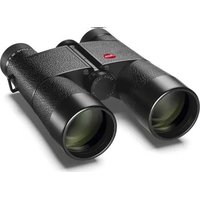
40420 - Binoculars LEICA - Free user manual and instructions
Find the device manual for free 40420 LEICA in PDF.


| Product Type | Binoculars |
| Brand | Leica |
| Model | 40420 |
| Magnification | 8x |
| Objective Lens Diameter | 20 mm |
| Field of View at 1000 m | 119 m |
| Focusing | Central, knurled wheel |
| Prism Type | Roof (Schmidt-Pechan) |
| Lens Coating | Multi-coated, anti-reflective |
| Minimum Focus Distance | 2.5 m |
| Diopter Adjustment | Right eyepiece, -4 to +4 D |
| Exit Pupil | 2.5 mm |
| Eye Relief | 15 mm |
| Waterproof | Yes, waterproof to 5 m |
| Nitrogen Filling | Yes, fog-proof |
| Housing Material | Robust aluminum |
| Rubber Coating | Non-slip rubber armor |
| Weight | 260 g |
| Dimensions (L x W x H) | 110 x 65 x 38 mm |
| Supplied Accessories | Case, strap, cleaning cloth, lens caps |
| Warranty | 10 years (conformity) |
Frequently Asked Questions - 40420 LEICA
User questions about 40420 LEICA
0 question about this device. Answer the ones you know or ask your own.
Ask a new question about this device
Download the instructions for your Binoculars in PDF format for free! Find your manual 40420 - LEICA and take your electronic device back in hand. On this page are published all the documents necessary for the use of your device. 40420 by LEICA.
USER MANUAL 40420 LEICA


Foreword
Leica Customer Service 11
Warning notice
Tripod adapter


Caution:
Caution:
Leica Customer Service
Worldwide, the name Leica stands for superb optical quality, close-tolerance precision engineering, absolute reliability, and long product life.
We wish you a great deal of enjoyment and success with your new Leica Duovid. The outstanding optical properties and the variable magnification allow you to adjust these handy binoculars to various viewing situations.
So that you can use them properly, we recommend that you first of all read these instructions.
Nomenclature
- Eyepiece cups
Position a: unscrewed for viewing without glasses
Position b: screwed in for viewing with glasses
- Adjustable rings for selecting the magnification with indexed markings
- Fixed rings with markings for the two magnifications
- Lockable diopter adjustment ring
- Eyelets for carrying strap
- Central focusing ring
- Hinged joint for adjusting the eyebase
Table of Contents
Foreword 12
Nomenclature 12
Possible applications 14
Attaching the carrying strap 14
Attaching the protective eyepiece cover ..... 14
Care and maintenance 15
Tripod Adapter 15
Carrying case 15
Adjusting the eyecups 16
Adjusting the eyebase 17
Setting the magnification 17
Focusing/Diopter adjustment ..... 18
Technical Data 21
Leica Academy 22
Leica in the Internet 22
Leica Information Service 22
Leica Customer Service 22
Warning notice
As with all binoculars, avoid looking directly at sources of bright light with your Leica Duovid as this could cause eye damage.
Possible applications
The Leica Duovid is a high-performance set of binoculars with two magnifications that can be selected as required. The lower magnification provides a bright, stable image with a large field of view and a large depth of field. The higher magnification offers outstanding recognition of details of distant objects and in conditions of poor light. The balanced weight distribution and the perfect ergonomics combine to give an extraordinarily stable image despite the high magnification.
The Leica Duovid has a hermetically sealed, nitrogen-filled, and die-cast aluminum housing. It is therefore suited for rough outdoor use. There is no need to be concerned with moisture as it is 100% waterproof to a depth of 5 m and the internal optical system is not subject to fogging.
Attaching the carrying strap
Attaching the protective eyepiece cover
The eyepiece cover is placed over the eyepiece cups. It is fixed using the carrying strap.
Care and maintenance
Your Leica binoculars need no special maintenance. Use a soft lens brush or a blower to remove large particles of dirt, sand, etc. To remove fingerprints etc., first wipe the eyepiece and lens with a damp cloth, then dry them with a piece of clean, soft chamois leather or lint-free cloth. If the binoculars, particularly the telescopic eyepiece tubes, are very dirty, rinse them in a basin of water rather than under a running faucet.
Always rinse off salt water.
Moisture inside the central focusing unit (visible through the scale window) will dry quickest when the diopter adjustment ring (4) is pulled up, i.e. unlocked.

Tripod Adapter
This practical tripod adapter is equipped with a 1/4" thread for all Duovid models and allows long-term shake-free viewing. In the case of the Leica Duovid 10+15x50 it is included in the scope of delivery.
Carrying case
The soft leather carrying case supplied with your Leica binoculars protects them from dirt. A flap with snap fasteners is provided at the top of the case, through which the carrying case strap can be fed.


Adjusting the eyecups
The eyepiece cups (1) can be easily adjusted by turning them and they lock securely into the selected positions. They can also be completely removed for thorough cleaning.
For viewing with eyeglasses (Figure A) they remain in the fully screwed-in position. For viewing without eyeglasses, they are unscrewed


by turning them anticlockwise. Two positions are available for optimum adjustment (Figure B, C). If the eyepieces are very dirty, it is recommended to remove the cups for cleaning (Figure D). To do this, they are turned slightly back clockwise and gently pulled while in the fully unscrewed position.


Adjusting the eyebase
To set the eyebase, adjust the binoculars at the hinged joint. The left and right fields of view must merge and produce a single circular image.
Setting the magnification
The Leica Duovid offers the user a choice of two magnifications. The magnification is adjusted using the adjustable rings (2) below the two eyepiece cups. Both rings must always be completely moved into the appropriate end position.
Notes:
Intermediate settings are possible, although identical magnification in both optical systems cannot be guaranteed in this case. Furthermore, the automatic diopter setting (ADC™ – Automatic Diopter Compensation, see also the next section “Focusing/Diopter compensation”) only applies in the two end positions. Incorrect settings can therefore quickly lead to a strain on the eyes and to fatigue.
As the left ring is linked to the automatic diopter setting, its movement is slightly stiffer than that of the right ring.

Focusing/Diopter adjustment
With the Leica Duovid the central focusing ring (6) is used to set the focus for variously distant objects.
Note:
The focusing of the Leica Duovid is retained after the magnification is changed. However, a slight adjustment can be required in practice. This is especially true when changing to a higher magnification after having focused with a lower magnification. The reasons for this are the larger depth of field at lower magnification, which often leads to slightly less precise focusing, and the eyes' accommodation capacity.

Compensation for individual defective vision for viewing without eyeglasses is made using the diopter ring (4), which is normally locked. (Figure A). First of all, the central focusing ring is used to focus the right barrel on an object. The diopter ring is then released by pulling it up. (Figure B).

Attention:
If the left magnification adjustment ring is not in an end position, i.e. at 8x or 12x/10x or 15x, the diopter ring is locked and cannot be released.
The diopter ring is then twisted to set the optimum focusing for the left barrel. Pressing the diopter ring back down locks the set value. Defective vision differences of up to ±3 diopters can be compensated in this way.

Attention:
Do not adjust the magnification with the diopter ring released. The left ring for adjusting the magnification is locked when the diopter ring is released.
For viewing on just the left or the right side, the other eye should be kept closed or the appropriate half of the binoculars simply covered at the front on the lens.
The set value can be conveniently read from the accurate scale on the diopter ring.
Technical Data
| LEICA DUOVID 8+12x 42 LEICA DUOVID | 10+15x50 | |
| Magnification: 8-/12x 10-/15x | ||
| Lens diameter: 42mm 50mm | ||
| Exit pupil: for 8x magnification: 5.25mm, for 10x magnification: 5.00mm, for 12x magnification: 3.5mm for 15x magnification: 3.3 mm | ||
| Twilight factor: for 8x magnification: 18.33, for 10x magnification: 22.36, for 12x magnification: 22.45 for 15x magnification: 27.39, | ||
| Geometric light value: | for 8x magnification: 27.56, for 12x magnification: 12.25 for 15x magnification: 11.1, | for 10x magnification: 25.00, |
| Field of view: | for 8x magnification: 118 m at 1.000m distance, in degrees 6.7°, for 12x magnification: 90m at 1.000m distance, in degrees: 5.1° | for 10x magnification: 92 m at 1.000m distance, in degrees 5.3°, for 15x magnification: 70 m at 1.000m distance, in degrees: 4.0° |
| Close focusing limit: | 3.50m, -4,5dptr. focussing above infinity | 3.80m, -4,5dptr. focussing above infinity |
| Adjusting magnification: | single eyepiece setting | |
| Diopter compensation: | ±3 dptr., -4.5 diopters focusing above infinity, setting is retained when magnification is changed (ADC TM – Automatic Diopter Compensation) | |
| Eyebase: | adjustable between 56–74mm | |
| Type of prism: | roof | |
| Phase correction coating on prisms: | yes, P40 | |
| Operating temperature: | -25°C to 55°C | |
| Storage temperature: | -40°C to 85°C | |
| Waterproofing: | waterproof up to 0.5 bar = 5 m water depth, nitrogen-filled to avoid fogging in any situation | |
| Housing material: | die-cast aluminum, completely rubber-armored and ergonomically shaped for secure grip | |
| Dimensions (W 1 x H 2 x D 1 ): | 120 x 157 x 67mm | 126 x 195 x 67mm |
| Weight: | 1.045g | 1.250g |
1 With eyebase set to 65mm
2 With eyecups screwed in
Leica Academy
Our seminars offer participants practical information on the Leica world of values and the fascination of skilled use of Leica products. Course programs are application-oriented and informative. They offer a wealth of practical suggestions, help, and advice.
Leica Camera AG
Leica Akademie
Oskar-Barnack-Str. 11/D 35606 Solms
Tel: +49(0)64 42-208 421
Fax: +49(0)64 42-208 425
e-mail: la@leica-camera.com
Leica in the Internet
You can find up to date information about products, novelties, special events, and the Leica company on our home page in the internet:
http://www.leica-camera.com
Leica Information Service
Should you have any technical questions regarding the use of Leica products, the Leica
information service will be happy to answer in writing or by phone, fax, or e-mail:
Leica Camera AG
Leica Customer Service
For service of your Leica equipment and in case of necessary repairs please contact the customer services of Leica Camera AG or of any national Leica agency (see warranty card for address list). Ask your authorized dealer and Leica specialist for advice.
Leica Camera AG
Repair Service
Oskar-Barnack-Str. 11/D 35606 Solms
Tel: +49(0)64 42-208 189
Fax: +49(0)64 42-208 339
e-mail: customer.service@leica-camera.com
Foreword
Dear customer,


Attention:
Attention:
Leica Customer Service
Tripod adapter


Note:
Note:
Leica Customer Service


Attention:
Attention:
Leica Customer Service
Leica & Minox Department
I-20090 Opera-Zerbo (Milano)
Tel: +39 - 02 53 0021
Fax: +39 - 02 5760 9141
e-mail: informazioni@leica-italy.com
Foreword
Dear customer,
Tripod adapter


Attention:
Attention:
Customer Service Leica


- FOREWORD
- WARNING NOTICE
- TRIPOD ADAPTER
- CAUTION
- LEICA CUSTOMER SERVICE
- NOMENCLATURE
- TABLE OF CONTENTS
- POSSIBLE APPLICATIONS
- ATTACHING THE PROTECTIVE EYEPIECE COVER
- CARE AND MAINTENANCE
- CARRYING CASE
- ADJUSTING THE EYECUPS
- ADJUSTING THE EYEBASE
- SETTING THE MAGNIFICATION
- NOTES
- FOCUSING/DIOPTER ADJUSTMENT
- NOTE
- ATTENTION
- LEICA ACADEMY
- LEICA IN THE INTERNET
- LEICA INFORMATION SERVICE
- CUSTOMER SERVICE LEICA
Brand : LEICA
Model : 40420
Category : Binoculars