Pro 21 S GCV - Lawn mower Klippo - Free user manual and instructions
Find the device manual for free Pro 21 S GCV Klippo in PDF.




Frequently Asked Questions - Pro 21 S GCV Klippo
User questions about Pro 21 S GCV Klippo
0 question about this device. Answer the ones you know or ask your own.
Ask a new question about this device
Download the instructions for your Lawn mower in PDF format for free! Find your manual Pro 21 S GCV - Klippo and take your electronic device back in hand. On this page are published all the documents necessary for the use of your device. Pro 21 S GCV by Klippo.
USER MANUAL Pro 21 S GCV Klippo
m = 311 ;
1
1
0
.
1



Www.KUPO.COM
SE Businger 1
DR Baugersang 5
FRI Krychopfer 19
Gd net zentrum normal 1
Frenkelmann 20
Fricakowicz-Halczyn 36
Firlikznezhny 24
M. Cahn-Bernoulli 32
M. Diederich 37
M. Ebelach 40



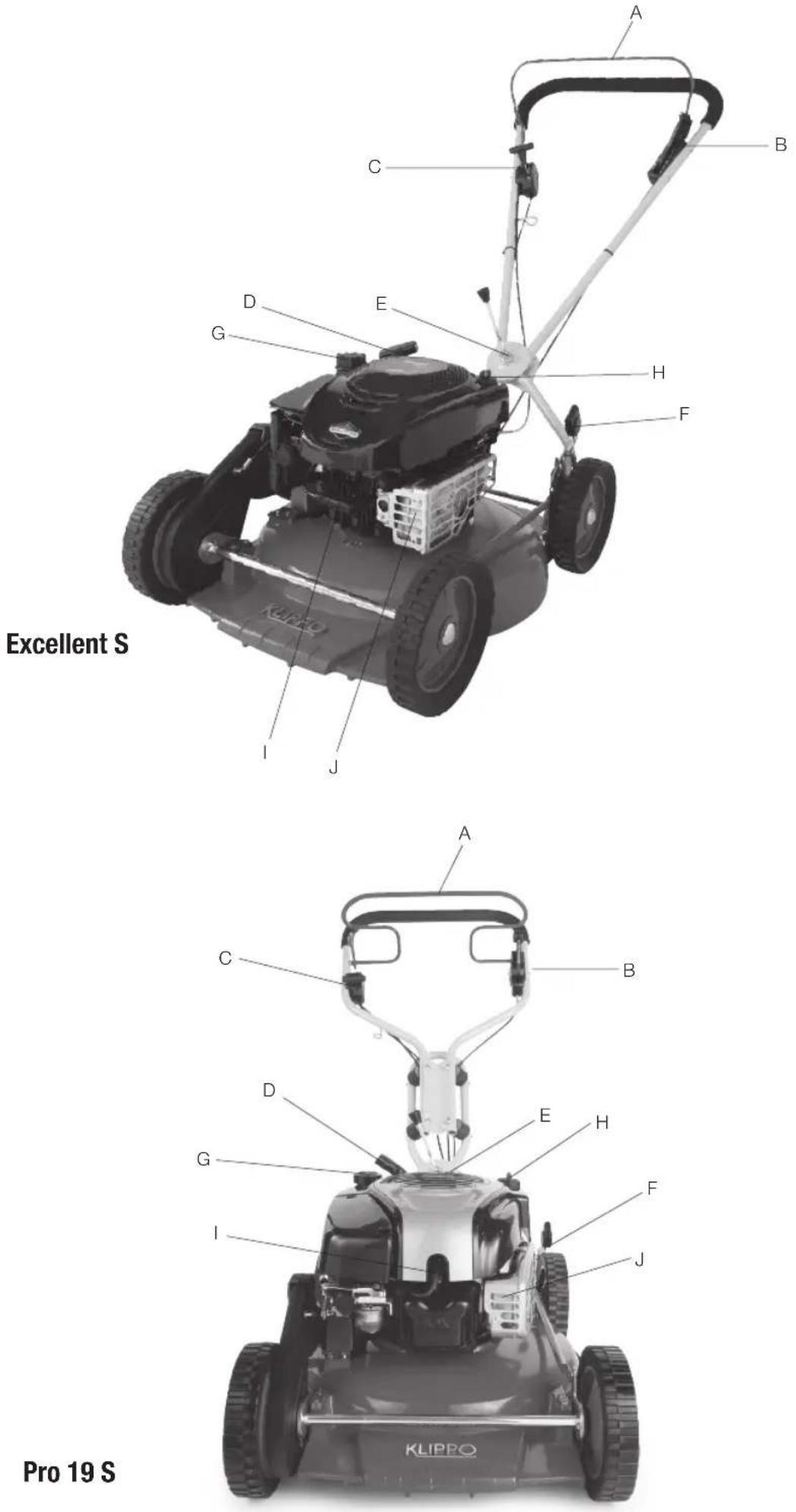
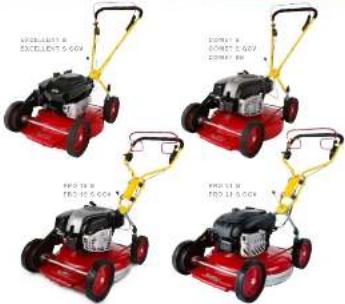
Pro 19 S
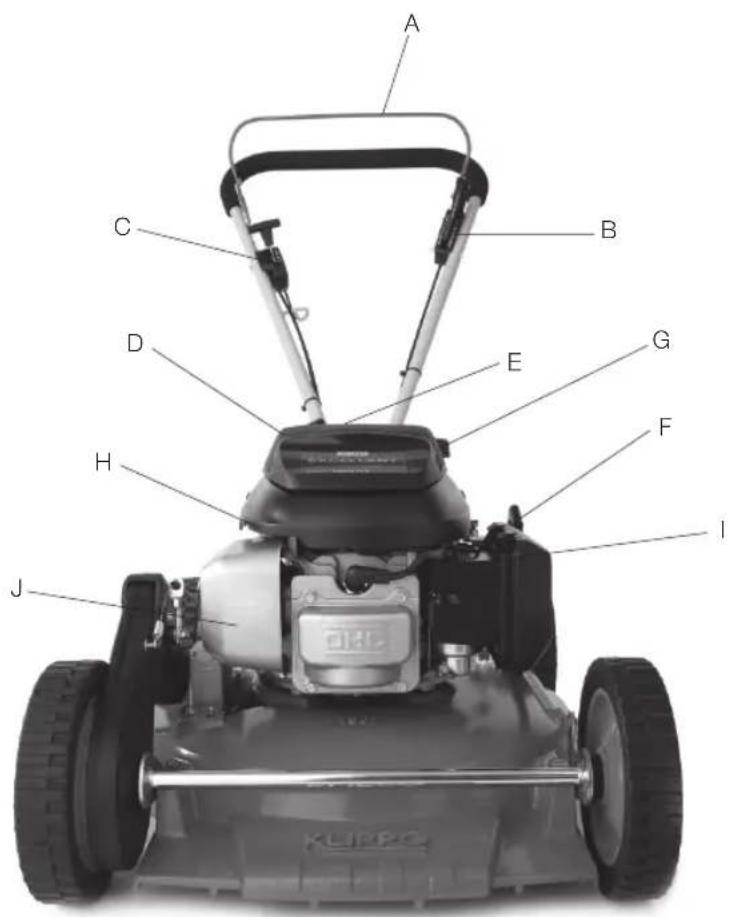
Excellent S GCV
Comet S GCV
Pro 19 S GCV
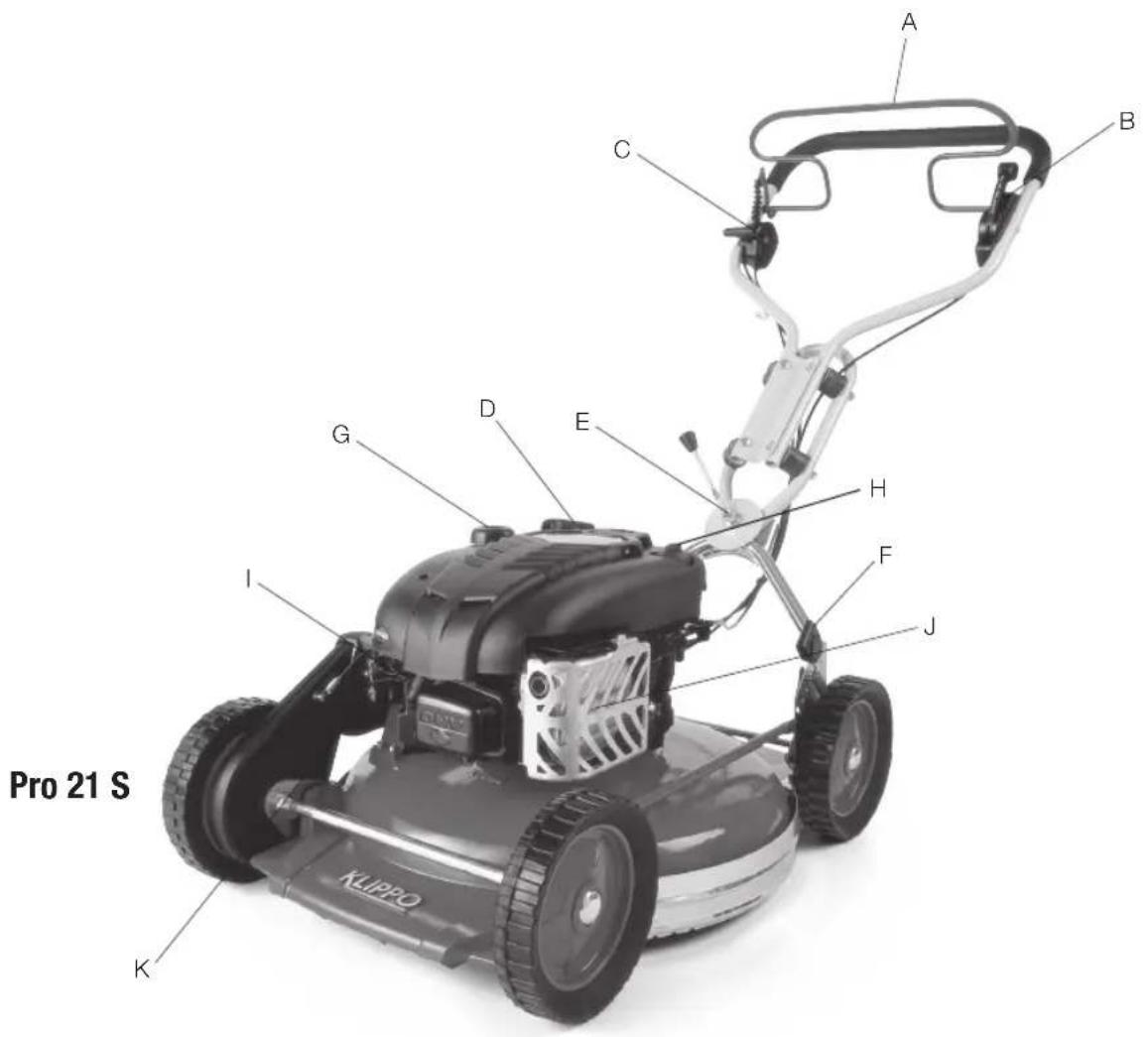
Pro 21 S GCV
Anvisningar for KLIKPO GRÄSKLIPPARE
Modeller: Excellent S, Excellent S GCV, Comet S, Comet S GCV, Comet SE, Pro 19 S, Pro 19 S GCV, Pro 21 S, Pro 21 S GCV.
Motorer: Briggs & Stratton; 675 Series, 700 Series DOV, 825 Series. Honda; GCV 135, GCV 160
Excellent S 17/901/017 Excellent S GCV 17/901/022
Comet S 17/901/021 Comet S GCV 17/901/023
Comet SE 17/901/004 Pro 19 S 17/901/018
Pro 19 S GCV 17/901/012 Pro 21 S 17/901/014
Pro 21 S GCV 17/901/019
Huskvarna 3 oktober, 2008
Motorer: Briggs & Stratton; 675 Series, 700 Series DOV, 825 Series. Honda; GCV 135, GCV 160.
Excellent S 17/901/017 Excellent S GCV 17/901/022
Comet S 17/901/021 Comet SGCV 17/901/023
Comet SE 17/901/004 Pro 19 S 17/901/018
Pro 19 S GCV 17/901/012 Pro 21 S 17/901/014
Pro 21 S GCV 17/901/019
Huskvama 3. oktober 2008
INNKJØRING, FØRSTE OLJESKIFT
VEDLIKEHOLDSFORSKRIFTER
Excellent S 17/901/017 Excellent S GCV 17/901/022
Comet S 17/901/021 Comet S GCV 17/901/023
Comet SE 17/901/004 Pro 19 S 17/901/018
Pro 19 S GCV 17/901/012 Pro 21 S 17/901/014
Pro 21 S GCV 17/901/019
Huskvara, 3. oktober 2008
| Modell Art.nr. Motor Motor | volume/cc | Målt lydeffektnivå, dB(A) | Garanteret lydeffektnivå, dB(A) | Operatörsbuller, dB(A) | Knivtype | Klippe-bredde, cm | ||
| Excellent S | 965227801 | B&S 675 Series | 190 | 92 | 96 | 82 | Mulcher | 48 |
| Excellent S GCV | 965227901 | Honda GCV 135 | 135 | 89 | 96 | 78 | Mulcher | 48 |
| Comet S | 965224901 | B&S 700 Series DOV | 160 | 91 | 98 | 80 | Mulcher | 53 |
| Comet S GCV | 965224701 | Honda GCV 160 | 160 | 91 | 96 | 79 | Mulcher | 53 |
| Comet SE | 965225001 | 700 Series DOV | 160 | 91 | 98 | 79 | Mulcher | 53 |
| Pro 19 S | 965229301 | 700 Series DOV | 160 | 91 | 96 | 79 | Mulcher | 48 |
| Pro 19 S GCV | 965864301 | Honda GCV 135 | 135 | 89 | 96 | 78 | Mulcher | 48 |
| Pro 21 S | 965230801 | B&S 825 Series | 190 | 94 | 98 | 83 | Mulcher | 53 |
| Pro 21 S GCV | 965230901 | Honda GCV 160 | 160 | 92 | 98 | 81 | Mulcher | 53 |
Vibrationsniveau: Setekniske specifi kationer, sid. 43!
Pro 21 S GCV. Moottorit: Briggs & Stratton; 675 Series, 700 Series DOV, 825 Series. Honda; GCV 135, GCV 160.
Excellent S 17/901/017 Excellent S GCV 17/901/022
Comet S 17/901/021 Comet S GCV 17/901/023
Comet SE 17/901/004 Pro 19 S 17/901/018
Pro 19 S GCV 17/901/012 Pro 21 S 17/901/014
Pro 21 S GCV 17/901/019
Instruction manual for KLIppo LAWNMOWERS
Models: Excellent S, Excellent S GCV, Comet S, Comet S GCV, Comet SE, Pro 19 S, Pro 19 S GCV, Pro 21 S, Pro 21 S GCV.
Engines: Briggs & Stratton; 675 Series, 700 Series DOV, 825 Series. Honda; GCV 135, GCV 160.
Congratulations on purchasing a Klippo Lawnmower!
Before starting, we recommend that you carefully read instruction manual in order to obtain the best from your mower.
Safety instructions for power lawnmower with horizontally rotating blades
These instructions are to be carfully studied before the lawnmower is used.
- Keep hand and feet clear of the rotating blades and never put your hand or foot into any ejector opening without first making sure that the blade is not moving and the ignition cable is disconnected from the spark plug.
- Do not touch the blade until the ignition cable has been disconnected from the spark plug. Rotating the blades may cause the engine to start.
- Do not leave the machine unattended without stopping the engine.
- The engine speed regulator must not be disabled. The pre-adjusted number of revolutions may not be changed. Protections and safety devices may not be taken away or be set out of function.
- Do not top up with fuel when the engine is warm. Don't smoke while flling up with fuel or in the near of the tank. WARNING! Petrol is very fl ammable! Store the fuel in containers intended for petrol. Don't remove the fuel filler or fl up with fuel while the engine is running.
-
Never allow children or other persons whom are not familiar with the machine to operate the lawnmower. Even if the machine has very effective protections it could throw out solid objects that can cause injuries.
-
Keep the lawn as clear as possible of stones or other objects that the lawnmower can strike. Avoid driving over gravel paths etc.
- Familiarize lawnmower operators with the risks and explain how accident are to be avoided.
- The machine may not be used for any other purpose than cutting grass.
- Wear pants and suitable shoes while cutting grass. Beaware that a lawn could be slippery!
- Comet SE: Don' leave the machine with the ignition key!
- Never touch anything under the cutting deck, as for instance dismount or mount the mulching insert, without disconnecting the spark plug cable first.
- Do not use the lawnmower if any protection or safety device is damaged. Inspect the machine before every use. Control regularly that all screws and nuts are fastened, especially blade and engine.
Fitting and adjustment
UPPER HANDLE
Fitted without tools, with a strong nut on the articulated plate.
HANDLE POSITION
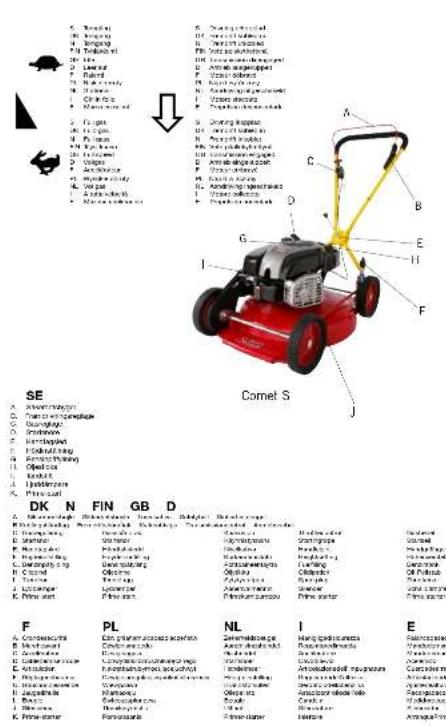
When required, the handle can be rotated laterally to some extent by means of the handle joint, e.g., when mowing close to hedges or house walls. The handle can be set to different positions for the best operating position. The handle can be altered in height at the chassis mount by turning the nylon knobs (fig. 1).
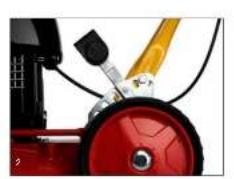
SETTING THE CUTTING HEIGHT (fi g. 2)
Move the lever forwards for taller grass. The lever positions correspond to 3-6 mm grass height. All the weels are set simultaneously in one operation. Make use of the effcient
height setting of the KLIPO lawn-mowers when mowing edges or trimming.
Never cut grass unnecessarily short. This makes spreading/ collection more difficult and increases the risk of "scalping".
Mulching insert
This insert is mounted on the Excellent-models and is dismounted on the Pro 19-models by delivery. This is mounted/dismounted by the two screws on the rear/upper part of the cutting deck (fi g. 16). Beware that the spark plug cable is disconnected before dismounting/mounting!
Before starting the engine
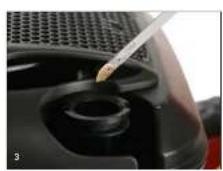
Before starting engines for the first time: fill with oil (fig 3.) and READ THE ENCLOSED INSTRUCTION MANUAL FOR THE ENGINE!
Unscrew the dipstick and fi ll up with approx 0,55 lit. of engine oil, viscosity SAE 30, Klippo oil no. 502873501 or accor-ding to the engine manual. Fill up to the full graduation mark on the dipstick (do not fi ll above it).
NB. THE OIL IS DRAINED PRIOR TO DELIVERY!
When operated for the first time, the silencer will change colour and may smoke briefly.
OIL CHECK
Check the oil level before starting and every five hours. Take off the dipstick and dry it up. Screw the dipstick into the tube completely and make sure that the oil reaches the FULL mark (fig. 3).
RUNNING-IN and FIRST OIL CHANGE
The engine has already been adjusted and required no running-in as such, although you should run it at no more than moderate load for the first few hours. Remember to change the oil the first time after five hours of operation, and then every twenty-five hours.
PETROL
Use leadfree 95 octane petrol. Stop the engine before flling. Do not overfill the tank so much that it overflows. Leave around 6mm for the fuel to expand.
Don't let the machine stay over the winter with petrol in the tank. This could cause starting problems in spring.
Starting the engine
825 Series-engines
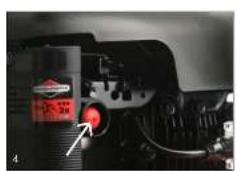
- Starting a cold engine: Set the throttle control to full speed position (hare). Push the Prime-starter (fi g. 4) throughly three times. It is placed in the front of the engine. When starting a warm engine, normally pushing the prime-starter is unnecessary.
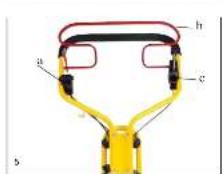
- The security bail (fi g. 5b) must be in operating position, by starting and operating.
- Give the staring string a powerful lug. By cold weather it could be necessary to repeat the proce-dure. If the engine has got too much petrol, try to start with the throttle control in idle position (turtle). If the engine still doesn't start, take off the spark plug and clean it and try again.
675 Series and 700 Series DOV-engine
- The security bail (fi g. 5b) must be in operating position, by starting and operating.
- Give the starting string a powerful lug.
MODELS WITH HONDA ENGINE:
- Starting a cold engine: Set the throttle control to choke position (hare), pulsed forward as far as possible. And open the petrol valve (behind the air fiiter on the left side of the engine). If the engine has got too much petrol, try to start with the throttle control in idle position. If it doesn't start, take off the spark plug and clean it from petrol and dirt. When starting a warm engine, normally the choke is unnecessary.
- The security bail (fi g. 5b) must be in operating position, by starting and operating.
- Give the staring string a powerful lug.
General remarks
Tidy up the lawn before mowing. Solid objects laying in the grass are dangerous to hit with blade and are woming out the blades unnecessarily.
A lawnmower must not be driven into solid objects, check the lawn for any concealed pipes and mark their position. Drive the lawnmower calmly and methodically, e.g., in continuous circles and always in such a way that you even out any stripes. Mow in different directions every time.
TIPS ON MOWING
Experts agree that it is the best to trim only one third of the length of the grass at one time, as this stimulates its growth and gives a tougher and greener lawn.
See to that the blades are in good condition. If they are worn
Maintenance
NB. To prevent accidental engine starting, always disconn-nect the ignition cable when the engine or lawnmower is being serviced!
The machine should be left to an authorized KLIPO-workshop after every season. Machines with catalytic converter should be left to an authorized KLIPO-workshop at least ever third year or every 100 operating hours, whichever occurs first.
MAINTENANCE INSTRUCTIONS
Keep the top underneath of the lawnmower clean and wipe off any grass before it dries. When working underneath the machine place the machine with the spark plug upwards and disconnect the ignition cable. Tighten all mounting bolts from time to time and lubricate catches and axles after every season. Bare-metal parts should be rubbed down with a rag dipped in anti-corrosion oil. Routine servicing every fifty hours is recommended in cases of professional use. Use only KLIPO original spare parts and accessories. (It's a condition for the CE-marking).
COMET SE
When starting for the first time, the battery may not be sufficiently charged. In that case start the engine with the starting string and then charge the battery with the charger supplied. Refer to "Maintenance", "Battery charging".
ELECTRIC STARTER
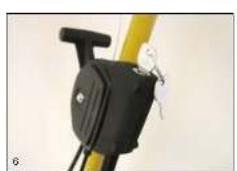
Fig. 6) before starting for the first time, connect the battery cable.
Follow the starting instructions above according to point 1 and 2 then turn the ignition key on the handle clockwise. Hold the key in this position until the engine starts, release it when it has done so and move the controls to the operating position.
STOP
Stopped by dropping the safety bail (fi g. 5b). If you just want to stop the transmission while the engine is running, drop the safety bail just a little bit until the transmission control is dropping. To engage the transmission again, push the transmission control forwards (fi g. 5c).
the cut will be uneven and the grass will be yellow in the section surface. Mow often. An ornamental lawn should be mown twice a week but never do so when the grass is wet with rain or dew, as it makes spreading more difficult.
ADVANTAGES OF FRONT-WHEEL DRIVE
The entire lawnmower is more manoeuvrable and can turn, reverse and mow close to trees etc. Just depress the handle and allow the front wheels to spin in the air. Mowing can also be done with front-wheel drive disengaged.
Blade replacement: Firm blade/Blade plate
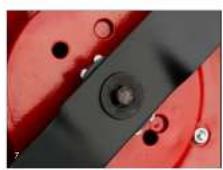
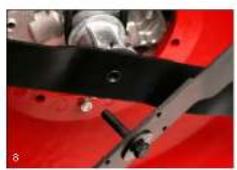
A robust cup spring presses the blade plate/blade against a friction washer. A 14mm ring spanner or sockel is recommended for removal of the blade bolt, which has a conventional right-hand thread. To assemble, tighten the bolt firmly and carefully knock the sockel onto it with a hammer. The blade also functions as a flywheel. If it slips the engine may run unevenly or be difficult to start, e.g., may backfire. N.B. To avoid vibration, fit the blade with the markings on the blade mount facing the side of the blade. See fig. 7 (mulcher), fig. 8 (Cross-Cut).
VIBRATIONS
Never run a lawnmower if it vibrates abnormally. If a blade is damaged, replace it.
AIR CLEANER SERVICE
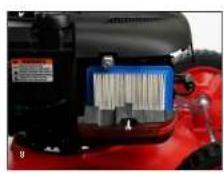
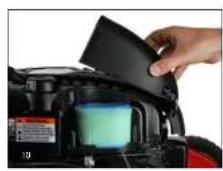
675 Series- and 825 Series-engines (fi g. 9 and 10)
Clean the element every three months or every twenty-five hours, whichever comes first. NB. Clean the element more frequently when operating under dusty conditions.
- Loosen the screw and lower the cover as shown in the figure.
- Carefully remove the element.
- Clean the element by carefully knocking it against a flat surface. If it is heavily soiled, it must be replaced.
- Replace the element, close the cover and tighten firmly.
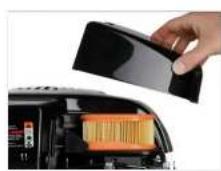
700 Seies DOV (fi g. 11)
- Loosen the screws and remove the cover.
- Carefully remove the element.
- Clean the element by carefully knocking it againts a flat surface. If it is heavily soiled, it must be replaced.
- Replace the element, close the cover and tighten firmly.
Honda GCV-engines (fi g. 12)
Clean the element every three months or every twenty-five hours, whichever comes first. NB. Clean the element more frequently when operating under dusty conditions.
- Loosen the snap-on fastenings and lower the cover as shown in the figure.
- Carefully remove the element.
- Clean the element by carefully knocking it against a fl at surface. If it is heavily soiled, it must be replaced.
- Replace the element, close the cover and push the snap-on fastenings properly
NORMAL OIL CHANGE
Unscrew the dipstick. Place a container which holds at least 1 litre, beside the lawnmower and lean the lawnmower carefully to the left (if Briggs & Stratton engine) alternatively to the right (if Honda engine) to allow the oil to run out into the container. This can be done most easily when the engine is warm and the fuel tank is empty.
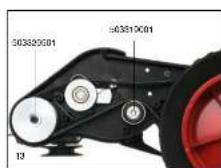
REPLACEMENT AND ADJUSTMENT OF V-BELTS (fig.13)
- Remove the cover from the gearbox (4 pcs screws). Clean out any dirt in the gear housing.
- Remove the hub from the front wheel by the transmission, prising it out carefully with a screwdriver. Unscrew the locking screw and remove the wheel.
- Lift off the belt from the pulley 503329501. Before installing the new belt, check that the inner pulley runs easily on the shaft. If not, spray a little rustdissolving oil between and behind the pulleys and put a little grease on the shaft. Mount the new belt and make sure that is is correctly located by the belt adjustment ball bearing. 503319001.
- Adjustment: The belt can be adjusted by moving the ball bearing 503319001 upwards or downwards. When the lawnmower has been in use for some hours the belt will have been stretched and it should be readjusted.
- Screw the cover in position on the gearbox and testdrive the lawnmower.
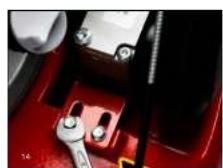
REPLACEMENT AND ADJUSTMENT OF THE V-BELT, ENGINE -WORM GEAR
To replace or adjust the belt between the engine and the worm gear follow the instructions below:
- Remove the blade (only when replacing the belt).
- By removal: unscrew the four adjustment screws on the worm gear bracket. By adjustment: loosen the four adjustment screws a bit (figure 14).
- Remove the old belt and mount the new one. Tighten the four adjustment screws a bit (only when replacing the belt).
- Adjust the belt by pushing the worm gear forwards or backwards. The tension of the belt should be so that it can move 10mm in the middle when pushing with a force of 3 kilos (to be checked underneath the machine).
- Tighten the adjustment screws properly.
- Check the function of the drive as the adjustment of the worm gear influences the tension of the belt in the transmission (the transmission angles more or less).
- Double check that the screws are properly tightened.
THE BATTERY
(Comet SE) is a 12-volt lead-acid battery that does not normally require maintenance and is charged during operation. If repeated starting attempts are made without the engine starting, the battery may have been discharged and starting will have to be done manually with the starting string. A completely discharged battery can be recharged by means of the charger supplied with the lawnmower. NB. The battery may require charging at some point during the mowing season and absolutely prior to winter storage.
CHARGING THE BATTERY
(Comet SE)
- Disassemble the connector on to the cable by the battery
- Connect the battery cable to the charger and connect the latter to a 220 v 50 Hz wall socket (fig. 15).
- After charging, which may take up to 24 hours in the case of a completely flat battery, disconnect the charger and reconnect the battery to the engine cable. NB. Do not charge at temperatures below +5^ . NB! A used lead-acid batter must not be disposed of in household refuse and should be handed in at you nearest service workshop.
TROUBLESHOOTING
If the engine does not start, check the following:
- Is there fresh petrol in the tank and is the petrol valve open (if Honda engine)?
- Control that the brake cable is correctly adjusted.
- That the spark plug is not fouled with soot and the gap is correct (it should be 0,7-0,8 mm).
- Is the blade properly fastened?
- Is the air filter blocked with dirt? Clean or change it! If the engine fails to start after these measures, contact your nearest service workshop.
- Does the cutting result being bad and the blades of the grass being uneven in cut area? Change the blade of the lawnmower! Also the collecting is influenced by a worn blade.
CLEANING
Place the lawnmower with the spark plug upwards. First run until the tank is half empty, otherwise petrol will leak out through the venting hole in the tank cap. Beware of the environment and the fire danger! NB. Never flush the lawnmower with a high-pressure cleaner.
WINTER STORAGE
Run until no more petrol is left and change the oil. Then pour one spoonful of oil into the spark-plug hole and turn over the engine so that the oil is distributed. Clean the air filter and gear housing. Store the lawnmower indoors in a dry spot. Charge the battery with the charger.
EC-declaration of conformity
(Appplies to Europe only)
Husqvarna AB, SE-561 82 Huskvarna, Sverige, tel: +46-36-146500, declares under sole responsibility that the lawn mowers Klippo Excellent S, Excellent S GCV, Comet S, Comet S GCV, Comet SE, Pro 19 S Pro 19 S GCV, Pro 21 S, Pro 21 S GCV from the serial numbers 08XXXXXX and onwards comply with the requirements of the COUNCIL'S DIRECTIVE:
- of June 22, 1998 "relating to machinery" 98/37/EC.
- of December 15, 2004 "relating to electromagnetic compatibility" 2004/108/EC.
- of May 8, 2000 "relating to the noise emissions in the environment" 2000/14/EC.
Registered body 0404, SMP Svensk Maskinprovning AB, Fyrisborgsgatan 3, SE-754 50 Uppsala, Sweden, has issued reports regarding the assessment of conformity according to annex VI of the COUNCIL'S DIRECTIVE of May 8, 2000 "relating to the noise emissions in the environment" 2000/14/EC.
The certifi cates have the numbers:
Excellent S 17/901/017 Excellent S GCV 17/901/022
Comet S 17/901/021 Comet S GCV 17/901/023
Comet SE 17/901/004 Pro 19 S 17/901/018
Pro 19 S GCV 17/901/012 Pro 21 S 17/901/014
Pro 21 S GCV 17/901/019
Huskvarna 3 October 2008
Bengt Ahlund, Development manager
| Model type Art.no. Engine | Engine volume/cc | Measured noise level, dB(A) | Guaranteed noise level, dB(A) | Operators noise level type, dB(A) | Blade type | Cutting width, cm | ||
| Excellent S | 965227801 | B&S 675 Series | 190 | 92 | 96 | 82 | Mulcher | 48 |
| Excellent S GCV | 965227901 | Honda GCV 135 | 135 | 89 | 96 | 78 | Mulcher | 48 |
| Comet S | 965224901 | B&S 700 Series DOV | 160 | 91 | 98 | 80 | Mulcher | 53 |
| Comet S GCV | 965224701 | Honda GCV 160 | 160 | 91 | 96 | 79 | Mulcher | 53 |
| Comet SE | 965225001 | 700 Series DOV | 160 | 91 | 98 | 79 | Mulcher | 53 |
| Pro 19 S | 965229301 | 700 Series DOV | 160 | 91 | 96 | 79 | Mulcher | 48 |
| Pro 19 S GCV | 965864301 | Honda GCV 135 | 135 | 89 | 96 | 78 | Mulcher | 48 |
| Pro 21 S | 965230801 | B&S 825 Series | 190 | 94 | 98 | 83 | Mulcher | 53 |
| Pro 21 S GCV | 965230901 | Honda GCV 160 | 160 | 92 | 98 | 81 | Mulcher | 53 |
Vibration level: See Technical specifications, page 43!
Excellent S 17/901/017 Excellent S GCV 17/901/022
Comet S 17/901/021 Comet S GCV 17/901/023
Comet SE 17/901/004 Pro 19 S 17/901/018
Pro 19 S GCV 17/901/012 Pro 21 S 17/901/014
Pro 21 S GCV 17/901/019
Huskvarna, den 3. Oktober 2008
Moteurs: Briggs & Stratton; 675 Series, 700 Series DOV, 825 Series. Honda; GCV 135, GCV 160.
Excellent S 17/901/017 Excellent S GCV 17/901/022
Comet S 17/901/021 Comet S GCV 17/901/023
Comet SE 17/901/004 Pro 19 S 17/901/018
Pro 19 S GCV 17/901/012 Pro 21 S 17/901/014
Pro 21 S GCV 17/901/019
Excellent S 17/901/017 Excellent S GCV 17/901/022
Comet S 17/901/021 Comet S GCV 17/901/023
Comet SE 17/901/004 Pro 19 S 17/901/018
Pro 19 S GCV 17/901/012 Pro 21 S 17/901/014
Pro 21 S GCV 17/901/019
Zie Fig. 7 (mulcher), Fig.8 (Cross-Cut).
TRILLINGEN
Excellent S 17/901/017 Excellent S GCV 17/901/022
Comet S 17/901/021 Comet S GCV 17/901/023
Comet SE 17/901/004 Pro 19 S 17/901/018
Pro 19 S GCV 17/901/012 Pro 21 S 17/901/014
Pro 21 S GCV 17/901/019
Excellent S 17/901/017 Excellent S GCV 17/901/022
Comet S 17/901/021 Comet S GCV 17/901/023
Comet SE 17/901/004 Pro 19 S 17/901/018
Pro 19 S GCV 17/901/012 Pro 21 S 17/901/014
Pro 21 S GCV 17/901/019
Excellent S 17/901/017 Excellent S GCV 17/901/022
Comet S 17/901/021 Comet S GCV 17/901/023
Comet SE 17/901/004 Pro 19 S 17/901/018
Pro 19 S GCV 17/901/012 Pro 21 S 17/901/014
Pro 21 S GCV 17/901/019
English - SAFETY INSTRUCTIONS - WARNING!
- Please read the operator's manual carefully and make sure you understand the instructions before using the machine.
- Under no circumstances should you modify the original design of the machine without approval from the manufacturer. Always use original spare parts. Unauthorized modifications and/or accessories may lead to serious injury or death to the user or others.
- A lawn mower is a dangerous tool if used carelessly or incorrectly and can cause serious, even fatal injuries. It is extremely important that you read and understand the contents of this operator's manual.
- Avoid all usage which you consider to be beyond your capability.
- You must use personal protection whenever you use the machine.
- Never use a machine that has faulty safety equipment!
-
The muffler gets very hot in use and remains so for a short time afterwards. Do not touch the muffler if it is hot!
Always shut off the engine before refuelling. -
The exhaust fumes from the engine are hot and may contain sparks which can start a fire. Never start the machine indoors or near combustible material! Do not smoke or place hot objects near fuel.
- Never run the engine indoors, in enclosed or poorly ventilated areas. The exhaust fumes contain toxic carbon monoxide. Always ensure there is adequate ventilation when handling fuel.
- Always move the machine about 3 metres from the refuelling position before starting.
- A faulty cutting attachment may increase the risk of accidents.
- Make sure that your hands and feet do not come near the cutting attachment when the engine is running.
- Keep people and animals well away from the working area.
- Do not start a lawn mower unless the cutter and all covers are fitted correctly. Otherwise the cutter could come loose and cause personal injuries.
- Make sure the cutting attachment has stopped before cleaning, carrying out repairs or an inspection. Disconnect the HT lead from the spark plug.
Always wear heavy-duty gloves when repairing the cutting attachment. The blades are very sharp and can easily cause cuts. - The ignition system of this machine produces an electromagnetic field during operation. This field may under some circumstances interfere with pacemakers. To reduce the risk of serious or fatal injury, we recommend persons with pacemakers to consult their physician and the pacemaker manufacturer before operating this machine.
- Overexposure to vibration can lead to circulatory damage or nerve damage in people who have impaired circulation. Contact your doctor if you experience symptoms of overexposure to vibration. Such symptoms include numbness, loss of feeling, tingling, pricking, pain, loss of strength, changes in skin colour or condition. These symptoms normally appear in the fingers, hands or wrists. The risk increases at low temperatures.
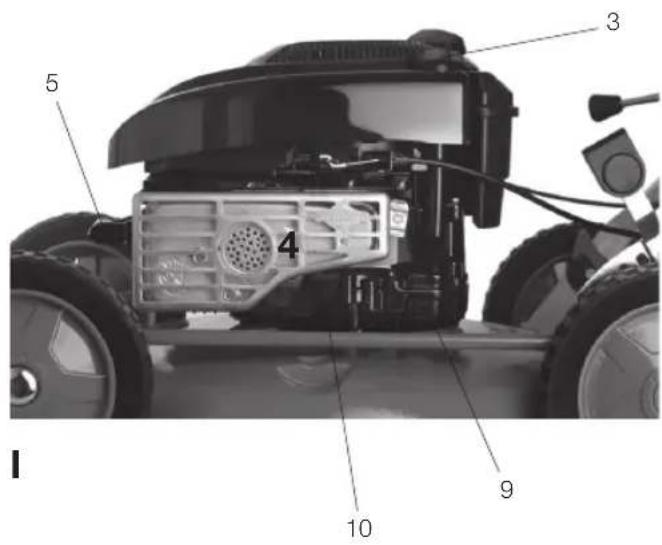
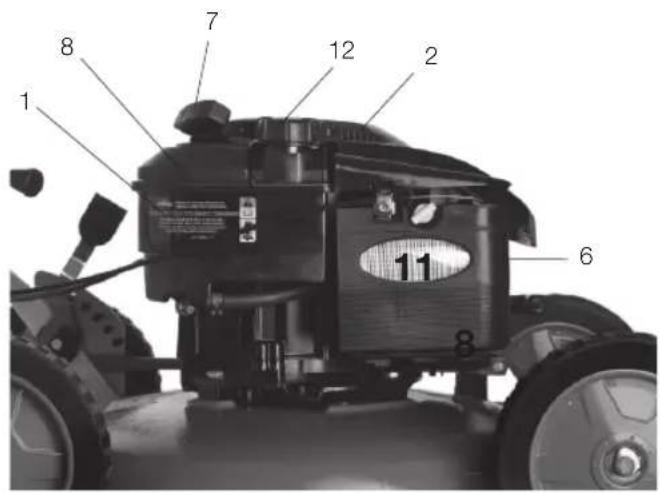
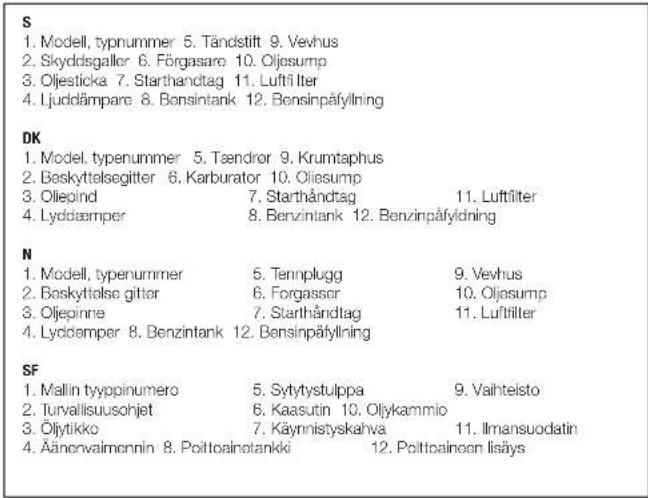
Briggs & Stratton 675 Series (Excellent S)
SF
II
Honda GCV 135, GCV 160
(Excellent S GCV, Comet S GCV, Pro 19 S GCV, Pro 21 S GCV)
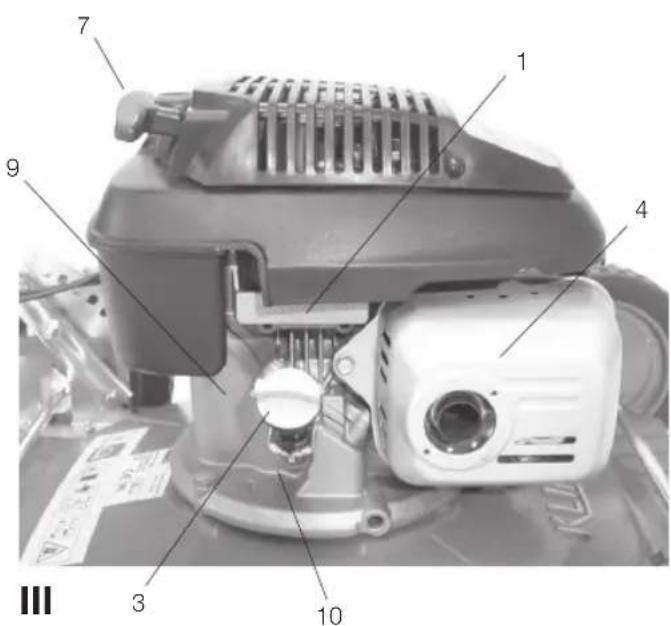
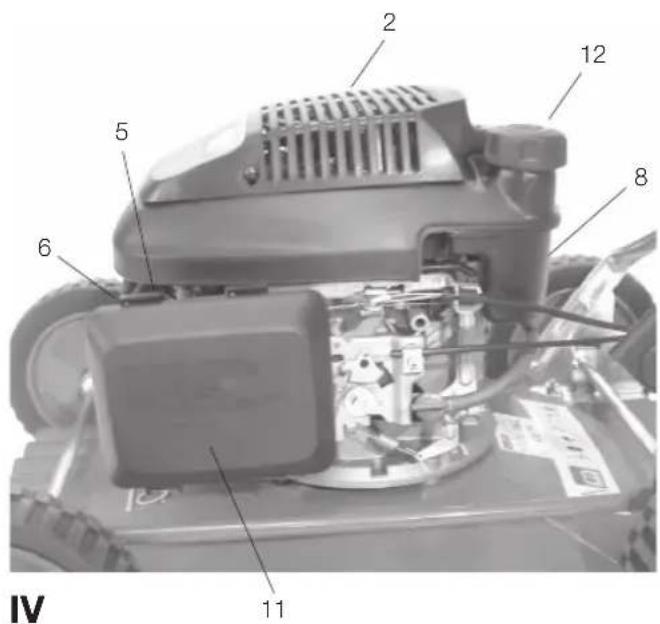

Briggs & Stratton 825 Series (Pro 21 S)
V
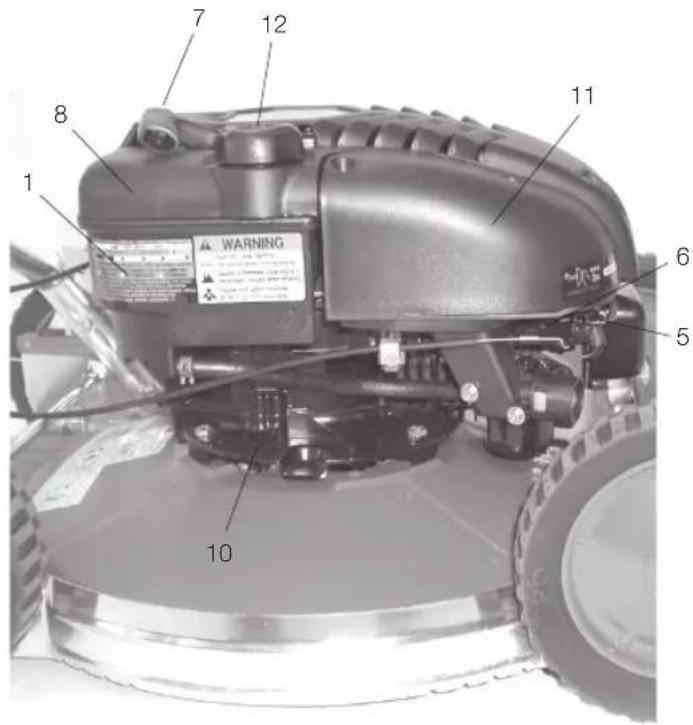
VI
Briggs & Stratton 700 Series D0V (Comet S, Pro 19 S)
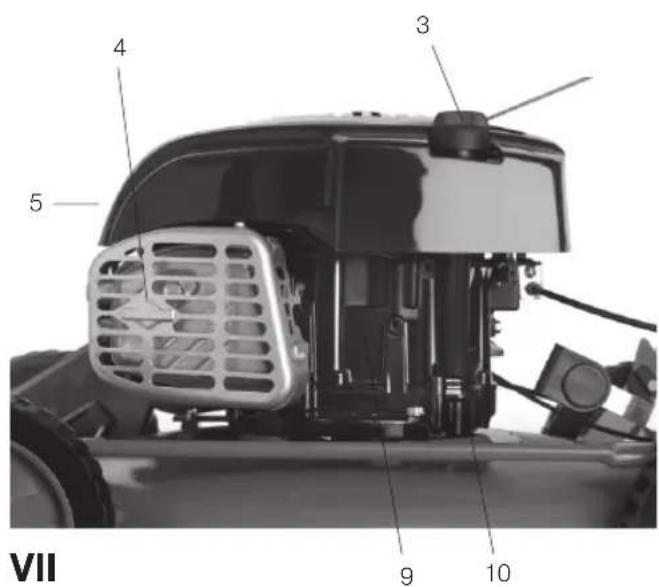
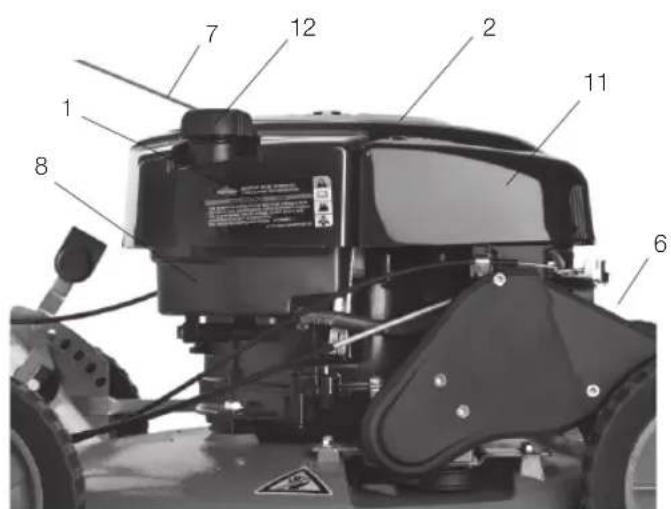
VIII
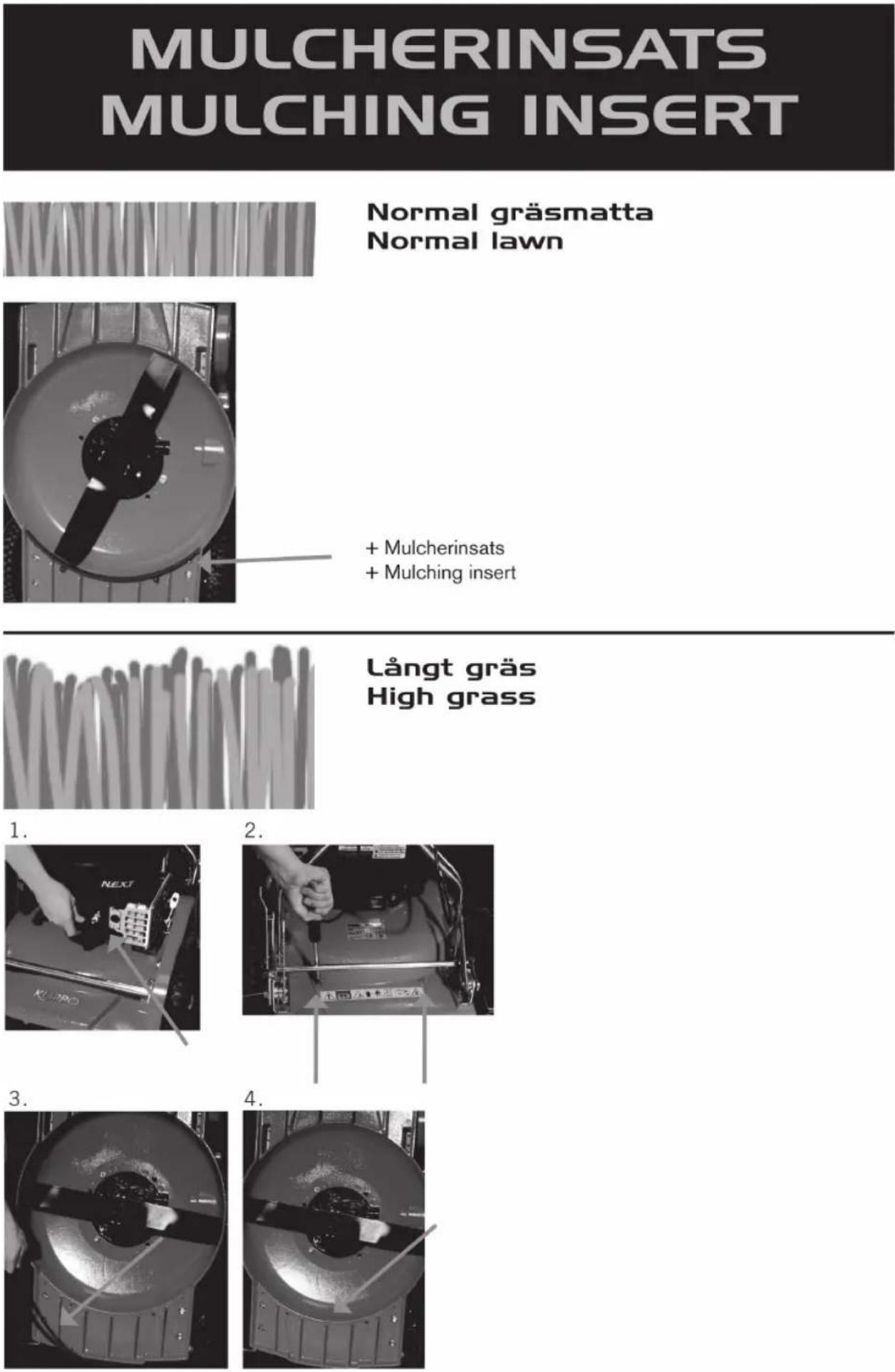
Fig. 16