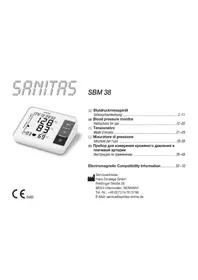
SBM 38 - Blood pressure monitor SANITAS - Free user manual and instructions
Find the device manual for free SBM 38 SANITAS in PDF.


| Product type | Automatic upper arm blood pressure monitor |
| Brand / Model | Sanitas SBM 38 |
| Measurement method | Oscillometric, non-invasive |
| Pressure measurement range | 30 to 280 mmHg (systolic and diastolic) |
| Pulse measurement range | 40 to 199 pulses/minute |
| Pressure accuracy | ± 3 mmHg |
| Pulse accuracy | ± 5% of displayed value |
| Memory | 90 memory slots with date and time |
| WHO classification | Color-coded bar graph |
| Detection of cardiac arrhythmias | Yes, via « ♥ » symbol |
| Dimensions (W x D x H) | 140 × 110 × 48 mm |
| Weight (without batteries) | Approx. 450 g |
| Power supply | 4 AA 1.5 V batteries (LR06, alkaline) |
| Battery life | Approx. 200 measurements |
| Compatible arm circumference | 22 to 32 cm |
| Operating conditions | +5 °C to +40 °C, 30 – 80 % RH |
| Storage conditions | -20 °C to 55 °C, 10 – 93 % RH |
| Automatic shut-off | After 1 minute of inactivity |
| Included accessories | Instruction manual, 4 AA batteries, storage pouch |
| Cleaning | Slightly damp cloth, without detergent |
| Protection rating | IPX0 (not protected against water) |
| Electrical class | Internal power supply, type BF device |
| Standards | Directive 93/42/EEC, EN1060-1, EN1060-3, IEC 80601-2-30 |
Frequently Asked Questions - SBM 38 SANITAS
User questions about SBM 38 SANITAS
0 question about this device. Answer the ones you know or ask your own.
Ask a new question about this device
Download the instructions for your Blood pressure monitor in PDF format for free! Find your manual SBM 38 - SANITAS and take your electronic device back in hand. On this page are published all the documents necessary for the use of your device. SBM 38 by SANITAS.
USER MANUAL SBM 38 SANITAS
natural_image
Illustration of a wristwatch with a bandage and forearm, no text or symbols present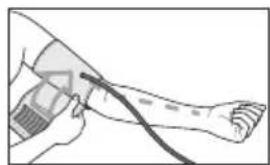
natural_image
Medical illustration showing a hand holding a medical device near the ankle and foot (no text or symbols present)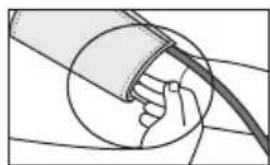
natural_image
Illustration of a hand holding a medical device with a curved tube (no text or symbols)natural_image
Pure diagram of a device with an arrow pointing to a curved line and a dashed vertical line, no text or symbols present.natural_image
Side view of a person sitting at a desk using a pressure monitor (no text or symbols visible)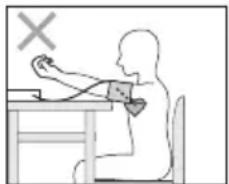
natural_image
Illustration of a person sitting at a desk with a medical device and a cross symbol above (no text or labels)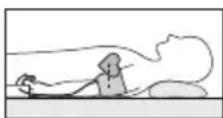
Please read these instructions for use carefully and keep them for later use, be sure to make them accessible to other users and observe the information they contain.
1. Getting to know your instrument
Check that the packaging of the Sanitas SBM 38 blood pressure monitor has not been tampered with and make sure that the required contents are present. Before use, ensure that there is no visible damage to the device or accessories and that all packaging material has been removed. If you have any doubts, do not use the device and contact your retailer or the specified Customer Services address.
The upper arm blood pressure monitor is used to carry out non-invasive measurement and monitoring of the arterial blood pressure values in adults.
This allows you to quickly and easily measure your blood pressure, save the measurements and display the development and average values of the measurements taken.
You are also warned of possible existing cardiac arrhythmia.
The recorded values are classified according to the WHO guidelines and evaluated graphically.
Store these instructions for use for future reference and make them accessible to other users.
2. Important notes

Signs and symbols
The following symbols are used in these instructions for use, on the packaging and on the type plate for the device and the accessories:
 | Attention |
 | NoteNote on important information |
 | Observe the instructions for use |
 | Application part, type BF |
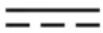 | Direct current |
 | Disposal in accordance with EC Directive 2002/96/EC – WEEE (Waste Electrical and Electronic Equipment) |
 | Manufacturer |
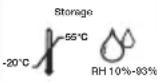 | Permissible storage temperature and humidity |
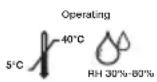 | Permissible operating temperature and humidity |
 | Protect from moisture |
| SN Serial number | |
 | The CE labelling certifies that the product complies with the essential requirements of Directive 93/42/EEC on medical products |

Notes on use
- In order to ensure comparable values, always measure your blood pressure at the same time of day.
- Before every measurement, relax for about five minutes.
- If you want to perform several measurements on the same person, wait five minutes between each measurement.
- Do not take a measurement within 30 minutes of eating, drinking, smoking or exercising.
- Repeat the measurement if you are unsure of the measured value.
-
The measurements taken by you are for your information only – they are no substitute for a medical examination! Discuss the measurements with your doctor and never base any medical decisions on them (e.g. medicines and their administration)!
-
Do not use the blood pressure monitor on newborns or patients with preeclampsia. We recommend consulting a doctor before using the blood pressure monitor during pregnancy.
- Cardiovascular diseases may lead to incorrect measurements or have a detrimental effect on measurement accuracy. The same also applies to very low blood pressure, diabetes, circulatory disorders and arrhythmias as well as chills or shaking.
- The blood pressure monitor must not be used in connection with a high-frequency surgical unit.
- Only use the unit on people that have the specified upper arm measurement for the unit.
- Please note that when inflating, the functions of the limb in question may be impaired.
- During the blood pressure measurement, the blood circulation must not be stopped for an unnecessarily long time. If the device malfunctions remove the cuff from the arm.
- Avoid any mechanical restriction, compression or bending of the cuff line.
- Do not allow sustained pressure in the cuff or frequent measurements. The resulting restriction of the blood flow may cause injury.
- Make sure that the cuff is not placed on an arm in which the arteries or veins are undergoing medical treatment, e.g. intravascular access or intravascular or therapy, or an arteriovenous (AV) shunt.
- Do not use the cuff on people who have undergone a mastectomy.
-
Do not place the cuff over wounds as this may cause further injury.
-
The blood pressure monitor can only be operated with batteries.
- To conserve the batteries, the blood pressure monitor switches off automatically if you do not press any buttons for 1 minute.
- The device is only intended for the purpose described in these instructions for use. The manufacturer is not liable for damage resulting from improper or careless use.

Instructions for storage and maintenance
- The blood pressure monitor is made from precision and electronic components. The accuracy of the measurements and service life of the device depend on its careful handling:
- Protect the device from impacts, humidity, dirt, marked temperature fluctuations and direct sunlight.
- Do not drop the device.
- Do not use the device in the vicinity of strong electromagnetic fields and keep it away from radio systems or mobile telephones.
- Only use the cuff included with the delivery or original replacement parts. Otherwise incorrect measurements will be recorded.
- Do not press the buttons before the cuff is placed on the arm.
- We recommend that the batteries be removed if the device will not be used for a prolonged period of time.

Notes on batteries
- Swallowing batteries can be extremely dangerous. Keep the batteries and products out of the reach of small children. If a battery is swallowed, seek medical attention immediately.
- Batteries must not be recharged, reactivated by other means, taken apart, thrown into an open fire or short circuited.
- If the batteries are empty or you do not intend to use the device for longer periods, remove the batteries from the device. This prevents damage which could occur when the batteries expire. Always replace all batteries at the same time.
- Do not use different types of batteries, different brands or batteries with different capacities. We recommend using alkaline batteries.

Notes on batteries and disposal
- Batteries do not belong in household waste. Please dispose of empty batteries at the collection points intended for this purpose.
- Do not open the device. Failure to comply will invalidate the warranty.
- Do not repair or adjust the device yourself. Proper operation can no longer be guaranteed in this case.
- Repairs must only be carried out by Customer Services or authorised suppliers. Before making a claim, please check the batteries first and replace them if necessary.
- Please dispose of the device in accordance with EC Directive 2002/96/EC – WEEE (Waste Electrical and Electronic Equipment).
If you have any questions, please contact the local authorities responsible for waste disposal.

- Unit description
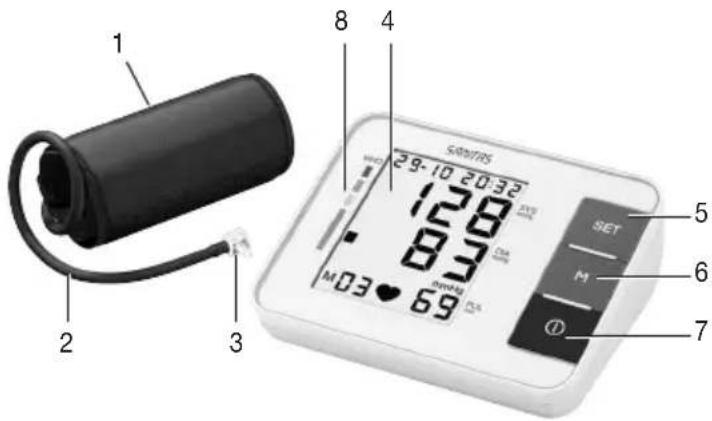
- Cuff
- Cuff line
- Cuff connector
- Display
- SET button
- Memory button M
- START/STOP button ①
- WHO scale
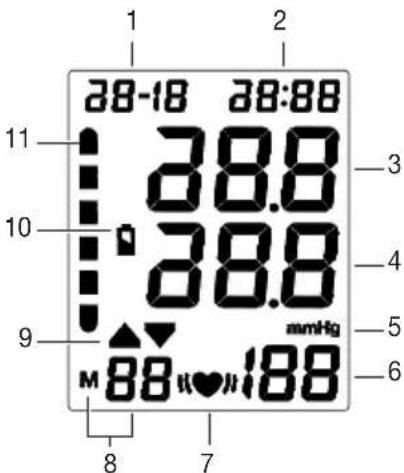
Information on the display:
- Date
- Time
- Systolic pressure
- Diastolic pressure
- Unit in mmHg
- Calculated pulse value
- Pulse symbol♥ and cardiac arrhythmia symbol «♥»
- Memory space number
- Inflate, release air ▲▼
- Low battery indicator
- WHO classification
4. Preparing for the measurement
Inserting the batteries
- Remove the battery compartment lid on the rear of the device.
- Insert four 1.5 V AA (alkaline type LR06) batteries. Make sure that the batteries are inserted the correct way round. Do not use rechargeable batteries.
- Close the battery compartment lid again carefully.
If the low battery indicator 🔒 is flashing, it is no longer possible to take measurements and all batteries must be replaced.
Once the batteries have been removed from the unit, the time must be set again.
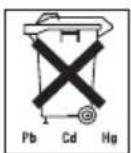
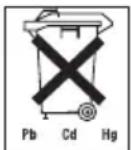
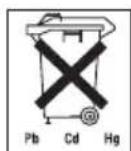
Used batteries should not be disposed of in normal household waste. Dispose of them via your electronics retailer or your local recycling point. You are legally obligated to do so.
Note: The codes below are printed on batteries containing harmful substances: Pb: battery contains lead, Cd: battery contains cadmium, Hg: battery contains mercury.
Setting the date and time
It is essential to set the date and time. Otherwise, you will not be able to save your measured values correctly with a date and time and access them again later. The time is displayed in the 24-hour format.
① If you press and hold the memory button M you can set the values more quickly.
To set the date and time, proceed as follows:
- Press and hold the SET button for 5 seconds.
- The year display will start to flash. Set the year using the memory button M and confirm with the SET button.
- Set the month, day, hour and minute and confirm each setting with the SET button.
5. Measuring blood pressure
Attaching the cuff
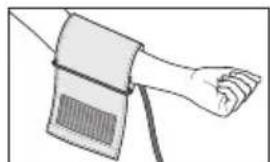
Place the cuff on to the bare left upper arm. The circulation of the arm must not be hindered by tight clothing or similar.
The cuff must be placed on the upper arm so that the bottom edge is positioned 2 – 3 cm above the elbow and over the artery. The line points to the centre of the palm.
natural_image
Illustration of a wristwatch with a barometer, showing the arm and wrist (no text or symbols present)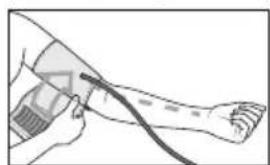
natural_image
Illustration of a person's leg with a medical device attached, showing a curved line and foot (no text or symbols)Now tighten the free end of the cuff, but make sure that it is not too tight around the arm and close the hook-and-loop fastener.
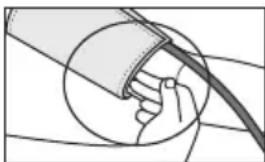
The cuff should be fastened so that two fingers fit under the cuff.
Now insert the cuff line into the connection for the cuff connector.
Important: The unit may only be operated with the original cuff. The cuff is suitable for an arm circumference of 22 to 32 cm.
natural_image
Illustration of a hand holding a medical device with a curved cable (no text or symbols)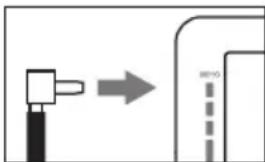
natural_image
Pure diagram of a device with an arrow pointing to a vertical line and a dashed line, no text or symbols present.Adopting the correct posture
natural_image
Side profile illustration of a person using a pressure monitor (no text or symbols)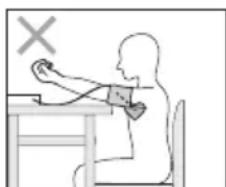
natural_image
Illustration of a person sitting at a desk with a medical device, no text or symbols present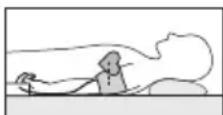
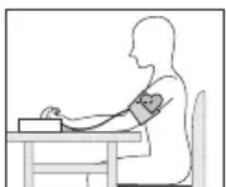
- Before every measurement, relax for about five minutes. Otherwise deviations can occur.
- You can take the measurement while sitting or lying. Make sure that the cuff is at heart level.
- To take your blood pressure, make sure you are sitting comfortably with your arms and back leaning on something. Do not cross your legs. Place your feet flat on the ground.
- To avoid falsifying the measurement, it is important to remain still during the measurement and not to speak.
Performing the blood pressure measurement
- As described above, attach the cuff and adopt the posture in which you want to perform the measurement.
- To start the blood pressure monitor, press the START/STOP button ⒹAll displays will illuminate briefly. The blood pressure monitor automatically begins to take the measurement; the cuff automatically inflates.
① You can cancel the measurement at any time by pressing the START/STOP button ①
- The cuff's air pressure is slowly released. If a tendency for high blood pressure is already recognised, the cuff is reinflated and the cuff's pressure is increased again. As soon as a pulse is found, the pulse symbol 🧑s displayed.
- The systolic pressure, diastolic pressure and pulse rate measurements are displayed.
- E_- appears if the measurement could not be performed properly. Observe the chapter on error messages/troubleshooting in these instructions for use and repeat the measurement.
- The measurement is automatically stored.
- To switch the monitor off, press the START/STOP button . If you forget to turn off the device, it will switch off automatically after approx. 1 minute.
Wait at least 5 minutes before taking another measurement!
Evaluating results
Cardiac arrhythmia:
This unit can identify potential disruptions of the heart rhythm when measuring and if necessary, indicates this after the measurement with the symbol «♥».
This can be an indicator for arrhythmia. Arrhythmia is a condition in which the heart rhythm is abnormal because of flaws in the bioelectrical system that regulates the heartbeat. The symptoms (skipped or premature heart beats, pulse being slow or too fast) can be caused by factors such as heart disease, age, physical make-up, excess stimulants, stress or lack of sleep.
Arrhythmia can only be determined through an examination by your doctor.
If the symbol “♥” is shown on the display after the measurement has been taken, repeat the measurement. Please ensure that you rest for 5 minutes beforehand and do not speak or move during the measurement. If the symbol “♥” appears frequently, please consult your doctor.
Self-diagnosis and treatment based on the measurements can be dangerous. Always follow your GP's instructions.
WHO classification:
In accordance with the guidelines/definitions of the World Heath Organization and the latest findings, the measurements can be classified and assessed according to the following table.
However, these standard values serve only as a general guideline, as the individual blood pressure varies in different people and different age groups etc.
It is important to consult your doctor regularly for advice. Your doctor will tell you your individual values for normal blood pressure as well as the value above which your blood pressure is classified as dangerous.
The bar chart on the display and the scale on the unit show which category the recorded blood pressure values fall into.
If the systolic and diastolic values fall into two different WHO categories (e.g. systolic in the 'High normal' category and diastolic in the 'Normal' category), the graphical WHO classification on the device always shows the higher category; for the example given this would be 'High normal'.
| Blood pressure value category | Systolic (in mmHg) | Diastolic (in mmHg) | Action |
| Grade 3: severe hypertension | ≥ 180 ≥ 110 | seek medical attention | |
| Grade 2: moderate hypertension | 160–179 100–109 | seek medical attention | |
| Grade 1: mild hypertension | 140–159 90–99 | regular monitoring by doctor | |
| High normal 130–139 | 85–89 | regular monitoring by doctor | |
| Normal 120–129 | 84 | self-monitoring | |
| Optimal <120<80 | self-monitoring |
Source: WHO, 1999
6. Saving, displaying and deleting measurements
- The results of every successful measurement are stored together with the date and time. If there are more than 90 measurements, the oldest measurements are lost.
- Press the memory button M to display the average value of the last 3 saved measurements.
- Continue pressing the memory button M to display the latest individual measurement, press the SET button to display the oldest measurement, with the date, time and WHO classification in each case.
- You can delete the memory by pressing and holding the memory button M for 5 seconds (appears in the display).
- To switch the monitor off, press the START/STOP button ⭕.
- If you forget to switch off the unit, it will switch off automatically after 1 minute.
7. Cleaning and storing the unit
- Clean the unit and cuff carefully using a slightly damp cloth only.
- Do not use any cleaning agents or solvents.
- Under no circumstances should you hold the unit under water, as this can cause liquid to enter and damage the unit.
- If you store the unit, no heavy objects should be placed on top of it. Remove the batteries. The cuff line should not be bent sharply.
8. Error message/troubleshooting
Error messages may appear if:
• The cuff has not inflated sufficiently (E);
- You move or speak while the measurement is being taken (E2, E4);
• The pump pressure is too high (E3);
• The batteries are almost empty
In such cases, repeat the measurement. Ensure that the cuff line is correctly attached and that you do not move or speak. If necessary, reinsert or replace the batteries.
9. Technical specifications
Model no. SBM 38
| Measurement method | Oscillometric, non-invasive blood pressure measurement on the upper arm |
| Measurement range | Cuff pressure 30 – 280 mmHg,systolic 30–280 mmHg,diastolic 40–199 mmHg,pulse 40 – 199 beats per minute |
| Display accuracy | Systolic ± 3 mmHg,diastolic ± 3 mmHg,pulse ± 5% of the value shown |
| Measurement inaccuracy | Max. permissible standard deviation according to clinical testing:systolic 8 mmHg /diastolic 8 mmHg |
| Memory 90 memory spaces | |
| Dimensions L 140 mm x W 110 mm x H 48 mm | |
| Weight Approximately 450 g (without batteries) | |
| Cuff size 22 to 32 cm | |
| Permissible operating conditions | +5°C to +40°C, 30% – 80% relative air humidity (non-condensing) |
| Permissible storage conditions | - 20°C to + 55°C, 10% – 93% relative air humidity, 500 – 1060 hPa ambient pressure |
| Power supply | 4x1.5V — — — AA batteries (alkaline type LR06) |
| Battery life For approx. 200 measurements, depending on levels of blood pressure and pump pressure | |
| Accessories Instructions for use, 4 x 1.5 V AA batteries (alkaline type LR06), storage pouch | |
| Classification Internal supply, IPX0, no AP or APG, continuous operation, application part type BF | |
Technical information is subject to change without notification to allow for updates.
- This device complies with European Standard EN60601-1-2 and is subject to particular precautions with regard to electromagnetic compatibility. Please note that portable and mobile HF communication systems may interfere with this unit. More
details can be requested from the stated Customer Service address or found at the end of the instructions for use.
- This device corresponds to the EU Medical Devices Directive 93/42/EC, the German Medical Devices Act (Medizinproduktgesetz) and the standards EN 1060-1 (non-invasive sphygmomanometers, Part 1: General requirements), EN 1060-3 (non-invasive sphygmomanometers, Part 3: Supplementary requirements for electro-mechanical blood pressure measuring systems) and IEC 80601-2-30 (Medical electrical equipment – Part 2 – 30: Particular requirements for the basic safety and essential performance of automated non-invasive sphygmomanometers).
- The accuracy of this blood pressure monitor has been carefully checked and developed with regard to a long useful life. If using the device for commercial medical purposes, it must be regularly tested for accuracy by appropriate means. Precise instructions for checking accuracy may be requested from the service address.
FRANÇAIS
natural_image
Illustration of a wristwatch with a bandage and forearm, no text or symbols present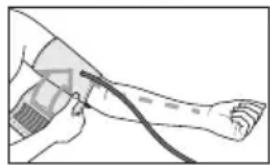
natural_image
Illustration of a medical procedure on human leg, showing a catheter and tube placement (no text or symbols)natural_image
Illustration of a hand holding a medical device with a curved cable (no text or symbols)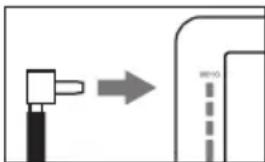
natural_image
Pure diagram of a mechanical or electrical component with an arrow indicating direction, no text or symbols present.natural_image
Side profile illustration of a person sitting at a desk using a computer (no text or symbols visible)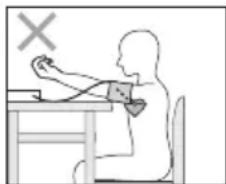
natural_image
Illustration of a person sitting at a desk using a pressure monitor (no text or symbols present)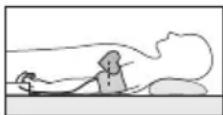
natural_image
Illustration of a wristwatch with a bandage and wrist, no text or symbols present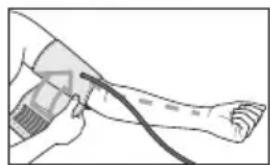
natural_image
Illustration of a human leg with a medical device attached, showing blood pressure application (no text or symbols)natural_image
Illustration of a hand holding a medical device with a circular component (no text or symbols)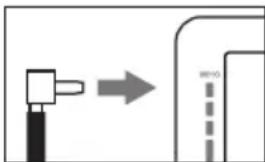
natural_image
Pure diagram of a mechanical or electrical component with an arrow indicating direction, no text or symbols present.natural_image
Side profile illustration of a person sitting at a desk using a computer (no text or symbols visible)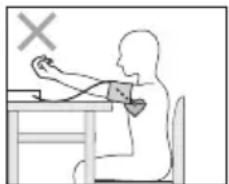
natural_image
Illustration of a person sitting at a desk using a pressure monitor (no text or symbols present)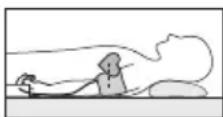
natural_image
Illustration of a wristwatch with a bandage and wrist, no text or symbols present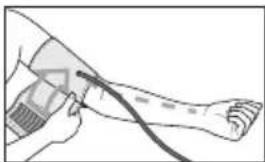
natural_image
Illustration of a person's leg with a medical device and cord, no text or symbols presentnatural_image
Side-view line drawing of a person sitting at a desk using a computer (no text or symbols)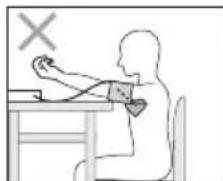
natural_image
Illustration of a person sitting at a desk using a pressure monitor (no text or symbols present)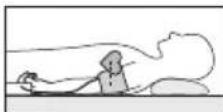
natural_image
Illustration of a hand holding a medical or surgical device with tubing (no text or symbols visible)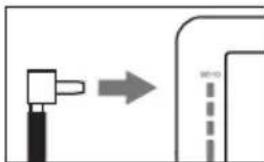
natural_image
Pure diagram of a mechanical or electrical component with an arrow indicating direction, no text or symbols present.Guidance and manufacture's declaration – electromagnetic emissions – for all EQUIPMENT and SYSTEMS
| Guidance and manufacture's declaration – electromagnetic emission | ||
| The SBM38 blood pressure monitor is intended for use in the electromagnetic environment specified below. The customer of the user of the SBM38 blood pressure monitor should assure that it is used in such and environment. | ||
| Emission test | Compliance | Electromagnetic environment – guidance |
| RF emissions CISPR 11 | Group 1 The | SBM38 blood pressure monitor uses RF energy only for its internal function. Therefore, its RF emissions are very low and are not likely to cause any interference in nearby electronic equipment. |
| RF emission CISPR 11 Class B | The SBM38 blood pressure monitor is suitable for use in all establishments, including domestic establishments and those directly connected to the public low-voltage power supply network that supplies buildings used for domestic purposes. | |
Guidance and manufacture's declaration – electromagnetic immunity – for all EQUIPMENT and SYSTEMS
| Guidance and manufacture's declaration – electromagnetic immunity | |||
| The SBM38 blood pressure monitor is intended for use in the electromagnetic environment specified below. The customer or the user of the SBM38 blood pressure monitor should assure that it is used in such an environment. | |||
| Immunity test IEC 60601 | test level | Compliance level | Electromagnetic environment – guidance |
| Electrostatic discharge (ESD)IEC 61000-4-2 | ± 6 kV contact ± 8 kV air | ± 6 kV contact ± 8 kV air | Floors should be wood, concrete or ceramic tile. If floor are covered with synthetic material, the relative humidity should be at least 30%. |
| Power frequency (50Hz)magnetic fieldIEC 61000-4-8 | 3 A/m 3 A/m | Power frequency magnetic fields should be at levels characteristic of a typical location in a typical commercial or hospital environment. | |
Guidance and manufacture's declaration – electromagnetic immunity – for EQUIPMENT and SYSTEMS that are not LIFE-SUPPORTING
| Guidance and manufacture's declaration – electromagnetic immunity | |||
| The SBM38 blood pressure monitor is intended for use in the electromagnetic environment specified below. The customer or the user of the SBM38 blood pressure monitor should assure that it is used in such an environment. | |||
| Immunity test | EC 60601 test level | Compliance level | Electromagnetic environment – guidance |
| Conducted RF IEC 61000-4-6 | 3 Vrms150 kHz to 80 MHz | 3 Vrms | Portable and mobile RF communications equipment should be used no closer to any part of the SBM38 blood pressure monitor, including cables, than the recommended separation distance calculated from the equation applicable to the frequency of the transmitter.Recommended separation distance: d = [ 3.5V_1 ] d = [ 3.5E_1 ] to 800 MHz d = [ 7E_1 ] 00 MHz to 2.5 GHzWhere P is the maximum output power rating of the transmitter in watts (W) according to the transmitter manufacturer and d is the recommended separation distance in metres (m).Field strengths from fixed RF transmitters, as determined by an electromagnetic site survey, ^a should be less than the compliance level in each frequency range. ^b Interference may occur in the vicinity of equipment marked with the following symbol: |
| Radiated RF IEC 61000-4-3 | 3 V/m80 MHz to 2.5 GHz | 3 V/m | |
| NOTE 1 At 80 MHz and 800 MHz, the higher frequency range applies.NOTE 2 These guidelines may not apply in all situations. Electromagnetic propagation is affected by absorption and reflection from structures, objects and people. | |||
| ^a Field strengths from fixed transmitters, such as base stations for radio (cellular/cordless) telephones and land mobile radios, amateur radio, AM and FM radio broadcast and TV broadcast cannot be predicted theoretically with accuracy. To assess the electromagnetic environment due to fixed RF transmitters, an electromagnetic site survey should be considered. If the measured field strength in the location in which the SBM38 blood pressure monitor is used exceeds the applicable RF compliance level above, the SBM38 blood pressure monitor should be observed to verify normal operation. If abnormal performance is observed, additional measures may be necessary, such as reorienting or relocating the SBM38 blood pressure monitor. ^b Over the frequency range 150 kHz to 80 MHz, field strengths should be less than 3 V/m. | |||
Recommended separation distances between portable and mobile RF communications equipment and the EQUIPMENT or SYSTEM – for EQUIPMENT or SYSTEM that are not LIFE-SUPPORTING
| Recommended separation distances between portable and mobile RF communications equipment and the SBM38 blood pressure monitor | |||
| The SBM38 blood pressure monitor is intended for use in an electromagnetic environment in which radiated RF disturbances are controlled. The customer or the user of the SBM38 blood pressure monitor can help prevent electromagnetic interference by maintaining a minimum distance between portable and mobile RF communications equipment (transmitters) and the SBM38 blood pressure monitor as recommended below, according to the maximum output power of the communications equipment. | |||
| Rated maximum output power of transmitter (W) | Separation distance according to frequency of transmitter (m) | ||
| 150 kHz to 80 MHz d = [ 3.5V_1 ] | 80 MHz to 800 MHz d = [ 3.5E_1 ] | 800 MHz to 2.5 GHz d = [ 7E_1 ] | |
| 0.01 0.117 0.117 0.234 | |||
| 0.1 0.370 0.370 0.740 | |||
| 1 1.170 1.170 2.340 | |||
| 10 3.700 3.700 7.400 | |||
| 100 11.7 11.7 | 23.4 | ||
| For transmitters rated at a maximum output power not listed above, the recommended separation distance d in metres (m) can be estimated using the equation applicable to the frequency of the transmitter, where P is the maximum output power rating of the transmitter in watts (W) according to the transmitter manufacturer.NOTE 1 At 80 MHz and 800 MHz, the separation distance for the higher frequency range applies.NOTE 2 These guidelines may not apply in all situations. Electromagnetic propagation is affected by absorption and reflection from structures, objects and people. | |||

- Getting to know your instrument
- Important notes
- Signs and symbols
- Notes on use
- Instructions for storage and maintenance
- Notes on batteries
- Notes on batteries and disposal
- Information on the display:
- Preparing for the measurement
- Inserting the batteries
- Setting the date and time
- Measuring blood pressure
- Attaching the cuff
- Adopting the correct posture
- Performing the blood pressure measurement
- Evaluating results
- Cardiac arrhythmia:
- WHO classification:
- Saving, displaying and deleting measurements
- Cleaning and storing the unit
- Error message/troubleshooting
- Technical specifications
- FRANÇAIS
- Recommended separation distances between portable and mobile RF communications equipment and the EQUIPMENT or SYSTEM – for EQUIPMENT or SYSTEM that are not LIFE-SUPPORTING
Brand : SANITAS
Model : SBM 38
Category : Blood pressure monitor