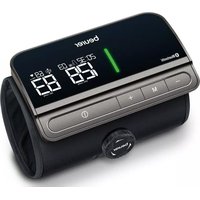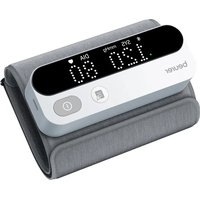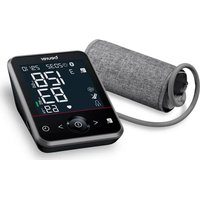
BC 40 - Blood pressure monitor BEURER - Free user manual and instructions
Find the device manual for free BC 40 BEURER in PDF.


Frequently Asked Questions - BC 40 BEURER
User questions about BC 40 BEURER
0 question about this device. Answer the ones you know or ask your own.
Ask a new question about this device
Download the instructions for your Blood pressure monitor in PDF format for free! Find your manual BC 40 - BEURER and take your electronic device back in hand. On this page are published all the documents necessary for the use of your device. BC 40 by BEURER.
USER MANUAL BC 40 BEURER
Quelle: WHO, 1999 (World Health Organization)
- Getting to know your device 17
- Important notes 18
- Unit description 22
4.Preparing the measurement 22 - Measuring blood pressure 24
6.Evaluating results 25
Included in delivery:
Blood pressure monitor with cuff
2 x 1.5 V LR03 AAA batteries
Storage box
Instructions for use
Dear customer,
thank you for choosing a product from our range. Our name stands for high-quality, thoroughly tested products for applications in the areas of heat, weight, blood pressure, body temperature, pulse, gentle therapy, massage, beauty and air. Please read these instructions for use carefully and keep them for later use, be sure to make them accessible to other users and observe the information they contain.
- Saving, displaying and deleting measurements 26
- Error messages/troubleshooting 27
- Cleaning and storing the device and cuff 28
- Technical specifications 28
- Warranty/service 29
With kind regards,
Your Beurer team
1. Getting to know your device
Check that the device packaging has not been tampered with and make sure that all contents are present. Before use, ensure that there is no visible damage to the device or accessories and that all packaging material has been removed. If you have any doubts, do not use the device and contact your retailer or the specified Customer Services address.
The wrist blood pressure monitor is used for non-invasive measurement and monitoring of adults' arterial blood pressure.
This allows you to quickly and easily measure your blood pressure and to display the last recorded measurement. A warning is issued for anyone suffering from cardiac arrhythmia.
The recorded values are classified and evaluated graphically. Store these instructions for use for future reference and make them accessible to other users.
2. Important notes

Signs and symbols
The following symbols are used in these instructions for use, on the packaging and on the type plate for the device and the accessories:
| Attention | |
| Note Note on important information | |
| Observe the instructions for use | |
| Application part, type BF |
| Direct current | |
| Disposal in accordance with the Waste Electrical and Electronic Equipment EC Directive - WEEE | |
| 21 PAP | Disposition of packaging in an environmentally friendly manner |
| Manufacturer | |
| Storage / Transport | Permissible storage and transport temperature and humidity |
| Operating | Permissible operating temperature and humidity |
| IP22 | Protection against harmful ingress of water and dust. Protected against foreign objects equal to or greater than 12.5 mm in diameter and against drops of water falling at up to 15° from vertical |
| SN | Serial number |
| CE0483 | The CE labelling certifies that the product complies with the essential requirements of Directive 93/42/EEC on medical products. |
| EAC | Certification symbol for products that are exported to the Russian Federation and members of the CIS |

Notes on use
- In order to ensure comparable values, always measure your blood pressure at the same time of day.
- Before every measurement, relax for about five minutes.
- If you want to perform several measurements on the same person, wait five minutes between each measurement.
- Do not take a measurement within 30 minutes of eating, drinking, smoking or exercising.
- Repeat the measurement if you are unsure of the measured value.
- The measurements taken by you are for your information only - they are no substitute for a medical examination. Discuss the measurements with your doctor and never base any medical decisions on them (e.g. medicines and their administration).
- Using the blood pressure monitor outside your home environment or whilst on the move (e.g. whilst travelling
in a car, ambulance or helicopter, or whilst undertaking physical activity such as playing sport) can influence the measurement accuracy and cause incorrect measurements.
- Do not use the blood pressure monitor on newborns or patients with pre-eclampsia. We recommend consulting a doctor before using the blood pressure monitor during pregnancy.
- In the case of restricted circulation on the arm as a result of chronic or acute vascular diseases (including vascular constriction), the accuracy of the wrist measurement is limited. In this case you should avoid using an upper arm blood pressure monitor.
- Cardiovascular diseases may lead to incorrect measurements or have a detrimental effect on measurement accuracy. The same also applies to very low blood pressure, diabetes, circulatory disorders and arrhythmias as well as chills or shaking.
- The blood pressure monitor must not be used in connection with a high-frequency surgical unit.
- Only use the unit on people who have the specified wrist measurement for the device.
-
Please note that when inflating, the functions of the limb in question may be impaired.
-
During the blood pressure measurement, the blood circulation must not be stopped for an unnecessarily long time. If the device malfunctions remove the cuff from the arm.
- Do not allow sustained pressure in the cuff or frequent measurements. The resulting restriction of the blood flow may cause injury.
- Make sure that the cuff is not placed on an arm in which the arteries or veins are undergoing medical treatment, e.g. intravascular access or intravascular or therapy, or an arteriovenous (AV) shunt.
- Do not use the cuff on people who have undergone a mastectomy.
- Do not place the cuff over wounds as this may cause further injury.
- The blood pressure monitor can only be operated with batteries.
- To conserve the batteries, the blood pressure monitor switches off automatically if you do not press any buttons for 3 minutes.
- The device is only intended for the purpose described in these instructions for use. The manufacturer is not liable for damage resulting from improper or careless use.
Instructions for storage and maintenance
-
The blood pressure monitor is made from precision and electronic components. The accuracy of the measurements and service life of the device depend on its careful handling:
-
Protect the device from impacts, humidity, dirt, marked temperature fluctuations and direct sunlight.
- Do not drop the device.
- Do not use the device in the vicinity of strong electromagnetic fields and keep it away from radio systems or mobile telephones.
-
Only use the cuff included with the delivery or original replacement parts. Otherwise incorrect measurements will be recorded.
-
Do not press the buttons before the cuff is placed on the arm.
- We recommend that the batteries be removed if the device will not be used for a prolonged period of time.
Notes on handling batteries
If your skin or eyes come into contact with battery fluid, flush out the affected areas with water and seek medical assistance.
- Choking hazard! Small children may swallow and choke on batteries. Store the batteries out of the reach of small children.
- Observe the plus (+) and minus (-) polarity signs.
- If a battery has leaked, put on protective gloves and clean the battery compartment with a dry cloth.
- Protect the batteries from excessive heat.
Risk of explosion! Never throw batteries into a fire.
- Do not charge or short-circuit batteries.
- If the device is not to be used for a long period, take the batteries out of the battery compartment.
- Use identical or equivalent battery types only.
Always replace all batteries at the same time. - Do not use rechargeable batteries.
- Do not disassemble, split or crush the batteries.
i Instructions for repairs and disposal
- Batteries do not belong in household waste. Please dispose of empty batteries at the collection points intended for this purpose.
- Do not open the device. Failure to comply will invalidate the warranty.
-
Do not repair or adjust the device yourself. Proper operation can no longer be guaranteed in this case.
-
Repairs must only be carried out by Customer Services or authorised suppliers. Before making a claim, please check the batteries first and replace them if necessary.
- For environmental reasons, do not dispose of the device in the household waste at the end of its useful life.
Dispose of the device at a suitable local collector or recycling point. Dispose of the device in
accordance with EC Directive - WEEE (Waste Electrical and Electronic Equipment). If you have any questions, please contact the local authorities responsible for waste disposal.
Notes on electromagnetic compatibility
- The device is suitable for use in all environments listed in these instructions for use, including domestic environments.
- The use of the device may be limited in the presence of electromagnetic disturbances. This could result in issues such as error messages or the failure of the display/ device.
-
Avoid using this device directly next to other devices or stacked on top of other devices, as this could lead to faulty operation. If, however, it is necessary to use the device in the manner stated, this device as well as the other devices must be monitored to ensure they are working properly.
-
The use of accessories other than those specified or provided by the manufacturer of this device can lead to an increase in electromagnetic emissions or a decrease in the device's electromagnetic immunity; this can result in faulty operation.
- Failure to comply with the above can impair the performance of the device.
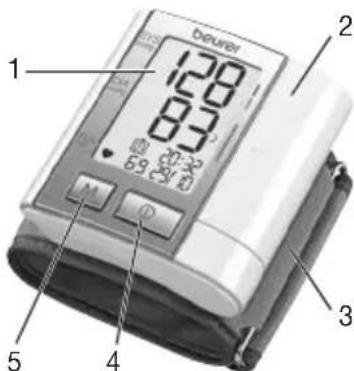
3. Unit description
- Display
- Battery compartment lid
- Wrist cuff
- START/STOP button①
- Memory button M
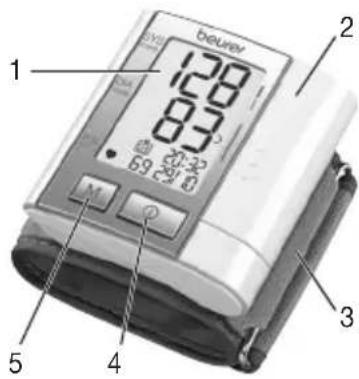
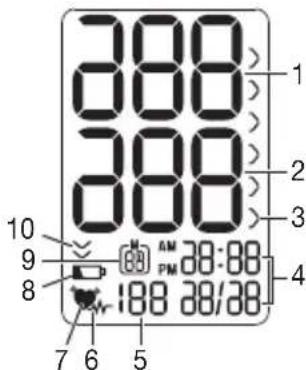
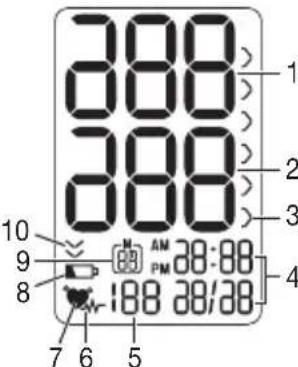
Information on the display:
- Systolic pressure
- Diastolic pressure
- Risk indicator
- Time and date
- Calculated pulse value
6.Cardiac arrhythmia symbol - Pulse symbol
- Battery replacement symbol
- Memory space number/ 7 memory display average value (R), morning (Rf), evening (Pf)
- Release air (arrow)
4.Preparing the measurement Insert the batteries
- Remove the battery compartment lid on the right side of the device.
- Insert two 1.5 V micro (alkaline type LR03) batteries. Make sure that the batteries are inserted the correct way round. Do not use rechargeable batteries.
- Close the battery compartment lid again carefully.
If the battery replacement symbol is displayed, you can no longer perform any measurements and must replace all batteries.

Battery disposal
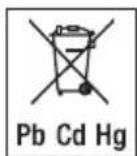
- The empty, completely flat batteries must be disposed of through specially designated collection boxes, recycling points or electronics retailers. You are legally required to dispose of the batteries.
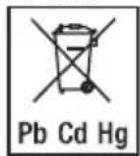
The codes below are printed on batteries containing harmful substances: Pb = Battery contains lead, Cd = Battery contains cadmium, Hg = Battery contains mercury
Setting the hour format, date and time
This menu allows you to set the following functions, one after another.
Hour format Date Time
It is essential to set the date and time. Otherwise, you will not be able to save your measurements correctly with a date and time and access them again later.
If you press and hold the memory button M you can set the values more quickly.
To access the settings mode, either reinsert the batteries or press and hold the START/STOP button for 5 seconds when the device is switched off.
Hour format
- Select the desired hour format using the memory button M and confirm with the START/STOP button ①
24 n 12n
Date
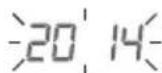
The year flashes on the display.
- Select the desired year using the memory button M and confirm with the START/ STOP button ①
20 14
The month flashes on the display.
- Select the desired month using the memory button M and confirm with the START/STOP button ①
1
The day flashes on the display.
- Select the desired day using the memory button M and confirm with the START/STOP button ①
If the hour format is set as 12h, the day/month display is reversed.
Time
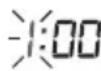
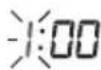
The hours flash on the display.
- Select the desired hour using the memory button M and confirm with the START/STOP button ①
The minutes flash on the display. - Select the desired minute using the memory button M and confirm with the START/STOP button ①
Once all the data has been set, the device switches off automatically.
5. Measuring blood pressure
Ensure the device is at room temperature before measuring. The measurement can be performed on the left or right wrist.
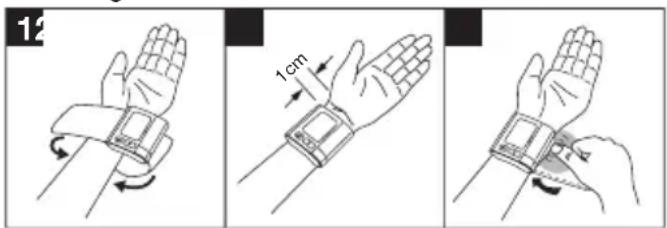
Attaching the cuff
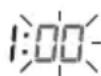
- Expose your wrist. Ensure that the circulation of the arm is not hindered by tight clothing or similar. Place the cuff on the inside of your wrist.
- Fasten the cuff with the hook and loop fastener so that the upper edge of the monitor is positioned approx. 1 cm below the ball of your thumb.
- The cuff must be fitted tightly around the wrist, but must not constrict.
Blood pressure may vary between the right and left wrist, which may mean that the measured blood pressure values are different. Always perform the measurement on the same wrist. If the values between the two wrists are significantly different, please consult your doctor to determine which wrist should be used for the measurement.
Important: The unit may only be operated with the original cuff.
Adopt the correct posture
Before every measurement, relax for about five minutes. Otherwise deviations can occur.
- You can take the measurement while sitting or lying. To take your blood pressure, make sure you are sitting comfortably with your arms and back leaning on something. Do not cross your legs. Place your feet flat on the
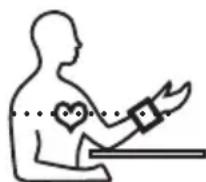
ground. Make sure to rest your arm and move it. Always make sure that the cuff is at heart level. Otherwise significant deviations can occur. Relax your arm and the palm of your hand.
- To avoid falsifying the measurement, it is important to remain still during the measurement and not to speak.
- Let your hand and wrist relax or form a loose fist. Keep your hand and wrist in the same position throughout the measurement process.
Performing the blood pressure measurement
- Start the blood pressure monitor with the button ①.
- All displays will illuminate briefly.
- The blood pressure monitor will begin the measurement automatically after 3 seconds. The measurement is taken during the inflation phase.
- As soon as a pulse is found, the pulse symbol is displayed.
- The systolic pressure, diastolic pressure and pulse rate measurements are displayed.
Measuring can be cancelled at any time by pressing the button.
- EE appears if the measurement has not been performed properly.
-
Observe the chapter on error messages/troubleshooting in these instructions for use and repeat the measurement.
-
The measurement is automatically stored.
6. Evaluating results
Cardiac arrhythmia:
This device can identify potential disruptions of the heart rhythm when measuring and if necessary, indicates this after the measurement with the symbol
This can be an indicator for arrhythmia. Arrhythmia is an illness in which the heart rhythm is abnormal because of flaws in the bioelectrical system that regulates the heartbeat. The symptoms (skipped or premature heart beats, pulse being slow or too fast) can be caused by factors such as heart disease, age, physical make-up, excess stimulants, stress or lack of sleep. Arrhythmia can only be determined through an examination by your doctor.
If the symbol is shown on the display after the measurement has been taken, repeat the measurement. Please ensure that you rest for 5 minutes beforehand and do not speak or move during the measurement. If the symbol appears frequently, please consult your doctor. Self-diagnosis and treatment based on the measurements can be dangerous. Always follow your GP's instructions.
Risk indicator:
The measurements can be classified and evaluated in accordance with the following table.
However, these standard values serve only as a general guideline, as the individual blood pressure varies in different people and different age groups etc.
It is important to consult your doctor regularly for advice. Your doctor will tell you your individual values for normal blood pressure as well as the value above which your blood pressure is classified as dangerous.
The classification on the display and the scale on the unit show which category the recorded blood pressure values fall into. If the values of systole and diastole fall into two different categories (e.g. systole in the ,High normal' category and diastole in the ,Normal' category), the graphical classification on the device always shows the higher category; for the example given this would be ,High normal'.
| Blood pressure value category | Systole (in mmHg) | Diastole (in mmHg) | Action |
| Setting 3: severe hypertension | ≥180≥110 | seek medical attention | |
| Setting 2: moderate hypertension | 160–179 | 00–109 | seek medical attention |
| Setting 1: mild hypertension | 140–159 | 0–99 | regular monitoring by doctor |
| High normal 130– | 13985–89 | regular monitoring by doctor |
| Blood pressure value category | Systole (in mmHg) | Diastole (in mmHg) | Action |
| Normal 120–129.8 | 0–84 self-monitoring | ||
| Optimal <120<80 | self-monitoring |
Source: WHO, 1999 (World Health Organization)
7. Saving, displaying and deleting measurements
The results of every successful measurement are stored together with the date and time. If there are more than 60 measurements, the oldest measurements are lost.
- To access the memory recall mode, press the memory button M.
Your last measurement will appear on the display.
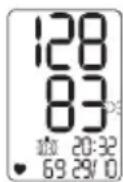
Displaying average values
- Press the memory button M.
R flashes on the display.
The average value of all saved measurements is displayed.
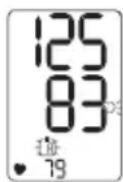
- Press the memory button M.
Rn flashes on the display.
The average value of the morning measurements for the last 7 days is displayed (morning: 5.00 a.m. - 9.00 a.m.). - Press the memory button M.
Fl flashes on the display.
The average value of the evening measurements for the last 7 days is displayed (evening: 6.00 p.m. - 8.00 p.m.).
Displaying individual measurements
- When the memory button M is pressed again, the last individual measurement is displayed.
- When the memory button M is pressed again, you can view your individual measurements.
- To switch the device off again, press the START/STOP button①
You can exit the menu at any time by pressing the START/STOP button
Deleting measurements
Deleting individual measurements
- Start individual measurement access.
- Press and hold the memory button M for approx. 5 seconds. The relevant measurement is deleted.
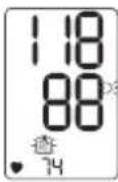
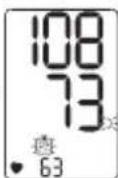
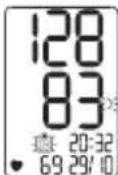
- The display starts to flash, then an empty display with empty user memory frame is displayed. Press the memory button M to delete additional values or press the START/STOP button switch off the device.
Deleting all measurements
- Start access to average value of all saved measurements by pressing the memory button M twice.
- Press and hold the memory button M for approx. 5 seconds. All measurements are deleted.
- The display starts to flash, then an empty display with empty user memory frame is displayed. Press the memory button M to delete additional values or press the START/STOP button switch off the device.
8. Error messages/troubleshooting
In the event of errors, the error message EE appears on the display.
Error messages may appear if:
- you move or speak during the measurement (EE appears on the display)
- the cuff is placed on the arm too tightly or loosely or if the cuff is damaged (EE appears on the display)
the pump pressure is higher than 290mmHg (B appears on the display)
the batteries are almost worn out and
In such cases, repeat the measurement. Ensure that you do not move or speak during the measurement. If necessary, reinsert or replace the batteries.
9. Cleaning and storing the device and cuff
- Clean the device and cuff carefully using a slightly damp cloth only.
- Do not use any cleaning agents or solvents.
- Under no circumstances hold the device and cuff under water, as this can cause liquid to enter and damage the device and cuff.
- If you store the device and cuff, do not place heavy objects on the device and cuff. Remove the batteries.
10. Technical specifications
Model no. BC 40
| Measurement method | Oscillometric, non-invasive blood pressure measurement on the wrist |
| Measurement range | Cuff pressure 0 – 290 mmHg,Systolic 50 – 250 mmHg,Diastolic 40 –180 mmHg,Pulse 40 – 180 beats/minute |
| Display accuracy | Systolic ±3 mmHg, diastolic ±3 mmHg, pulse ±5 % of the value shown |
| Measurement inaccuracy | Max. permissible standard deviation according to clinical testing: systolic 8 mmHg/ diastolic 8 mmHg |
| Memory 60 memory spaces | |
| Dimensions | L 76 mm x W 70 mm x H 23 mm |
| Weight Approximately 105 g (without batteries, with cuff) | |
| Cuff size 12.5 to 21.5 cm | |
| Permissible operating conditions | + 10 °C to + 40 °C, ≤ 85 % relative humidity (non-condensing) |
| Permissible storage conditions | - 5°C to + 50 °C, ≤ 85 % relative humidity, 800-1060 hPa ambient pressure |
| Power supply | 2 x 1.5V AAA batteries |
| Battery life For approx. 300 measurements, depending on levels of blood pressure and pump pressure | |
| Classification Internal supply, continuous operation, application part type BF, IP22, no AP or APG | |
The serial number is located on the device or in the battery compartment. Technical information is subject to change without notification to allow for updates.
- This device is in line with European Standard EN 60601-1-2 (In accordance with CISPR 11, IEC 61000-4-2, IEC 61000-4-3 and IEC 61000-4-8) and is subject to particular precautions with regard to electromagnetic compatibility (EMC). Please note that portable and mobile HF communication systems may interfere with this unit.
- This device corresponds to the EU Medical Devices Directive 93/42/EEC, the German Medical Devices Act (Medizinproduktgesetz) and the standards EN 1060-1 (non-invasive sphygmomanometers, Part 1: General requirements), EN 1060-3 (non-invasive sphygmomanometers, Part3: Supplementary requirements for electro-mechanical blood pressure measuring systems) and IEC80601-2-30 (Medical electrical equipment - Part 2 - 30: Particular requirements for the basic safety and essential performance of automated non-invasive sphygmomanometers).
- The accuracy of this blood pressure monitor has been carefully checked and developed with regard to a long useful life. If using the device for commercial medical purposes, it must be regularly tested for accuracy by appropriate means. Precise instructions for checking accuracy may be requested from the service address.
11.Warranty/service
In case of a claim under the warranty please contact your local dealer or the local representation which is mentioned in the list "service international".
In case of returning the unit please add a copy of your receipt and a short report of the defect.
The following warranty terms shall apply:
- The warranty period for BEURER products is either 5 years or- if longer- the country specific warranty period from date of Purchase.
In case of a warranty claim, the date of purchase has to be proven by means of the sales receipt or invoice. - Repairs (complete unit or parts of the unit) do not extend the warranty period.
-
The warranty shall not be valid for damages because of a. improper treatment, e.g. nonobservation of the user instructions.
b. repairs or tampering by the customer or unauthorised third parties.
c. transport from the manufacturer to the consumer or during transport to the service centre.
d. The warranty shall not be valid for accessories which are subject to normal wear and tear (cuff, batteries etc.). -
Liability for direct or indirect consequential losses caused by the unit are excluded even if the damage to the unit is accepted as a warranty claim.
FRANÇAIS
Sommaire
Chere cliente, cher client,
2. Consels important

Symboles utilisés
Source: WHO, 1999 (World Health Organization)
Fuente: WHO, 1999 (World Health Organization)
Fonte: WHO, 1999 (World Health Organization)
Kaynak: WHO, 1999 (World Health Organization)
Onachocb B3pbIb! He 6pocaTe 6aTapeiKn BV b.
He 3apjaTe n He 3ambkaTe 6aTapeKn HAKOPOTko.
- Ecni npnbop dInTeNbHoe BpeMa He nCnOJIb3yeTcra, n3BJIeKInTe n3 Hero 6aTaapeKn.
- IcnoIb3yIte 6aTapeKu TOnbKO OndHoro Tnna nn paBHOeHHbIX TINOB.
3aMeHnTe Bce 6aTapeKn cpa3y.
He nCnoJb3yIte nepe3apjXaembIe aKkyMylTOpbl!
- He pa36bpaaiTe, He oTKpbIbaiTe n He pa36buaTe 6aTaapeiKn.
Uka3aHnnopeMOHTyUYtIN3aun
He BbI6paBbAaTe NcNoJIb3OBAHbIe 6aTapeKn B 6bITOBoMycOp. YtJIN3NpyTe NcNoJIb3OBAHbIe 6aTapeKn B IpeDyCMOTpeHHbIX dIg 3TOI pyHKTax c6opa.
- He pa3bupaIte npnbop. HecobJeHne 3Toro Tpe6oBaHnB BeDeT K nOtepe rapaHTn.
HnBkoem cnyae He peMOHTnpyTe nHe peryInpyTe np6op camocToTebHo. B npotNBHom cnyae naexHoCTb pa60tbl np6opa 6oJIbWe He rapaHTnpyeTc.
PemOHbIe pa60TbIOJXHbI npOu3BOUHTbCToTbKO cepBnCHo CnyK6oN uIN aBTOpN3OBaHHbIMN TOPROBIMnpedCTaBtJIaM. Ipeep npeBraJIeHHeM npTeH3nIpOBepBe Tn pIn Heo6xOdMocTn 3aMeHnte 6aTapeiKn.
B INTEpecax 3auntbI OKpykaIOUeI cpebl no OKOHuaHn Cpoka Cnyk6bl CneJeYtynImnoBaT np6op OTdJIbHOOTbTOBOrO Mycopa.
yTnIN3aunIdoJnxHa npOn3BODntbCryepe3 COOTBeTCTByIOune nyHKtbi c6opabBaWei Ctpane. Pnp6op cJeNyET yTnIN3npoBaTb corlacho DnpeKTnBE EC no OTxOam 3JIeKTPnueckoro n 3JIeKTPoHnOro o6OpdyoBaHn - WEEE (Waste Electrical and Electronic Equipment). Pnp noRbneHH BONpocOB o6paauTeCb B MeCTHyIO KOMMyHaJIbHyIO CnyX6y, OTBETCTBeHHyIO 3a yTnIN3aunIO OTxOoB.
Yka3aHnno 3neKtpomarHHTHO COBmecTmOCTN
- Pnp6op npedna3nueH dpaaboBtbyycnoBnax, npeuNCJIeHHbIX B HactoJeu INCTpyKcNl N0 npImMeHeHIO,B TOM YNCJIe B DOMaHnx ycNoBnX.
- Pn haJIuHm 3JIeKTPomarHHTbIX NOMex BO3MOxHOCTN
NCNoJIb3OBAHnI np6opa MOryT 6bITb ORpaHnueHb.I. B
pe3yJIbTaTe, HApPIMep, MOryT NOBnTbC4 COo6UeHnI
OB OwH6kax NII pOn3OuDet BBIXoD n3 CTrpo DnCnpe/
camoro np6opa.
He nCnoIb3yIte daHHbI np6Op pIOM c DpyrIMn yCTpoIcTBAMN I He yCTaHaBnBaIe erO Ha dpyrne np6Opbl, 3TO MOKeT Bbl3BaTb OUn6Kn B pa6Ote. Ondako, ecnncnoJIb3OBAHne np6opba BCE-TaKn Heo6xOIMMO B TOM BnDE, KaK ONuCAHO BblEe, CNeDyET Ha6JIOJaTb 3a HmN I DpyrIMn yCTpoIcTBAMN, YTo6bl y6eITbcra, YTO OHn pa60aIoT HndJeXkaUIM Mcbpa3Om. - PpIMHeHHe CToPOHHx PpHaJNeXKHOCTe, OTnuaOuXcROT PpNlaFemO K DaHOMy Pnp6OpY, MOKeT PpNBecTn K POCTy 3JIeKTpOMaHTbIX NOMEx IIN OcIa6JIeHIO NOMexOyCTOnuBOCTn Pnp6Opa N TeM CAMbIM Bbl3BaTb OUn6Kn Bpa6Te.
- HecobioeHne daHHoro yka3aHn MOKeT OTpucaTeNbHO cka3aTbCra Ha xapaKTePncTikax MoUHocT np6opa.
3.Опсане пибopa
1.Диспел
2.Kpbuika OTeJeHnna 6atapeek
3. MaXkeTa Ha 3aIЯCTbe
4. Khonka BKN./BblKJ.①
5. Khonka coxpaheHHa M
Hdkaunha ducnnee:
1.CucToJIuueckoe daBneHne
2.ДиactoJIuYeCKoe daBHeHne
3.ИнданkaTop рисka
4. Bpemn n data
5.ИЗмeperнhoe 3haueHne nylbca
6.CmBoJ HApUeHn cepJeHoro PutMa
7.CmBOn npynba
8.CMBOJ Heo6xOIMOCTN 3aMeHbI 6aTapeeK
9.Homep yueken namrN/HHnKauncpeHero 3naeHnI3 COxpaHeHHbIX B nAMrN (R),yTpOM (R),Beepom (P)
10. Bbinyck Bo3dyxa (CTpeJka)
4.ПодгOTOBКИЗМершю
YcTaHOBKa 6aTapeKn
QHIMTe KpbIiKy OToJeHnI dJa 6aTaapeek c npaBoi CTOpOnbI npi6opa.
BCTaBbTe DBe aIkaJIINHObIe 6aTapeKu 1,5 B Micro (TIN LR 03).O63aTeNbHO npocneIte 3a TeM, YTO6bI 6aTapeKn 6bln yCTaHOBHeHbC npabUNbHOJ NOJpHOcTBIO B COOTBeTcBm C MapKupOBko. He nCNoJIb3yIte 3apJaKaEMbIe aKKMyJrTopbl.
TataelbHO 3akpoTe KpbuWky OtdeneHn Ira 6aTaapeek.
Ipi OTo6paXeHn CmB0Ja 3aMeHbI 6aTapeek PBeHeNe N3MepeHn HeBO3MOxHO, CJIeNyET 3aMeHHTb BCE 6aTapeEKn.

Ytun3aun6aTapeek
BbI6paCbIbAaTe NcNoJIb3OBAHbIE, NOHOCbIO pa3pJxHeHbIe 6aTapeKn B CneUaJIbHbIE KOHTeHepbl, cdaBaITe B NyKtBI pInema CNEQOTXoOB UIN B MaRa3INbI 3NeKTpOo6OpyDObaHnra. 3aKOH O8a3bIbAE T NOb3ObaTeNei ObecneuTb yTuIN3aUHIO 6aTapeek.
Cneyuouine 3HaKn npedynpexkaIOT o haJIuHIN B6ata
peiKax TOKCnHbIX BeLcECTB:
Pb = CBUNHeU,
Cd = a_Mn
Hg = pTytb.
HactpoKa yacoboro fopmata, BpeMeHn daTbI
B 3TOM MeHIO MOxHO NocJeIOBaTeIbHO HaCTpOITb CJIeNyIOUne FyHKUIN.
C NOMOUBKONKOCXpAHN M BbIepeH Te HyxHOE KOJIueCTBO YacOB INoTBePnTe BbIOp HaxKaTNEM KONK BNJI./BblKI. ①
Ha nncnlee 3amrraeT INHnkaun MmhyT.


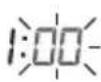
C NOMOJIbIO KHOKN COXpAHENI M Bbl6epNTe HxKHOe YNCJIO MNHT I NOITBepNTe Bbl6Op HaKaTNEM KHOKN BKJ./BblKJI. ①
Iocne ycTaHOBKn BceX daHHbIX npu6op aBTOMaTnueckN OTKJIIOHTCra.
Zródio: WHO, 1999 (World Health Organization)