BM 70 - Blood pressure monitor BEURER - Free user manual and instructions
Find the device manual for free BM 70 BEURER in PDF.


Frequently Asked Questions - BM 70 BEURER
User questions about BM 70 BEURER
0 question about this device. Answer the ones you know or ask your own.
Ask a new question about this device
Download the instructions for your Blood pressure monitor in PDF format for free! Find your manual BM 70 - BEURER and take your electronic device back in hand. On this page are published all the documents necessary for the use of your device. BM 70 by BEURER.
USER MANUAL BM 70 BEURER
text_image
Medical diagram showing a blood pressure monitor with labeled components and digital display screennatural_image
Two views of a device showing internal components with no visible text or symbolsnatural_image
Illustration of a person receiving a medical or therapeutic procedure on a leg, with no visible text or symbols.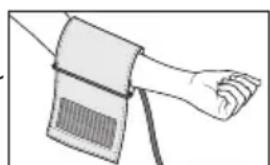
natural_image
Illustration of a wristwatch with a bandage and wrist, no text or symbols present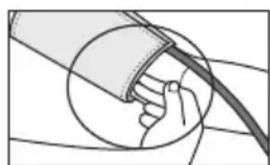
natural_image
Illustration of a hand holding a medical device with a curved tube (no text or symbols)natural_image
Diagram showing a vertical component with an arrow pointing to a curved structure (no text or symbols)text_image
Medical illustration showing three different positions of a human arm and neck position, with annotations indicating correct and incorrect states.Thank you for choosing one of our products. Our name stands for high-quality, thoroughly tested products for the applications in the areas of heat, weight, blood pressure, body temperature, pulse, gentle therapy, massage and air.
Please read these instructions for use carefully and keep them for later use, be sure to make them accessible to other users and observe the information they contain.
Best regards,
Your Beurer Team
1. Getting to know your instrument
The upper arm blood pressure monitor is used for non-invasive measurement and monitoring of adults' arterial blood pressure. You can use it to measure your blood pressure quickly and easily, storing the results and displaying the progression of readings together with the average.
A warning is issued for anyone suffering from cardiac arrhythmia. The values determined are classified and graphically evaluated according to WHO guidelines.
Additionally, this blood pressure monitor includes a haemodynamic stability indicator, which will subsequently be referred to as a resting indicator. This shows whether the circulatory system is sufficiently at rest when taking a blood pressure measurement and is therefore a more precise indicator of your resting blood pressure. Read more about this on p. 17–18. Keep these instructions carefully for further use and also let other users have access to them.
2. Important information

Advice on use
- Always measure your blood pressure at the same time of day, in order to ensure that values are comparable.
- Relax for approx. 5 minutes before each measurement.
- You should wait five minutes before measuring a second time.
- The readings that you take may only be used for information purposes – they are not a substitute for a medical examination! Discuss your results with the doctor. Never use them to make medical decisions independently (e.g. regarding medication and dosage thereof).
- There may be incorrect measurements where there is cardiocirculatory disease, as well as with very low blood pressure, circulatory disorders, dysrhythmia and other preexisting diseases.
- Only use the instrument on persons whose upper arm has the right circumference for the instrument.
- You can operate the blood pressure monitor with both batteries and mains. Note that it is only possible to save data when your blood pressure monitor is receiving power. As soon as the batteries wear out or you disconnect the mains adapter from the mains, the blood-pressure instrument loses the date and time.
- The automatic switch-off function switches off the blood pressure monitor in order to preserve the batteries, if no button is pressed within one minute.

Storage and Care
- The blood pressure monitor is made up of precision electronic components. Accuracy of readings and the instrument's service life depend on careful handling.
- You should protect the device from impact, moisture, dirt, major temperature fluctuations and direct exposure to the sun's rays.
- Never drop the device.
- Do not use near strong electromagnetic fields, i.e. keep it away from any radio systems and mobile phones.
- Only ever use the cuffs provided with the monitor or original replacement cuffs. Otherwise erroneous results will be recorded.
- Do not press any buttons until the cuff is in position.
- If the instrument is not used for any length of time, we recommend removing the batteries.

Advice on batteries
- Batteries can be fatal if swallowed. You should therefore store the batteries and products where they are inaccessible to small children. If a battery has been swallowed, call a doctor immediately.
- Batteries should not be charged or reactivated with any other means, nor should they be taken apart, thrown in the fire or short-circuited.
- Remove the batteries from the instrument if they are worn out or if you are not going to use the instrument for any
length of time. This prevents any damage as a result of leakage. Always replace all the batteries at the same time.
- Never use different types of battery, battery brands or batteries with different capacities. You should preferably use alkaline batteries.

Repair and disposal
- Batteries do not belong in domestic refuse. Used batteries should be disposed of at the collection points provided.
- Never open the instrument. If these instructions are not heeded, the warranty will be null and void.
- Never attempt to repair the instrument or adjust it yourself. We can no longer guarantee perfect functioning if you do.
- Repairs may only be performed by Beurer Customer Service or authorized dealers. However, always check the batteries and replace them if necessary prior to making any complaint.
- The appliance should be disposed of according to Regulation 2002/96/EC-WEEE (Waste Electrical and Electronic Equipment). In case of queries, please contact the municipal authorities responsible for waste disposal in your area.
3. Unit description
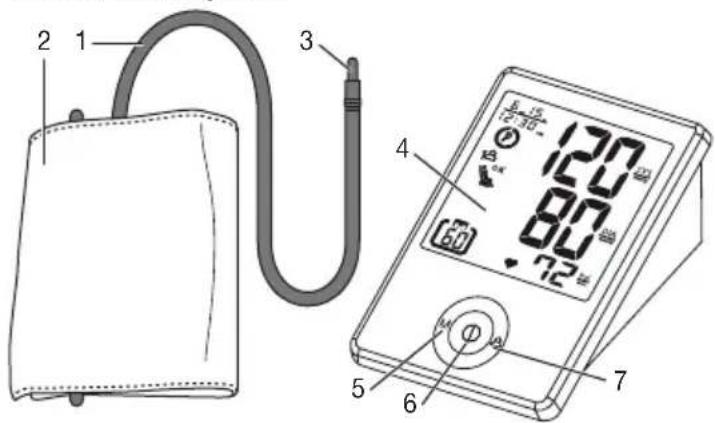
text_image
Medical device diagram showing a blood pressure monitor with labeled components and digital display showing temperature readings.-
Cuff tube
-
Cuff
-
Cuff connector
-
Display
-
Memory button M
-
ON/OFF button ①
-
User selection button 📊
-
Date/time button
-
Adjustment button ⊕
-
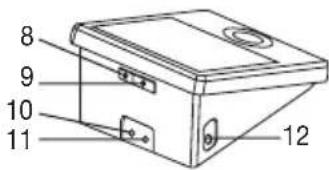
Connector, power supply
-
Data interface
-
Cuff connector port (left side)
text_image
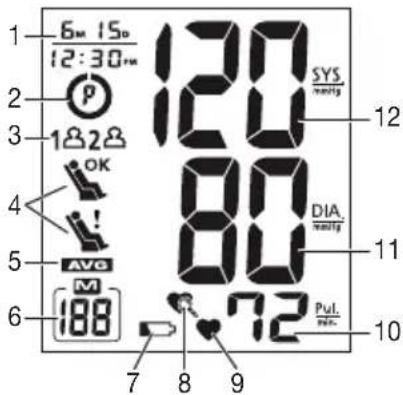
8 9 10 11 12Icons in the display:
-
Date/Time Indicator
-
WHO classification
-
Memory Zones
-
Resting indicator
-
Average value (AVG)
-
Memory Sequence Number
-
Weak Battery Mark

-
Cardiac arrhythmia icon
-
Pulse Marl♥
-
Pulse Rate
-
Diastolic Pressure
-
Systolic Pressure
text_image
6m 15o 12:30pm 120 SYS magg 12 1828 OK AVG 80 DIA magg 11 188 72 Pul. min 10 7 8 94. Prepare measurement Inserting battery
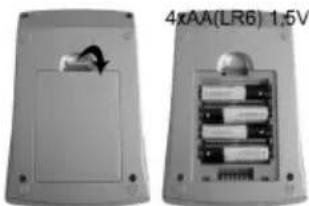
- Remove the battery cover from the back of the monitor.
- Insert four AA 1.5 V alkaline batteries. making absolutely sure that you insert them with the correct polarity as marked. Never use rechargeable batteries.
- Replace the battery cover carefully.
natural_image
Two views of a device casing showing internal components and a labeled component (no text or symbols on the casing itself)If the battery change is continuously illuminated, measurement is no longer possible and you must replace all the batteries. Once batteries have been removed from the device, the time must be reset.
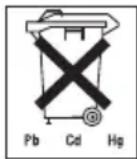
Used batteries do not belong in the household waste. You are legally obliged to dispose of the batteries. Dispose of them via your specialist electrical supplier or local collecting point for recyclable waste.
Note: Batteries containing pollutant substances are marked as follows: Pb = Battery contains lead, Cd = Battery contains cadmium, Hg = Battery contains mercury.
Setting date and time
It is vital to set date and time. Only in this way is it possible to save and subsequently retrieve your measured values with the right date and time.
Press the ⏻ key and ⏱ to adjust the month. Then press the ⏻ and ⏱ in turn to adjust the date, hour, minute and confirm the entry ⏻.
The time is being displayed in 12-hour format, which means a time from 13:00 onwards is being displayed as "01:00 PM".
Mains operation
You can also operate this device with a mains adapter. No batteries should be in the battery compartment for this. The mains adapter is available from retailers or from the service address under order no. 071.29. The blood pressure monitor should only be used with the mains adapters specified here. The mains adapter should only be connected to the mains voltage indicated on the rating plate. Once you have disconnected the device from the mains, the date and time on the blood pressure monitor are lost. Any measurement results that have been stored are however retained.
Software
The device also has a data interface.
The accompanying software including a data cable is available from the stated service address, order number 656.26.
5. Measuring blood pressure
5.1 Positioning cuff
Fit the cuff round your bare left upper arm. Blood circulation in the arm should not be restricted by tight clothing or other objects.
The cuff should be placed on the upper arm so that the lower edge is 2 to 3 cm above the bend of the elbow and above the artery. The tube should be in line with the centre of the palm.
Now place the free end of the cuff snugly, but not too tightly, around the arm, and fix it with the Velcro fastener. The cuff should be fitted tight enough to allow just two fingers to fit beneath the cuff.
Insert the cuff tubing into the socket for the cuff attachment.
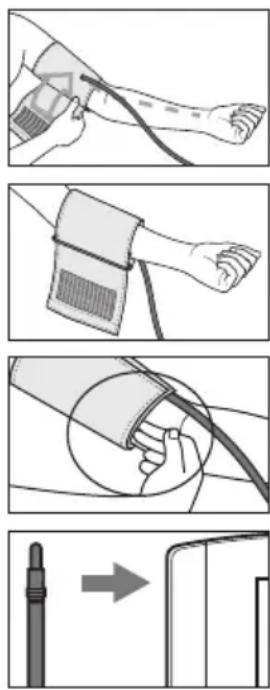
Important: The instrument should only be operated with the original cuff. The cuff is suitable for an arm circumference of 24 to 36 cm. A larger cuff for upper arm circumferences from 34 to 46 cm is available from retailers or the service address under order no. 162.797.
5.2 Correct posture
natural_image
Side-view line drawing of a person sitting at a desk using a medical or health device (no text or symbols visible)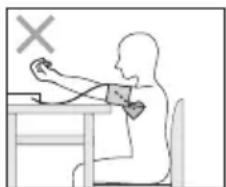
natural_image
Illustration of a person sitting at a desk with a medical device, no text or symbols present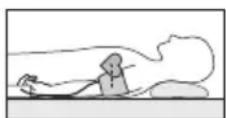
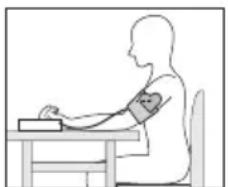
- Rest for approx. 5 minutes before each measurement. Otherwise there may be divergences.
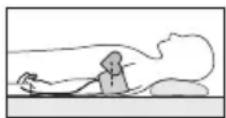
- You can perform the measurement either sitting or lying down. Always make sure that the cuff is on a level with your heart.
- In order not to distort the result, it is important to keep still during the measurement and not talk.
5.3 Select memory
You have two memories (60 memory spaces each) in order to save the test results of 2 different people separately, or else save measurements in the morning and evening separately. Select the required memory space by pressing the user selection button ⚙️. Confirm your selection with the On/Off button ⏻
5.4 Measuring blood pressure
- Put on the cuff as described previously and assume the position in which you want to carry out the measurement.
- Press the "User-Switching key" to select a memory zone, and press the ① key 2x to start measurement in the chosen
memory zone. After checking the display with all digits lighting up, the monitor will automatically inflate. Following the self-test, during which all display elements briefly appear, the measurement begins. During inflation the device already determines measured values used to estimate the required inflation pressure. If this pressure is insufficient, the device automatically inflates by another 40 mmHg (Real Fuzzy Logic).
- Then the pressure in the cuff is slowly released and the pulse is measured.
- It displays pulse, systolic and diastolic blood pressure as well as the stop indicator (see Chapter 5.6).
- You can interrupt measurement at any time by pressing the ON/OFF button ①.
- To switch off and release the pressure, press the ON/OFF button ⓘ again. If you forget to switch off the device, it switches off automatically after approx. 1 minute.
Wait at least 5 minutes before taking another measurement!
5.5 Evaluating results
Cardiac arrhythmia:
This instrument can identify possible cardiac arrhythmia disorders during measurement and if necessary indicates the measurement with the flashing icon
This may be an indicator for arrhythmia. Arrhythmia is a condition where the heart rhythm is abnormal as a result of defects in the bioelectrical system controlling the heart beat. The symptoms (omitted or premature heart beats, slow or excessively fast heart rate) may be caused, among other things, by heart disease, age, physical predisposition, excessive use of stimulants, stress or lack of sleep. Arrhythmia can only be ascertained through examination by your doctor.
Repeat the measurement if the flashing icon 🔒 is displayed after the measurement. Please note that you should rest for 5 minutes between measurements and not talk or move during the measurement. If the icon 🔒 appears often, please contact your doctor. Any self-diagnosis and treatment based on the test results may be dangerous. It is vital to follow your doctor's instructions.
WHO classification:
The World Health Organization (WHO) and National High Blood Pressure Education Program Coordinating Committee have developed a blood pressure standard, according to which areas of low- and high-risk blood pressure are identified. This standard, however, is a general guideline as individual's blood pressure varies among different people and different age groups ... etc. It is important that you consult with your physician regularly. Your physician will tell you your normal blood pressure range as well as the point at which you will be considered at risk.
Table for classification of blood pressure values (unit of measurement mmHg) for adults:
| Range Systolic Diastolic Action | ||
| Hypotonia (degraded blood pressure) lower than 105 lower than 60 Check with doctor | ||
| Normal range between 105 and 120 between 60 and 80 Self check | ||
| Pre-hypertensive blood pressure range* | between 120 and 140 between 80 and 90 Check with doctor | |
| High blood pressure - degree | between 140 and 160 between 90 and 100 Consult your doctor | |
| High blood pressure - degree | higher than 160 higher than 100 | Consult your doctor |
(*) Blood pressure range that might transfer to high blood pressure Adapted from JNC 2003
The WHO classification in the display shows the range of the measured blood pressure.
If the values for systolic and diastolic pressure are in two different WHO ranges (e.g. systolic in the grade Ⓡ hypertension range and diastolic pressure in the normal range), the WHO classification on the unit always indicates the higher range (grade Ⓡ hypertension in the example described).
5.6 Resting indicator measurement (using HSD diagnostics)
The most frequent error made when measuring blood pressure is taking the measurement when not at rest (haemodynamic stability), which means that both the systolic and the diastolic blood pressures are incorrect in this case. During blood pressure measurement, the device automatically determines whether the circulatory system is sufficiently at rest or not. If there is no indication that the circulatory system is not sufficiently at rest, OK (haemodynamic stability) is displayed and
the measurement can be recorded as a reliable resting blood pressure value.

haemodynamic stability
Measurement of the systolic and diastolic pressure is increased when the circulatory system is sufficiently at rest and is a very reliable indicator of resting blood pressure. However, if the circulatory system is not sufficiently at rest (haemodynamic instability), the symbol ⚫ is displayed.
In this case, the measurement should be repeated after a period of physical and mental rest. The blood pressure measurement must be taken when the patient is physically and mentally rested, as it will be the basis for a diagnosis and regulation of the patient's medical treatment.

lack of haemodynamic stability
It is very probable that the measurement of systolic and diastolic blood pressure has not been carried out at rest and has therefore distorted the measurement.
Repeat the measurement after a rest and relaxation period of at least 5 minutes. Go to a sufficiently calm and comfortable spot and remain there calmly; close your eyes, breathe deeply and evenly and try to relax.
If the following measurement shows a lack of stability again, repeat the measurement after another period of rest. In case of further unstable measurements, identify these measurements as they were taken when the circulatory system had not be sufficiently rested.
In this case, inner unrest of the nervous system could be the cause, which cannot be cured by brief periods of rest. Developing cardiac arrhythmia can also prevent stable blood pressure measurements.
A lack of resting blood pressure can have various causes, such as physical or mental strain or distraction and speaking or experiencing heart rhythmic disturbance during the measurement.
In an overwhelming number of cases, the HSD diagnosis will give a very good guide as to whether the circulatory system is rested when taking the measurement. Certain patients suffering from cardiac arrhythmia or chronic mental conditions can remain haemodynamically unstable in the long-term, something which persists even after repeated periods of rest. The precision of the results of the resting blood pressure is reduced in these users. Like any medical measurement method, the precision of the HSD diagnosis is limited and can lead to incorrect results in some cases. The blood pressure measurements taken when the circulatory system was at rest represent particularly reliable results.
6. Saving, retrieving and deleting results
The computer automatically saves the blood pressure readings of the last 60 measurements. When the 60 memory locations are exceeded, the current oldest value is deleted.
You can display the memory as follows:
- Press the "User-Switching key" to select a memory zone, and press the "M" key to switch from memory to memory with sequence numbers.
- The average value "AVG" of the last three measurements is displayed first.
- Continue pressing the memory button to recall other individual measurement results - the first result to appear is that of the most recent value measured.
- Press the On/Off switch to turn the unit off.
- If you forget to switch off the computer, it will switch off automatically after 1 minute.
Press the "User-Switching key" to select a memory zone, then press and hold the "M" key for approximately 5-seconds to clear the data in the pre-designated memory zone.
7. Cleaning and storing the instrument
- Clean your blood pressure computer carefully only with a slightly moistened cloth.
- Do not use detergents or solvents.
- On no account must you immerse the computer in water, otherwise liquid can enter it and cause damage.
- When storing the device, make sure that no heavy objects are placed on top of it. Remove the batteries. The cuff tube should not have any sharp kinks.
8. Rectifying faults
Error messages can occur when
- measurement error ("EE" appears in the display),
- you move or talk during the measurement ("EE" appears in the display),
- the cuff tube is not properly inserted ("E1" appears in the display),
- inflation takes longer than 15 seconds ("E1" appears in the display),
- the inflation pressure is higher than 300 mmHg ("E2" appears in the display),
- an error occurs when storing the measured values ("E3" appears in the display),
- exceeding measurement range ("Er" appears in the display).
In the about cases, you must repeat the measurement. Make sure that the cuff tube is properly inserted and that you do not move or talk. Put the batteries back in if necessary, or else replace them.
9. Specifications
Model No. BM 70
Method of Oscillometric, non-invasive blood
Measurement range of measurement pressure measurement on the upper arm Pressure0–300mmHg, systolic30–260mmHg, diastolic30–260mmHg, pulse40–199beats/minute
Accuracy of the Systolic ± 3 mmHg / diastolic ± 3 mmHg / pressure reading pulse ± 5% of the isplayed value
Measuring Max. permissible standard deviation according uncertainty to clinical testing: systolic: 8 mmHg / diastolic:
8 mmHg
Sets of Memory 2 x 60 memory places
Unit Dimension L 117 x W 156 x H 80 mm
Unit Weight Approx. 530 g
Cuff Size Cuff for upper arm circumference of 24–36 cm Operating
Temperature +10°C to +40°C, 40–85% RH
Storage-
Temperature -10°C to +60°C, 10–90% RH
Power Supply 4 x 1,5 V AA batteries (alkaline type LR6)
Battery Life For approx. 300 measurements, depending on blood pressure level or inflation pressure
Accessories With storage pouch, instruction manual, 4 pcs "AA" battery
Classification Application part Type BF
Key to symbols Important! Read the operating instruction!
Application part Type BF


These specification are subject to change without notice for purpose of improvement.
10. Adapter
Model No. FW 7333SM/12
Input 100 – 240 V, 50 – 60 Hz
Output 12 V DC, 700 mA, only in connection with beurer blood pressure monitor.
Protection This device is double insulated and protected against short circuit and overload by a primary thermal fuse.
The green LED lights under normal conditions.
Make sure to take the batteries out of the compartment before using the adapter.
Double insulated /
□ Double insulate equipment class 2
Enclosures and Equipment enclosed to protect against
Protective Covers contact with live parts, and with parts which can become live (finger, pin, hook test).
The operator shall not contact the patient and the output plug of AC adaptor simultaneously.
- This unit is in line with European Standard EN60601-1-2 and is subject to particular precautions with regard to electromagnetic compatibility (EMC). Please note that portable and mobile HF communication systems may interfere with this instrument. For more details, please contact customer service at the address indicated.
- The instrument is in line with the EU Medical Products Directive 93/42/EC, the German medical products act and European standards EN1060-1 (non-invasive blood pressure monitors, Part 1: general requirements) and EN1060-3 (non-invasive blood pressure monitors, Part 3: Supplementary Requirements for Electromechanical Blood Pressure Measurement Systems).
- If you are using the instrument for commercial or economic purposes, you must check measurement precision regularly in accordance with the 'Operators' Ordinance on Medical Products'. Even in the case of private use, we recommend checking measurement precision every two years at the manufacturers.
FRANÇAIS
Chère cliente, cher client,
text_image
Medical device diagram showing a blood pressure monitor with labeled components and digital display screennatural_image
Two views of a remote control panel showing internal components and a labeled component (no text or symbols on the panels themselves)natural_image
Illustration of a person receiving a medical or therapeutic procedure on a leg, with no visible text or symbols.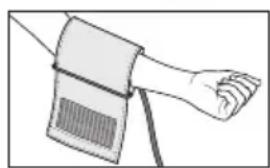
natural_image
Illustration of a wristwatch with a bandage and wrist, no text or symbols present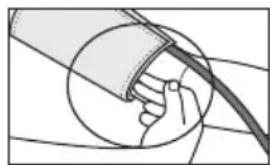
natural_image
Illustration of a hand holding a medical device with a curved tube (no text or symbols)natural_image
Diagram showing a device with a sensor and an arrow pointing to a curved panel (no text or symbols)text_image
Medical illustration showing three different positions of a human arm and neck position, with a cross symbol indicating the knee point.text_image
Medical device diagram showing a blood pressure monitor with labeled components and digital display screennatural_image
Two views of a device rear panel showing internal components and a battery stack (no text or symbols visible)natural_image
Medical illustration showing a hand holding a medical device near a human leg (no text or symbols present)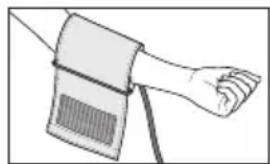
natural_image
Illustration of a wristwatch with a bandage and wrist, no text or symbols presentnatural_image
Illustration of a hand holding a cable with a circular component, no text or symbols present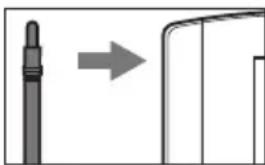
natural_image
Diagram showing a pipe fitting with an arrow pointing to a curved structure (no text or symbols)natural_image
Side-view line drawing of a person using a pressure monitor on a table (no text or symbols)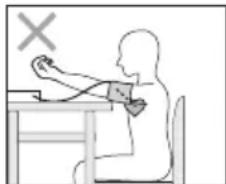
natural_image
Silhouette of a person sitting at a desk with a medical device, no text or symbols visible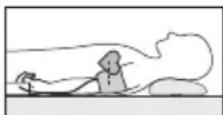
text_image
Medical device diagram showing blood pressure monitor with labeled components and digital displaynatural_image
Two views of a remote control panel with internal components, one showing a scroll arrow (no text or symbols on panel)natural_image
Medical illustration showing a hand holding a medical device near a human leg (no text or symbols present)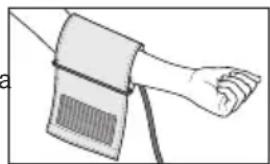
natural_image
Illustration of a wristwatch with a bandage and forearm, no text or symbols present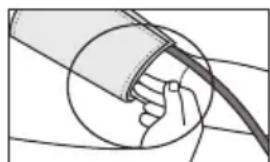
natural_image
Illustration of a hand holding a medical device with a curved tube (no text or symbols)natural_image
Simple line drawing of a pen tip and a curved object with an arrow indicating direction (no text or symbols)natural_image
Side profile illustration of a person using a pressure monitor (no text or symbols)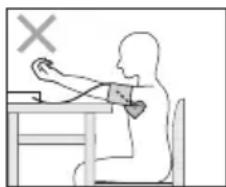
natural_image
Illustration of a person sitting at a desk using a pressure monitor (no text or symbols present)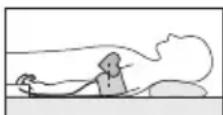
natural_image
Two views of a device casing showing internal components and a pull-up arrow (no text or symbols visible)natural_image
Illustration of a person's leg with a medical device attached, showing a force or pressure technique (no text or symbols present)natural_image
Illustration of a wristwatch with a bandage and wrist, no text or symbols presentnatural_image
Line drawing of a hand holding a medical device with a curved cable (no text or symbols)natural_image
Diagram showing a pipe fitting with an arrow indicating direction, next to a curved structure (no text or symbols)natural_image
Side profile illustration of a person sitting at a desk using a computer (no text or symbols present)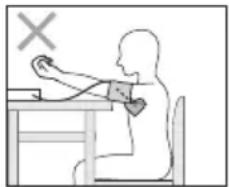
natural_image
Illustration of a person sitting at a desk using a pressure monitor (no text or symbols present)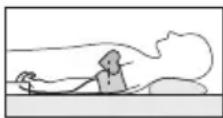
Dünya Sağlık Örgütü (WHO) ve National High Blood Pressure Education Program Coordinating Committee (Yüksek Kan
text_image
Medical device diagram showing a blood pressure monitor with labeled parts and digital display screennatural_image
Two views of a device showing internal components with a labeled arrow (no text or symbols on the devices themselves)natural_image
Illustration of a person receiving a medical or therapeutic procedure on a leg, with no visible text or symbols.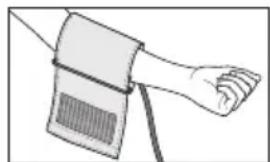
natural_image
Illustration of a wristwatch with a bandage and wrist, no text or symbols presentnatural_image
Illustration of a hand holding a medical device with a circular component (no text or symbols visible)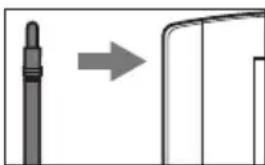
natural_image
Diagram showing a device with a sensor and an arrow pointing to a curved panel (no text or symbols)natural_image
Side profile illustration of a person using a pressure monitor (no text or symbols)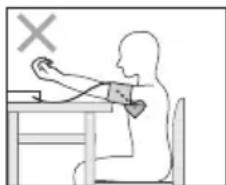
natural_image
Illustration of a person using a pressure monitor on a desk, with a cross symbol above (no text or labels)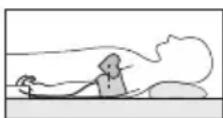
natural_image
Two views of a device rear panel showing internal components and a labeled component (no text or symbols on the main body)natural_image
Illustration of a person's leg with a medical device attached to the ankle (no text or symbols present)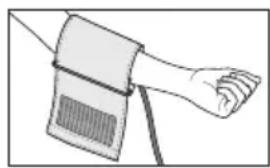
natural_image
Illustration of a wristwatch with a bandage and wrist, no text or symbols present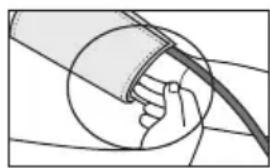
natural_image
Illustration of a hand holding a medical device with a curved tube (no text or symbols)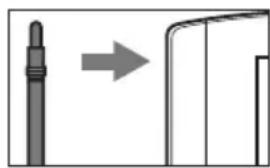
natural_image
Diagram showing a cylindrical object with an arrow pointing to a curved panel or bracket (no text or symbols present)natural_image
Side profile illustration of a person using a blood pressure monitor (no text or symbols)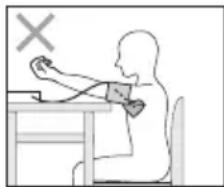
natural_image
Illustration of a person sitting at a desk using a pressure monitor (no text or symbols present)