ETS EC 1503 A EQ - Sander FESTOOL - Free user manual and instructions
Find the device manual for free ETS EC 1503 A EQ FESTOOL in PDF.


Frequently Asked Questions - ETS EC 1503 A EQ FESTOOL
User questions about ETS EC 1503 A EQ FESTOOL
0 question about this device. Answer the ones you know or ask your own.
Ask a new question about this device
Download the instructions for your Sander in PDF format for free! Find your manual ETS EC 1503 A EQ - FESTOOL and take your electronic device back in hand. On this page are published all the documents necessary for the use of your device. ETS EC 1503 A EQ by FESTOOL.
USER MANUAL ETS EC 1503 A EQ FESTOOL
ETS EC 150/3 A EQ ETS EC 150/5 A EQ
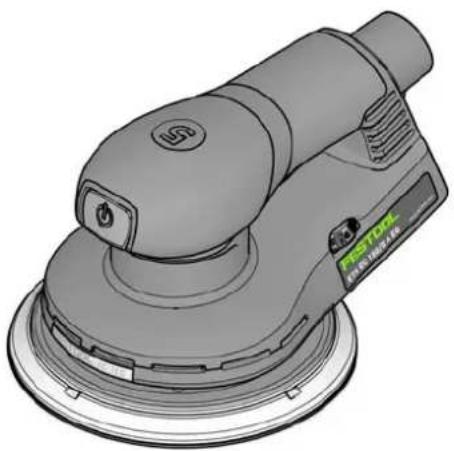
natural_image
Illustration of a precision sander with brand logo and 'FASTOL' branding (no text-heavy elements)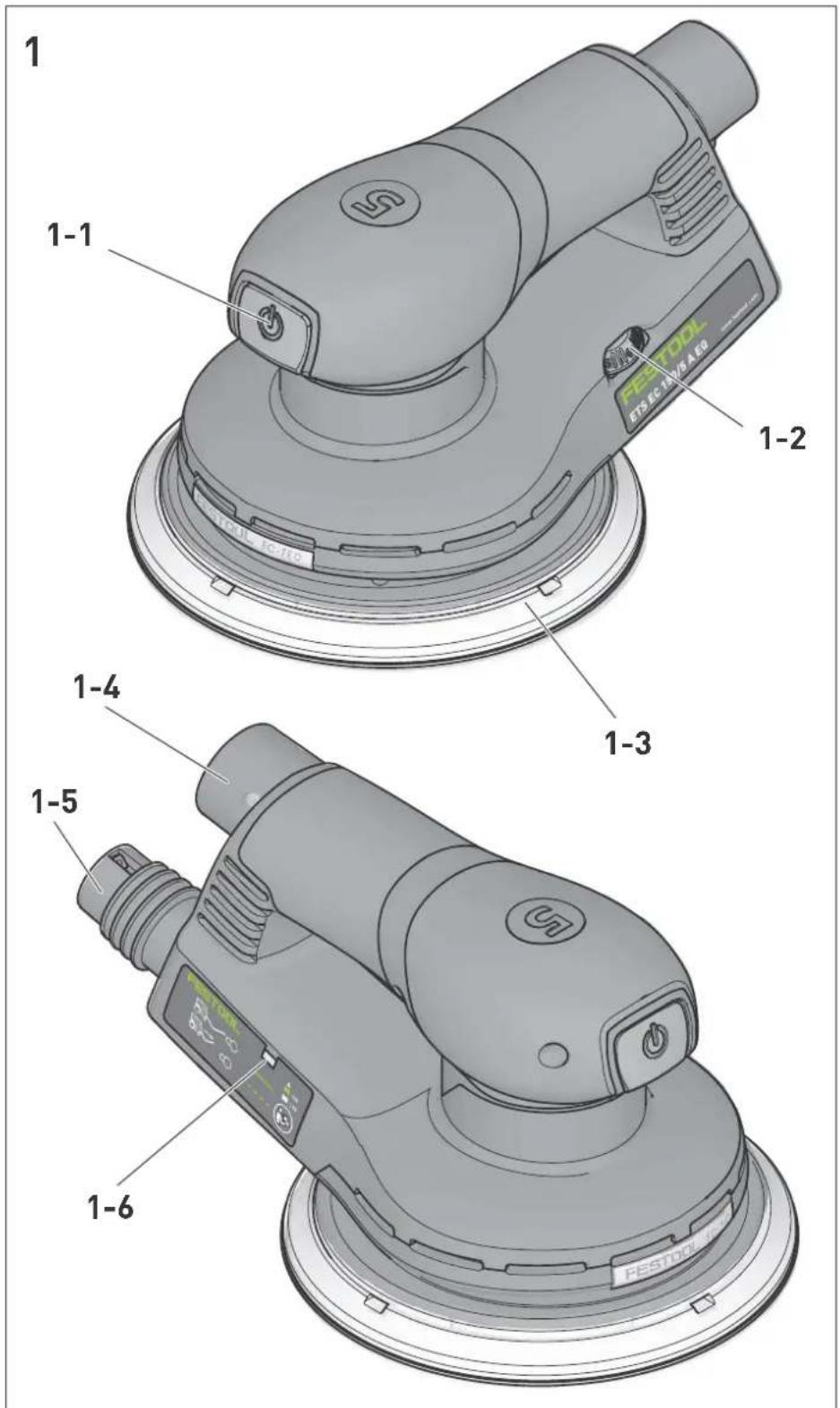
text_image
1 1-1 FESTODL ELECTR/PAGE 1-2 1-3 1-4 1-5 1-6 FESTODL ELECTR/PAGE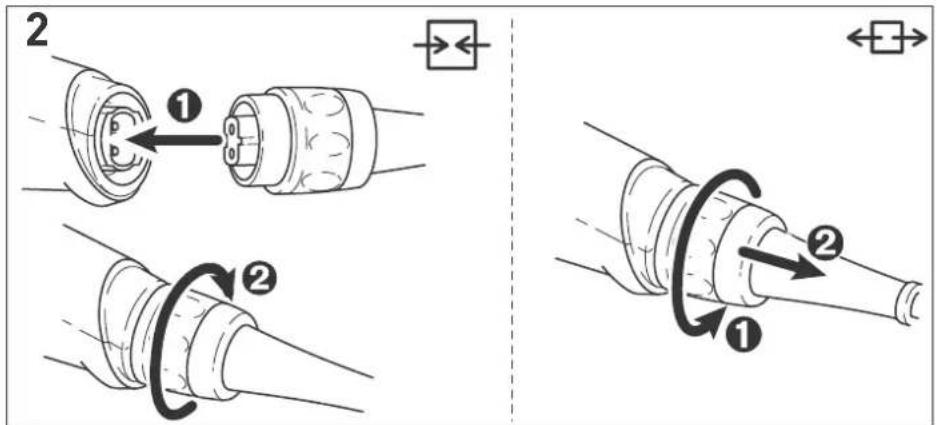
text_image
Technical diagram illustrating two-step assembly steps of a cable connector, labeled with numbered components and directional arrows.3
text_image
FESTOOL IC-15C FESTOOL EIS 15C 10/19 A B6 3bStickFix
natural_image
Technical illustration of a showerhead with a circular base and mounting holes, showing no text or symbols.4
text_image
FESTOOL ETS EC 100/19 A-50 4-1 4-2Original operating manual
1 S y m b o

Warning of general danger

Risk of electric shock

Read the Operating Instructions/Notes!

Wear protective goggles.

Wear ear protection.

Wear a dust mask.
2 Safety instructions
2.1 General safety instructions

WARNING! Read all safety warnings and all instructions. Failure to follow the warnings and instructions may result in electric shock, fire and/or serious injury.
Save all warnings and instructions for future reference.
The term "power tool" in the warnings refers to your mains-operated (corded) power tool or battery-operated (cordless) power tool.
2.2 Machine-related safety instructions
- Harmful/toxic dusts can be produced during your work (e.g. lead-containing paint, some types of wood and metal). Contact with these dusts, especially inhaling them, can represent a hazard for operating personnel or persons in the vicinity. Comply with the safety regulations that apply in your country. Connect the electric power tool to a suitable extraction system.

To protect your health, wear a P2 protective mask.

Always wear protective goggles to protect against sanding hazards.
-Use the power tool for wet grinding and metal grinding with just one earth leakage protection device. In the event of an electric shock, the protective switch protects you against life-threatening current through the body.
- Clean work equipment soaked in oils, for example sanding pad or polishing felt, with water and allow to dry. Work equipment soaked in oil may combust spontaneously.
- Attention: Risk of fire! Avoid overheating the grinding material and the sander. Always empty
the dust container before taking a break. Swarf in the dust bag, microfilter, paper bag (or in the filter bag or filter of the mobile dust extractor) may spontaneously combust in unfavourable conditions such as flying sparks when sanding metals. Particular danger exists if the swarf is mixed with paint, polyurethane residue or other chemical materials and the grinding material is hot after long periods of work.
- Always use original Festool sanding pads. Foreign pads are not suitable for the speed of the sander and may break.
- If the power tool is dropped or falls, check for damage to the machine and sanding pad. Remove the sanding pad for closer inspection. Repair damaged parts before using again. Broken sanding pads and damaged machines can cause injuries and machine instability.
2.3 Metal processing

When processing metal, the following measures must be taken for safety reasons:
-Install an upstream residual-current circuit-breaker (FIG, PRCD).
- Connect the machine to a suitable dust extractor.
- Regularly remove dust deposits in the motor housing.

Wear protective goggles.
2.4 Emission levels
Levels determined in accordance with EN 60745 are typically:
Sound pressure level L _PA = 72 dB(A)
Noise level L W_A = 83 dB(A)
Measuring uncertainty allowance K = 3 dB

CAUTION
Operating noise
Damage to hearing
▶ Use ear protection!
Vibration emission value a_h (vector sum for three directions) and uncertainty K measured in accordance with EN 60745:
Vibration emission level a_h=6,0 m/s^2 (3 directions) K=3,0 m/s^2
The specified emissions values (vibration, noise)
GB ETS EC 150
- are used to compare machines.
- They are also used for making preliminary estimates regarding vibration and noise loads during operation.
- They represent the primary applications of the power tool.
Increase possible for other applications, with other insertion tools or if not maintained adequately. Take note of idling and downtimes of machine!
3 Intended use
As specified, the sanders are designed for sanding wood, plastic, composite, paintwork, filler and similar materials. The special safety information must be observed when sanding metal. Material containing asbestos cannot be processed.
The user is liable for improper or non-in-tended use.
4 T e c h n i c a l d a t
Eccentric sander ETS EC 150/3 A EQ ETS EC 150/5 A EQ
| Power 400 W 400 W | ||
| Idle speed 6000 - 10000 rpm 6000 - 10000 rpm | ||
| Sanding stroke | 3,0 mm | 5,0 mm |
| Sanding pad | D 150 mm | D 150 mm |
| Weight (without mains cable, with sanding pad) | 1,2 kg | 1,2 kg |
| Safety class | ☐ /II | ☐ /II |
5 Machine features
[1-1] ON/OFF button
[1-2] Speed control
[1-3] Sanding pad
[1-4] plug it-connection
[1-5] Extractor connector
[1-6] LED for extractor signal
The specified illustrations appear at the beginning of the Operating Instructions.
6 0 p e r a

WARNING
Unauthorised voltage or frequency!
Risk of accident
The mains voltage and the frequency of the power source must correspond with the specifications on the machine's name plate.
▶ In North America, only Festool machines with the voltage specifications 120 V/60 Hz may be used.
Connecting and detaching the mains power cable - see Fig. [2].

Before switching on the machine make sure that the bayonet fitting at the power supply cord is closed fully and locked.
ON/OFF button [1-1]
ON Press the ON/OFF button[1-1]
OFF Press the ON/OFF button[1-1]
① When the extractor signal is active, the power tool cannot be switched on without a connected extractor hose - see chapter 7.3.
7 Settings

WARNING
Risk of injury, electric shock
▶ Always pull the mains plug out of the socket before performing any type of work on the machine!
7.1 Electronics
The machine features full-wave electronics with the following features:
Smooth start-up
The electronically controlled smooth start-up ensures that the machine starts up jolt-free.
Constant speed
The preselected motor speed is kept constant through electronic control to ensure a uniform sanding speed even when under load.
Speed reduction in the event of high vibrations
If high vibrations and oscillations occur at the power tool, e.g. with the use of an interface pad, the speed is automatically reduced in order to protect the power tool and the user.
Temperature cut-out
To avoid the motor overheating, the power consumption is limited at an excessive motor temperature. If the temperature continues to rise, the power tool switches off and can only be switched on again once the motor has cooled sufficiently.
7.2 Setting and adjusting the speed
The speed can be set [1-6] between 6000 and 10000 rpm using the adjusting wheel.
This enables you to optimise the sanding speed to suit the material (see chapter 8).
7.3 Extractor signal
The electronic extractor signal detects whether an extractor hose is connected at the power tool. Upon activation the power tool can only be switched on with a connected extractor hose.
Switching the extractor signal ON/OFF
The extractor signal is supplied in a deactivated state.
▶ Switch on the power tool using the ON/OFF button[1-1].
▶ Hold down the ON/OFF button [1-1].
Motor switches off, power tool beeps once.
▶ Turn speed control [1-2] to level 1 and level 6. Power tool beeps three times.
▶ Release ON/OFF button [1-1].
Extractor signal is activated.

Permanent light: Extractor hose is connected

Flashing light: No extractor hose connected, power tool cannot be switched on.
No light: Extractor signal is not active.
① To deactivate the extractor signal repeat the above-mentioned procedure, power tool beeps twice.
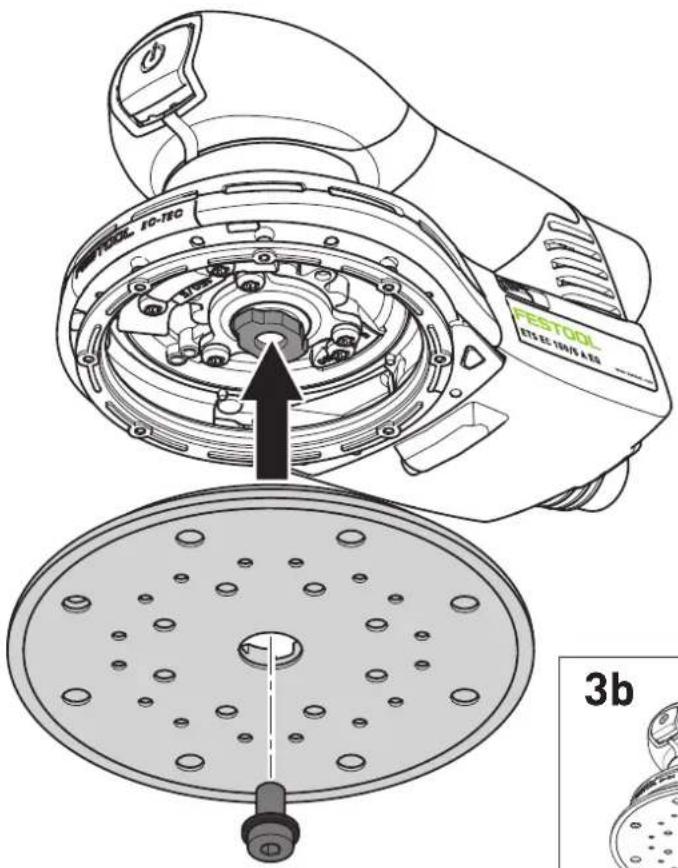
7.4 Replacing the sanding pad [3]
![FESTOOL ETS EC 1503 A EQ - Replacing the sanding pad [3] - 1](/content/2026/02/400439/images/f37b40d47d340943acf2aaebdc4dbb06a1ae12c47ff22f71b85f7c689fa39c9c.jpg)
An optimal work result can only be achieved using original accessories and consumables.
The use of non-original accessories or consumables invalidates the right to claim under warranty.
![FESTOOL ETS EC 1503 A EQ - Replacing the sanding pad [3] - 2](/content/2026/02/400439/images/a0ac63c45612db67af1ad564d67fca1432d256cd22b6a0caa2b7e366f83c655a.jpg)
Warning! Do not perform any structural changes in the open interior space of the machine when the sanding pad is dismantled.
![FESTOOL ETS EC 1503 A EQ - Replacing the sanding pad [3] - 3](/content/2026/02/400439/images/291b64405eddec986533430c56dc64ece1cf01dcde22d85fa092c7c86b09857a.jpg)
Health risk: Fitting sanding pads of incorrect size causes excessive vibration of the machine.
Tuned to the surface being processed, the machine can be equipped with three sanding pads of different hardnesses.
Hard: Coarse and fine sanding on surfaces. Sanding edges.
Soft: Universal for coarse and fine sanding, for flat and convex surfaces.
Extra-soft: Fine sanding of moulded parts, arches, radii. Do not use on edges.
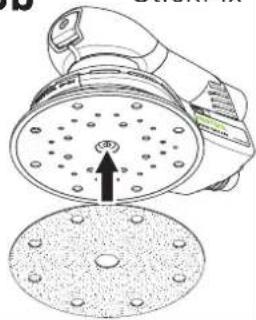
7.5 Attaching sanding accessories using StickFix [3b]
The suitable StickFix sandpaper and StickFix sanding cloth can be attached quickly and simply to the StickFix sanding pad.
▶ Press the self-adhesive sanding accessory onto the sanding pad [1-3].
7.6 Dust extraction

WARNING
Dust hazard
▶ Dust can be hazardous to health. Always work with a dust extractor.
▶ Always read applicable national regulations before extracting hazardous dust.
At the extractor connector [1-5], a Festool mobile dust extractor with an extraction hose diameter of 27 mm can be connected.
Recommendation: Use anti-static extractor hose! This helps reduce the electric charge.
8 Working with the machine

WARNING
Risk of injury
▶ Always secure the workpiece in such a manner that it cannot move while being machined.
Observe the following instructions:
- Do not overload the machine by pressing with excessive force! The best sanding results are achieved with moderate application pressure. The sanding capacity and quality are mainly dependent on the selection of the correct abrasive.
GB ETS EC 150
- Hold the machine with two hands, one on the motor housing and one on the gear head.
For machines with electronics systems, we recommend the following settings for the adjusting wheel [1-2]:
Sanding work Adjusting
wheel setting
- Sanding with max. abrasion 5 - 6
- Sanding off old paint
- Sanding of wood and veneered surface prior to paintwork
- Intermediate sanding of paintwork on surfaces
- Sanding thinly applied undercoat 4 - 5
- Sanding wood with nonwoven pad
- Edge breaking on wooden parts
- Smoothing primed wooden surfaces
- Sanding solid wood and veneered edges 3 - 4
- Sanding rebate of windows and doors
- Intermediate sanding of paintwork at edges
- Light sanding of natural wood windows using nonwoven pad
- Smoothing wooden surfaces using non-woven pad before staining
- Rubbing or removing excess limestone residue using nonwoven pad
- Intermediate sanding of paintwork on 2 - 3 stained surfaces
- Cleaning natural wood window rebate using nonwoven pad
- Sanding stained edges 1 - 2
- Sanding of thermoplastics
9 Service and maintenance

WARNING
Risk of injury, electric shock
▶ Always disconnect the mains plug from the socket before performing maintenance work on the machine!
▶ All maintenance and repair work which requires the motor housing to be opened must only be carried out by an authorised service workshop.

Customer service and repair only through manufacturer or service workshops: Please find the nearest address at: www.festool.com/service

Use only original Festool spare parts! Order No. at: www.festool.com/service
To ensure constant air circulation, always keep the cooling air openings in the motor housing clean and free of blockages.
In the event of a slowdown in performance or increased vibrations, blow and clean cooling air openings.
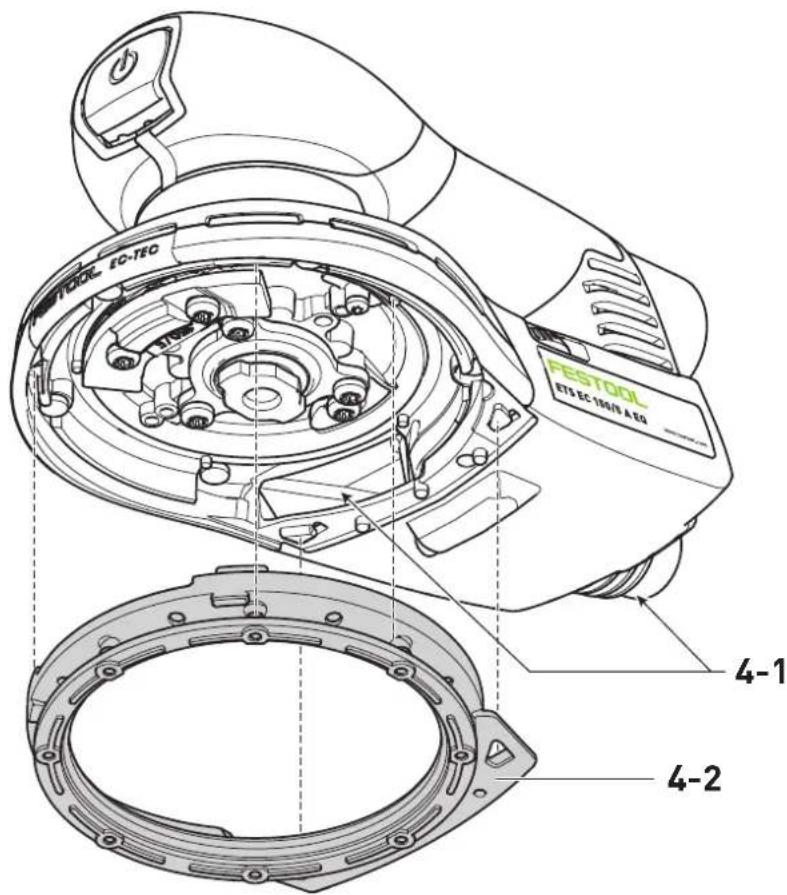
9.1 Sanding pad brake
The rubber sleeve[4-2] brushes off the sanding pad and prevents uncontrolled turning of the sanding pad. This must be replaced if the braking effect decreases.
9.2 Cleaning the extraction channels
We recommend cleaning the extraction channels in the machine roughly once a week (particularly if sanding synthetic resin, in the case of wet sanding and if sanding plaster) [4-1] using a small flat brush or a cloth.
10 Accessories
Only use original Festool sanding and polishing pads. Low-quality sanding and polishing pads may cause serious machine imbalance that decreases the quality of the working results and increases machine wear.
The order numbers of the accessories and tools can be found in the Festool catalogue or on the Internet under "www.festool.com".
11 Environment
Do not dispose of electric power tools in household waste! Recycle devices, accessories and packaging. Observe applicable country-specific regulations.
EU only: In accordance with European Directive on waste electrical and electronic equipment and implementation in national law, used electric power tools must be collected separately and handed in for environmentally friendly recycling.
Information on REACH: www.festool.com/reach
12 EU Declaration of Conformity
Eccentric sander Serial no.
ETS EC 150/3 A EQ 500069
ETS EC 150/5 A EQ 10006674
Year of CE mark: 2014
We declare under sole responsibility that this product complies with all the relevant requirements in the following Directives, standards and normative documents:
2006/42/EG, 2004/108/EG, 2011/65/EU, EN 60745-1, EN 60745-2-4, EN 55014-1, EN 55014-2, EN 61000-3-2, EN 61000-3-3.
Head of Research, Development and Technical Documentation
2014-02-05
Vibrationsemission a_h=6,0 m/s^2
(3-akset) K = 3,0 m/s^2
2.3 Metallbearbeiding

[1-2] Regulace otáček
[1-3] Brusný talíř
[1-4] Přípojka plug it